
A complete issue · 34 pages · 1897
Life — December 4, 1897
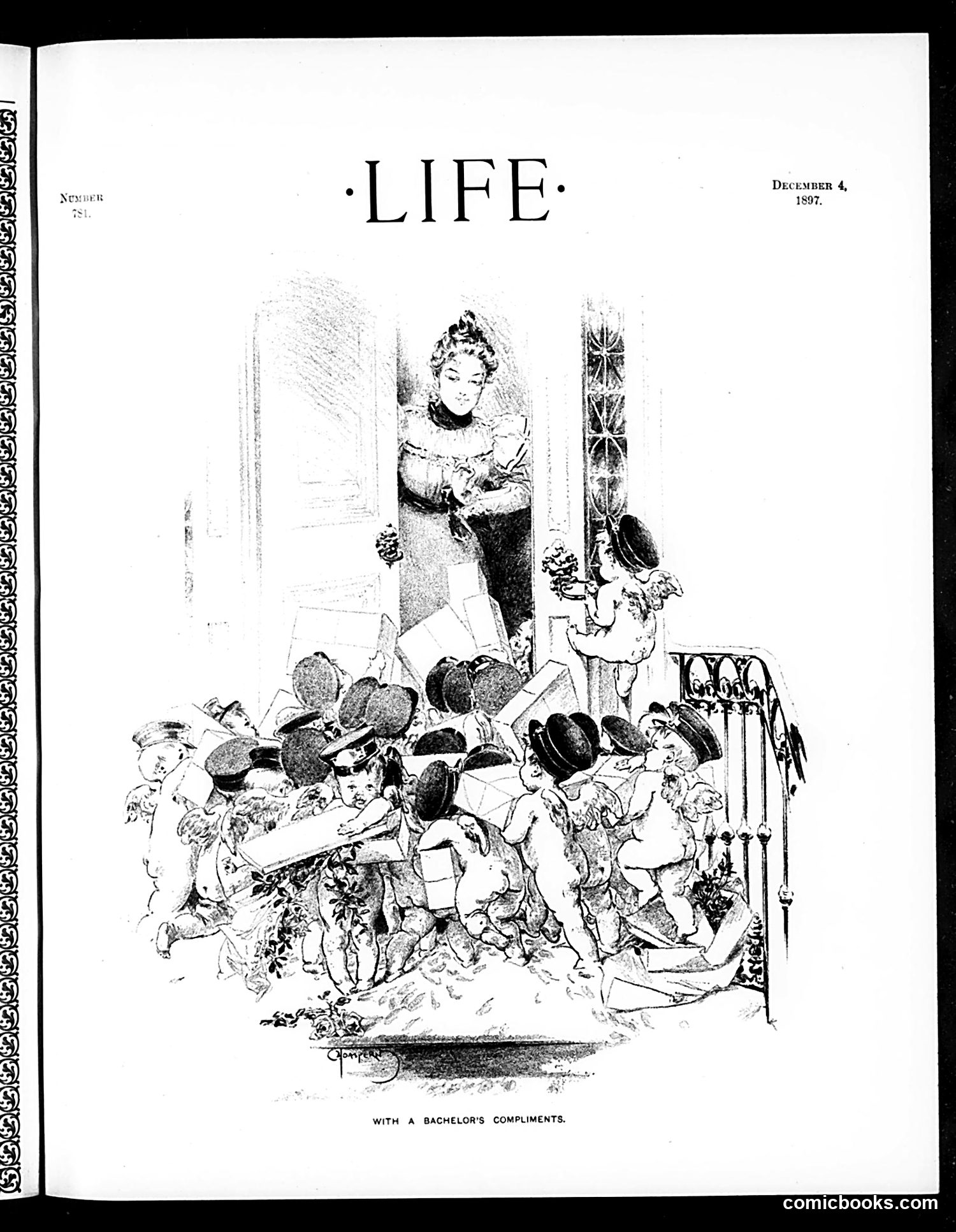
This satirical illustration depicts a wealthy woman distributing gifts to cherubs (cupids) from a doorway, captioned "WITH A BACHELOR'S COMPLIMENTS." The satire appears to target the social practice of wealthy individuals—particularly bachelors—giving expensive holiday gifts as a form of social obligation or courtship ritual. The numerous cherubs eagerly receiving lavish presents suggests mockery of this gift-giving custom as excessive or performative generosity intended to gain favor or romantic attention. The woman's elegant dress and the ornate interior setting emphasize wealth and social status. The artist (signed "Cesare," likely the cartoonist) criticizes what may have been perceived as artificial or mercenary expressions of goodwill during the holiday season among the upper classes.
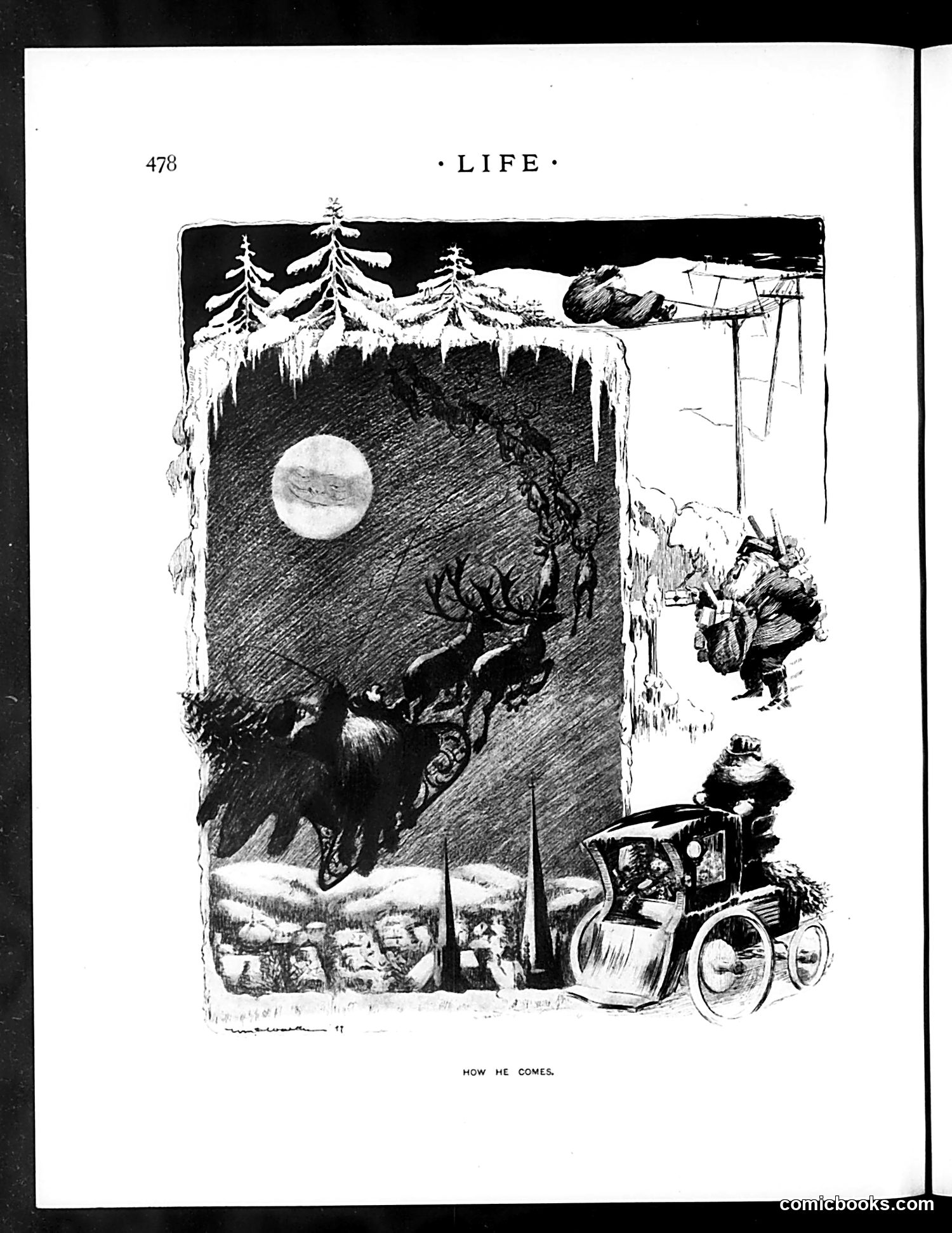
This is a Christmas-themed illustration from *Life* magazine titled "How He Comes." The image depicts Santa Claus's journey to deliver presents, showing multiple modes of transportation: reindeer-drawn sleigh at the top, what appears to be figures climbing or descending on the right side, and a motorized vehicle (possibly an automobile or early mechanical conveyance) at the bottom right. The satire likely reflects early 20th-century anxieties about modernization replacing traditional Christmas imagery. While Santa traditionally travels by reindeer and magic, this cartoon shows him adopting contemporary transportation methods—automobiles and mechanical devices—suggesting how even beloved traditions were being transformed by industrial progress and technology during this era.
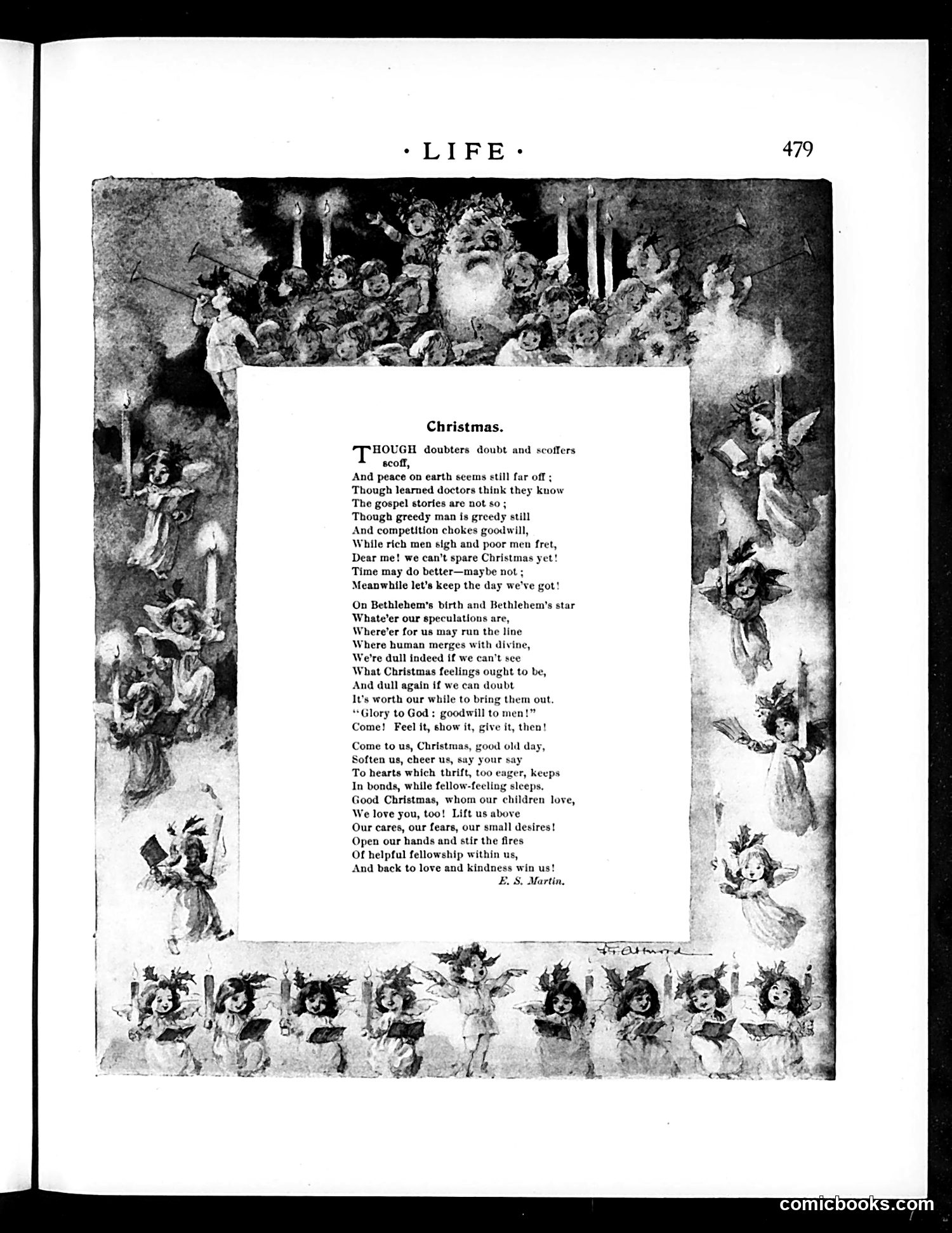
This page features a Christmas poem by E.S. Martin titled "Christmas," surrounded by decorative Victorian-era illustrations of angels, cherubs, and holiday imagery. The poem's central satire targets widespread skepticism about Christian teachings. It mocks "doubters" and "scoffers" who question gospel stories while remaining greedy and competitive. The speaker argues that despite intellectual doubt, Christmas's message—peace, goodwill, human unity with the divine—remains worthy of genuine observance. The poem criticizes learned people who dismiss religious doctrine intellectually yet fail morally. It calls readers to embody Christmas values: kindness, fellowship, and love. The ornate angelic decorations reinforce the religious sentiment being defended. This represents turn-of-the-century American periodical satire addressing religious skepticism prevalent among educated readers.
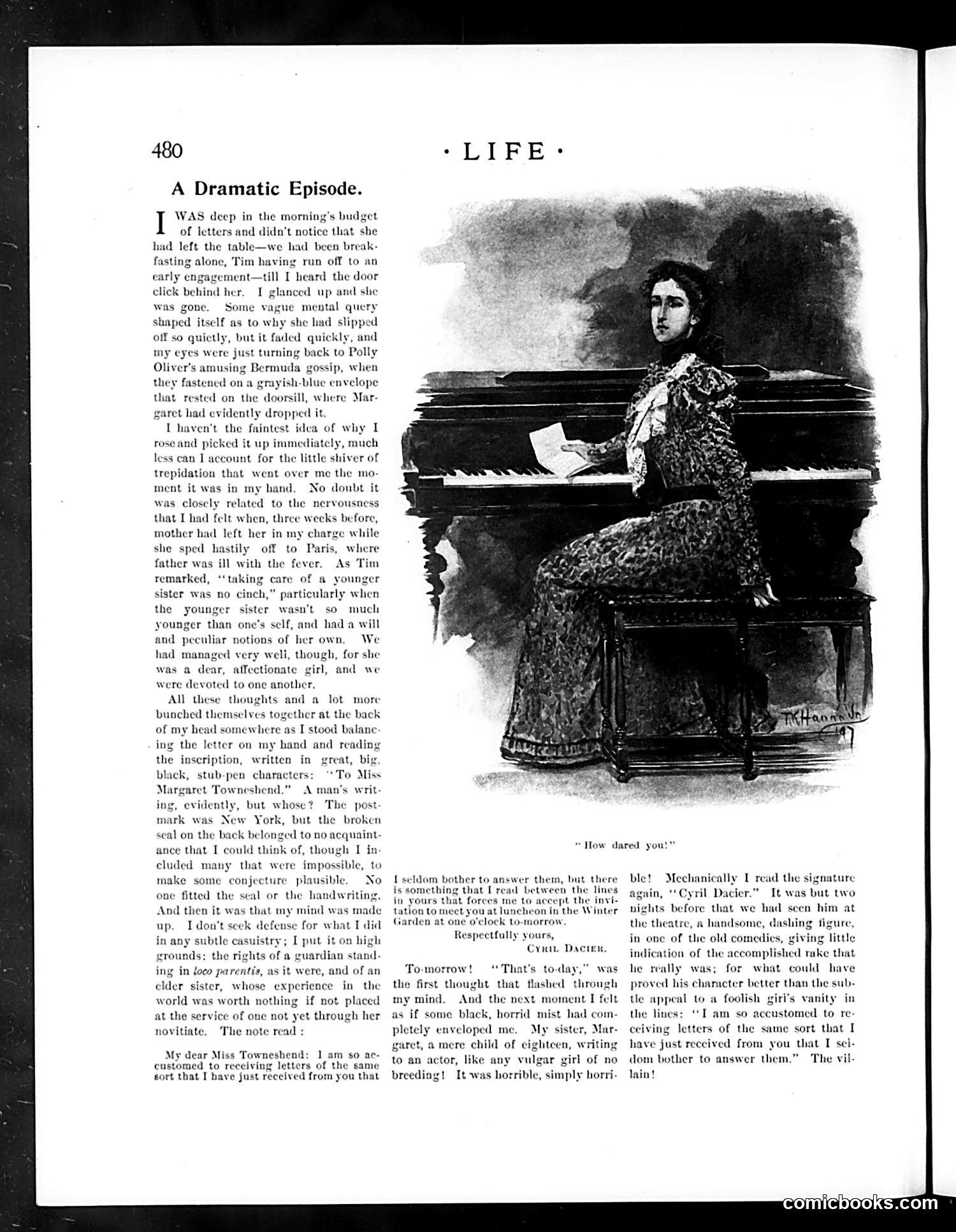
This page contains "A Dramatic Episode," a short story rather than political satire. The illustration shows a woman at a piano reading a letter, with the caption "How dared you!" The narrative concerns a domestic situation: the narrator discovers their mother has left for Paris while their father is ill with fever. The protagonist receives a letter addressed to "Miss Margaret Townshend" from someone named "Cyril Dacier"—apparently an actor the narrator's younger sister Margaret has been corresponding with. The story's drama hinges on this correspondence: Margaret, an eighteen-year-old aspiring actress, has been exchanging letters with Dacier, whom the narrator sees performing in comedies. The narrator expresses moral disapproval of such an unsuitable correspondence between an unmarried girl and an actor of questionable character. This reflects Victorian-era social anxieties about young women's independence and improper associations with theatrical figures.
This page is **not a cartoon or satirical illustration** — it's a prose fiction excerpt from Life magazine, page 481. The text appears to be a short story or serialized narrative featuring dialogue between characters including "Thompson," "Mrs. Appleton," "Tim," "Dacier," and "Margaret Townshend." The narrative involves domestic drama: a woman confronting someone about a letter, discussions of lunch appointments, and references to proper social conduct. One character describes a young woman lunching alone with a man as unconventional and potentially scandalous ("rather unconventional manners"). Without seeing illustrations on this specific page, I cannot identify specific cartoons or political references. This is primarily **literary content** rather than visual satire.
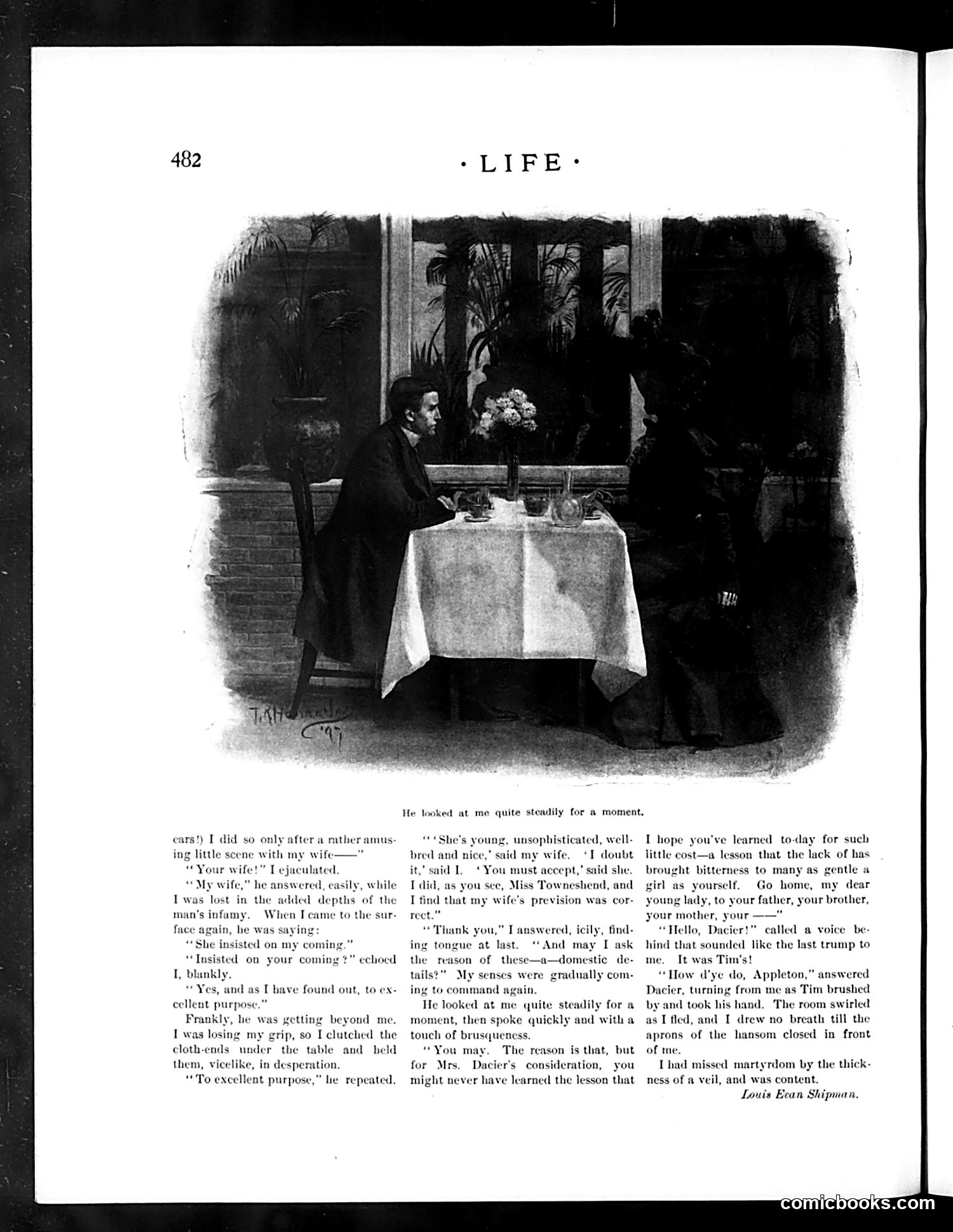
This page contains a short story or sketch titled "He looked at me quite steadily for a moment," bylined to Louis Eonn Shipman. The illustration depicts a domestic scene: two men and a woman seated at a dinner table in what appears to be an elegant room with potted plants and windows visible behind them. The narrative concerns a marital dispute—a husband appears to be defending or explaining himself to his wife regarding her "premonition" about their relationship. The dialogue touches on themes of wifely intuition, domestic propriety, and male reassurance. Rather than political satire, this appears to be a humorous *social commentary* on middle-class marriage dynamics and gender relations of the early 20th century, satirizing conventional attitudes about wives' "women's intuition" and husbandly authority. No specific political figures or events are referenced.
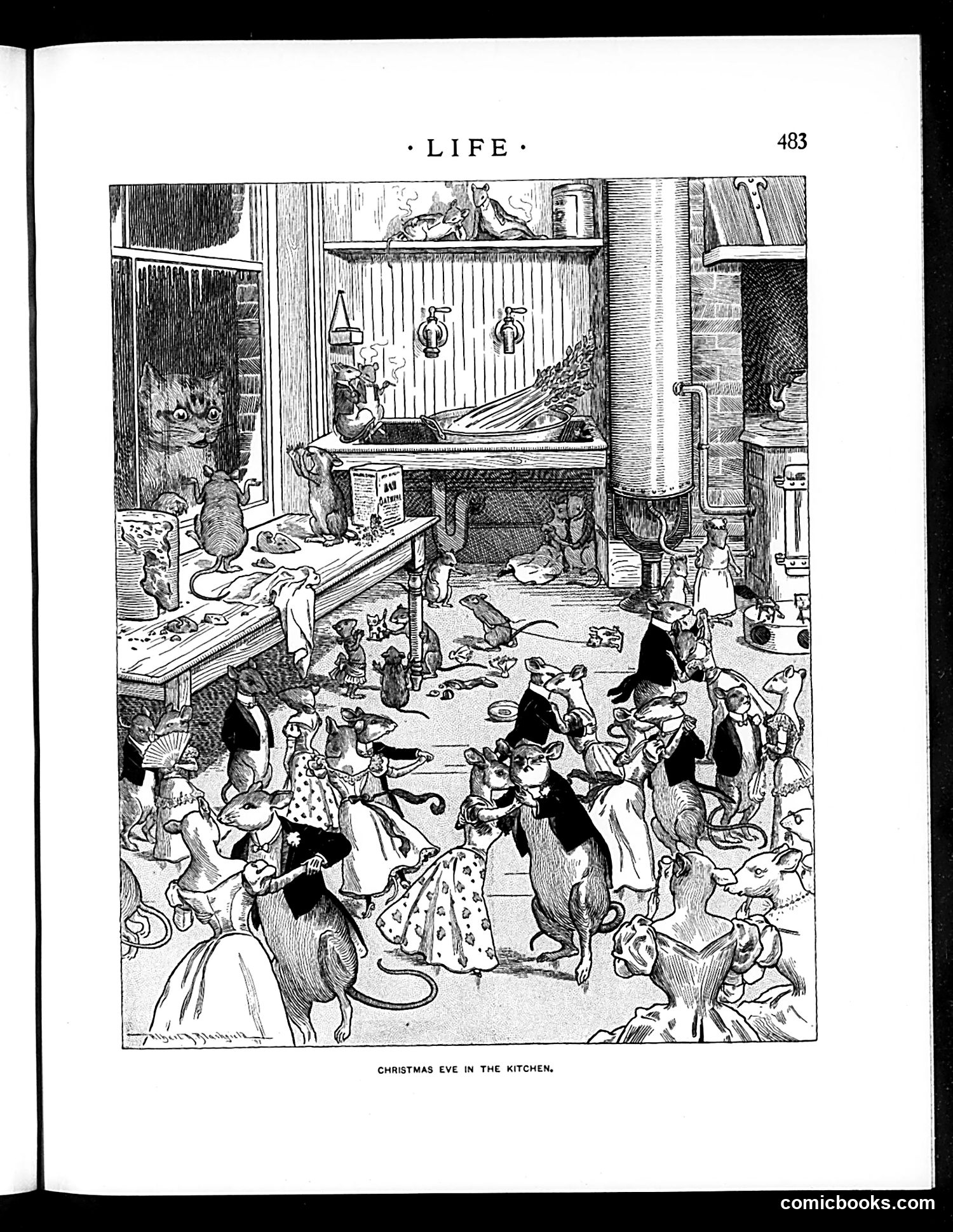
This is a whimsical illustration rather than political satire. It depicts anthropomorphized animals—primarily mice and rats—having a Christmas celebration in a Victorian-era kitchen. The creatures are dressed in human clothing, dancing and socializing around the kitchen floor while humans work above at the stove and counters. The humor derives from the absurdist scenario of mice treating the kitchen as their own festive venue, with the irony that they're celebrating in the very space where they'd normally be hunted or trapped. The detailed cross-hatched engraving style was typical of *Life* magazine's visual approach. This appears to be lighthearted holiday entertainment rather than commentary on social or political issues.
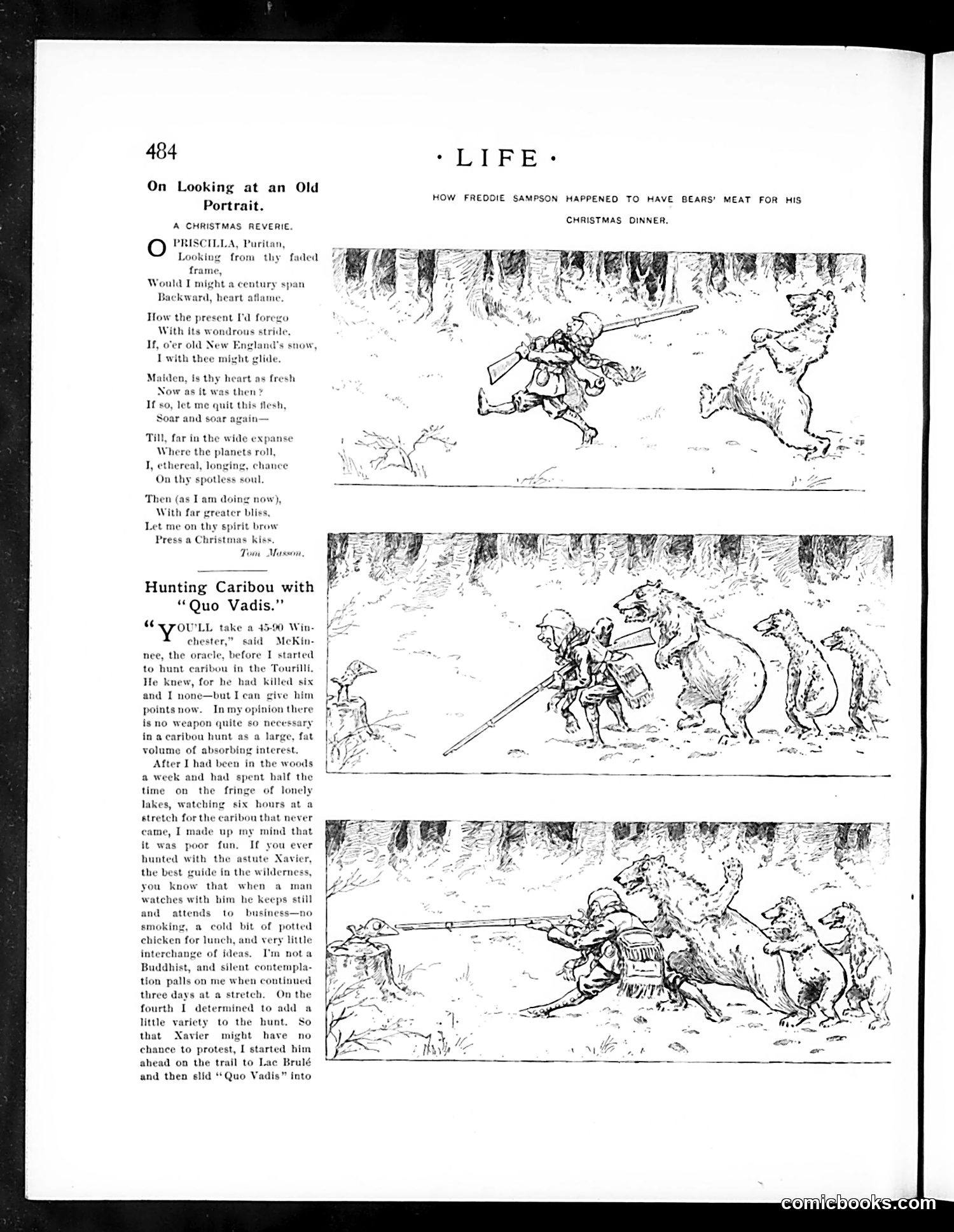
This page contains two unrelated pieces: **"On Looking at an Old Portrait"** is a sentimental Christmas poem by a Puritan speaker reflecting on aging and mortality. **"Hunting Caribou with Quo Vadis"** is a humorous hunting narrative. The author describes taking a Winchester rifle to hunt caribou in northern wilderness. The joke appears to be the title's reference to "Quo Vadis" (a popular novel), suggesting the author humorously applied literary contemplation to practical wilderness hunting. The accompanying illustrations show hunters with rifles pursuing caribou across snowy terrain. The piece mocks the contrast between romantic adventure literature and the mundane reality of patient, cold hunting.
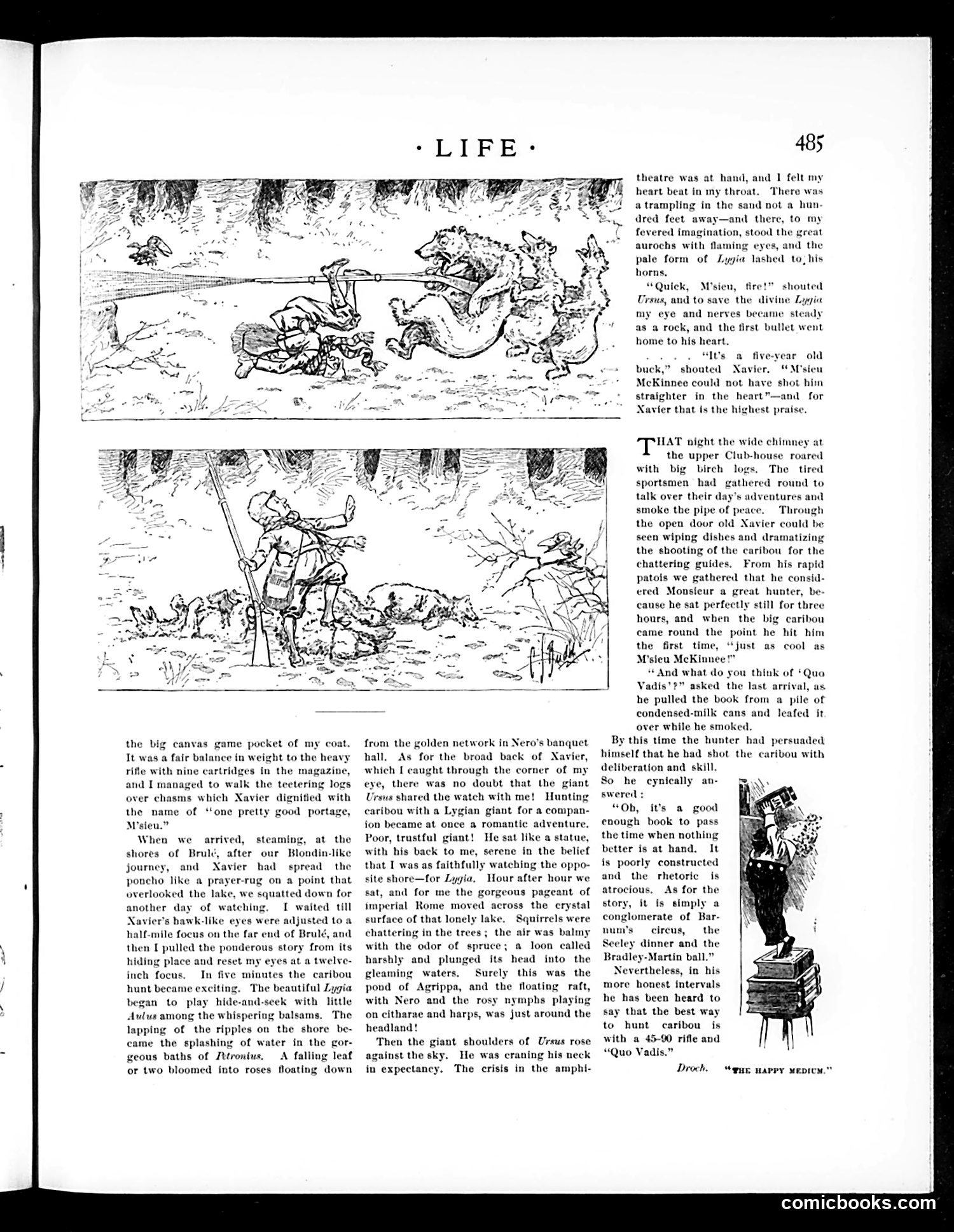
This page contains two illustrated scenes from what appears to be a hunting or adventure narrative. The text describes an expedition involving characters named Xavier, M'sieu McKinnee, and others hunting large game, apparently including a creature called *Ursus* (a giant bear). The illustrations show hunters in dramatic encounters with wildlife in wilderness settings. The narrative emphasizes the excitement and danger of the hunt, with detailed descriptions of tracking and confronting dangerous animals. However, **this is not political satire or social commentary**—it's a fictional adventure story with accompanying illustrations. Without knowing the publication date or broader context of this particular Life magazine issue, I cannot identify specific political references or satirical targets. The content appears to be entertainment-focused narrative fiction rather than editorial commentary.
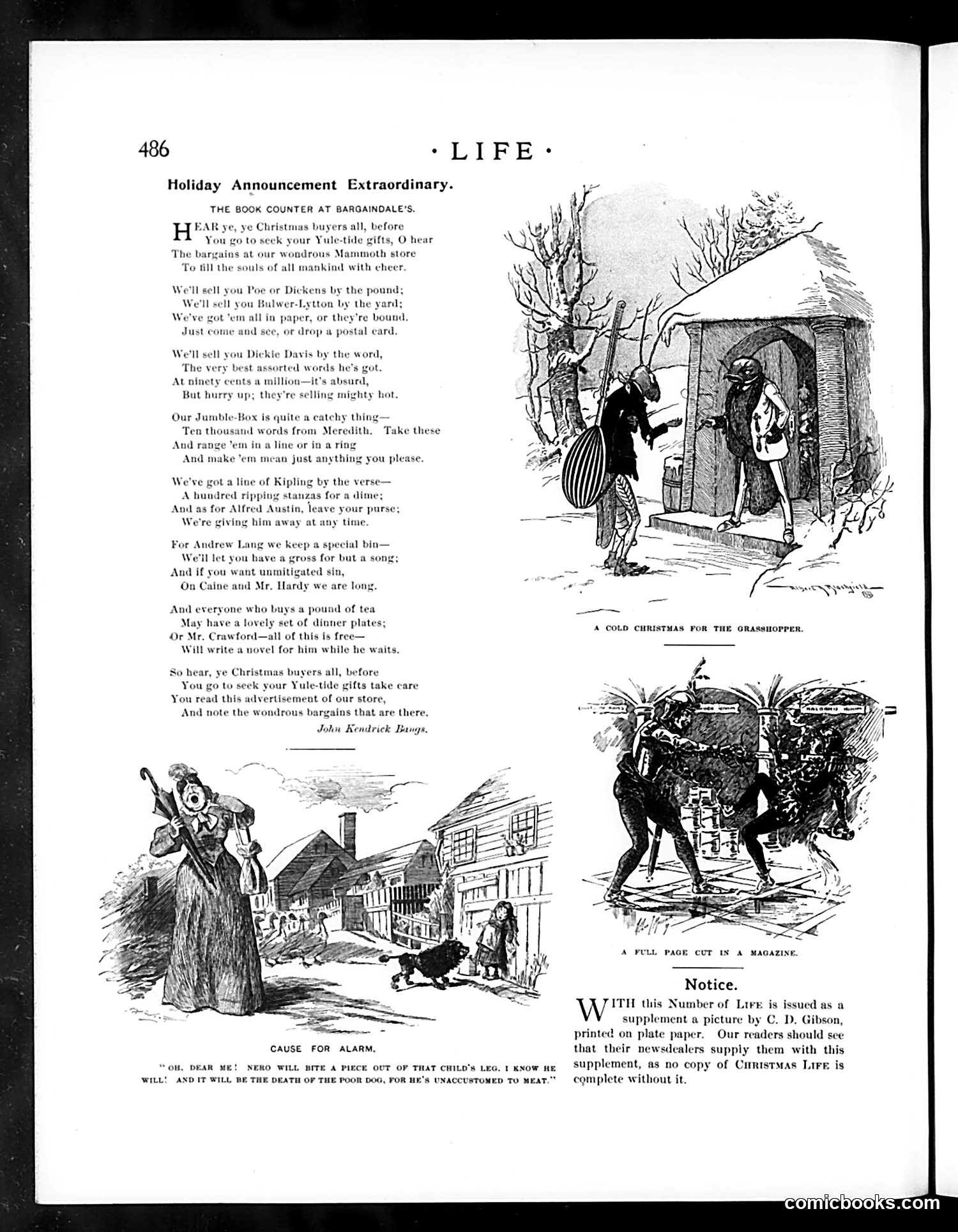
This page is primarily a **holiday advertisement** for Bookseller Bargain Dale's, written as a humorous poem by John Kendrick Bangs. The ad humorously promises Christmas shoppers they can buy books extremely cheaply—"Poe or Dickens by the pound," "Dickie Davis by the word," and literary works by famous authors at absurdly low prices. The three illustrations are unrelated vignettes: - **"Cause for Alarm"**: A woman confronts a child about a dog, suggesting domestic chaos - **"A Cold Christmas for the Grasshopper"**: A beggar at a door in winter - **"A Full Page Cut in a Magazine"**: Two figures examining something These sketches appear to be humorous filler rather than connected satire. The page functions primarily as commercial content disguised as entertainment, typical of *Life* magazine's advertising approach.
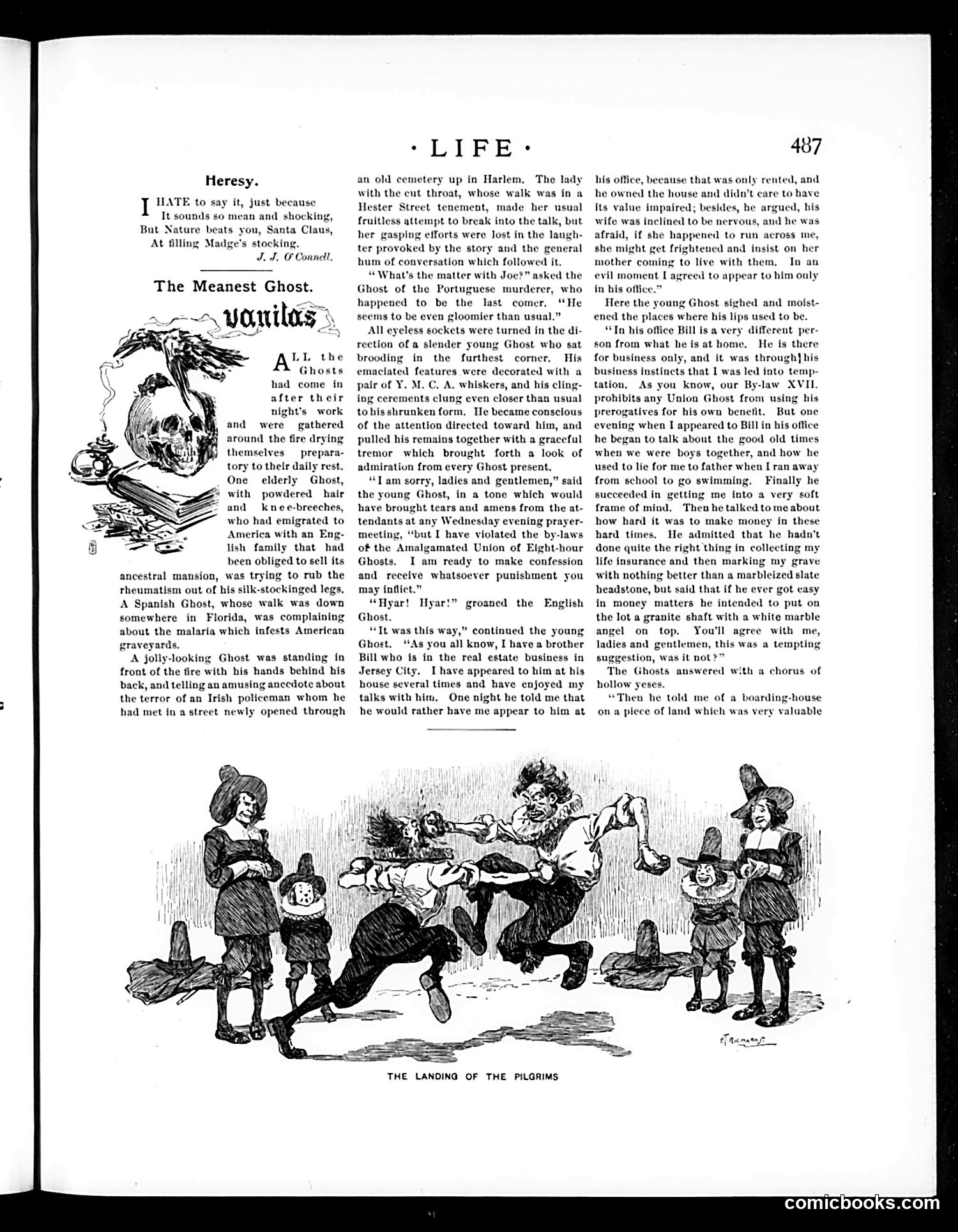
This page contains a short story by J.J. O'Connell about ghosts gathering to discuss their misdeeds. The main illustration, "The Landing of the Pilgrims," depicts a comedic inversion: rather than the historical Pilgrims landing in America, we see what appears to be mischievous figures (possibly meant as ghosts or spirits based on the story context) playfully accosting or tossing around people in period dress. The satire appears to mock the romanticized historical narrative of the Pilgrims' arrival by reimagining it as chaotic and undignified. The cartoonist uses this visual joke to subvert American historical mythology, presenting the foundational moment as absurd rather than noble—a typical Life magazine approach to deflating American mythology through irreverent humor.
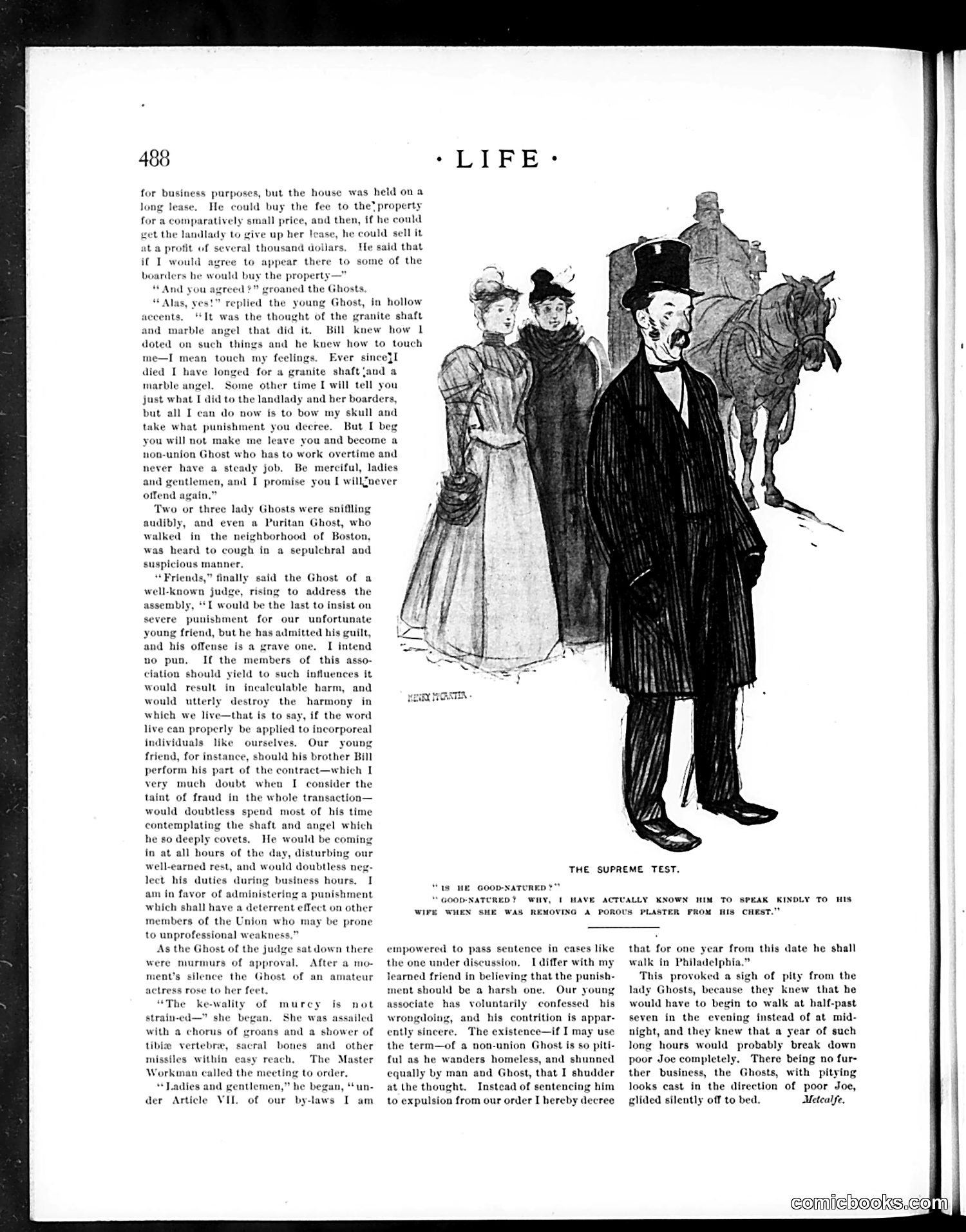
This cartoon satirizes labor disputes and union organization in early 20th-century America. The illustration shows a well-dressed man (likely a judge or authority figure) confronting two women, while a third figure lurks behind them. The text discusses a young man's punishment for wrongdoing and references "non-union Ghosts"—a metaphorical critique of labor union influence. The dialogue mocks the union's power, suggesting that union membership creates "non-union Ghost" status for those who don't comply. The satire targets anxieties about organized labor's growing power and its ability to enforce compliance through social pressure and potential economic harm. The cartoon appears to argue that strict union enforcement threatens social harmony and individual liberty, a common anti-union argument of the era.
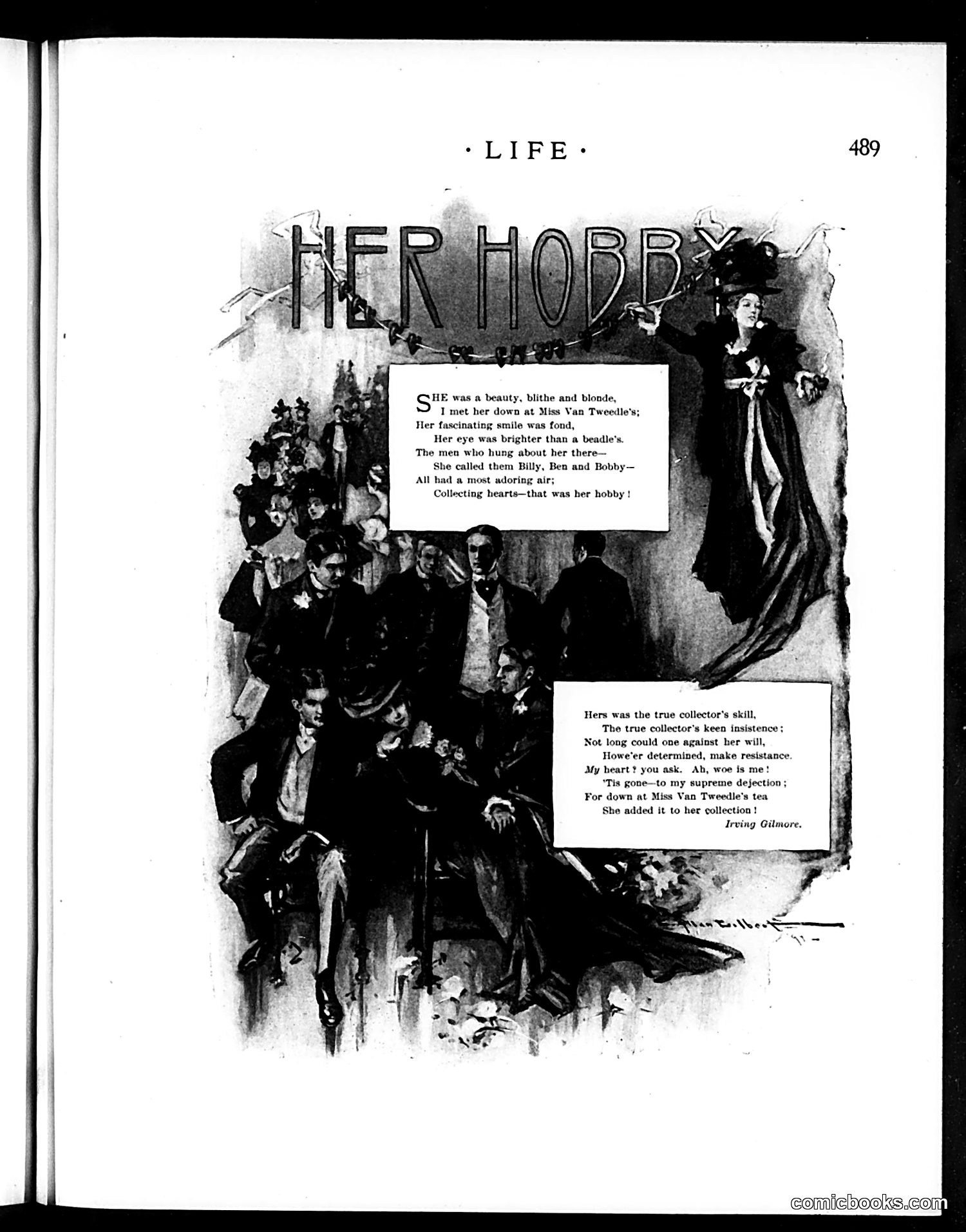
This is a humorous poem with accompanying illustration about a flirtatious young woman at a social gathering (Miss Van Tweedle's tea). The piece satirizes the romantic conventions of Edwardian courtship. "She" is a beautiful, charming woman who collects the hearts of admirers—Billy, Ben, and Bobby—treating romance like a hobby or collecting game rather than genuine emotion. The narrator describes her "collector's skill" and "keen insistence," suggesting she pursues romantic conquests systematically and persistently. The joke is that the narrator himself falls victim to her charms despite recognizing her pattern, surrendering his heart to join her "collection." The satire gently mocks both the woman's predatory flirtatiousness and the men's helpless susceptibility to her charms—a commentary on the artificial romantic games of polite society.
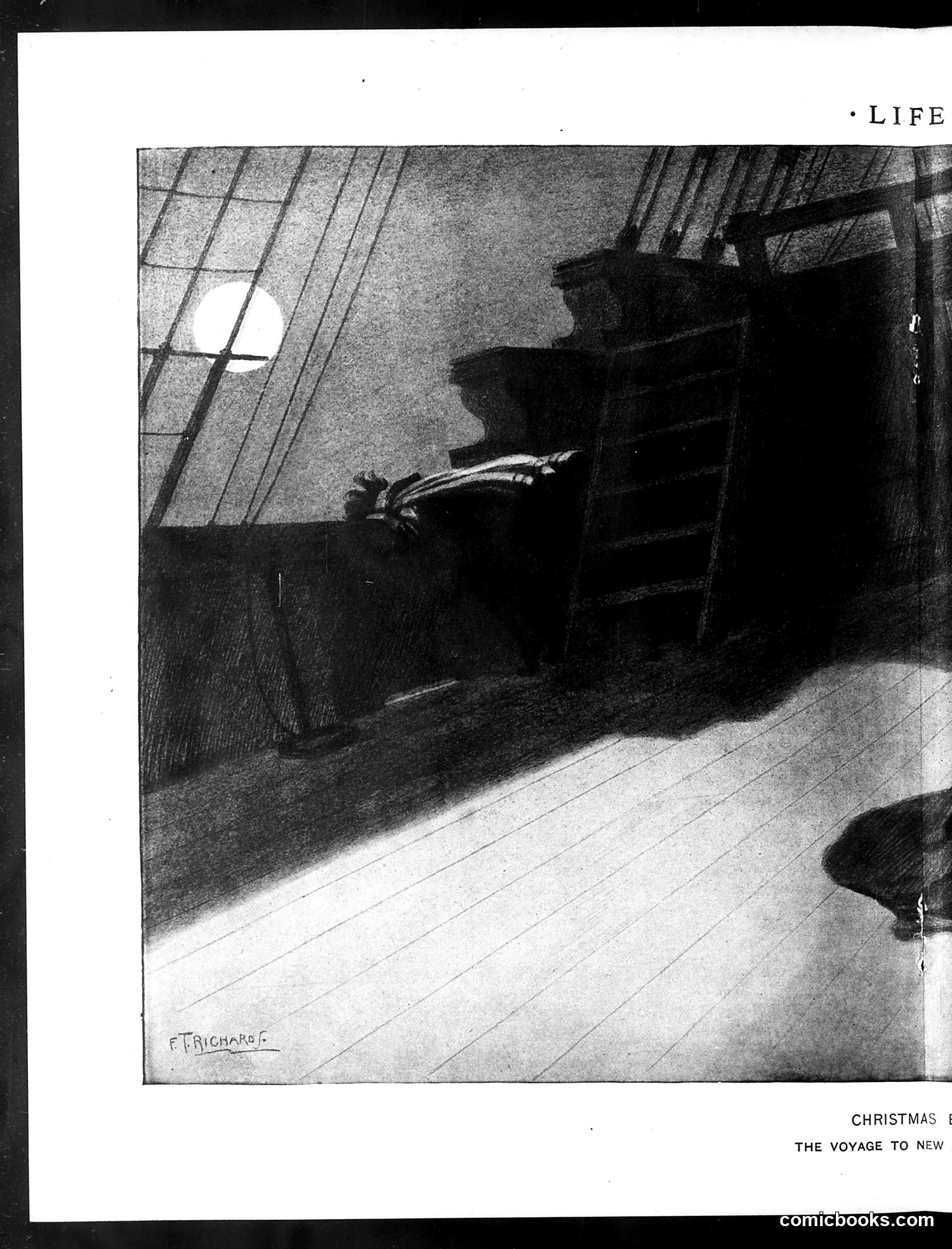
This appears to be a page from *Life* magazine featuring an illustration signed "F.RICHARDE" (or similar). The image shows a stark, dramatic interior scene—a sparse cabin or ship's quarters with a porthole window, wooden ladder, and what appears to be a figure or silhouette in shadow. The caption references "CHRISTMAS" and "THE VOYAGE TO NEW" (text cuts off), suggesting a nautical or maritime theme, possibly alluding to a famous voyage or journey associated with Christmas traditions. Without the complete caption text or knowing the publication date, I cannot definitively identify the specific historical reference or satire intended. The composition's dramatic lighting and shadowy figures suggest either a serious narrative illustration or social commentary, but the precise political or social meaning remains unclear from the visible portions.
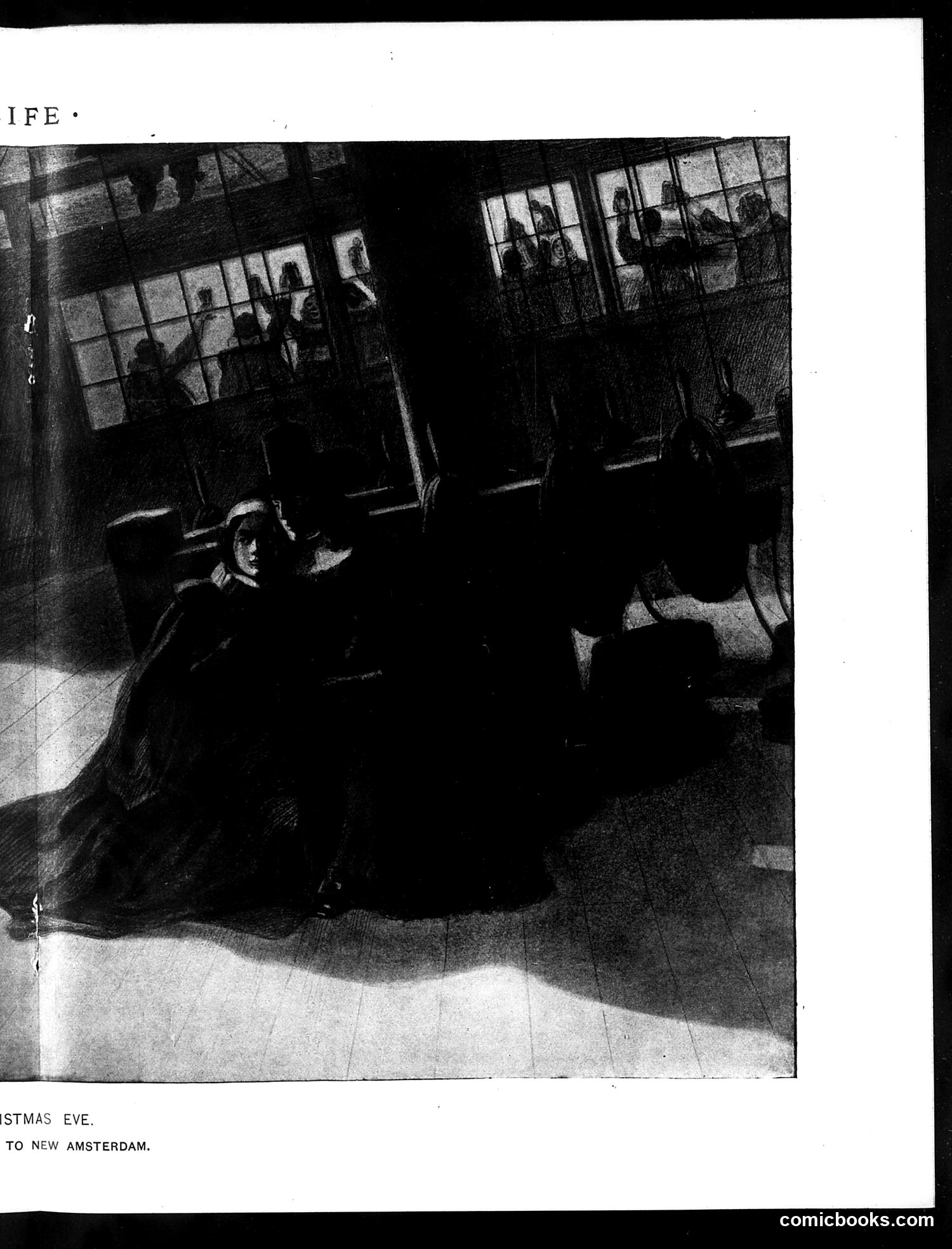
This appears to be a scene depicting travelers or immigrants on what looks like a ship or transport vessel on Christmas Eve, heading to New Amsterdam (the Dutch colonial name for New York City). The image shows silhouetted figures in the lower portion, with lit windows visible above them—suggesting crowded conditions typical of immigrant passage. The caption references "New Amsterdam," evoking either historical Dutch colonial period travel or, more likely, contemporary early-20th-century immigration. The satire likely comments on the contrast between the holiday season and the harsh realities of immigrant travel and living conditions—the cramped, dark quarters versus the celebratory occasion. Without additional context or visible artist attribution, the specific satirical target remains somewhat unclear, though it appears to critique either immigration conditions or the immigrant experience during this period.
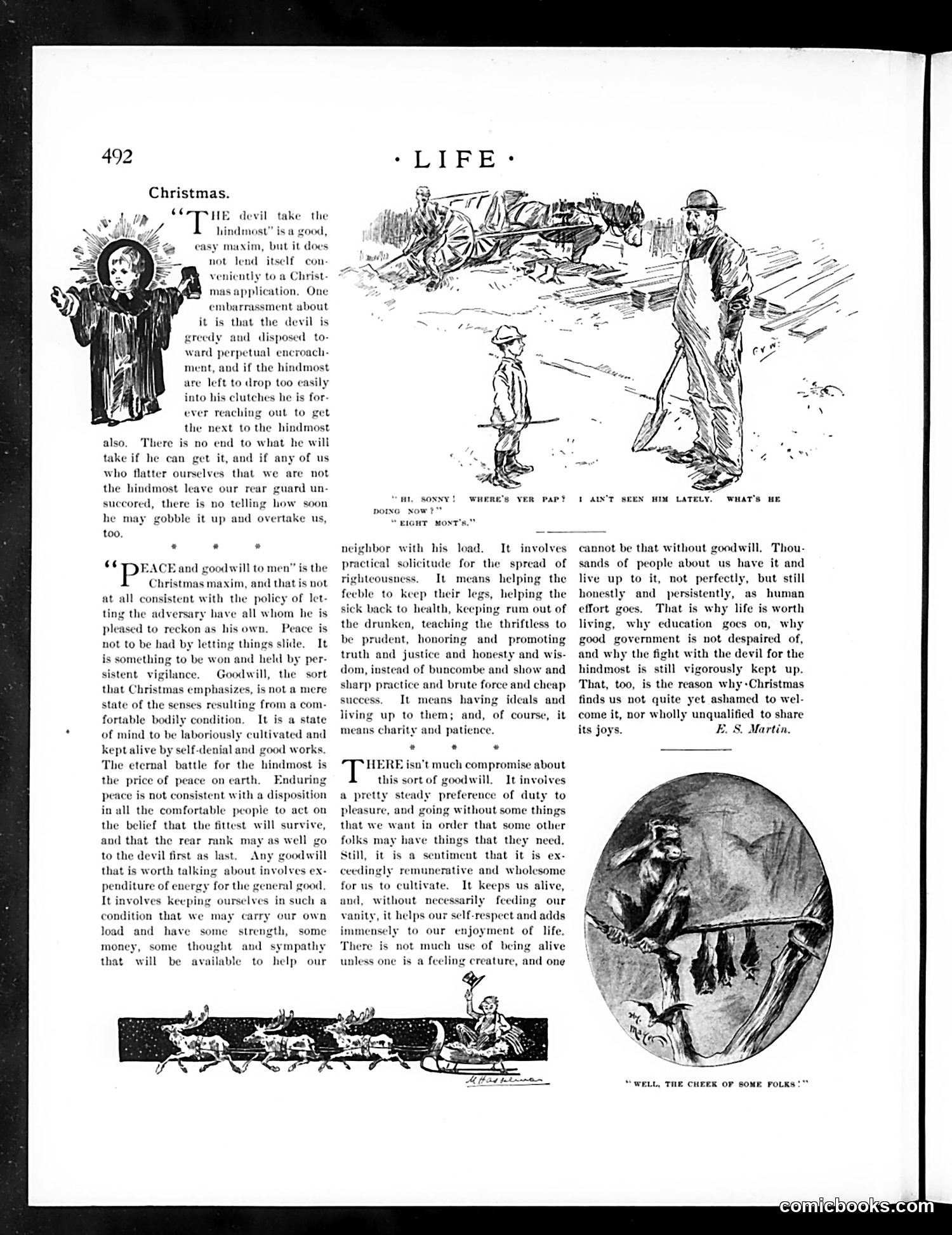
This page presents a Christmas editorial arguing for active Christian charity over passive indifference. The text contrasts the maxim "devil take the hindmost" with "Peace and goodwill to men," arguing that genuine Christmas spirit requires *effort*—not merely comfortable sentimentality. The editorial emphasizes that goodwill means helping the poor and disadvantaged: feeding the hungry, aiding the sick, promoting education and honest values. It critiques comfortable people who assume "the fittest will survive" while ignoring those falling behind. The cartoon illustrations show working-class figures—laborers, children in poverty—reinforcing the text's focus on practical aid to the struggling. The dialogue "Eight months" suggests a child describing their father's employment status, likely referencing economic hardship. The signature "E.S. Martin" indicates this is the magazine's editorial voice. The overall message: Christmas charity demands uncomfortable self-denial and active social responsibility, not merely feel-good sentiment.
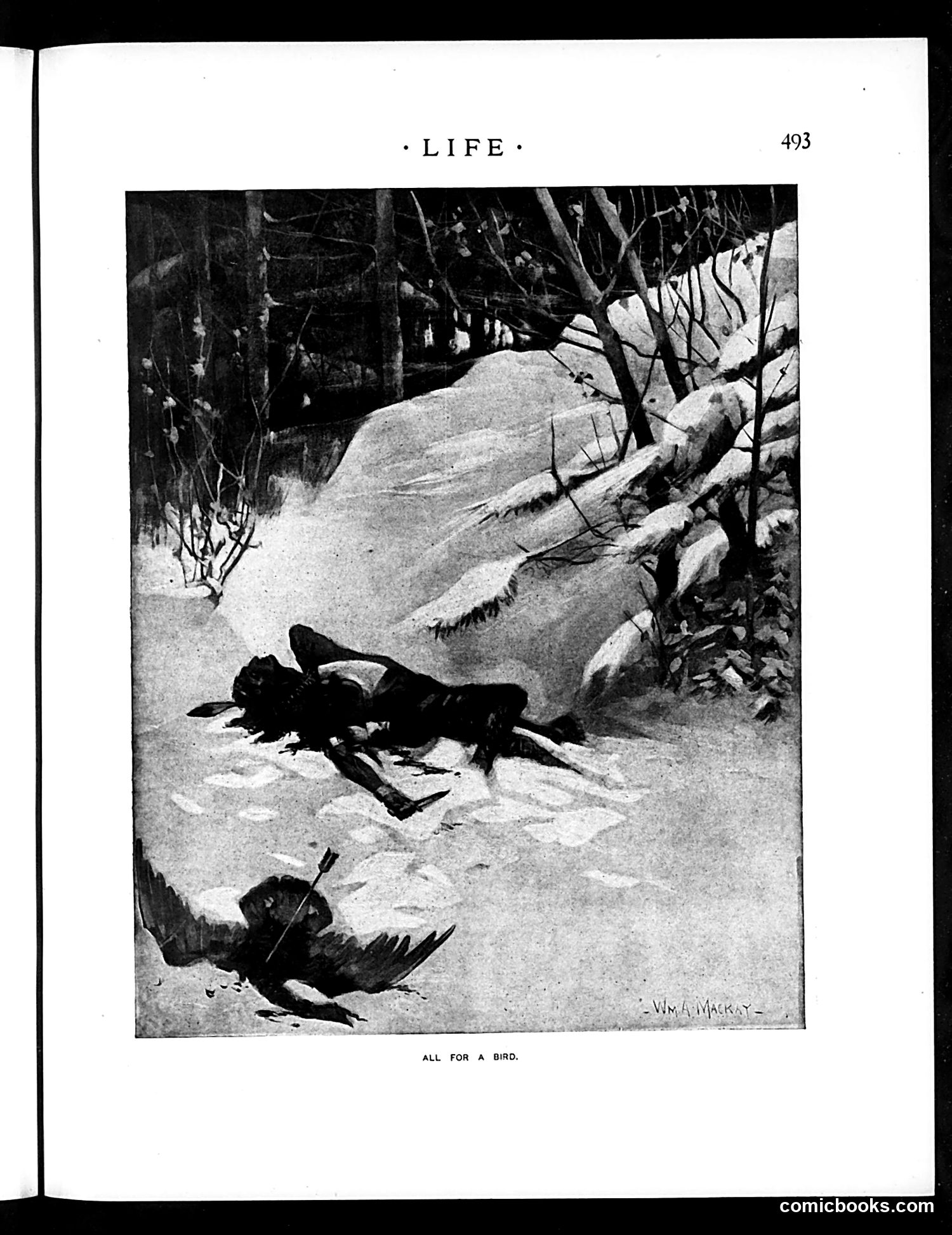
This is a single illustration by W.A. Mackay showing two cats engaged in combat on sandy ground near vegetation. The title "All for a Bird" suggests they are fighting over a bird—likely prey they both want to catch. The image appears to be a humorous observation about animal behavior rather than political satire. It depicts a relatable scene of competition: two predators willing to fight each other intensely for a single small prize (the bird). The satire likely operates as social commentary, using animal behavior as a metaphor for human conflict—suggesting people fight fiercely over things of minimal actual value, losing sight of what matters in their struggle. The work is credited to illustrator W.A. Mackay.
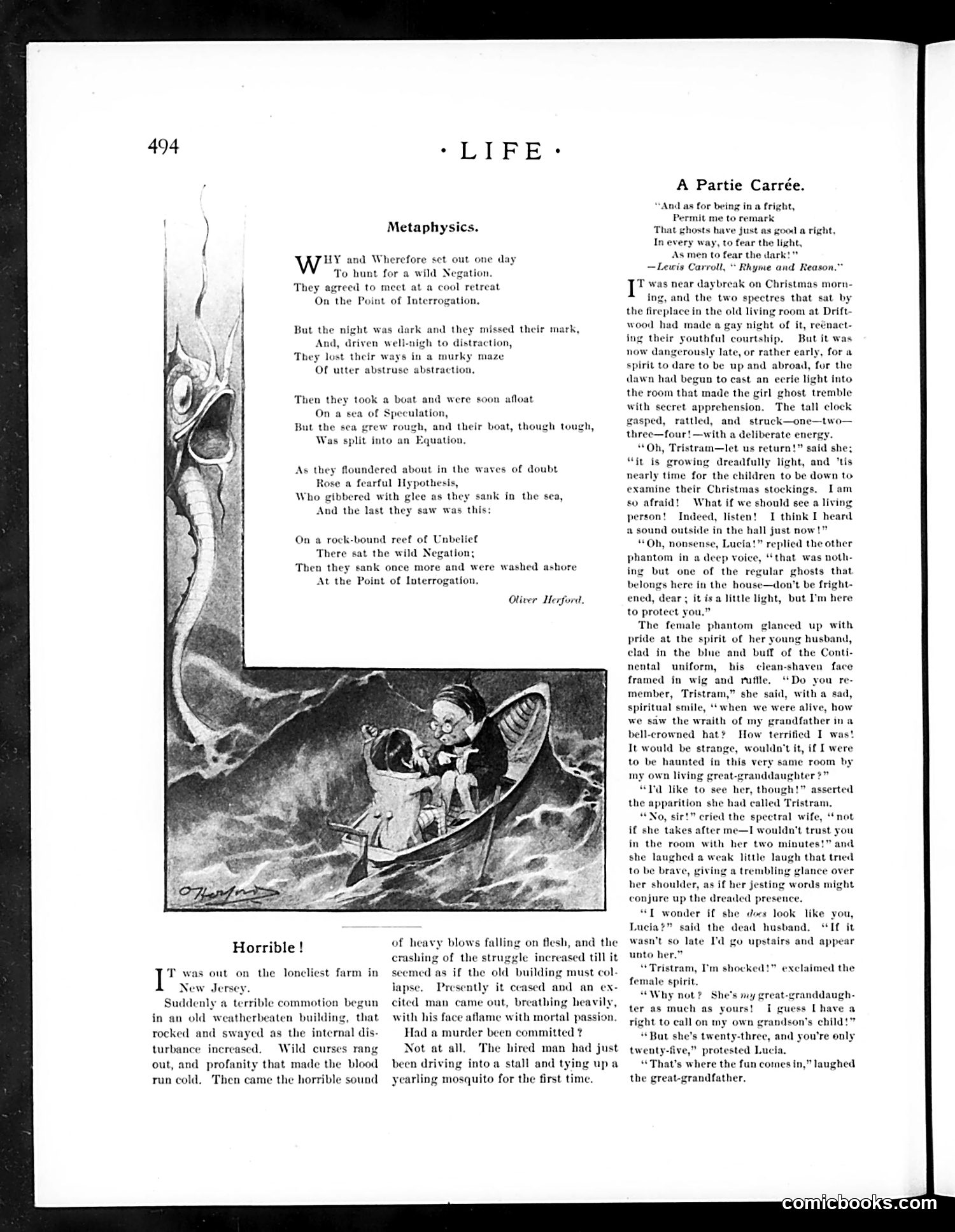
This page contains three separate satirical pieces typical of early 20th-century Life magazine humor: **"Metaphysics"** (by Oliver Herford): An illustrated poem mocking abstract philosophical debate. "Why" and "Wherefore" seek "wild Negation" but get lost in abstract concepts ("waves of doubt," "Hypothesis," "Unbelief"). The satire targets pretentious philosophical speculation that leads nowhere—a common target of Life's anti-intellectualism. **"Horrible!"**: A brief joke about a New Jersey farm where violent commotion erupts from a weatherbeaten building. The punchline reveals it's merely a hired man breaking in a "yearling mosquito"—satirizing rural life and the legendary oversized mosquitoes of New Jersey through exaggeration. **"A Partie Carrée"**: A ghost story set at Christmas featuring two Revolutionary War-era spectres reminiscing about their courtship. The humor derives from ghosts experiencing ordinary domestic anxieties (children waking, encountering living relatives) and the female ghost's concern about her great-granddaughter's inheritance of her appearance—applying human vanity to the supernatural.
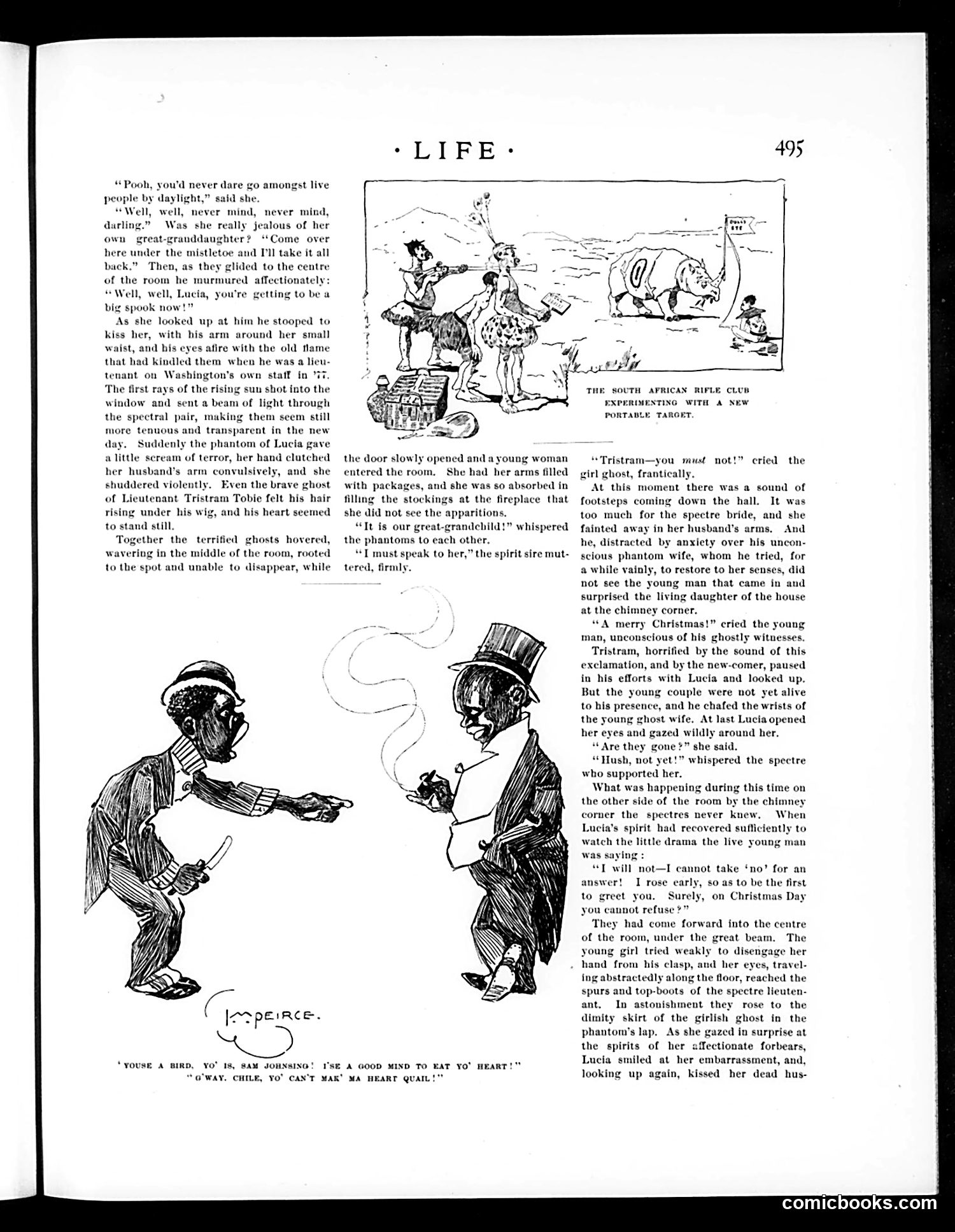
This appears to be a **Christmas ghost story** rather than political satire. The narrative concerns Lieutenant Tristram Tobie and his wife Lucia—spirits who died during the American Revolutionary War (he served "on Washington's own staff in '77"). On Christmas morning, they attempt to interact with their living great-granddaughter, who arrives to decorate the fireplace. When a young man enters and greets her romantically, the ghosts panic, fearing discovery. The girl eventually perceives the spectral couple. **The humor** derives from the sentimental, melodramatic ghost-romance plot typical of Victorian Christmas literature—mixing supernatural elements with domestic sentimentality. The lower cartoon (by J. Peirce) appears unrelated: two caricatured figures in dialect exchanging insults about eating hearts, likely reflecting period racial stereotypes. The overall page blends nostalgic Americana (Revolutionary War ghosts) with traditional Christmas-ghost-story conventions popular in 19th-century periodicals.
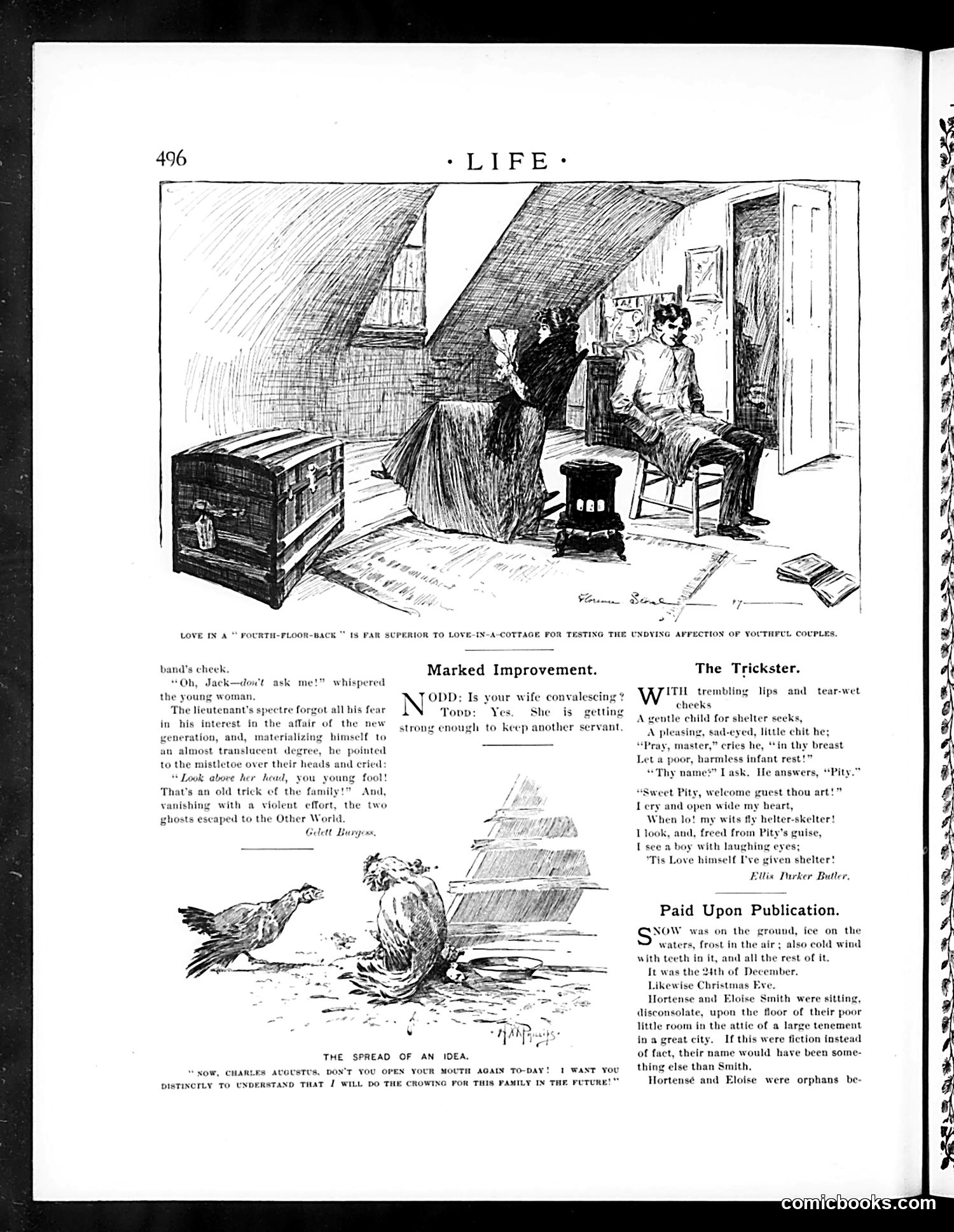
This Life magazine page contains three satirical pieces typical of early 20th-century American humor: **"Love in a Fourth-Floor-Back"** (top): A humorous ghost story by Galt Burgess about a young couple in a cramped apartment. A spectral lieutenant appears and points out mistletoe above their heads, revealing an "old family trick"—suggesting even ghosts used romantic ploys. **"Marked Improvement"** (middle): A brief domestic joke about a wife recovering from illness and becoming well enough to hire a servant, implying she's regaining her strength to manage household staff (or possibly her husband's household). **"Paid Upon Publication"** (bottom): Opens a serialized story about two orphan girls, Hortense and Eloise Smith, living in poverty in a city tenement on Christmas Eve. The narrator notes that if this were fiction, they'd have a more romantic name—a meta-joke about sentimental Victorian stories. These pieces reflect period preoccupations with romance, class anxiety, and domestic life, delivered through gentle satire and sentimental storytelling.
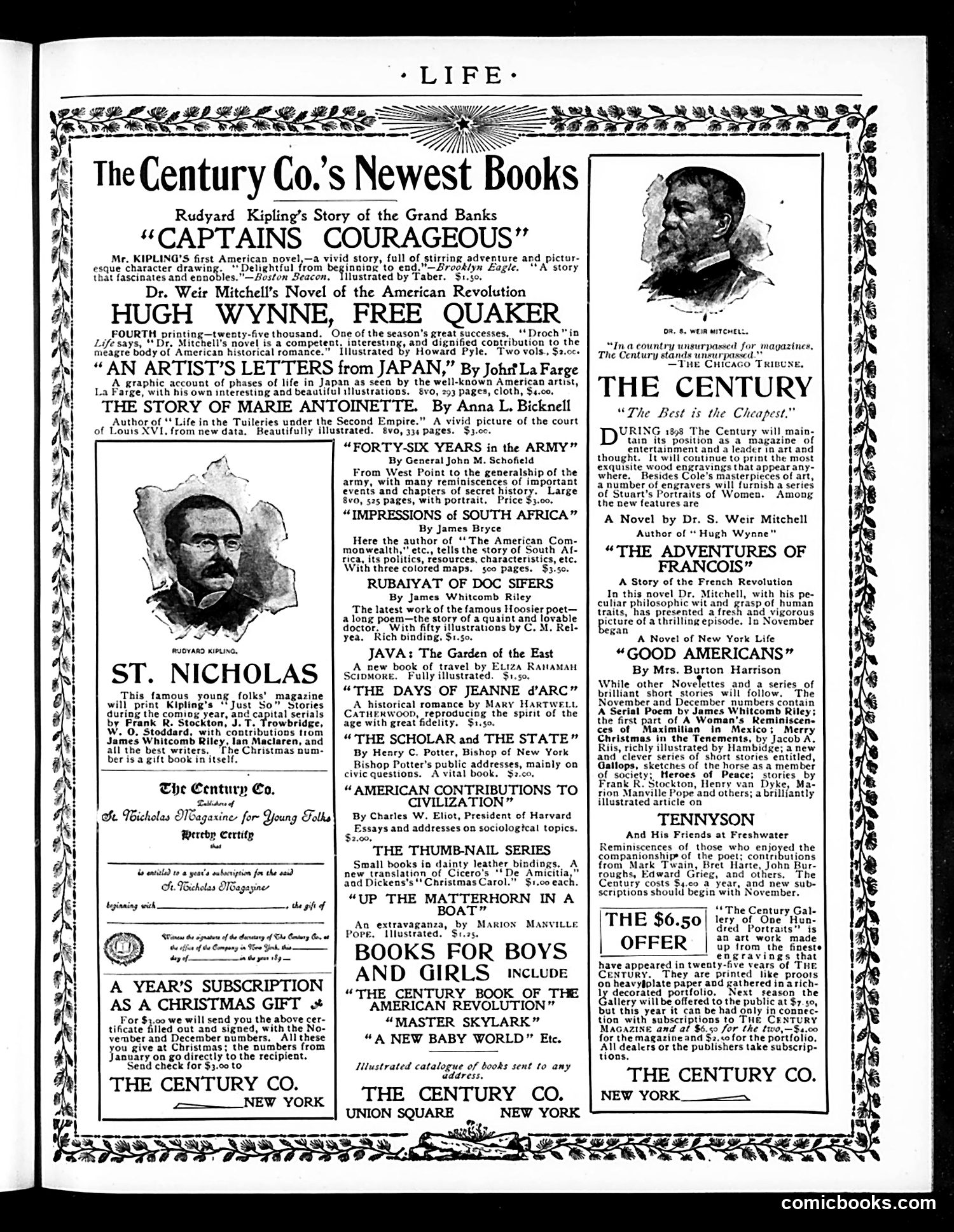
This page is primarily an **advertisement** for The Century Company's new books, not a political cartoon or satire. It showcases recent publications including Rudyard Kipling's *Captains Courageous* and Dr. Weir Mitchell's *Hugh Wynne, Free Quaker* (a Revolutionary War novel). The page includes portraits of Kipling and Mitchell, along with promotional blurbs praising these works. The only satirical element is the small portrait of James Whitcomb Riley accompanying the advertisement for his poem *Rubaiyat of Doc Sifers*—though this appears to be straightforward promotion rather than satire. The remainder consists of book listings, subscription offers for *St. Nicholas* magazine (a children's publication), and pricing information. This is essentially a catalog page disguised as magazine content, typical of *Life*'s revenue-generating advertising practices.
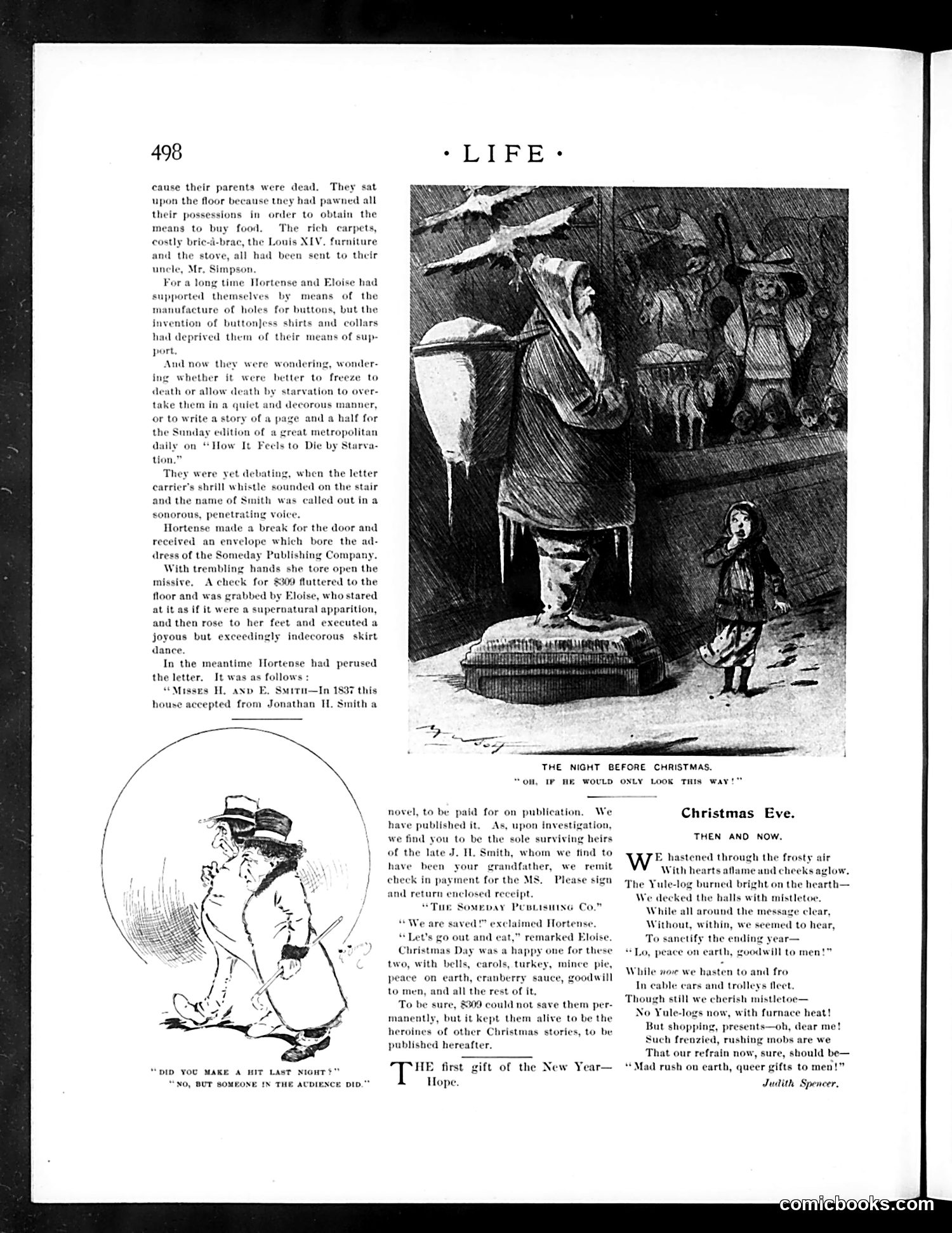
This page presents contrasting Christmas narratives. The main story depicts two impoverished sisters, Hortense and Eloise, literally starving after pawning all possessions. They contemplate whether to "freeze to death" or write a sensational story titled "How It Feels to Die by Starvation" for a metropolitan newspaper—satirizing how poverty becomes marketable content for middle-class readers. The satire's punch: their desperation is monetized when they receive a $300 check from a publishing company, discovering they're heirs to an estate. The irony is sharp—their suffering story literally saves them from suffering. Below, "Christmas Eve: Then and Now" (by Judith Spencer) contrasts Victorian idealized Christmas (peaceful hearths, "peace on earth, goodwill to men") with contemporary frenzied commercialism ("mad rush on earth, queer gifts to men"). Together, these pieces critique how modern life has replaced genuine human connection and meaning with commercialization, whether through sensationalizing poverty or holiday shopping.
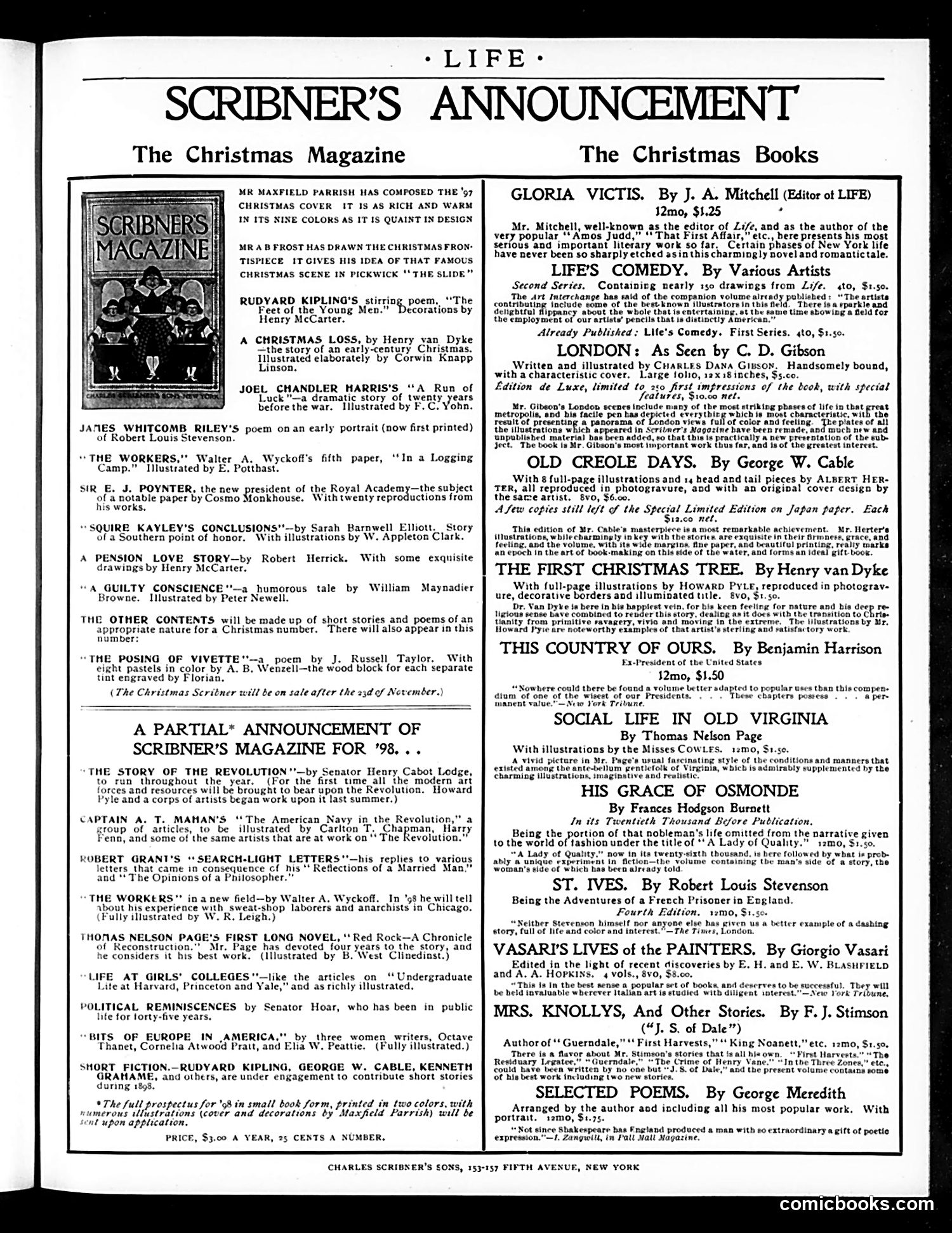
This is primarily a publisher's announcement page—not a political cartoon. It announces upcoming Christmas and 1898 content for Scribner's Magazine and Scribner's Christmas books. The page lists literary contributions from prominent authors of the 1890s: Rudyard Kipling, Joel Chandler Harris, Henry van Dyke, and James Whitcomb Riley. Key announcements include Senator Henry Cabot Lodge's multi-part "Story of the Revolution" with illustrations by Howard Pyle (a major artistic undertaking), and Thomas Nelson Page's first novel, "Red Rock," about Reconstruction. Notable planned content includes pieces on workers, colleges, and political reminiscences. The decorative cover mentioned—by Maxfield Parrish—was a significant artistic feature for holiday issues. There is no satire here; this is straightforward advertising for quality literary and illustrated content aimed at educated, affluent American readers.
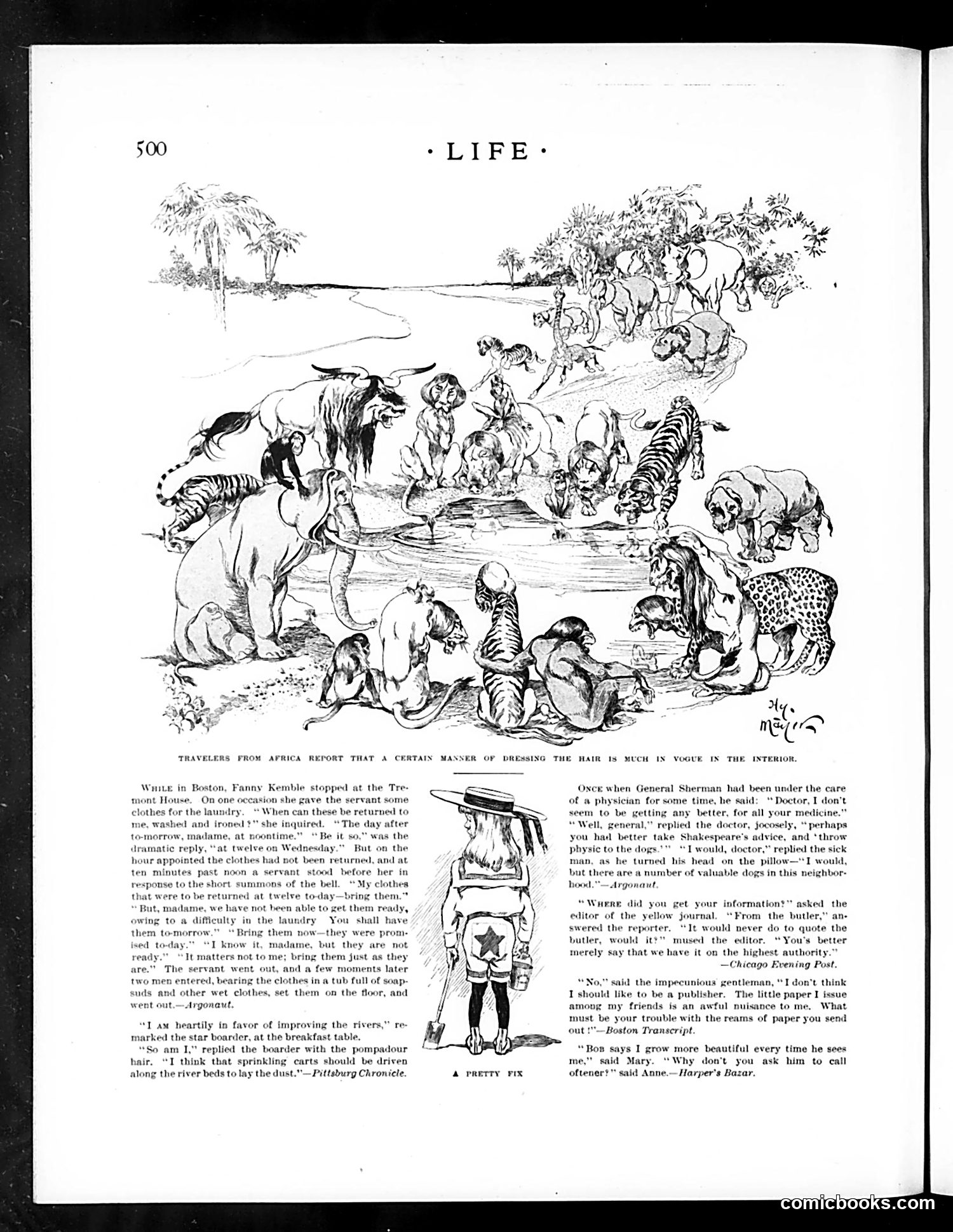
This page from *Life* magazine contains several unrelated humorous anecdotes and one cartoon, typical of the publication's format. **The Main Cartoon** (top): Depicts a diverse gathering of animals and humans at a watering hole in Africa, illustrating the caption about hair-dressing fashions in the African interior. The satire likely mocks European obsession with African trends or colonial misunderstandings of African culture. **The Accompanying Stories** are brief comedic vignettes about everyday absurdities: - A laundry service delivering unwashed clothes in soapy water - A boarder's contradictory river-improvement suggestion - General Sherman refusing medicine, joking about local dogs - A yellow journalist quoting unnamed "authorities" - An aspiring publisher complaining about his small publication - A woman suggesting her friend see a suitor more often to maintain his flattery **The Point**: These sketches satirize American social pretension, incompetence, journalistic dishonesty, and the vanity of romantic flattery—typical *Life* magazine commentary on contemporary manners and morals.
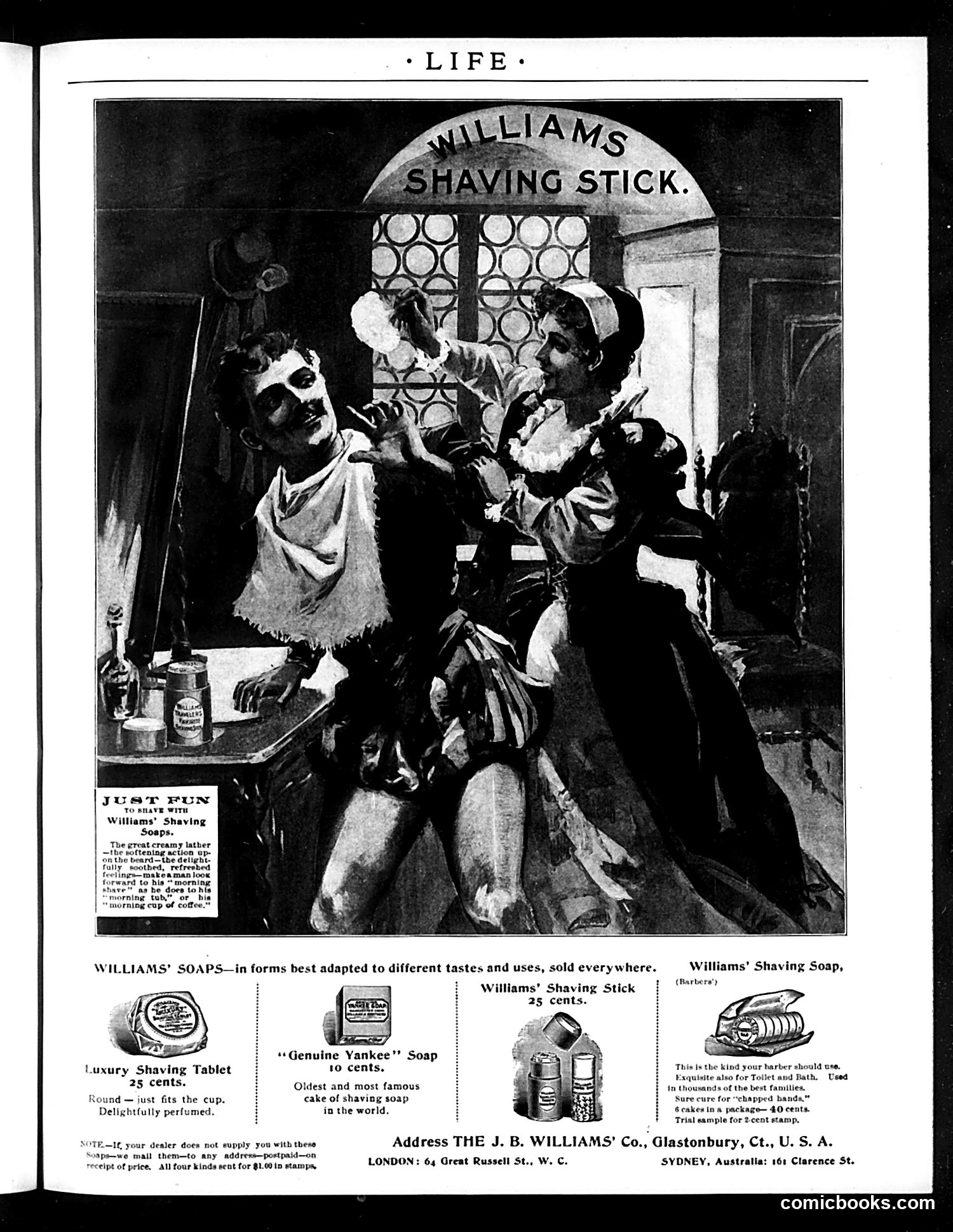
This is primarily a **product advertisement** for Williams' Shaving Soaps, not political satire. The page illustrates the company's product line through a theatrical scene rather than conveying social commentary. The image shows what appears to be a **barbershop or theatrical setting** with figures in period costume (possibly 18th-century dress) being shaved or prepared. The "JUST FUN" header signals this is meant as lighthearted entertainment advertising rather than serious journalism. The ad promotes four Williams soap products: Luxury Shaving Tablet, "Genuine Yankee" Soap, Shaving Stick, and Shaving Soap (for barbers). The theatrical presentation—using costumed figures and a staged scene—was a common advertising approach of the era, making the product memorable through entertainment. There is **no detectable political satire or caricature** here; this is straightforward commercial advertising using humor and spectacle to promote grooming products.
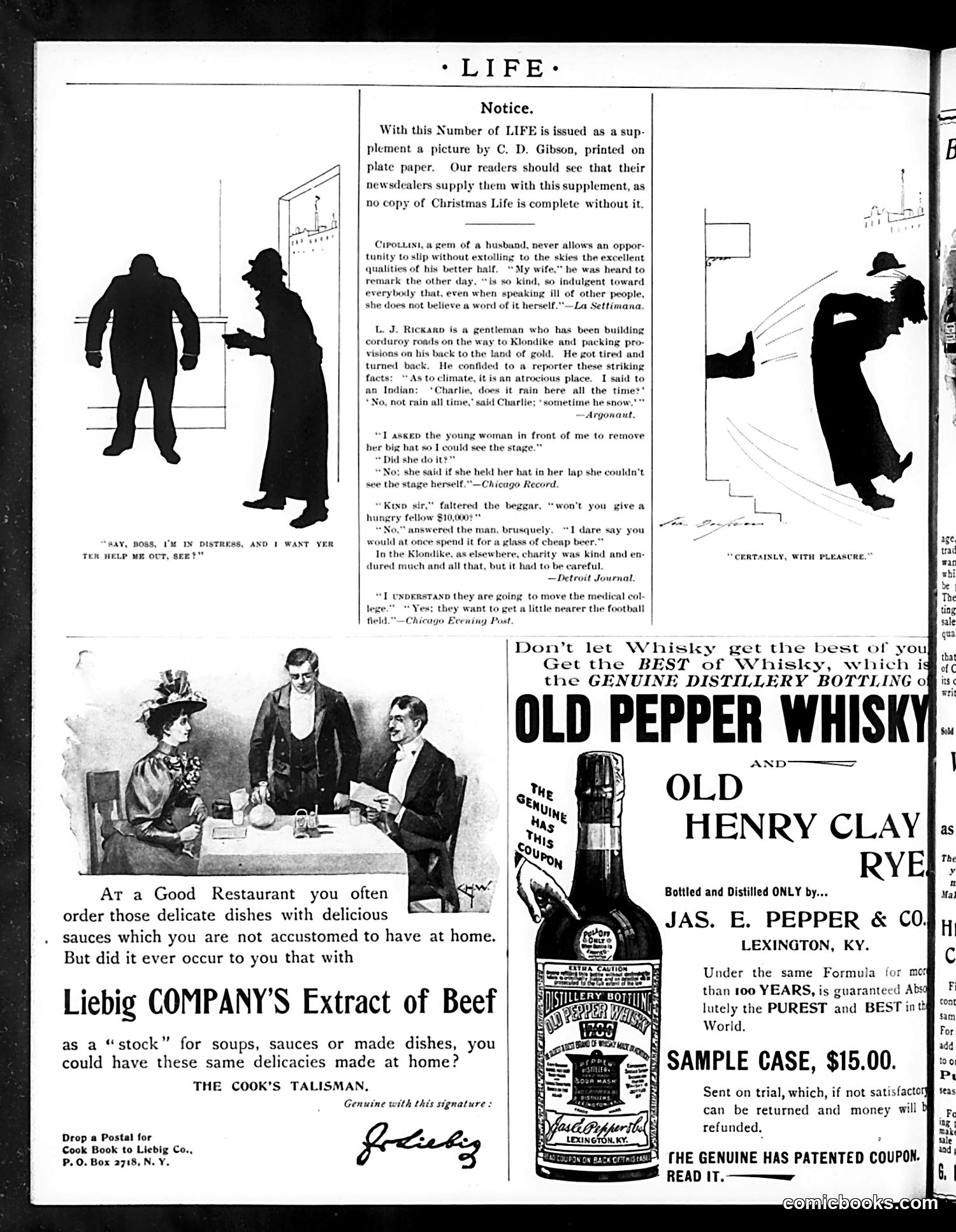
This page from *Life* magazine combines humor columns with period advertisements. The top section presents brief satirical anecdotes about contemporary life—a husband praising his wife's kindness, a Gold Rush prospector's observations about Yukon climate, and theater etiquette complaints. These jokes reflect early 20th-century social concerns: marital dynamics, the Klondike Gold Rush craze, and public behavior standards. The lower half features advertisements for Liebig Company's beef extract and Old Pepper Whisky—products typical of the era. The restaurant scene depicts middle-class dining aspirations. The single cartoon (left side) shows silhouetted figures in what appears to be a distressed situation, captioned "Say, Boss, I'm in Distress, and I Want Yer Help Be Got, See!" This likely satirizes urban poverty or panhandling, common *Life* subjects. Overall, the page reflects *Life's* satirical approach to contemporary manners, class anxieties, and consumer culture of the era.
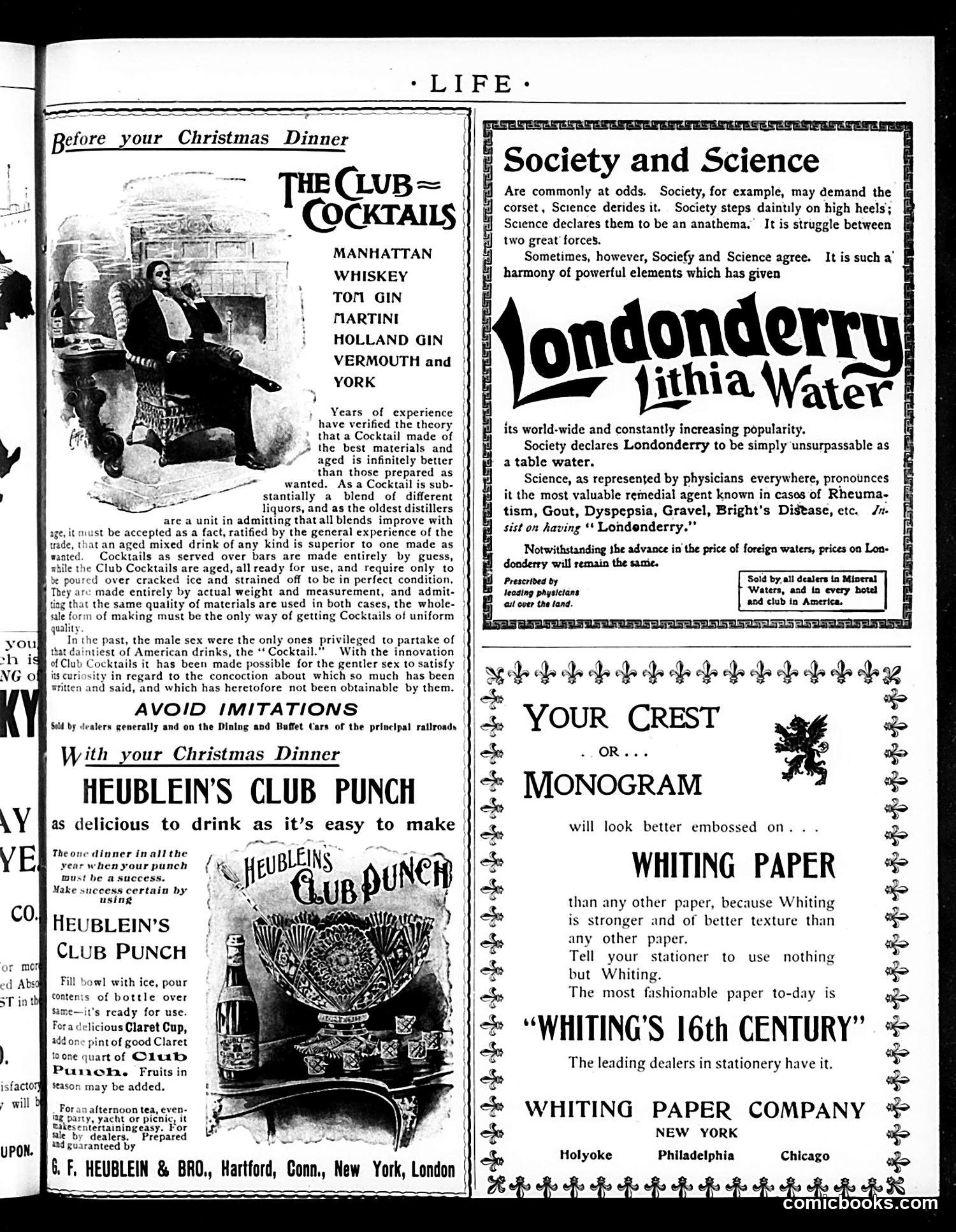
This is primarily an **advertising page** from an era (likely early 1900s) when Life magazine mixed editorial content with paid promotions. There is no political cartoon or satire here. The page features three liquor/beverage advertisements (Club Cocktails, Heublein's Club Punch, and Londonderry Water) alongside stationery ads. Notably, the **Londonderry Water ad uses mock-serious language** claiming that while "Society and Science" typically conflict—society demanding corsets and heels while science opposes them—they agree that Londonderry mineral water is excellent. This is light humor treating a mundane product (bottled water for medicinal purposes) as if it were a major philosophical reconciliation. The **Club Cocktails ad** includes a social observation that pre-made cocktails now allow "the gentler sex" to enjoy drinks previously exclusive to men, presented as progressive innovation rather than satire. These represent **period advertising conventions**: exaggerated claims, pseudo-scientific endorsements, and gentle social commentary used to sell consumer goods to affluent readers.
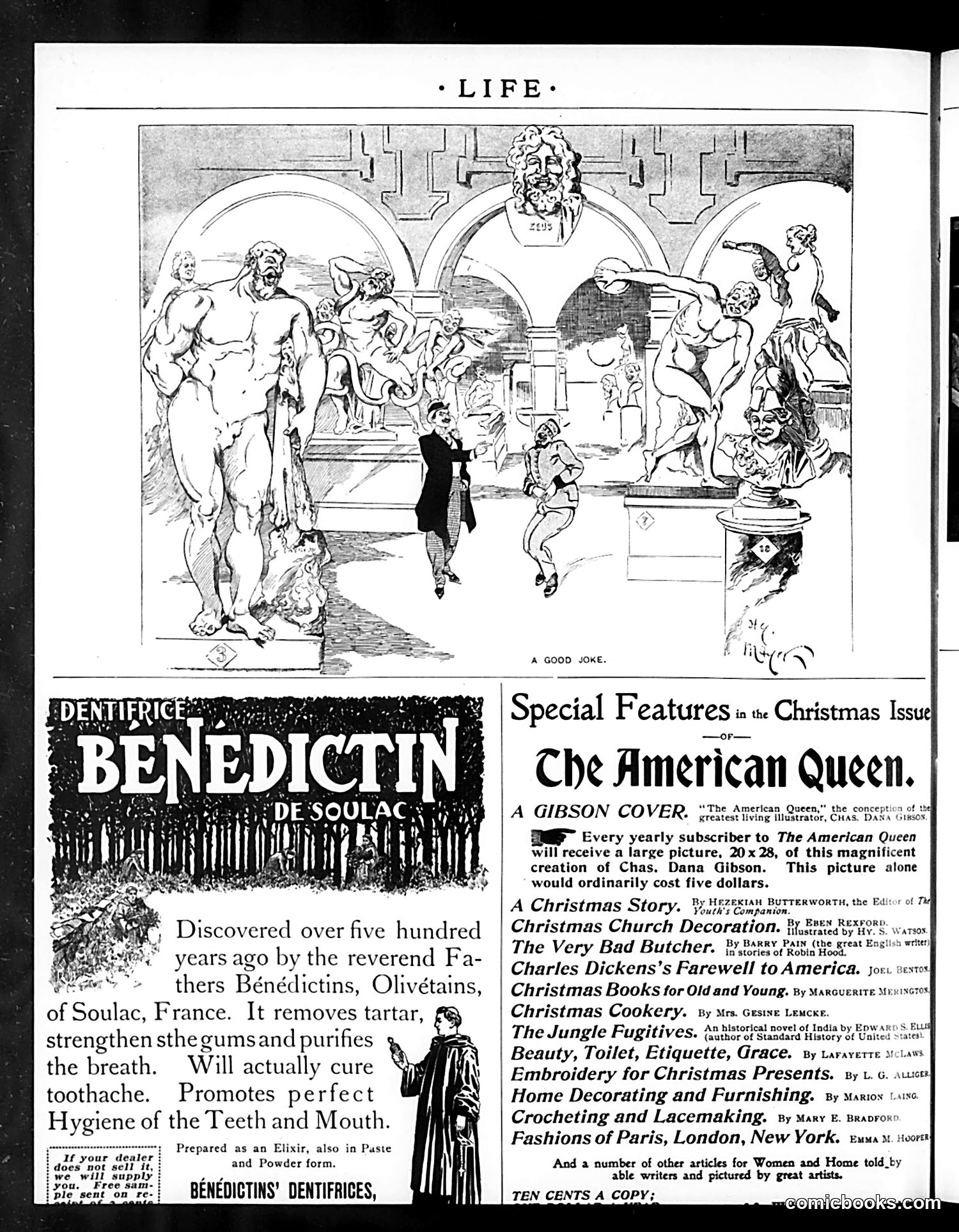
The cartoon depicts a modern gentleman and woman walking through a classical art gallery or museum filled with classical nude statuary. The humor—titled "A Good Joke"—plays on the Victorian era's prudish tension with artistic nudity. The joke appears to be that the formally-dressed modern couple are casually strolling past elaborate classical sculptures (which would have been considered respectable "high art"), while the statues' nudity would have been shocking to contemporary viewers if encountered in everyday life. The contrast between the couple's modest clothing and the sculptures' exposure creates the satirical point: what society accepted as "Art" in classical contexts would be scandalous elsewhere—highlighting the hypocrisy of Victorian attitudes toward the body and propriety. The page also advertises Benedictins' toothpaste and promotes *The American Queen* magazine's Christmas issue.
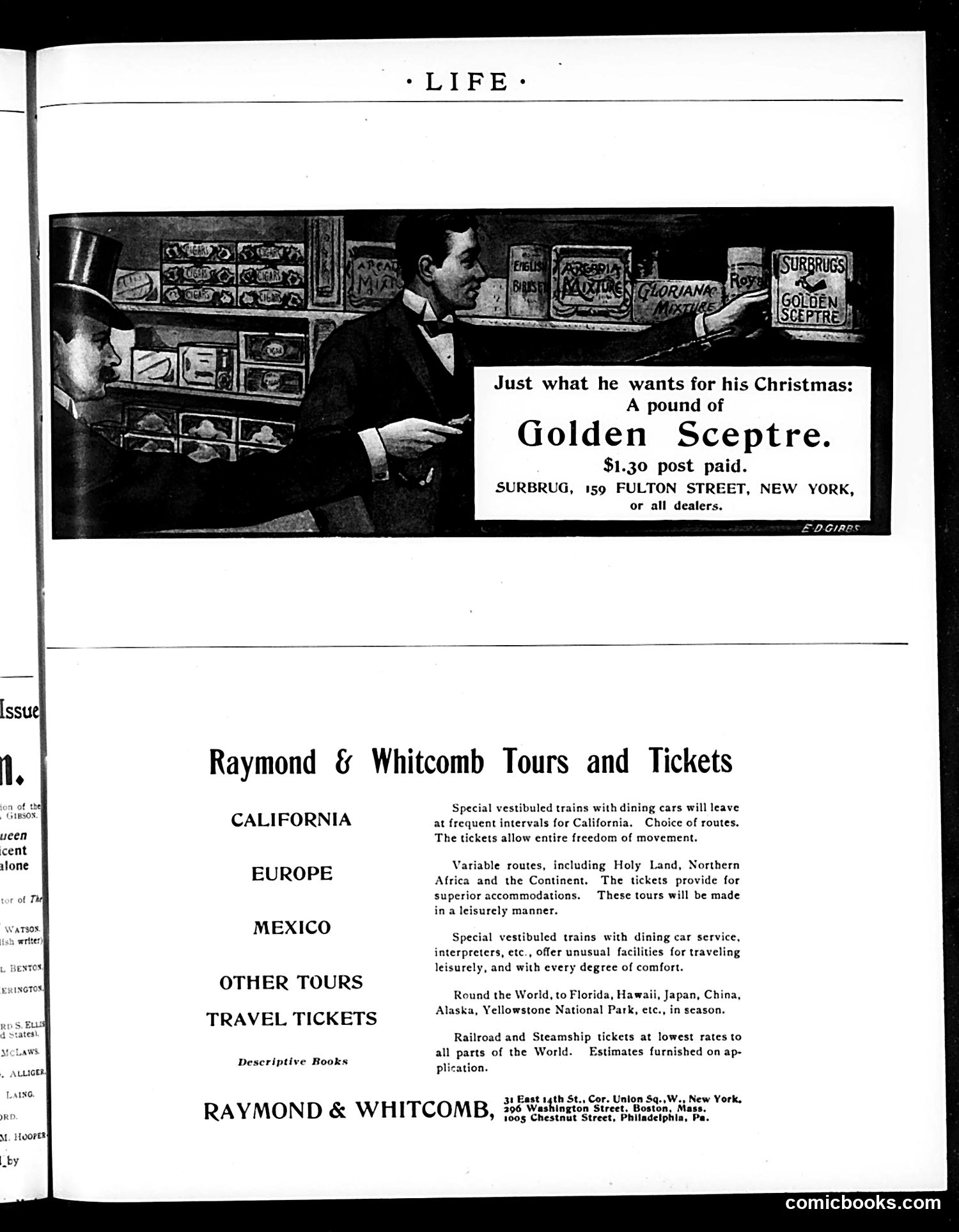
This page combines a cigarette advertisement with travel agency marketing. The top advertisement depicts a tobacconist's shop scene where a salesman presents "Golden Sceptre" cigars as an ideal Christmas gift—priced at $1.30 postpaid. The humor appears gentle: the product name suggests luxury and refinement, positioning cigars as a sophisticated gentleman's gift. The scene shows a well-dressed customer in a shop lined with branded cigar boxes, reinforcing the upscale product positioning. The remainder of the page contains straightforward advertising for Raymond & Whitcomb Tours, a legitimate travel agency offering guided tours to California, Europe, Mexico, and worldwide destinations with special trains featuring dining cars and interpreters. This is primarily an **advertising page** rather than satirical content. The cigarette ad's humor is understated—relying on product aspiration rather than social or political satire typical of Life magazine's editorial cartoons.
This page contains **humor essays and anecdotes**, not political cartoons. The content satirizes everyday American life circa early 1900s. **Key pieces:** 1. **"A Dear"** - Satirizes wealthy wives whose expensive tastes (earrings, costumes) drain husbands' finances. The husband complains about costs while professing love. 2. **The farmer/Bryan anecdote** - A farmer, after paying debts and buying wife amenities, ironically says he's glad William Jennings Bryan (Democratic candidate) lost the election—despite voting for him. The joke: his newfound prosperity contradicts his politics. 3. **The Southern gentlemen story** - Tourists plan to drink "every time we see the monument" in Washington, D.C., not realizing how frequently visible it is. The punchline: they abandon their week-long trip after one day, unable to sustain their drinking game. **The page also includes** a notice about the magazine supplement and a Gorham silverware advertisement for Christmas gifts—typical of the era's lifestyle publications.
This is not a cartoon but rather **advertising content**—a testimonial letter with official confirmation appended. The page promotes Waltham watches (American-manufactured) through a customer letter claiming his watch detected an error at the Royal Observatory in Greenwich, London, which set official time for the British Empire. The customer, Thomas Wireate, noticed the time-ball dropped eighteen seconds early and contacted the Astronomer Royal, who confirmed the error. The reply from H.P. Hollis at the Observatory validates this claim. **The appeal**: This testimonial leverages British institutional authority (the Royal Observatory) to advertise an American product, suggesting Waltham watches were so accurate they could catch mistakes made by the official timekeeping authority. For 1894 readers, this was compelling marketing—precision timekeeping was valuable and prestigious. The inclusion of the Observatory's confirming letter adds credibility and gives the advertisement an almost editorial appearance within *Life*.
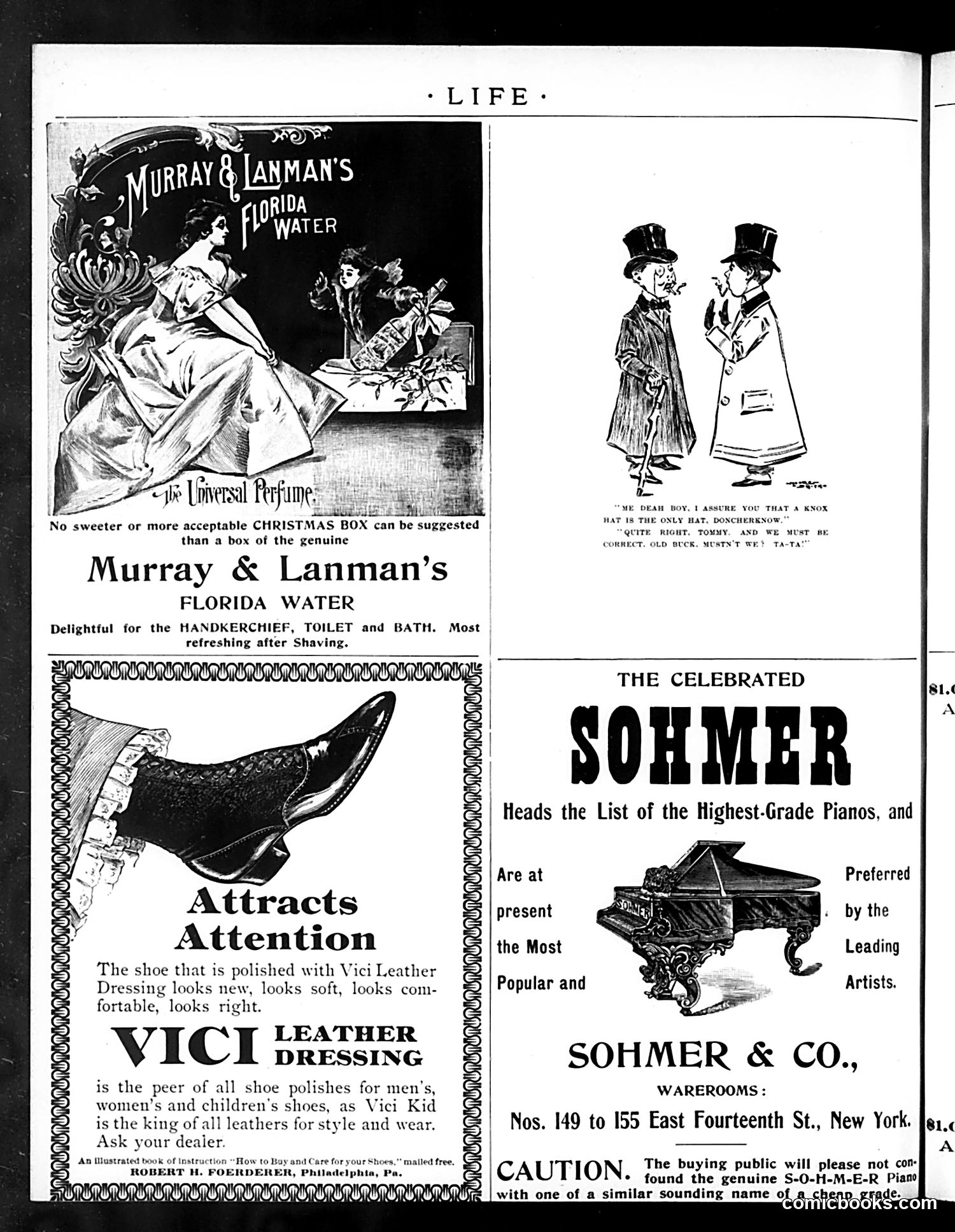
This page is primarily **advertising**, not political satire. It contains four product advertisements from the early 1900s. The small cartoon at top right shows two well-dressed men in top hats discussing hat brands—a mild social joke about snobbish fashion consciousness. One assures the other that only a "Knox" hat is acceptable, with the response "quite right" and "ta-ta"—mocking upper-class pretension and their affected speech patterns. The other ads promote: - **Murray & Lanman's Florida Water** (cologne/toiletry) - **Vici Leather Dressing** (shoe polish) - **Sohmer Pianos** (musical instruments) Each ad uses period-typical marketing appeals: luxury, sophistication, and endorsement by the elite. The Sohmer ad emphasizes preference "by the Leading Artists," while the hat cartoon ridicules the same aspirational snobbery the ads themselves exploit. The humor is gentle social observation about class anxieties and conspicuous consumption—not biting political commentary.
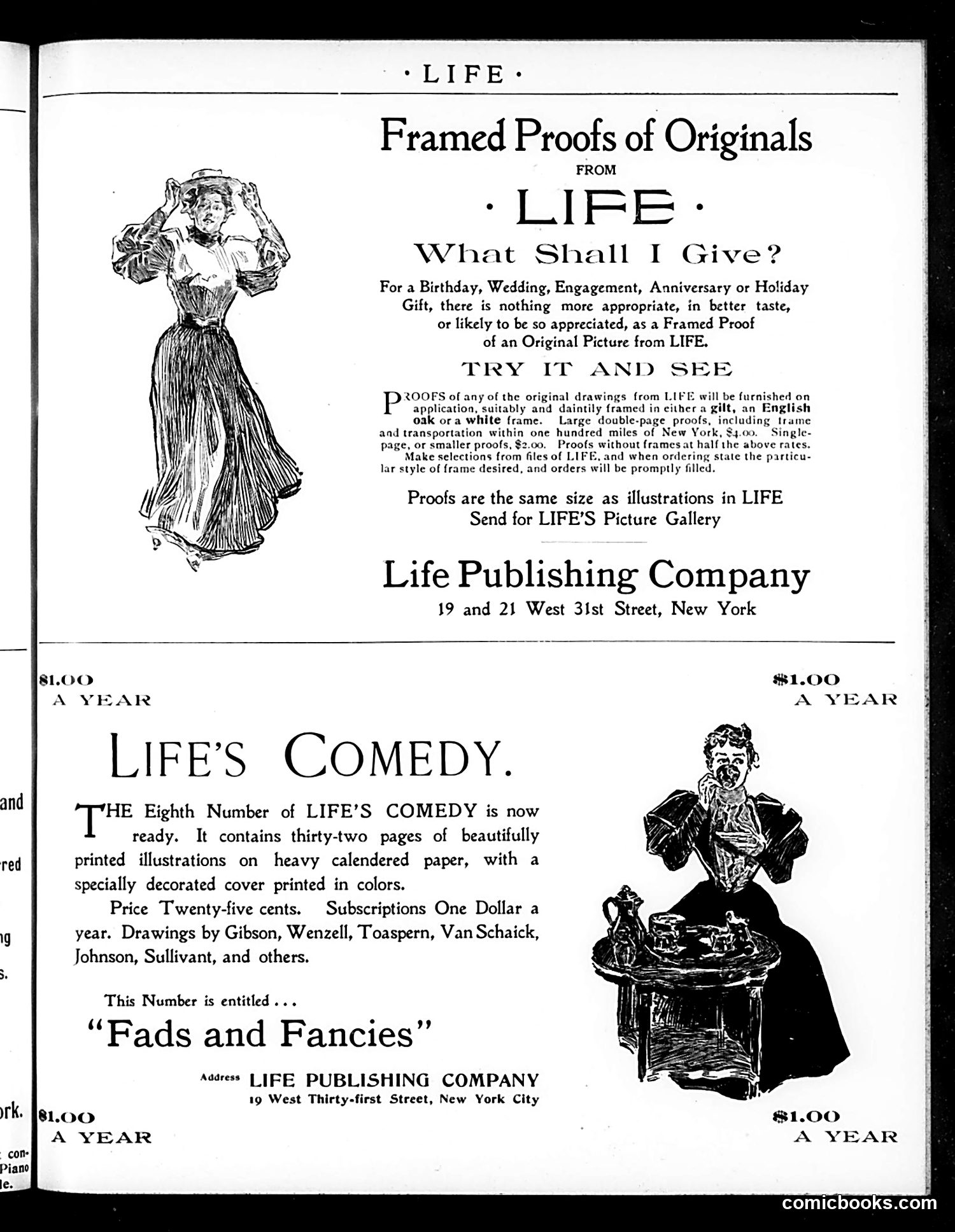
This is primarily a LIFE magazine advertising page, not a satirical cartoon. It contains two advertisements: 1. **Top section**: Promotes framed proofs of original artwork from LIFE magazine as gift items for birthdays, weddings, and holidays. The elegant illustration of a fashionable woman suggests the refined taste associated with owning such art. 2. **Bottom section**: Advertises "LIFE'S COMEDY," the eighth installment of a comedy collection featuring thirty-two pages of illustrations by notable cartoonists including Gibson, Wenzell, Van Schaick, Johnson, and Sullivant. This particular issue is titled "Fads and Fancies"—a fitting topic for a satirical magazine that frequently mocked contemporary social trends and fashions. The jovial figure with the overflowing bowl appears to represent comedic abundance or indulgence, reinforcing the entertainment value being sold. Both ads emphasize LIFE's role as a publisher of illustrated humor and social commentary.
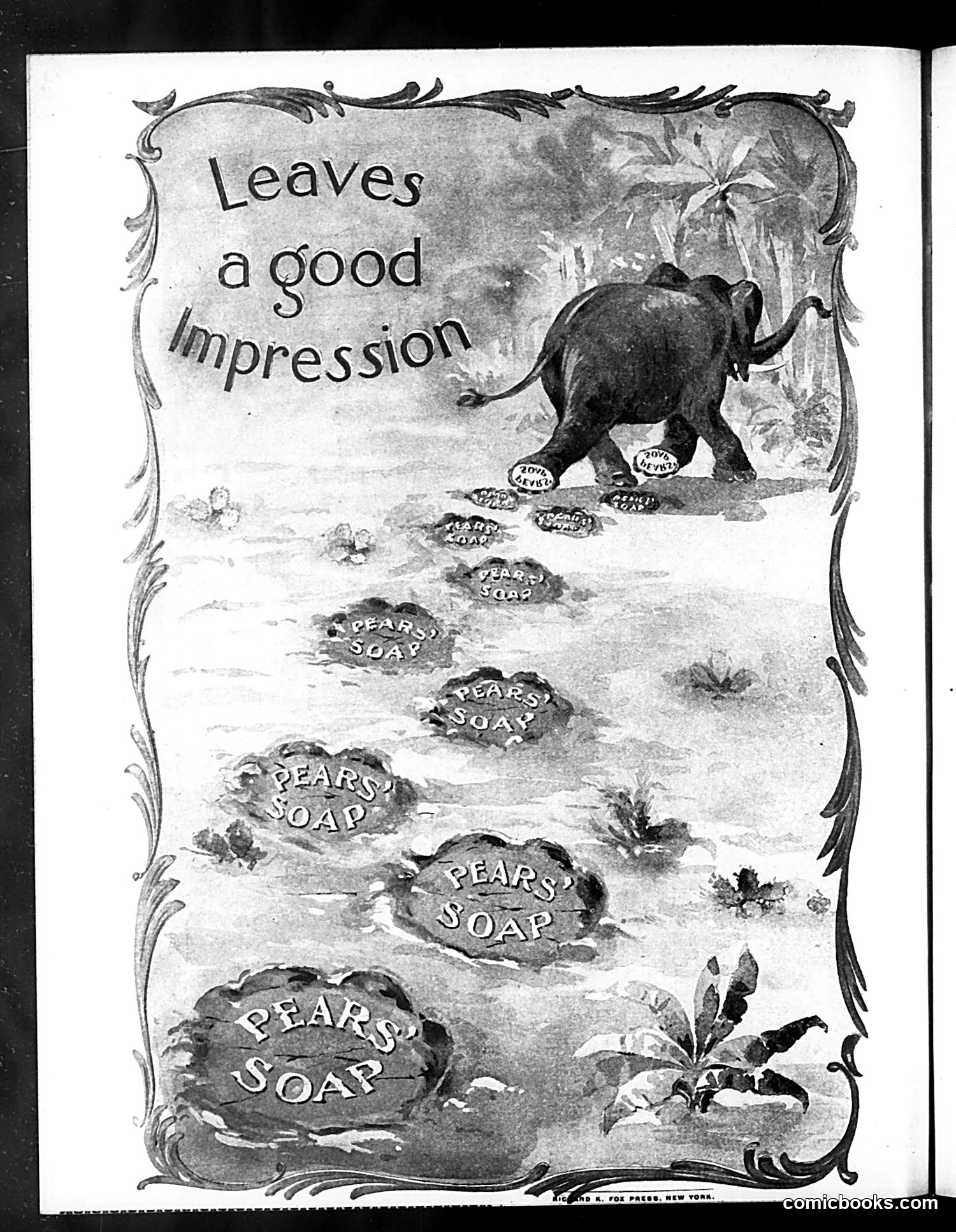
This is a **Pears' Soap advertisement**, not political satire. The page features an elephant walking through a landscape, leaving a trail of Pears' Soap bars behind it like footprints. The text reads "leaves a good impression." The humor is a visual pun: the elephant literally leaves "impressions" (footprints) in the ground, while the soap bars suggest it leaves a good "impression" (positive effect/reputation). This plays on the era's common advertising trope of linking product use to respectability and good character. The decorative border frames the scene in typical late-19th/early-20th-century magazine style. There's no political content—this is straightforward commercial advertising using wordplay and an exotic animal to catch reader attention.