
Life, 1897-12-04 · page 4 of 34
Life — December 4, 1897 — page 4: what you’re looking at
What you’re looking at
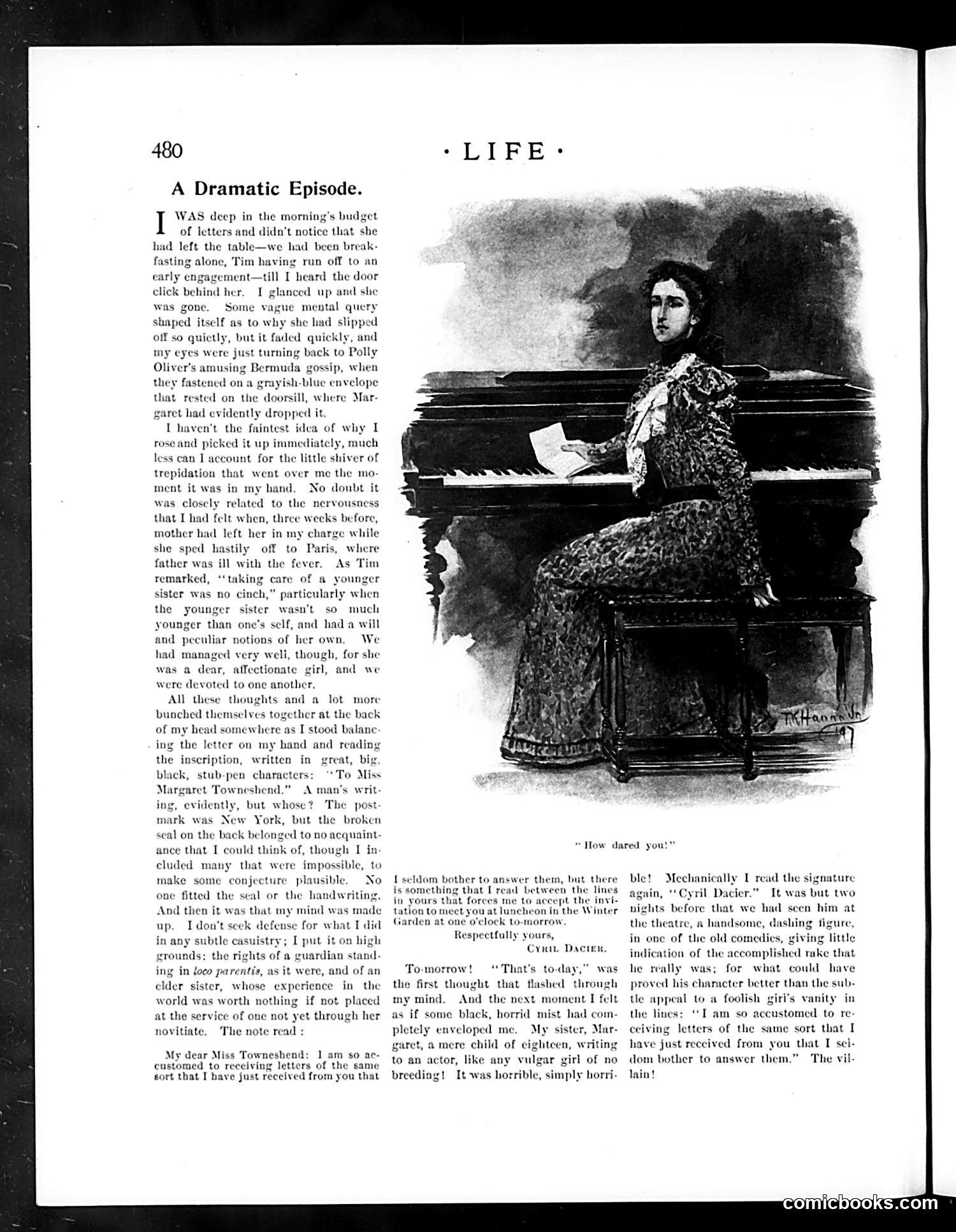
This page contains "A Dramatic Episode," a short story rather than political satire. The illustration shows a woman at a piano reading a letter, with the caption "How dared you!" The narrative concerns a domestic situation: the narrator discovers their mother has left for Paris while their father is ill with fever. The protagonist receives a letter addressed to "Miss Margaret Townshend" from someone named "Cyril Dacier"—apparently an actor the narrator's younger sister Margaret has been corresponding with. The story's drama hinges on this correspondence: Margaret, an eighteen-year-old aspiring actress, has been exchanging letters with Dacier, whom the narrator sees performing in comedies. The narrator expresses moral disapproval of such an unsuitable correspondence between an unmarried girl and an actor of questionable character. This reflects Victorian-era social anxieties about young women's independence and improper associations with theatrical figures.
📄 Transcribed text from this page (OCR, searchable)
Machine-transcribed from the original scan — historical spelling and the odd misread are preserved.
480 A Dramatic Episode. WAS deep in the mornin of letters and didn't notice that she had left the table—we had been break- fasting alone, Tim having run off to an early engagement—till I heard the door click behind her. I glanced up and she was gone. Some vague mental query shaped itself as to why she had slipped off so quietly, but it faded quickly, and my cyes were just turning back to Polly Oliver’s amusing Bermuda gossip, when they fastened on a grayish-blue envelope that rested on the doorsill, where Mar- garct had evidently dropped it I haven't the faintest idea of why I rose and picked it up immediately, much less can I account for the little shiver of trepidation that went over me the mo- ment it was in my hand. No doubt it was closely related to the nervousness that I had felt when, three wecks before, mother had left her in my charge while she sped hastily off to Paris, where father was ill with the fever. As Tim remarked, ‘‘taking care of a younger sister was no cinch,” particularly when the younger sister wasn't so much younger than one’s self, and had a will and peculiar notions of her own. We had managed very well, though, for she was a dear, affectionate girl, and we were devoted to one another, All these thoughts and a lot more bunched themselves together at the back of my I stood balane ing the letter on my hand and reading the inscription, written in great, big. black, stub-pen characters: “To Miss Margaret Towneshend.” A man’s writ- lently, but whose? The post- mark was New York, but the broken seal on the back belonged to no acquaint. ance that I could think of, though I in cluded many that were impossible, to make some conjecture plausible. No one fitted the seal or the handwriting. And then it was that my mind was made up. Idon't seek defense for what I did in any tle casuistry; I put it on high grounds: the rights of a guardian stand- ing in loco parentis clder sister, whose experience in the world was worth nothing if not placed at the service of one not yet through her novitiate. The note read : s budget ad somewhere a , as it were, and of an My dear Miss Towneshend: 1 am so ac- customed to receiving letters of the same sort that I have just received from you that How dared you!” I seldom bother to answer them, but there is something that I read between the lines in yours that forces me to accept the in tation to meet you at luncheon in the Winter Garden at one o'clock to-morrow Respectfully yours, Cyn Dacien, To-morrow! “That's to-day," was the first thought that flashed through my mind. And the next moment I felt as if some black, horrid mist had com- pletely enveloped me. My sister, Mar- garet, a mere child of cightcen, writing to an actor, like any vulgar girl of no breeding! It was horrible, simply horri- bh Mechanically I read the si again, ‘*Cyril Dacier.” It was but two. nights before that we had seen him at the theatre, a handsome, dashing fi in one of the old comedies, indication of the accomplished rake that he really was; for what could have proved his character better than the sub- tle appeal to a foolish giri’s vanity in the lines: “I am so accustomed to re- ceiving letters of the same sort that I have just received from you that I scl- dom bother to answer them.” The vil- lain!