
A complete issue · 20 pages · 1897
Life — November 11, 1897
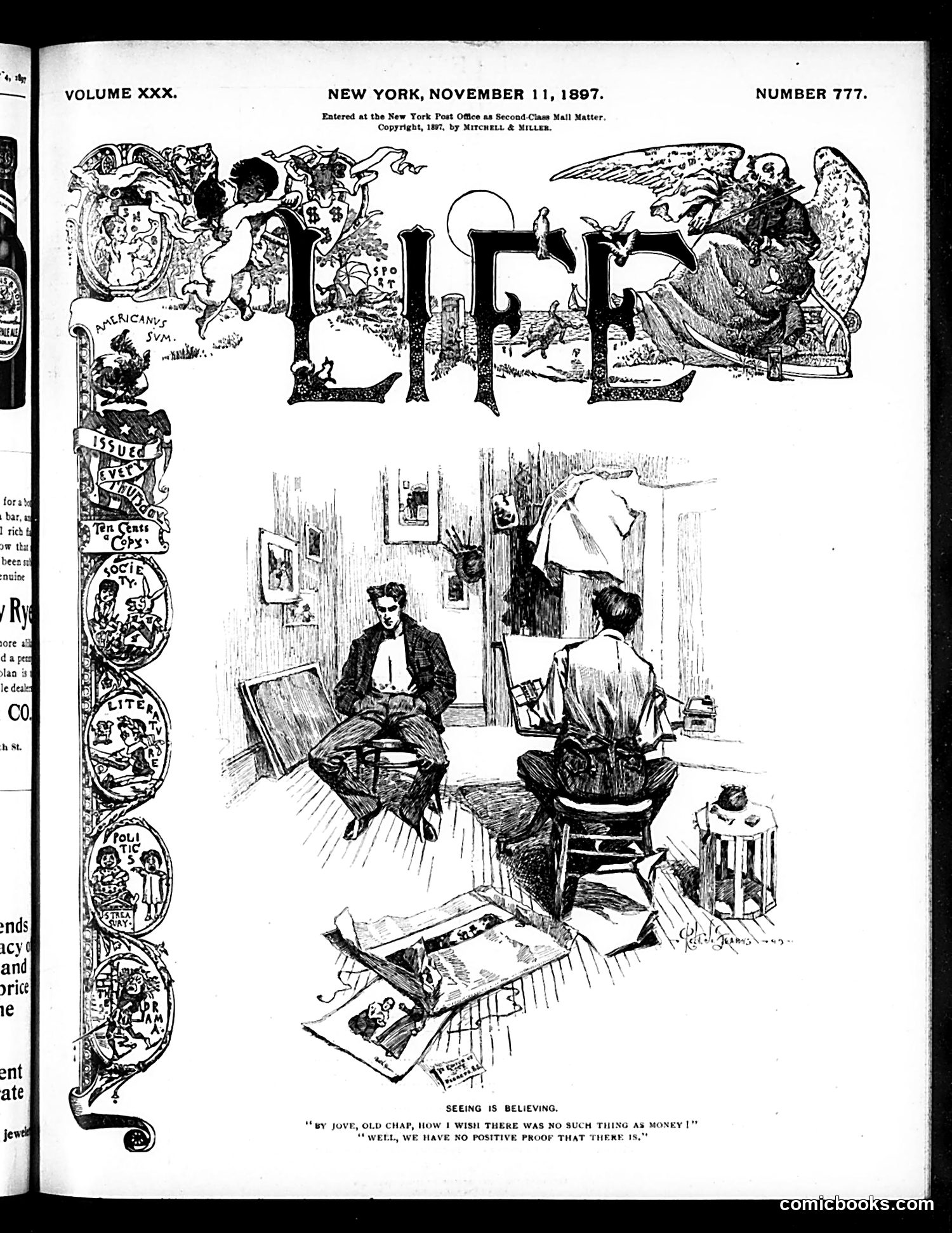
This page features a single cartoon titled "Seeing is Believing." Two men sit in an artist's studio examining what appear to be paintings or artworks on the floor. The caption reads: "By Jove, old chap, how I wish there was no such thing as money!" with the response, "Well, we have no positive proof that there is." The satire appears to target artists or bohemians who claim indifference to wealth while surrounded by creative work. The joke suggests that despite their professed idealism about art transcending materialism, they have no actual evidence that money doesn't exist—implying both their financial struggles and the contradiction between artistic pretensions and economic reality. The decorative border contains various emblems typical of Life magazine's design.
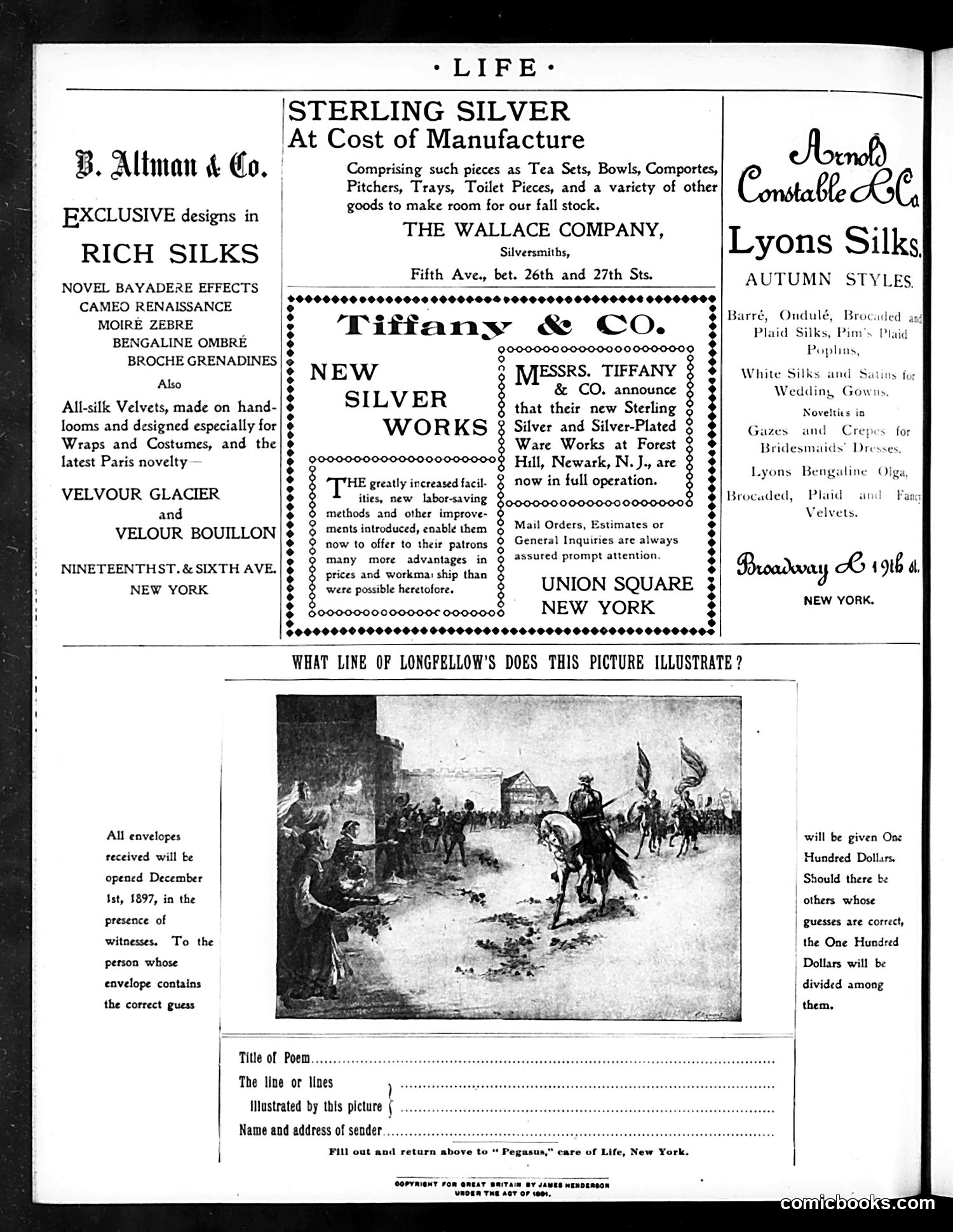
This page is primarily **advertising content** rather than political satire. The top section features luxury goods advertisements (Tiffany & Co. silver works, B. Altman silks, Arnold Constable fabrics). The lower half contains a **contest or puzzle** rather than satirical commentary. Readers are shown a historical engraving depicting what appears to be a colonial or Revolutionary War-era military scene with horsemen and soldiers. They're challenged to identify which line(s) from a Longfellow poem this image illustrates, with a $100 prize offered to the correct answer. This represents **early 1890s magazine content**: a mix of upscale advertising and reader-engagement contests typical of Life's format during this period.
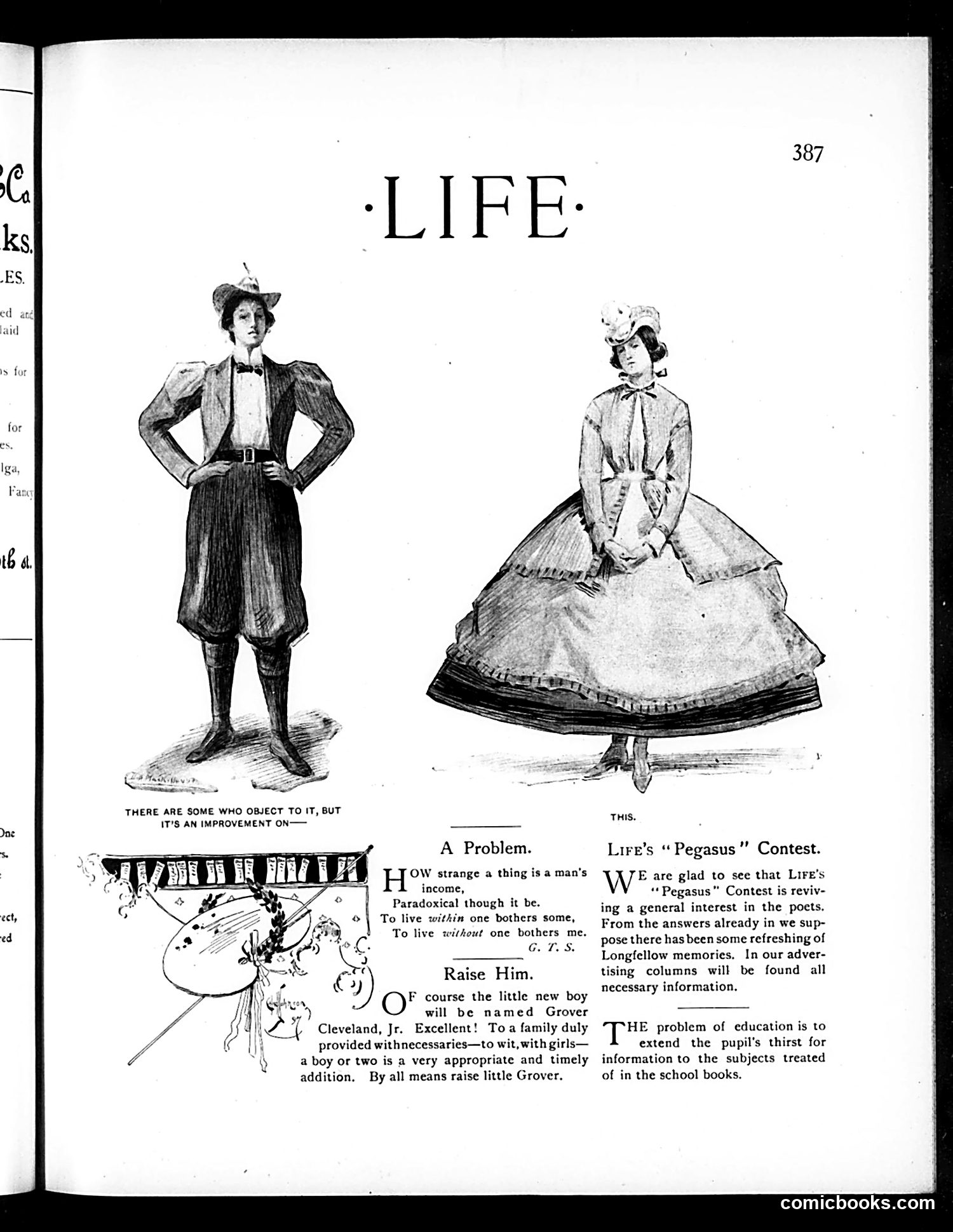
This page satirizes late-19th/early-20th century women's fashion and social roles through two contrasting illustrations. The left figure, labeled "THERE ARE SOME WHO OBJECT TO IT, BUT IT'S AN IMPROVEMENT ON—", depicts a woman in practical athletic wear with bloomers and a jacket—the "New Woman" style gaining acceptance. This represents progressive fashion reform. The right figure shows a woman in an extremely voluminous skirt, labeled "THIS," representing traditional restrictive fashion that the satire mocks. The text "A Problem" and "Raise Him" discusses whether a man's income should support a family, and announces a "Pegasus Contest" regarding education. The joke critiques the tension between emerging women's liberation (practical clothing) and traditional femininity, while questioning men's financial obligations—reflecting contemporary debates about women's evolving social roles.
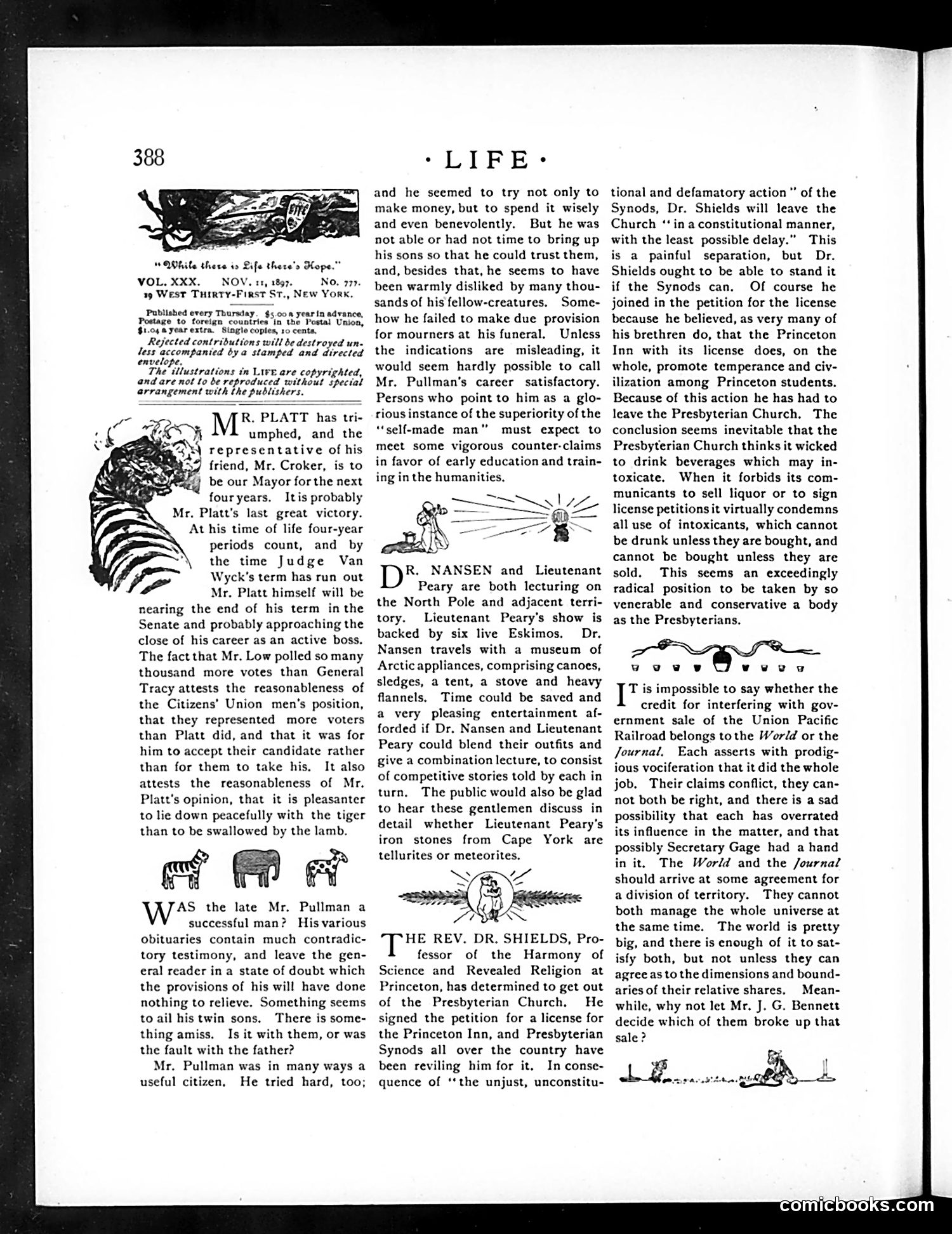
This page contains editorial commentary on prominent men of the era, with illustrations accompanying discussions of their careers and controversies. **Mr. Platt** (likely Thomas C. Platt, New York Republican politician) is discussed regarding his political influence and upcoming Senate race—described as his "last great victory" at age 74. **Dr. Nansen and Lieutenant Peary** are noted for their competing Arctic expeditions and lectures, with the text humorously noting the difficulty of determining who deserves credit for their accomplishments and suggesting magazine editor J.G. Bennett might decide which explorer's presentation is superior. **Rev. Dr. Shields** is criticized for his opposition to a Presbyterian Church license for an inn, with the satire questioning the Church's strict moral positions on alcohol sales. The commentary reflects late-1890s debates over temperance, political power, and exploration claims.
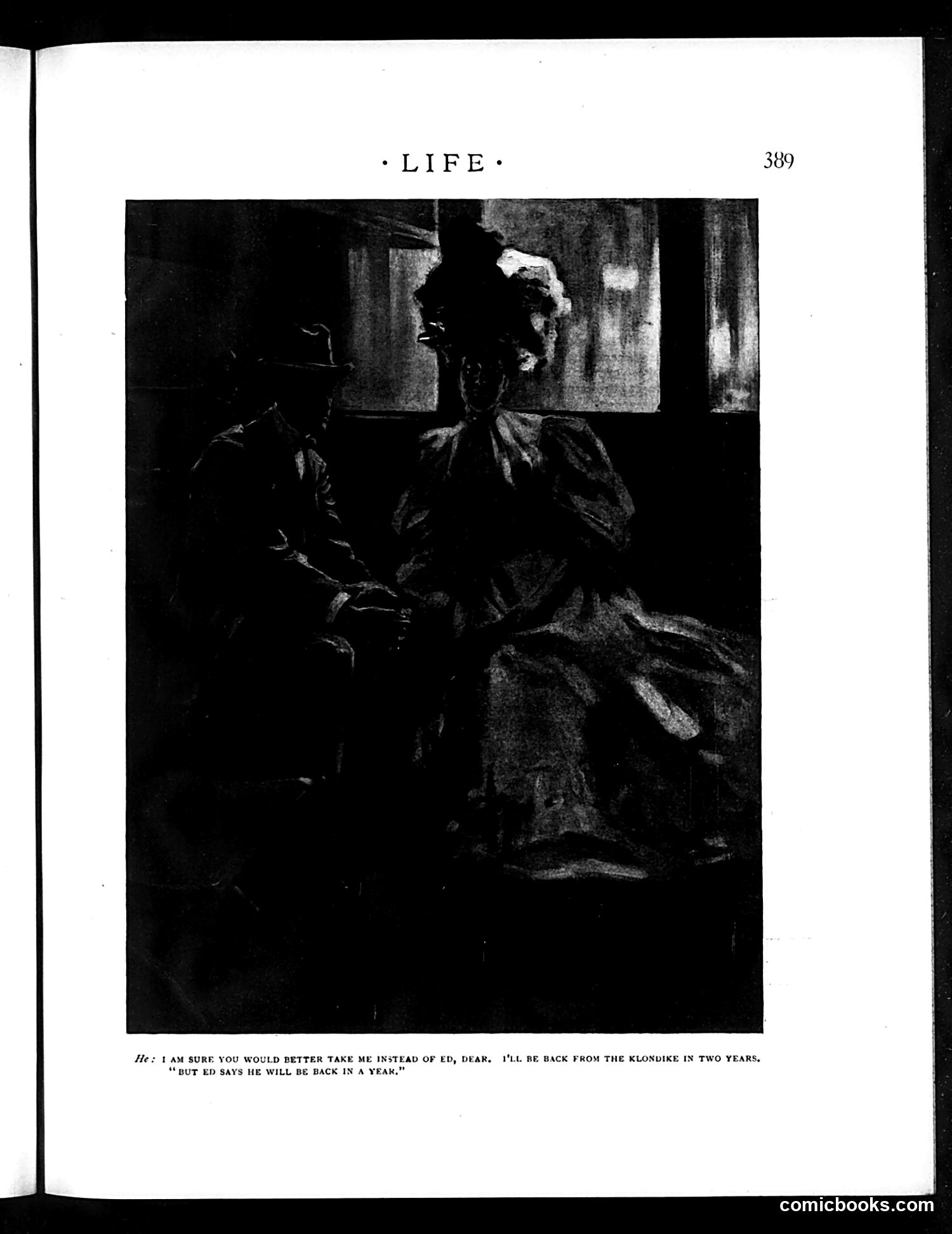
This page from *Life* magazine shows two figures in silhouette having a conversation. The dialogue caption indicates a discussion about someone going to the Klondike—a reference to the Klondike Gold Rush in Canada's Yukon Territory (1896-1899). One figure expresses concern that the other should "take me instead of Ed, dear," suggesting Ed is departing for the gold fields. The disagreement about timeline ("I'll be back in two years" versus "Ed says he will be back in a year") satirizes the common experience of men leaving their families with uncertain return dates during the gold rush boom. The satire targets the economic disruption and family separation caused by gold rush fever—a major social phenomenon of the 1890s that lured men away with promises of quick wealth.
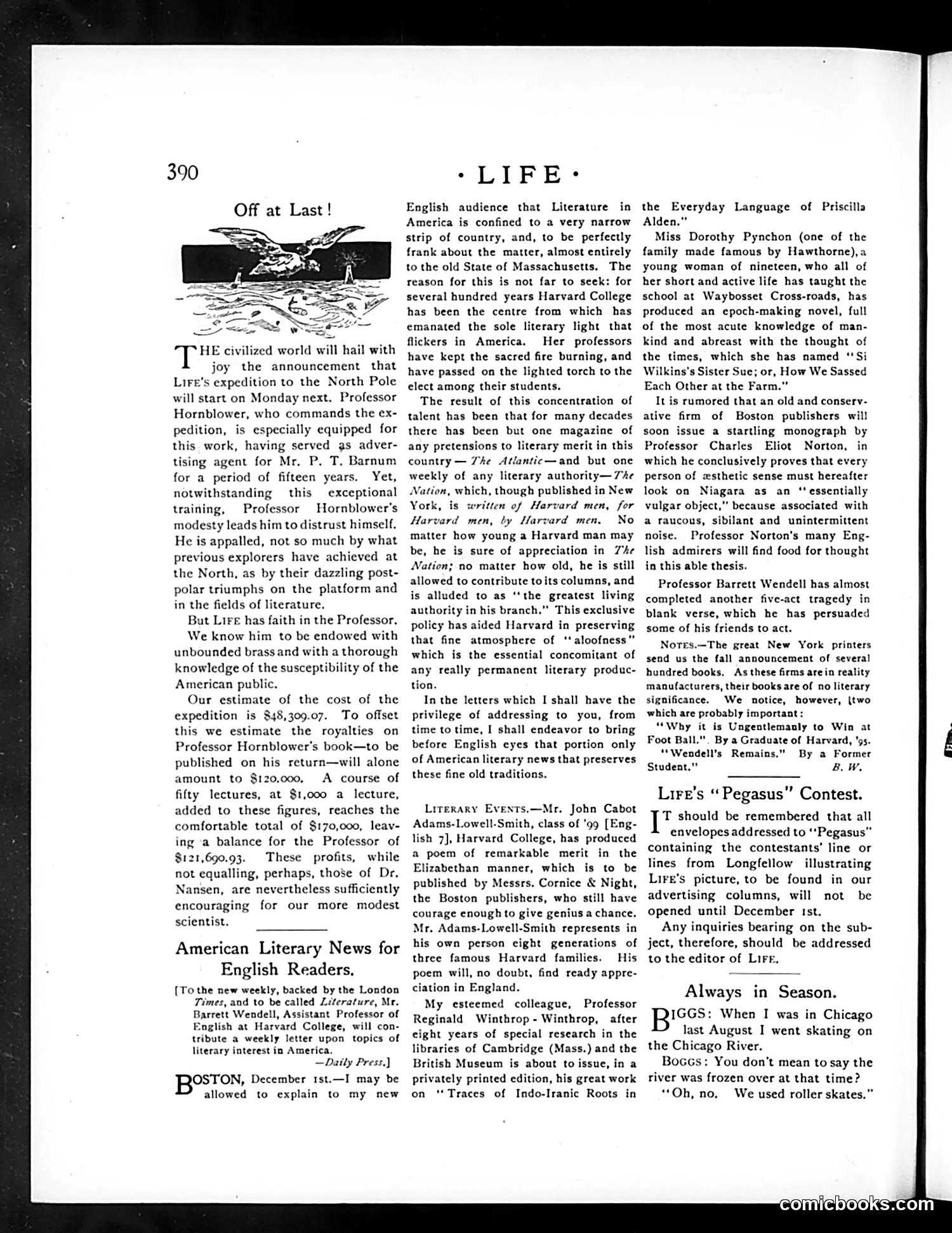
The cartoon depicts a bird carrying what appears to be a torch or flame, with the caption "Off at Last!" This illustrates the article's opening statement about Professor Hornblower's Arctic expedition beginning Monday. The satire operates on two levels: First, it celebrates the expedition's departure as a relief to the American public—the tortured phrasing "the civilized world will hail with joy" suggests sardonic undertones about Hornblower's unpopularity or long-windedness. Second, the torch-carrying bird may reference the passing of intellectual authority (mentioned in the article about Harvard's literary influence), suggesting Hornblower finally carries away some burden from civilization. The humor targets both the expedition itself and American intellectual pretensions of the era.
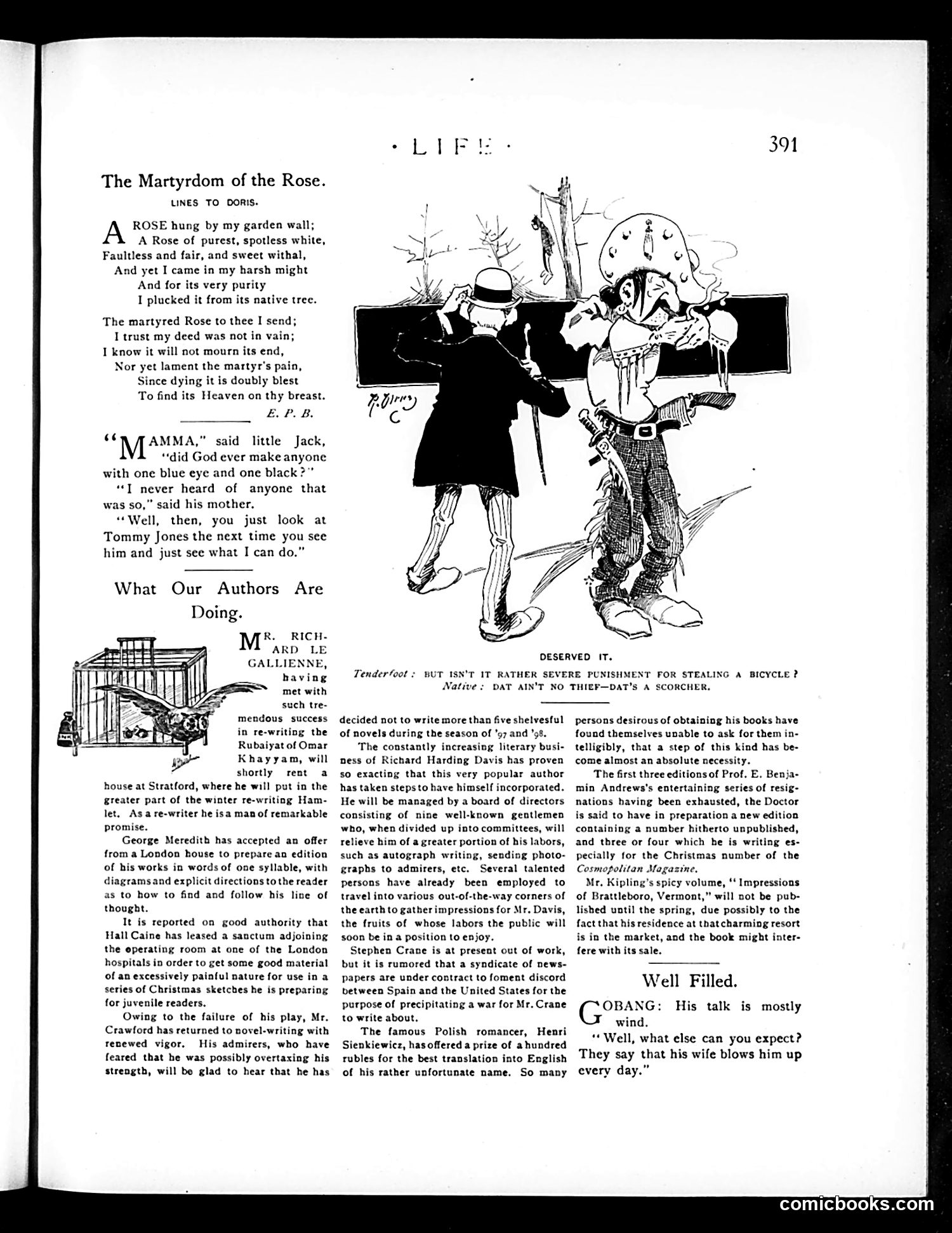
The main cartoon, titled "Deserved It," depicts two figures—one in formal dress (appearing to be an authority figure) and another in casual/disreputable clothing—in a confrontation scene with a bicycle. The caption reads: "**Tenderfoot**: BUT ISN'T IT RATHER SEVERE PUNISHMENT FOR STEALING A BICYCLE? **Native**: DAT AIN'T NO THIEF—DAT'S A MOOCHER." This appears to satirize frontier justice and social attitudes toward crime. The joke plays on class distinctions: a "moocher" (vagrant/freeloader) apparently deserves harsher treatment than a bicycle thief—suggesting both the era's prejudice against vagrants and ironic commentary on what society deemed worthy of punishment. The accompanying text discusses various authors' current projects, separate from the cartoon's satirical commentary.
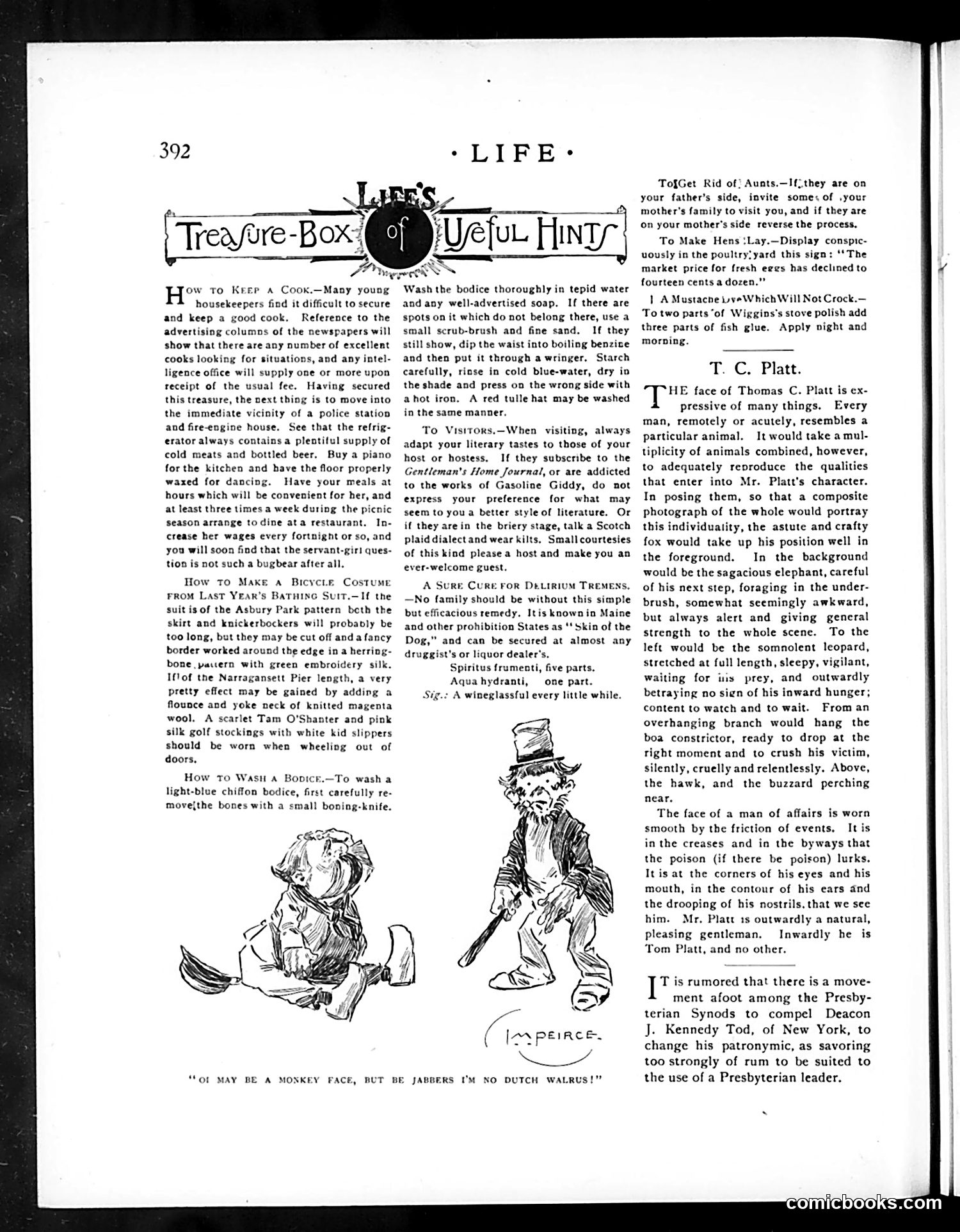
This page contains practical household hints under the "Treasure-Box of Useful Hints" header, alongside a character sketch of "T.C. Platt." The main cartoon depicts two figures labeled "Of May Be a Monkey Face, But Be Jabbers I'm No Dutch Walrus!" The illustration shows caricatured men in 19th-century dress. The text suggests satirical commentary on Thomas C. Platt, a political figure, describing him as resembling "a particular animal" while possessing cunning predatory qualities—comparing him metaphorically to foxes, leopards, and hawks. The piece appears to be political satire targeting Platt's character and behavior, though the specific political context and controversy referenced remain unclear without additional historical documentation about Platt's contemporaneous activities.
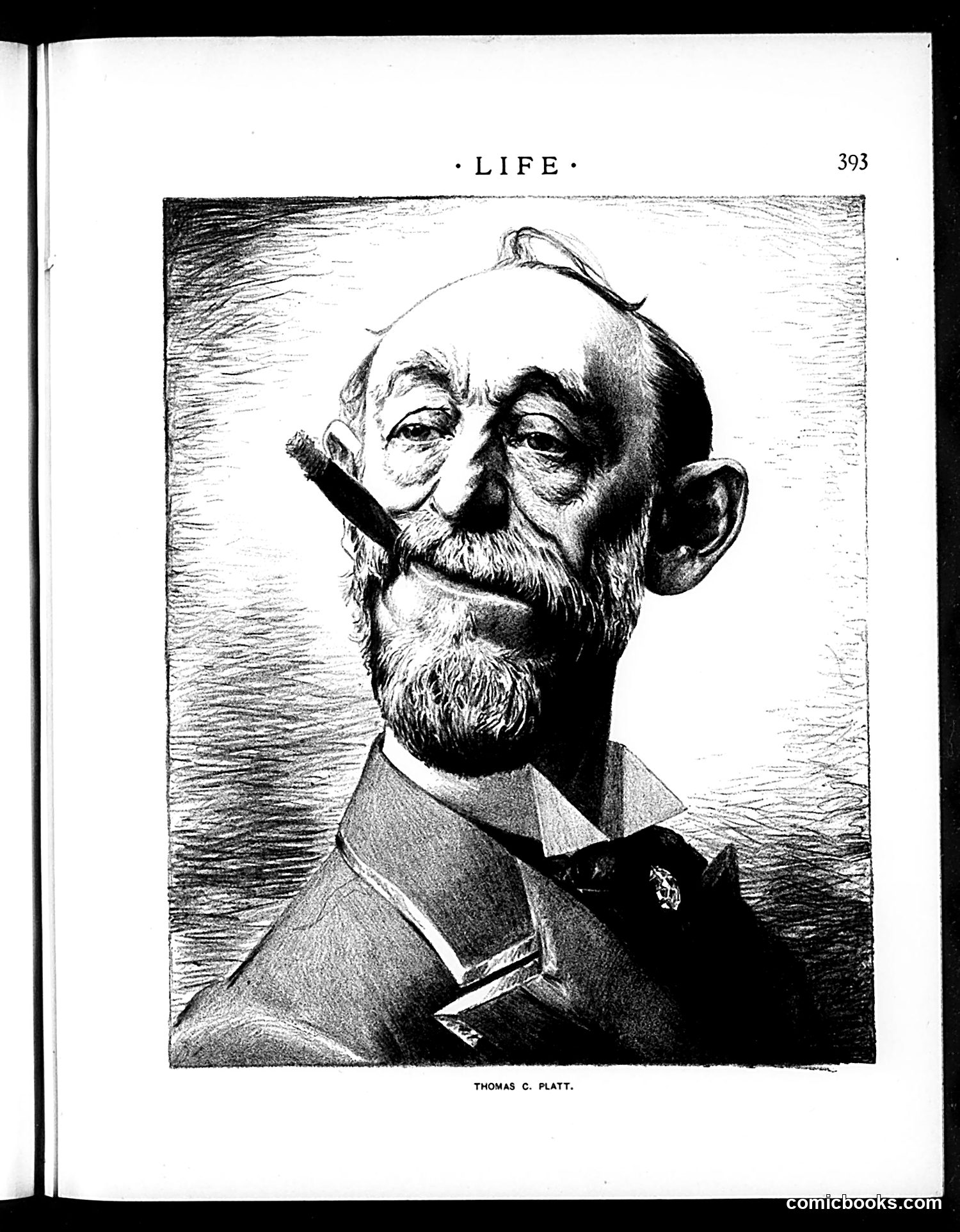
This page from *Life* magazine (page 393) features a portrait labeled "THOMAS C. PLATT." The image is a detailed engraving or etching showing an elderly bearded man in formal attire with a bow tie and what appears to be a decorative pin or badge. Without additional context visible on this page, I cannot determine the specific satirical point or cartoon being made. The portrait appears to be a straightforward illustration rather than an obvious caricature, though the rendering style is characteristic of *Life*'s visual commentary. To explain the satire's meaning, I would need to know more about Platt's contemporary prominence and any accompanying article text or caption that would clarify the magazine's intended critique or commentary on this figure.
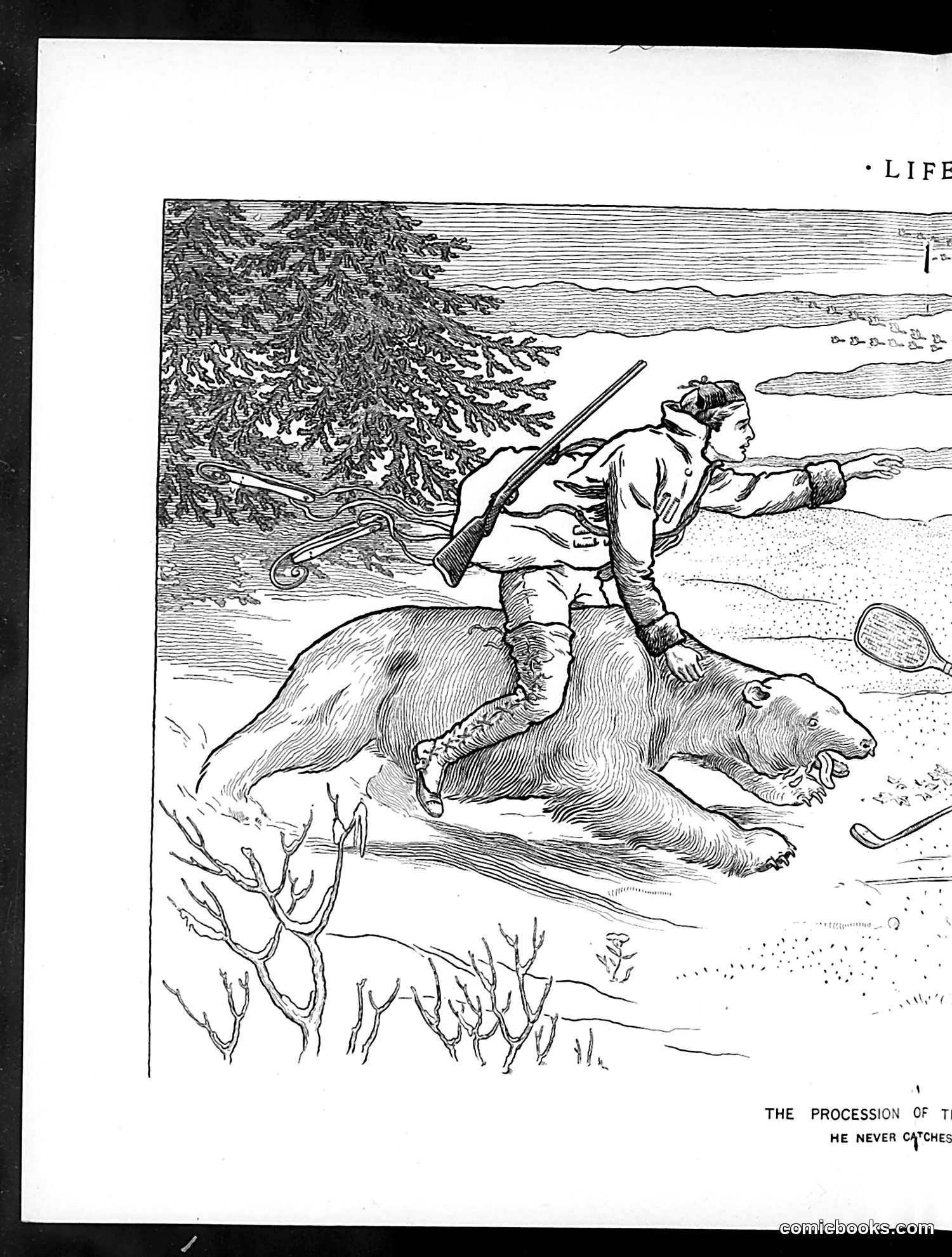
This engraving depicts a hunter riding an enormous bear across a snowy landscape, rifle in hand. The caption reads "THE PROCESSION OF THE...HE NEVER CATCHES," with the text partially cut off. The cartoon appears to satirize a futile pursuit or endless chase—the hunter perpetually chases something (the complete reference is unclear from the visible text) but never successfully "catches" it. The absurdist humor comes from the unstable image of riding a wild bear while hunting, suggesting the ridiculousness of the endeavor itself. Without the full caption, the specific political or social target remains unclear, though the visual joke emphasizes the futility and absurdity of the pursuit depicted.
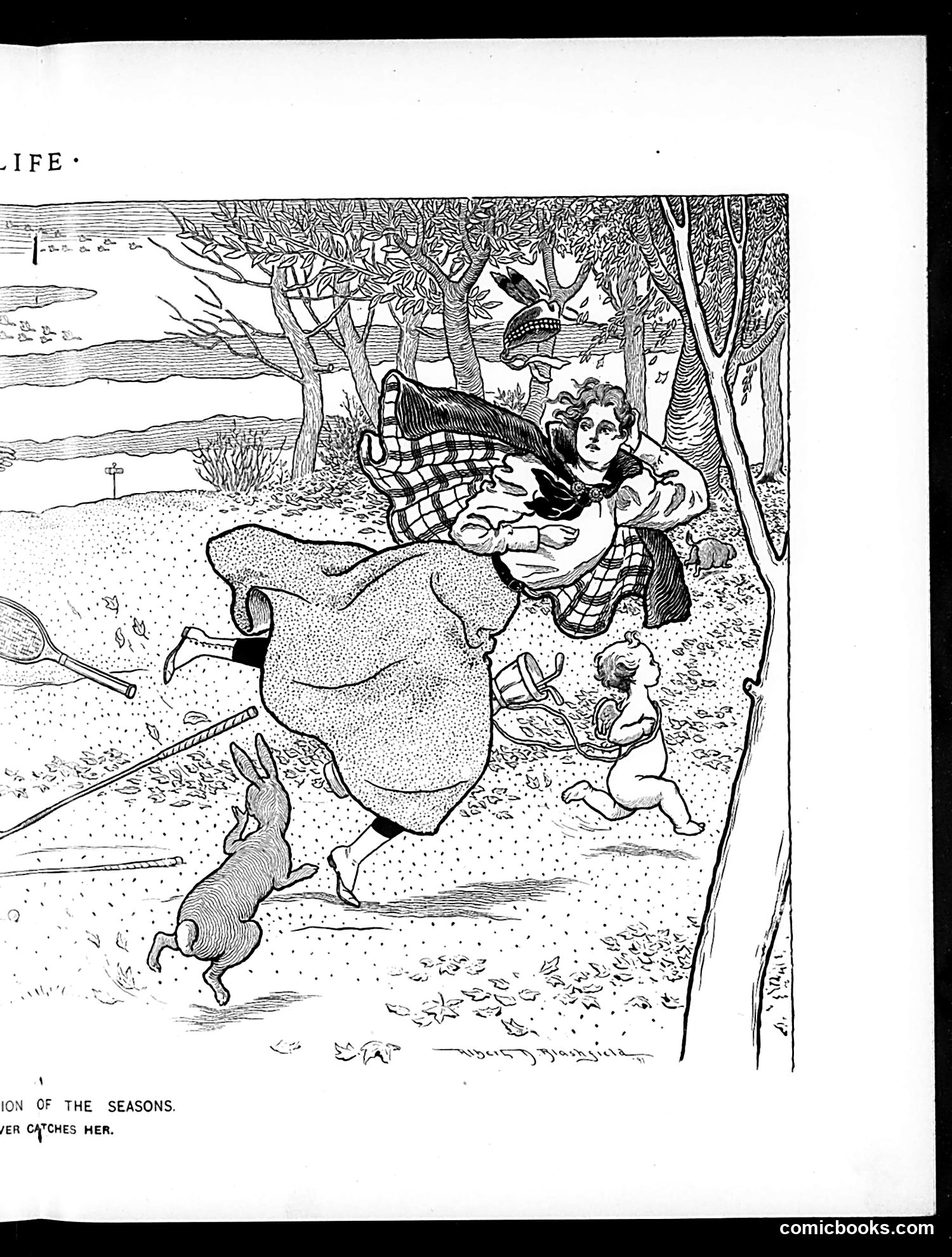
This illustration appears to be satirical social commentary about gender roles and domestic life. The image shows a rotund woman in a checkered dress running or moving energetically through a wooded outdoor setting, pursued by small animals (rabbits or similar creatures) and accompanied by a cherubic child figure. The partially visible text mentions "ION OF THE SEASONS" and "VER CATCHES HER," suggesting a narrative about pursuit or capture. The satire likely mocks either Victorian notions of femininity, maternal behavior, or domestic expectations—depicting an ungainly, robust woman in an undignified, active pose rather than the refined, stationary ideal. The accompanying animals and child may emphasize themes of fertility, domesticity, or natural instincts versus social pretension. Without complete caption text or publication date, the specific target remains unclear.
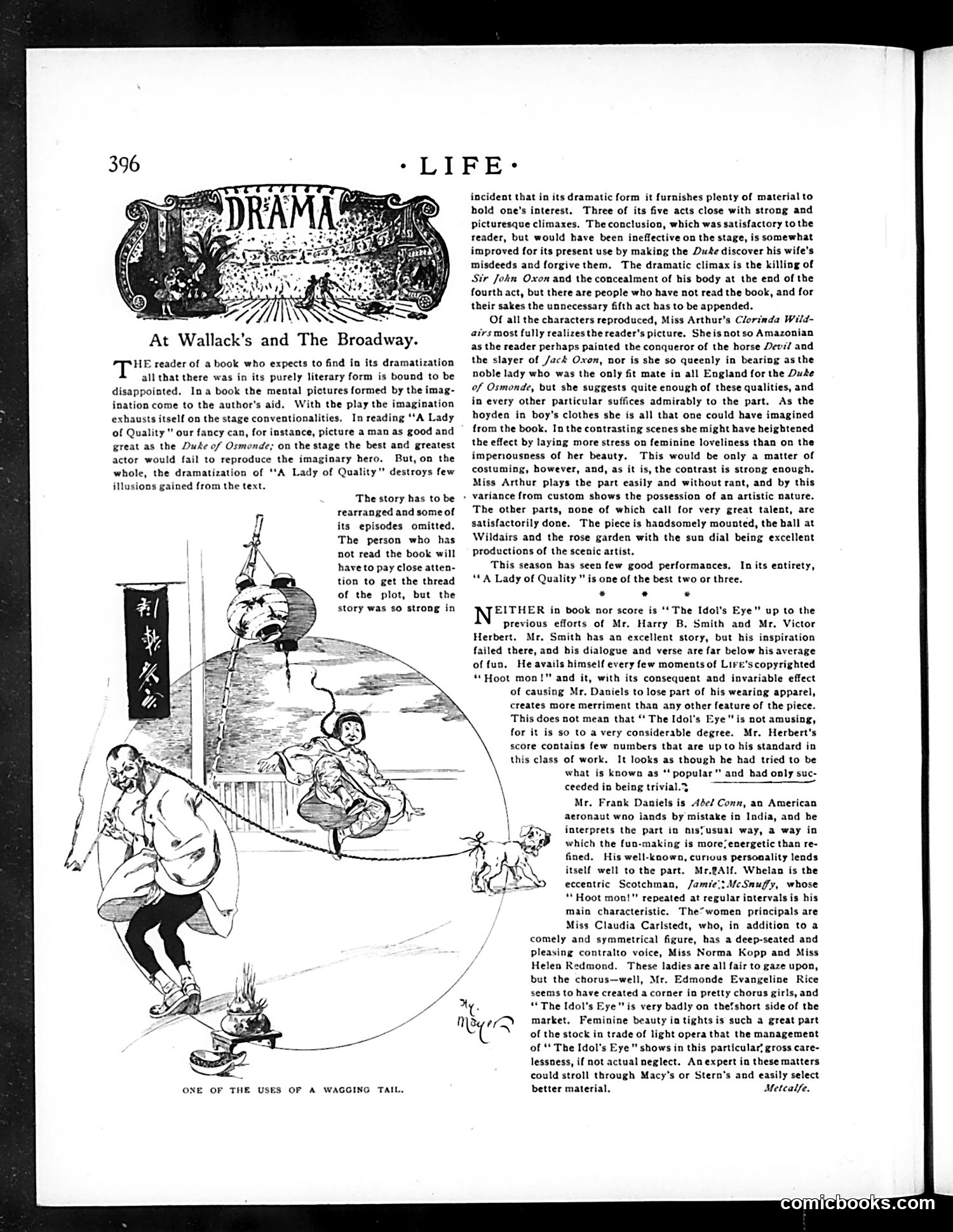
This page reviews theatrical productions at Wallack's and The Broadway theaters. The cartoon illustrates a scene from what appears to be a farce, showing figures engaged in comedic chaos—a man being swung by a rope or tail, with other characters tumbling about in exaggerated physical comedy. The reviews discuss "A Lady of Quality" (adapted from a novel) and "The Idol's Eye," criticizing both plays as somewhat trivial entertainment. The text notes that while the performances are competent, the material itself is lightweight, relying on physical humor, comic voices, and scenery rather than substantial drama. The "wagging tail" caption suggests the plays use obvious, broad comedic devices to entertain audiences.
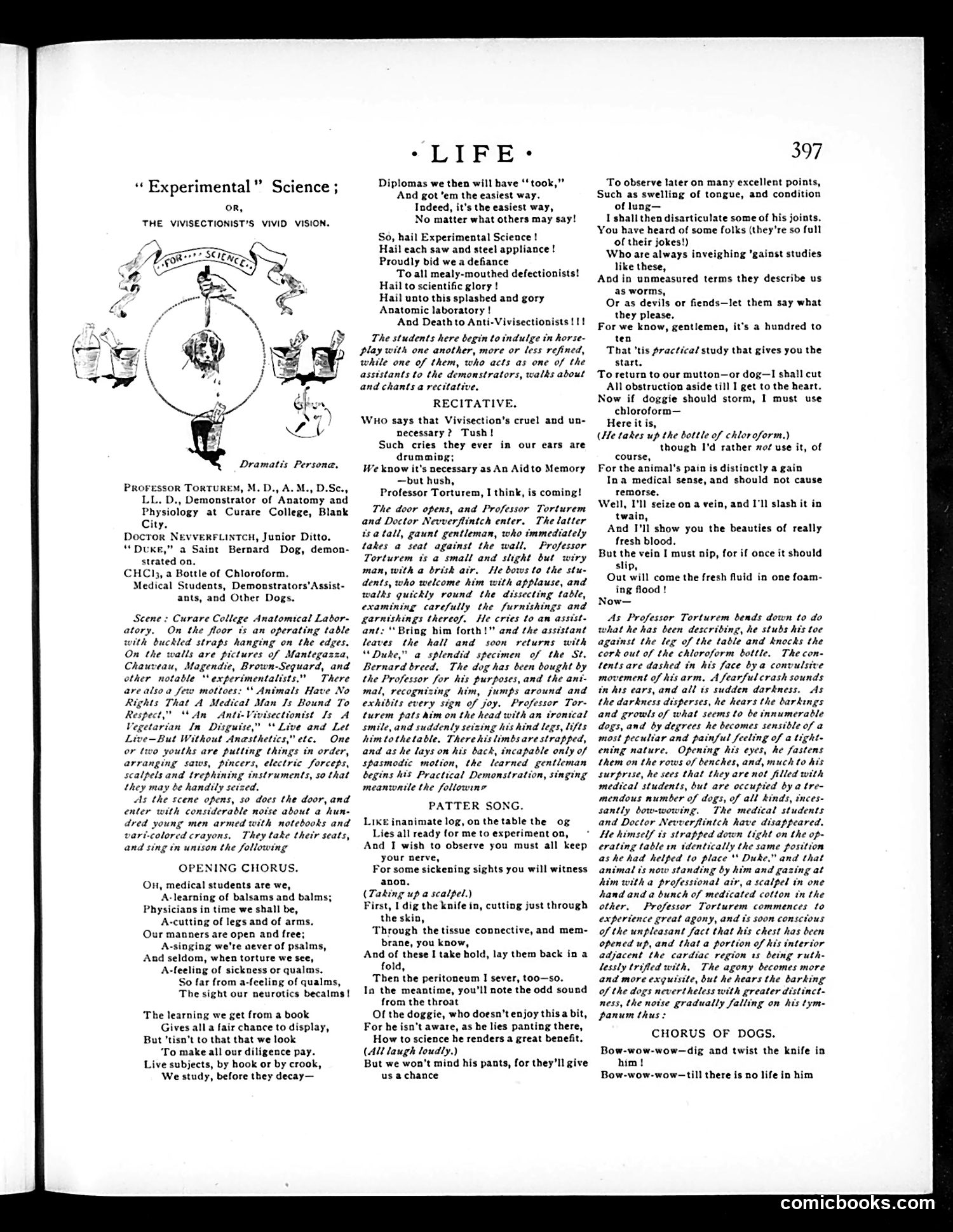
This is a satirical theatrical piece attacking **vivisection** (live animal experimentation on dogs), a hotly contested practice in 19th-century medical education. The satire targets medical professors and students who defended animal testing. The opening chorus mocks their callousness—they sing about obtaining diplomas "the easiest way" through live animal study rather than ethical learning. Characters are caricatured with names like "Professor Torturem" (torture) and "Doctor Nevverflintch," whose Latin-derived names mock pompous science. The scene depicts a medical lecture where a Saint Bernard dog named "Duke" is brought for live dissection, recognizing his tormentor with joy before being strapped down. Anti-vivisection mottos on the lab walls are satirized as contradicting themselves. **The point:** Medical educators used pragmatism ("necessary as an aid to memory") to justify cruelty. Life magazine ridicules this rationalization, presenting the doctors and students as callously indifferent to animal suffering—a position the magazine's satire implicitly opposes.
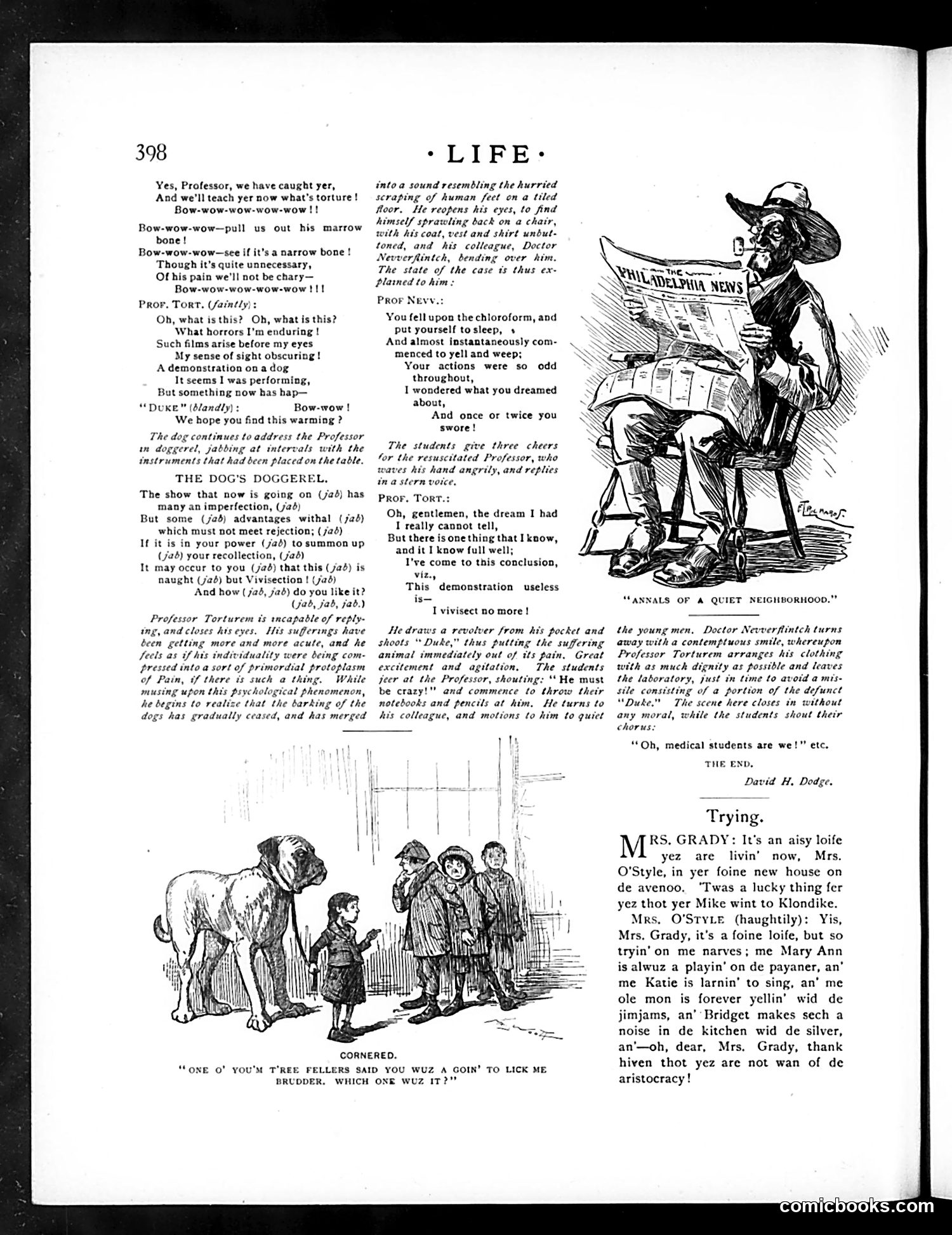
This cartoon satirizes **vivisection** (live animal experimentation), a heated Victorian controversy. Professor Torturem conducts a dog dissection demonstration on students; the dog then comically reverses roles, torturing the professor while reciting mock-heroic doggerel verse. The satire's point: the professor experiences what the dog felt, leading him to renounce vivisection entirely—he even shoots the suffering animal to end its pain. The students jeer at this moral awakening, representing the callousness of medical education. The accompanying diagram cartoon ("Cornered") shows a dog confronting street children, using similar animal-perspective humor. This reflects genuine 1890s-era animal welfare debates, when vivisection faced serious ethical opposition. The satire mocks both the cruelty of experimentation and medical students' indifference to animal suffering.
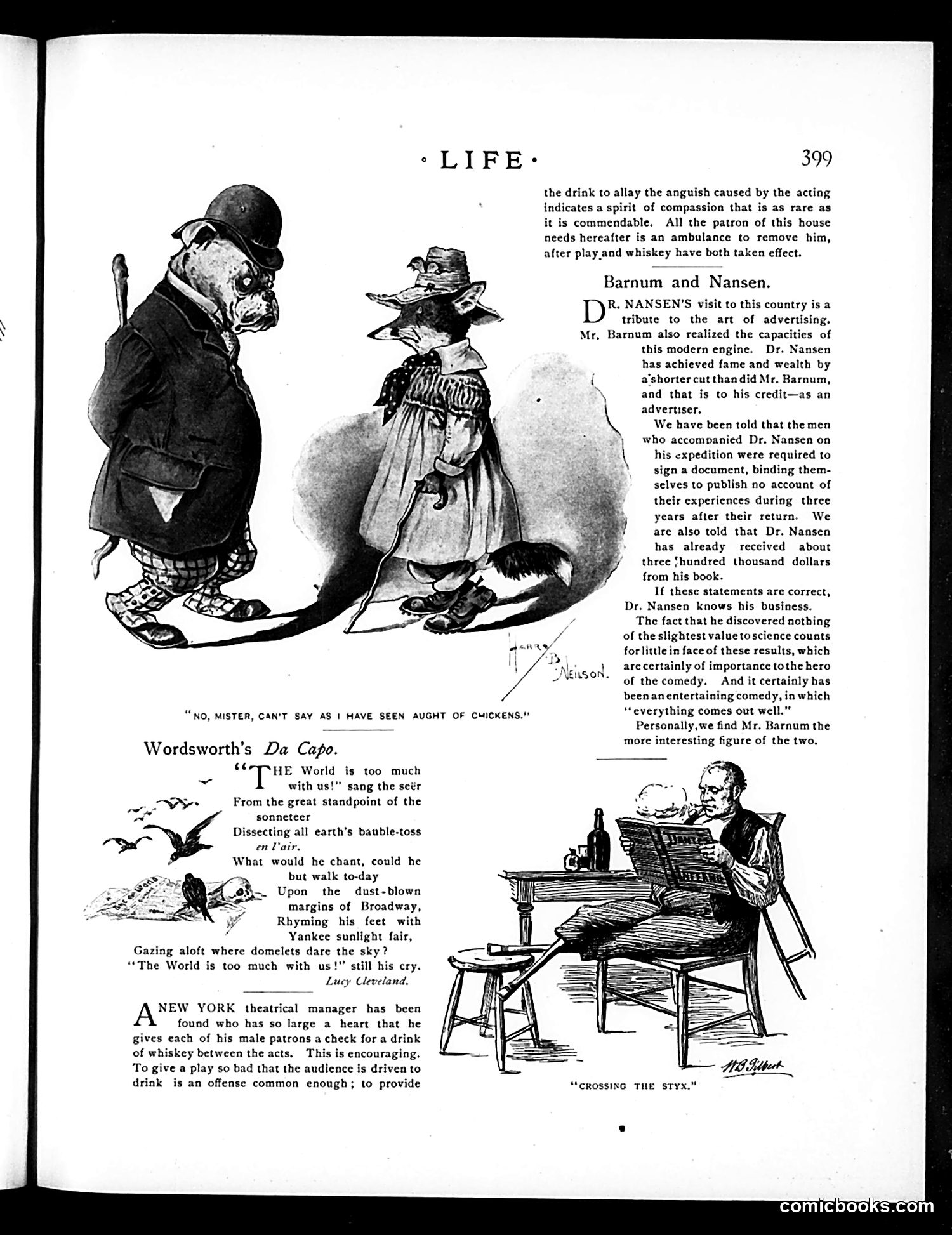
This page contains three distinct satirical pieces: **Top cartoon**: A caricatured figure (appears to be Irish, based on exaggerated features) denies seeing chickens—likely satirizing a theft or disappearance, though context is unclear. **Middle section**: A poem riffing on Wordsworth's famous line "The world is too much with us," but applied to modern Broadway's commercialism and bustle—contrasting Romantic idealism with urban chaos. **Main article**: Satirizes a New York theater manager who gives whiskey to male patrons between acts to cope with bad performances. The joke: the manager isn't being generous, but rather acknowledging his play is so terrible it drives audiences to drink. The final line suggests patrons will need ambulances afterward. **Bottom article**: Compares P.T. Barnum and polar explorer Dr. Nansen as advertisers. It mocks Nansen's Arctic expedition as having "discovered nothing of value to science" while profiting handsomely from publicity and book sales. The piece suggests Nansen is essentially a self-promoter like Barnum, though more efficient.
This page contains two distinct pieces of satirical content: **"When Doctors Disagree"** (top left): A poem satirizing medical contradictions. The narrator visits three doctors who give completely opposite diagnoses and prescriptions—one forbids exercise and activity, another demands it, a third restricts diet to meat only. The satire mocks how conflicting medical advice leaves patients confused, yet the narrator survives anyway, questioning whether doctors actually know what they're doing. The humor relies on the absurdity of contradictory expert opinions. **Donzelot anecdote** (right column): A brief story about a journalist so dedicated to his work that when shot during a riot, he's more concerned about getting his story to the newspaper than his own serious injury. When a surgeon urges him to focus on surviving, Donzelot insists his duty is reporting the news. This satirizes journalistic obsession and the perceived priorities of reporters. Both pieces mock professional expertise and institutional priorities through exaggeration.
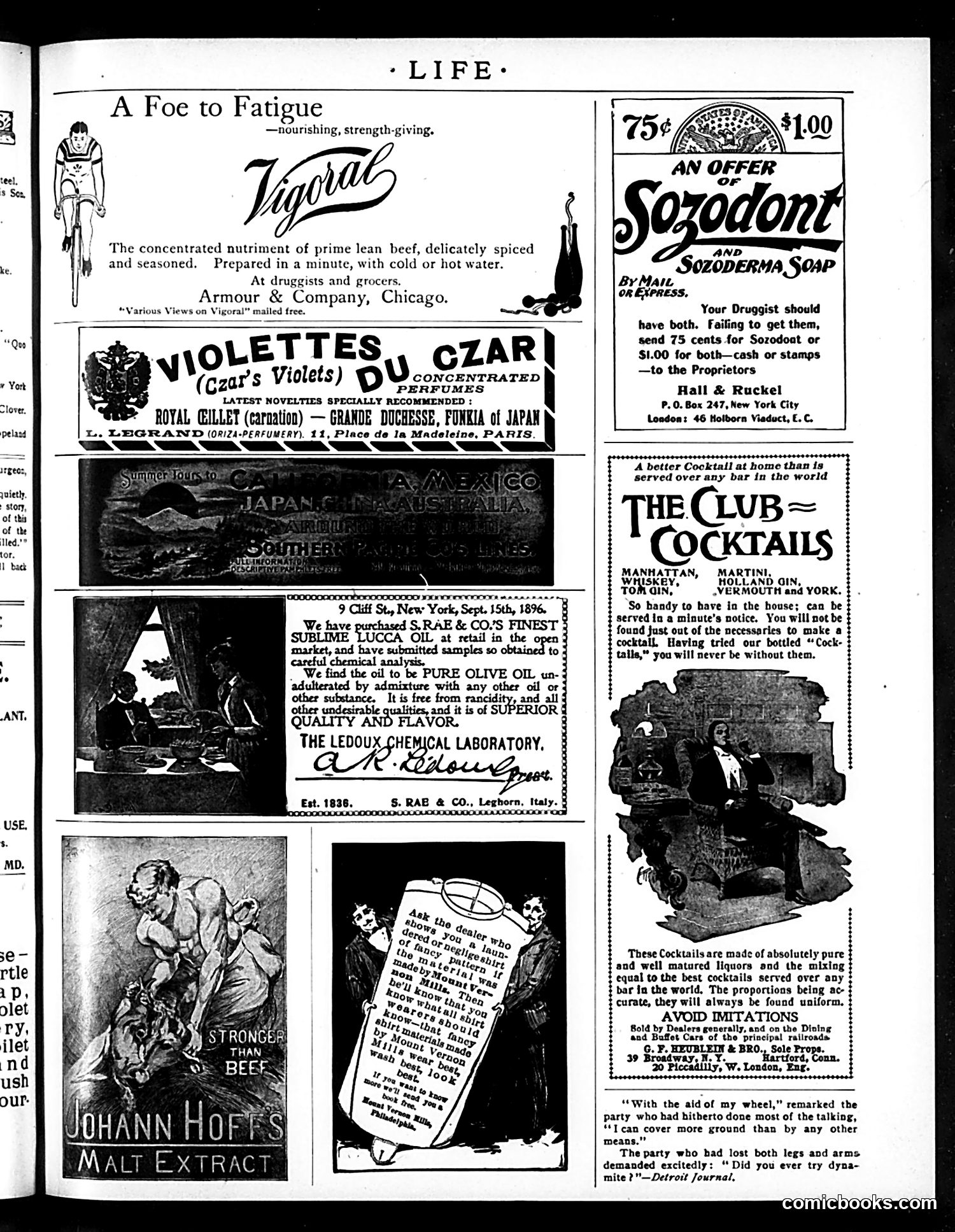
This page is primarily **advertisements** with one brief joke at the bottom. The ads promote various products: Vigoral beef extract (fatigue remedy), French perfumes, olive oil, malt extract, and cocktail mixers—typical of late-19th-century patent medicines and luxury goods. The sole cartoon/joke appears at the bottom: A man brags about covering ground with his bicycle ("wheel"), while someone who has lost both legs and arms sarcastically suggests dynamite would be more effective. **The satire:** This is dark humor mocking the bicycle craze of the 1890s. The legless, armless man represents the ultimate disability, making his deadpan retort absurdly brutal—he's sarcastically suggesting an explosive solution beats the cyclist's modest achievement. The joke relies on shocking contrast between mundane boasting and extreme physical limitation for comedic effect. This reflects period attitudes toward disability that modern readers would find offensive.
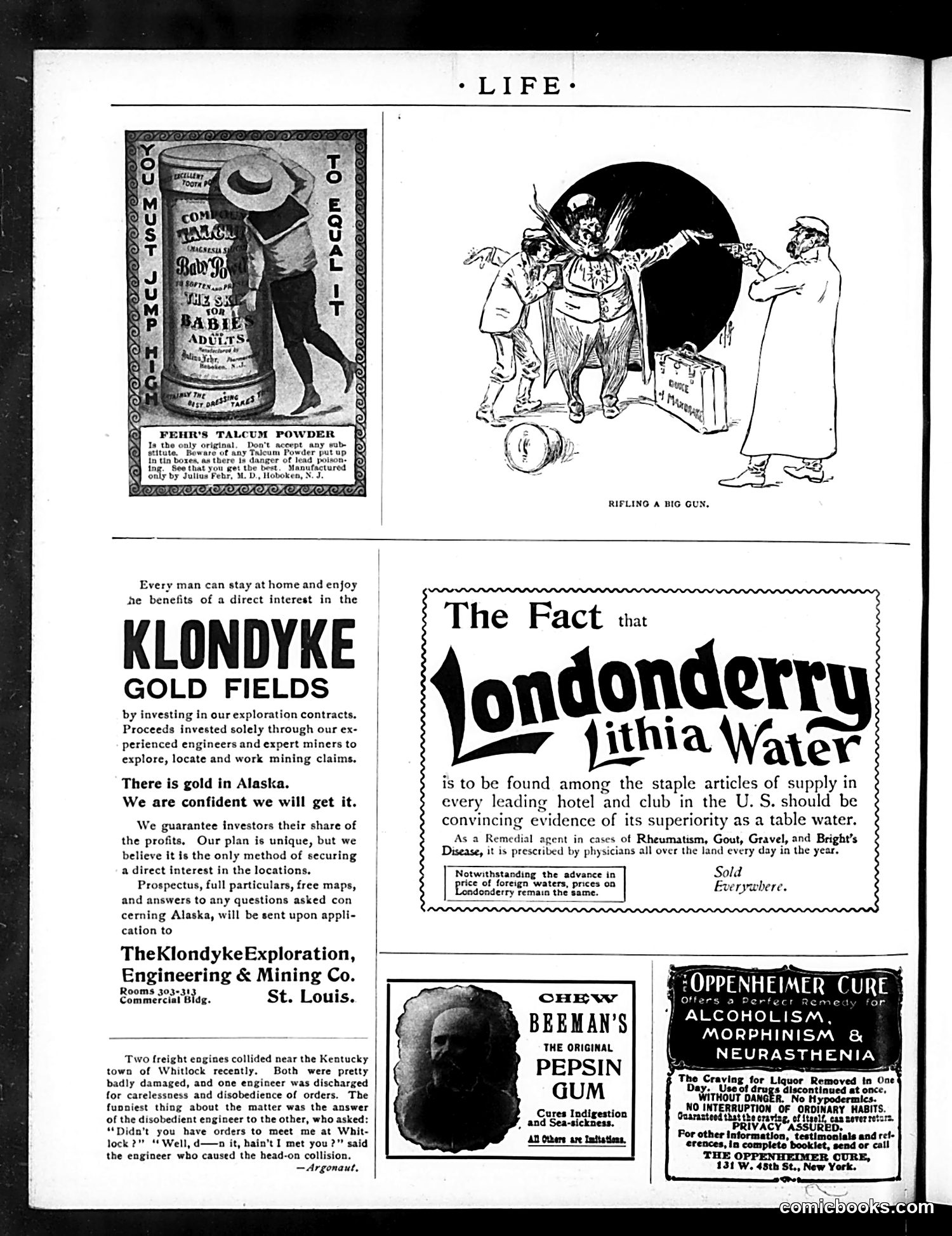
This page is primarily **advertising**, typical of early 1900s American magazines. The main cartoon, "Rifling a Big Gun," appears to be a visual pun—showing men literally "rifling" (stealing from) a large cannon, suggesting petty theft or opportunism. The advertisements reveal contemporary concerns and dubious medical claims: - **Klondyke Gold Fields**: Promotes investment schemes in Alaskan gold exploration, reflecting the era's gold-rush fever and investment speculation. - **Londonderry Lithia Water**: Markets mineral water as a cure for rheumatism, gout, and Bright's disease—typical of the patent medicine era when mineral waters were believed to have therapeutic properties. - **Beeman's Pepsin Gum**: Claims to aid digestion and cure sea-sickness. - **Oppenheimer Cure**: Advertises treatment for alcoholism, morphinism, and neurasthenia, offering "privacy assured"—reflecting stigma around addiction treatment. The anecdote about freight-train engineers appears unrelated humor filler. Overall, the page exemplifies early 1900s advertising's miraculous health claims and financial schemes later regulated by the FDA and FTC.
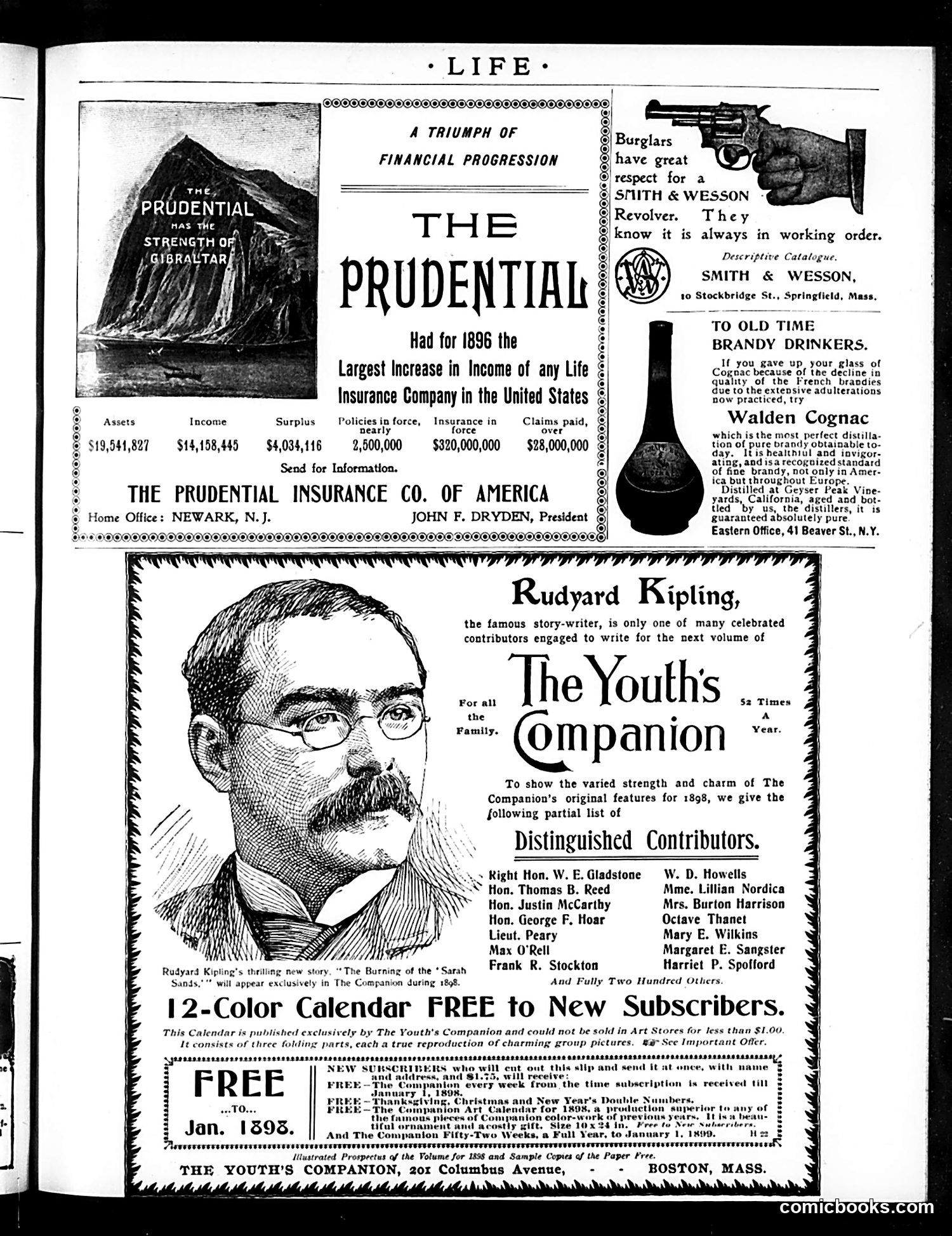
This is primarily an **advertising page** from Life magazine (circa 1897-1898), not a satirical cartoon page, though it includes several distinct ads: **The Prudential Insurance advertisement** (top) celebrates the company's financial growth in 1896 with statistics displayed alongside an image of the Rock of Gibraltar—a visual metaphor for financial stability and strength. **Smith & Wesson revolver ad** (top right) humorously claims "burglars have great respect" for the weapon because it's always reliable—a darkly comedic pitch for home defense. **Walden Cognac ad** (right) appeals to nostalgic brandy drinkers worried about French brandy quality decline, positioning their product as pure and healthy. **The Youth's Companion** (bottom) features Rudyard Kipling's portrait to promote the magazine's 1898 volume, listing celebrated contributors including W.E. Gladstone and other prominent figures, offering a free 12-color calendar to new subscribers. The page demonstrates how Life mixed satirical content with advertising, reflecting late-19th-century magazine publishing.
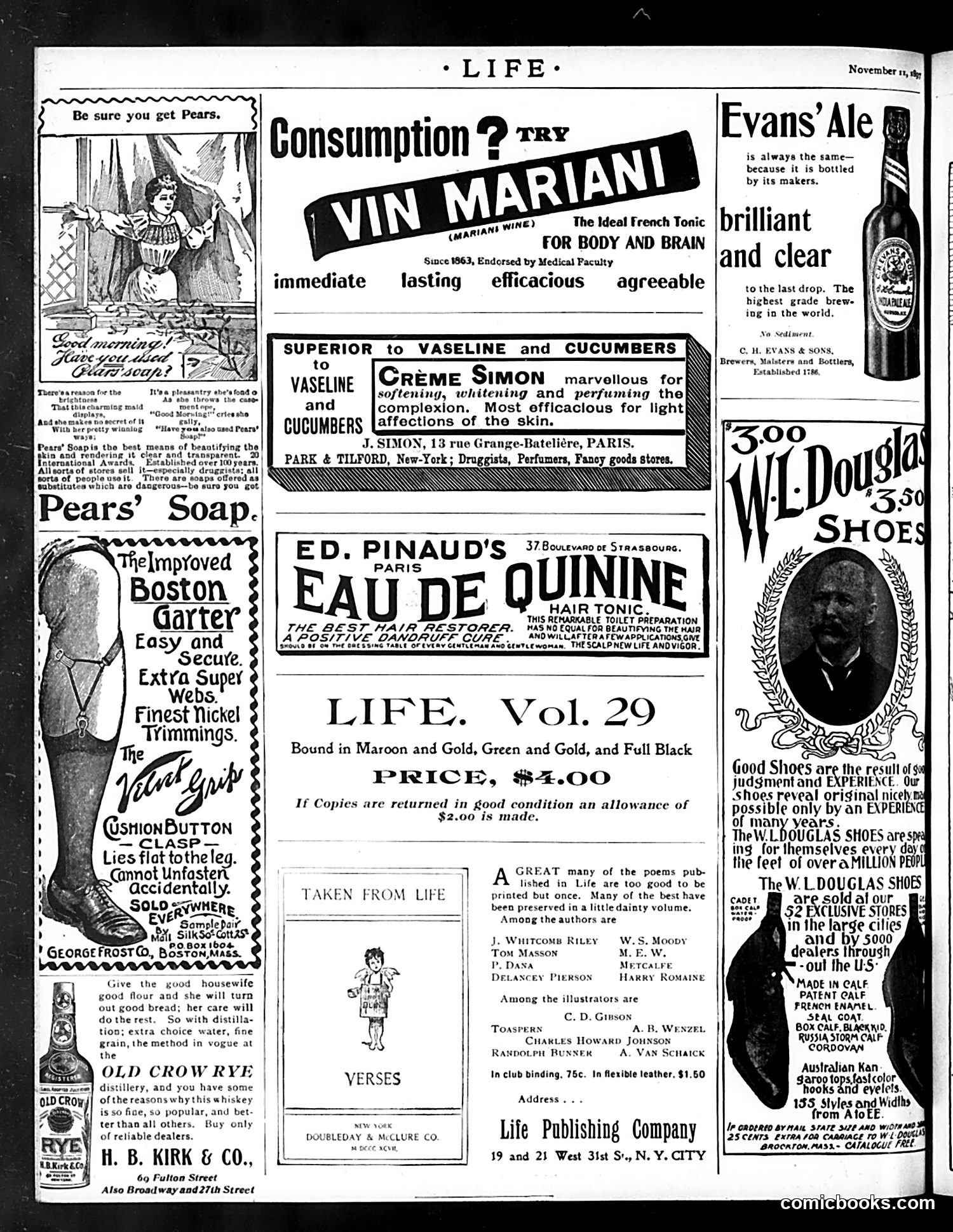
This is primarily a **magazine contents/advertising page** rather than a satirical cartoon. Key elements: **Main Content:** - Title page for *Life* magazine Volume 29, priced $4.00, with binding options ("Maroon and Gold, Green and Gold, and Full Black") - Announcement that the magazine is publishing a curated collection of previously-printed poems from contributors including James Whitcomb Riley and Tom Masson - Subscription information **Advertisements:** The page is dominated by product advertisements typical of early 20th century American print media: - **Pears' Soap** (multiple mentions emphasizing "beauty" and "skin clarity") - **Vin Mariani** (French wine tonic, claimed to aid "body and brain") - **Creme Simon** (complexion product) - **Eau de Quinine** (hair tonic) - **Old Crow Rye** whiskey - **W.L. Douglas Shoes** ($3.00-$3.50 price point) - **Boston Garter** (clothing accessory) **Notable Context:** Advertisements featuring unregulated health claims ("hair restorer," "dandruff cure") reflect pre-FDA regulation standards. This appears to be a table of contents/subscription page rather than editorial content.