
Life, 1897-11-11 · page 6 of 20
Life — November 11, 1897 — page 6: what you’re looking at
What you’re looking at
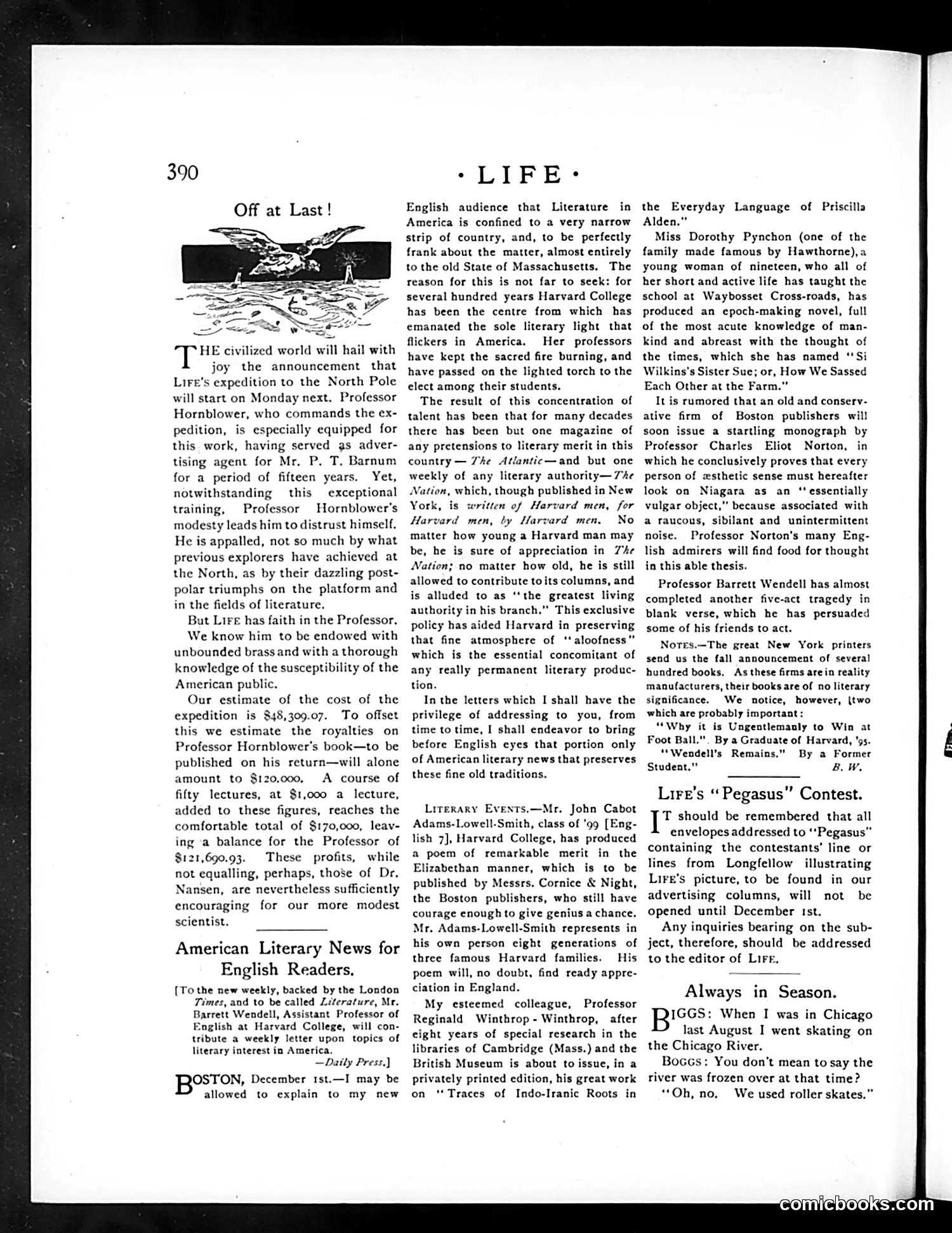
The cartoon depicts a bird carrying what appears to be a torch or flame, with the caption "Off at Last!" This illustrates the article's opening statement about Professor Hornblower's Arctic expedition beginning Monday. The satire operates on two levels: First, it celebrates the expedition's departure as a relief to the American public—the tortured phrasing "the civilized world will hail with joy" suggests sardonic undertones about Hornblower's unpopularity or long-windedness. Second, the torch-carrying bird may reference the passing of intellectual authority (mentioned in the article about Harvard's literary influence), suggesting Hornblower finally carries away some burden from civilization. The humor targets both the expedition itself and American intellectual pretensions of the era.
📄 Transcribed text from this page (OCR, searchable)
Machine-transcribed from the original scan — historical spelling and the odd misread are preserved.
Off at Last! HE civilized world will hail with joy the announcement that Lire’s expedition to the North Pole will start on Monday next. Professor Hornblower, who commands the ex- pedition, is especially equipped for this work, having served as adver- tising agent for Mr. P. T, Barnum for a period of fifteen years. Yet, notwithstanding this exceptional training, Professor Hornblower's modesty leads him to distrust himself. He is appalled, not so much by what previous explorers have achieved at the North, as by their dazzling post- polar triumphs on the platform and in the fields of literature, But Lire has faith in the Professor. We know him to be endowed with unbounded brass and with a thorough knowledge of the susceptibility of the American public, Our estimate of the cost of the expedition is $48,309.07. To offset this we estimate the royalties on Professor Hornblower’s book—to be published on his return—will alone amount to $120,000, A course of fifty lectures, at $1,000 a lecture, added to these figures, reaches the comfortable total of $170,000, leav- ing a balance for the Professor of $121,690.93. These profits, while not equalling, perhaps, those of Dr. Nansen, are nevertheless sufficiently encouraging for our more modest scientist. American Literary News for English Readers, [To the new weekly, backed by the London Times, and to be called Literature, Mr. Barrett Wendell, Assistant Professor of English at Harvard College, will con- tribute a weekly letter upon topics of literary interest in America. —Daily Press.) BoSTON, December 1st.—I may be allowed to explain to my new * LIFE: English audience that Literature in America is confined to a very narrow strip of country, and, to be perfectly frank about the matter, almost entirely to the old State of Massachusetts. The reason for this is not far to seek: for several hundred years Harvard College has been the centre from which has emanated the sole literary light that flickers in America. Her professors have kept the sacred fire burning, and have passed on the lighted torch to the elect among their students. The result of this concentration of talent has been that for many decades there has been but one magazine of any pretensions to literary merit in this country — The Atlantic—and but one weekly of any literary authority—7%e Nation, which, though published in New York, is written of Harvard men, for Harvard men, by Harvard men, No matter how young a Harvard man may be, he is sure of appreciation in Zhe Nation; no matter how old, he is still allowed to contribute to its columns, and is alluded to as ‘‘the greatest living authority in his branch.” This exclusive policy has aided Harvard in preserving that fine atmosphere of ‘‘ aloofness” which is the essential concomitant of any really permanent literary produc- tion. In the letters which I shall have the privilege of addressing to you, from time to time, I shall endeavor to bring before English eyes that portion only of American literary news that preserves these fine old traditions. Lirerary Events.—Mr. John Cabot Adams-Lowell-Smith, class of '99 [Eng- lish 7], Harvard College, has produced a poem of remarkable merit in the Elizabethan manner, which is to be published by Messrs. Cornice & Night, the Boston publishers, who still have courage enough to give genius a chance, Mr. Adams-Lowell-Smith represents in his own person cight generations of three famous Harvard families. His poem will, no doubt, find ready appre- ciation in England. My esteemed colleague, Professor Reginald Winthrop - Winthrop, after eight years of special research in the libraries of Cambridge (Mass.) and the British Museum is about to issue, in a privately printed edition, his great work on ‘Traces of Indo-Iranic Roots in the Everyday Language of Priscilla Alden.” Miss Dorothy Pynchon (one of the family made famous by Hawthorne), a young woman of nineteen, who all of her short and active life has taught the school at Waybosset Cross-roads, has produced an epoch-making novel, full of the most acute knowledge of man- kind and abreast with the thought of the times, which she has named ‘Si Wilkins's Sister Sue; or, How We Sassed Each Other at the Farm.” It is rumored that an old and conserv- ative firm of Boston publishers will soon issue a startling monograph by Professor Charles Eliot Norton, in which he conclusively proves that every person of wsthetic sense must hereafter look on Niagara as an ‘essentially vulgar object,” because associated with a raucous, sibilant and unintermittent noise. Professor Norton's many Eng- lish admirers will find food for thought in this able thesis. Professor Barrett Wendell has almost completed another five-act tragedy in blank verse, which he has persuaded some of his friends to act. Nores.—The great New York printers send us the fall announcement of several hundred books. As these firms are in reality manufacturers, their books are of no literary significance. We notice, however, (two which are probably important: “Why it is Ungentlemanly to Win at Foot Ball.”. By a Graduate of Harvard, ‘gs. “*Wendell’s Remains,” By a Former Student.” BW. Lire's “Pegasus” Contest. T should be remembered that all envelopes addressed to ‘‘Pegasus” containing the contestants’ line or lines from Longfellow illustrating Lire’s picture, to be found in our advertising columns, will not be opened until December ist. Any inquiries bearing on the sub- ject, therefore, should be addressed to the editor of Lirr, Always in Season. Biss: When I was in Chicago last August I went skating on the Chicago River. Boccs: You don't mean to say the river was frozen over at that time? “Oh, no, We used roller skates.”