
Life, 1897-11-11 · page 12 of 20
Life — November 11, 1897 — page 12: what you’re looking at
What you’re looking at
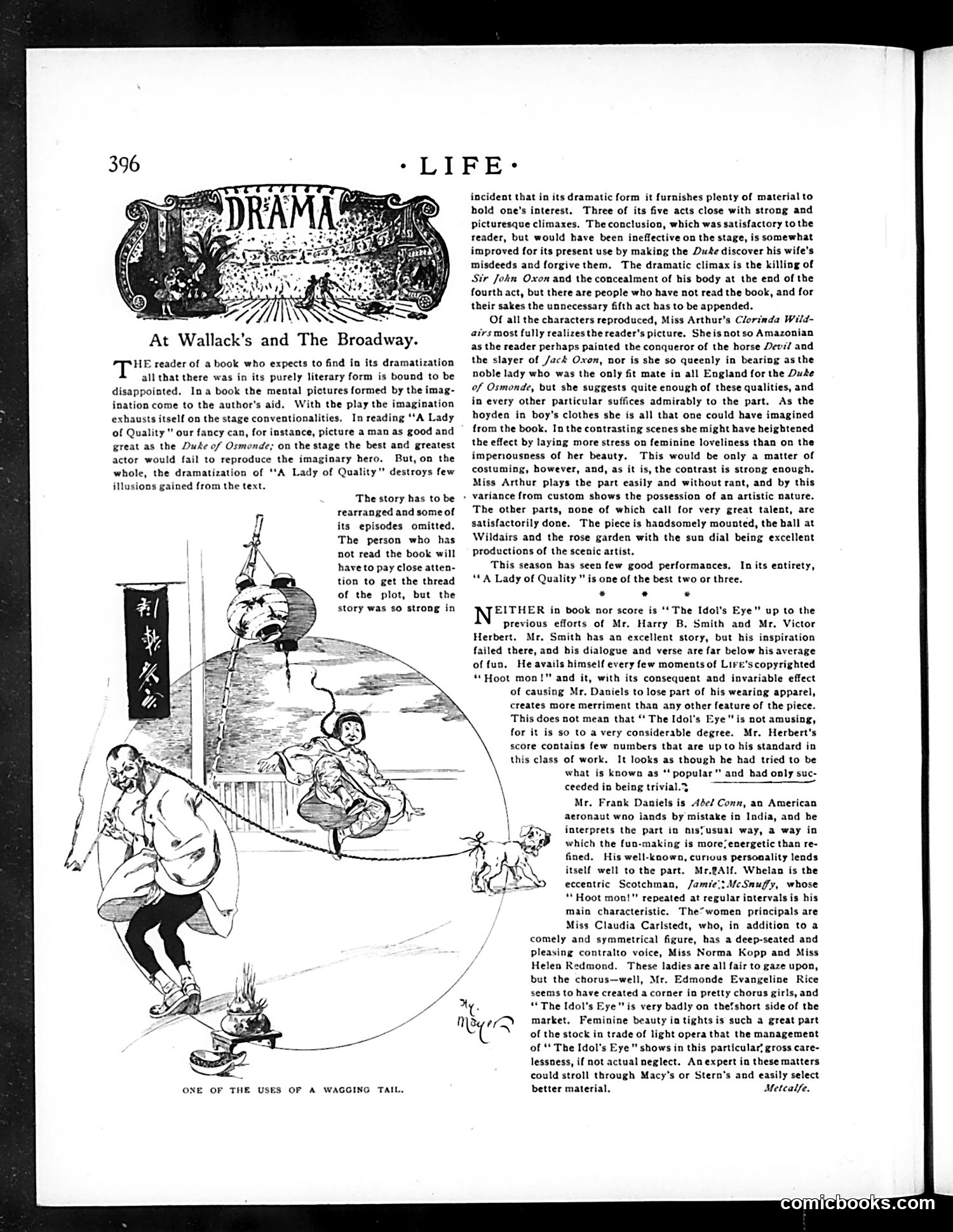
This page reviews theatrical productions at Wallack's and The Broadway theaters. The cartoon illustrates a scene from what appears to be a farce, showing figures engaged in comedic chaos—a man being swung by a rope or tail, with other characters tumbling about in exaggerated physical comedy. The reviews discuss "A Lady of Quality" (adapted from a novel) and "The Idol's Eye," criticizing both plays as somewhat trivial entertainment. The text notes that while the performances are competent, the material itself is lightweight, relying on physical humor, comic voices, and scenery rather than substantial drama. The "wagging tail" caption suggests the plays use obvious, broad comedic devices to entertain audiences.
📄 Transcribed text from this page (OCR, searchable)
Machine-transcribed from the original scan — historical spelling and the odd misread are preserved.
- LIFE: atv 1). bee wee Te reader of a book who expects to find in its dramatization all that there was in its purely literary form is bound to be disappointed. Ina book the mental pictures formed by the imag- ination come to the author's aid. With the play the imagination exhausts itself on the stage conventionalities, In reading ‘‘A Lady of Quality " our fancy can, for instance, picture a man as good and great as the Duke of Osmonde; on the stage the best and greatest actor would fail to reproduce the imaginary hero. But, on the whole, the dramatization of ‘A Lady of Quality” destroys few illusions gained from the text. The story has to be rearranged and some of its episodes omitted. The person who has not read the book will have to pay close atten- tion to get the thread of the plot, but the story was so strong in ONE OF THE USES OF A WAGGING TAIL. incident that in its dramatic form it furnishes plenty of material to hold one’s interest. Three of its five acts close with strong and picturesque climaxes. The conclusion, which was satisfactory tothe reader, but would have been ineffective on the stage, is somewhat improved for its present use by making the Duke discover his wife's misdeeds and forgive them, The dramatic climax is the killing of Sir John Oxon and the concealment of his body at the end of the fourth act, but there are people who have not read the book, and for their sakes the unnecessary fifth act has to be appended. Of all the characters reproduced, Miss Arthur’s Clorinda Wild- airs most fully realizes the reader's picture. She is not so Amazonian as the reader perhaps painted the conqueror of the horse Devil and the slayer of /ack Oxon, nor is she so queenly in bearing as the noble lady who was the only fit mate in all England for the Dute of Osmonde, but she suggests quite enough of these qualities, and in every other particular suffices admirably to the part. As the hoyden in boy’s clothes she is all that one could have imagined from the book. Inthe contrasting scenes she might have heightened the effect by laying more stress on feminine loveliness than on the imperiousness of her beauty. This would be only a matter of costuming, however, and, as it is, the contrast is strong enough. Miss Arthur plays the part easily and without rant, and by this » variance from custom shows the possession of an artistic nature. The other parts, none of which call for very great talent, are satisfactorily done. The piece is handsomely mounted, the ball at Wildairs and the rose garden with the sun dial being excellent productions of the scenic artist, This season has seen few good performances. In its entirety, “*A Lady of Quality " is one of the best two or three. . ° * EITHER in book nor score is ‘‘ The Idol's Eye” up to the Previous efforts of Mr. Harry B, Smith and Mr. Victor Herbert. Mr. Smith has an excellent story, but his inspiration failed there, and his dialogue and verse are far below his average of fun, He avails himself every few moments of Lire’scopyrighted “Hoot mon!" and it, with its consequent and invariable effect of causing Mr. Daniels to lose part of his wearing apparel, creates more merriment than any other feature of the piece. This does not mean that ‘ The Idol's Eye” is not amusing, for it is so to a very considerable degree. Mr. Herbert's score contains few numbers that are up to his standard in this class of work. It looks as though he had tried to be what is known as ‘ popular” and had only suc- ceeded in being trivial.3 | Mr. Frank Daniels is def Conn, an American aeronaut wno iands by mistake in India, and he interprets the part in nis}usual way, a way in which the fun-making is moreenergetic than re- fined. His well-known, curious personality lends itself well to the part. Mr.@Alf. Whelan is the eccentric Scotchman, /amie!:McSnuffy, whose ‘Hoot mon!" repeated at regular intervals is his main characteristic. The“ women principals are Miss Claudia Carlstedt, who, in addition to a comely and symmetrical figure, has a deep-seated and pleasing contralto voice, Miss Norma Kopp and Miss Helen Redmond. These ladies are all fair to gaze upon, but the chorus—well, Mr. Edmonde Evangeline Rice seems to have created a corner in pretty chorus girls, and “The Idol’s Eye" is very badly on thefshort side of the market. Feminine beauty in tights is such a great part of the stock in trade of light opera that the management of ** The Idol's Eye” shows in this particular, gross care- lessness, if not actual neglect. Anexpert in these matters could stroll through Macy's or Stern's and easily select better material. Metcalfe.