
Life, 1897-11-11 · page 4 of 20
Life — November 11, 1897 — page 4: what you’re looking at
What you’re looking at
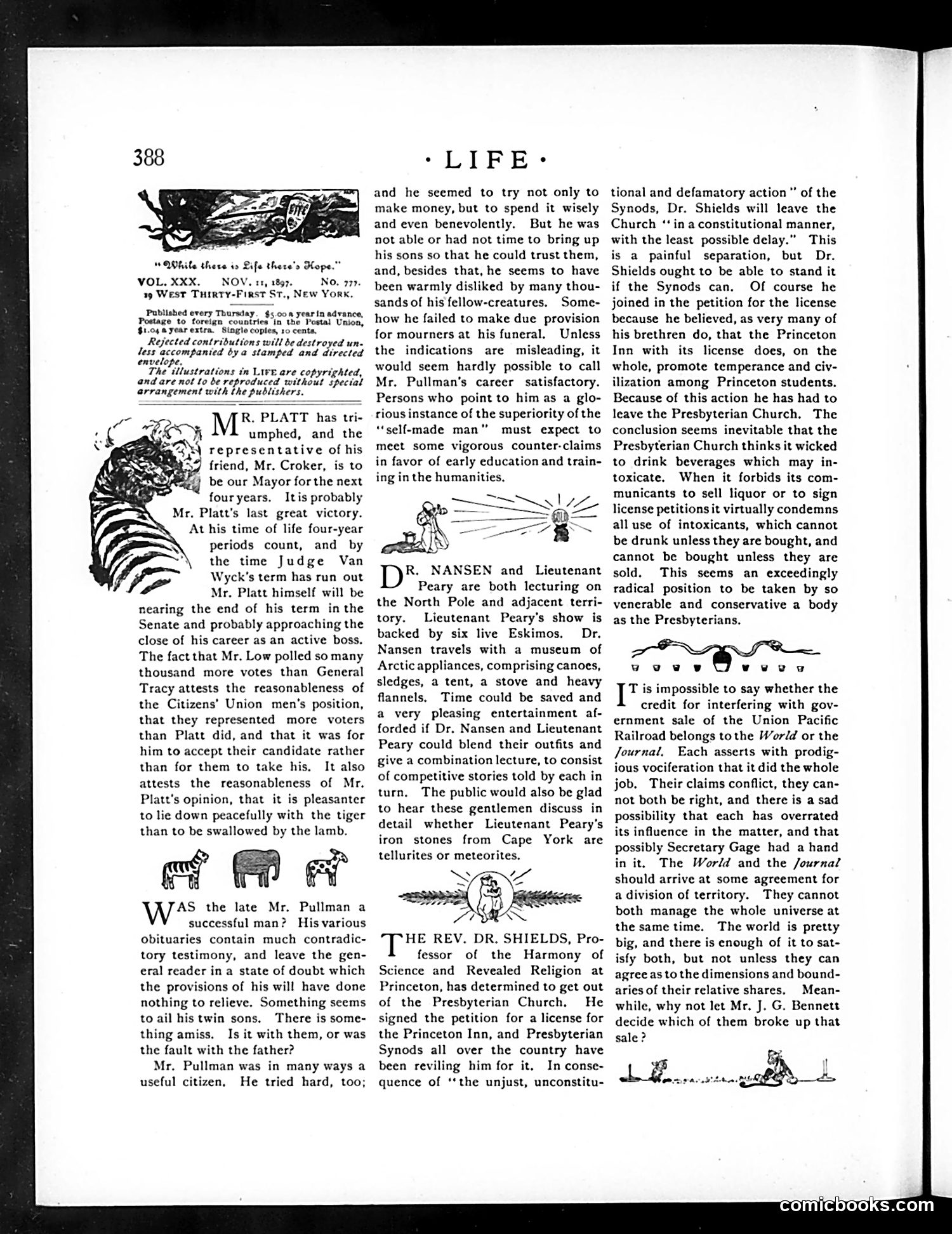
This page contains editorial commentary on prominent men of the era, with illustrations accompanying discussions of their careers and controversies. **Mr. Platt** (likely Thomas C. Platt, New York Republican politician) is discussed regarding his political influence and upcoming Senate race—described as his "last great victory" at age 74. **Dr. Nansen and Lieutenant Peary** are noted for their competing Arctic expeditions and lectures, with the text humorously noting the difficulty of determining who deserves credit for their accomplishments and suggesting magazine editor J.G. Bennett might decide which explorer's presentation is superior. **Rev. Dr. Shields** is criticized for his opposition to a Presbyterian Church license for an inn, with the satire questioning the Church's strict moral positions on alcohol sales. The commentary reflects late-1890s debates over temperance, political power, and exploration claims.
📄 Transcribed text from this page (OCR, searchable)
Machine-transcribed from the original scan — historical spelling and the odd misread are preserved.
“While there ao Life there's Hope.” VOL. XXX. NOV, 11, 1897. No. 777. ag West Tuirty-First St., New York. Published every Thursday. $5 oon yearin advance, Postage to foreign countries in the Postal Union, $1.04 ayearextra. Single copies, 10 centa, Rejected contributions will be destroyed un- tess accompanied bya stamped and directed envelope. The illustrations in Live are copyrighted, and are not to be reproduced without special arrangement with the publisher. R, PLATT has tri- umphed, and the representative of his friend, Mr. Croker, is to 4) be our Mayor forthe next four years. Itis probably Mr. Platt’s last great victory. At his time of life four-year periods count, and by the time Judge Van Wyck's term has run out Mr. Platt himself will be nearing the end of his term inthe Senate and probably approaching the close of his career as an active boss. The fact that Mr. Low polled so many thousand more votes than General Tracy attests the reasonableness of the Citizens’ Union men’s position, that they represented more voters than Platt did, and that it was for him to accept their candidate rather than for them to take his. It also attests the reasonableness of Mr. Platt’s opinion, that it is pleasanter to lie down peacefully with the tiger than to be swallowed by the lamb. ey Pe ef AS the late Mr, Pullman a successful man? His various obituaries contain much contradic- tory testimony, and leave the gen- eral reader in a state of doubt which the provisions of his will have done nothing to relieve. Something seems to ail his twin sons, There is some- thing amiss. Is it with them, or was the fault with the father? Mr. Pullman was in many ways a useful citizen, He tried hard, too; > LIFE: and he seemed to try not only to make money, but to spend it wisely and even benevolently. But he was not able or had not time to bring up his sons so that he could trust them, and, besides that, he seems to have been warmly disliked by many thou- sands of his fellow-creatures. Some- how he failed to make due provision for mourners at his funeral. Unless the indications are misleading, it would seem hardly possible to call Mr. Pullman's career satisfactory. Persons who point to him as a glo- rious instance of the superiority of the “self-made man” must expect to meet some vigorous counter-claims in favor of early education and train- ing in the humanities. R. NANSEN and Lieutenant Peary are both lecturing on the North Pole and adjacent terri- tory. Lieutenant Peary’s show is backed by six live Eskimos. Dr. Nansen travels with a museum of Arctic appliances, comprising canoes, sledges, a tent, a stove and heavy flannels. Time could be saved and a very pleasing entertainment af- forded if Dr. Nansen and Lieutenant Peary could blend their outfits and give a combination lecture, to consist of competitive stories told by each in turn, The public would also be glad to hear these gentlemen discuss in detail whether Lieutenant Peary’s iron stones from Cape York are tellurites or meteorites. HE REV. DR. SHIELDS, Pro- fessor of the Harmony of Science and Revealed Religion at Princeton, has determined to get out of the Presbyterian Church. He signed the petition for a license for the Princeton Inn, and Presbyterian Synods all over the country have been reviling him for it. In conse- quence of ‘‘the unjust, unconstitu- tional and defamatory action ” of the Synods, Dr. Shields will leave the Church ‘‘in aconstitutional manner, with the least possible delay.” This is a painful separation, but Dr. Shields ought to be able to stand it if the Synods can, Of course he joined in the petition for the license because he believed, as very many of his brethren do, that the Princeton Inn with its license does, on the whole, promote temperance and civ- ilization among Princeton students. Because of this action he has had to leave the Presbyterian Church, The conclusion seems inevitable that the Presbyterian Church thinks it wicked to drink beverages which may in- toxicate. When it forbids its com- municants to sell liquor or to sign license petitions it virtually condemns all use of intoxicants, which cannot be drunk unless they are bought, and cannot be bought unless they are sold. This seems an exceedingly radical position to be taken by so venerable and conservative a body as the Presbyterians. vows wewud T is impossible to say whether the credit for interfering with gov- ernment sale of the Union Pacific Railroad belongs tothe World or the Journal, Each asserts with prodig- ious vociferation that it did the whole job. Their claims conflict, they can- not both be right, and there is a sad possibility that each has overrated its influence in the matter, and that possibly Secretary Gage had a hand in it. The World and the Journal should arrive at some agreement for a division of territory. They cannot both manage the whole universe at the same time. The world is pretty big, and there is enough of it to sat- isfy both, but not unless they can agree as to the dimensions and bound- aries of their relative shares. Mean- while, why not let Mr. J. G. Bennett decide which of them broke up that sale?