
A complete issue · 20 pages · 1897
Life — August 19, 1897
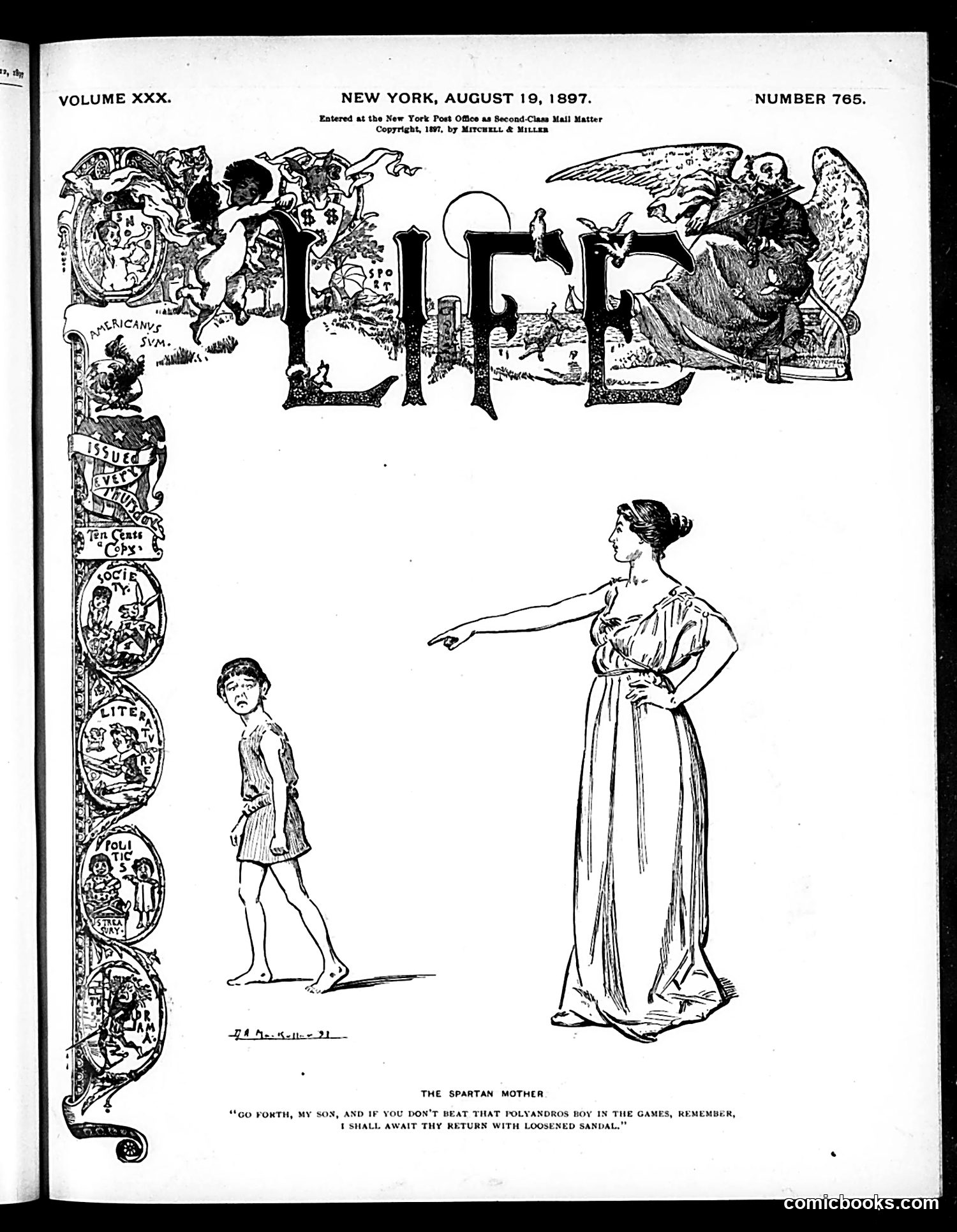
This illustration depicts a classical Spartan mother instructing her young son before athletic competition. The caption reads: "Go forth, my son, and if you don't beat that Polyandrοs boy in the games, remember, I shall await thy return with loosened sandal." The joke references the ancient Spartan practice where mothers would shame sons who returned defeated from battle or games—threatening corporal punishment (the "loosened sandal" suggesting she'd beat him). This satirizes strict parental discipline and the extreme pressure placed on children to achieve victory through competition. The ornate decorative border and classical aesthetic reinforce the historical reference, while the absurdity of applying ancient military values to modern athletic competition creates the satire's humor.
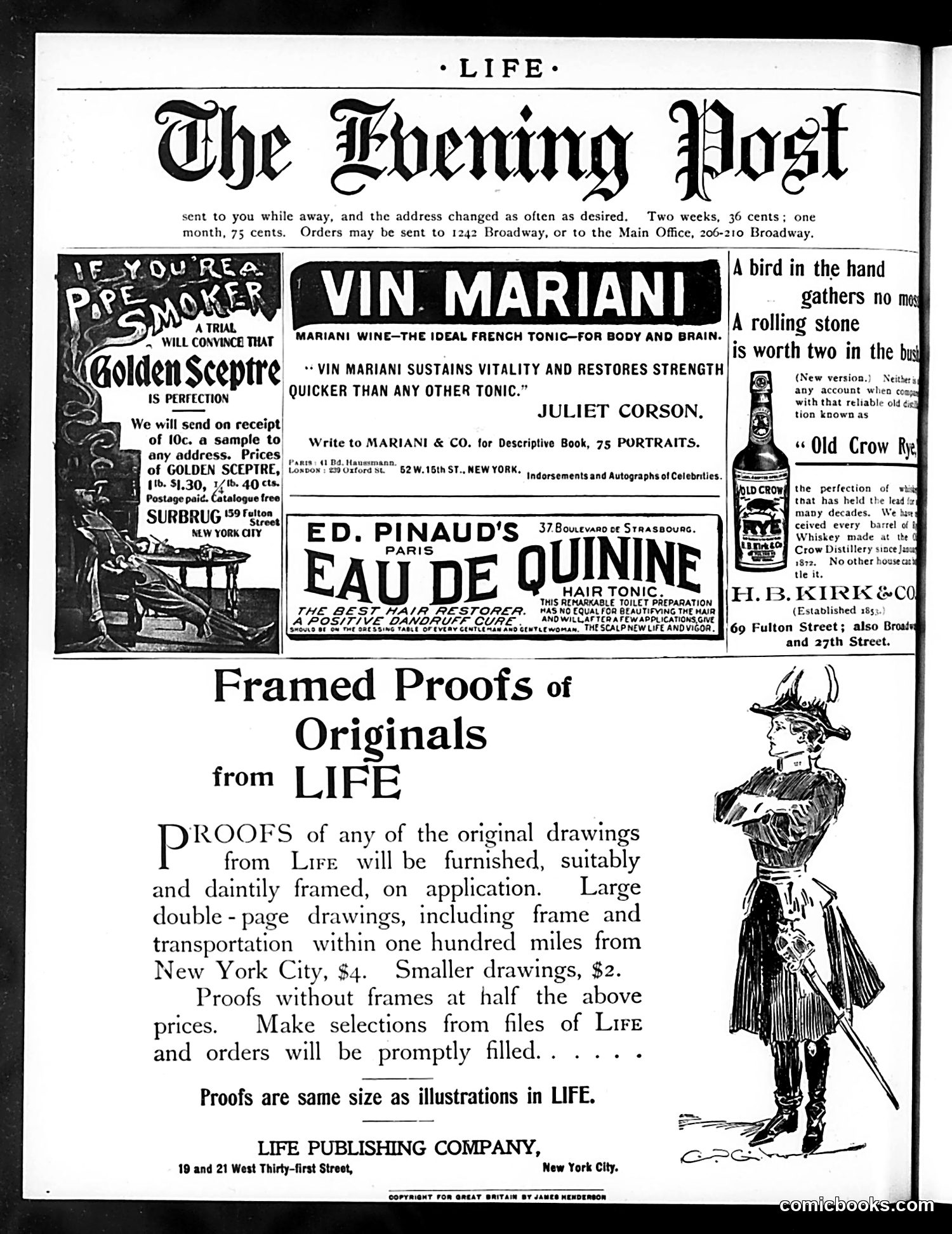
This page is primarily **advertising rather than editorial content**. It features three product advertisements from the early 20th century: 1. **Golden Sceptre pipe tobacco** - marketed as "perfection" 2. **Vin Mariani** - a French wine tonic claiming to sustain vitality, endorsed by actress Juliet Corson 3. **Fauде Quinine hair tonic** - marketed as a dandruff cure and hair restorer Below the ads is a **self-promotional notice** from Life Publishing Company offering framed proofs of original artwork from the magazine, available with or without frames at various prices. The illustration shows a fashionably dressed woman in early 1900s attire with a large feathered hat and parasol—typical period fashion imagery used to appeal to affluent readers. No political satire or social commentary is evident on this particular page.
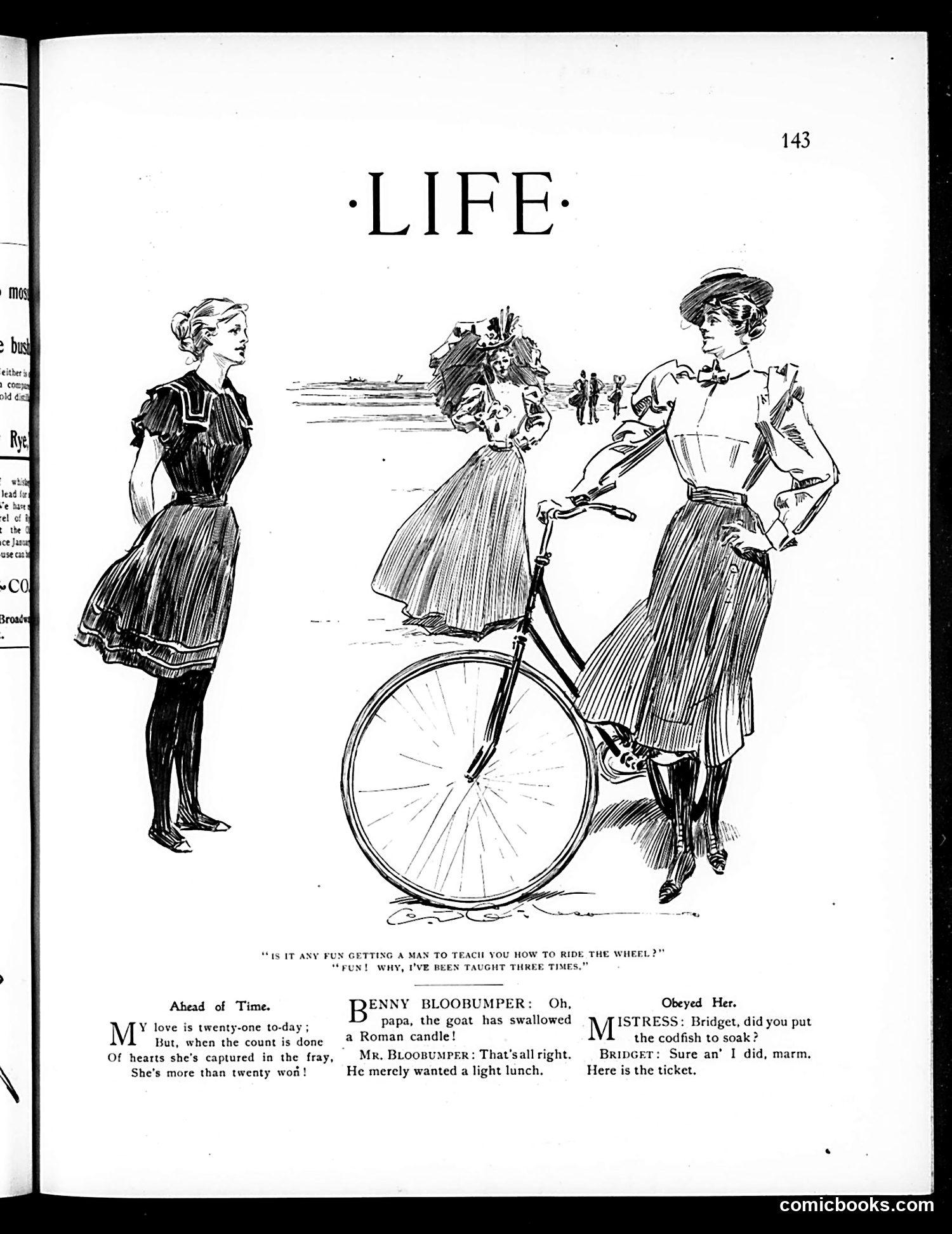
This page from *Life* magazine satirizes early 1900s women's fashion and social attitudes about bicycling. The headline asks, "IS IT ANY FUN GETTING A MAN TO TEACH YOU HOW TO RIDE THE WHEEL?" — referring to the bicycle, a then-revolutionary technology enabling women's independence. The three illustrated women display the era's fashionable "Gibson Girl" aesthetic with full skirts and fitted blouses. The accompanying dialogue between characters "Denny Bloomper," "Mr. Bloomper," "Mistress Bridget," and "Bridget" appears to contain malapropisms and wordplay typical of *Life's* humor — including a joke about a goat swallowing a candle and confusion over "codfish" and "ticket." The satire targets both women adopting new technologies and the pretensions of period fashion and speech affectations.
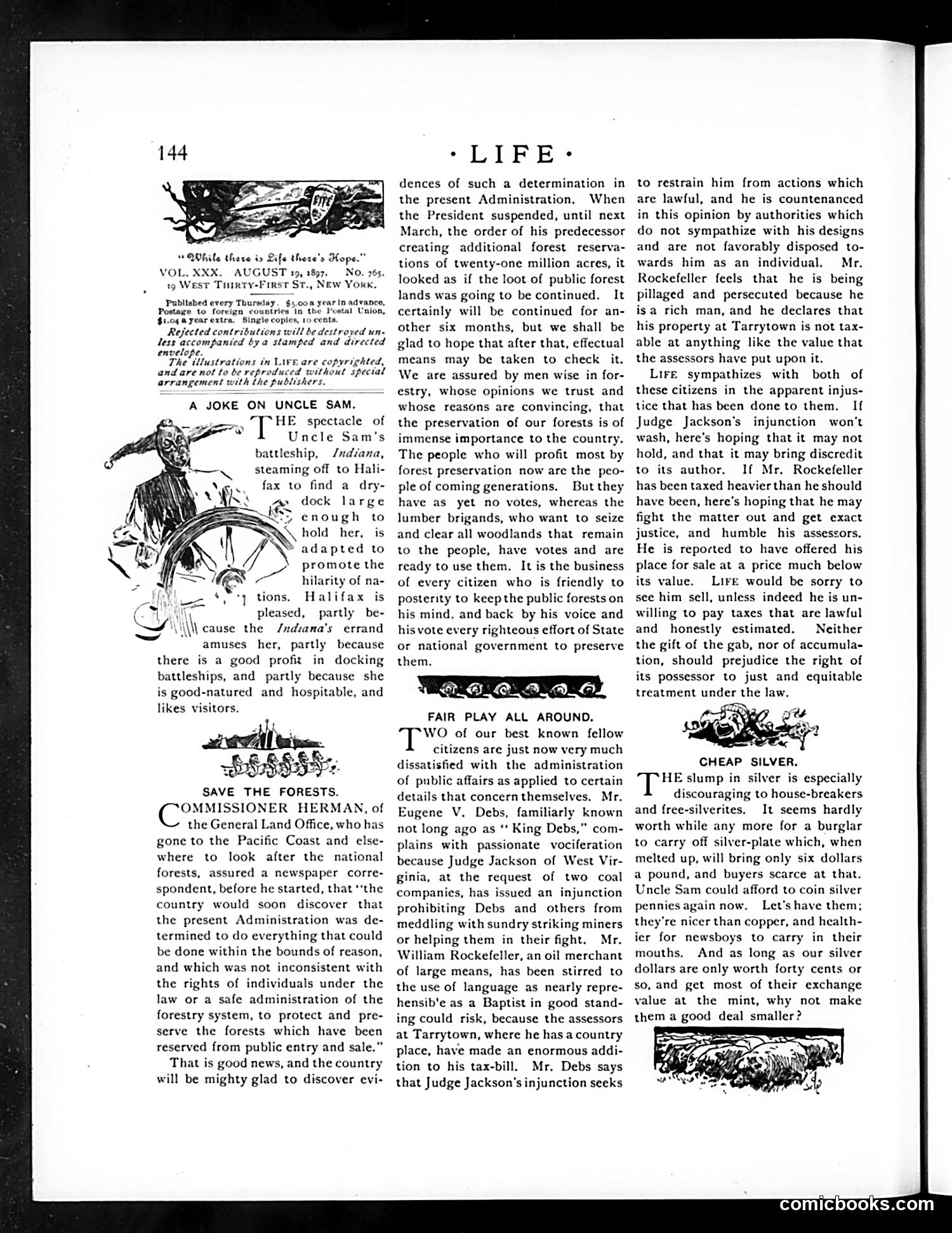
This page contains three satirical pieces addressing early 20th-century political controversies: **"A Joke on Uncle Sam"** features a caricatured figure (Uncle Sam) observing the USS *Indiana* steaming to Haiti. The joke appears to mock American military interventionism in the Caribbean, presented as absurd spectacle. **"Save the Forests"** criticizes the Roosevelt administration's forest conservation policies, suggesting the government was overreaching in restricting private property rights. It references specific disputes involving Judge Jackson, oil merchant William Rockefeller, and coal companies regarding land use and taxation. **"Fair Play All Around"** and **"Cheap Silver"** address contemporary economic grievances—the former concerning labor disputes, the latter mocking the declining value of silver coins. The cartoons collectively satirize government overreach, corporate interests, and economic policy debates of the Progressive Era.
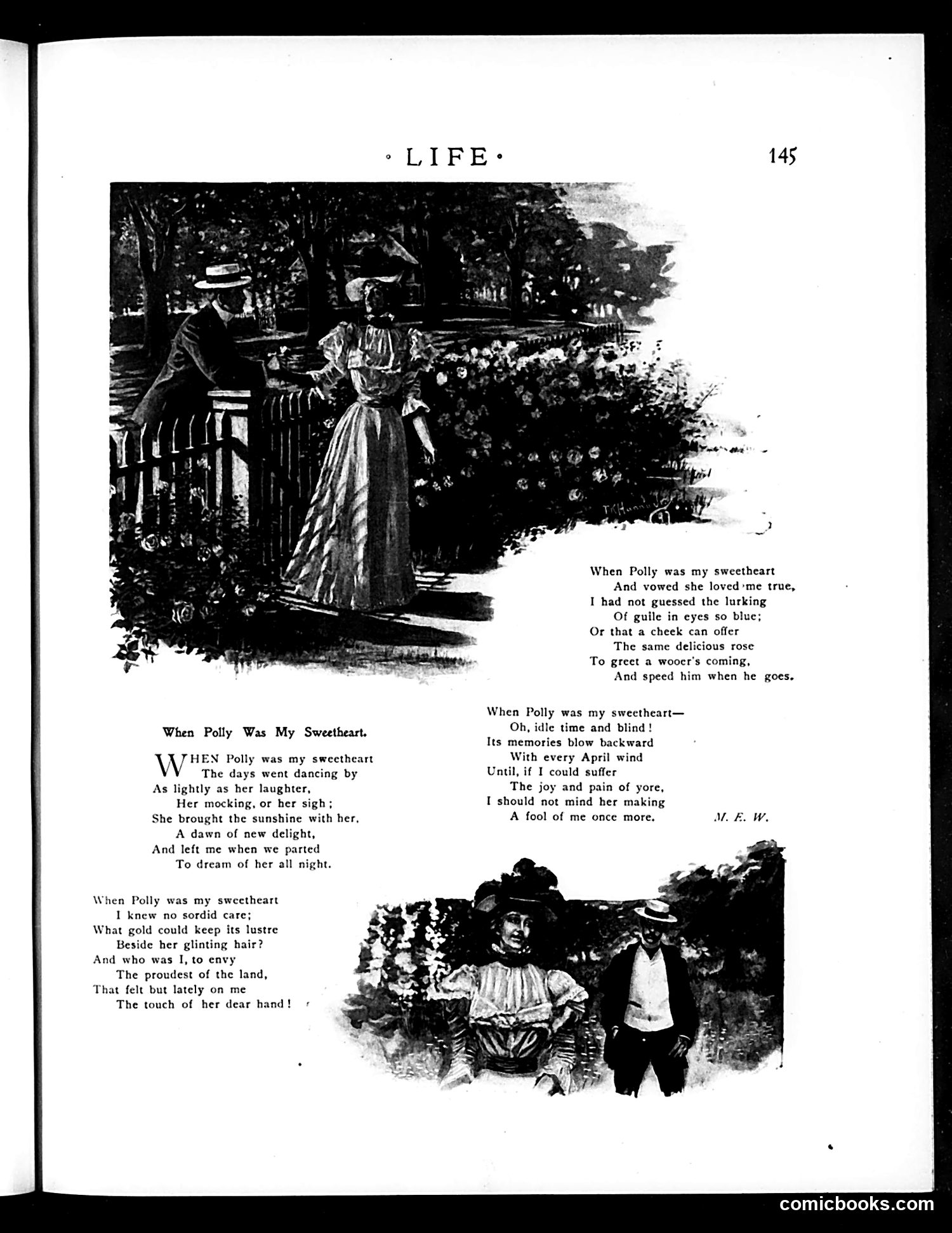
This page from *Life* magazine features a sentimental poem titled "When Polly Was My Sweetheart" with accompanying illustrations. The content appears to be nostalgic romantic verse rather than political satire—it recalls a past love named Polly, describing youthful courtship ("days went dancing by / As lightly as her laughter") and subsequent loss and longing. The two black-and-white illustrations depict couples in period dress in garden settings, emphasizing the romantic theme. The tone is wistful and melancholic, reflecting on how memory distorts past happiness. This is primarily literary content rather than satirical commentary. Without additional context about *Life* magazine's specific date and editorial stance, the "Polly" figure remains a generic romantic subject rather than an identifiable political or social reference.
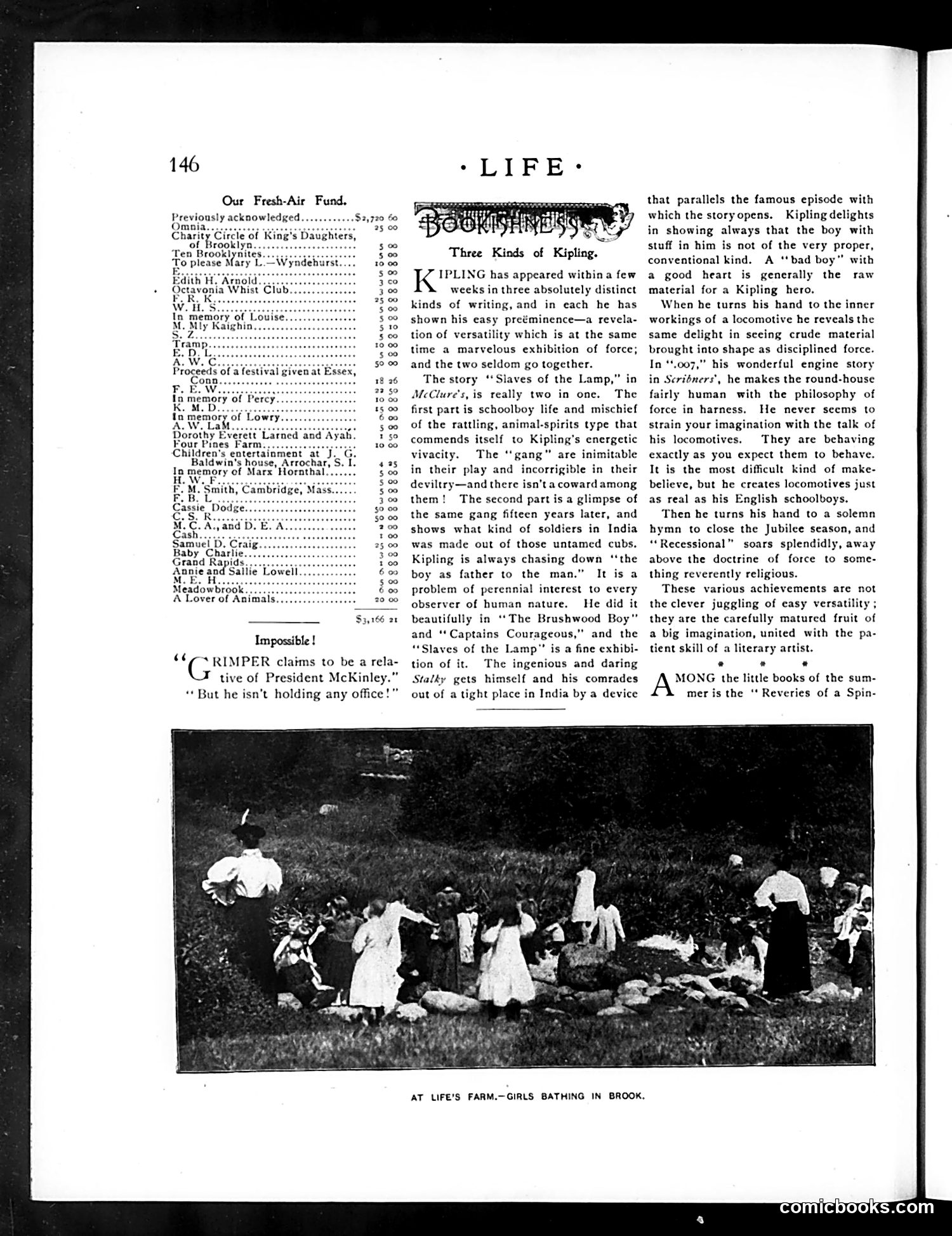
This page contains **no political cartoon**. Instead, it features: 1. **"Our Fresh-Air Fund"** - A charitable fundraising list showing donations to various organizations providing outdoor recreation for underprivileged children (hospitals, clubs, schools). 2. **"Three Kinds of Kipling"** - A literary article discussing Rudyard Kipling's works, analyzing how his stories depict boys and gang life realistically across different periods. 3. **"Impossible!"** - A brief joke: "CRIMPER claims to be a relative of President McKinley." "But he isn't holding any office!" 4. **Photograph** - "At Life's Farm—Girls Bathing in Brook" showing young women at a recreational facility. The page is primarily **educational/philanthropic content** with minimal satire, reflecting Life magazine's mix of social commentary and cultural criticism.
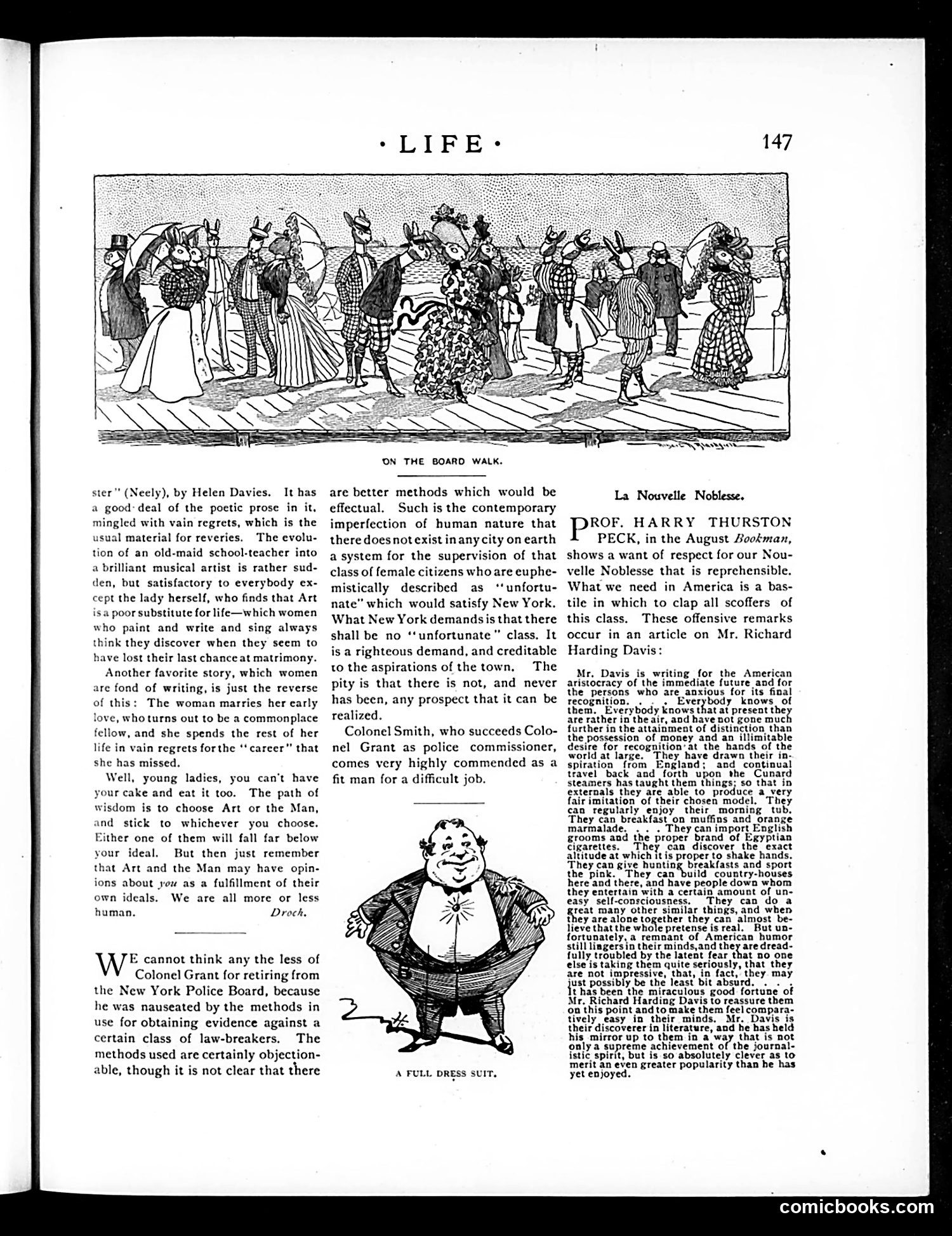
**Top Illustration:** A crowded seaside boardwalk scene showing fashionably dressed people in various poses—women in elaborate hats and dresses, men in suits. The style is typical early 20th-century social satire, likely mocking the pretensions and fashion consciousness of vacationing leisure-class Americans. **Bottom Cartoon:** Titled "A Full Dress Suit," depicts a rotund man in formal evening wear. This appears to be satirizing either obesity, vanity, or the absurdity of formal dress conventions—a common Life magazine target. The exaggerated proportions suggest mockery of either wealth, gluttony, or the gap between aspiration and reality among the social elite. Both images exemplify Life's trademark social commentary on American class and behavior during the magazine's satirical heyday.
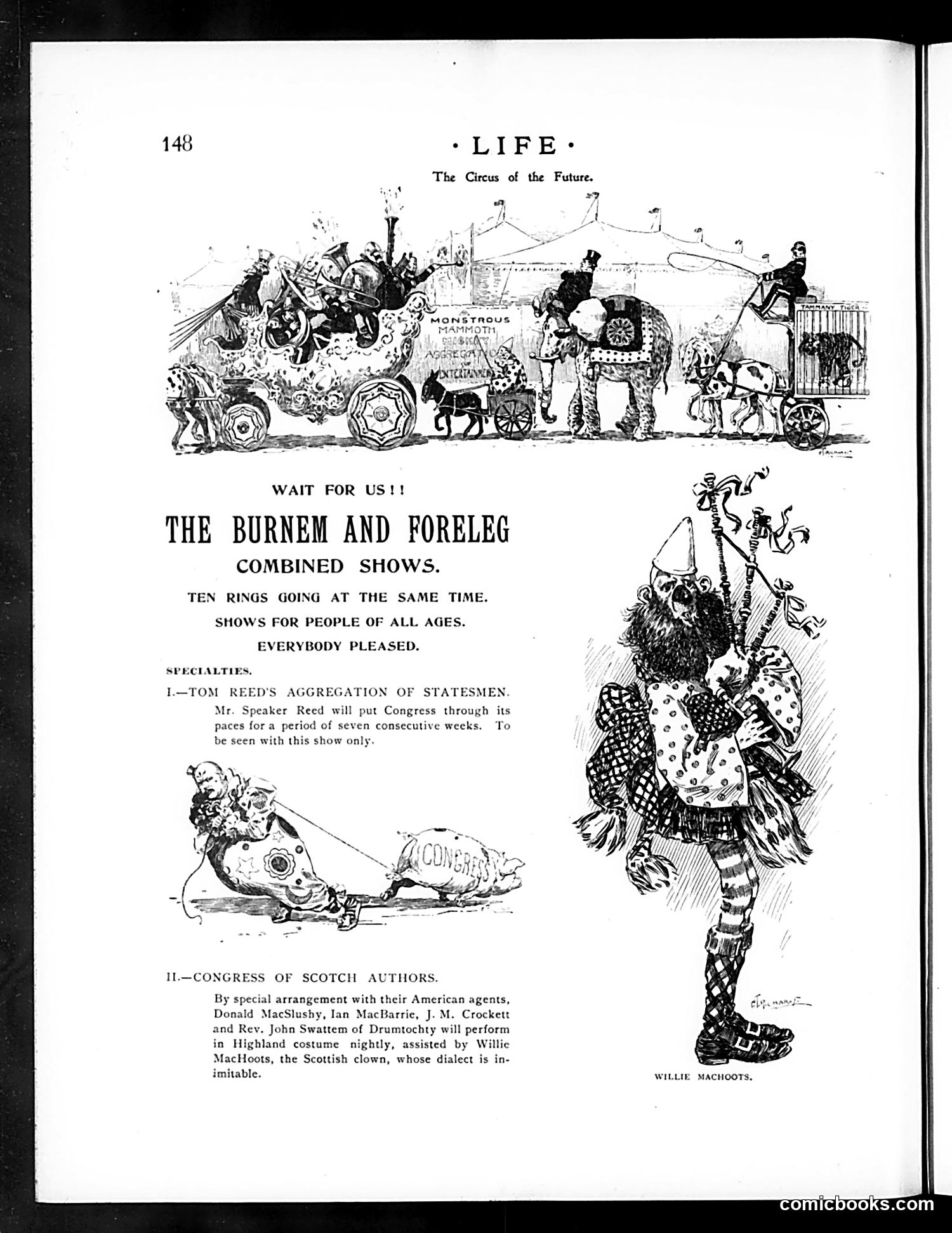
This page advertises "The Burnem and Foreleg Combined Shows," a circus merger featuring ten simultaneous rings. The top illustration depicts an extravagant future circus with fantastical contraptions, exotic animals, and elaborate performances. Below, two specialties are highlighted: 1. **Tom Reed's Aggregation of Statesmen**: A satirical act where Speaker Reed (likely Thomas B. Reed, a prominent politician) puts Congress "through its paces" for seven weeks—mocking Congress as a trained animal act. 2. **Congress of Scotch Authors**: Scottish writers and performers in Highland costume, including Willie MacHoots (a clown character), performing nightly. The satire treats political figures and literary celebrities as circus attractions, poking fun at their public personas and prominence. The cartoonish treatment emphasizes the spectacle of contemporary public life.
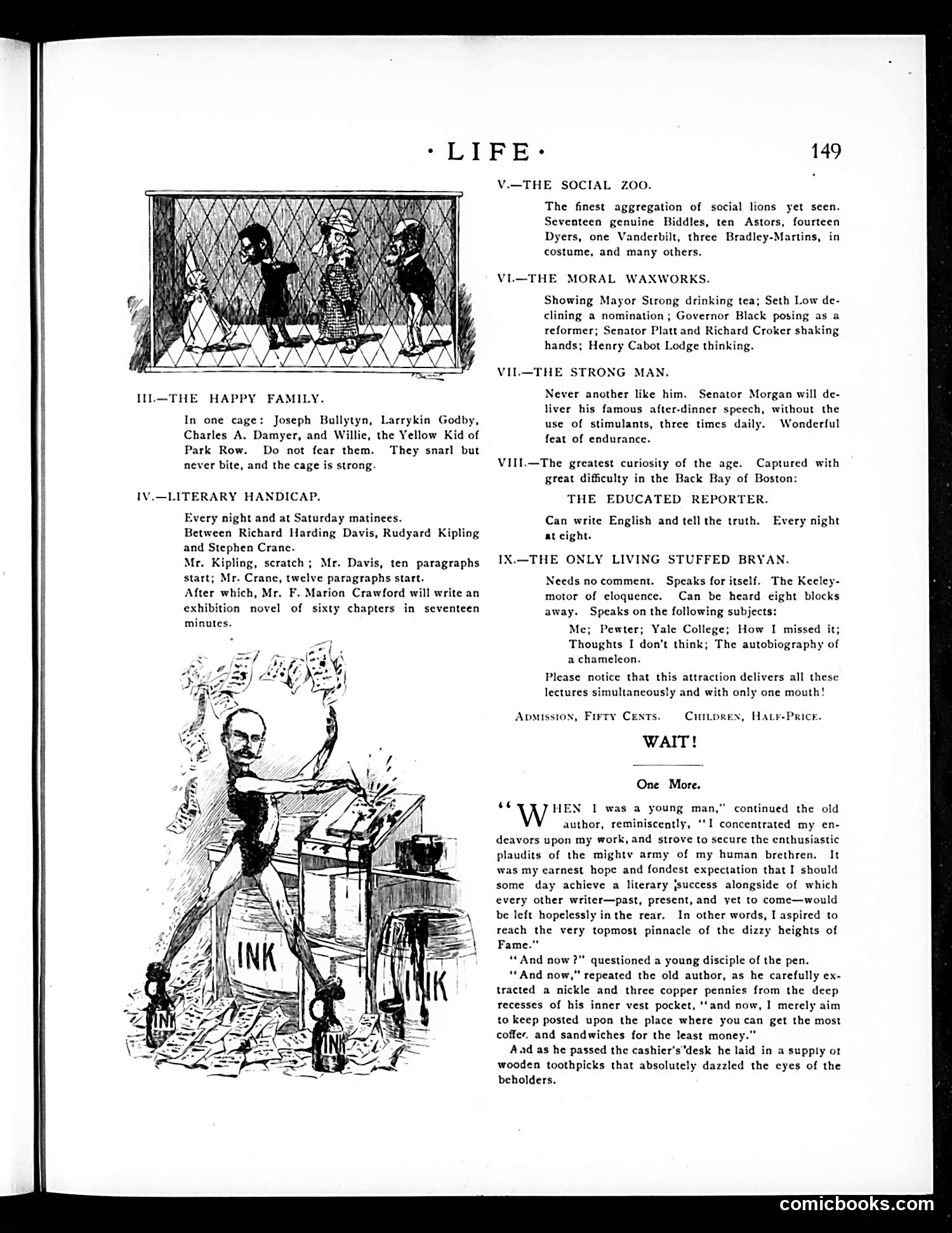
This page satirizes various public figures and cultural attractions of the era through mock "zoo" exhibits and curiosities: **Section V** ridicules prominent social figures—"Biddles," "Astors," and society names—as specimens worthy of display. **Section VI** mocks political figures: Mayor Strong, Governor Black, and Senator Platt as reformed characters, with Henry Cabot Lodge "thinking." **Section VII** ridicules Senator Morgan as an endurance specimen abusing stimulants. **Section VIII** presents "The Educated Reporter"—likely mocking sensationalist journalism. **Section IX** features "The Only Living Stuffed Bryan"—a cutting attack on William Jennings Bryan, portraying him as an automaton spouting memorized speeches rather than original thought. The bottom cartoon depicts an overworked author at his desk, satirizing literary ambitions and commercial pressures on writers.
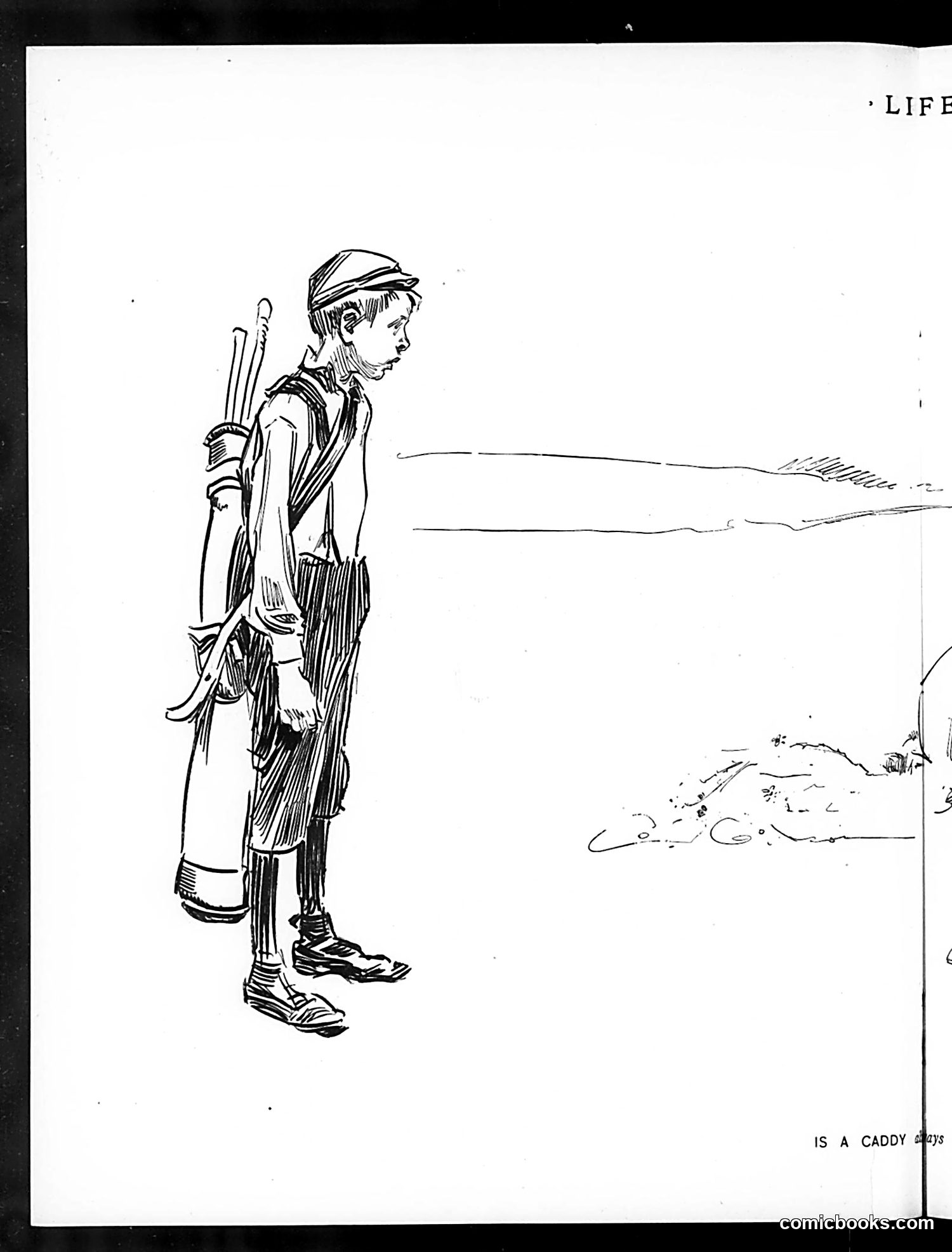
This single-panel cartoon depicts a young boy (likely a caddy—a golf course attendant who carries players' clubs) standing in profile against a sparse landscape. He carries golf clubs over his shoulder and wears period working-class clothing. The caption "LIFE IS A CADDY" appears to be a play on the philosophical phrase "life is a game." The satire suggests that for working-class youth, life amounts to servile labor—literally carrying others' burdens. The cartoon critiques economic inequality by equating human existence to menial service work. The sparse background emphasizes isolation and limitation. This reflects early 20th-century social commentary in *Life* magazine about labor conditions and limited opportunities for poor children.
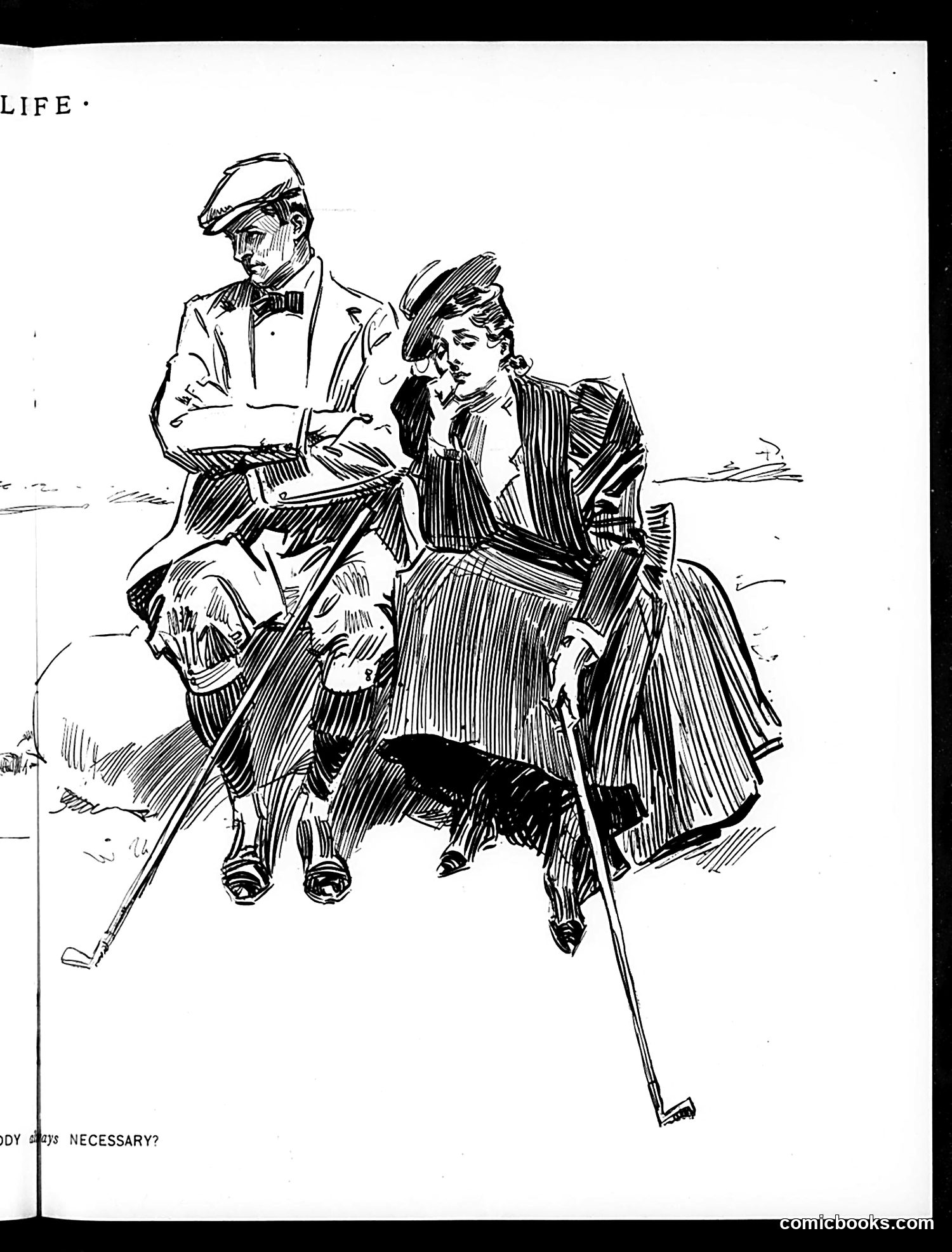
This sketch depicts two fashionably dressed figures in early 20th-century attire engaged in what appears to be a golf outing. The caption reads "CADDY SAYS NECESSARY?" suggesting a humorous commentary on social conventions or extravagance. The cartoon satirizes upper-class leisure activities and possibly the perceived frivolousness of wealthy society during this era. The well-dressed man and woman, their formal clothing despite being at a golf course, and the presence of a caddy underscore the pretension of maintaining social appearances even during recreational activities. The joke likely critiques either unnecessary expense (hiring a caddy), unnecessary formality in dress, or perhaps broader questions about class distinctions and social expectations among the wealthy. The ambiguous caption invites interpretation about what is truly "necessary" in such social contexts.
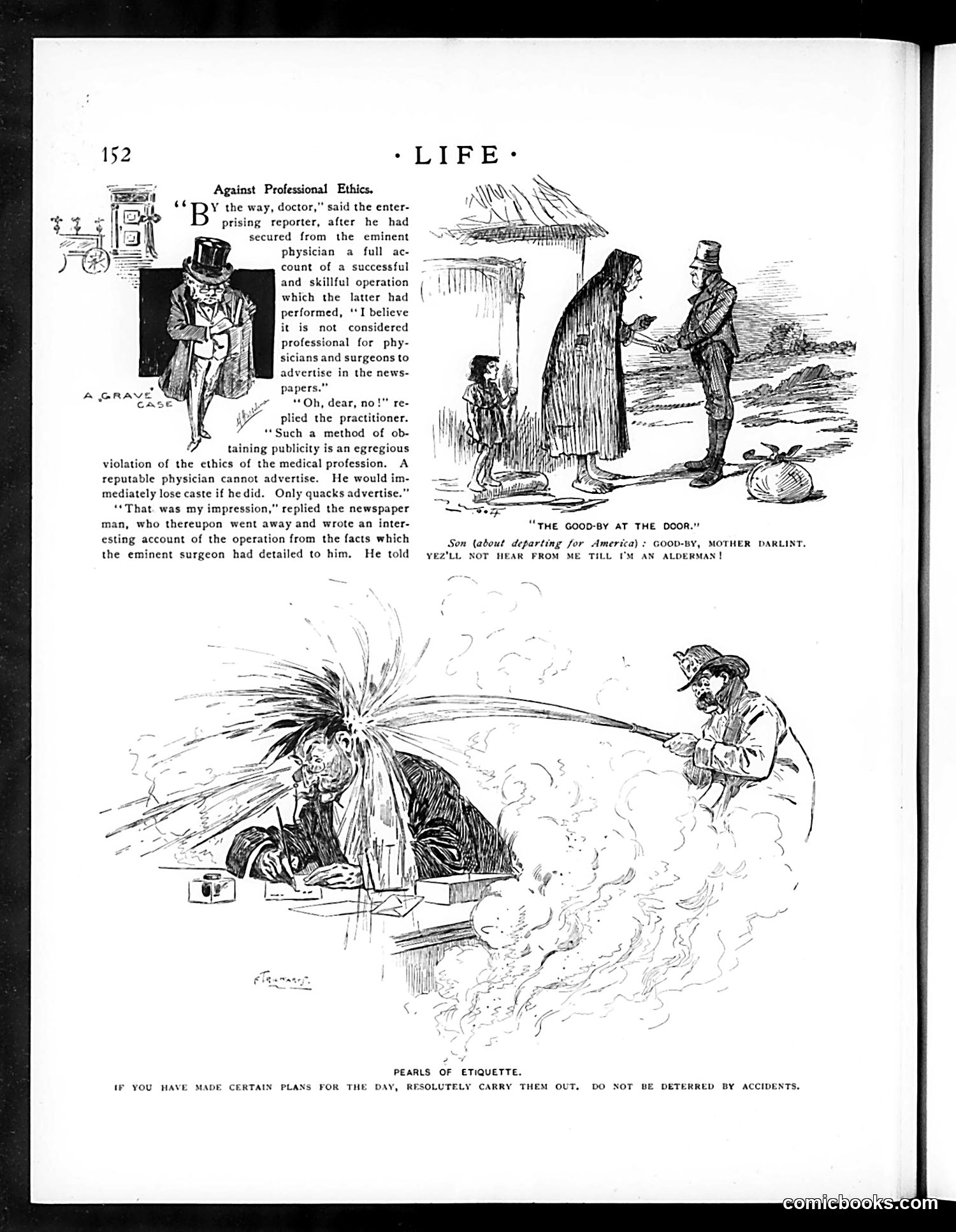
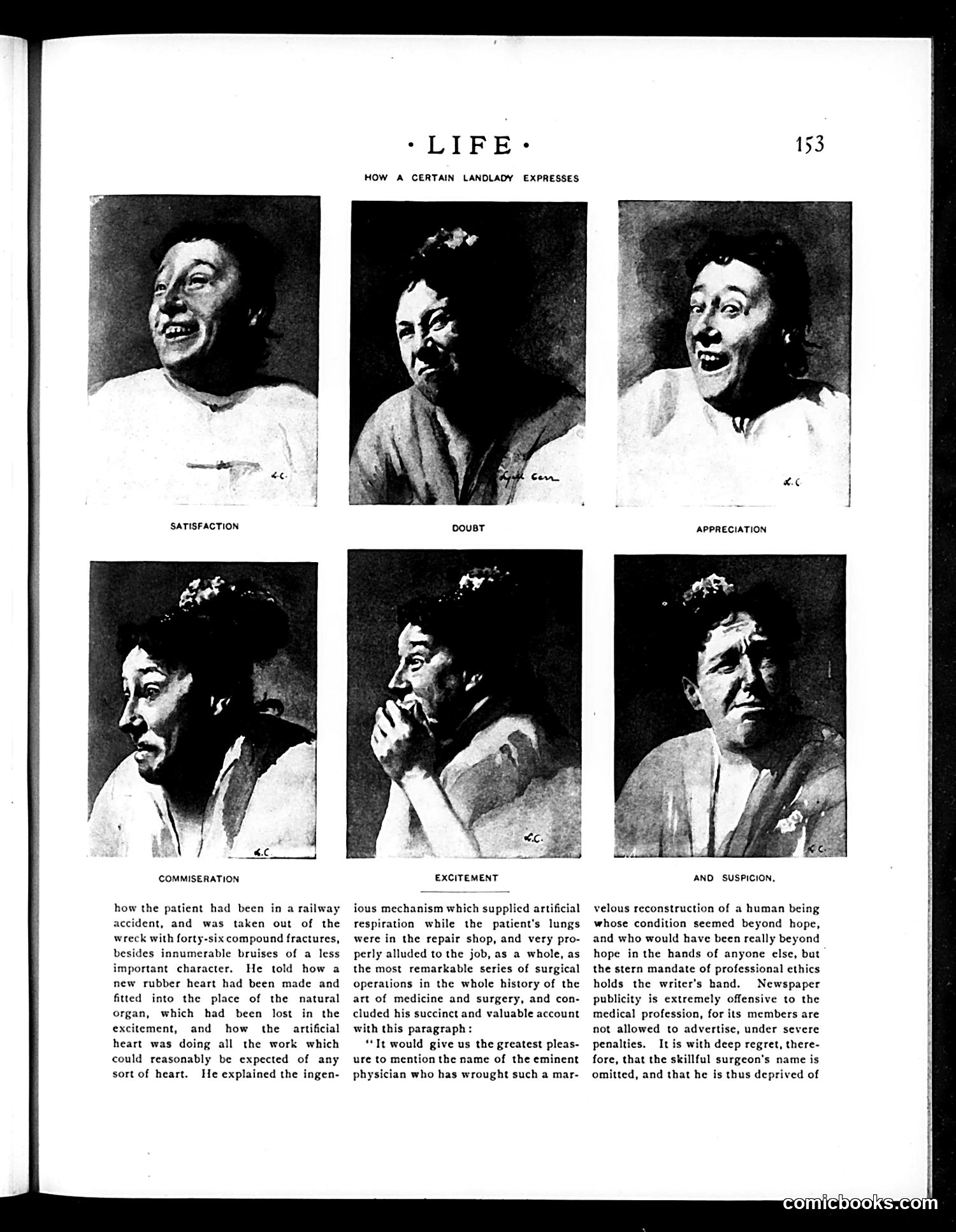
This page satirizes a landlady's varying emotional reactions, using six photographs of the same woman displaying different expressions labeled: Satisfaction, Doubt, Appreciation, Commiseration, Excitement, and Suspicion. The accompanying text describes a medical marvel—a patient who survived a railway accident with 46 compound fractures and received an artificial rubber heart and artificial respiration apparatus. The joke appears to hinge on the disconnect between the landlady's expressions and the story's content: her reactions seem exaggerated or inappropriate to the medical narrative, or possibly her expressions are being comically mismatched to what should logically provoke them. The text also satirizes medical professional ethics that prevent doctors from being publicly credited for their achievements, forcing anonymity despite remarkable surgical accomplishments. The satire criticizes both the artificial restrictions on medical publicity and perhaps the absurdity of the medical scenario itself.
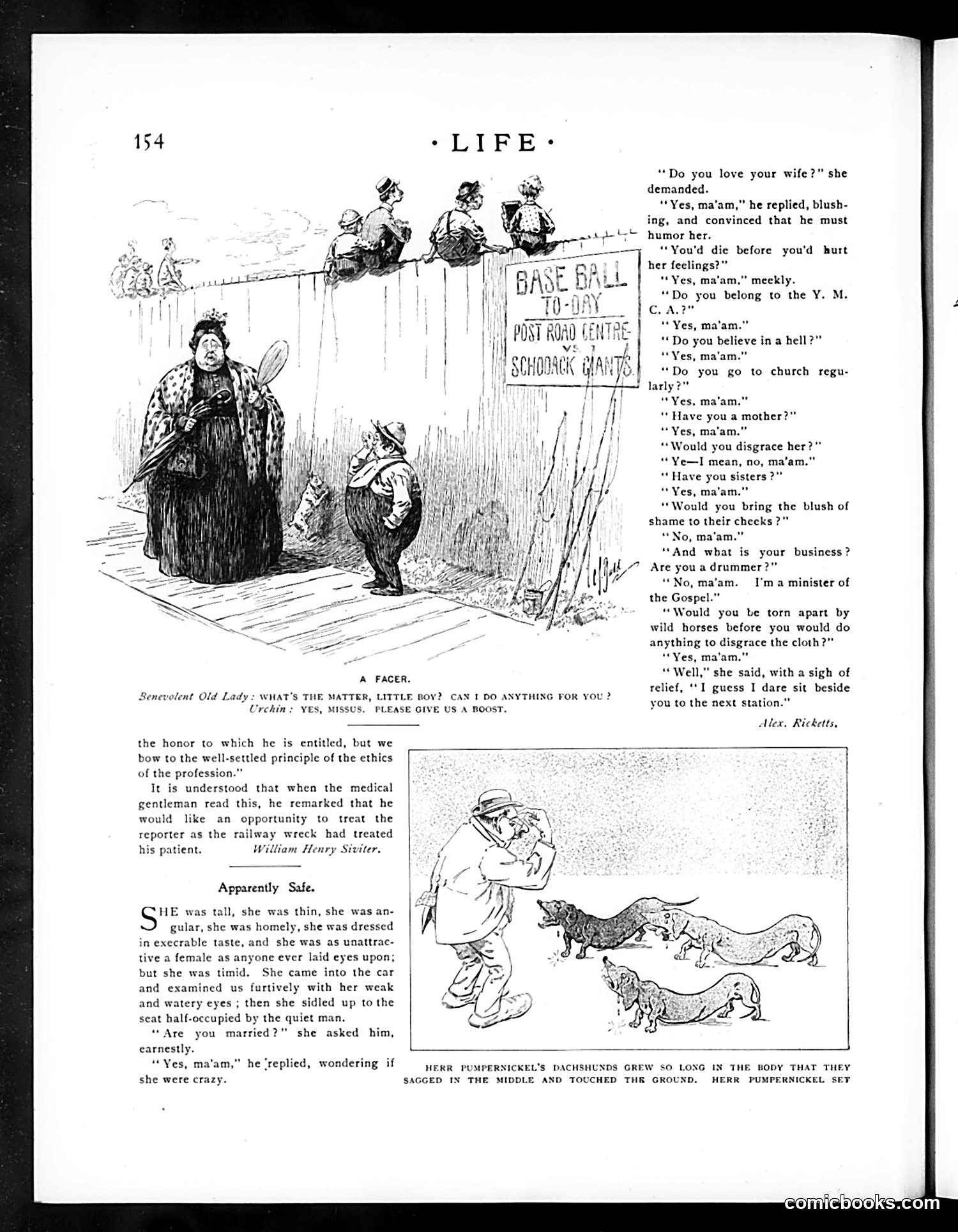
This page contains three separate satirical pieces: **"A Facer"** (top): An elderly woman interrogates a nervous man about his moral character—his marriage, church attendance, beliefs, family loyalty—before deciding he's "safe" to sit beside on a train. The joke: her exhaustive vetting of a minister (the ultimate "respectable" profession) reveals anxiety about potential impropriety, mocking Victorian-era concerns about unchaperoned interactions between strangers. **"Apparently Safe"** (middle): Similar theme—a homely, unattractive woman's self-consciousness leads her to scrutinize a man extensively before sitting near him, suggesting she fears being perceived as forward. **Bottom cartoon**: Shows a man with dachshunds so elongated they drag on the ground—absurdist humor about selective breeding taken to ridiculous extremes. The page satirizes Victorian social propriety, particularly gender anxieties and the elaborate courtesies required in public spaces among strangers.
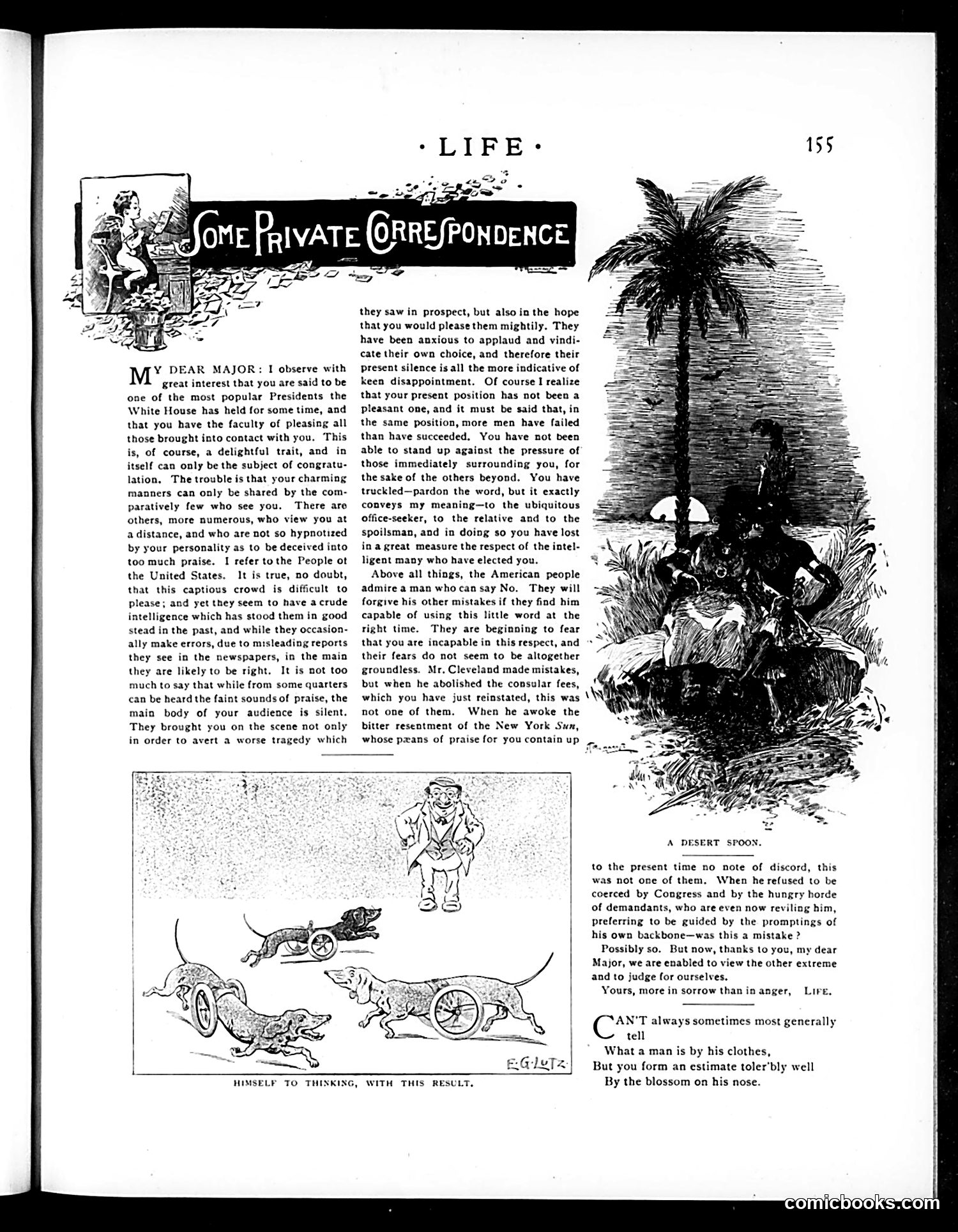
This letter-to-the-editor satirizes an unnamed sitting U.S. President (likely Benjamin Harrison, based on the reference to "Major" and the Cleveland comparison). The writer praises the President's personal charm but attacks his political weakness—specifically his capitulation to patronage seekers and office-hunters rather than standing firm on principle. The satire's target: the President has disappointed the American people by compromising on issues like reinstating consular fees (which Cleveland had abolished). The writer contrasts this unfavorably with Cleveland's backbone, suggesting the current President lacks the courage to say "No" to corrupt political pressure. The bottom cartoon—dachshunds on wheels—illustrates the letter's central metaphor: the President, attempting bold action through sheer willpower, has instead become a grotesque, undignified creature, "truckled" by handlers. The closing verse mocks judging character by appearance, particularly politicians' "blossoms on his nose"—likely referring to red noses associated with drinking or poor health.
This page is primarily **advertising and miscellaneous content**, not a unified political cartoon. The main text section titled "Pat Scissors at Nulls" contains several **short humorous anecdotes and poems** rather than cohesive satire: 1. **"A Poster Tragedy"** (poem): Satirizes overwrought Romantic poetry with absurd color descriptions ("green-haired maid," "lavender song"), mocking pretentious artistic expression. 2. **Conductor anecdote**: A dark joke where a woman claims she swallowed her streetcar fare, prompting the conductor to beat an innocent boy—satirizing both passenger desperation and authority's cruel absurdity. 3. **Other jokes**: Brief sketches about a Kansas editor's tax troubles and a marriage proposal involving a bicycle. The page is **primarily filled with period advertisements** (Ivory Soap, Hunter Baltimore Rye, Yale Tobacco, etc.), indicating this is a commercial publication mixing editorial content with revenue-generating ads. There are no identifiable political figures or specific contemporary events referenced.
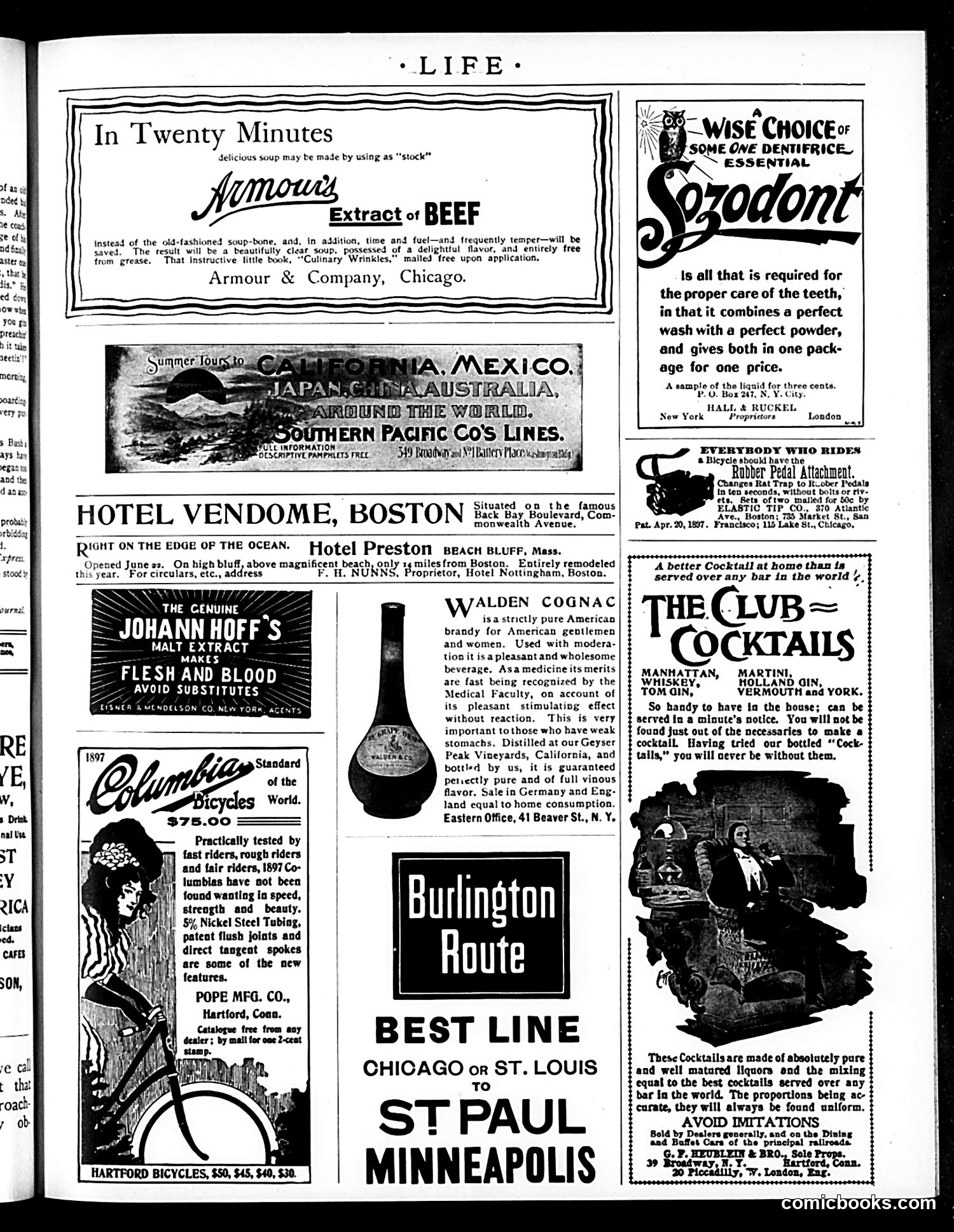
This is primarily an **advertising page** from Life magazine (dated April 29, 1897, based on visible patent date). Rather than containing political cartoons, the page consists entirely of commercial advertisements. The ads reflect late-19th-century consumer concerns: Armour's beef extract promises quick soup-making; Johann Hoff's malt extract claims to build "flesh and blood"; Walden Cognac is marketed as medicinal for "weak stomachs"; Szodont toothpowder combines wash and powder in one package for convenience. Notable is the prominence of **bicycle advertisements** (Columbia and Hartford brands), reflecting the 1890s cycling craze. Travel ads promote luxury hotels and railroad routes. The ads reveal period anxieties about health, efficiency, and modern convenience—themes Life's educated readership presumably found amusing or useful. The page demonstrates how Life monetized its satirical platform through upscale product advertising rather than using editorial space for social commentary.
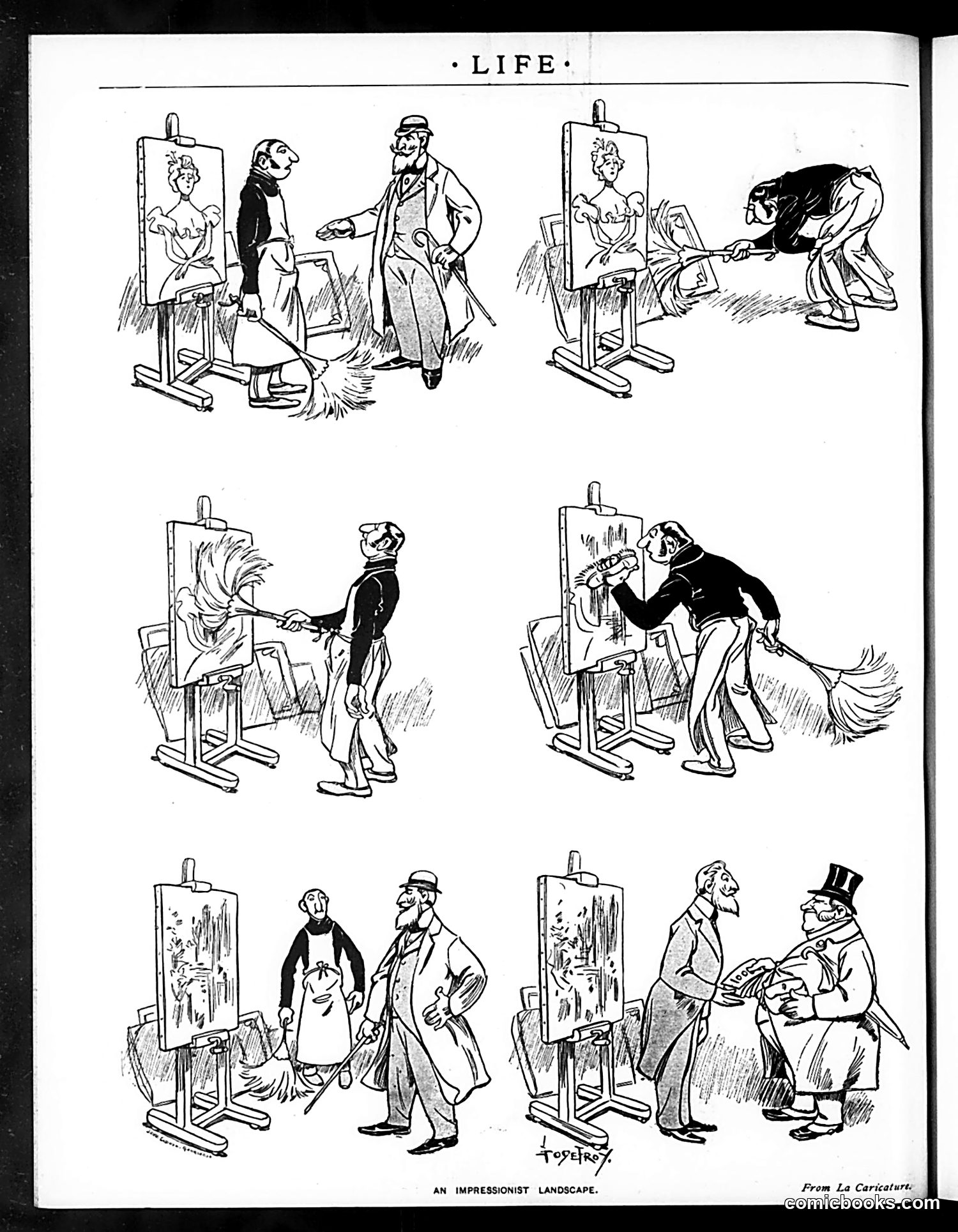
This cartoon satirizes **Impressionist art** and artistic pretension. The six panels show successive stages of a portrait's degradation—from a recognizable society woman at top to increasingly abstract, chaotic brushwork below. Each panel depicts **art critics or wealthy patrons** examining the work with apparent approval, despite its deteriorating quality. The joke: as the painting becomes more incomprehensible, the observers respond with greater enthusiasm and elaborate praise. This mocks the **early 20th-century Impressionist and modernist art movements**, which traditionalists viewed as fraudulent or meaningless. The cartoon suggests that wealthy collectors and critics enthusiastically endorse artistic nonsense simply because it appears fashionably avant-garde. The title ironically presents aesthetic degradation as legitimate artistic "progress."
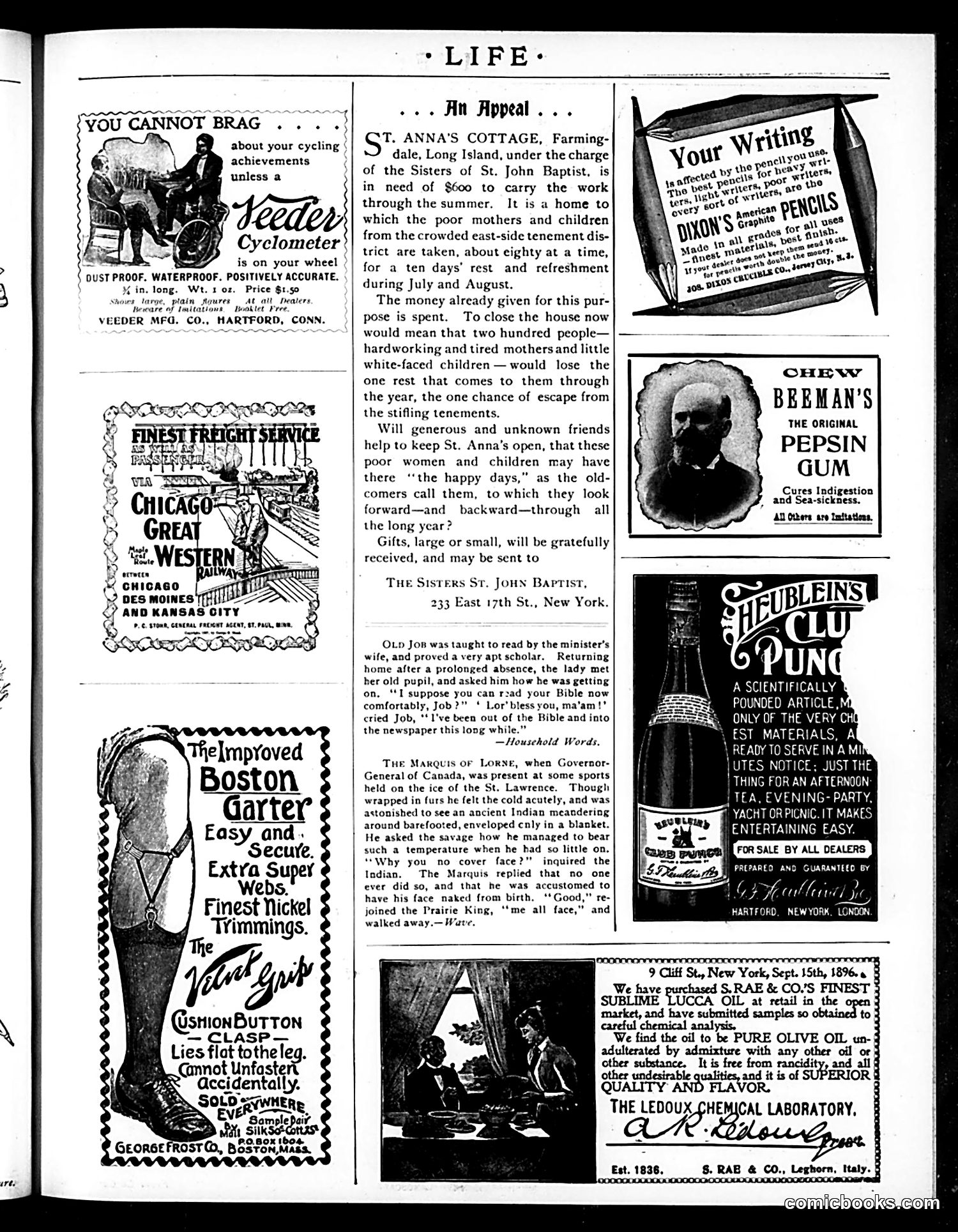
This Life magazine page (September 1896) mixes advertisements with charitable appeal and humorous anecdotes. **The Main Content:** A fundraising appeal for St. Anna's Cottage, a summer retreat on Long Island for poor mothers and children from NYC tenements. The Sisters of St. John Baptist need $600 to keep it open through summer—otherwise 200 exhausted working-class families lose their only annual escape from crowded, unhealthy city housing. **The Humor Section** features two period anecdotes: one about an old man ("Job") who stopped reading the Bible to follow newspapers instead, and another about the Marquis of Lorne meeting a barefoot Native American in winter Canada—the punchline playing on racial stereotyping ("me all face"). **The Advertisements** (garters, pencils, gum, cycling equipment, cushion buttons) are typical 1890s products marketed with earnest claims of superiority. The page reflects Victorian-era attitudes: charitable concern for the urban poor mixed casually with racial humor, all surrounded by consumer goods promoting self-improvement.
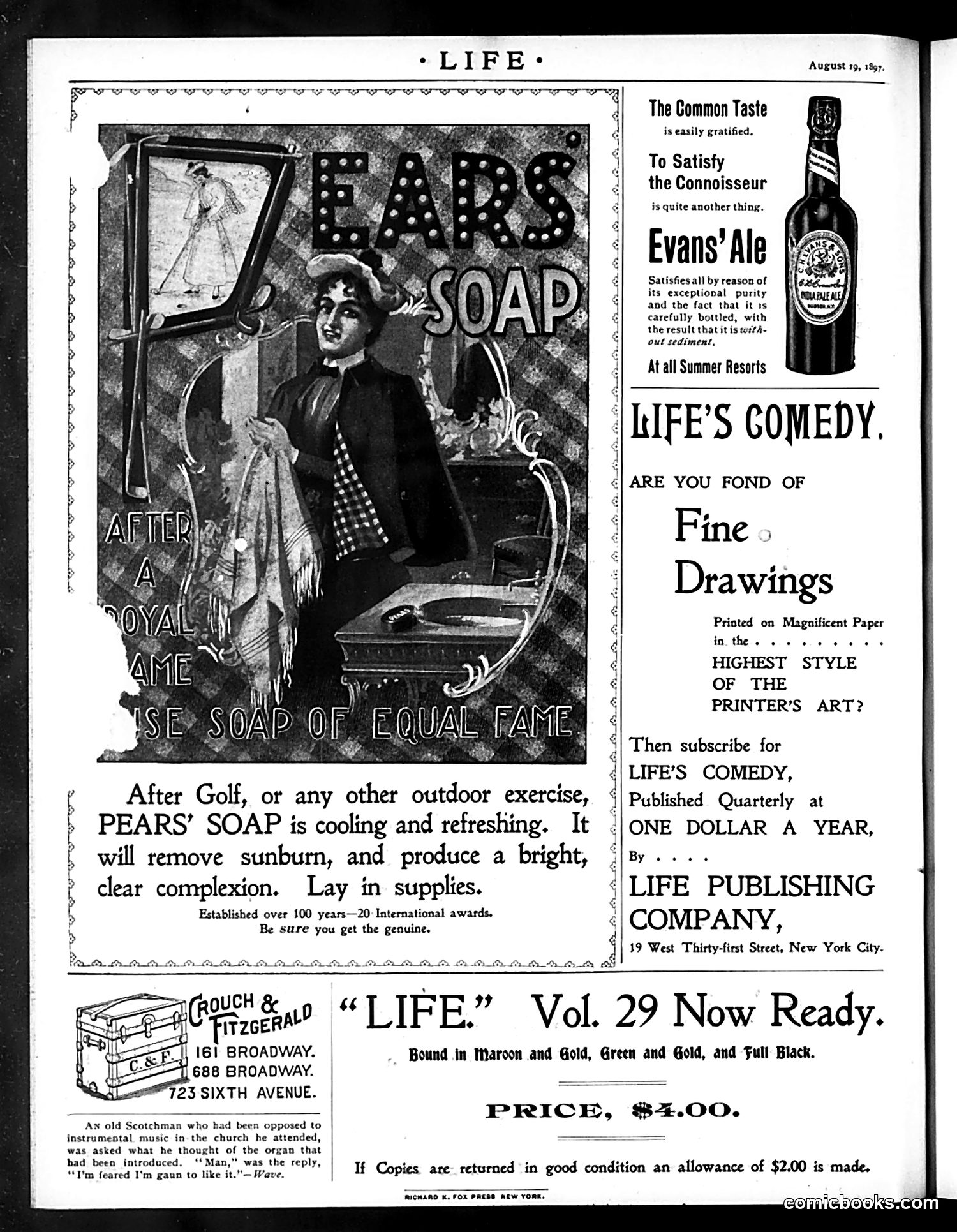
This page is primarily **advertising and promotional content** rather than political satire. The main visual element is a Pears' Soap advertisement featuring a theatrical scene labeled "After a Royal Game" — likely referencing a golf match. The image shows elegantly dressed figures in a bathroom setting, using the soap after outdoor exercise. The ad promises the product removes sunburn and produces clear complexion. The page also promotes **Life magazine itself** (Vol. 29) and Evans' Ale beer, positioning them as products for discerning consumers. The only satirical content is a brief anecdote at bottom: a Scottish man opposed to church organs, when asked his opinion of a newly introduced one, replies "I'm feared I'm gaun to like it" — gentle humor about reluctant acceptance of modern conveniences. The overall page reflects **turn-of-century consumer culture** and Life's positioning as a publication for educated, affluent readers.