
Life, 1897-08-19 · page 4 of 20
Life — August 19, 1897 — page 4: what you’re looking at
What you’re looking at
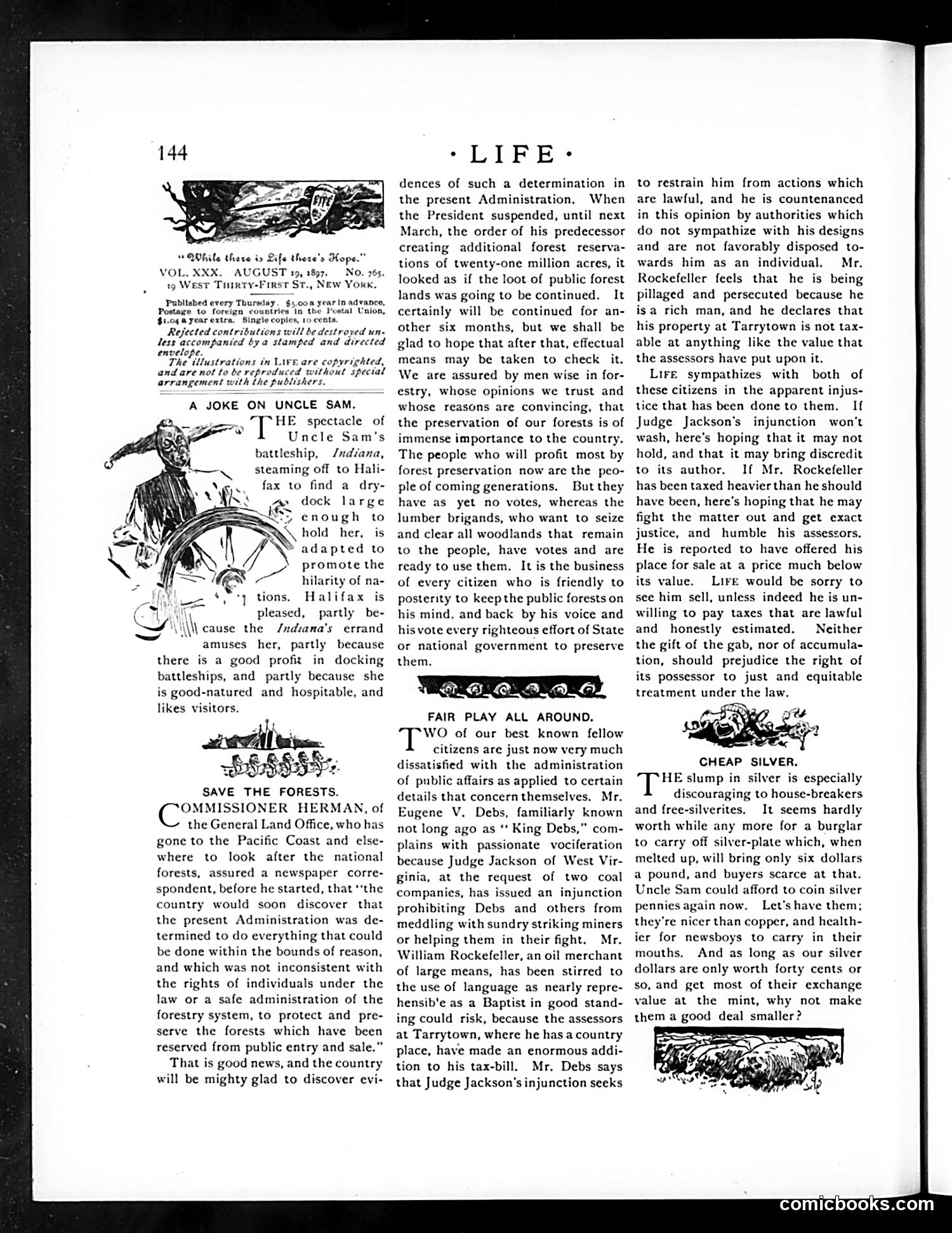
This page contains three satirical pieces addressing early 20th-century political controversies: **"A Joke on Uncle Sam"** features a caricatured figure (Uncle Sam) observing the USS *Indiana* steaming to Haiti. The joke appears to mock American military interventionism in the Caribbean, presented as absurd spectacle. **"Save the Forests"** criticizes the Roosevelt administration's forest conservation policies, suggesting the government was overreaching in restricting private property rights. It references specific disputes involving Judge Jackson, oil merchant William Rockefeller, and coal companies regarding land use and taxation. **"Fair Play All Around"** and **"Cheap Silver"** address contemporary economic grievances—the former concerning labor disputes, the latter mocking the declining value of silver coins. The cartoons collectively satirize government overreach, corporate interests, and economic policy debates of the Progressive Era.
📄 Transcribed text from this page (OCR, searchable)
Machine-transcribed from the original scan — historical spelling and the odd misread are preserved.
“OMhile there is Life there's Hope.” X. AUGUST 19, 1857. No. 76s. 1g West Tuirty-First St., New York. Published every Thureday. $5.coa year in advance, Postage to foreign countries in th $1.04 @yearextra. Single copies, 1 Rejected contributions will be destroyed un- tess accompanied bya stamped and directed envelope. The illustrations in Live are copyrighted, and are not to be reproduced without special arrangement with the publishers. A JOKE ‘ON UNCLE SAM. HE spectacle of Uncle Sam's battleship, /xd/ana, steaming off to Hali- fax to find a dry- wae dock large 'y enough to \\ hold her, is adapted to promote the vy + hilarity of na- *y tions, Halifax is pleased, partly be- ANY cause the /ndrana’s errand amuses her, partly because there is a good profit in docking battleships, and partly because she is good-natured and hospitable, and likes visitors. SAVE THE FORESTS. OMMISSIONER HERMAN, of the General Land Office, who has gone to the Pacific Coast and else- where to look after the national forests, assured a newspaper corre- spondent, before he started, that ‘the country would soon discover that the present Administration was de- termined to do everything that could be done within the bounds of reason, and which was not inconsistent with the rights of individuals under the law or a safe administration of the forestry system, to protect and pre- serve the forests which have been reserved from public entry and sale.” That is good news, and the country will be mighty glad to discover evi- LIFE dences of such a determination in the present Administration, When the President suspended, until next March, the order of his predecessor creating additional forest reserva- tions of twenty-one million acres, it looked as if the loot of public forest lands was going to be continued. It certainly will be continued for an- other six months, but we shall be glad to hope that after that, effectual means may be taken to check it, We are assured by men wise in for- estry, whose opinions we trust and whose reasons are convincing, that the preservation of our forests is of immense importance to the country. The people who will profit most by forest preservation now are the pco- ple of coming generations. But they have as yet no votes, whereas the lumber brigands, who want to seize and clear all woodlands that remain to the people, have votes and are ready to use them. It is the business of every citizen who is friendly to posterity to keep the public forests on his mind, and back by his voice and his vote every righteous effort of State or national government to preserve them. FAIR PLAY ALL AROUND. WO of our best known fellow citizens are just now very much dissatisfied with the administration of public affairs as applied to certain details that concern themselves. Mr. Eugene V. Debs, familiarly known not long ago as ‘‘ King Debs,” com- plains with passionate vociferation because Judge Jackson of West Vir- ginia, at the request of two coal companies, has issued an injunction prohibiting Debs and others from meddling with sundry striking miners or helping them in their fight. Mr. William Rockefeller, an oil merchant of large means, has been stirred to the use of language as nearly repre- hensib'e as a Baptist in good stand- ing could risk, because the assessors at Tarrytown, where he has a country place, have made an enormous addi- tion to his tax-bill. Mr. Debs says that Judge Jackson's injunction seeks to restrain him from actions which are lawful, and he is countenanced in this opinion by authorities which do not sympathize with his designs and are not favorably disposed to- wards him as an individual. Mr. Rockefeller feels that he is being pillaged and persecuted because he isa rich man, and he declares that his property at Tarrytown is not tax- able at anything like the value that the assessors have put upon it, Lire sympathizes with both of these citizens in the apparent injus- tice that has been done to them. If Judge Jackson's injunction won't wash, here’s hoping that it may not hold, and that it may bring discredit to its author. If Mr. Rockefeller has been taxed heavier than he should have been, here’s hoping that he may fight the matter out and get exact justice, and humble his assessors. He is reported to have offered his place for sale at a price much below its value. Lire would be sorry to see him sell, unless indeed he is un- willing to pay taxes that are lawful and honestly estimated. Neither the gift of the gab, nor of accumula- tion, should prejudice the right of its possessor to just and equitable treatment under the law. CHEAP SILVER. HE slump in silver is especially discouraging to house-breakers and free-silverites. It seems hardly worth while any more for a burglar to carry off silver-plate which, when melted up, will bring only six dollars a pound, and buyers scarce at that. Uncle Sam could afford to coin silver pennies again now. Let's have them; they're nicer than copper, and health- ier for newsboys to carry in their mouths. And as long as our silver dollars are only worth forty cents or so, and get most of their exchange value at the mint, why not make them a good deal smaller? comicbooks.com