
Life, 1897-08-19 · page 7 of 20
Life — August 19, 1897 — page 7: what you’re looking at
What you’re looking at
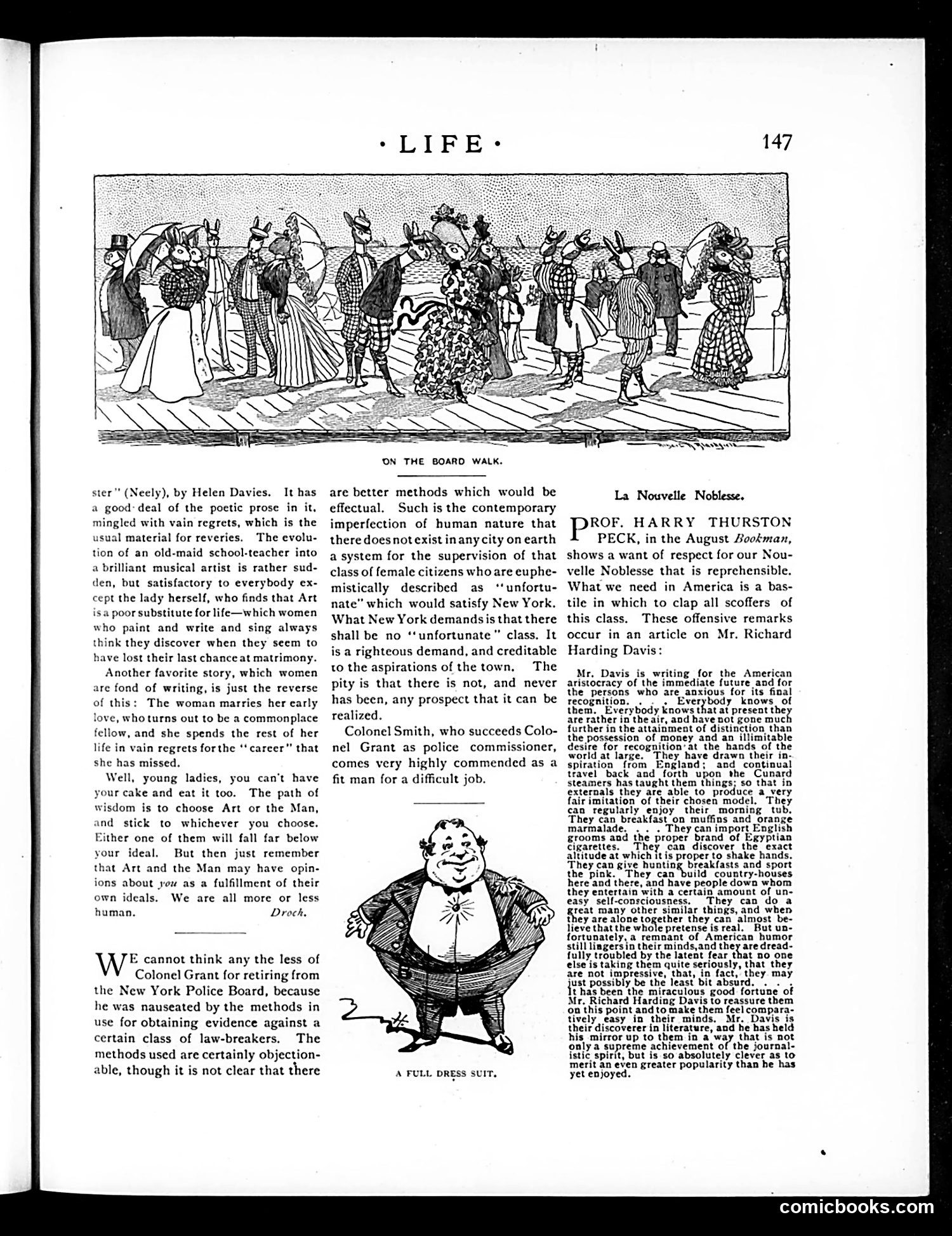
**Top Illustration:** A crowded seaside boardwalk scene showing fashionably dressed people in various poses—women in elaborate hats and dresses, men in suits. The style is typical early 20th-century social satire, likely mocking the pretensions and fashion consciousness of vacationing leisure-class Americans. **Bottom Cartoon:** Titled "A Full Dress Suit," depicts a rotund man in formal evening wear. This appears to be satirizing either obesity, vanity, or the absurdity of formal dress conventions—a common Life magazine target. The exaggerated proportions suggest mockery of either wealth, gluttony, or the gap between aspiration and reality among the social elite. Both images exemplify Life's trademark social commentary on American class and behavior during the magazine's satirical heyday.
📄 Transcribed text from this page (OCR, searchable)
Machine-transcribed from the original scan — historical spelling and the odd misread are preserved.
ster” (Neely), by Helen Davies. It has a good: deal of the poetic prose in it, mingled with vain regrets, which is the usual material for reveries. The evolu- tion of an old-maid school-teacher into a brilliant musical artist is rather sud- den, but satisfactory to everybody ex- cept the lady herself, who finds that Art isa poor substitute for life—which women who paint and write and sing always think they discover when they seem to have lost their last chance at matrimony. Another favorite story, which women are fond of writing, is just the reverse of this: The woman marries her early love, who turns out to be a commonplace fellow, and she spends the rest of her life in vain regrets forthe ‘‘carcer” that she has missed. Well, young ladies, you can’t have your cake and eat it too. The path of wisdom is to choose Art or the Man, and stick to whichever you choose. Either one of them will fall far below your ideal. But then just remember that Art and the Man may have opin- ions about you as a fulfillment of their own ideals. We are all more or less human. Droch, E cannot think any the less of Colonel Grant for retiring from the New York Police Board, because he was nauseated by the methods in use for obtaining evidence against a certain class of law-breakers. The methods used are certainly objection- able, though it is not clear that there ‘ON THE BOARD WALK. are better methods which would be effectual. Such is the contemporary imperfection of human nature that there doesnot exist inany city on earth a system for the supervision of that class of female citizens who are euphe- mistically described as ‘‘unfortu- nate” which would satisfy New York. What New York demands is that there shall be no ‘unfortunate ” class. It is a righteous demand, and creditable to the aspirations of the town, The pity is that there is not, and never has been, any prospect that it can be realized. Colonel Smith, who succeeds Colo- nel Grant as police commissioner, comes very highly commended as a fit man for a difficult job. A FULL DRESS SUIT, La Nowvelle Noblesse. ROF. HARRY THURSTON PECK, in the August Bookman, shows a want of respect for our Nou- velle Noblesse that is reprehensible. What we need in America is a bas- tile in which to clap all scoffers of this class. These offensive remarks occur in an article on Mr. Richard Harding Davis: Mr. Davis is writing for the American aristocracy of the immediate future and for the persons who are anxious for its final recognition. . . . Everybody knows of them. Everybody knows that at present the: are rather in the air, and have not gone muc! further in the attainment of distinction than the possession of money and an illimitable desire for recognition’ at the hands of the world at large. They have drawn their in- spiration from England; and continual travel back and forth upon the Cunard steamers has taught them things; so that in externals they are able to produce avery fair imitation of their chosen model. They can regularly enjoy their morning tub. They can breakfast on muffins and orange marmalade, . . . They can import English grooms and the proper brand of Egyptian cigarettes. They can discover the exact altitude at which it is proper to shake hands. ‘They can give hunting breakfasts and sport the pink. They can build country-houses here and there, and have people down whom they entertain with a certain amount of un- easy self-consciousness. They can do a reat many other similar things, and when they are alone together they can almost be- lieve that the whole pretense is real. But un- fortunately, a remnant of American humor still lingersin their minds,and {hey are dread: fully troubled by the latent fear that no one else is taking them quite seriously, that they are not impressive, that, in fact, they may just possibly be the least bit absurd. = thas been the miraculous good fortune of Mr. Richard Harding Davis to reassure them on this point and to make them feel compara- tively easy in their minds, Mr, Davis is their discoverer in literature, and he has held his mirror up to them in a way that is not only a supreme achievement of the journal- istic spirit, but is so absolutely clever as to merit an even greater popularity than he has yet enjoyed. comicbooks.com