
Life, 1897-08-19 · page 6 of 20
Life — August 19, 1897 — page 6: what you’re looking at
What you’re looking at
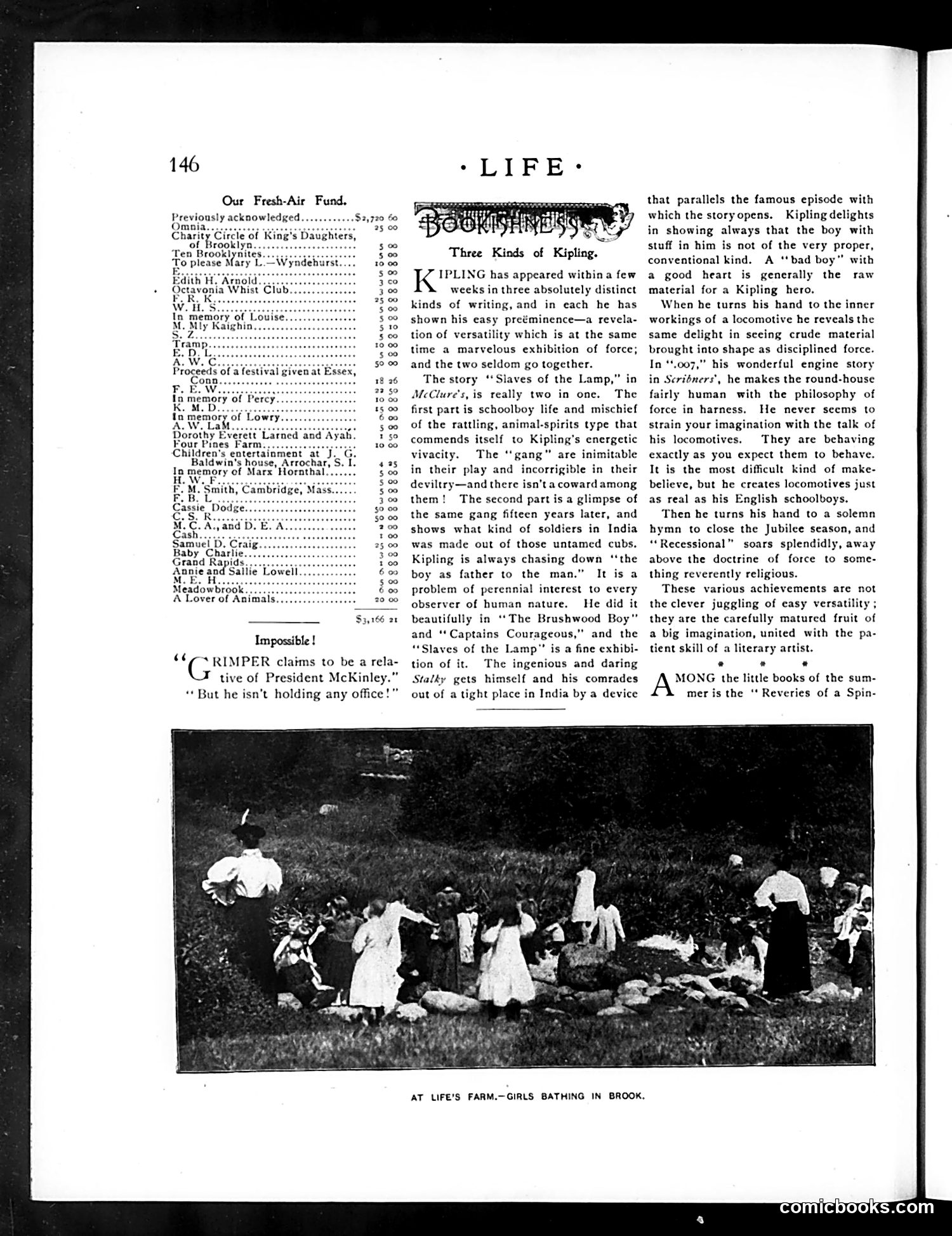
This page contains **no political cartoon**. Instead, it features: 1. **"Our Fresh-Air Fund"** - A charitable fundraising list showing donations to various organizations providing outdoor recreation for underprivileged children (hospitals, clubs, schools). 2. **"Three Kinds of Kipling"** - A literary article discussing Rudyard Kipling's works, analyzing how his stories depict boys and gang life realistically across different periods. 3. **"Impossible!"** - A brief joke: "CRIMPER claims to be a relative of President McKinley." "But he isn't holding any office!" 4. **Photograph** - "At Life's Farm—Girls Bathing in Brook" showing young women at a recreational facility. The page is primarily **educational/philanthropic content** with minimal satire, reflecting Life magazine's mix of social commentary and cultural criticism.
📄 Transcribed text from this page (OCR, searchable)
Machine-transcribed from the original scan — historical spelling and the odd misread are preserved.
146 Our Fresh-Air Previously acknowledged. Omnia, Charity Circle of King's of Brooklyn. Ten Brooklynite: To please Mary I Edith id Octavonia Whist Club FIR. K W. H. In memory of Louise. M ply Kaighin, E. A.W, : Proceeds of a festivai give! ‘on In memory of Pere K. M.D: 88ee tn memory of Lowry. A.W. Lam oe: Dorothy Ev La Four Pines Farm. Children's entertai Baldwin's house, Arrochar, te memory of Marx Hornthal. 83 mith, Cambridge, Mass. amet anwSSunnne Baby Charlie. Grand Rapids Annie and Saliie Lowell M.E. E Meadowbrook: A Lover of Animais 00 0 00 00 © 00 © co oo 0 oo rey Impossible ! ¢¢7- RIMPER claims to be a rela- tive of President McKinley. ‘But he isn’t holding any office! Three Kinds of Kipling. Kress has appeared within a few weeks in three absolutely distinct kinds of writing, and in each he has shown his easy pretminence—a revela- tion of versatility which is at the same time a marvelous exhibition of force; and the two seldom go together. The story ‘Slaves of the Lamp,” in McClure's, is really two in one. The first part is schoolboy life and mischief of the rattling, animal-spirits type that commends itself to Kipling’s energetic vivacity. The “gang” are inimitable in their play and incorrigible in their deviltry—and there isn'ta coward among them! The second part is a glimpse of the same gang fifteen years later, and shows what kind of soldiers in India was made out of those untamed cubs. Kipling is always chasing down “the boy as father to the man.” It is a problem of perennial interest to every observer of human nature. He did it beautifully in ‘The Brushwood Boy” and “Captains Courageous," and the ‘Slaves of the Lamp” is a fine exhibi- tion of it. The ingenious and daring Stalky gets himself and his comrades out of a tight place in India by a device AT LIFE’S FARM.—GIRLS BATHING IN BROOK. that parallels the famous episode with which the story opens. Kipling delights in showing always that the boy with stuff in him is not of the very proper, conventional kind. A ‘bad boy” with a good heart is generally the raw material for a Kipling hero. When he turns his hand to the inner workings of a locomotive he reveals the same delight in seeing crude material brought into shape as disciplined force. In ‘,007,” his wonderful engine story in Scriéners’, he makes the round-house fairly human with the philosophy of force in harness. He never seems to strain your imagination with the talk of his locomotives. They are behaving exactly as you expect them to behave. It is the most difficult kind of make- believe, but he creates locomotives just as real as his English schoolboys. Then he turns his hand to a solemn hymn to close the Jubilee season, and “Recessional” soars splendidly, away above the doctrine of force to some- thing reverently religious. These various achievements are not the clever juggling of casy versatility they are the carefully matured fruit of a big imagination, united with the pa- tient skill of a literary artist. * * * MONG the little books of the sum- mer is the ‘‘ Reveries of a Spin-