
A complete issue · 20 pages · 1897
Life — August 12, 1897
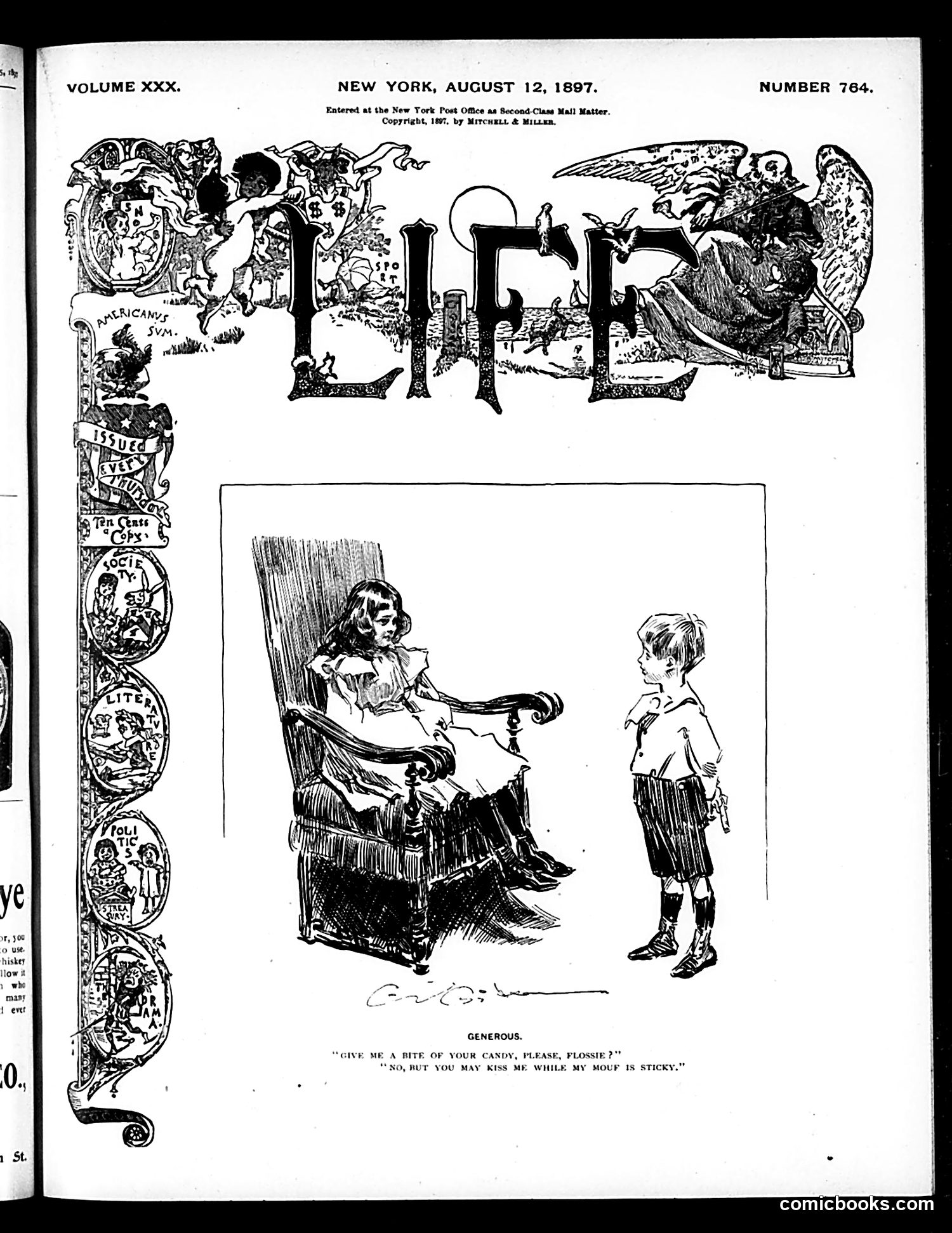
This page contains a single cartoon titled "Generous," depicting an interaction between a woman seated in a chair and a young boy standing before her. The dialogue reads: "GIVE ME A BITE OF YOUR CANDY, PLEASE, FLOSSIE?" / "NO, BUT YOU MAY KISS ME WHILE MY MOUTH IS STICKY." The cartoon appears to be a humorous commentary on social propriety and childhood behavior in the 1890s. The joke hinges on the woman's conditional offer—she won't share candy directly, but permits a kiss, which she frames as acceptable only because her mouth is "sticky" (presumably from the candy). This satirizes Victorian-era social conventions around acceptable physical contact and the somewhat contradictory or illogical reasoning adults used to justify their actions to children.
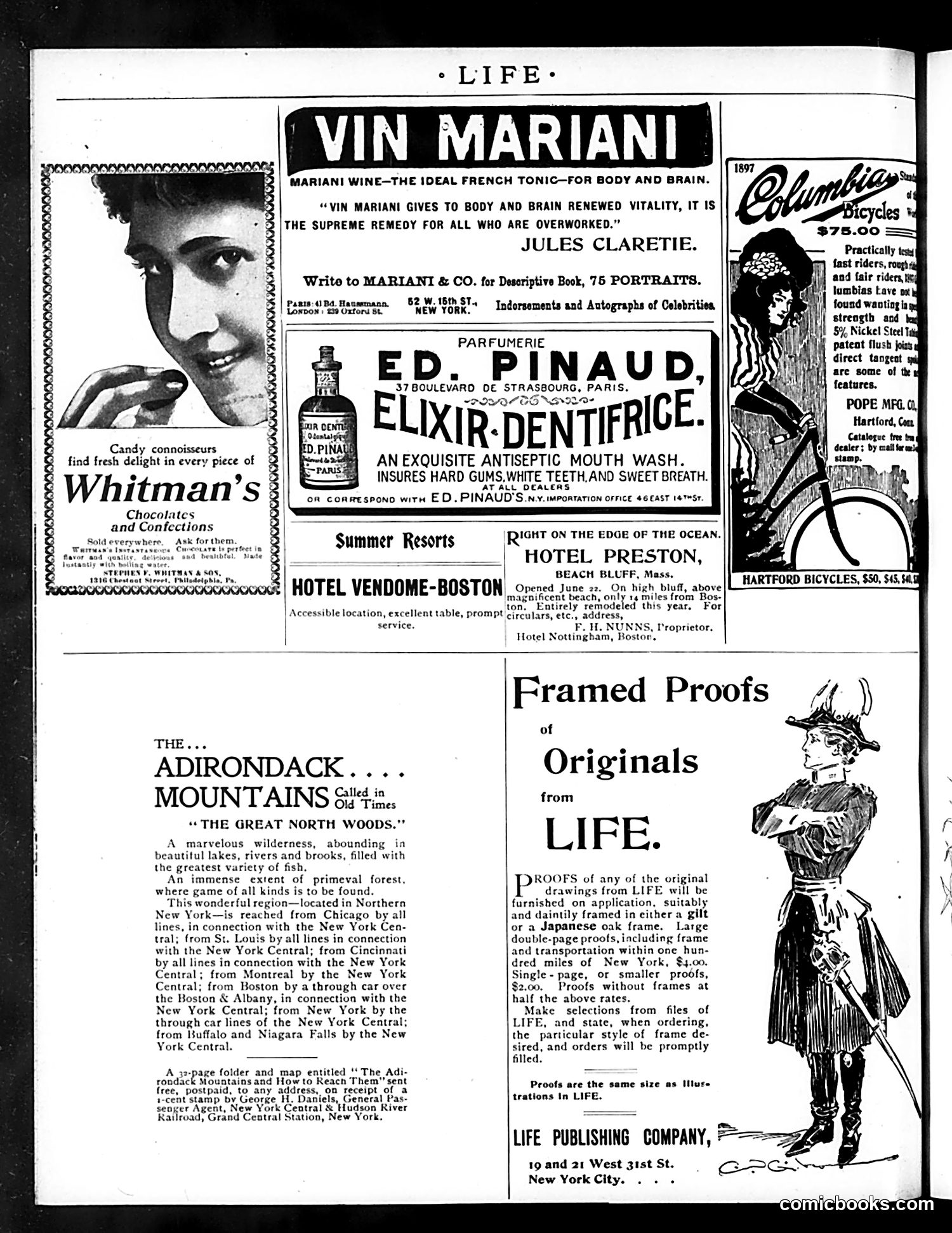
This page is primarily **advertising**, not political satire or cartooning. The top half contains ads for consumer products: Vin Mariani wine (marketed as a health tonic), Whitman's chocolates, Ed. Pinaud's mouthwash, bicycles, and resort hotels. These reflect late 19th/early 20th-century consumer culture. The lower half advertises the **Adirondack Mountains** as a tourist destination and promotes **Life Publishing Company's framed proofs** of original artwork—available in gilt or Japanese oak frames at various prices. The only illustration with a figure shows a fashionably-dressed woman advertising the framing service, but she's not a political caricature—simply a marketing image typical of the era. This is a straightforward commercial page rather than satirical content.
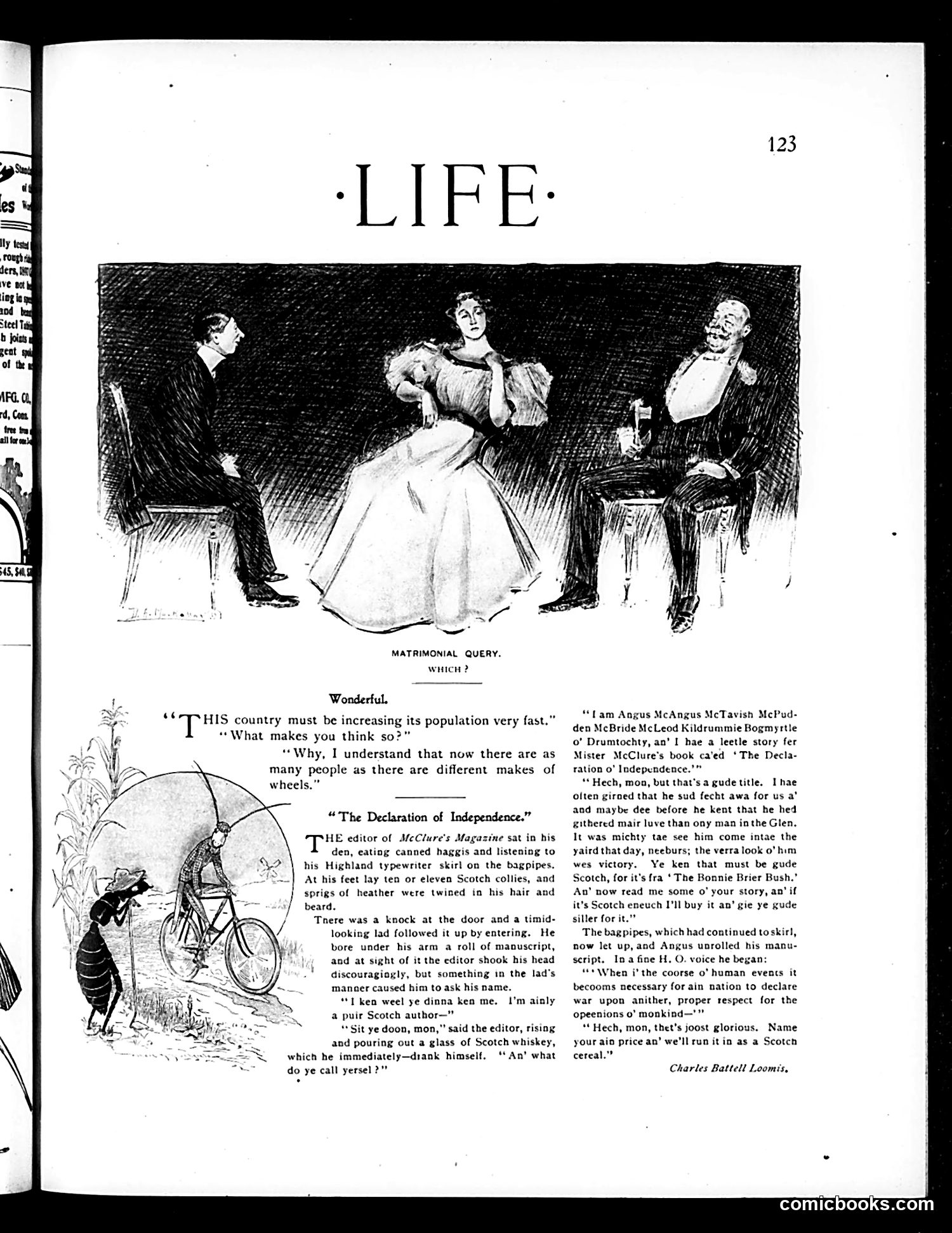
**Top Illustration: "Matrimonial Query"** This sketch depicts a social scene with a woman in an elaborate gown seated between two men in formal dress, with a third man observing. The caption "Which?" suggests satire about marriage prospects or romantic indecision—likely mocking the social conventions of courtship among the wealthy. **Bottom Story: "The Declaration of Independence"** This humorous piece describes a Scottish editor of *McClure's Magazine* who encountered bagpipes and Scottish collies while eating canned haggis. The narrative puns on Scottish identity ("The Declaration of Independence"), culminating in a joke about naming a breakfast cereal after Scottish heritage. The satire targets both Scottish stereotypes and the commercialization of ethnic identity.
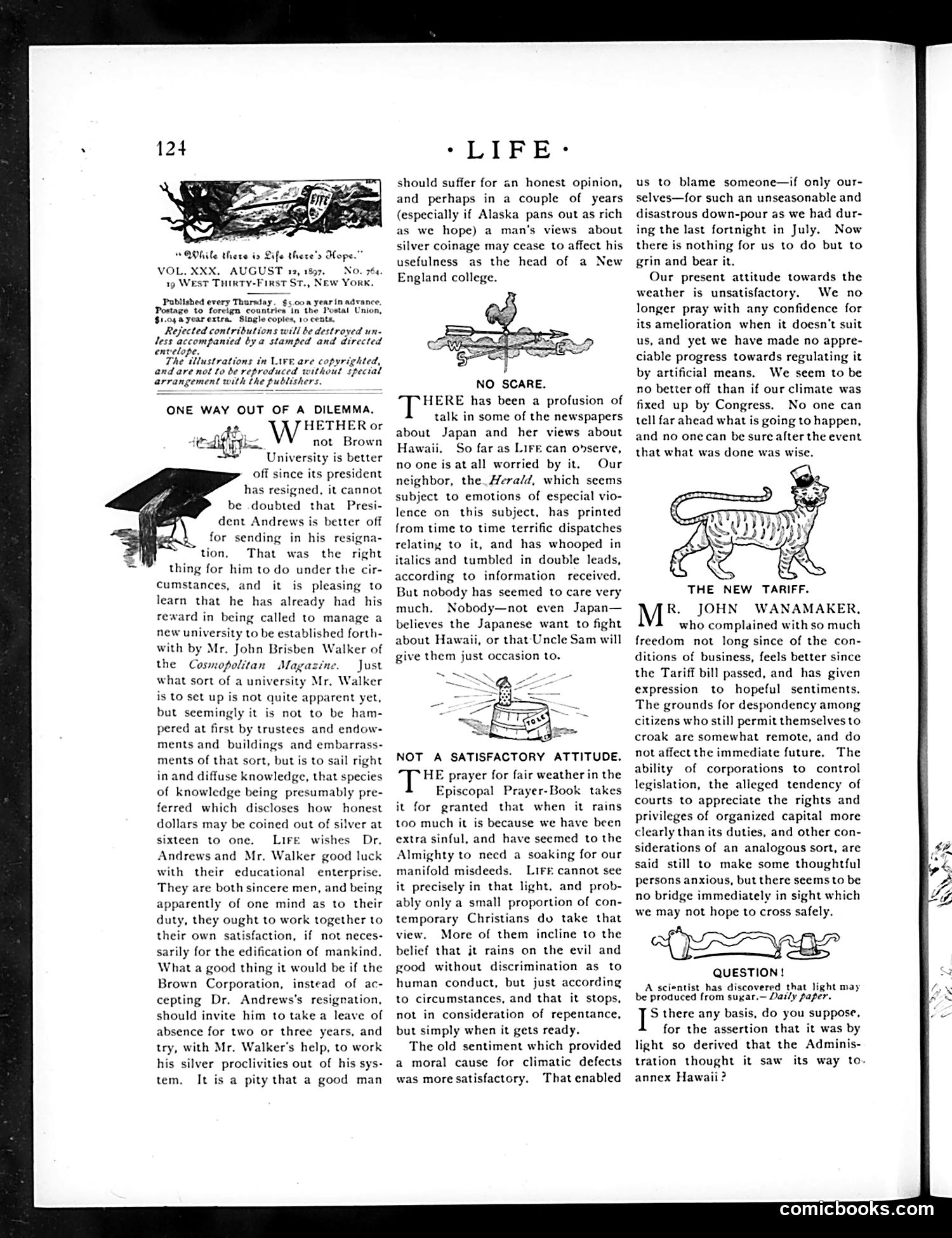
This page contains several political commentaries and satirical cartoons from early 20th-century *Life* magazine. **"One Way Out of a Dilemma"** discusses Brown University's president's resignation, debating whether the university should have accepted it. The text suggests President Andrews had his reputation questioned, and trustee Eben Wyer supports his departure. **"No Scare"** and subsequent sections address Japan and Hawaii—apparently responding to newspaper panic about Japanese intentions. The text mocks excessive alarm, suggesting the *Herald* newspaper has sensationalized concerns about conflict. **"Not a Satisfactory Attitude"** satirizes weather prayers in the Episcopal Prayer-Book, arguing that blaming moral failings for rain is outdated thinking. **"The New Tariff"** shows a cat, likely caricaturing businessman John Wanamaker, who supports the tariff bill's passage. The page primarily critiques institutional decisions and contemporary anxieties through political satire.
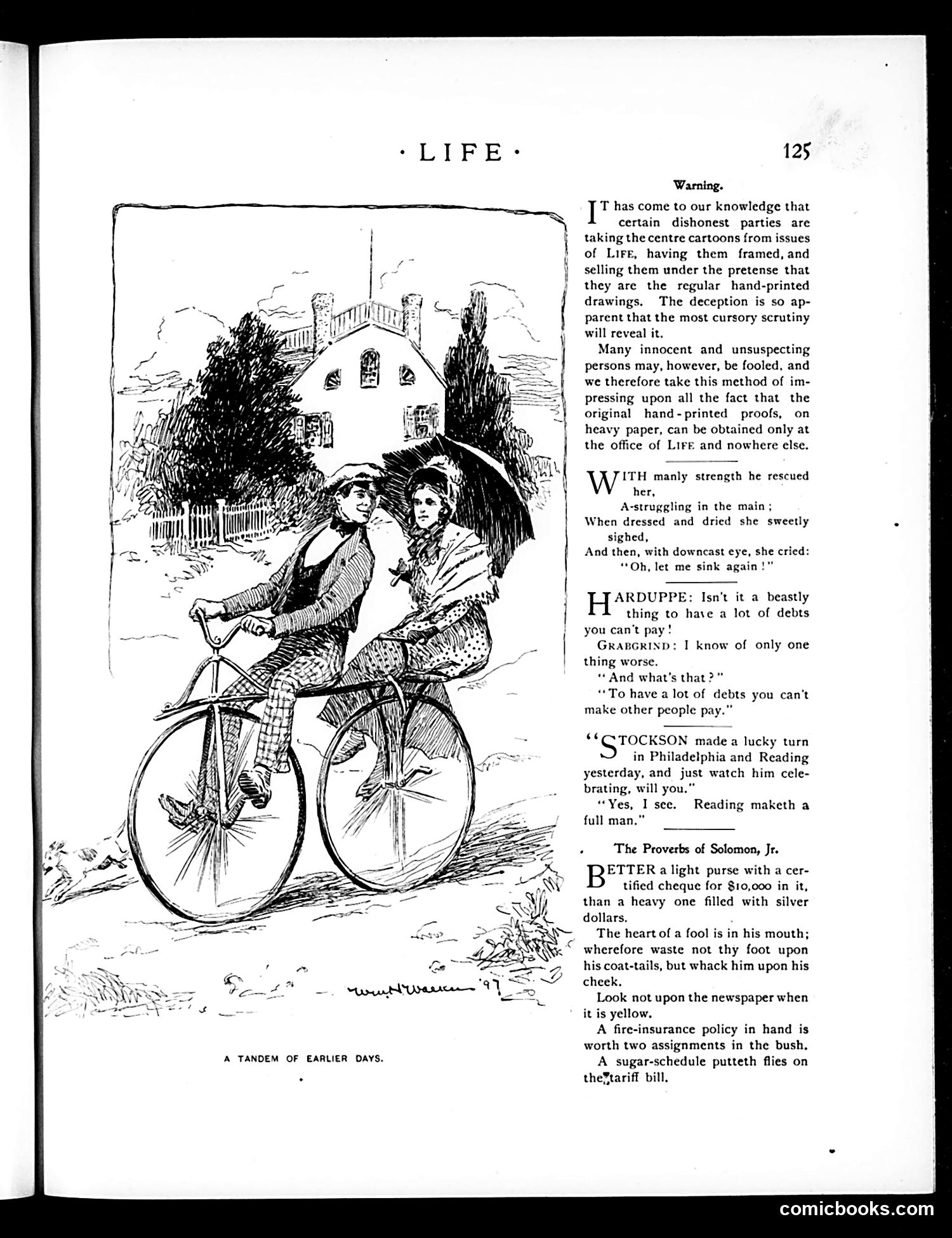
This illustration depicts two people on a tandem bicycle, with the woman appearing distressed ("Oh, let me sink again!"). The caption suggests nostalgia for an earlier era of courtship. The satire likely mocks Victorian-era romance and the physical awkwardness of early bicycle riding—a relatively new technology. The woman's distress humorously contrasts with supposed "earlier days" of romance, suggesting that tandems (requiring close physical proximity) were uncomfortable or compromising for couples, particularly by contemporary standards. The image plays on tension between romantic idealization of the past and its actual difficulties. The page's "Warning" section addresses art forgery—apparently counterfeit LIFE cartoons were being sold, making this both a consumer notice and implicit claim to authenticity.
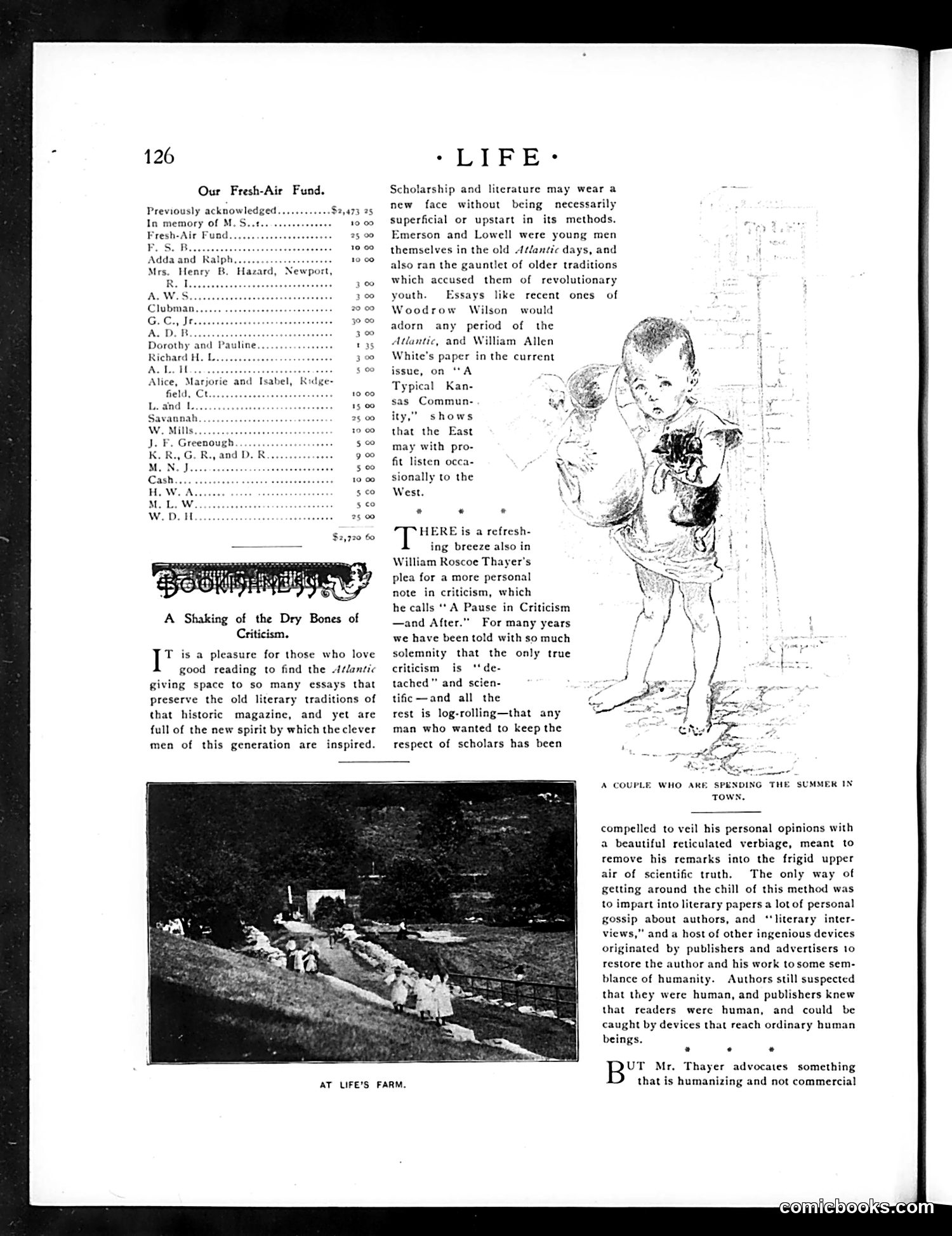
This page contains a literary essay titled "A Shaking of the Dry Bones of Criticism" discussing the *Atlantic* magazine's role in preserving literary traditions while embracing new ideas. The text praises figures like Emerson and Lowell for balancing old and new approaches. The right-side illustration shows a couple relaxing outdoors during summer, captioned "A COUPLE WHO ARE SPENDING THE SUMMER IN TOWN." This appears to be gentle satire about urbanites remaining in the city rather than vacationing elsewhere—a commentary on summer leisure habits of the era. The bottom photograph labeled "AT LIFE'S FARM" shows people in a rural pastoral setting, likely illustrating the contrast between urban and country life the article implicitly discusses.
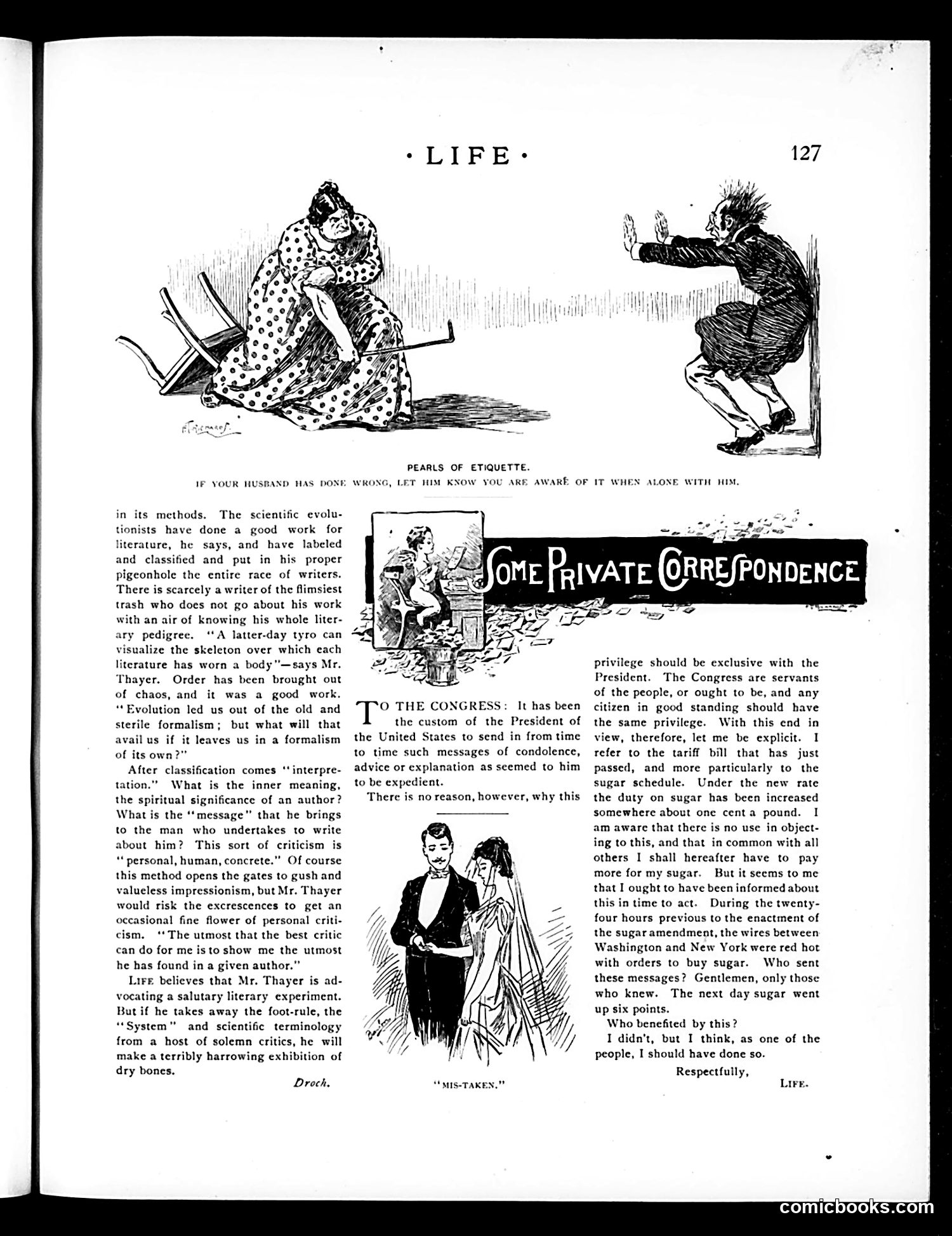
This page contains satirical commentary on literary criticism and a letter to Congress about sugar prices during wartime rationing. **Top cartoon ("Pearls of Etiquette"):** Shows a woman striking a man with a chair while another woman watches, captioned "If your husband has done wrong, let him know you are aware of it when alone with him." This mocks Victorian-era etiquette advice about marital conduct. **"Some Private Correspondence" section:** Features a letter from "Life" (the magazine) to Congress criticizing President Wilson's sugar price policies. The writer claims the new sugar duty increased prices by one cent per pound, and questions who benefited from advance warning allowing stockpiling before the price increase—implying insider trading or corruption among Washington elites. The illustration shows a bride, possibly referencing wedding expenses or domestic concerns.
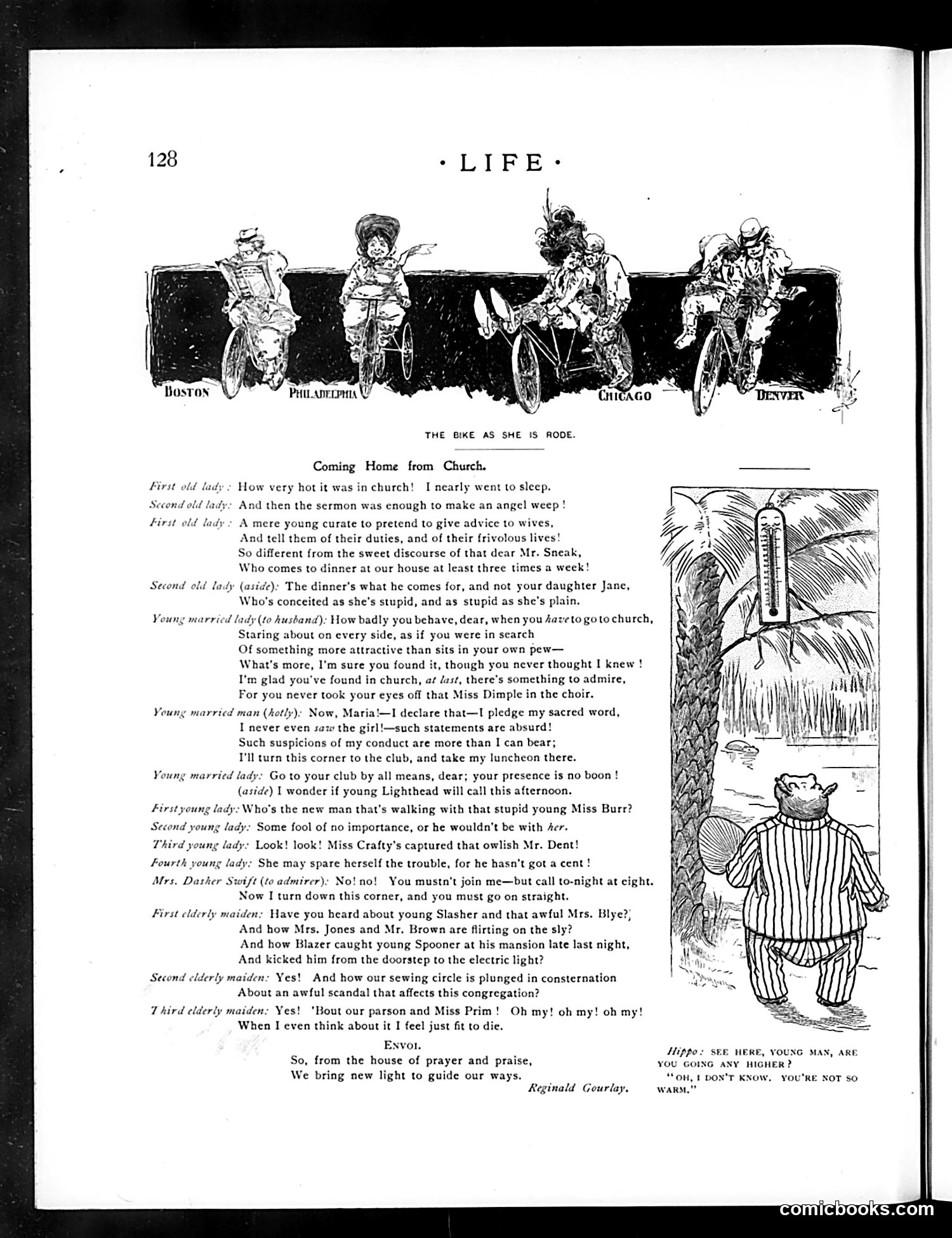
This satirical piece mocks women cyclists in five American cities (Boston, Philadelphia, Chicago, Denver) by depicting exaggerated, foppish male riders in feminine dress and affected poses. The accompanying dialogue, "Coming Home from Church," ridicules church gossip and propriety among elderly and young married women. They discuss scandals involving young people, flirtations, and social improprieties. The satire targets both the bicycle craze (then considered radical for women's independence) and Victorian social hypocrisy—particularly how church-going ladies obsess over others' moral failings while engaging in petty gossip. The crude stereotypes suggest contemporary anxiety about changing gender roles and women's newfound mobility through cycling.
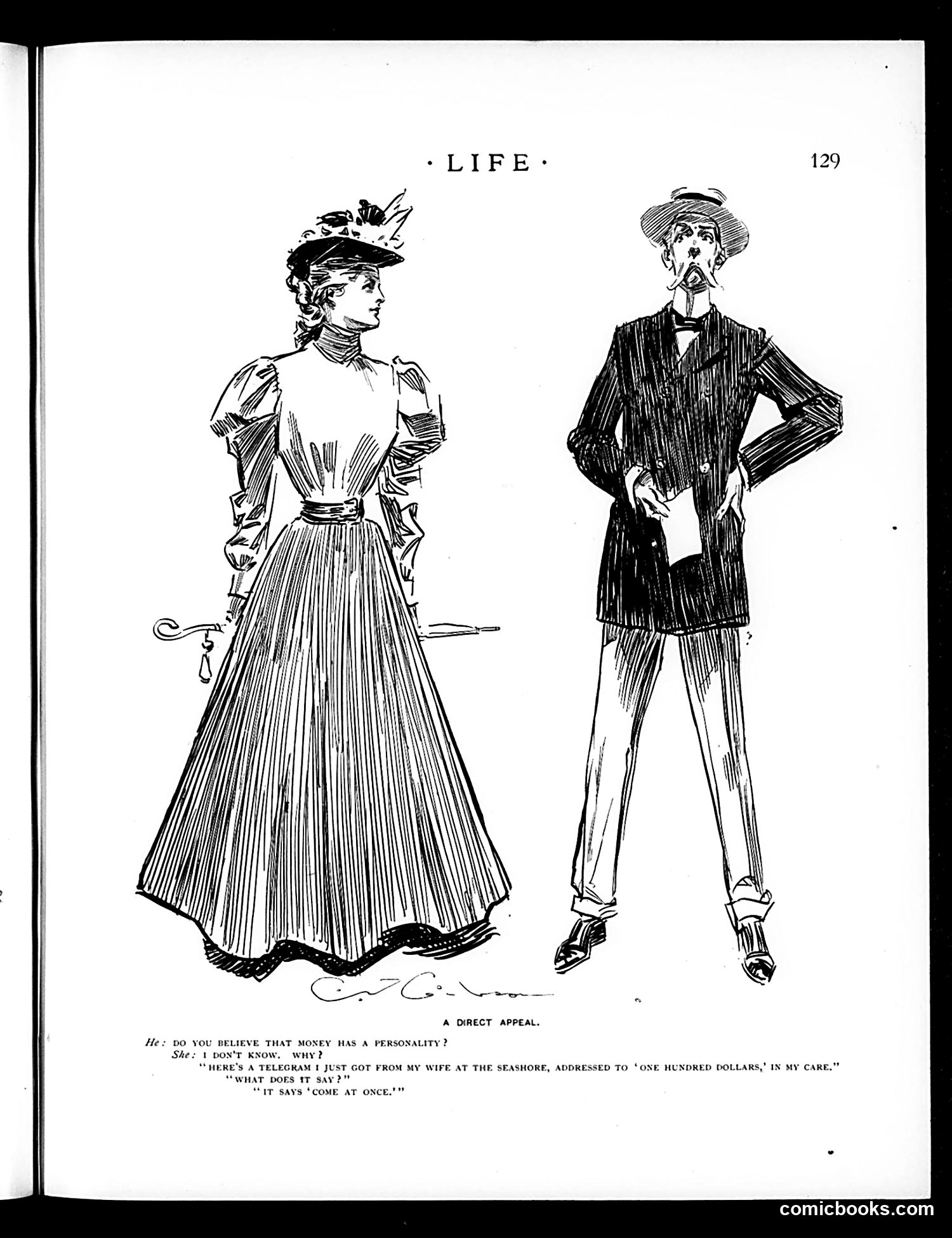
This cartoon satirizes marital dynamics and money. A woman in Edwardian dress confronts a man about a telegram from his wife at the seashore demanding "$100" urgently, with the message "Come at once." The humor plays on the phrase "money has a personality"—the man questions whether money itself has character, and the woman responds by demonstrating through this example that money certainly *acts* like it has personality: it appears and disappears with will and urgency. The "direct appeal" of the title refers both to the telegram's direct request and to money's apparent ability to make demands on people. The joke satirizes how financial anxiety, particularly wives' spending and husbands' obligation to pay, was a common marital tension point in early 20th-century domestic life.
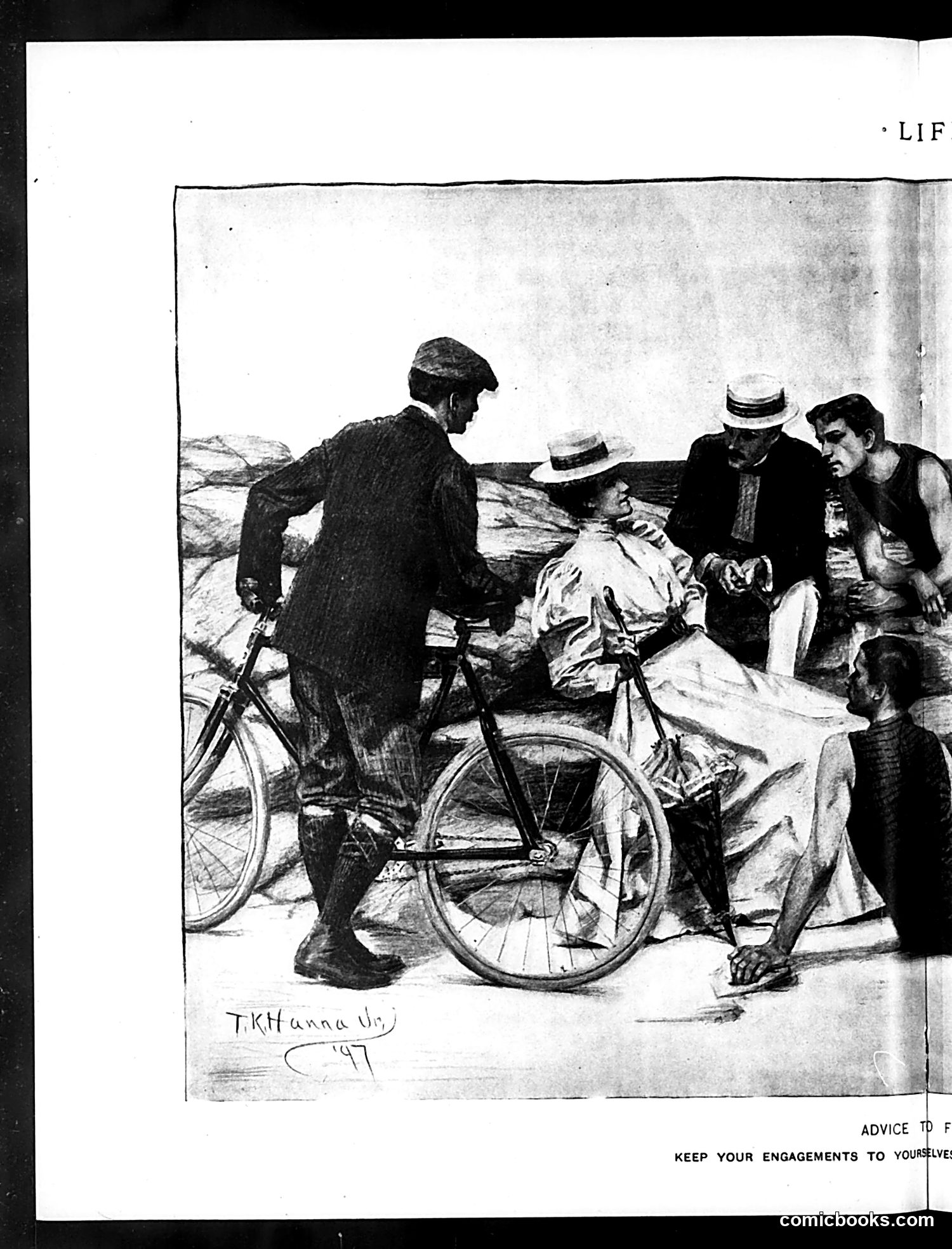
This appears to be a satirical illustration from Life magazine's advice column or editorial section. The cartoon depicts a man on a bicycle encountering a group of people (appearing to include a woman and children) on a roadside. The visible caption reads "ADVICE TO P[EOPLE]" and "KEEP YOUR ENGAGEMENTS TO YOURSELVE[S]" — suggesting the cartoon satirizes oversharing or publicly announcing one's plans or commitments. The scene depicts the cyclist as an intrusive figure, perhaps representing how people broadcast their personal affairs to strangers. The overall joke appears to criticize the social tendency to discuss private matters publicly, advising discretion instead. The artist's signature appears to read "T. Kittana" or similar, though this is not entirely clear from the image.
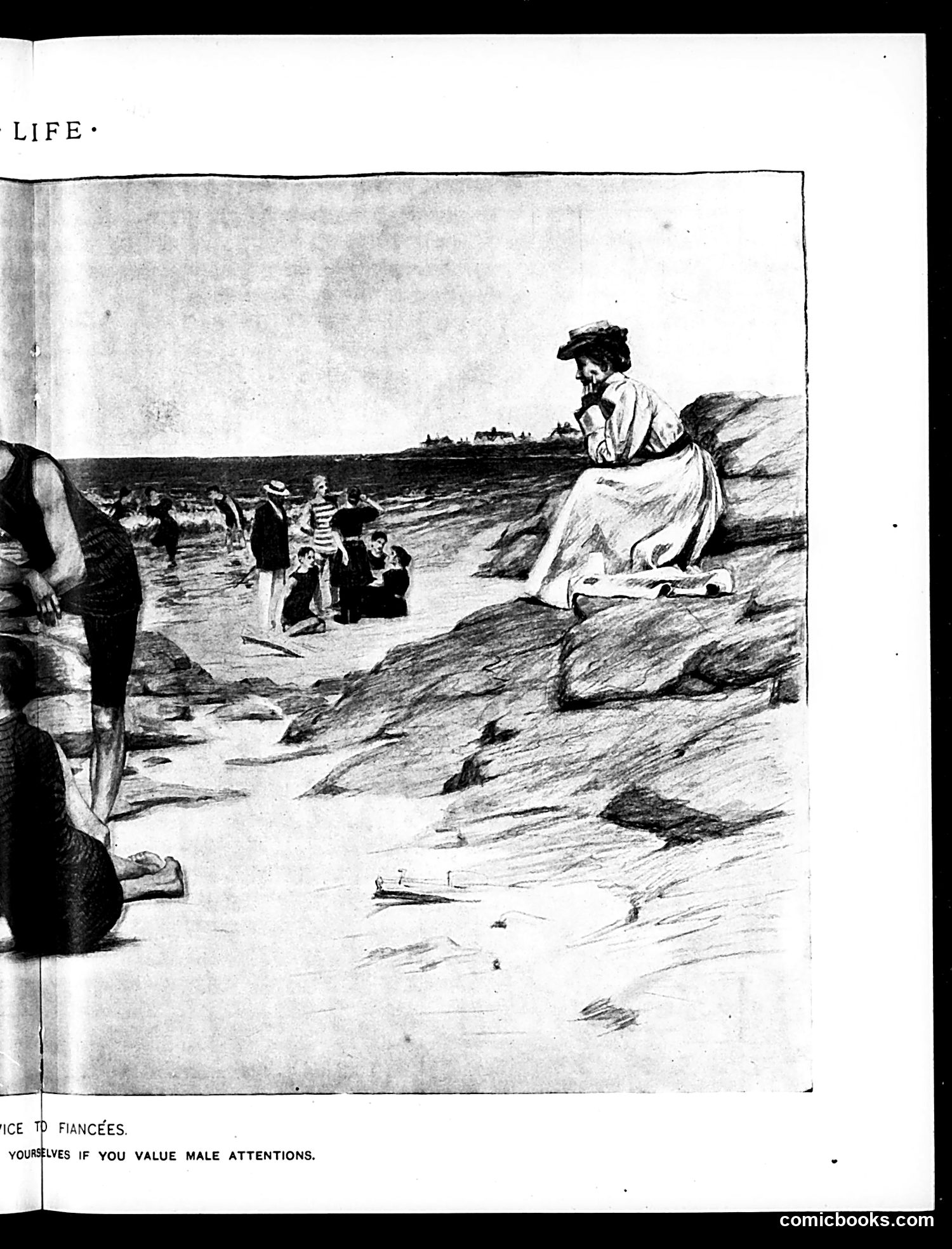
This page from *Life* magazine shows a beach scene with Victorian-era figures. The visible text at bottom reads "...ICE TO FIANCÉES" and "YOURSELVES IF YOU VALUE MALE ATTENTIONS," suggesting the caption offers advice to engaged women. The satire appears to mock Victorian social conventions around courtship and female behavior at leisure. A woman prominently positioned on the rocks (right) observes beachgoers below, likely illustrating a point about female decorum or modesty in public settings. The full caption, cut off in this image, presumably counsels women to maintain certain propriety to retain male interest. The cartoon satirizes rigid gender norms and courtship rituals of the era, using a beach outing to critique expectations placed on women's public comportment.
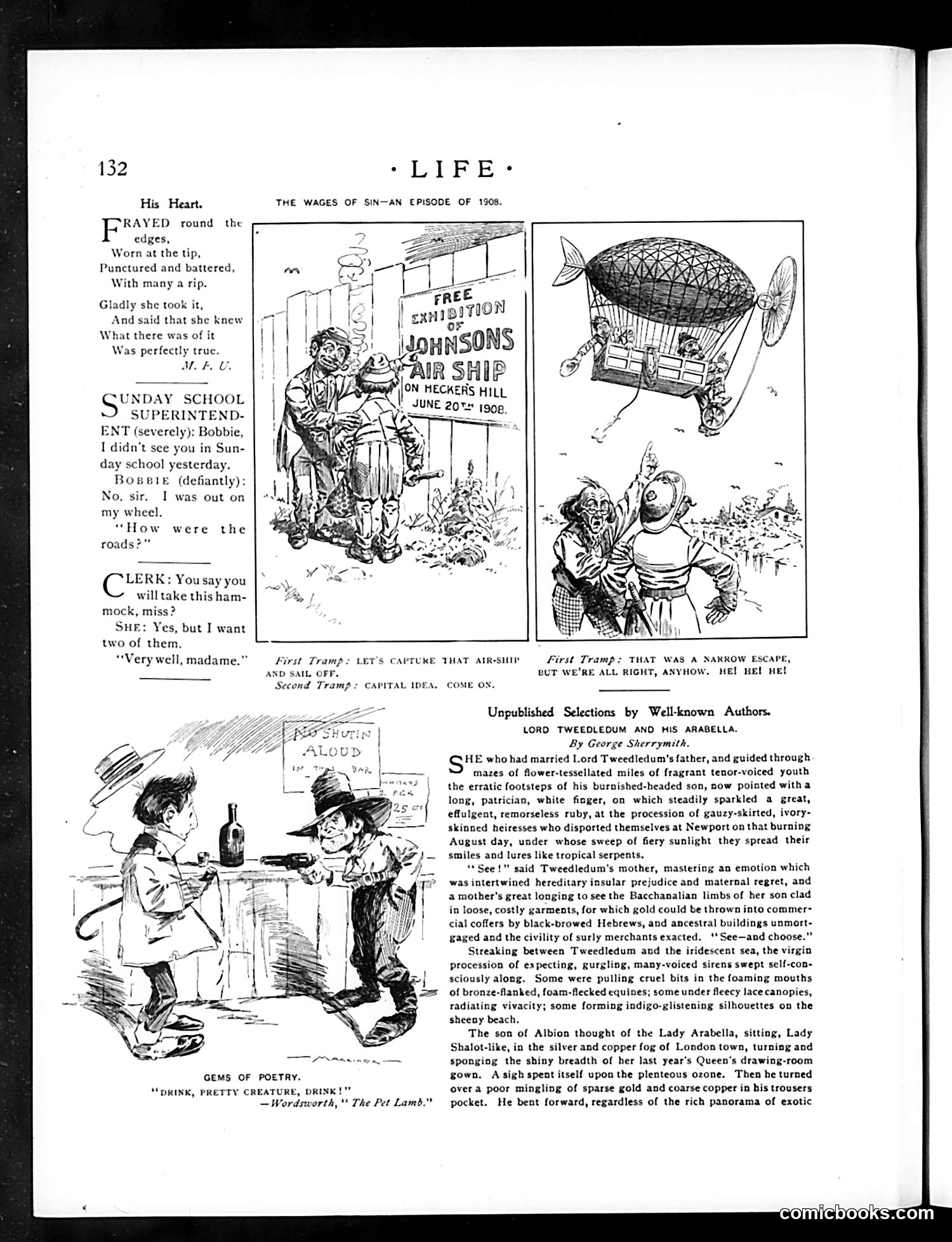
This page contains two distinct sections: **Top cartoons**: Satirize the 1908 Johnson airship exhibition at Neckers Hill. The sketches mock the spectacle of early aviation, showing crowds gawking at a primitive airship. The humor centers on the wonder and danger of experimental flying machines—the second panel jokes about a "narrow escape" from the airship, reflecting public fascination and anxiety about this novel technology. **Bottom section**: "Gems of Poetry" presents a dialogue between two working-class men at what appears to be a pub, discussing drink. The illustration satirizes lower-class speech and behavior through crude caricature, typical of Life's social humor of the era. The quoted phrase from Wordsworth is used ironically to mock the men's vulgar interests. Both segments employ satire of public spectacle and class stereotypes common to early 1900s humor.
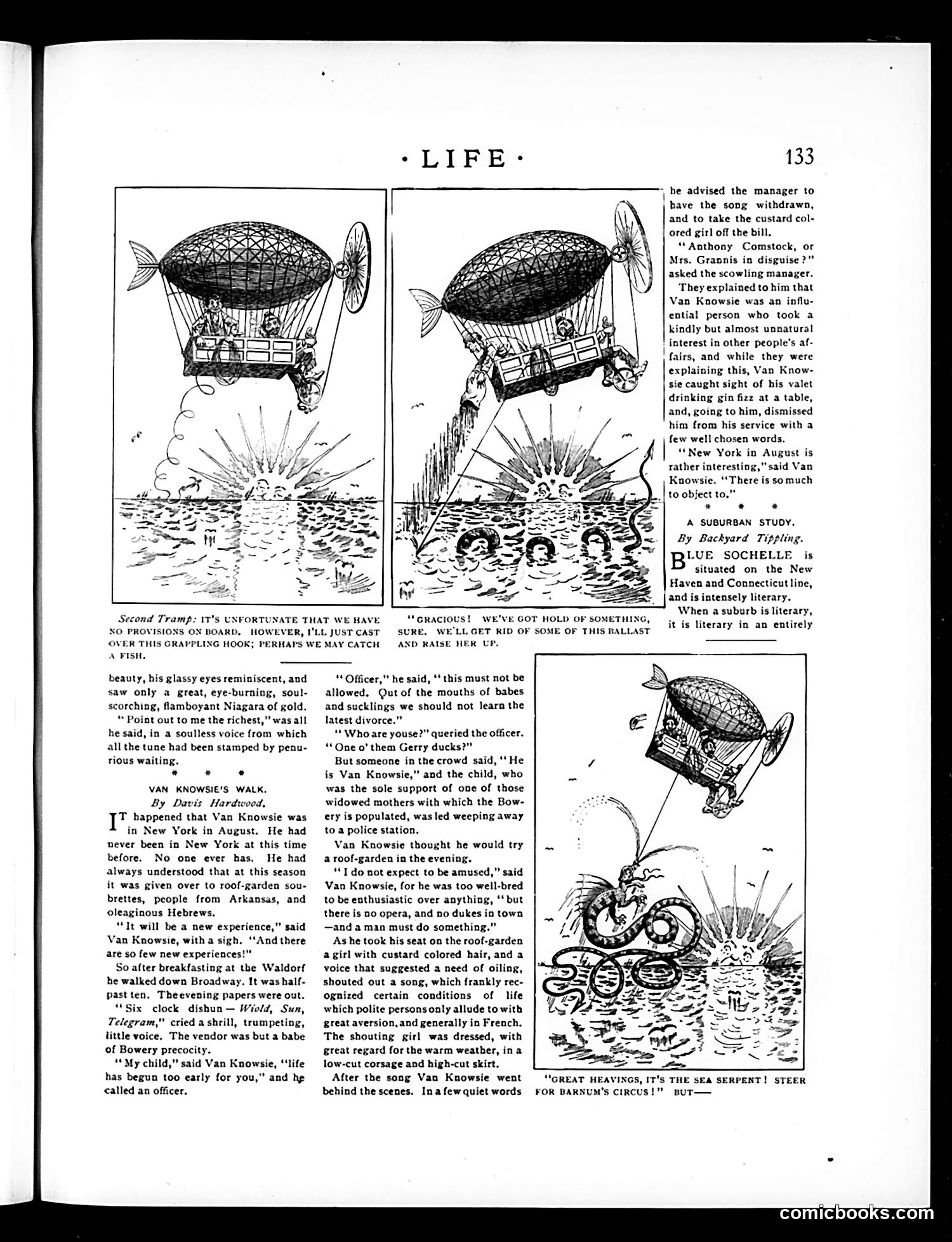
This page contains two satirical stories mocking social pretension and hypocrisy in early 1900s America. **"Van Knowsie's Walk"** ridicules an insufferably sanctimonious wealthy man who polices others' morality while being oblivious to his own servant's behavior. He calls a police officer to arrest a child newspaper vendor (referencing "Gerry ducks"—children protected by the Society for Prevention of Cruelty to Children), objects to a risqué song at a roof-garden theater, and lectures the manager about decency—yet fails to notice his own valet drinking gin at a nearby table. The satire targets moral busybodies and the era's rigid Victorian propriety enforced selectively by the wealthy. The top cartoons show hot-air balloons landing/crashing, with captions about fishing for provisions and jettisoning ballast—likely metaphorical commentary on financial speculation or social climbing (unclear without fuller context). **"A Suburban Study"** begins a story about "Blue Sochelle," a Connecticut suburb described as "intensely literary"—suggesting intellectual pretension in affluent communities.
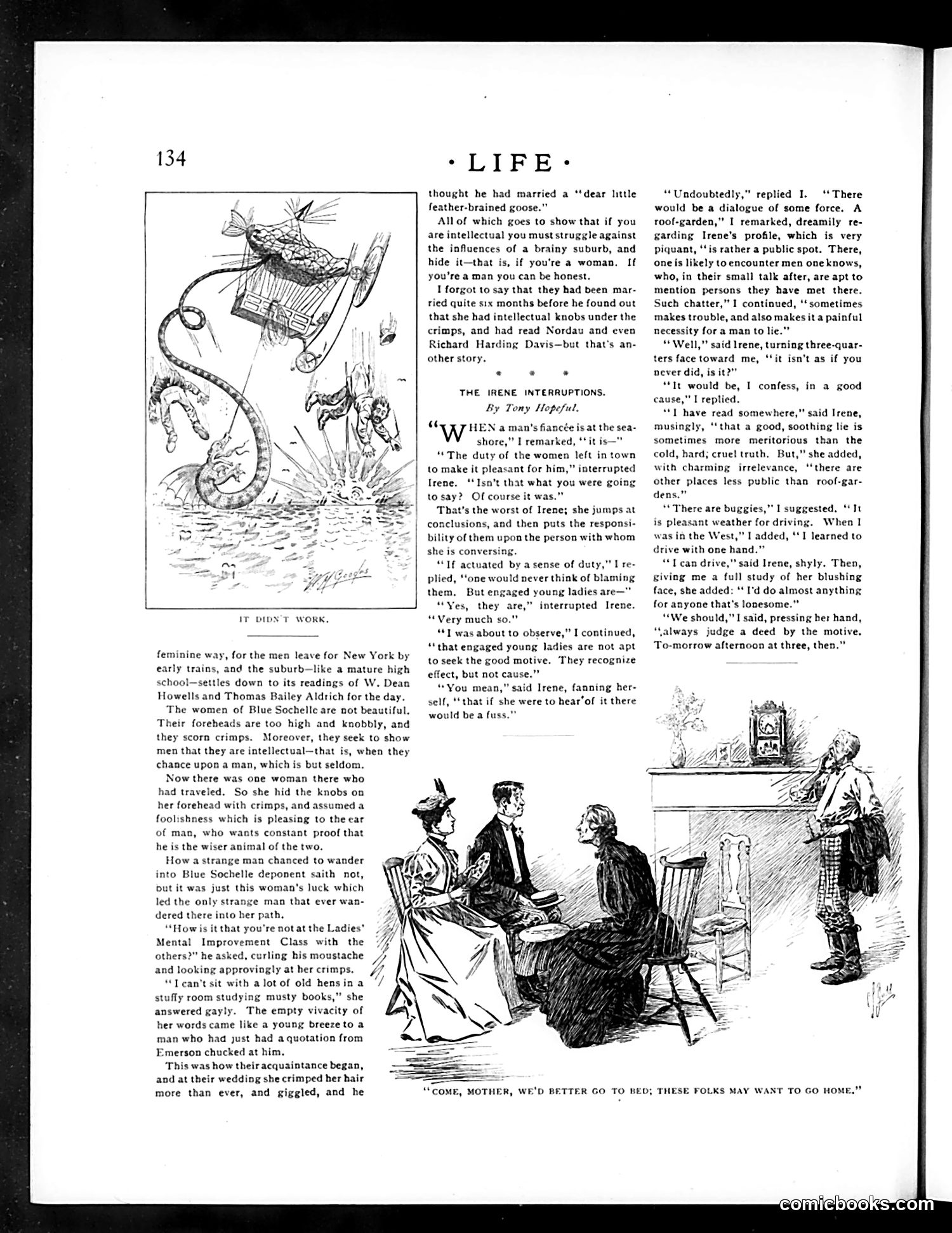
This page satirizes early 20th-century gender dynamics and courtship rituals in suburban America. The main cartoon shows a conversation between a male narrator and "Irene," an intelligent woman from "Blue Sochelle" suburb who strategically hides her intellectual abilities (conceals her "intellectual knobs" under crimps/curled hair) to appear attractively "feather-brained" to men. The satire's target: women are forced to disguise intelligence to appeal to suitors, yet men resent discovering the deception afterward. The narrator's repeated interruptions by Irene mock male conversational pretension—she anticipates and completes his sentences, deflating his attempts at witty remarks. The subplot reveals Irene's calculated strategy: by playing foolish, she has successfully attracted the only available bachelor in the suburb. The joke ultimately critiques both sexes: men's desire for "wiser animal" superiority, and women's necessary performance of ignorance within courtship's constraints.
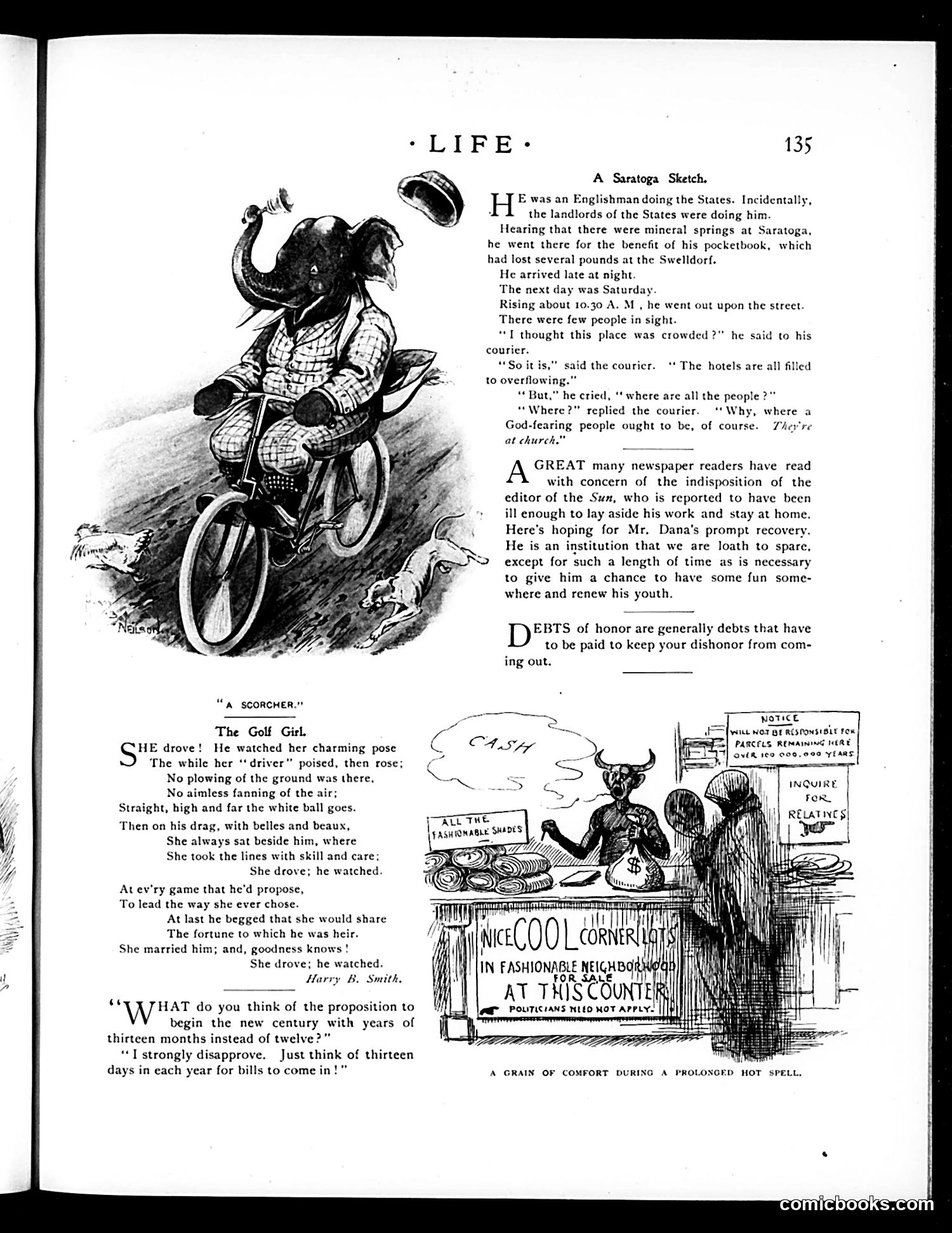
This page contains three satirical pieces typical of late-19th-century American humor: **"A Saratoga Sketch"** mocks wealthy English tourists visiting Saratoga Springs, a fashionable resort town. The joke hinges on the Englishman's surprise that the crowded hotels are empty on Saturday morning—his courier's response that people are "at church" sarcastically suggests Americans are hypocritically pious while simultaneously engaging in gambling and financial excess (the Englishman lost money at "the Swelldorf," implying gambling losses). **"The Golf Girl"** (by Harry B. Smith) is a romantic poem about a woman golfer who dominates her suitor—literally and figuratively. The repeated refrain "She drove; he watched" plays on double meaning: she drives the golf ball *and* drives the carriage, while he remains passive. The satire gently mocks both the "New Woman" of the era and submissive masculinity. **The lower cartoon** advertises a "Nice Cool Corner" shop offering relief during hot weather, with a humorous notice that "politicians need not apply." The page reflects turn-of-century anxieties about social change, wealth, leisure, and shifting gender roles.
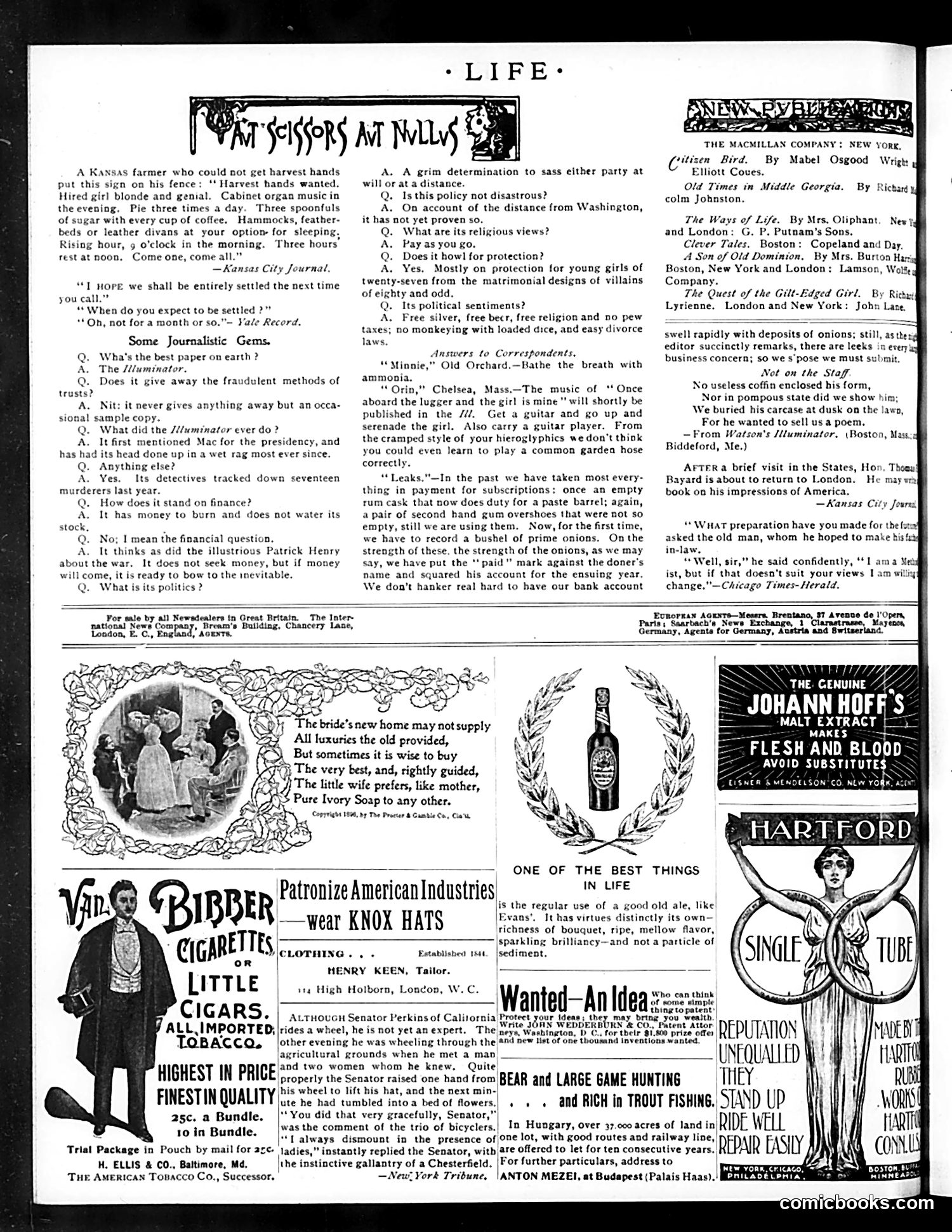
This page satirizes American journalism and rural life through humorous Q&A exchanges mocking *The Illuminator*, a newspaper portrayed as politically evasive and sensationalist. The main cartoon lampoons the publication's contradictory stance: it claims independence ("sass either party at will") yet distances itself from Washington politics to avoid consequences. The joke is that this supposed fearlessness is hollow—safe only because geographically remote. The "Journalistic Gems" section ridicules common newspaper hypocrisies: claiming investigative integrity while avoiding real scrutiny of trusts, chasing sensational crime stories, and adopting populist positions (free silver, free beer) without serious conviction. The final "Answers to Correspondents" mocks the paper's desperation for payment—accepting onions instead of cash. The Kansas farmer anecdote and "When do you expect to be settled?" jokes are separate rural humor, typical of *Life*'s satirical miscellany. The page reflects late-19th-century concerns about journalistic credibility and sensationalism.
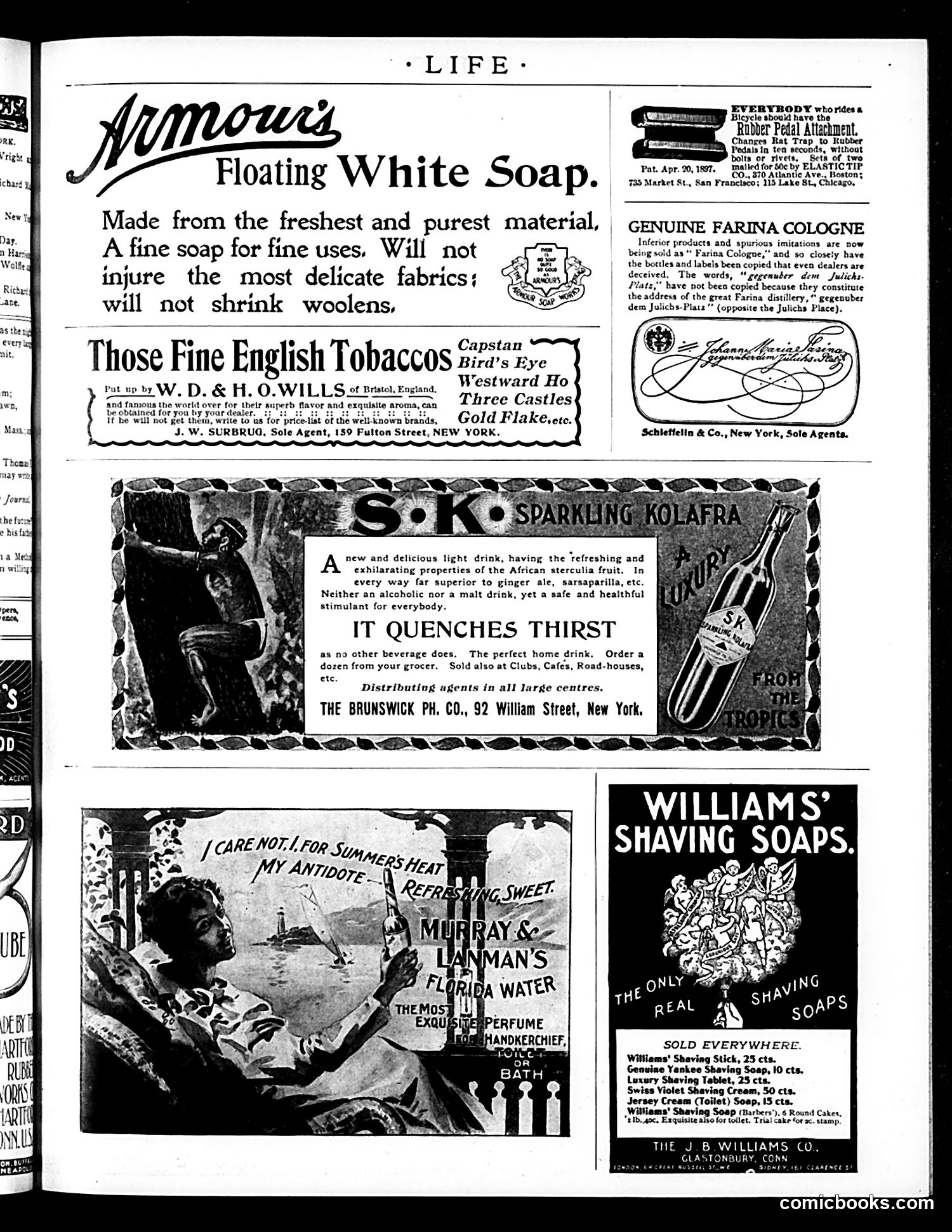
This page is **primarily advertising**, not satire or political commentary. It contains multiple product advertisements typical of early 20th-century magazines: **Notable ads include:** - **Armour's Floating White Soap** — emphasizes purity and gentleness on fabrics - **S.K. Sparkling Kolafra** — a non-alcoholic beverage made from African fruit, marketed as a safe "stimulant for everybody" - **Murray & Lanman's Florida Water** — featured in an illustration of a man seeking relief from summer heat - **Williams' Shaving Soaps** — various formulations sold at different price points The imagery is straightforward product promotion rather than satirical commentary. The largest illustration shows a man cooling himself, promoting perfumed water as a summer remedy—a practical appeal to readers rather than social critique. This appears to be a standard advertising section, reflecting consumer products and marketing approaches of the era.
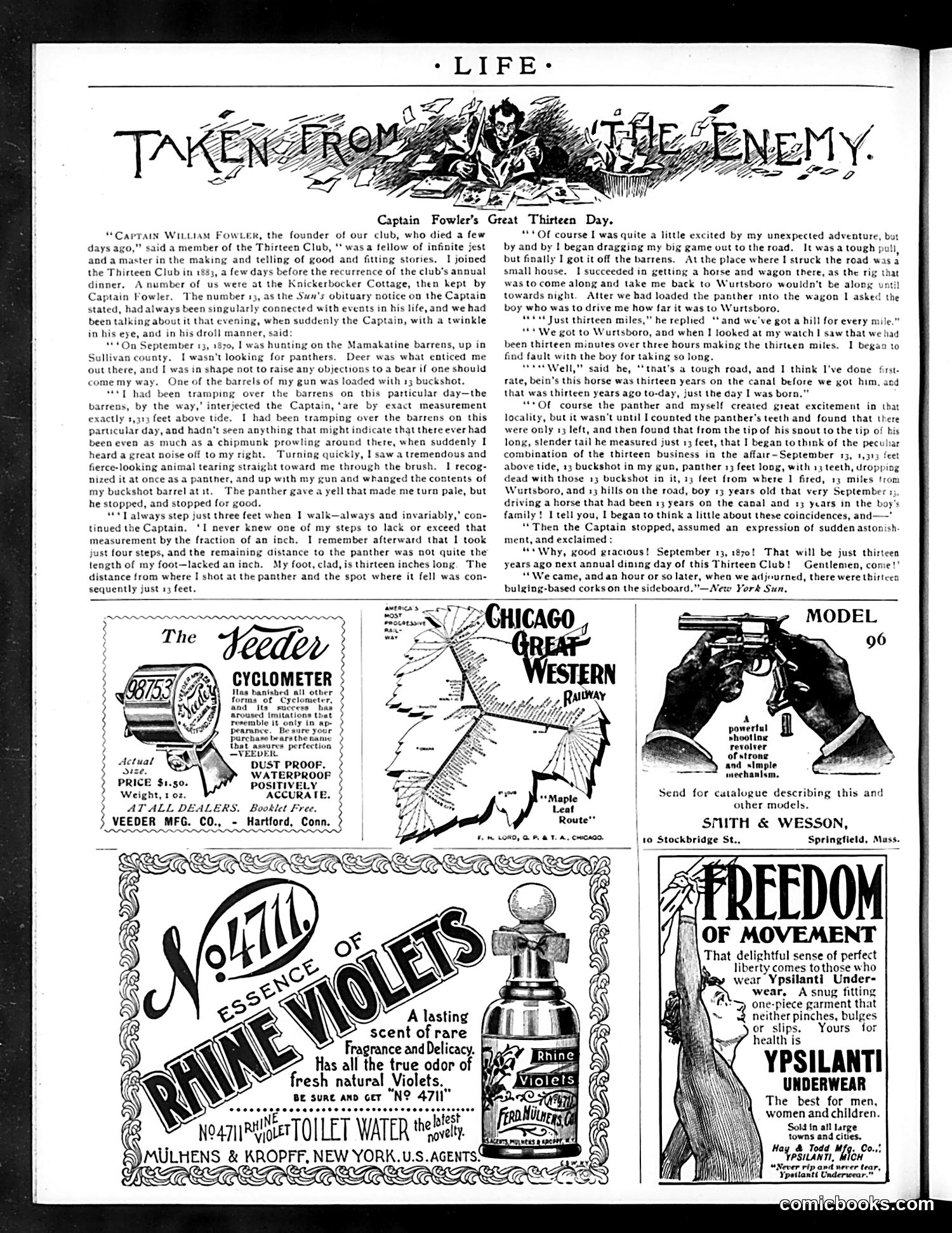
This page contains a humorous tall tale by Captain William Fowler, founder of the "Thirteen Club," a real organization that celebrated the number 13 and dining on the 13th of the month (considered unlucky by superstitious people). The narrative is a comic exaggeration: Fowler recounts hunting in 1870 and killing a panther with remarkable coincidences—all involving the number 13. His gun held 13 buckshots, the terrain was 1,313 feet high, he took exactly 13 steps to the dead panther, his foot measured 13 inches, the journey took 13 hours and 13 minutes for 13 miles, the horse was 13 years old, and the panther had exactly 13 teeth remaining. The satire mocks superstition about unlucky numbers while celebrating the club's irreverent philosophy—that 13 is merely coincidental, not supernatural. The story's absurd accumulation of 13s becomes increasingly ridiculous, the point being to laugh at numerical superstition itself. The surrounding advertisements (Rhine Violets toilet water, Ypsilanti underwear, Smith & Wesson revolver) are period product placements.
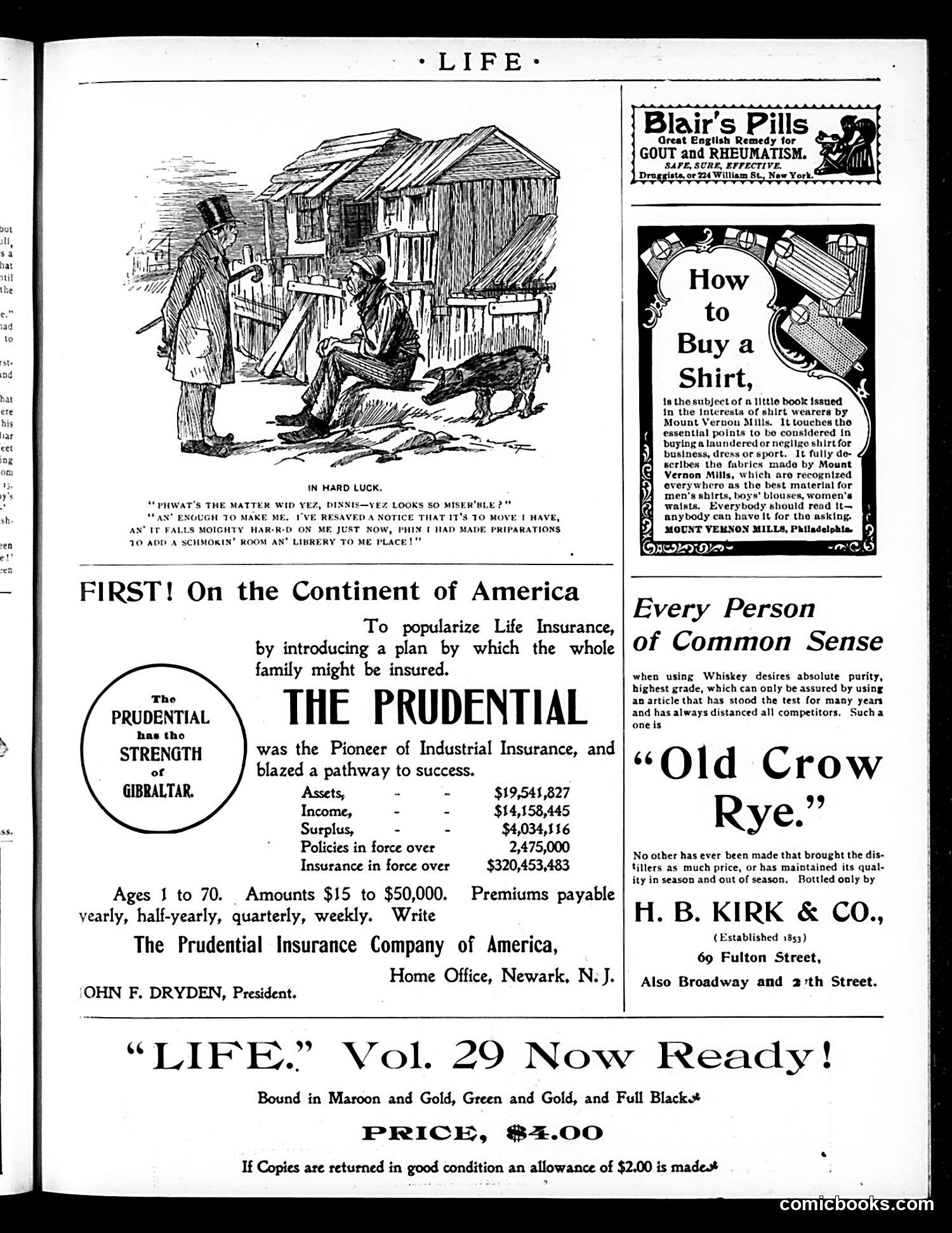
**The Cartoon ("In Hard Luck"):** Shows an Irish immigrant (identifiable by the dialect and caricature style typical of early 1900s American satire) complaining to another man that he's received an eviction notice. Despite having made preparations to add rooms and a library to his home, he must now move. The joke relies on the contrast between his aspirations for improvement and his precarious housing situation—a common experience for working-class immigrants facing housing instability and landlord demands. **The Context:** This reflects real tensions in early-20th-century America regarding immigrant workers' economic vulnerability and housing insecurity. The exaggerated Irish accent and visual caricature represent period-standard (though now offensive) ethnic humor typical of Life magazine's satirical approach. **The Advertisements:** The page is largely filled with insurance, patent medicines, and whiskey ads—typical early 1900s marketing reflecting what advertisers believed would appeal to the magazine's readership.
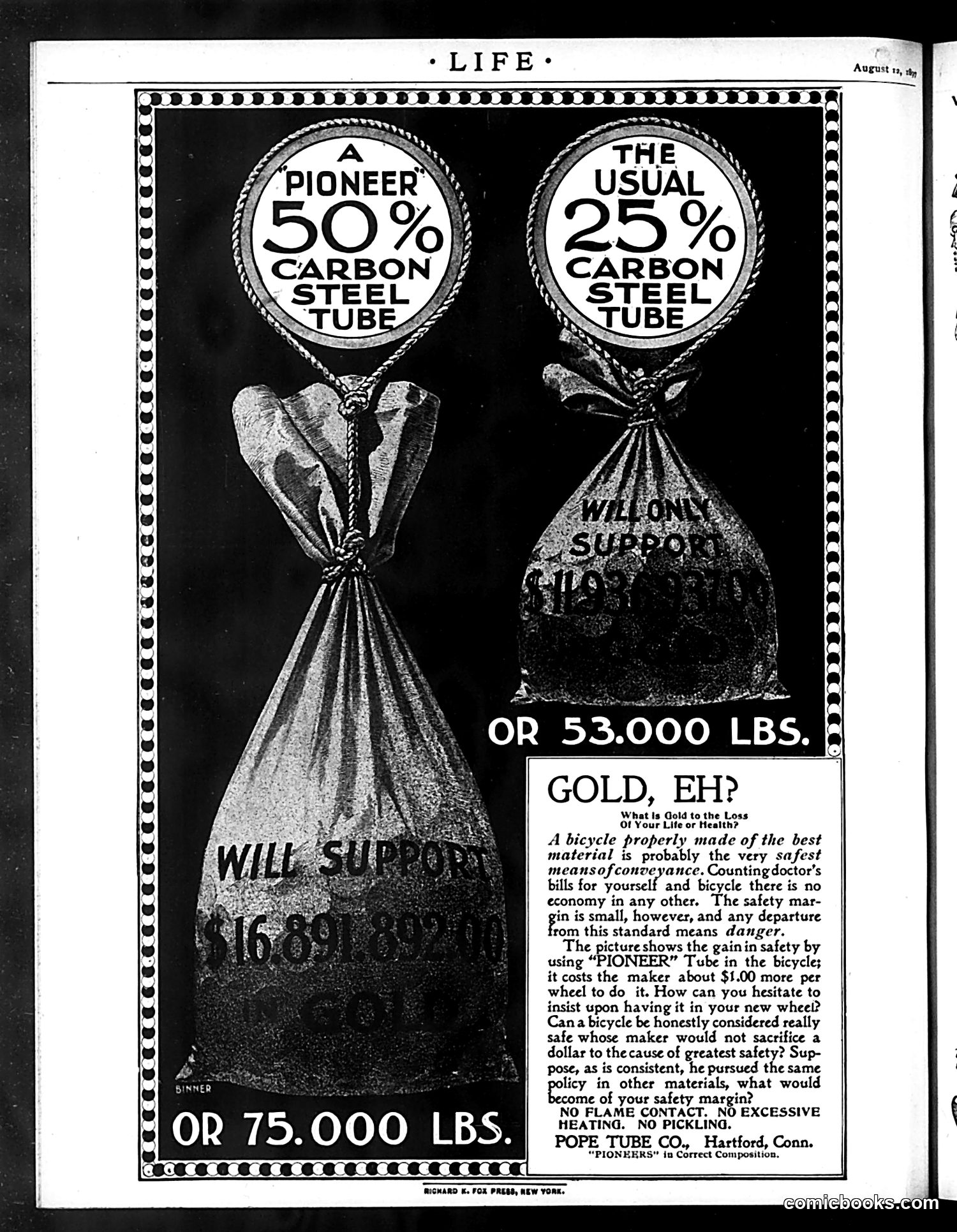
This is a **bicycle tube advertisement** disguised as satirical commentary, published in *Life* magazine (likely early 1900s, based on the bicycle-focused content and typography). The cartoon compares two scenarios using visual metaphor: - **Left bag (75,000 lbs)**: represents the weight/cost of using standard 25% carbon steel tubes - **Right bag (53,000 lbs)**: represents savings from Pioneer's 50% carbon steel tubes The satire criticizes manufacturers who won't spend an extra $1.00 per wheel on superior safety materials. The rhetorical question "Gold, eh?" sarcastically asks: what is money compared to your life and health? The text argues that penny-pinching on bicycle construction contradicts claims about prioritizing safety. It's a **moral argument dressed as humor**—shaming manufacturers (and consumers who accept inferior products) for prioritizing profit over the safety margin that quality materials provide. This reflects early 1900s advertising's use of *Life*'s satirical platform to shame competitors and consumers toward premium products.