
Life, 1897-08-12 · page 14 of 20
Life — August 12, 1897 — page 14: what you’re looking at
What you’re looking at
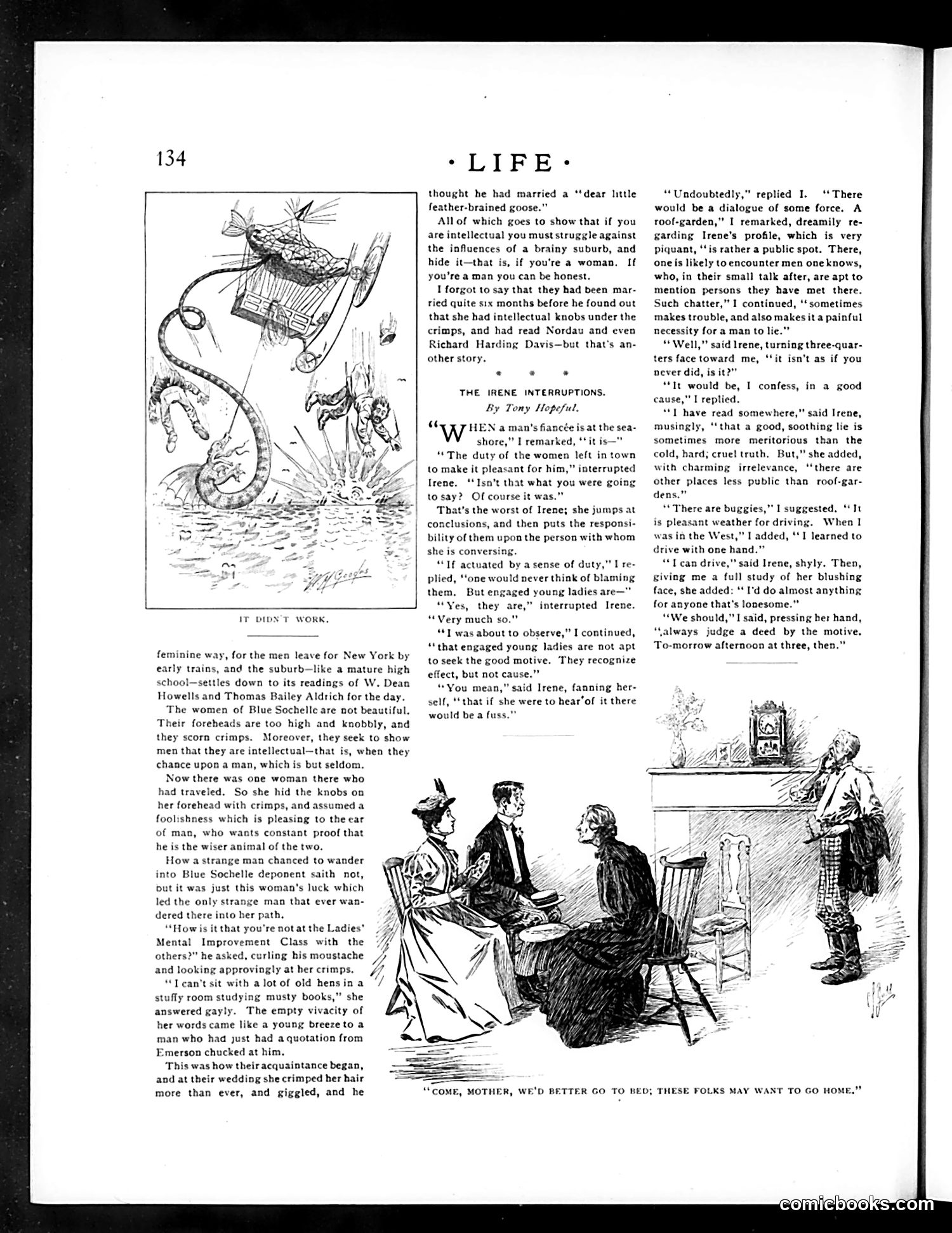
This page satirizes early 20th-century gender dynamics and courtship rituals in suburban America. The main cartoon shows a conversation between a male narrator and "Irene," an intelligent woman from "Blue Sochelle" suburb who strategically hides her intellectual abilities (conceals her "intellectual knobs" under crimps/curled hair) to appear attractively "feather-brained" to men. The satire's target: women are forced to disguise intelligence to appeal to suitors, yet men resent discovering the deception afterward. The narrator's repeated interruptions by Irene mock male conversational pretension—she anticipates and completes his sentences, deflating his attempts at witty remarks. The subplot reveals Irene's calculated strategy: by playing foolish, she has successfully attracted the only available bachelor in the suburb. The joke ultimately critiques both sexes: men's desire for "wiser animal" superiority, and women's necessary performance of ignorance within courtship's constraints.
📄 Transcribed text from this page (OCR, searchable)
Machine-transcribed from the original scan — historical spelling and the odd misread are preserved.
IT DIDN'T WorK, *LIFE: thought he had married a ‘dear little feather-brained goose.” Allof which goes to show that if you are intellectual you must struggle against the influences of a brainy suburb, and hide it—that is, if you're a woman. If you're a man you can be honest. 1 forgot to say that they had been mar- ried quite six months before he found out that she had intellectual knobs under the crimps, and had read Nordau and even Richard Harding Davis—but that's an- other story. . * . THE IRENE INTERRUPTIONS. By Tony Hopeful. “wt EN a man’s fiancée is at the sea- shore,” I remarked, ‘it is—” “The duty of the women left in town to make it pleasant for him,” interrupted Irene, ‘Isn't that what you were going tosay? Of course it was.” That's the worst of Irene; she jumps at conclusions, and then puts the responsi- bility of them upon the person with whom she is conversing. “Tf actuated by a sense of duty," I re- plied, ‘one would never think of blaming them. But engaged young ladies are—" “Yes, they are,” interrupted Irene. “Very much so.” “*T was about to observe,” I continued, “that engaged young ladies are not apt “Undoubtedly,” replied I. ‘There would be a dialogue of some force. A roof-garden,” I remarked, dreamily re- garding Irene’s profile, which is very piquant, ‘‘is rather a public spot. There, one is likely to encounter men one knows, who, in their small talk after, are apt to mention persons they have met there. Such chatter," 1 continued, ‘sometimes makes trouble, and also makes it a painful necessity for a man to li “Well,” said Irene, turning three-quar- ters face toward me, ‘‘it isn't as if you never did, is it?” “It would be, I confess, in a good cause," I replied. “I have read somewhere,” said Irene, musingly, ‘that a good, soothing lie is sometimes more meritorious than the cold, hard; cruel truth, But,” she added, with charming irrelevance, ‘there are other places less public than roof-gar- dens.” “There are buggies," I suggested, “It is pleasant weather for driving. When 1 was in the West,” I added, ‘I learned to drive with one hand.” “*IT can drive," said Irene, shyly, Then, giving me a full study of her blushing face, she added: ** I'd do almost anything for anyone that's lonesome.” “We should,” I said, pressing ber hand, ‘always judge a deed by the motive. To-morrow afternoon at three, then.” feminine way, forthe men leave for New York by early trains, and the suburb—like a mature high school—settles down to its readings of W. Dean Howells and Thomas Bailey Aldrich for the day. The women of Blue Sochelle are not beautiful. Their foreheads are too high and knobbly, and they scorn crimps. Moreover, they seek to show men that they are intellectual—that is, when they chance upon a man, which is but seldom. Now there was one woman there who had traveled. So she hid the knobs on her forehead with crimps, and assumed a foolishness which is pleasing to the ear of man, who wants constant proof that he is the wiser animal of the two. How a strange man chanced to wander into Blue Sochelle deponent saith not, but it was just this woman's luck which led the only strange man that ever wan- dered there into her path, “*How is it that you're not at the Ladies’ Mental Improvement Class with the others?” he asked, curling his moustache and looking approvingly at her crimps. “Tcan't sit with a lot of old hensin a stufly room studying musty book: she answered gayly. The empty vivacity of her words came like a young breeze to a man who had just had a quotation from Emerson chucked at him, This was how their acquaintance began, and at their wedding she crimped her hair more than ever, and giggled, and he to seek the good motive. They recognize effect, but not cause.” “You mean,” said Irene, fanning her- self, ‘that if she were to hear’of it there would be a fuss.” “COME, MOTHER, WE'D BETTER GO TO BED; THESE FOLKS MAY WANT TO GO HOME,””