
Life, 1897-08-12 · page 6 of 20
Life — August 12, 1897 — page 6: what you’re looking at
What you’re looking at
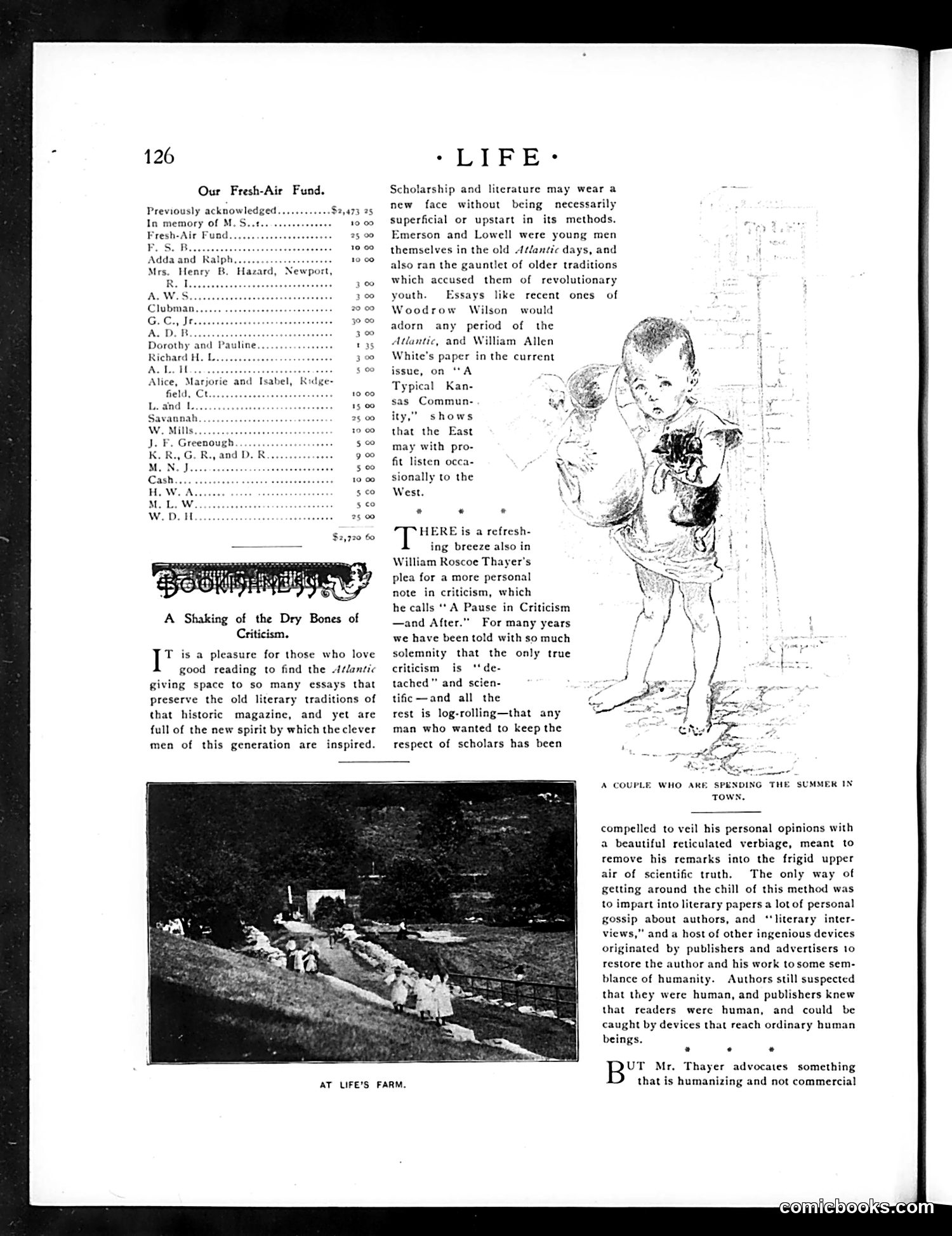
This page contains a literary essay titled "A Shaking of the Dry Bones of Criticism" discussing the *Atlantic* magazine's role in preserving literary traditions while embracing new ideas. The text praises figures like Emerson and Lowell for balancing old and new approaches. The right-side illustration shows a couple relaxing outdoors during summer, captioned "A COUPLE WHO ARE SPENDING THE SUMMER IN TOWN." This appears to be gentle satire about urbanites remaining in the city rather than vacationing elsewhere—a commentary on summer leisure habits of the era. The bottom photograph labeled "AT LIFE'S FARM" shows people in a rural pastoral setting, likely illustrating the contrast between urban and country life the article implicitly discusses.
📄 Transcribed text from this page (OCR, searchable)
Machine-transcribed from the original scan — historical spelling and the odd misread are preserved.
126 Our Fresh-Air Fund. Previously acknowledged In memory of M.S.. Fresh-Air Fund F. S. B Adda and R aeagnes Mrs. Henry B. Hazard, R.1 ALW.S Clubman, A. Dorothy and Pa Richard H. Savannah W. Mills....... reenough Cash... H.W. A. ML. W W.DLIL A Shaking of the Dry Bones of Criticism. T is a pleasure for those who love good reading to find the -4élantic giving space to so many essays that preserve the old literary traditions of that historic magazine, and yet are full of the new spirit by which the clever men of this generation are inspired. * LIFE: Scholarship and literature may wear a new face without being necessarily superficial or upstart in its methods. Emerson and Lowell were young men themselves in the old Atantic days, and also ran the gauntlet of older traditions which accused them of revolutionary youth. Essays like recent ones of Woodrow Wilson would adorn any period of the Atlantic, and William Allen White's paper in the current issue, on “A Typical Kan- sas Commun- ity,” shows that the East may with pro- fit listen occa- sionally to the West. HERE is a refresh- ing breeze also in William Roscoe Thayer's plea for a more personal note in criticism, which he calls ‘A Pause in Criticism —and After.” For many years we have been told with so much solemnity that the only true criticism is ‘*de- tached" and scien- tific—and all the rest is log-rolling—that any man who wanted to keep the respect of scholars has been ING THE SUMMER IN compelled to veil his personal opinions with a beautiful reticulated verbiage, meant to remove his remarks into the frigid upper air of scientific truth, The only way of getting around the chill of this method was to impart into literary papers a lot of personal gossip about authors, and “‘literary inter- views,” and a host of other ingenious devices originated by publishers and advertisers 10 restore the author and his work to some sem- blance of humanity. Authors still suspected that they were human, and publishers knew that readers were human, and could be caught by devices that reach ordinary human beings. * . * UT Mr. Thayer advocates something AT LIFE’S FARM. that is humanizing and not commercial