
Life, 1897-08-12 · page 7 of 20
Life — August 12, 1897 — page 7: what you’re looking at
What you’re looking at
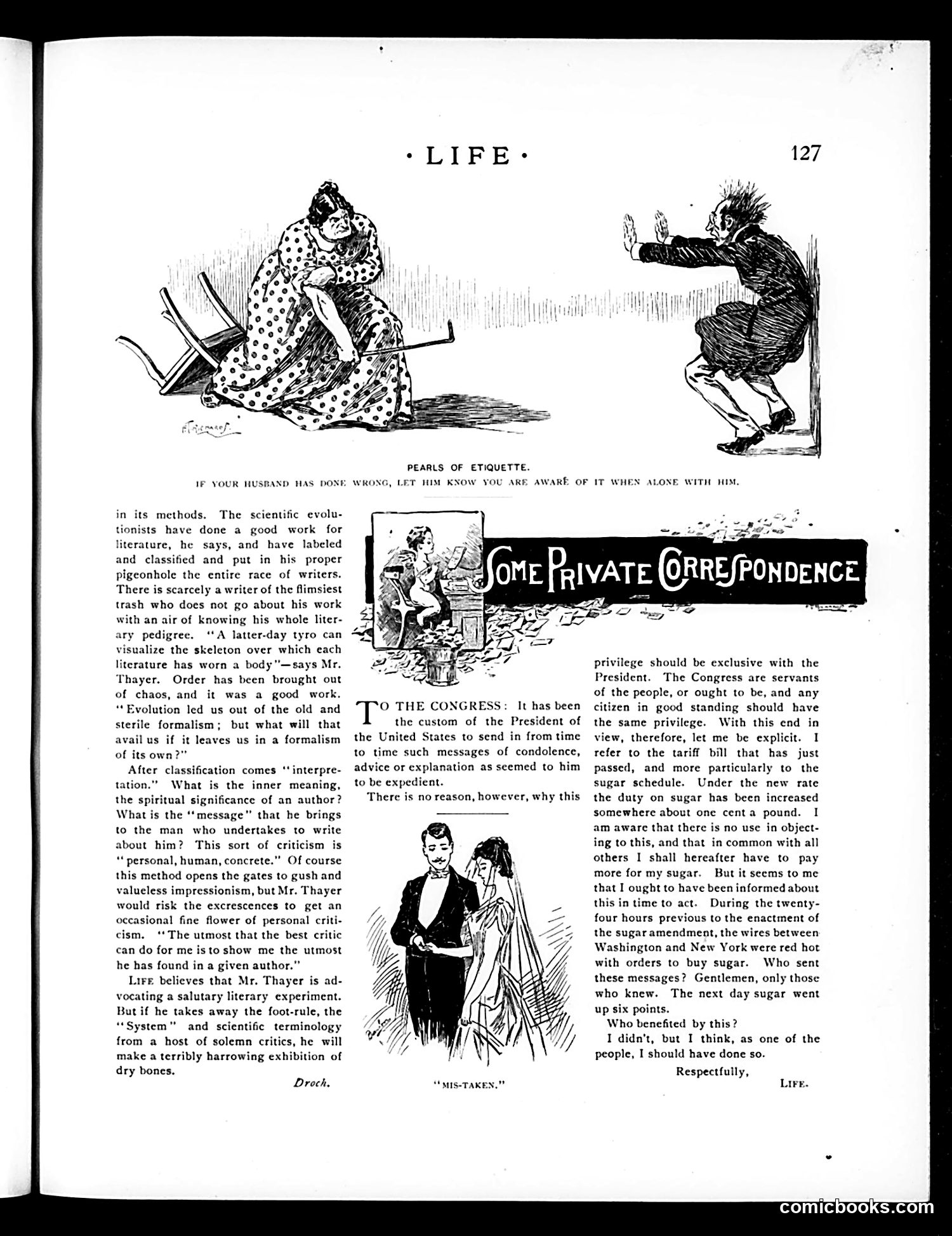
This page contains satirical commentary on literary criticism and a letter to Congress about sugar prices during wartime rationing. **Top cartoon ("Pearls of Etiquette"):** Shows a woman striking a man with a chair while another woman watches, captioned "If your husband has done wrong, let him know you are aware of it when alone with him." This mocks Victorian-era etiquette advice about marital conduct. **"Some Private Correspondence" section:** Features a letter from "Life" (the magazine) to Congress criticizing President Wilson's sugar price policies. The writer claims the new sugar duty increased prices by one cent per pound, and questions who benefited from advance warning allowing stockpiling before the price increase—implying insider trading or corruption among Washington elites. The illustration shows a bride, possibly referencing wedding expenses or domestic concerns.
📄 Transcribed text from this page (OCR, searchable)
Machine-transcribed from the original scan — historical spelling and the odd misread are preserved.
PEARLS OF ETIQUETTE. IF YOUR HUSBAND HAS DONE WRONG, LET HIM KNOW YOU ARE AWARE OF IT WHEN ALONE WITH HIM, in its methods. The scientific evolu- tionists have done a good work for literature, he says, and have labeled and classified and put in his proper pigeonhole the entire race of writers. There is scarcely a writer of the flimsiest trash who does not go about his work with an air of knowing his whole liter- ary pedigree. ‘A latter-day tyro can visualize the skeleton over which each literature has worn a body "—says Mr. Thayer. Order has been brought out of chaos, and it was a good work. ‘Evolution led us out of the old and sterile formalism; but what will that avail us if it leaves us in a formalism of its own?” After classification comes ‘ interpre- tation.” What is the inner meaning, the spiritual significance of an author? What is the ‘‘message” that he brings to the man who undertakes to write about him? This sort of criticism is * personal, human, concrete.” Of course this method opens the gates to gush and valueless impressionism, but Mr. Thayer would risk the excrescences to get an occasional fine flower of personal criti cism. ‘The utmost that the best critic can do for me isto show me the utmost he has found in a given author.” Lire believes that Mr. Thayer is ad- vocating a salutary literary experiment. But if he takes away the foot-rule, the “*System" and scientific terminology from a host of solemn critics, he will make a terribly harrowing exhibition of dry bones. Droch. O THE CONGRESS: It has been the custom of the President of the United States to send in from time to time such messages of condolence, advice or explanation as seemed to him to be expedient. There is no reason, however, why this “*MIS-TAKEN."” privilege should be exclusive with the President. The Congress are servants of the people, or ought to be, and any citizen in good standing should have the same privilege. With this end in view, therefore, let me be explicit. I refer to the tariff bill that has just passed, and more particularly to the sugar schedule. Under the new rate the duty on sugar has been increased somewhere about one centa pound. I am aware that there is no use in object- ing to this, and that in common with all others I shall hereafter have to pay more for my sugar. But it seems to me that I ought to have been informed about this in time to act. During the twenty- four hours previous to the enactment of the sugar amendment, the wires between Washington and New York were red hot with orders to buy sugar. Who sent these messages? Gentlemen, only those who knew. The next day sugar went up six points. Who benefited by this? I didn't, but I think, as one of the people, I should have done so. Respectfully, Lire. comicbooks.com