
A complete issue · 20 pages · 1897
Life — July 8, 1897
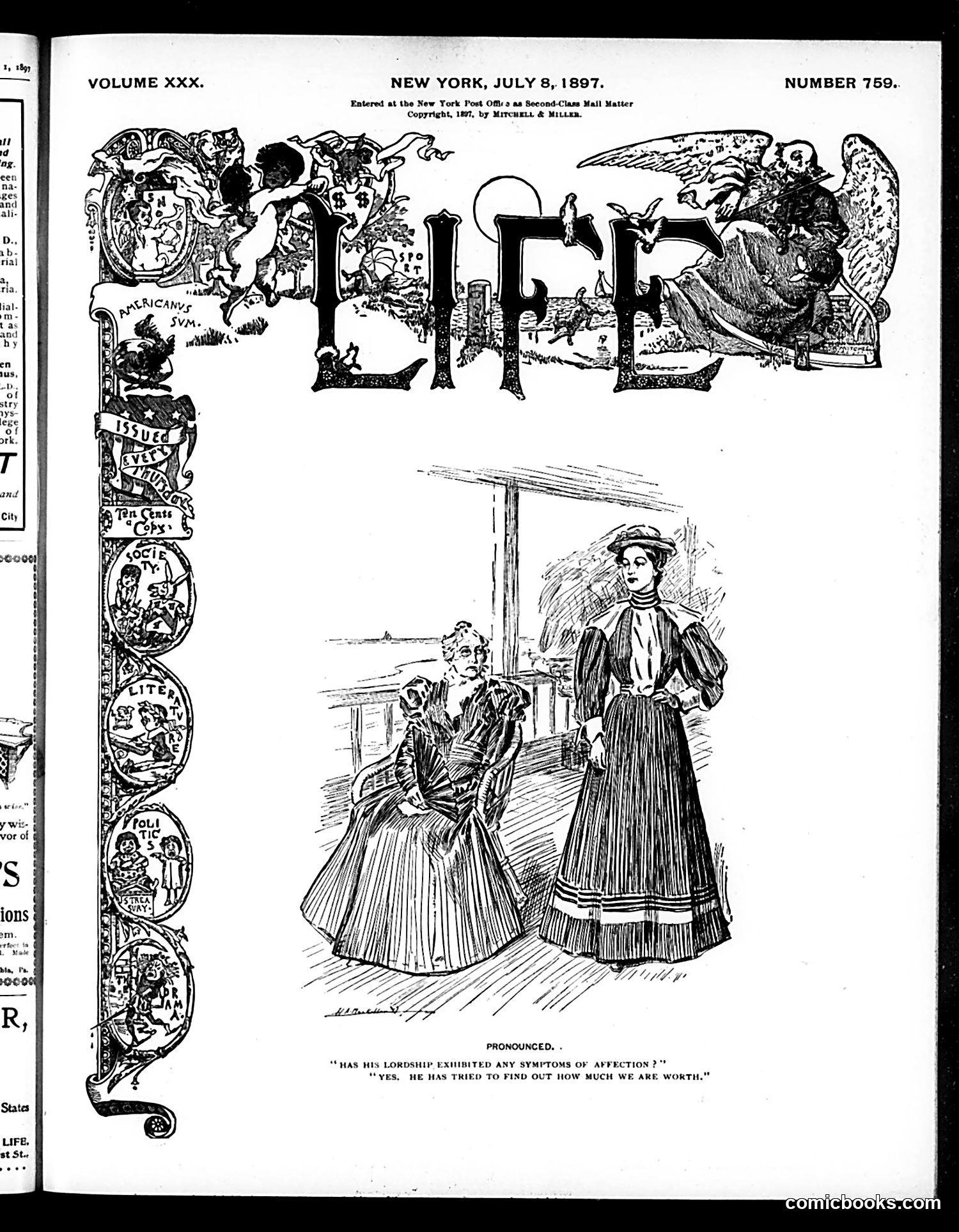
This page features a satirical illustration with a caption: "Has his Lordship exhibited any symptoms of affection?" / "Yes, he has tried to find out how much we are worth." The cartoon depicts two women—one seated, one standing—in late 1890s dress on what appears to be a ship's deck. The joke concerns a wealthy British nobleman ("his Lordship") allegedly courting one of them, but proving interested only in her financial assets rather than genuine romantic affection. This reflects a common American satirical theme of the era: British aristocrats marrying American heiresses for their fortunes. The cartoon mocks both the calculating nobleman and, implicitly, the transatlantic marriage market where wealth trumped genuine feeling. The ornate decorative border on the left contains various publication details and imagery typical of Life's design.
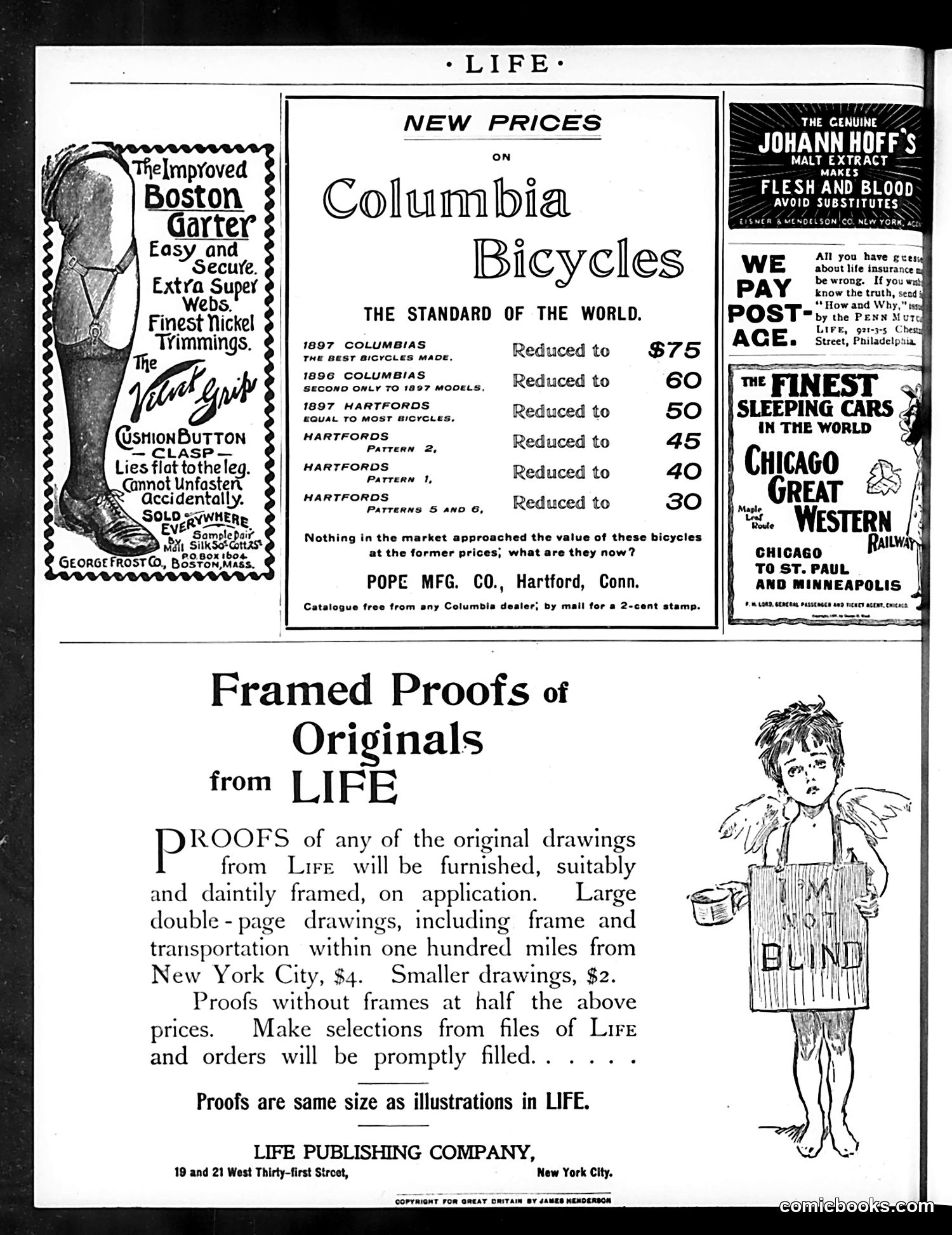
This page is primarily **advertising** rather than editorial satire. It contains three distinct ads: 1. **Boston Garter** (left): A leg-focused advertisement for garters, emphasizing their secure fit using a "cushion button" mechanism. The copy promises they won't slip or unfasten accidentally. 2. **Columbia Bicycles** (center): Announces price reductions on various Columbia and Hartford bicycle models, positioning them as "the standard of the world." 3. **Additional ads** (right): Johann Hoff's Malt Extract, life insurance messaging ("We Pay Postage"), and Chicago Great Western Railway sleeping cars. The lower half advertises **Life Publishing Company's framed proofs service** for original artwork. These are straightforward commercial advertisements typical of late 19th/early 20th-century magazines—no political satire is present on this particular page.
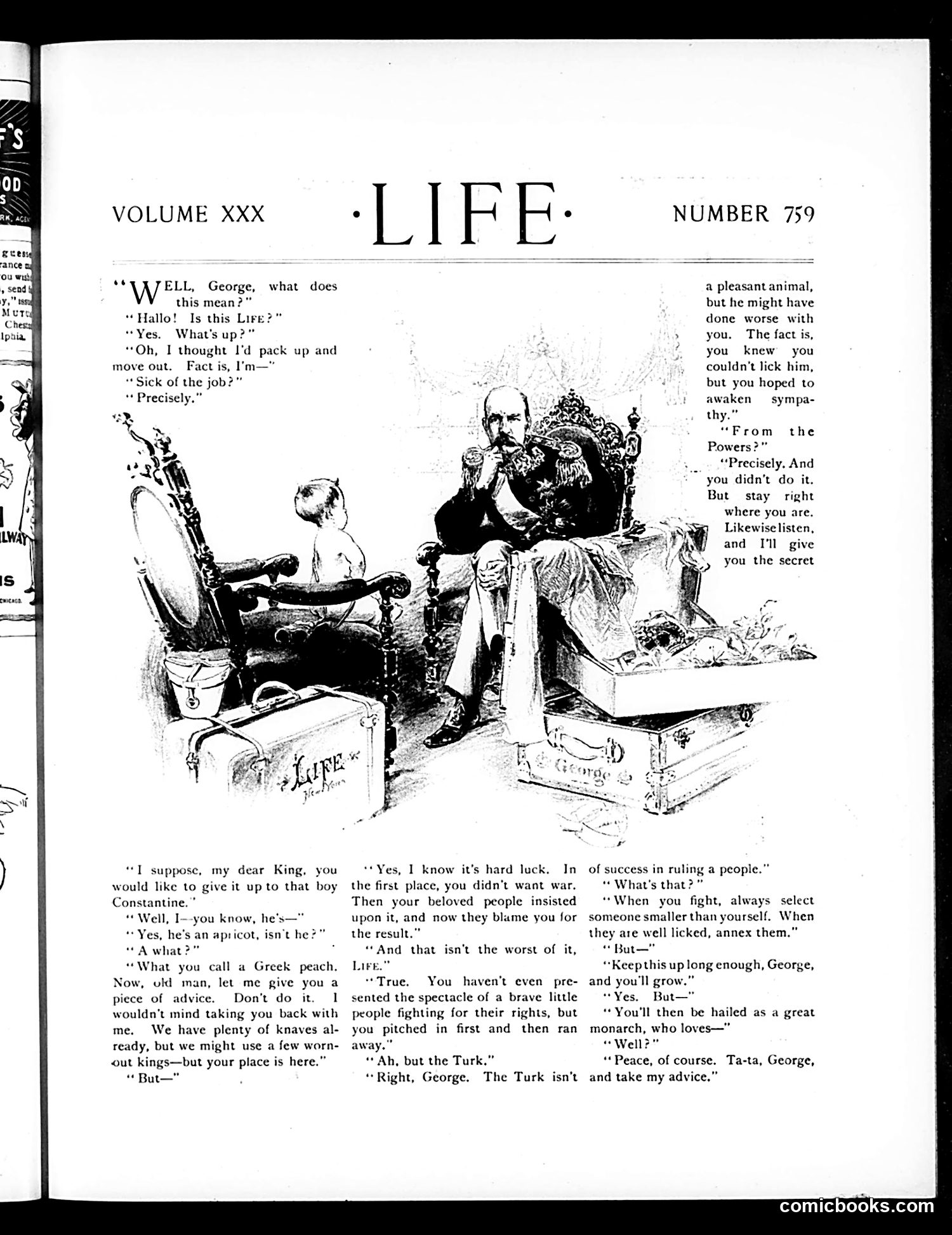
This page depicts a conversation between a bearded older man (appears to be a European monarch or political figure) and a young child named George. The dialogue satirizes political compromise and weakness in leadership. The child George is being advised to abandon his principles—specifically regarding war and conflict with "the Turk"—in exchange for power and success. The older figure counsels pragmatism over idealism: selecting allies based on convenience rather than morality, and accepting blame for unpopular decisions. The satire critiques how political leaders abandon their values for expediency. The "apricot" reference and casual tone mask serious commentary on political corruption and moral compromise. Without the specific publication date visible, the exact historical context (likely early 20th century European politics) remains unclear, though the Turkist reference suggests Ottoman-era conflicts.
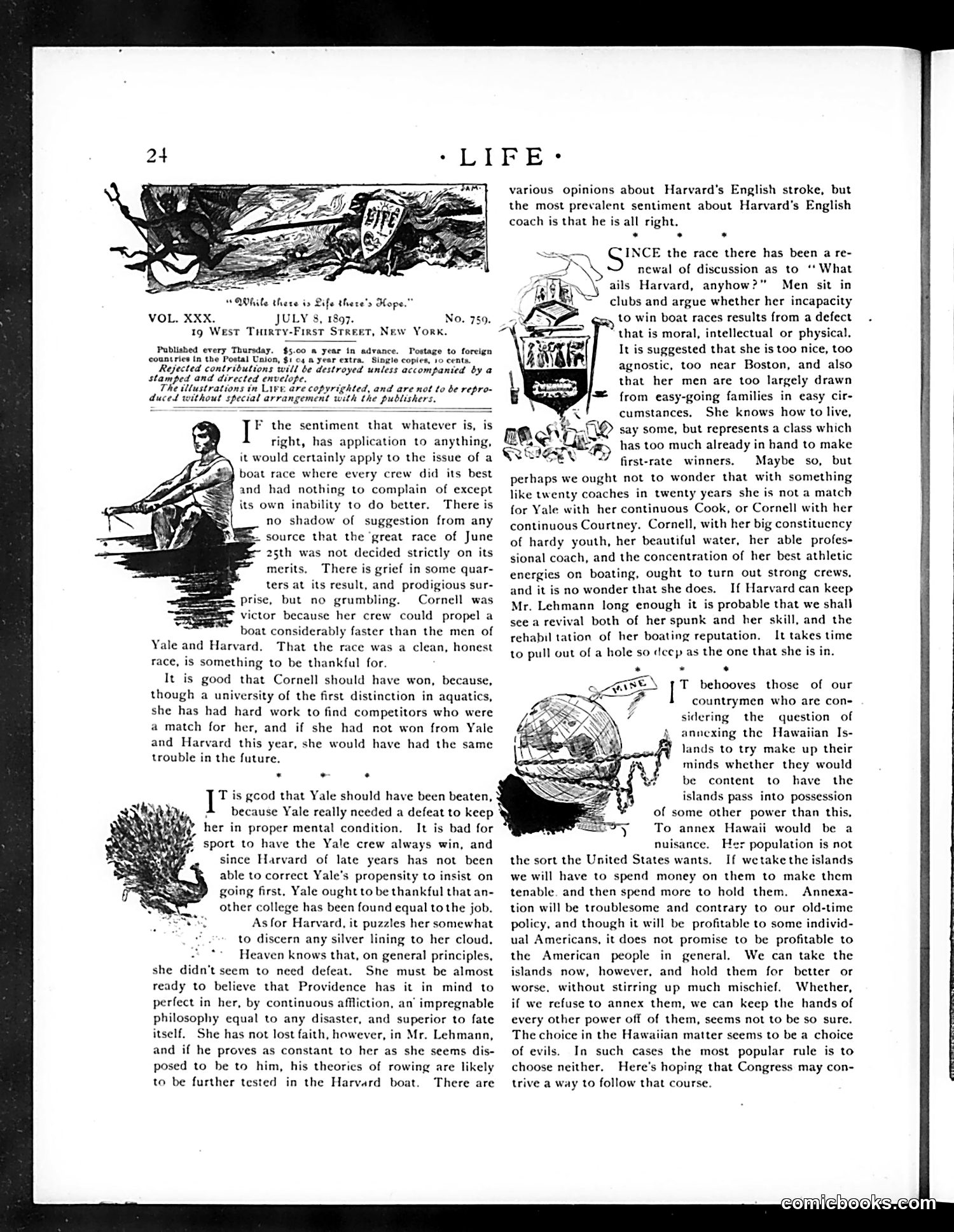
This page discusses Harvard's recent boat race victory, satirizing attitudes about collegiate rowing and institutional pride. The text debates whether Harvard's win was deserved, acknowledging that Cornell had historically been the stronger crew but suggesting Harvard's coach (Mr. Lehmann) has improved their performance. The cartoons appear to show rowers in action. The article defends Harvard's victory while also discussing whether Yale should have won instead—suggesting competitive tensions between these elite universities. A secondary section addresses annexing the Hawaiian Islands, presenting the matter as a "choice of evils" where Americans must decide between possessing Hawaii themselves or allowing another power to do so. This reflects 1890s American imperial expansion debates.
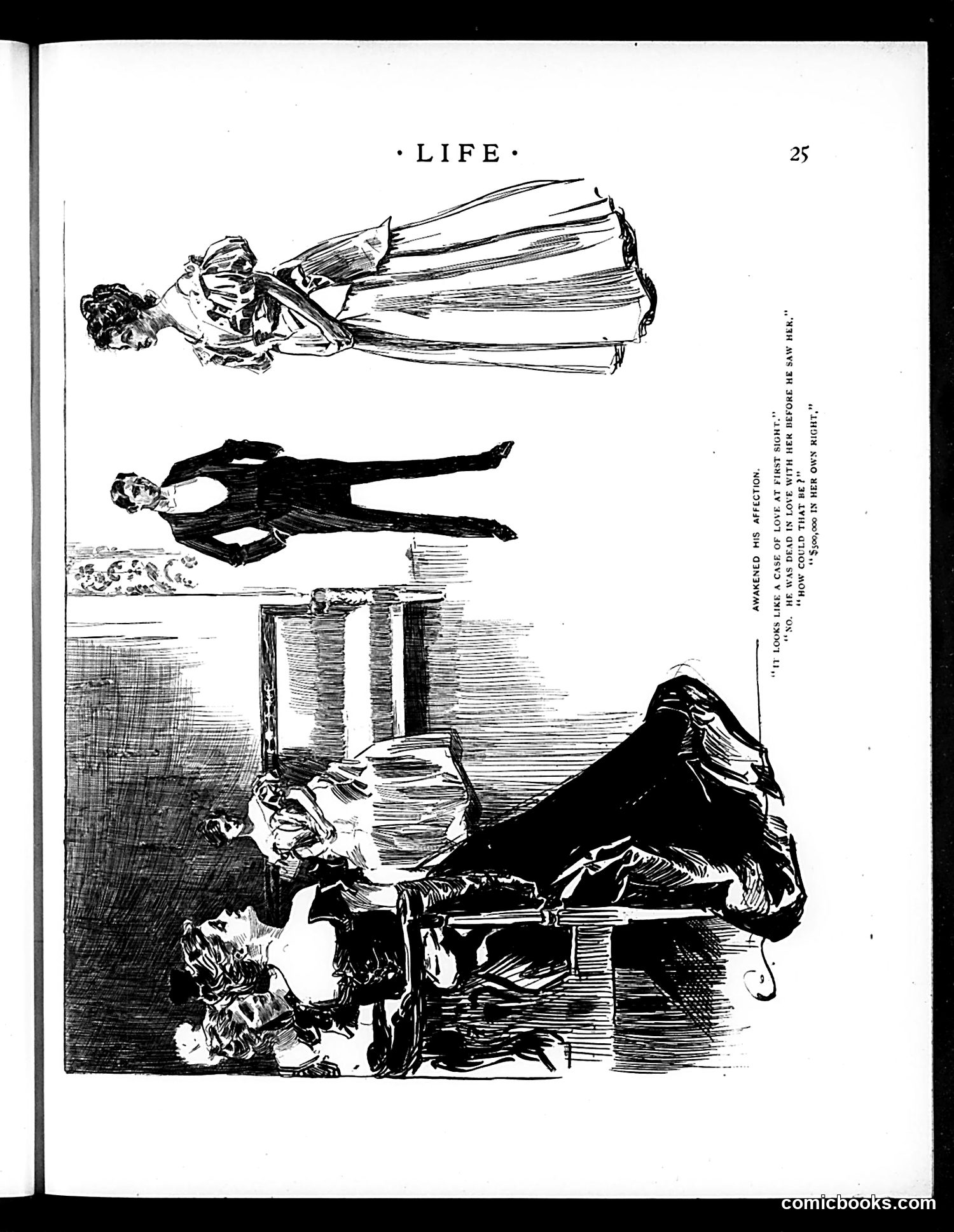
This page from *Life* magazine (page 25) contains three satirical sketches in ink. The top image shows a figure in an elaborate dress viewed from behind. The middle depicts a man in formal attire in a horizontal flying or floating pose. The bottom scene shows a seated figure in dark clothing with what appears to be a small dog or similar animal. The OCR text is largely illegible, preventing precise identification of the specific political figures, events, or satire being referenced. Without clear captions or readable text, I cannot reliably determine which contemporary political or social figures are being caricatured or what particular scandal, fashion trend, or social commentary these drawings address. The sketching style suggests early 20th-century American satire, but the specific context remains unclear from the image alone.
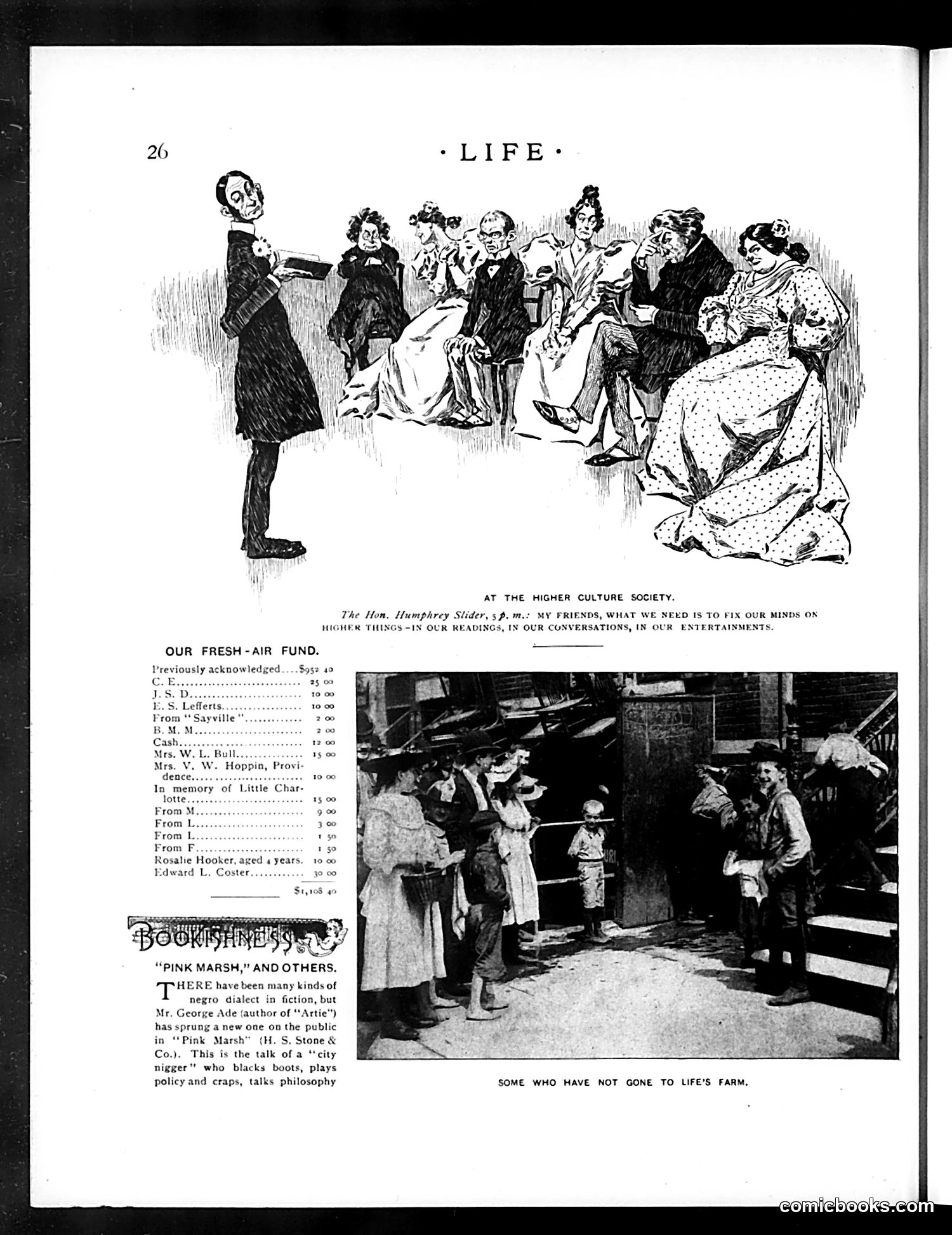
The top cartoon satirizes intellectual pretension at "the Higher Culture Society." A speaker presents to an assembled group, with the caption quoting Hon. Humphrey Slider claiming that entertainment and light reading matter more than serious intellectual pursuits. The joke mocks those who dress up shallow entertainment as "culture." Below, "Our Fresh-Air Fund" lists donors to a charitable cause, likely supporting poor urban children's access to countryside experiences—a common Progressive-era social reform. The bottom section reviews "Pink Marsh" by George Ade, describing it as dialect fiction about a "city nigger" character who engages in morally questionable behavior. The accompanying photograph titled "Some Who Have Not Gone to Life's Farm" shows urban poor, likely illustrating the book's subject matter. The content reflects early 1900s attitudes and terminology now recognized as offensive.
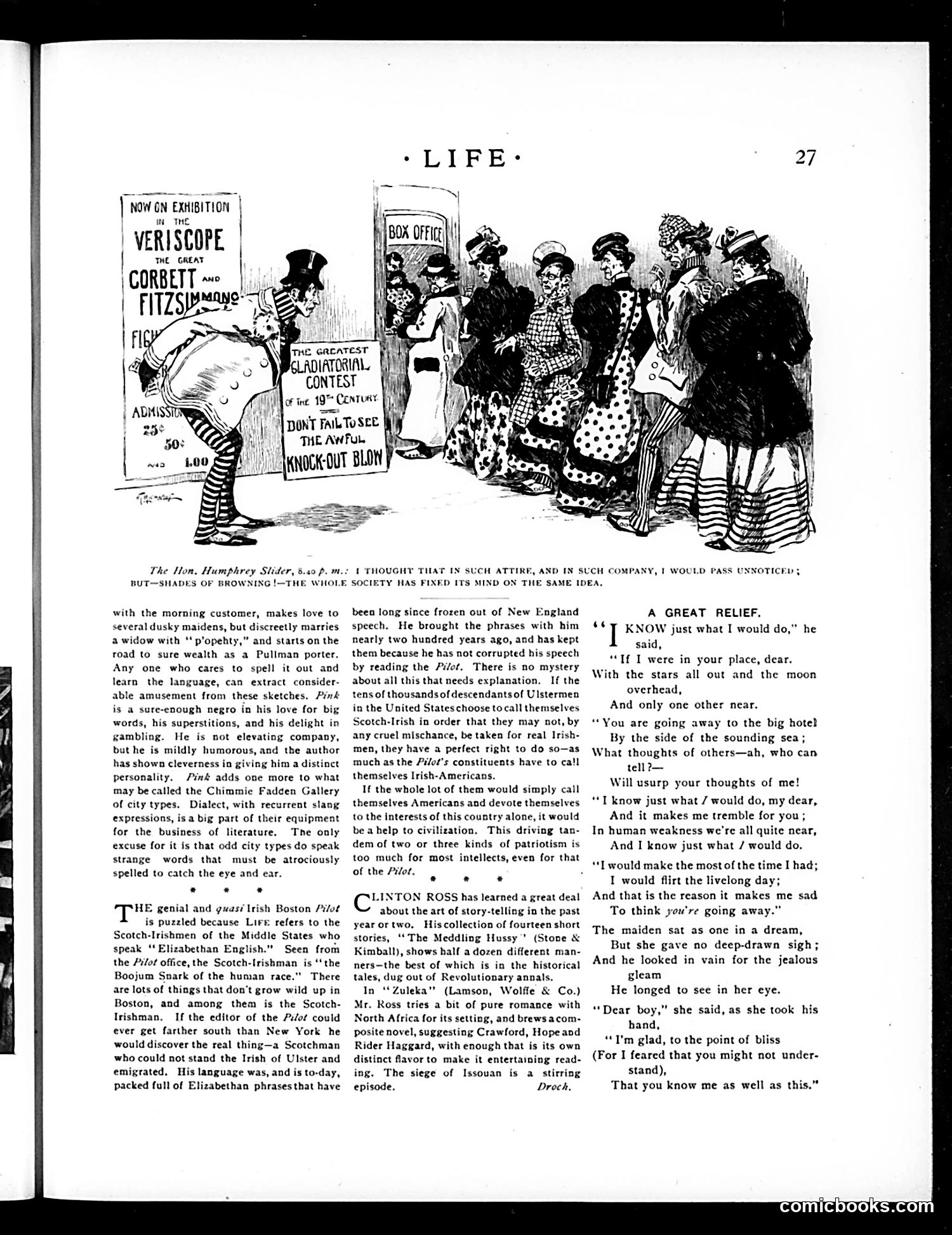
The main cartoon depicts a barker outside a theater hawking attractions including "Veriscope" films of "The Great Corbett and Fitzsimmons" fight, alongside other popular entertainments. A crowd of well-dressed women in elaborate hats and polka-dot dresses queue at the box office. The satire targets the spectacle and commercialization of celebrity boxing matches. The "Veriscope" reference likely concerns early cinema technology used to film and distribute major boxing events. The crowd of fashionable society women suggests the fight had become mainstream entertainment, crossing social boundaries. The cartoon appears to mock both the sensationalism of prize-fighting promotion and the novelty of cinema technology being exploited for commercial gain. The elaborate dress of attendees underscores how boxing had become fashionable entertainment rather than a niche sport.
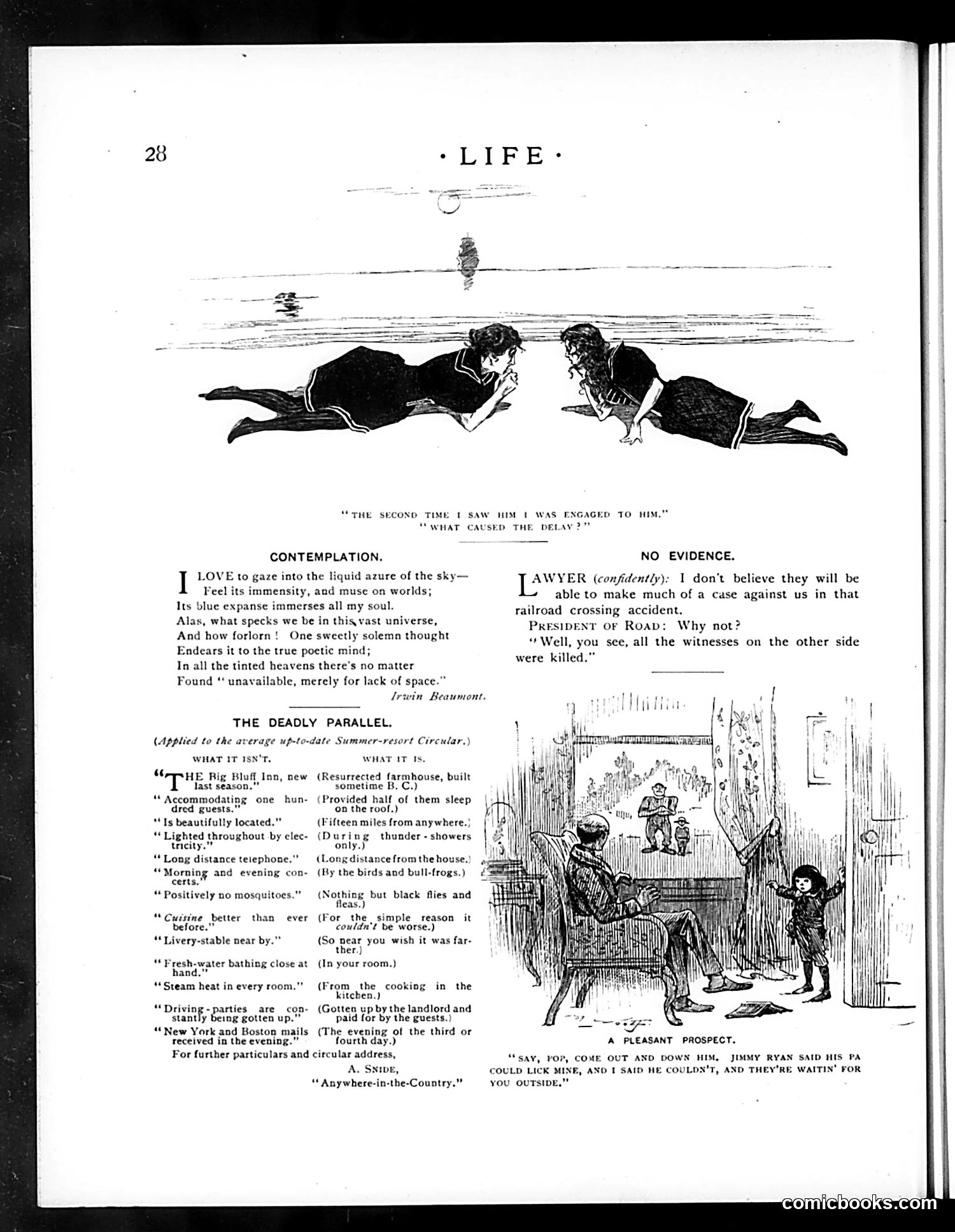
This page contains three satirical pieces: 1. **Top illustration**: Two figures lying prone, captioned about seeing someone "the second time I was engaged to him" with "What caused the delay?" — likely satirizing broken engagements or unreliable suitors. 2. **"Contemplation"**: A poem about gazing at the sky, attributed to "Erin Beaumont," appears to be gentle philosophical humor. 3. **"The Deadly Parallel"**: A two-column comparison mocking summer resort advertising. The left column lists exaggerated claims ("Beautifully located," "positively no mosquitoes"), while the right reveals the reality in parentheses (e.g., "fifteen miles from anywhere," "black flies and fleas"). This satirizes deceptive resort marketing practices common to the era. 4. **Bottom cartoon**: "A Pleasant Prospect" depicts children negotiating outdoor play, with dialogue about one boy's jealous father — gentle domestic humor.
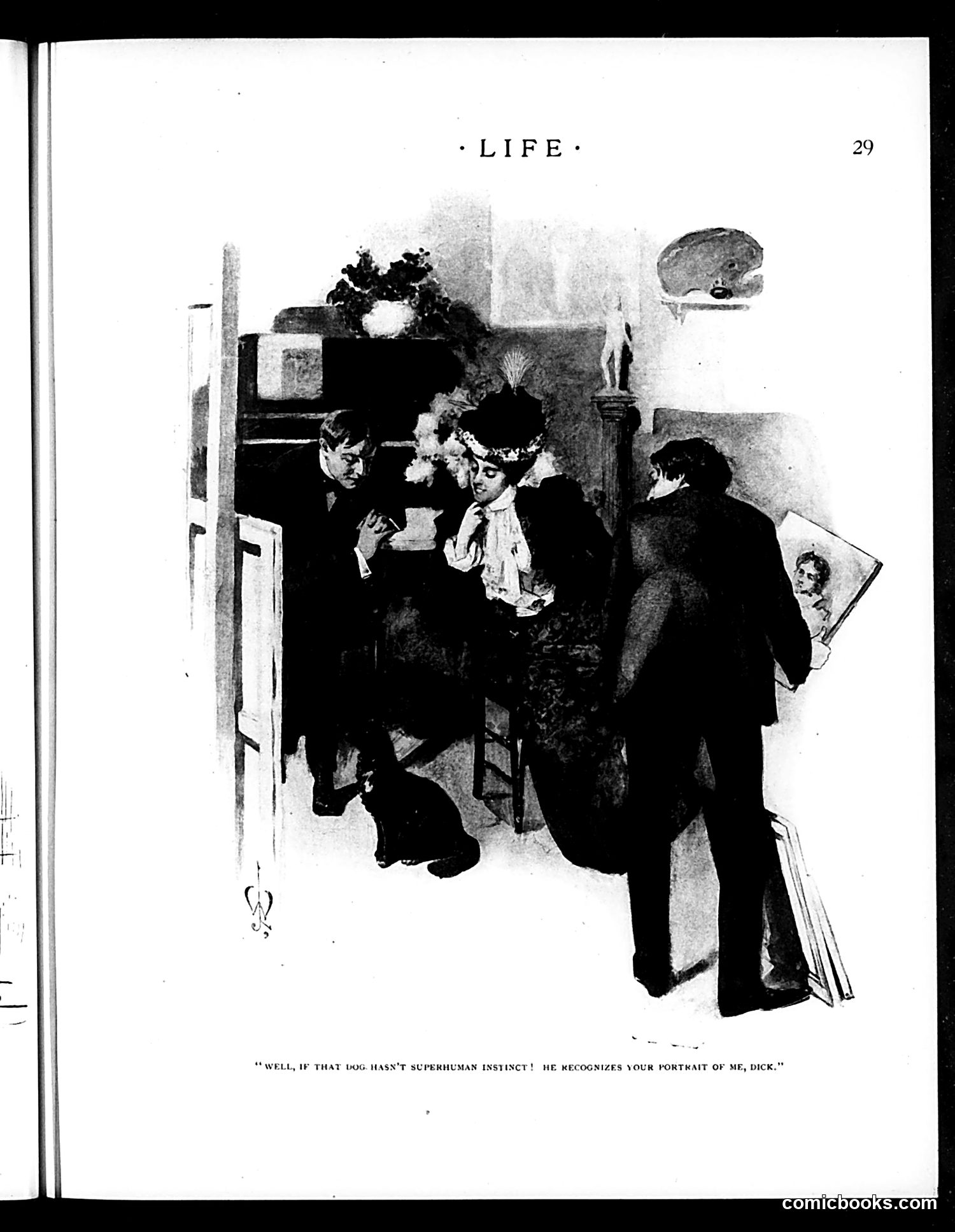
This is a single-panel cartoon from *Life* magazine (page 29) depicting what appears to be a social gathering or meeting. The caption reads: "Well, if that dog hass't superhuman instinct! he recognizes your portrait of me, Dick." The humor relies on a dog recognizing a portrait, which the speaker attributes to "superhuman instinct." The joke appears to be self-deprecating—suggesting the portrait is so unflattering or distinctive that even a dog can identify it, implying the artwork doesn't capture a flattering likeness of the subject. The scene shows well-dressed figures in what appears to be an interior setting, with a dog on the wall (likely a portrait), examining the situation. The satire targets either portrait-painting quality or vanity around artistic representation.
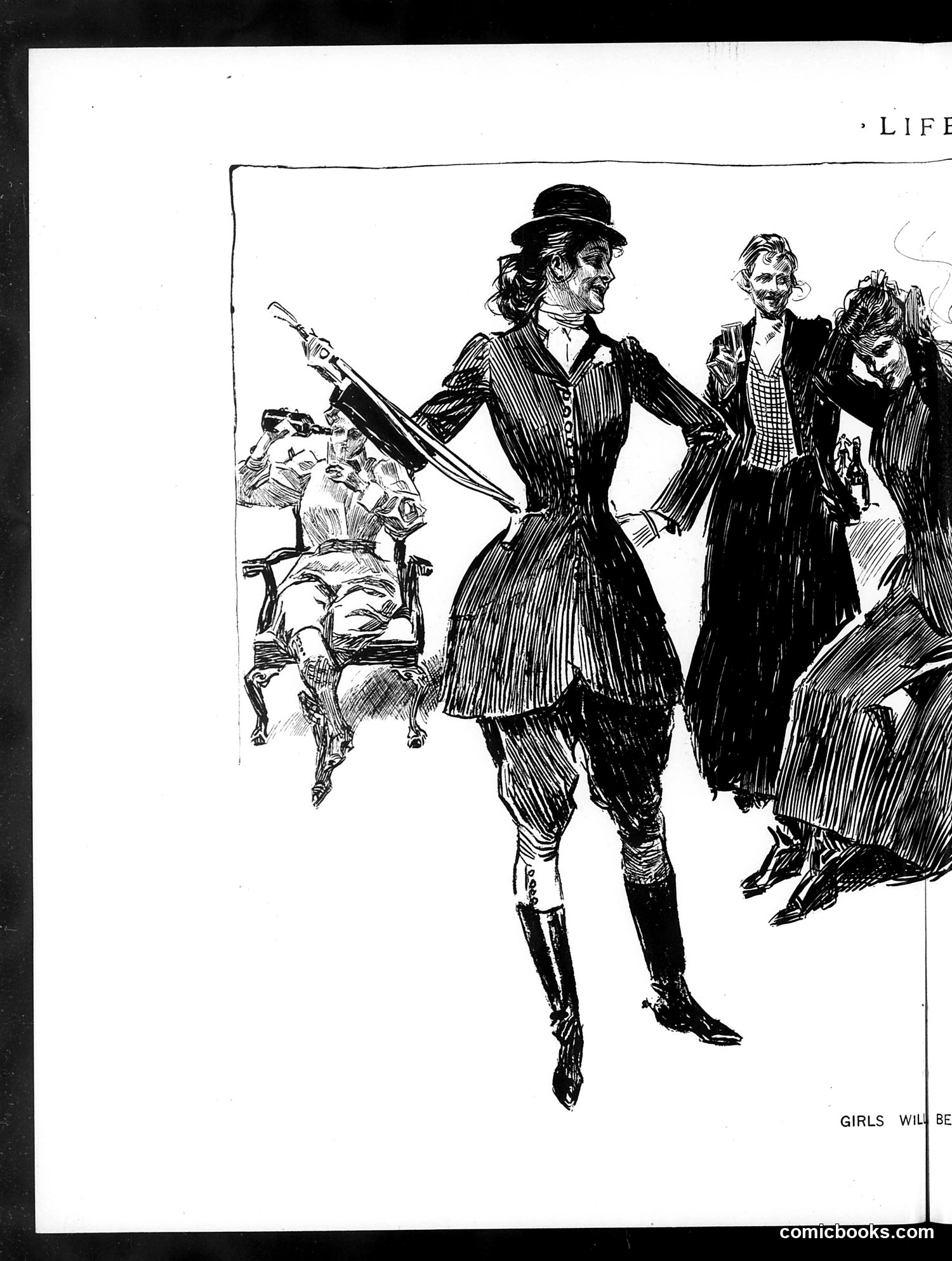
This appears to be a satirical illustration from *Life* magazine depicting a woman in military or adventuring attire wielding a large sword or rifle, surrounded by formally dressed men in suits. The caption at bottom reads "GIRLS WILL BE—" (incomplete). The satire likely comments on **women's changing roles**, possibly during or around World War I era when women increasingly entered non-traditional occupations. The contrast between the woman's aggressive, militaristic pose and the passive, observant men suggests commentary on gender role reversals or the growing female independence movement of that period. The incomplete caption invites readers to finish the thought, implying ironic surprise at what "girls" are now doing—stepping into traditionally masculine domains of warfare or adventure rather than conforming to expected domestic roles.
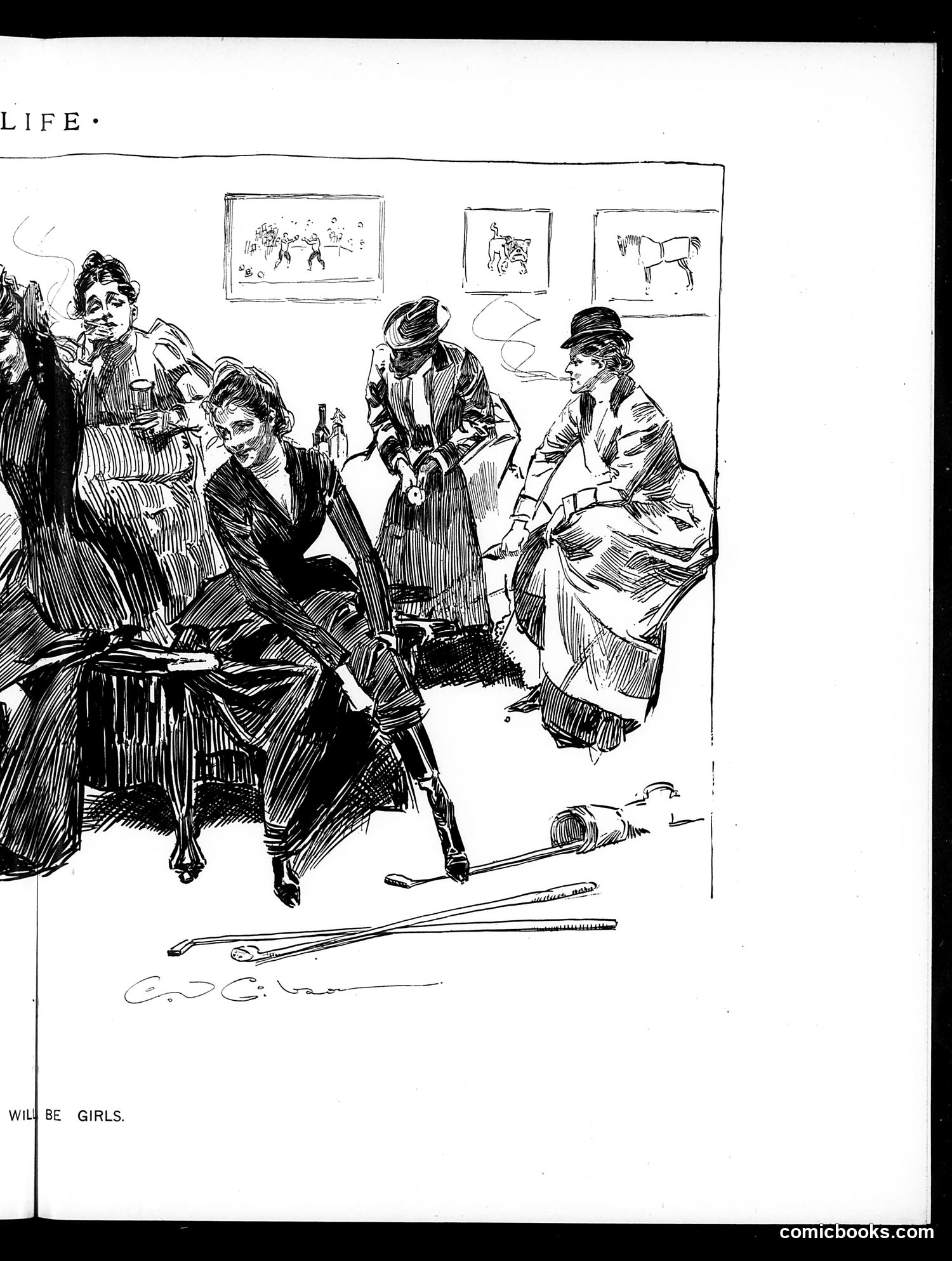
This Life magazine cartoon depicts several well-dressed men in early 20th-century attire observing women engaged in artistic pursuits—specifically painting and sketching. The men appear amused or condescending as they watch the women work with art supplies and easels scattered on the floor. The satire targets gender assumptions about women's capabilities and interests. The caption "Will Be Girls" suggests a patronizing view—that women's artistic ambitions are merely a frivolous phase, a passing whim rather than serious professional work. The men's body language conveys skepticism or gentle mockery toward female artists. This reflects Progressive Era debates about women's education and professional opportunities, mocking the dismissive attitudes men held toward women pursuing art and culture seriously.
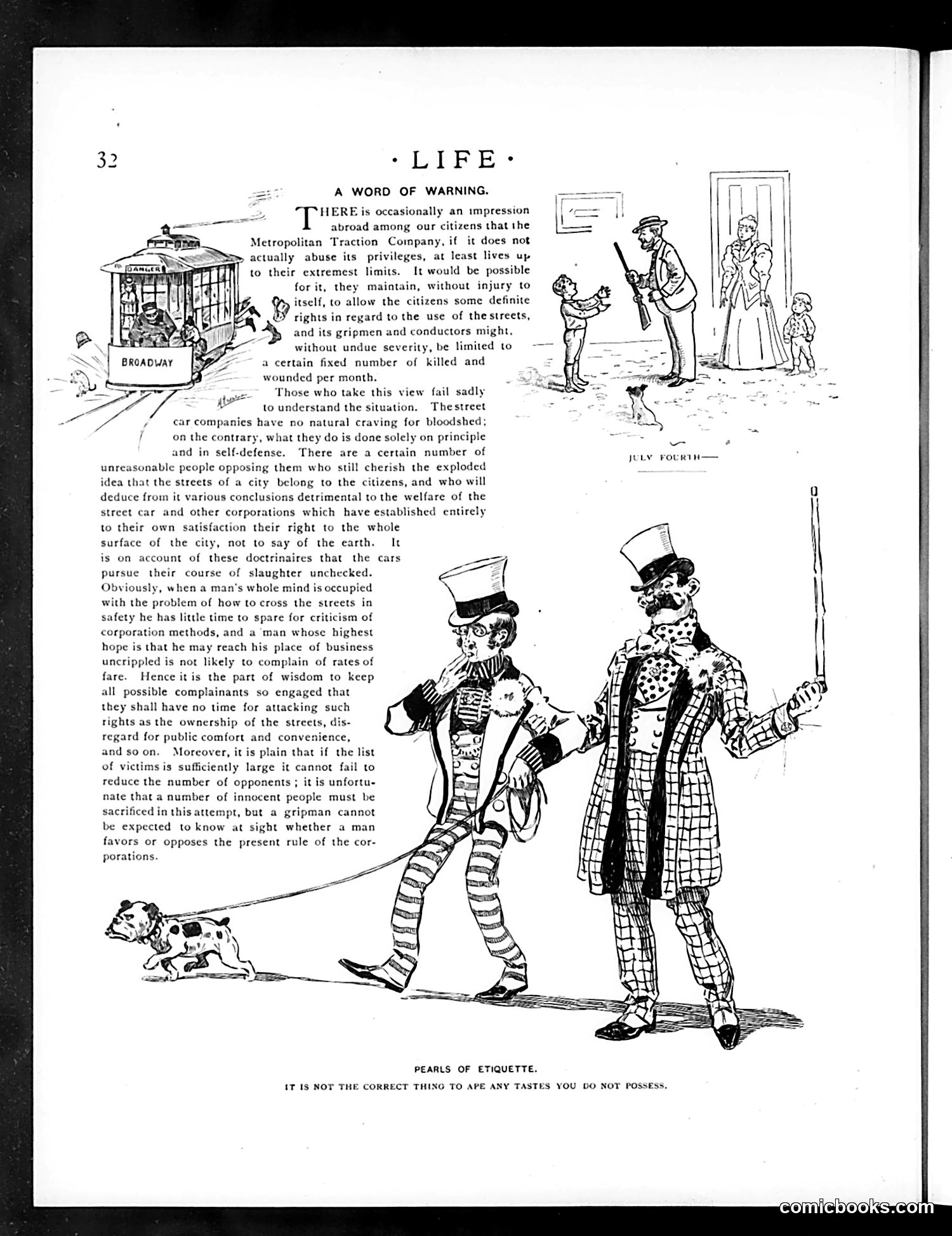
This page satirizes the Metropolitan Traction Company (streetcar operators) and their conflicts with pedestrians. The main article, "A Word of Warning," argues that streetcar companies wrongfully claim exclusive rights to city streets, endangering citizens. The text criticizes the notion that corporations have absolute dominion over public spaces. The lower cartoon, "Pearls of Etiquette," mocks the absurdity through visual irony: two well-dressed gentlemen in top hats walk a small dog on a leash through the street. The caption states, "It is not the correct thing to ape any tastes you do not possess," suggesting these men are pretentiously displaying refined manners they lack—paralleling how the streetcar companies claim rights they shouldn't possess.
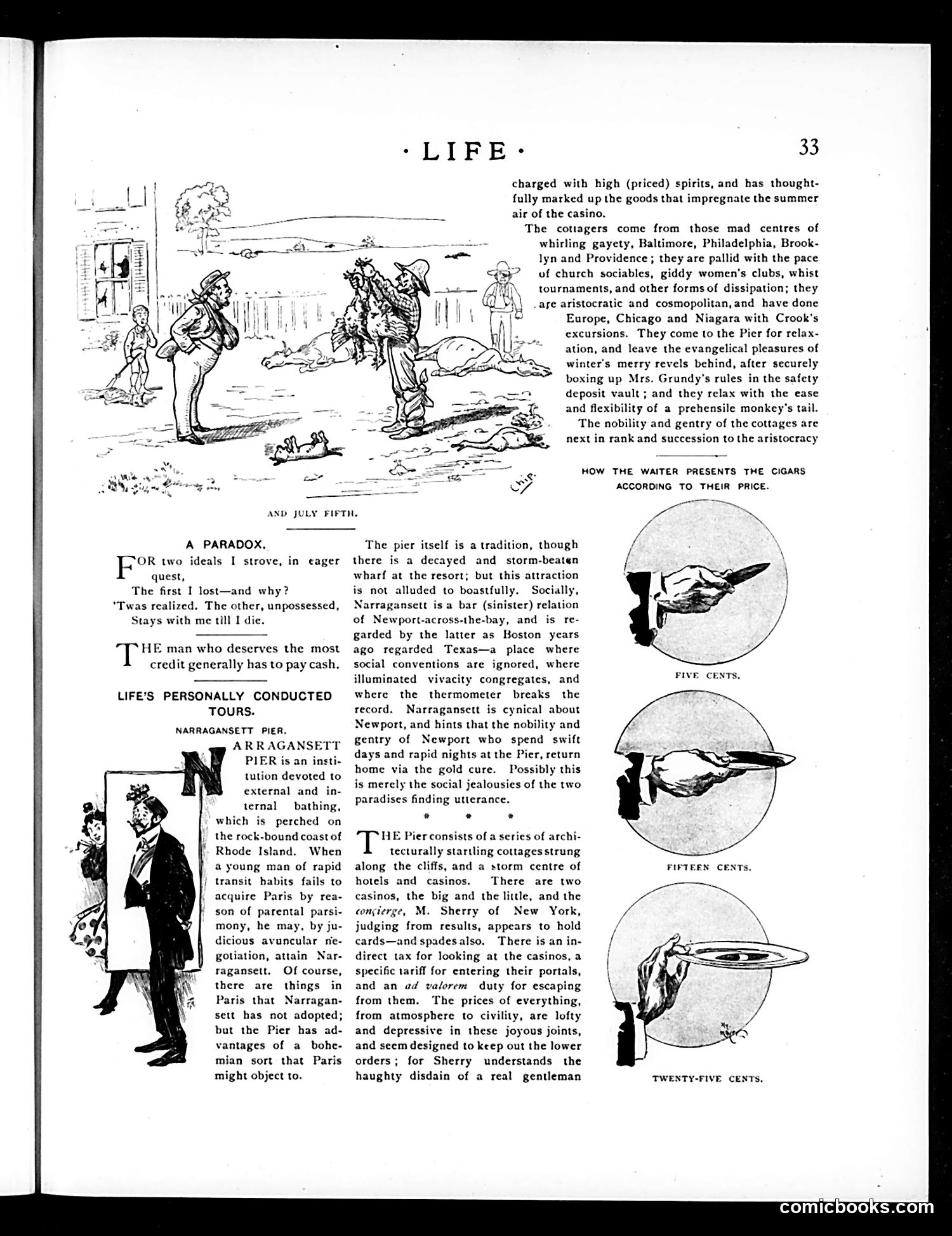
This page satirizes the pretensions of America's nouveau riche leisure class at Narragansett Pier, Rhode Island—a resort competing with the more established Newport. **The Main Cartoon** (top) depicts well-dressed visitors in comically exaggerated poses, mocking the artificial gaiety and excess of summer resort culture. **The Social Critique**: The text mocks cottagers from Baltimore, Philadelphia, and Brooklyn who come to "relax" after winter's church socials and women's clubs. It compares them satirically to "prehensile monkeys," suggesting their behavior is primitive beneath their claims to sophistication. **The Pier's Hypocrisy**: Narragansett is presented as a "sinister relation" of the more prestigious Newport—a place where social conventions are ignored, yet prices are artificially inflated to exclude "lower orders." The concierge M. Sherry maintains exclusivity through high costs rather than genuine breeding. **The Cigar Illustrations** (right margin) mock the waiter's presentation of cigars at different price points—visual satire of the venue's mercenary nature disguised as refinement. The overall message: these resorts are commercialized facades of gentility, catering to aspiring social climbers.
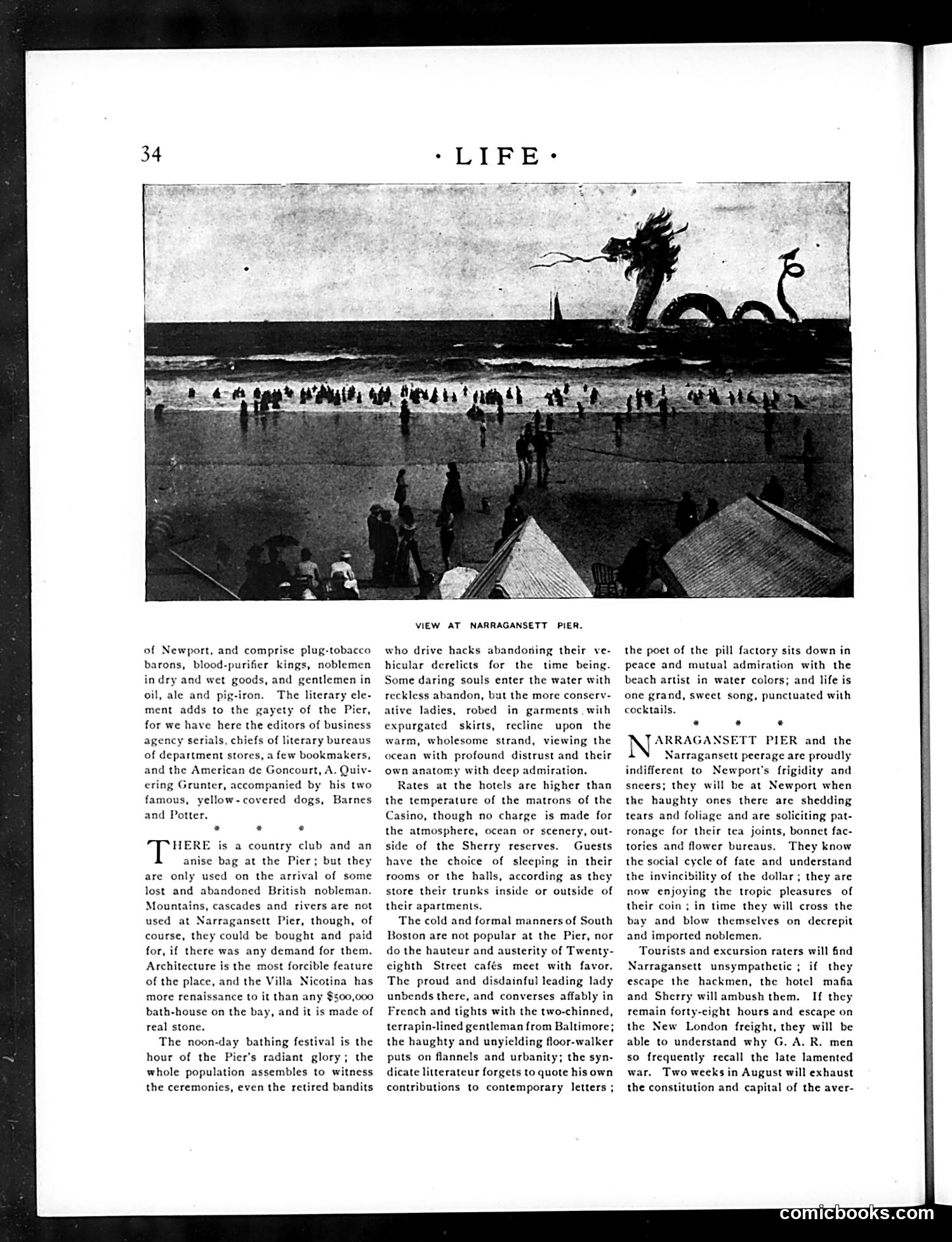
This is a satirical article about Narragansett Pier, Rhode Island, a fashionable seaside resort competing with Newport. The illustration shows crowded beach bathing in the era. The satire targets the resort's nouveau riche clientele—"plug-tobacco barons, blood-purifier kings" and industrial magnates who lack Newport's old-money sophistication. Life mocks their pretensions: expensive hotels with no actual amenities, guests sleeping in hallways due to trunk overflow, and the resort's absurd claim that its architecture rivals Renaissance villas. The piece ridicules social mobility and class-crossing: at Narragansett, proud ladies, snobbish shopwalkers, and literary phonies all abandon their pretensions and mingle freely over "cocktails." The final jab suggests tourists should escape quickly—the place will bankrupt them through hackmen overcharges and inflated Sherry restaurant bills. Life's broader point: this upstart resort represents the vulgar materialism and democratic leveling of American wealth, threatening established East Coast social hierarchies.
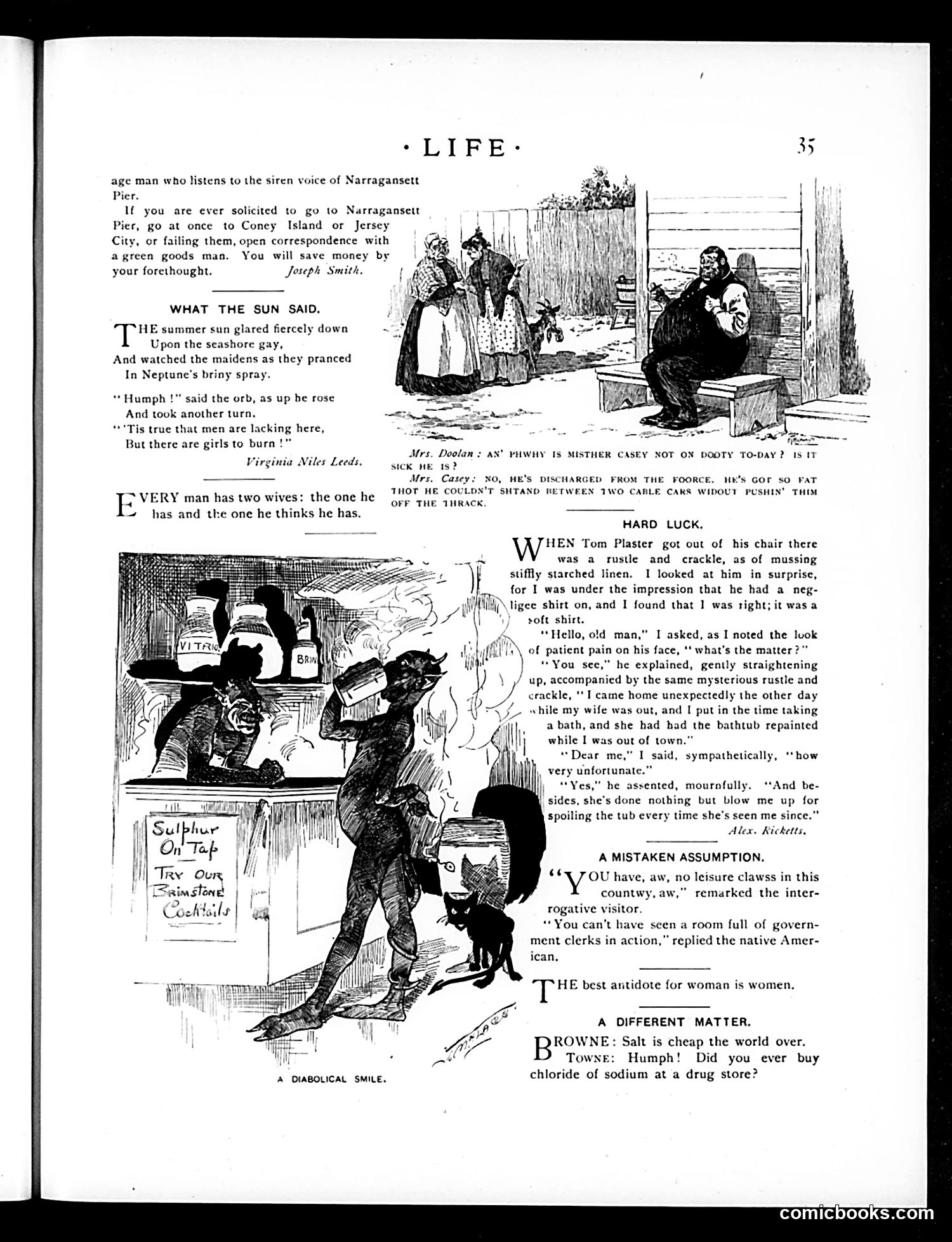
This page contains multiple short humorous items typical of early 20th-century American satirical magazines: **Main cartoons/jokes:** 1. **"Hard Luck"** - A man's wife repainted their bathtub while he was away; when he took a bath, the paint stuck to his clothes, creating stiff, crackling fabric. The joke: domestic inconvenience and marital miscommunication. 2. **Irish police officers dialogue** - Officer Casey was discharged from the police force because he'd gained so much weight he couldn't stand between two cable cars without pushing them apart. Ethnic humor targeting Irish immigrants in city police forces. 3. **"A Mistaken Assumption"** - A visitor assumes America has no leisure class after seeing government clerks working. The joke plays on bureaucratic inefficiency. 4. **Salt/chemistry joke** - "Salt is cheap" until you buy it as "chloride of sodium" at a pharmacy at inflated prices—satirizing marketing and pharmaceutical markups. The page also includes brief satirical verses about beaches and marriage. All humor relies on contemporary urban American life, immigration stereotypes, and consumer culture observations.
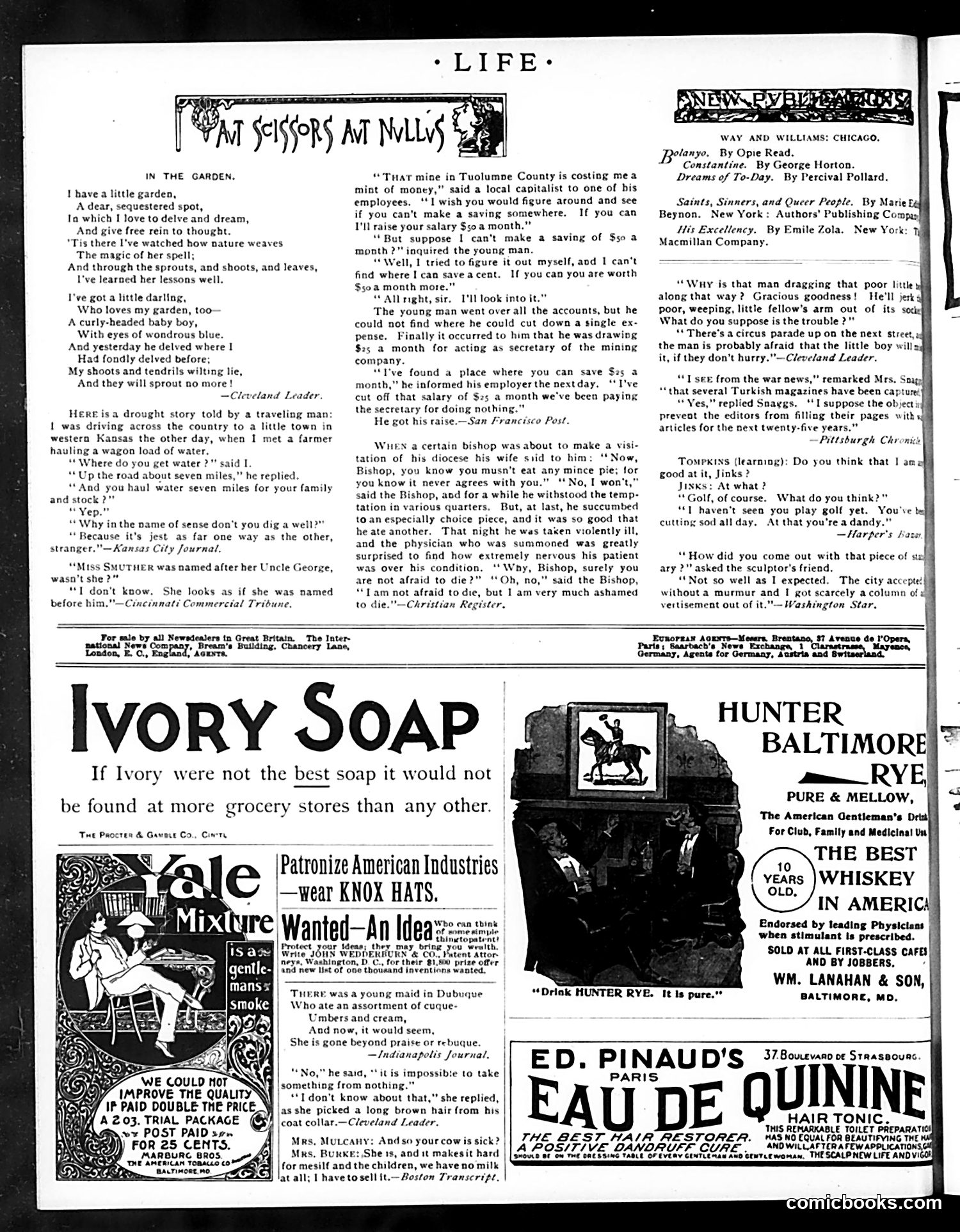
This page from *Life* magazine (a satirical publication) contains mostly humorous anecdotal content and advertising, rather than political cartoons. The humor pieces are short jokes and stories about everyday life: - A poem about a child destroying a garden - Drought stories from Kansas (exaggerated for comedy) - Jokes about naming conventions and salary negotiations - An anecdote about a bishop embarrassed to die after eating forbidden mince pie The content reflects *Life*'s typical format: gentle, domestic humor targeting middle-class readers. There's no sharp political satire here—just light ribbing of human foibles (parental anxiety, rural poverty, workplace cleverness, marital advice, religious hypocrisy). The advertisements (Ivory Soap, Knox Hats, Hunter Rye Whiskey) occupy significant space, indicating this was a commercial publication balancing editorial content with revenue. The satire is mild and apolitical, focusing on universal human situations rather than current events or social criticism.
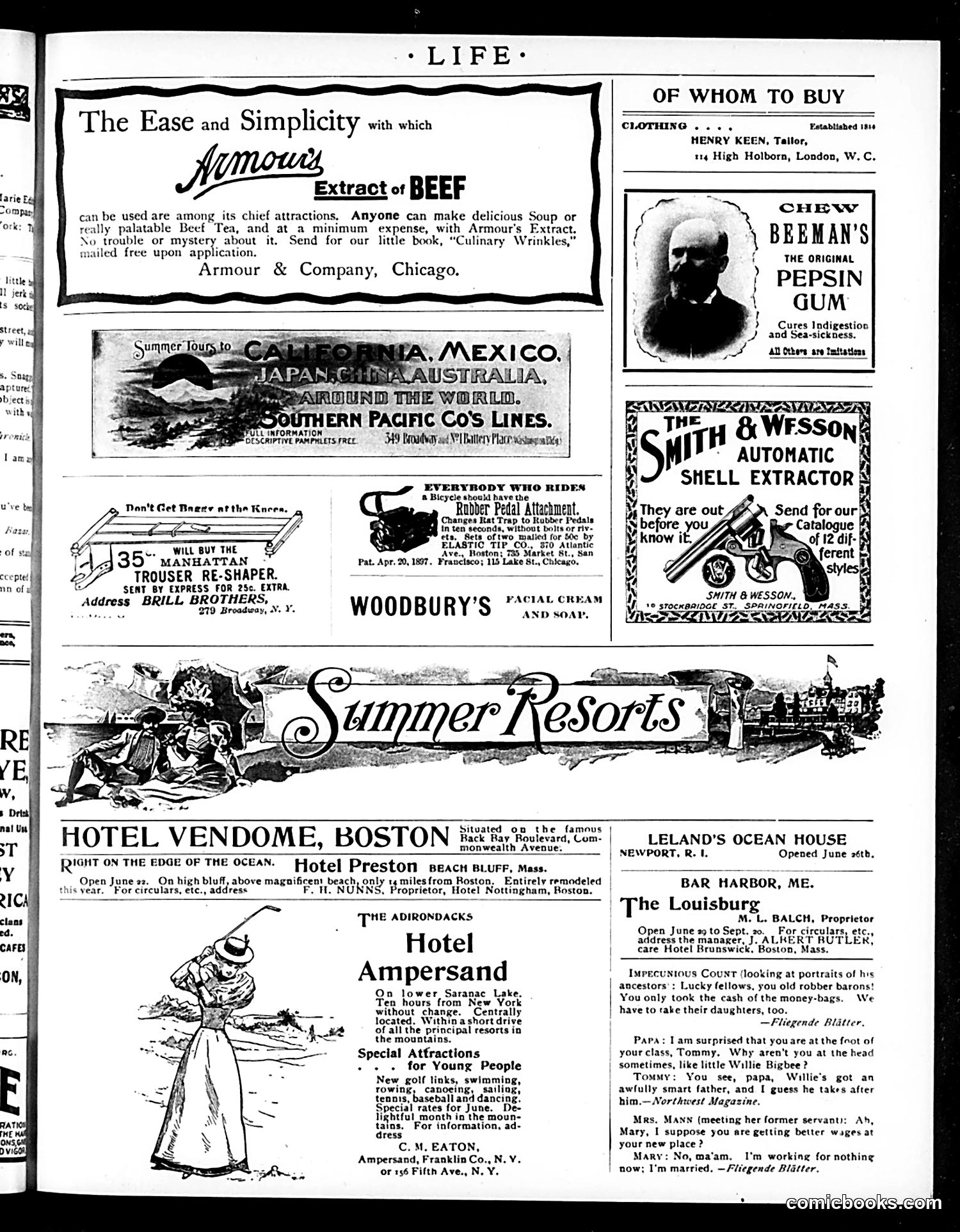
This is primarily an **advertising page** from an early American Life magazine, typical of late 19th-century publications. The ads promote consumer goods and summer resorts. The small **captioned cartoons/jokes** at bottom are brief social satire: 1. **"Impecunious Count"**: A European aristocrat laments that while 19th-century robber barons merely stole money, modern counts must marry wealthy Americans' daughters—a jab at the era's common transatlantic marriages between impoverished European nobility and rich American heiresses. The satire mocks both the scheme and American wealth. 2. **"Tommy's Grades"**: A father asks why his son can't be top student like Willie Bigbee. Tommy implies Willie has an unfair advantage (his father), suggesting inherited privilege matters more than merit. 3. **"Mrs. Mann & Mary"**: A former employer meets her ex-servant, now married. Mary jokes she's "working for nothing"—satirizing marriage as unpaid labor for women, a common feminist critique of the era. These represent typical *Life* humor: gentle social commentary on class, marriage, and inequality.
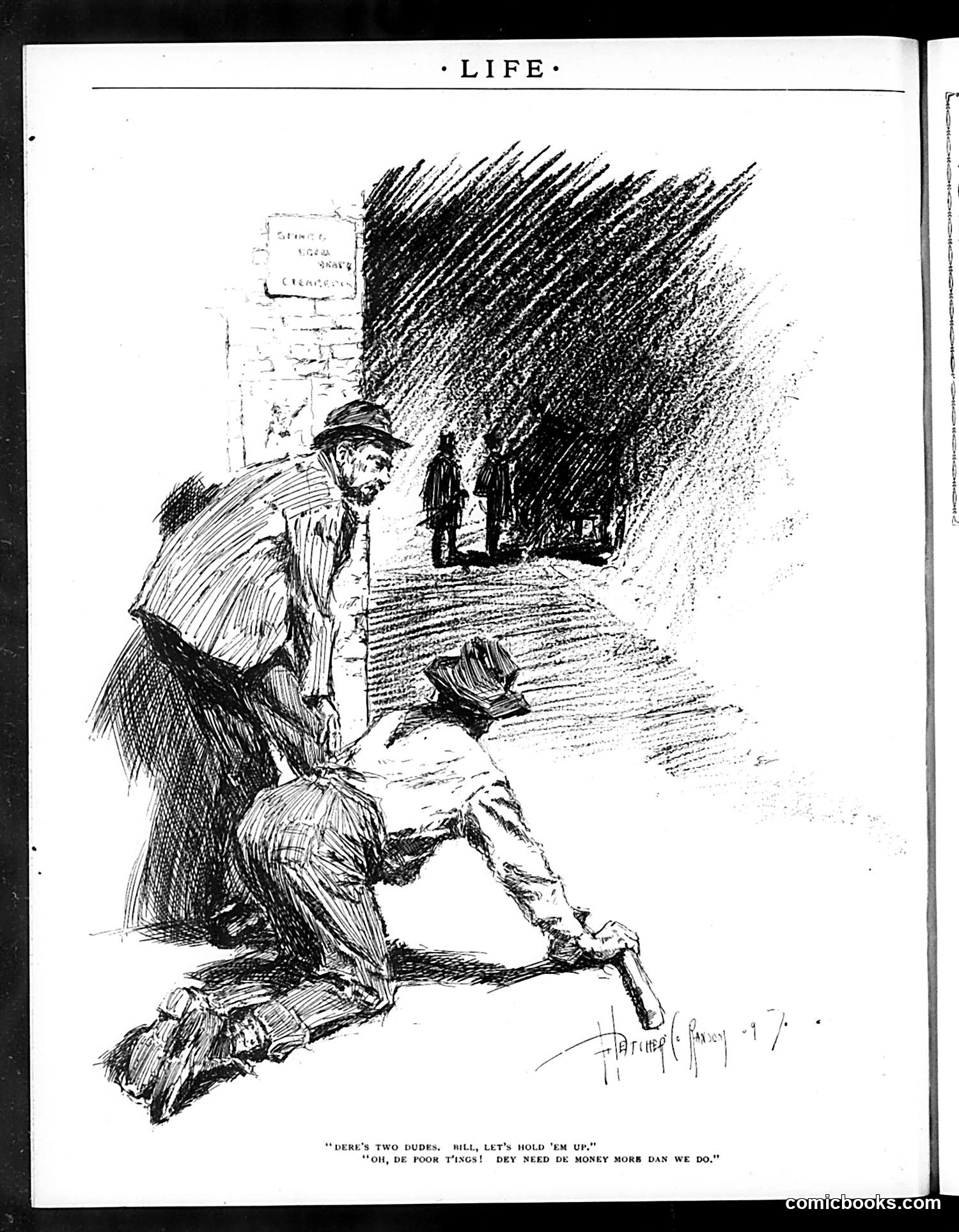
This is a satirical sketch depicting two figures—an adult and a child—as street robbers or muggers confronting wealthy passersby in an alley. The dialogue captures a cynical social commentary: the adult instructs the child to "hold 'em up" (rob them), justifying the crime with the rationalization that the victims "need de money more dan we do"—inverting typical moral logic. The cartoon satirizes poverty and desperation during what appears to be an economically difficult period. It uses dark humor to critique both the desperation driving crime and the wealth inequality that creates such conditions. The crude dialect in the speech suggests commentary on class and social stratification, mocking both the criminals' reasoning and implicitly the society that produces such inequality.
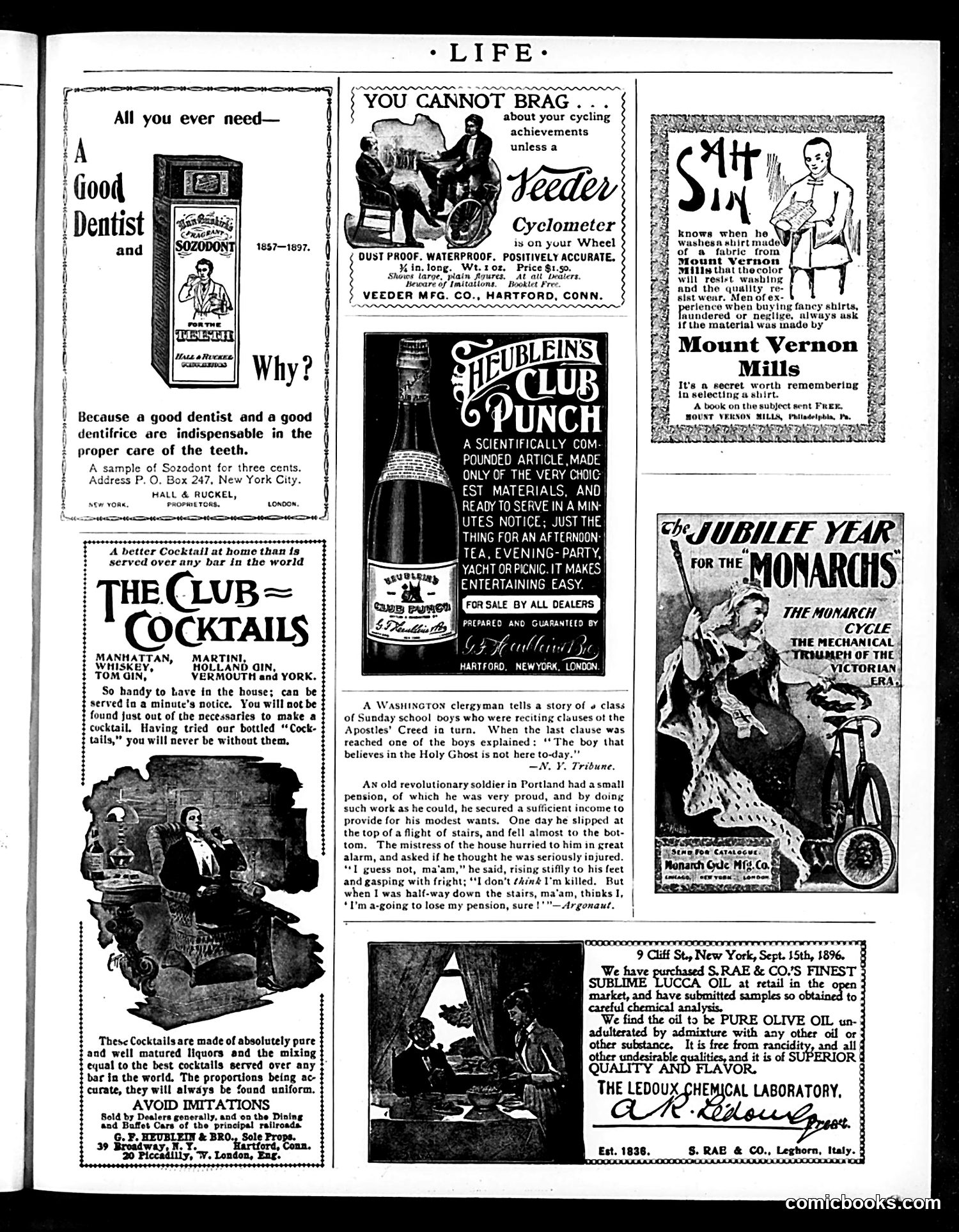
This is primarily an **advertising page** with minimal editorial content. The few satirical elements include: **Small anecdotes** (bottom sections): - A clergyman's story mocking a Sunday school boy who claims "the boy that believes in the Holy Ghost is not here to-day"—likely satirizing literal-minded children or religious hypocrisy - A Revolutionary War pension joke about an elderly soldier worrying about losing his modest pension after falling down stairs—poking fun at both the soldier's priorities and the meagerness of veterans' benefits **Advertisements dominate**, hawking products like: - Veeder Cyclometers (bicycle odometers) - Heublein Club Punch and Club Cocktails - Mount Vernon Mills shirts - The Monarch bicycle ("Triumph of the Victorian Era") - S. Rae & Co.'s olive oil - Dentifrice and dental care The page reflects 1890s consumer culture and life's preoccupations: cycling (a major craze), cocktail culture, quality merchandise. The satire is light and incidental—Life's primary function here is generating advertising revenue.
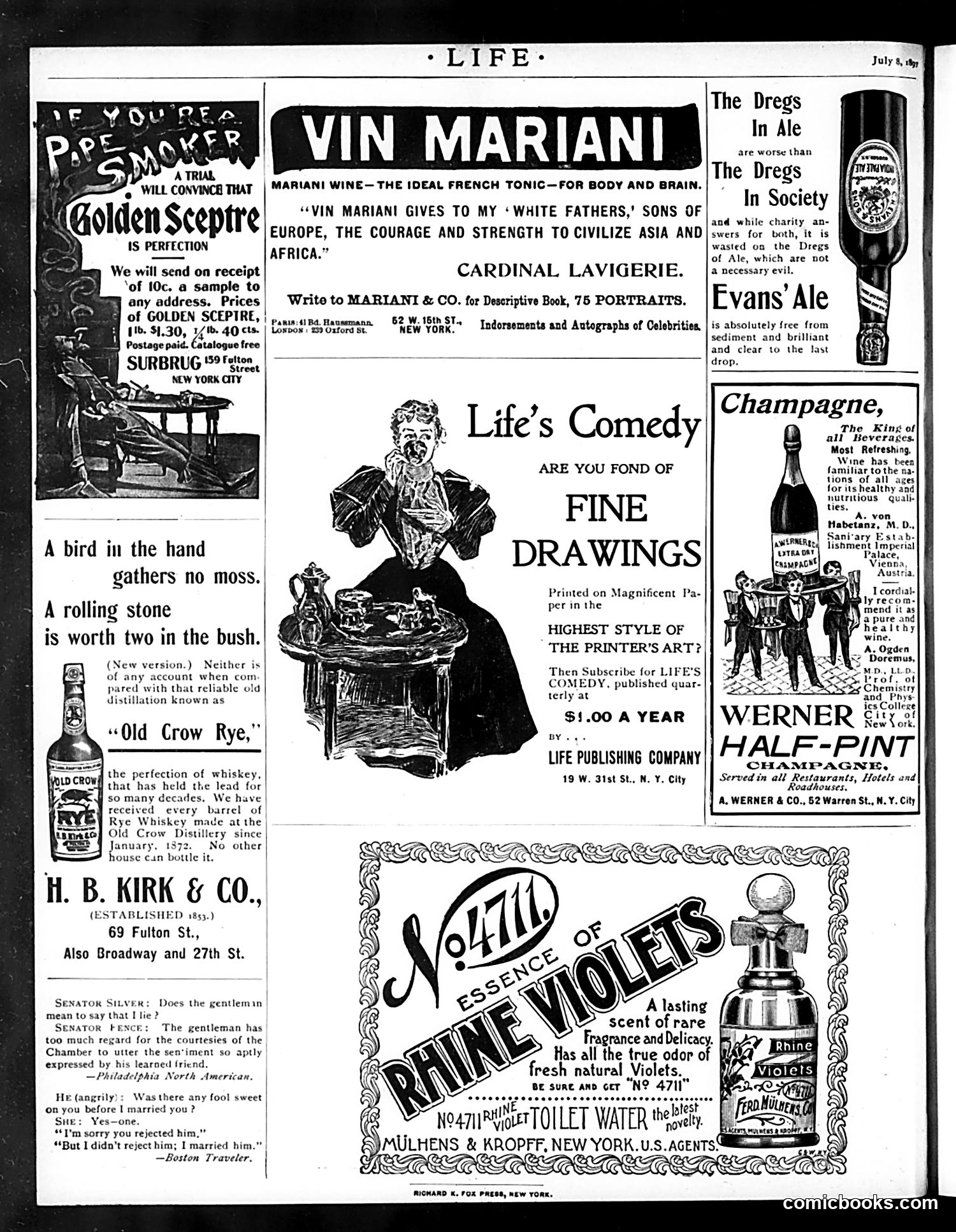
This page is predominantly **advertising**, typical of early Life magazine's revenue model. The main content includes: **Notable Advertisement**: The **Vin Mariani** wine ad features a quote from Cardinal Lavigerie claiming the wine gives "white fathers, sons of Europe" courage to "civilize Asia and Africa"—reflecting period colonial ideology and the Church's missionary work. **Humor Section**: Two brief comedic dialogues appear: - A Senate exchange between "Senator Silver" and "Senator Fence" playing on courteous evasion of accusations - A domestic joke about marriage and rejection **Other Ads**: Promotions for whiskey (Old Crow Rye), champagne, ale, and perfume dominate the page—standard luxury goods marketing for Life's affluent readership. The page reflects early-1900s attitudes: colonial expansion as "civilizing," gender dynamics in marriage humor, and alcohol consumption as respectable entertainment. The advertising-heavy format was Life's business model during this era.