
Life, 1897-07-08 · page 4 of 20
Life — July 8, 1897 — page 4: what you’re looking at
What you’re looking at
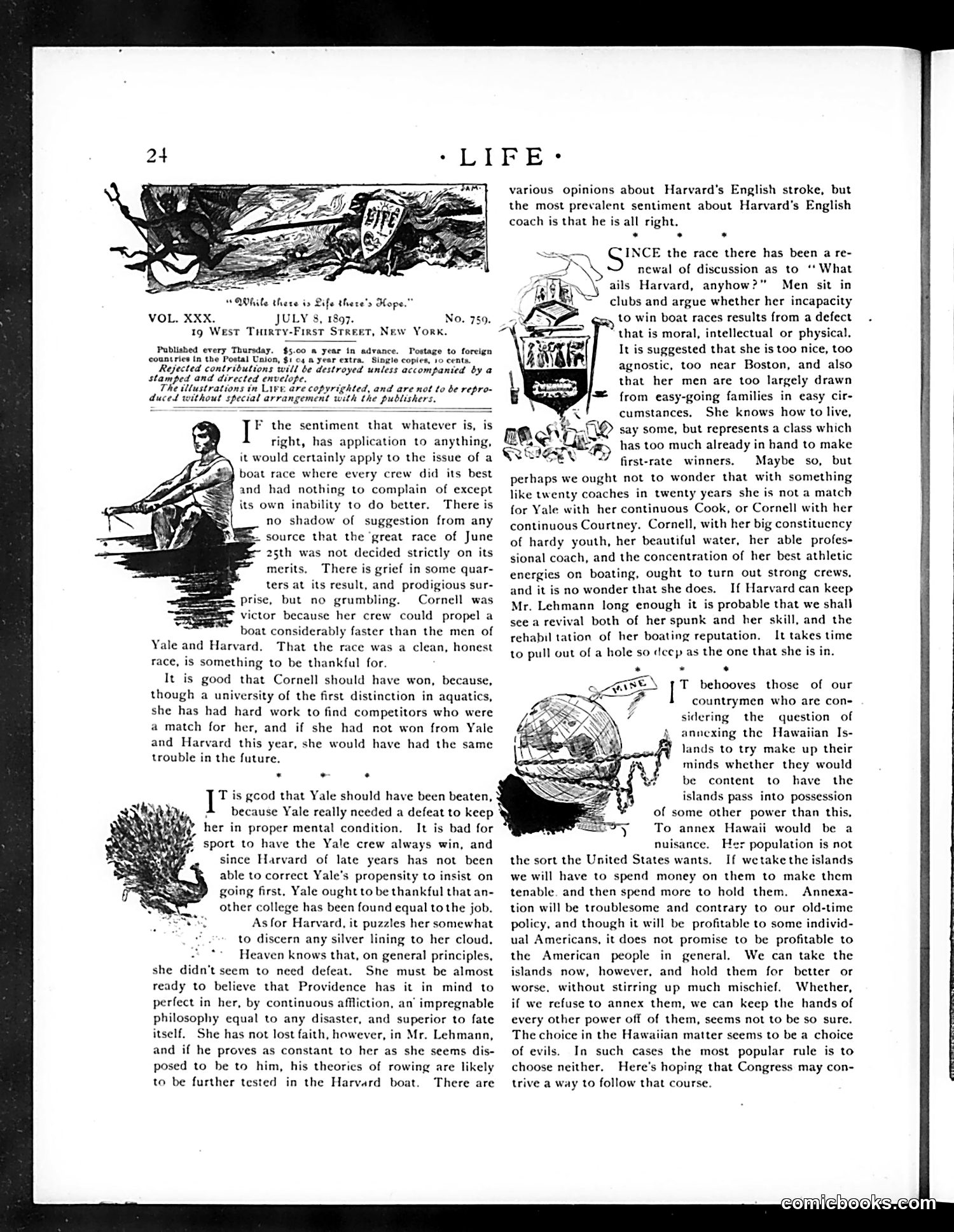
This page discusses Harvard's recent boat race victory, satirizing attitudes about collegiate rowing and institutional pride. The text debates whether Harvard's win was deserved, acknowledging that Cornell had historically been the stronger crew but suggesting Harvard's coach (Mr. Lehmann) has improved their performance. The cartoons appear to show rowers in action. The article defends Harvard's victory while also discussing whether Yale should have won instead—suggesting competitive tensions between these elite universities. A secondary section addresses annexing the Hawaiian Islands, presenting the matter as a "choice of evils" where Americans must decide between possessing Hawaii themselves or allowing another power to do so. This reflects 1890s American imperial expansion debates.
📄 Transcribed text from this page (OCR, searchable)
Machine-transcribed from the original scan — historical spelling and the odd misread are preserved.
“While there is Life there's Hope.” VOL. XXX. JULY 8, 1897. 19 West Tirty-First Ste Published every Thursday. $5.co a year in advance. Postage to foreign countries in the Postal Union, $1 04 a year extra. Single copies, 10 centa, Rejected contributions will be destroyed unless accompanied by @ stamped and directed envelope. The illustrations in Live are copyrighted, and are not to be repro- duced without special arrangement with the publishers. the sentiment that whatever is, is right, has application to anything, it would certainly apply to the issue of a boat race where every crew did its best 4 and had nothing to complain of except { its own inability to do better. There is no shadow of suggestion from any source that the great race of June 25th was not decided strictly on its merits. There is grief in some quar- ters at its result, and prodigious sur- prise, but no grumbling. Cornell was victor because her crew could propel a boat considerably faster than the men of Yale and Harvard. That the race was a clean, honest race, is something to be thankful for. It is good that Cornell should have won, because, though a university of the first distinction in aquatics, she has had hard work to find competitors who were a match for her, and if she had not won from Yale and Harvard this year, she would have had the same trouble in the future. . . . T is gcod that Yale should have been beaten, because Yale really needed a defeat to keep in proper mental condition, It is bad for sport to have the Yale crew always win, and since Harvard of late years has not been able to correct Yale's propensity to insist on going first. Yale ought to be thankful that an- other college has been found equal tothe job. As for Harvard, it puzzles her somewhat to discern any silver lining to her cloud, Heaven knows that, on general principles, she didn’t seem to need defeat. Sne must be almost ready to believe that Providence has it in mind to perfect in her, by continuous affliction, an’ impregnable philosophy equal to any disaster, and superior to fate itself. She has not lost faith, however, in Mr. Lehmann, and if he proves as constant to her as she seems dis- posed to be to him, his theories of rowing are likely to be further tested in the Harvard boat. There are various opinions about Harvard's English stroke, but the most prevalent sentiment about Harvard's English coach is that he is all right. . . . INCE the race there has been a re- newal of discussion as to ‘* What ails Harvard, anyhow?” Men sit in clubs and argue whether her incapacity to win boat races results from a defect that is moral, intellectual or physical. It is suggested that she is too nice, too agnostic, too near Boston, and also that her men are too largely drawn from easy-going families in easy cir- cumstances, She knows how to live, © say some, but represents a class which x Aone has too much already in hand to make SEN” 2 first-rate Maybe so, but perhaps we ought not to wonder that with something like twenty coaches in twenty years she is not a match for Yale with her continuous Cook, or Cornell with her continuous Courtney. Cornell, with her big constituency of hardy youth, her beautiful water, her able profes- sional coach, and the concentration of her best athletic energies on boating, ought to turn out strong crews, and it is no wonder that she does. If Harvard can keep Mr. Lehmann long enough it is probable that we shall see a revival both of her spunk and her skill, and the rehabil tation of her boating reputation. It takes time to pull out of a hole so deep as the one that she is in. * winners, . . [7 behooves those of our countrymen who are con- sidering the question of annexing the Hawaiian Is- lands to try make up their minds whether they would be content to have the islands pass into possession of some other power than this, To annex Hawaii would nuisance. Her population is not the sort the United States wants. If wetake the islands we will have to spend money on them to make them tenable. and then spend more to hold them. Annexa- tion will be troublesome and contrary to our old-time policy, and though it will be profitable to some indi ual Americans, it does not promise to be profitable to the American people in general. We can take the islands now, however, and hold them for better or worse, without stirring up much mischief. Whether, if we refuse to annex them, we can keep the hands of every other power off of them, seems not to be so sure. The choice in the Hawaiian matter seems to be a choice of evils. In such cases the most popular rule is to choose neither. Here's hoping that Congress may con- trive a way to follow that course. be a