
Life, 1897-07-08 · page 7 of 20
Life — July 8, 1897 — page 7: what you’re looking at
What you’re looking at
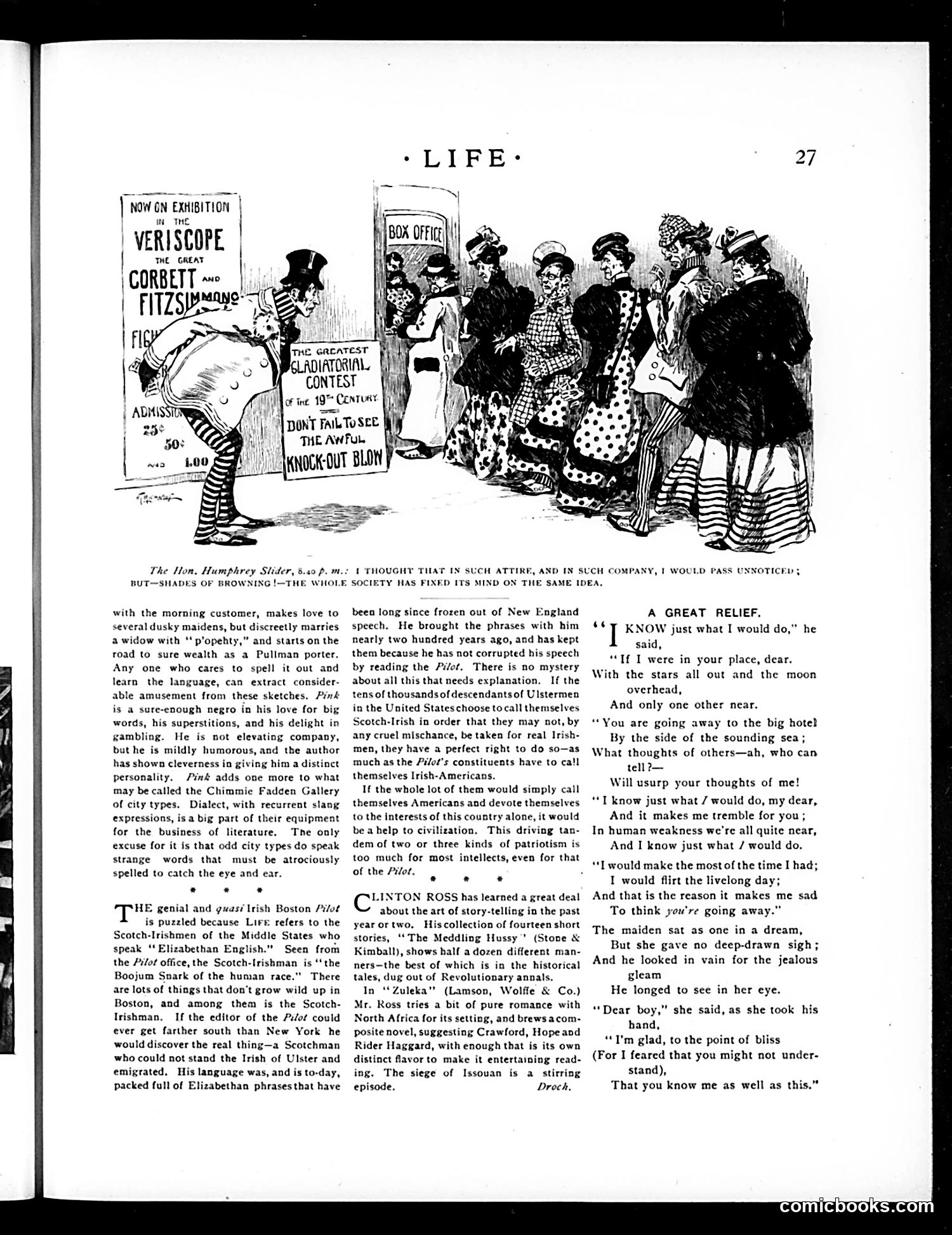
The main cartoon depicts a barker outside a theater hawking attractions including "Veriscope" films of "The Great Corbett and Fitzsimmons" fight, alongside other popular entertainments. A crowd of well-dressed women in elaborate hats and polka-dot dresses queue at the box office. The satire targets the spectacle and commercialization of celebrity boxing matches. The "Veriscope" reference likely concerns early cinema technology used to film and distribute major boxing events. The crowd of fashionable society women suggests the fight had become mainstream entertainment, crossing social boundaries. The cartoon appears to mock both the sensationalism of prize-fighting promotion and the novelty of cinema technology being exploited for commercial gain. The elaborate dress of attendees underscores how boxing had become fashionable entertainment rather than a niche sport.
📄 Transcribed text from this page (OCR, searchable)
Machine-transcribed from the original scan — historical spelling and the odd misread are preserved.
J now on extisition mh oTHE | VERISCOPE THE GREAT | | CORBETT ~» FITZS4=aue THE GREATEST CLADIATORIAL CONTEST ine 19% ConTUse “| pont Fal Tosce | } THE AWFUL {anata OUT BLOW The Hon. Humphrey Slider, 6.40 p.m. BUT—SHADES OF BROWNING !—THE WHOLE SOCIETY HAS FIXED IT: with the morning customer, makes love to several dusky maidens, but discreetly marries a widow with “ pfopehty,” and starts on the road to sure wealth as a Pullman porter. Any one who cares to spell it out and learn the language, can extract consider- able amusement from these sketches. Pink is a sure-enough negro in his love for big words, his superstitions, and his delight in gambling. He is not elevating company, but he is mildly humorous, and the author has shown cleverness in giving him a distinct personality. ink adds one more to what may be called the Chimmie Fad¢en Gallery of city types. Dialect, with recurrent slang expressions, is a big part of their equipment for the business of literature. The only excuse for it is that odd city types do speak strange words that must be atrociously spelled to catch the eye and ear. * * * HE genial and guasi Irish Boston Pilot is puzzled because Lire refers to the Scotch-Irishmen of the Middle States who speak ‘Elizabethan English.” Seen from the Pilot office, the Scotch-trishman is ‘the Boojum Snark of the human race.” There are lots of things that don’t grow wild up in Boston, and among them is the Scotch- Irishman, If the editor of the Pilot could ever get farther south than New York he would discover the real thing—a Scotchman who could not stand the Irish of Ulster and emigrated, His language was, and is to-day, packed full of Elizabethan phrases that have : | THOUGHT THAT IN been long since frozen out of New England speech. He brought the phrases with him nearly two hundred years ago, and has kept them because he has not corrupted his speech by reading the Pr/ot, There is no mystery about all this that needs explanation. If the tens of thousands of descendants of Ulstermen in the United States choose tocall themselves Scotch-Irish in order that they may not, by any cruel mischance, be taken for real Irish- men, they have a perfect right to do so—as much as the Plot's constituents have to ca!l themselves Irish-Americans. If the whole lot of them would simply call themselves Americans and devote themselves to the interests of this country alone, it would be a help to civilization, This driving tan- dem of two or three kinds of patriotism is too much for most intellects, even for that of the Pilot, . * LINTON ROSS has learned a great deal about the art of story-telling in the past year ortwo. Hiscollection of fourteen short stories, ‘‘The Meddling Hussy ' (Stone & Kimball), shows half a dozen different man- ners—the best of which is in the historical tales, dug out of Revolutionary annals. In “Zuleka" (Lamson, Wolffe & Co.) Mr. Ross tries a bit of pure romance with North Africa for its setting, and brews acom- posite novel, suggesting Crawford, Hope and Rider Haggard, with enough that is its own distinct flavor to make it entertaining read- ing. The siege of Issouan is a. stirring episode. Drock. CH ATTIRE, AND IN SUCH COMPANY, 1 WOULD PASS UNNOTICED 5 MIND ON THE SAME IDEA, A GREAT RELIEF, ©©T KNOW just what I would do,” he said, “If L were in your place, dear. With the stars all out and the moon overhead, And only one other near. “You are going away to the big hotel By the side of the sounding sea; What thoughts of others—ah, who can tell 2— Will usurp your thoughts of me! “TL know just what / would do, my dear, And it makes me tremble for you ; In human weakness we're all quite near, And I know just what / would do, “I would make the most of the time I had; I would flirt the livelong day; And that is the reason it makes me sad To think you're going away.” The maiden sat as one in a dream, But she gave no deep-drawn sigh; And he looked in vain for the jealous gleam He longed to see in her eye. “Dear boy,” she said, as she took his hand, “I'm glad, to the point of bliss (For I feared that you might not under- stand), That you know me as well as this.”