
A complete issue · 20 pages · 1897
Life — June 10, 1897
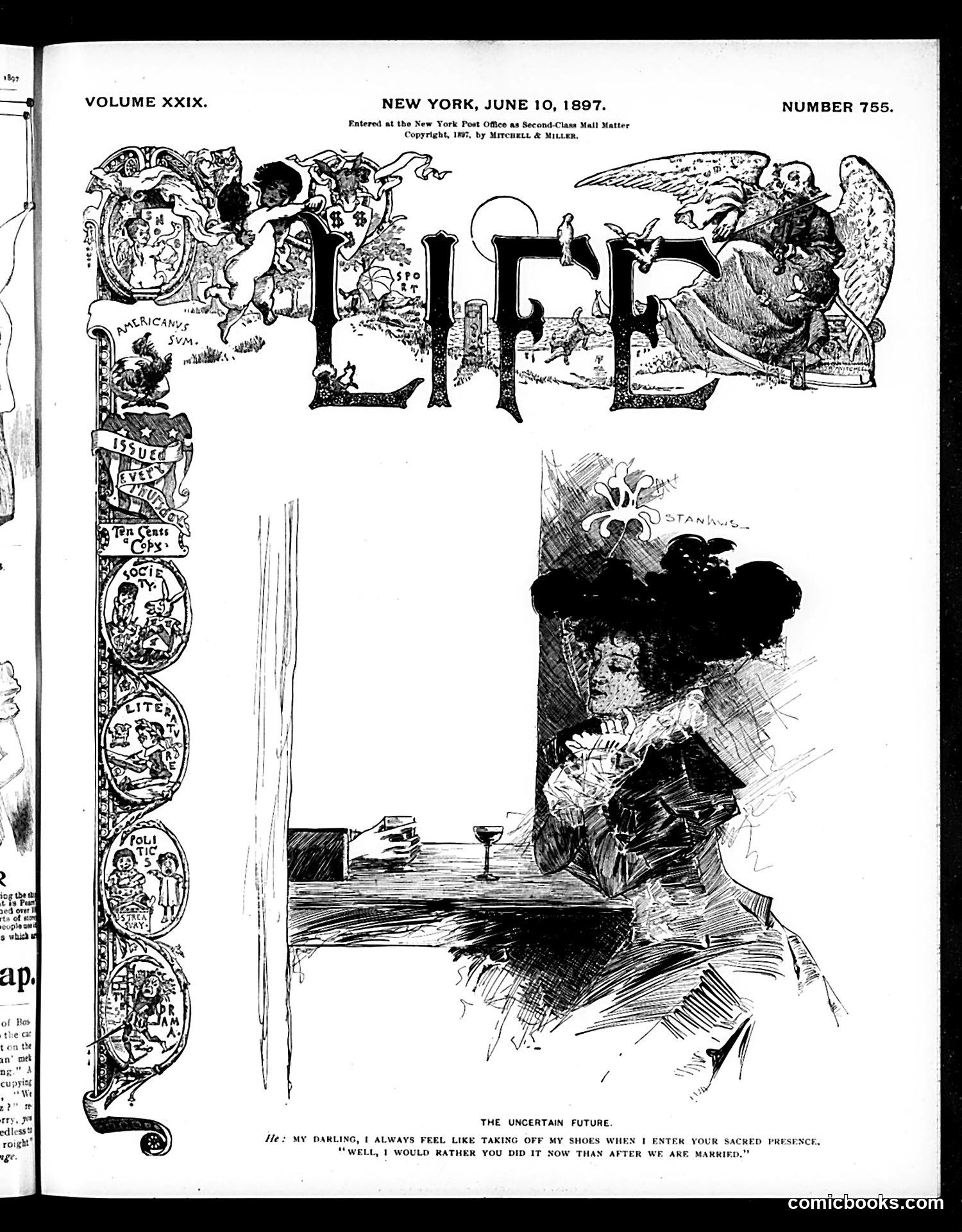
**The Main Cartoon: "The Uncertain Future"** The large illustration shows a woman in elegant dress with an elaborate hat, seated indoors. The caption quotes her saying: "My darling, I always feel like taking off my shoes when I enter your sacred presence. Well, I would rather you did it now than after we are married." This is a marriage-anxiety joke typical of 1890s satire. The woman expresses uncertainty about her fiancé's character—suggesting she'd prefer to discover his true nature (implied to be unpleasant) *before* marriage rather than after. The "sacred presence" phrase is ironic, implying his supposedly gentlemanly demeanor may be performative. The ornate left border contains decorative period imagery unrelated to the main cartoon.
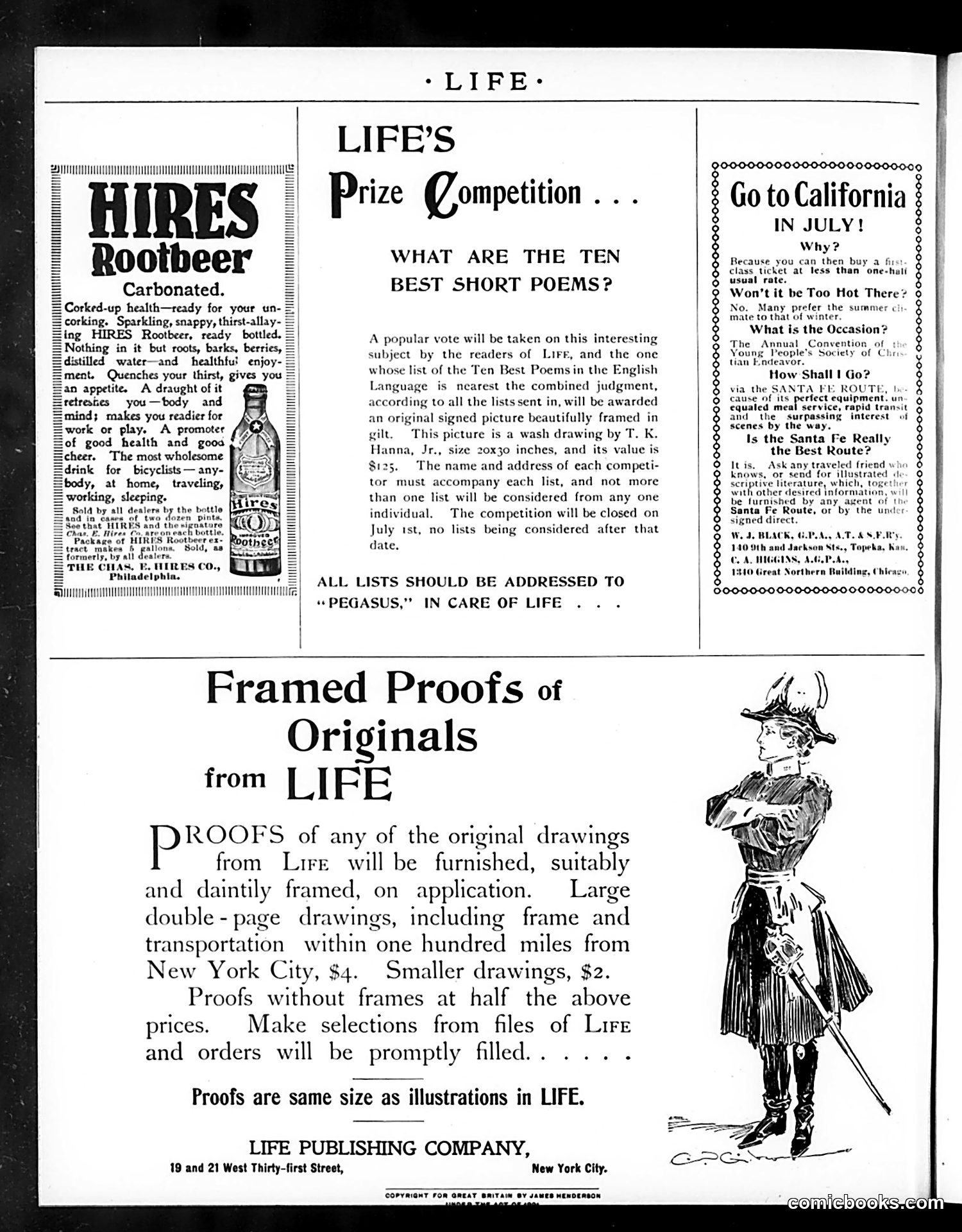
This page is primarily **advertising and announcements** rather than political satire or commentary. The content includes: 1. **HIRES Rootbeer advertisement** (left) — a carbonated beverage marketed as health-promoting and refreshing 2. **LIFE's Prize Competition** (center) — soliciting readers to vote on the ten best short poems in English, with prizes including a framed artwork 3. **California tourism advertisement** (right) — promoting summer travel to California 4. **Framed Proofs service** (bottom) — LIFE Publishing Company offering to sell framed reproductions of original artwork from the magazine The only illustration is a **fashion sketch** of a woman in early 20th-century clothing with a large feathered hat and sword/riding crop, accompanying the framed proofs service. No political satire or caricature appears on this page. It represents typical magazine filler content: product advertising, reader engagement contests, and merchandise sales.
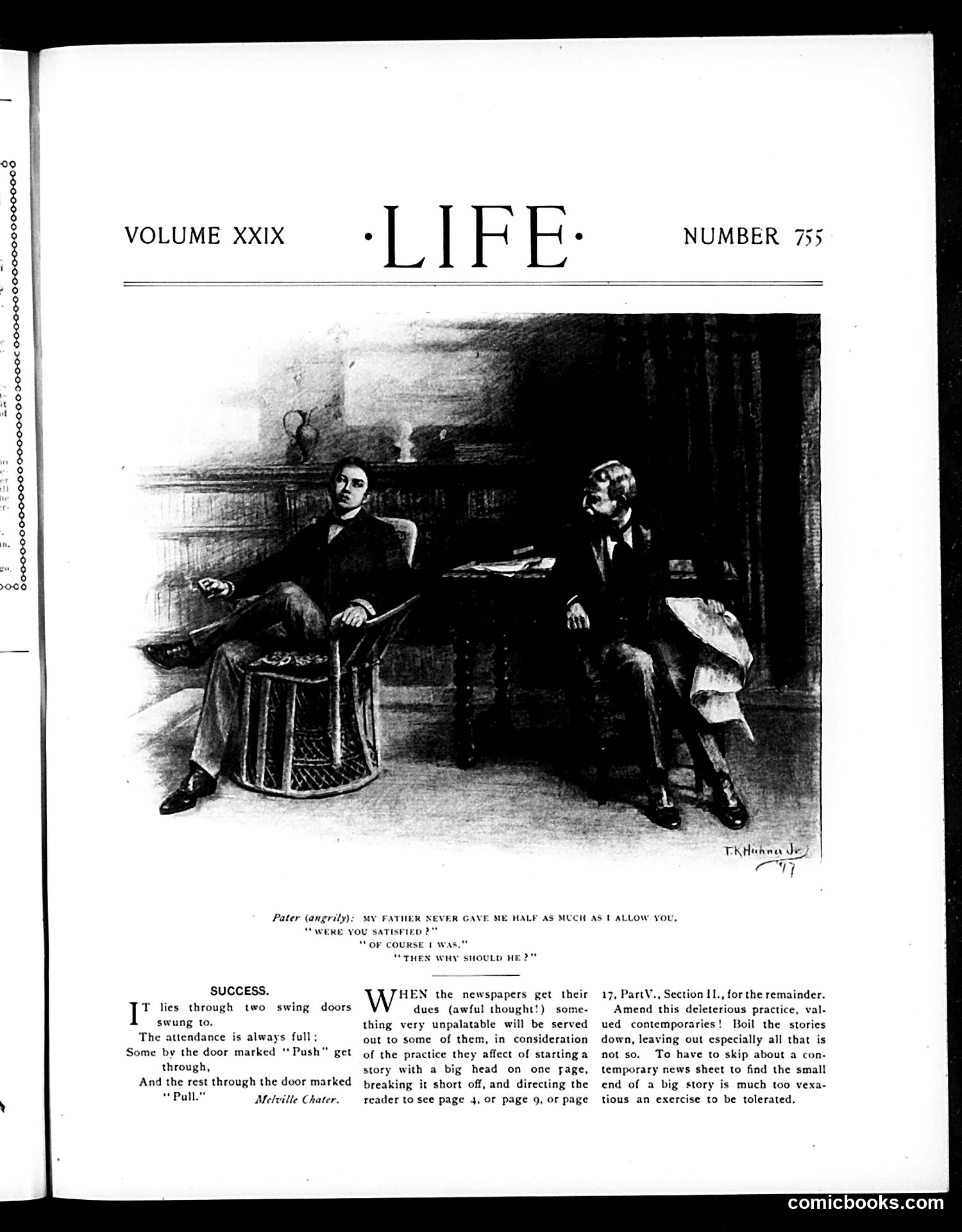
This page from *Life* magazine (Volume XXIX, Number 755) contains a satirical cartoon about newspaper practices. The illustration shows three men in an interior setting, with a caption where "Pater" (the father figure) complains that his father never gave him half the allowance he gives his son, asking if the son is satisfied. The son replies he is, then asks "Then why should he?" The accompanying article titled "SUCCESS" critiques how newspapers sensationalize stories. It explains that newspapers use prominent headlines to attract readers, often breaking up longer stories across multiple pages to encourage continued reading. The satire targets this manipulative publishing practice—using artificial drama and pagination strategies to boost circulation rather than serving readers honestly. The joke equates this to arbitrary generosity without principle.
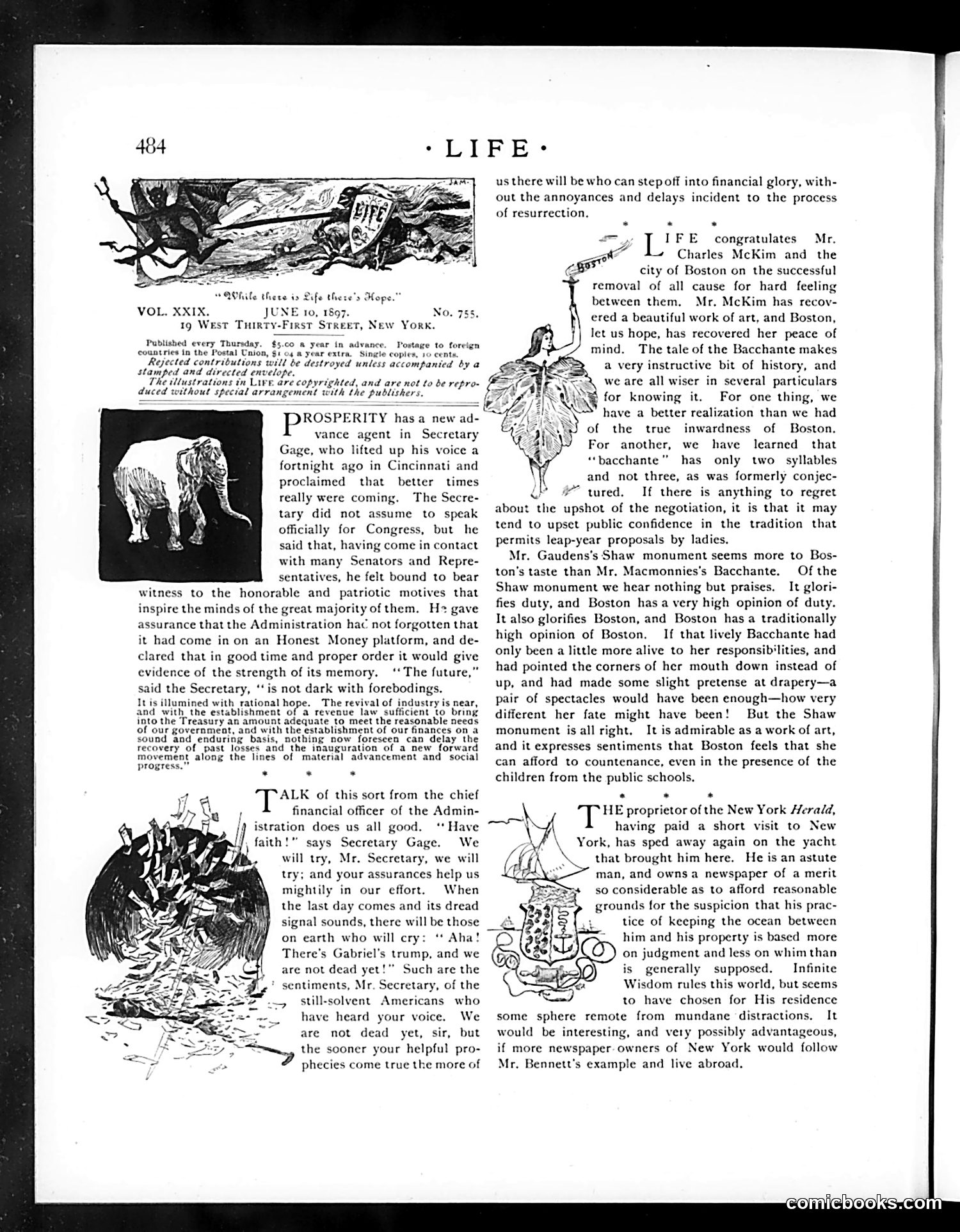
This page contains two satirical pieces about American politics and society: **Top cartoon**: Shows Secretary of the Treasury Gage speaking optimistically about economic recovery, claiming "better times are coming." The satire mocks his confident predictions despite ongoing financial difficulties—the text notes he spoke to Congress about the Administration's strength while actual economic hardship persisted. **Bottom cartoon**: Depicts what appears to be an allegorical scene related to political prophecy or Gabriel's trumpet (referencing apocalyptic imagery), accompanying text about economic sentiment and financial recovery hopes. The page also includes commentary congratulating Charles McKim and Boston on resolving disputes, and discusses the New York *Herald* proprietor's yacht activities. The overall theme ridicules government optimism disconnected from citizens' economic reality.
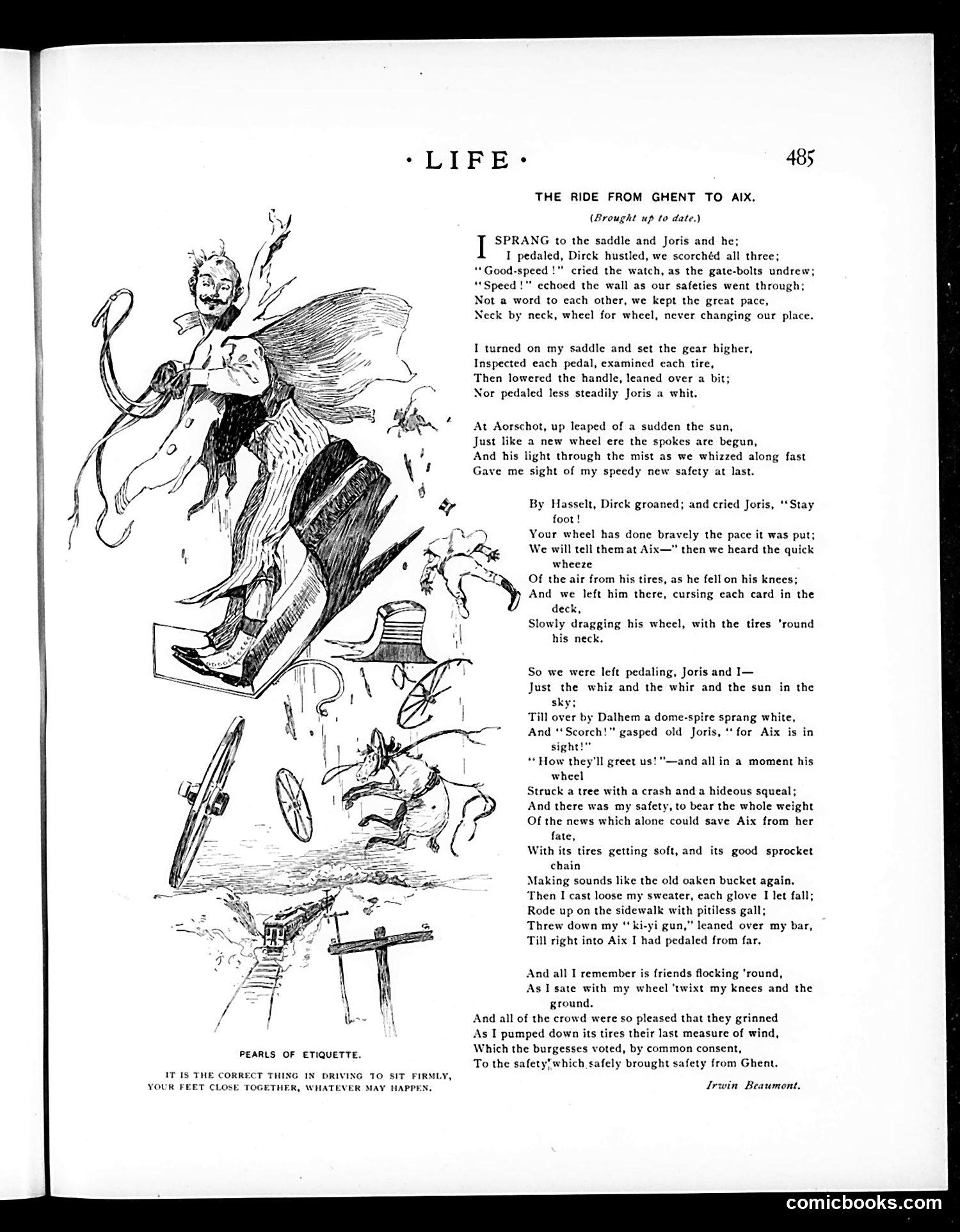
This page presents a humorous poem by Irwin Beaumont recounting a bicycle race from Ghent to Aix (Aix-la-Chapelle). The narrative parodies the famous historical poem "How They Brought the Good News from Ghent to Aix," substituting galloping horses with bicycles and modern cycling culture. The accompanying cartoon depicts cyclists in various states of chaos and mishap—crashed wheels, tangled riders, and mechanical failures—satirizing the Victorian bicycle-riding craze and its hazards. The illustration titled "Pearls of Etiquette" humorously addresses proper cycling posture. The satire mocks both the romanticism of historical adventure narratives and the newfound obsession with bicycles as modern transportation, treating mechanical cycling mishaps as inherently comedic subject matter for the era's readers.
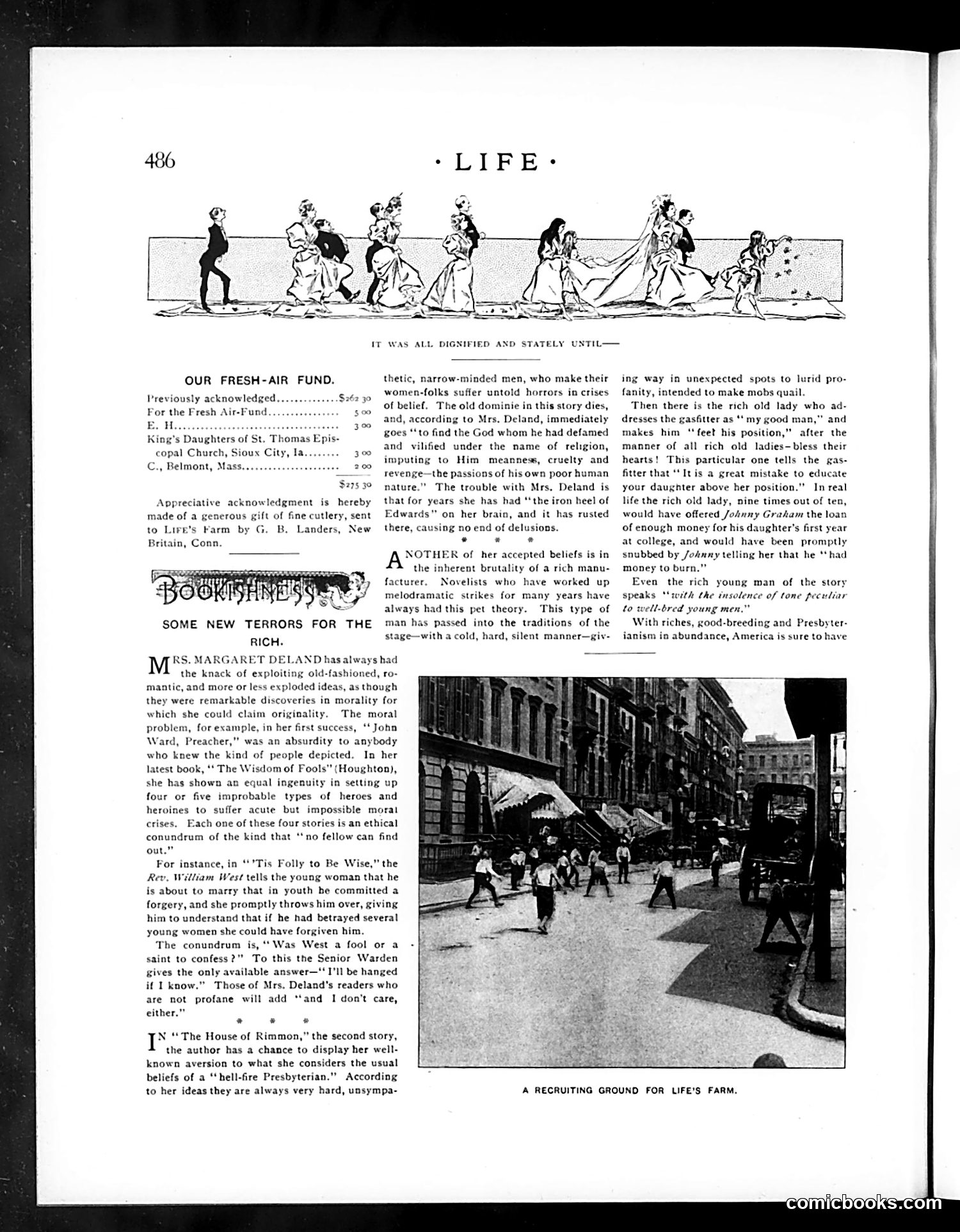
The decorative header illustration shows a line of figures in Victorian/Edwardian dress engaged in what appears to be a dignified procession or formal activity—the caption reads "IT WAS ALL DIGNIFIED AND STATELY UNTIL—" suggesting the humor derives from an implied breakdown of decorum that follows. The page primarily contains literary criticism by Margaret Deland, discussing moral themes in her short stories (including "John Ward, Preacher" and "The Folly to Be Wise"). The accompanying photograph shows "A Recruiting Ground for Life's Farm"—likely depicting a street scene related to agricultural or social recruitment efforts. The satire appears indirect, focused on critiquing Deland's narrative choices regarding morality rather than specific political figures or events. Without clearer visual caricatures, the primary humor seems literary rather than political.
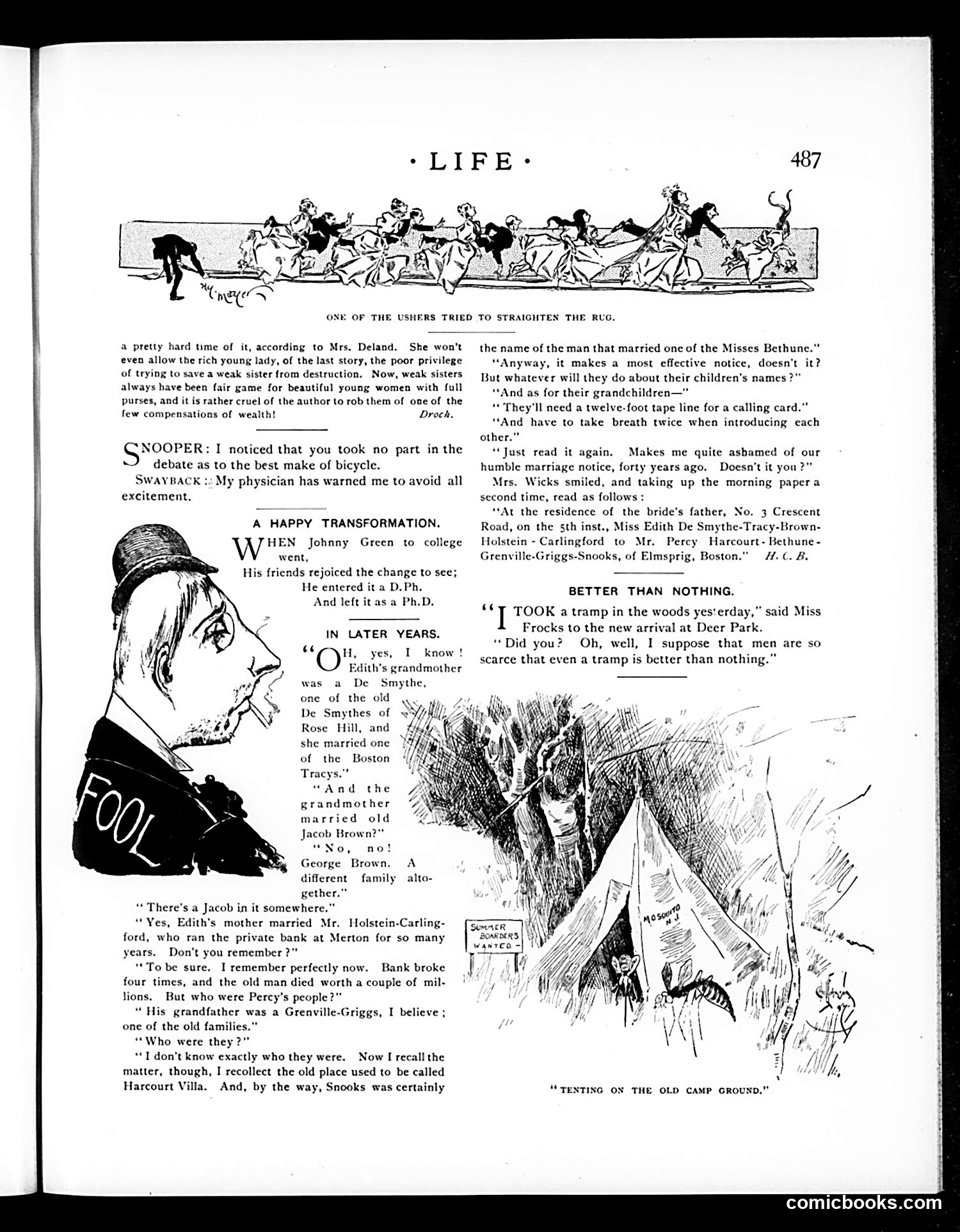
This page contains two separate humorous pieces rather than a unified political cartoon: 1. **"A Happy Transformation"** (left): A sketch mocking someone named Johnny Green who went to college and earned advanced degrees (D.Ph., Ph.D.), transforming into an overeducated "fool." The satire targets academic pretension. 2. **"Better Than Nothing"** (right): A brief dialogue joke where Miss Frocks encounters a tramp at Deer Park. She comments that men are "so scarce that even a tramp is better than nothing"—satirizing the apparent shortage of eligible men and women's lowered standards. The page primarily contains social satire about class, education, and gender relations typical of early 20th-century Life magazine humor, rather than political commentary.
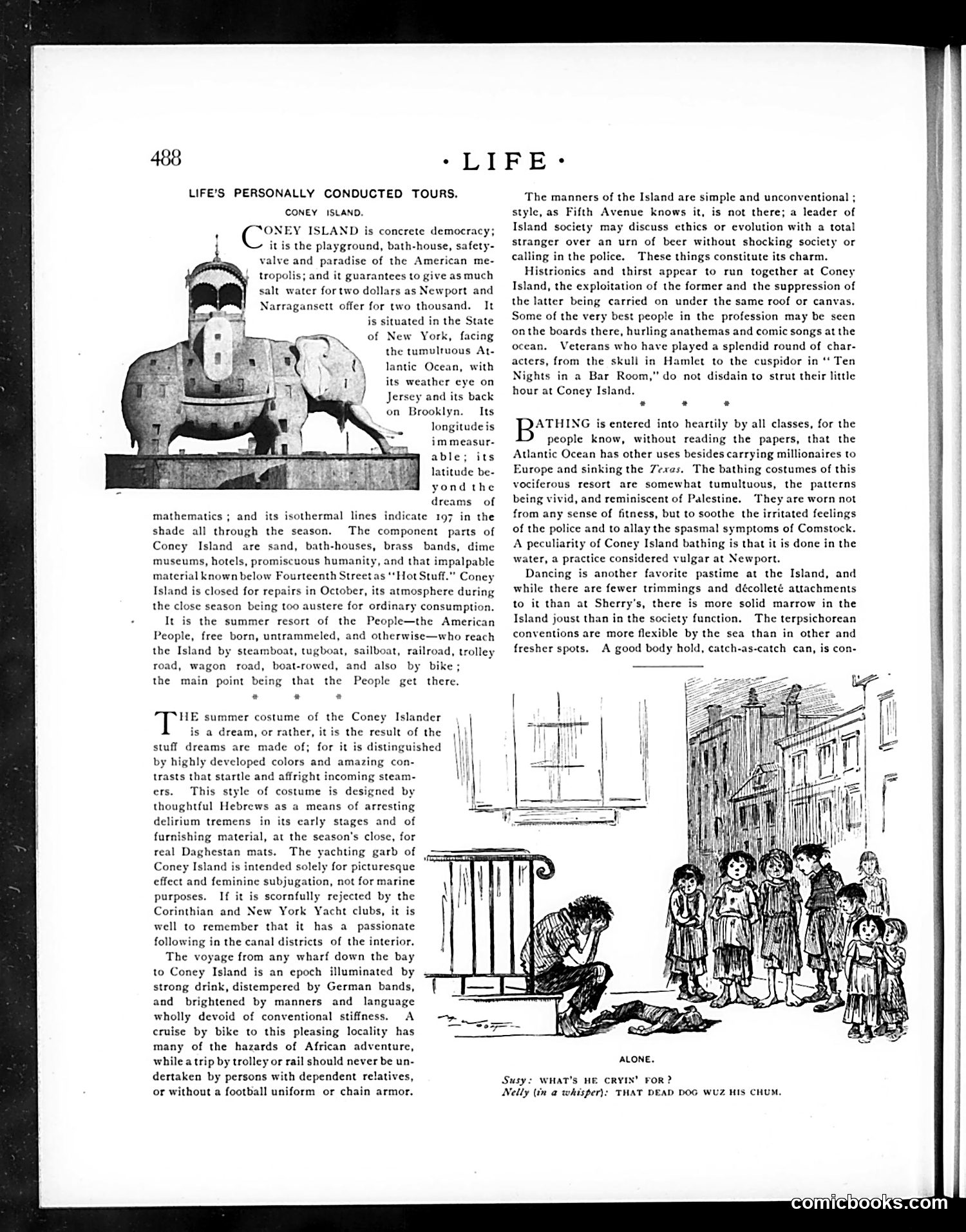
This is a humorous essay about Coney Island as a summer resort, illustrated with social commentary. The main cartoon at bottom, captioned "ALONE," depicts a beggar child sitting alone while well-dressed adults and children pass by indifferently. The dialogue—"What's he cryin' for?" / "That dead dog wuz his chum"—uses dark humor to satirize the callousness of Coney Island's crowd and the contrast between wealthy vacationers and the poor. The essay text mocks Coney Island's pretensions: its "concrete democracy," garish bathing costumes "reminiscent of Palestine," and unconventional social manners. It portrays the resort as simultaneously democratic and morally questionable—a place where social conventions collapse and people behave badly, indifferent to suffering around them.
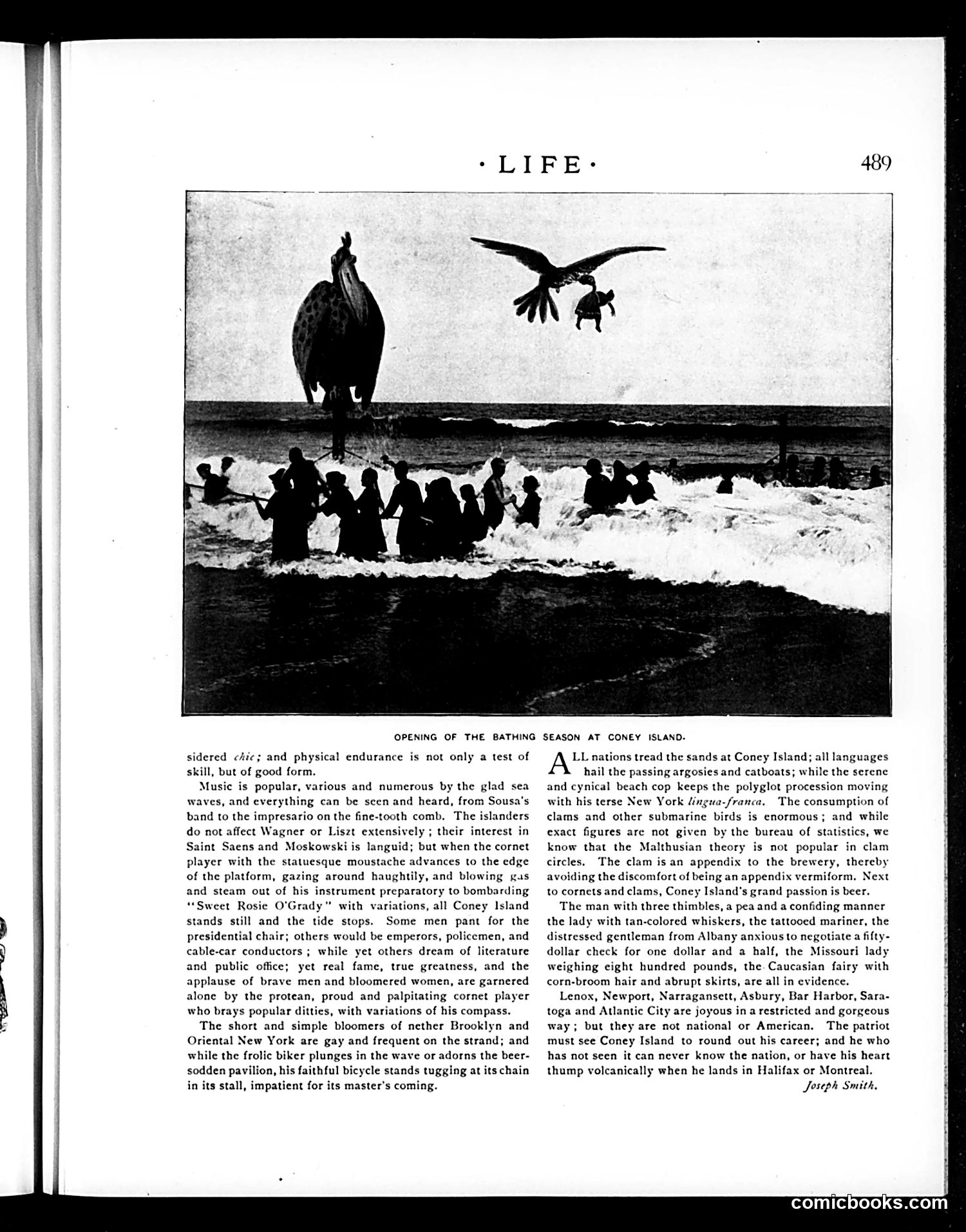
This is a photographic illustration captioned "OPENING OF THE BATHING SEASON AT CONEY ISLAND," showing beachgoers in the surf with an elephant and bird overhead. The accompanying text by Joseph Smith is a celebration of Coney Island as a democratic, culturally diverse public space. It praises the beach's appeal to "all nations" and "all languages," describing the varied crowds—including immigrants, workers, and socialites—who gather there. The text humorously catalogs the musical entertainment, street performers, and types of visitors (policemen, poets, cable-car conductors, "bloomed women"). Rather than satire, this appears to be *affectionate* commentary on American mass culture and social mixing. The whimsical elephant and bird in the photograph underscore the page's tone of entertainment and amusement rather than critique.
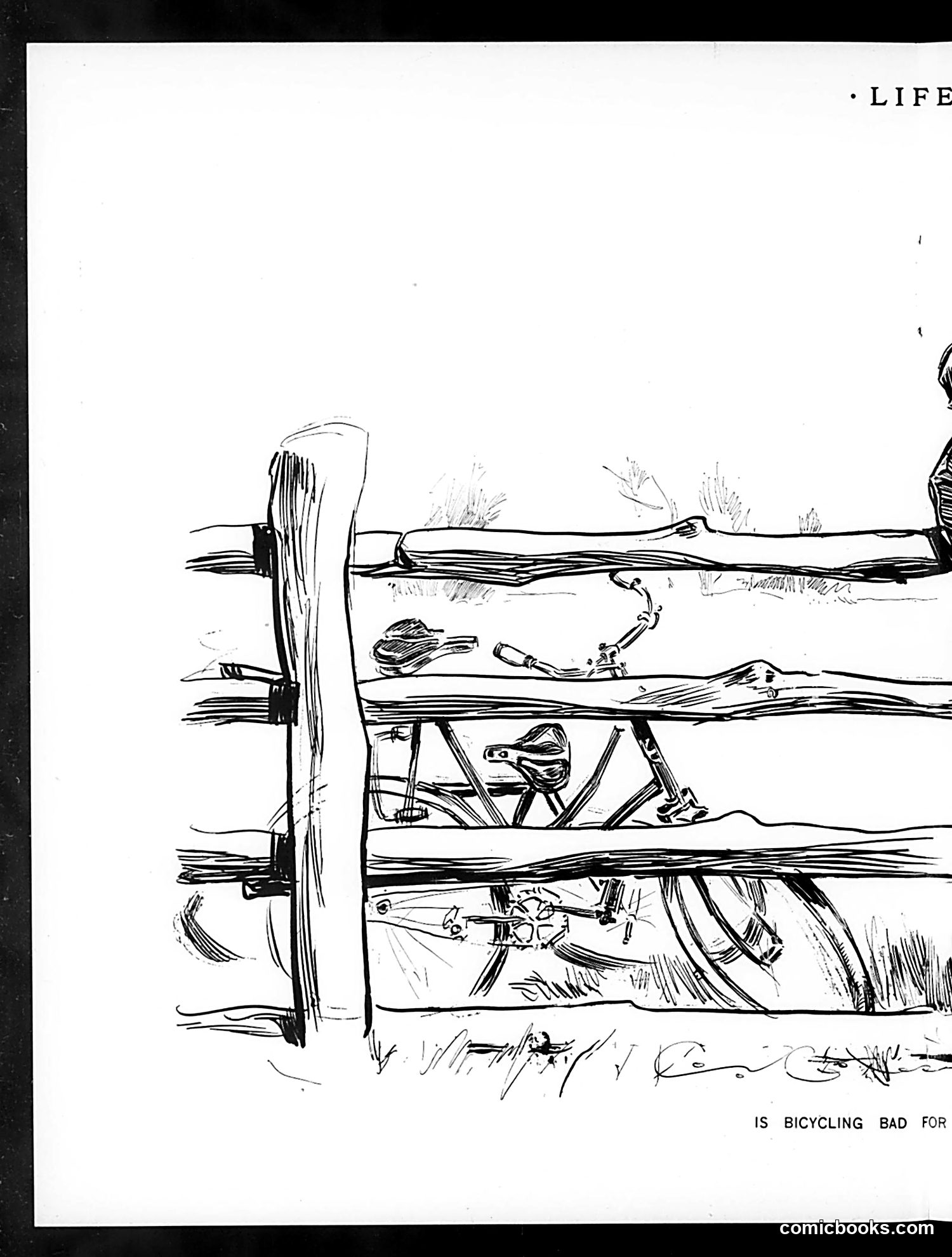
This page shows a single-panel cartoon sketch depicting a bicycle leaning against a rustic wooden fence. The drawing is minimal and gestural, rendered in black ink lines. The caption reads: "IS BICYCLING BAD FOR"—the sentence appears incomplete or continues beyond the visible page. Without the full caption or additional context, the cartoon's specific satirical point is unclear. However, it likely addresses a contemporary health or social debate about bicycling—possibly concerns about its physical effects, particularly on women (a common worry in early 20th-century discussions of female cyclists). The unfinished text suggests this was part of a larger feature or series examining attitudes toward cycling. The sketch style is typical of Life magazine's editorial cartooning from the early 1900s.
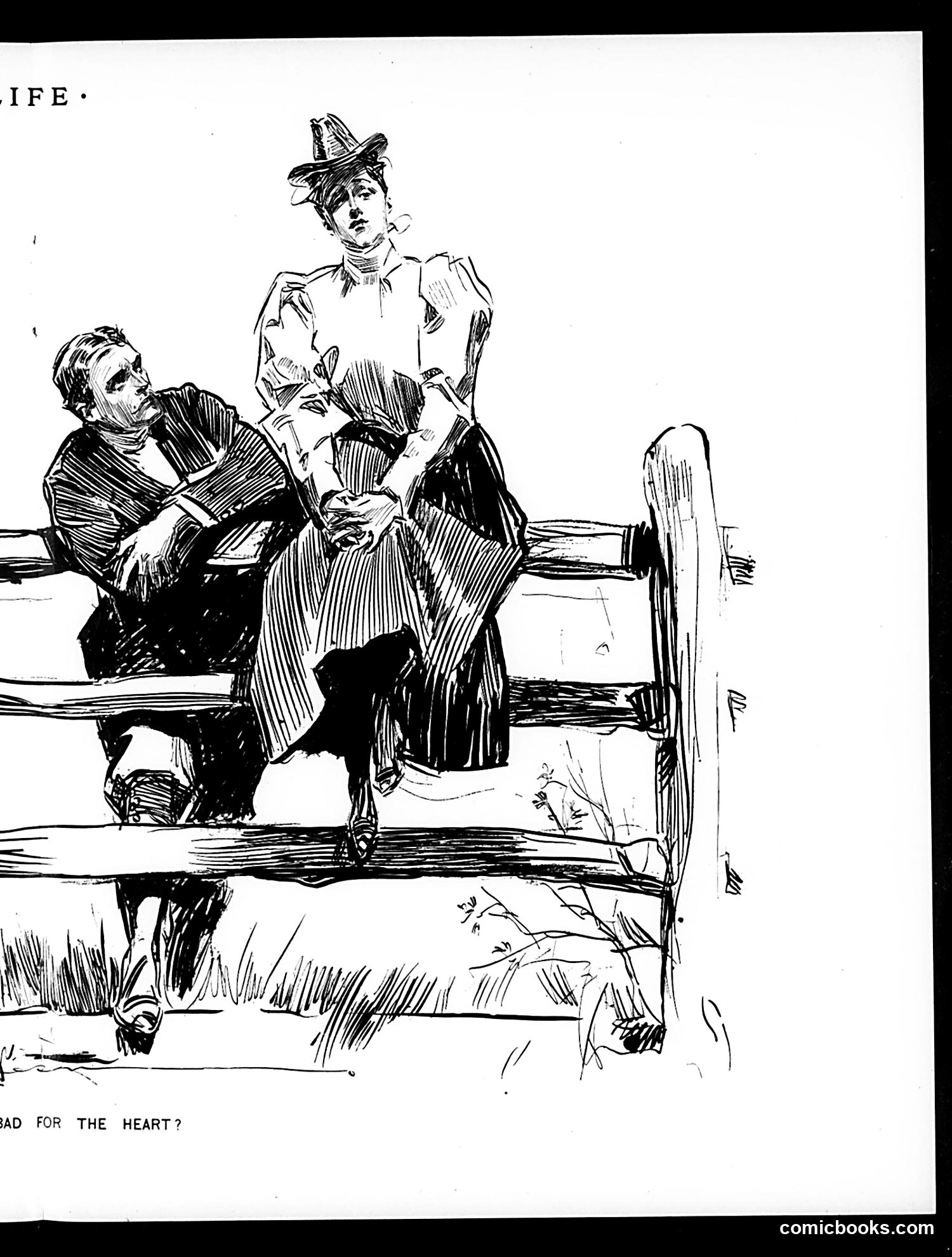
This appears to be a satirical illustration from Life magazine showing a couple on a fence. A man sits below while a woman stands above him on the fence railing, both dressed in early 20th-century attire. The woman wears a hat and fashionable dress; the man wears dark clothing. The partially visible caption reads "BAD FOR THE HEART?" The satire likely comments on gender dynamics or courtship customs of the era. The woman's elevated position above the man—physically dominant in the composition—may mock romantic or social role reversals, or question whether such situations were considered emotionally taxing ("bad for the heart"). Without the complete caption, the precise target of the satire remains unclear, though it appears to critique contemporary attitudes about relationships or propriety.
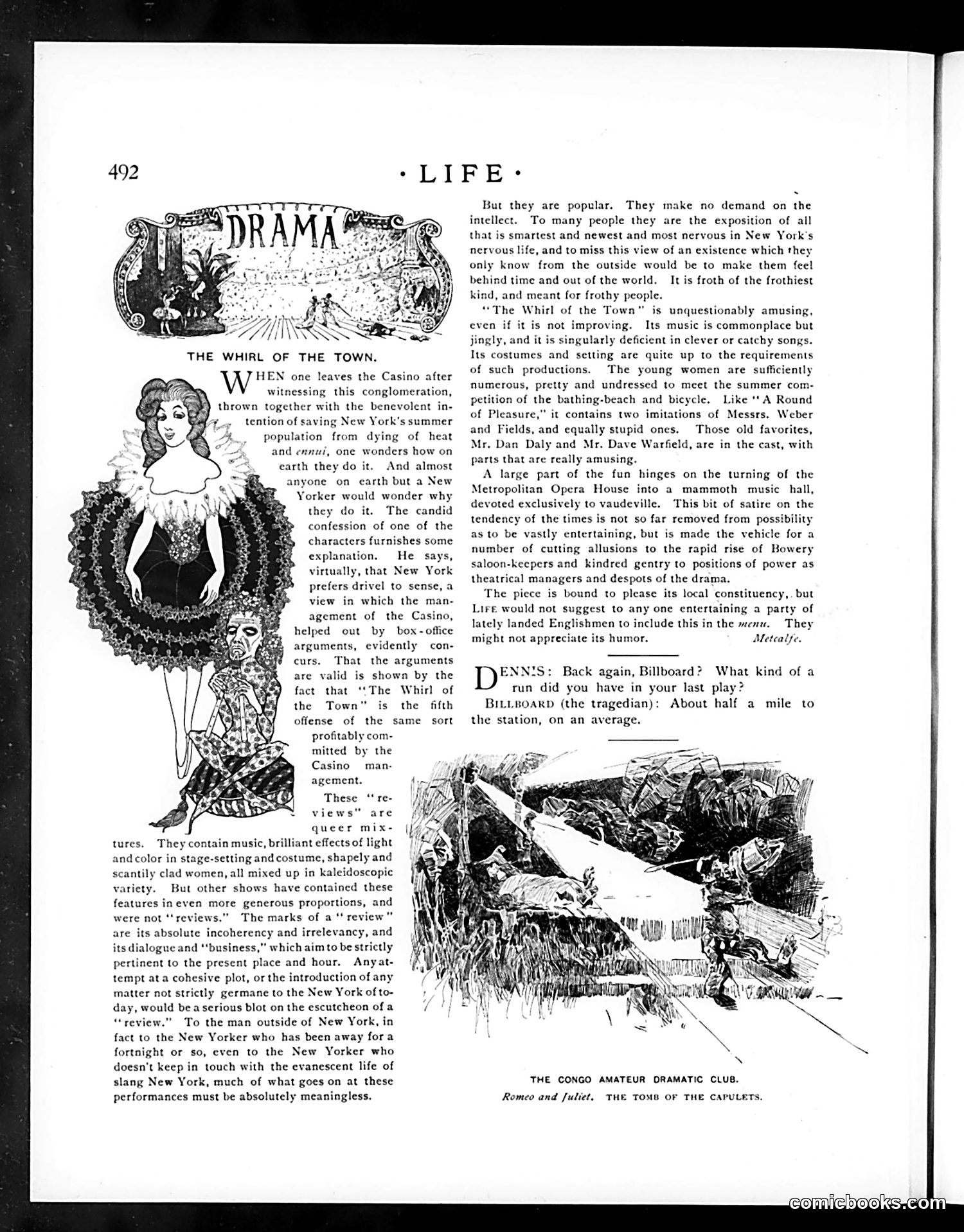
This page critiques New York's theatrical entertainment scene, specifically reviewing popular "revue" productions like "The Whirl of the Town" at the Casino theater. The satirist argues these shows appeal to people seeking escapism from "nervous life" rather than intellectual substance. The illustration depicts a fashionably dressed woman—representing the typical revue attendee—embodying the shallow sophistication the author mocks. The text condemns these productions as "queer mixtures" lacking coherent plot or meaningful dialogue, designed merely as vehicles for scantily-clad women, elaborate costumes, and rapid-fire jokes. The satire suggests revues represent frivolous entertainment for those avoiding serious engagement with contemporary issues, particularly during the World War I era when such escapism was widespread among New York's leisure class.
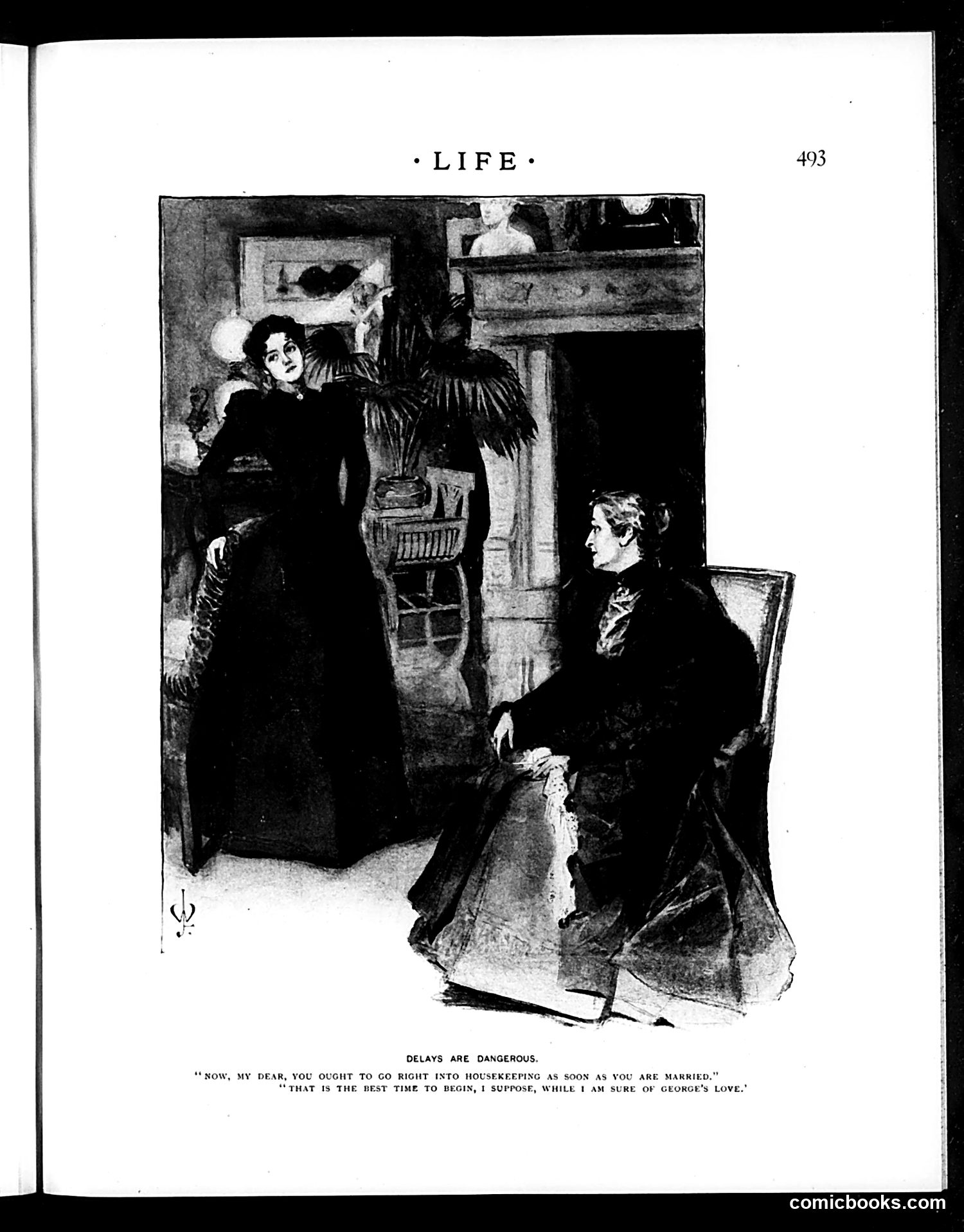
This is a satirical cartoon about marriage and domestic life, likely from the early 20th century. The title "Delays Are Dangerous" appears to warn against postponing household duties after marriage. The scene shows two women in conversation—one standing (appearing animated or emphatic) and one seated. The dialogue suggests an older woman advising a younger woman to begin housekeeping immediately upon marriage, while the younger woman expresses concern that she can only be "sure of George's love" at the beginning. The satire targets the precarious position of wives: the cartoon implies that a husband's love and affection depend on a wife maintaining domestic duties from day one. The joke is bitterly cynical—suggesting that marital affection is conditional and transient unless constantly serviced through housework. This reflects early 20th-century anxieties about marriage, gender roles, and women's limited agency within domestic arrangements.
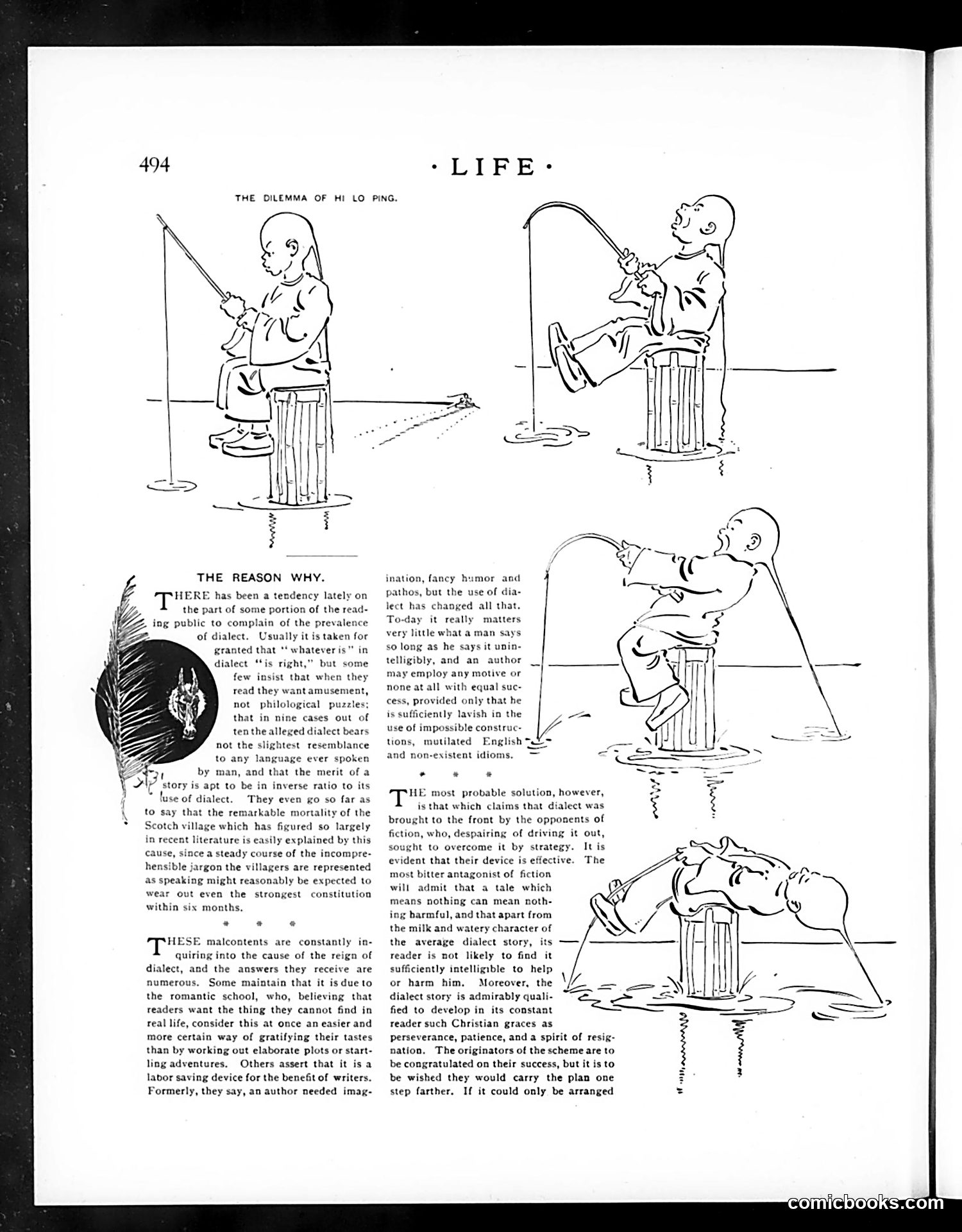
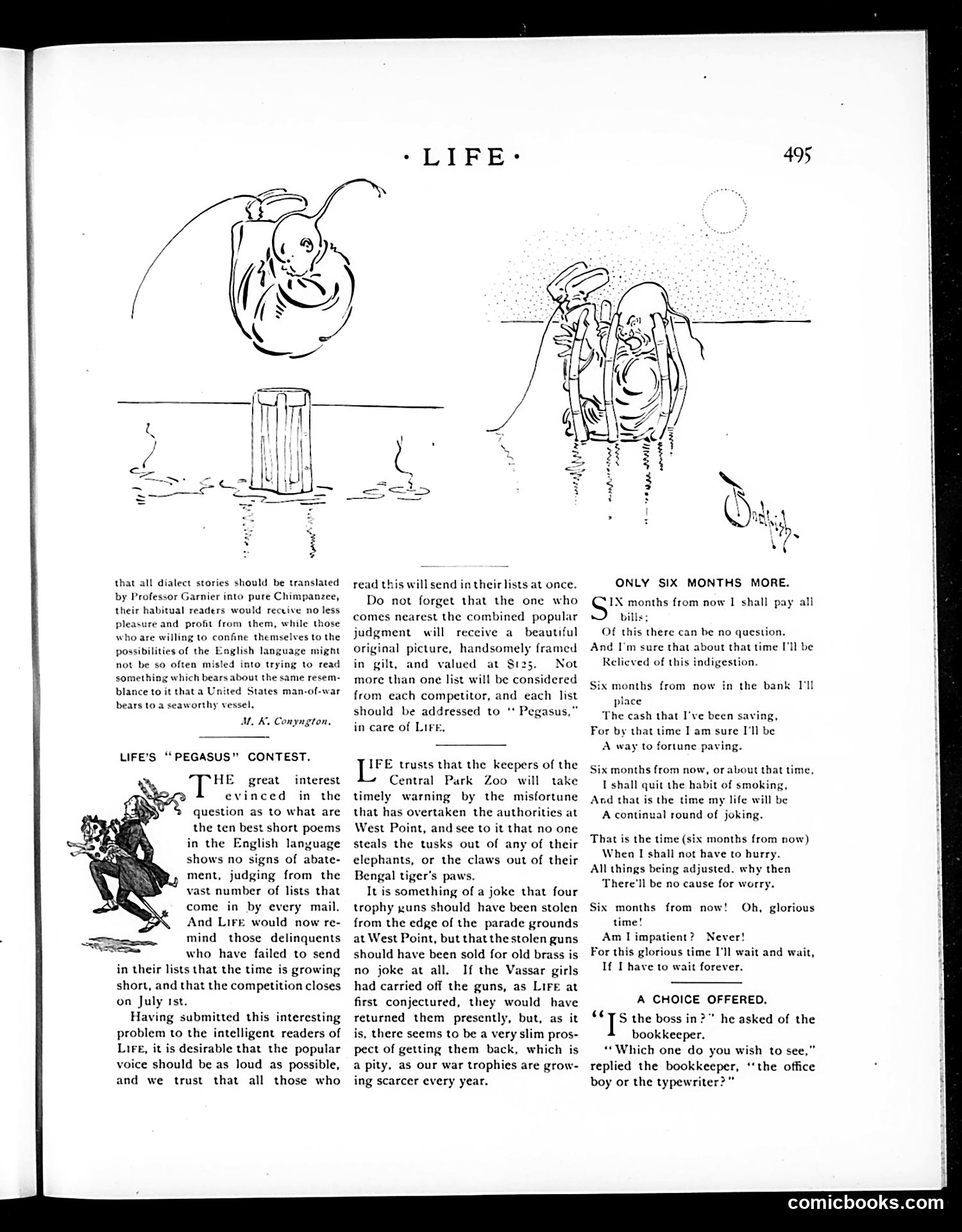
This page satirizes the widespread use of dialect in contemporary fiction. The cartoons show a character (Hi Lo Ping, apparently Chinese) sitting on a stool fishing, in progressively absurd positions—the visual joke illustrating how incomprehensible dialect writing is to readers. The accompanying essay argues that dialect has become a lazy literary device masking poor plotting and characterization. Writers use impenetrable, invented "dialect" instead of developing real stories. The text suggests dialect was introduced *by opponents of fiction* as a sabotage strategy—making stories so unintelligible they become harmless and unreadable. The satire targets both romantic writers who use dialect for supposed authenticity, and critics who embraced it. The author sarcastically notes that unreadable dialect stories do develop "Christian graces" like perseverance and resignation—in frustrated readers trying to understand them. This reflects genuine literary debates of the early 1900s about dialect's prevalence in popular fiction.
This page contains several satirical pieces typical of Life's social commentary: **"Life's Pegasus Contest"**: Life is running a competition asking readers to submit lists of the ten best English-language short poems. The winner receives a framed picture valued at $125. The satire mocks both literary pretension and reader participation in such contests. **Central Park Zoo/West Point Theft**: Life jokes about stolen trophy guns from West Point being sold for scrap brass rather than returned—implying the thieves lacked patriotic sentiment. The reference to "Vassar girls" suggests upper-class college women might have taken them as a prank, which would have been recoverable. **"Only Six Months More"**: A humorous poem about perpetual procrastination—putting off bill-paying, saving money, quitting smoking, and stopping worry "in six months," a relatable human tendency. **"A Choice Offered"**: A brief joke where a bookkeeper asks which "boss" the visitor wants—the office boy or the typewriter—implying the office boy is equally mechanical/unhelpful. The page showcases Life's mix of literary contests, social satire, and workplace humor.
This page contains poetry and humorous anecdotes rather than political cartoons. The main content is "An Epode," a verse lamenting modern courtship obstacles. The speaker, seeking to woo "Lucy," contrasts idealized past romance (Strephon and Chloé) with present-day hardships: landlords demanding rent, creditors ("duns"), and financial insecurity making marriage impossible. He humorously suggests waiting until Lucy is thirty-eight before he can afford to marry. Below are three brief comedic anecdotes about social awkwardness: a child's blunt questions to a separated lecturer, a woman's frustrated attempts to discuss a theatrical performance while seated behind an obstruction, and a bicycle accident witness. The humor relies on Victorian propriety colliding with frank speech or practical reality.
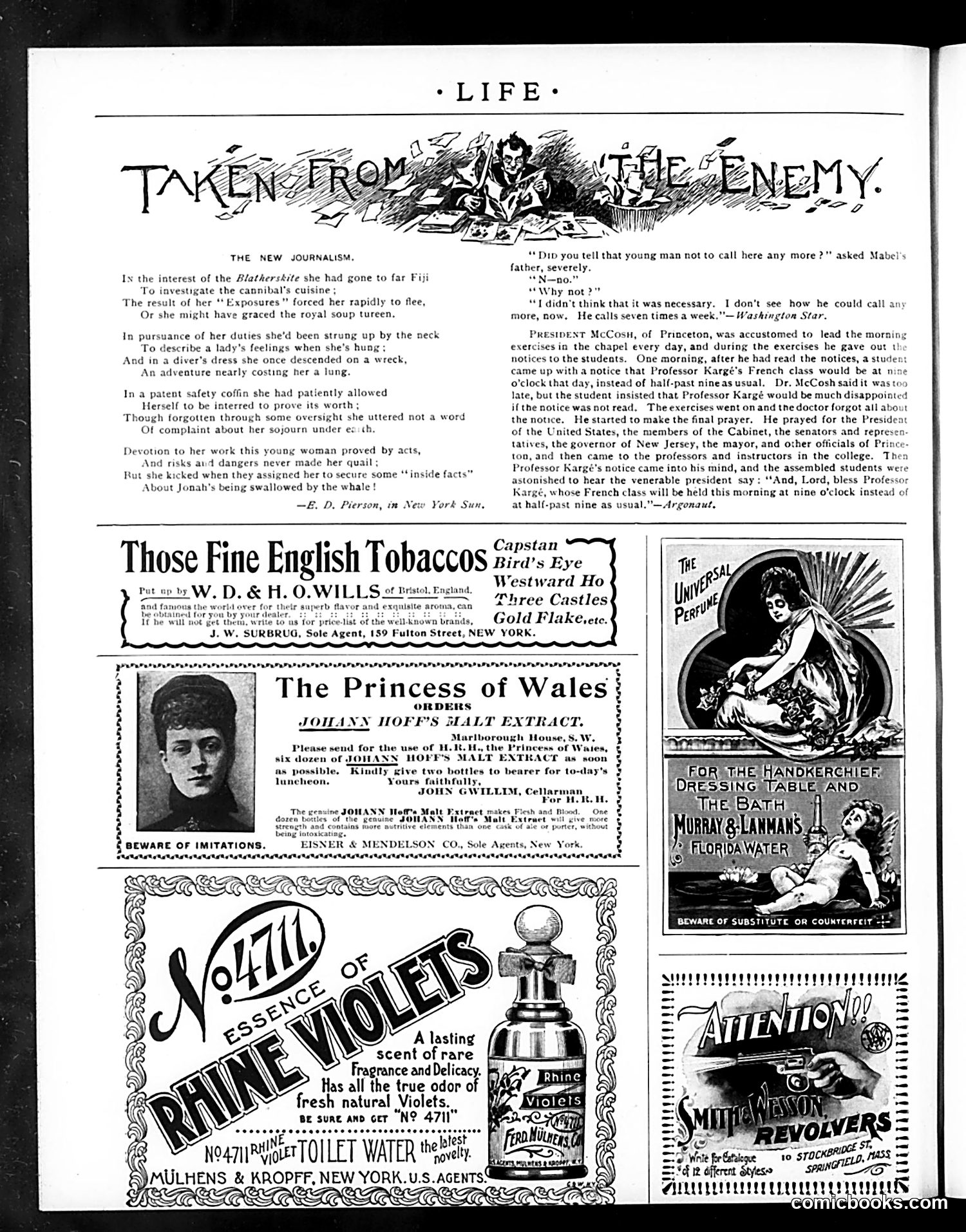
This page satirizes **"The New Journalism"**—a late 19th-century trend of sensationalist reporting where journalists, particularly women, performed dangerous stunts for stories. The poem mocks a female reporter who fearlessly endured extreme ordeals: investigating cannibals in Fiji, being hanged to describe the sensation, diving to wrecks, and being buried alive. The satire's punchline: she *refused* only one assignment—reporting on Jonah being swallowed by a whale—because it was impossible, not dangerous. The joke critiques how "New Journalism" prioritized spectacle over truth. Reporters sought authentic "inside facts" through physical risk, but this female journalist drew the line at the genuinely absurd, exposing the practice's illogic: if danger proves journalistic dedication, why reject the impossible? The accompanying anecdotes mock similar pretensions to earnest documentation. The rest of the page contains period advertisements (tobacco, perfume, medicinal products), typical of Life magazine's format.
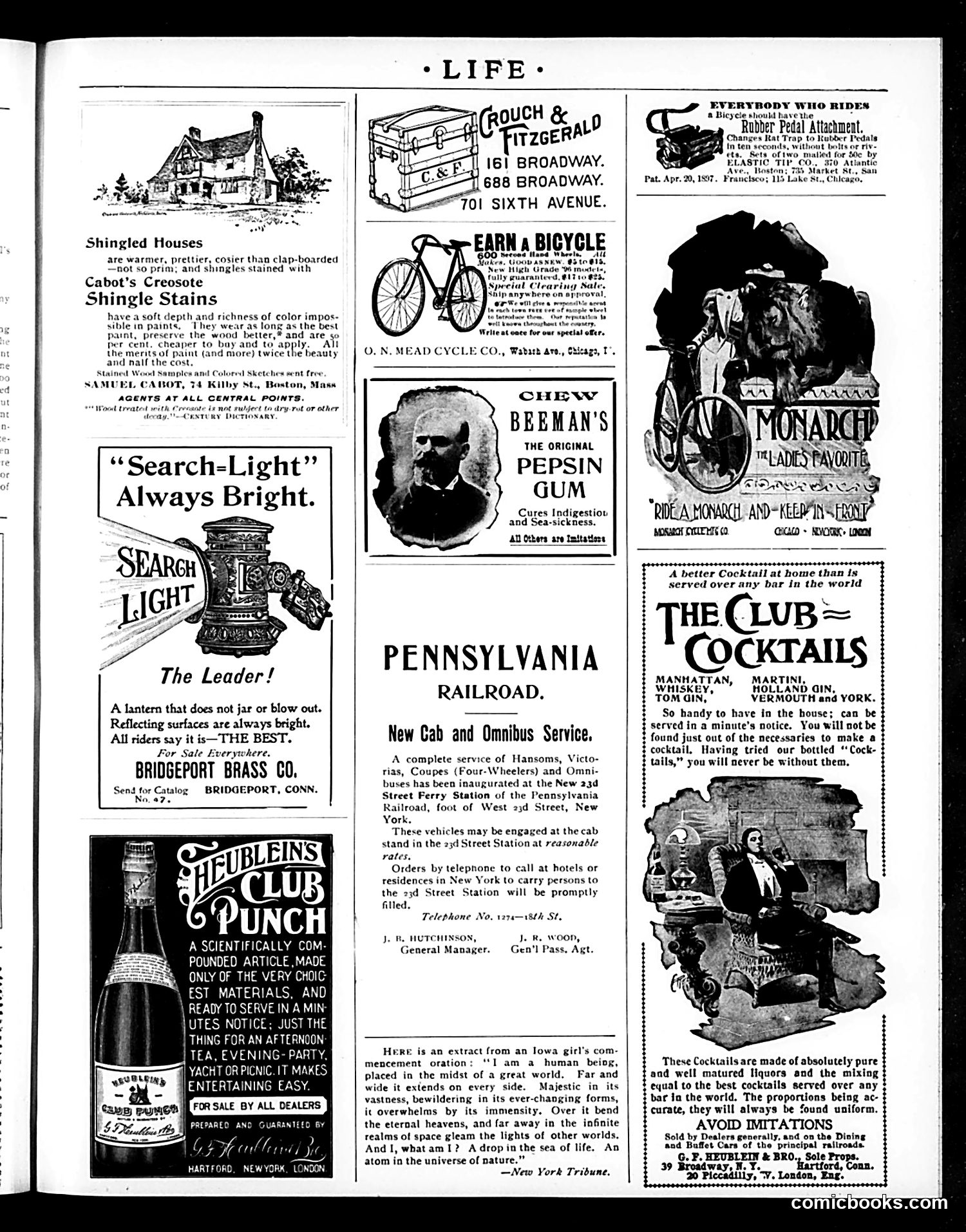
This page is primarily **advertising**, not satire. It contains commercial advertisements for various products popular in the early 1900s: wood stain, lanterns, bicycles, chewing gum, railroad transportation, patent pedals, punch concentrate, and cocktail mixtures. The only potentially satirical element appears to be the **Iowa girl's commencement oration excerpt** (bottom of page), which quotes grandiose, flowery philosophical language about human insignificance ("A drop in the sea of life. An atom in the universe of nature"). This excerpt seems designed to gently mock the overwrought, pretentious oratory typical of graduation speeches—presenting her elaborate musings about cosmic vastness and existential smallness as somewhat absurd or amusing for a local newspaper. However, the joke is mild and the page's primary function remains commercial advertising typical of early 20th-century magazines.
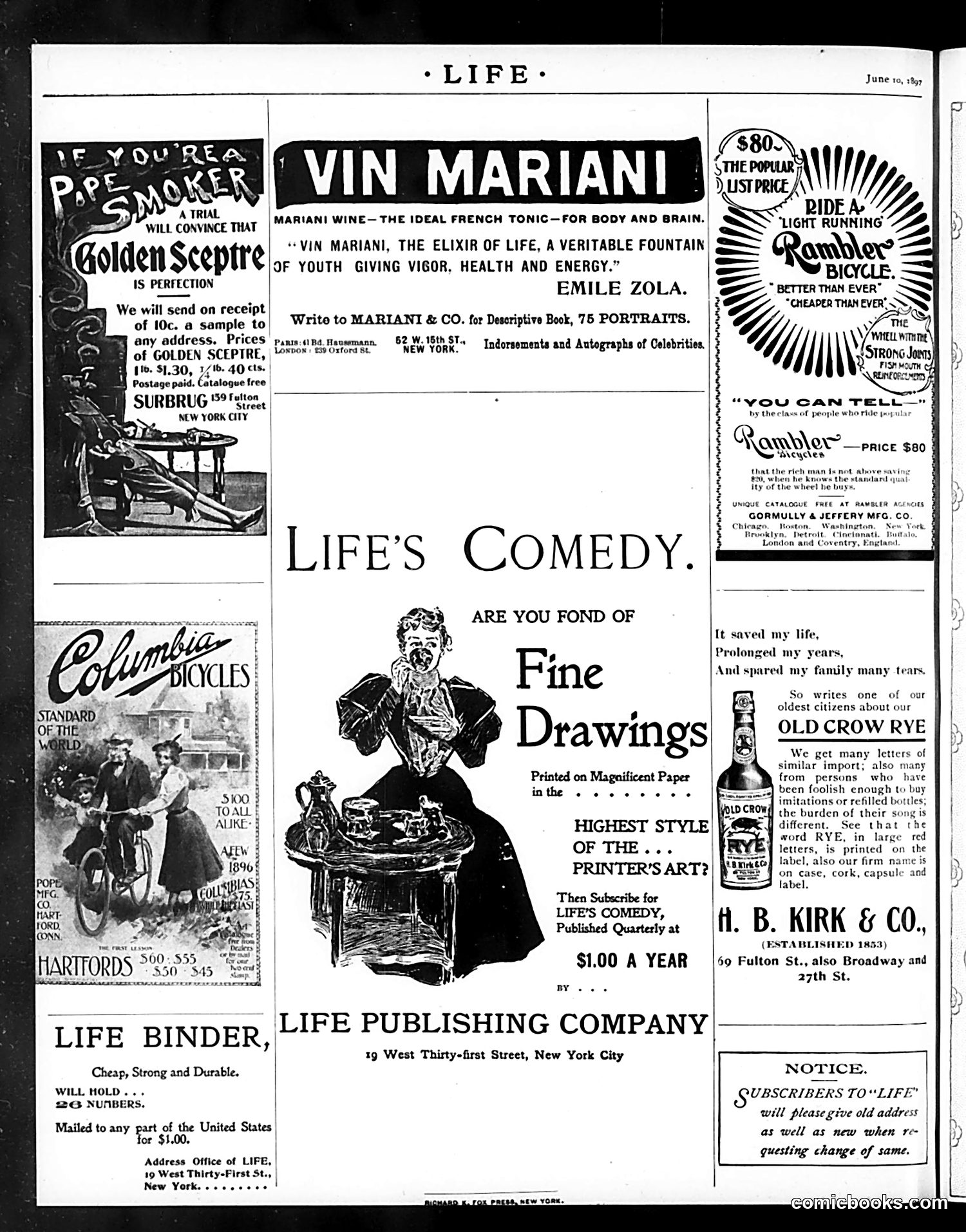
This is primarily an **advertising page** rather than editorial content. The central cartoon shows a figure (unclear who) presenting a large platter—likely satirizing patent medicine or "miracle cure" advertisements common in the 1890s. Key advertisements include: - **Vin Mariani wine**: marketed as a health tonic with endorsements from celebrity (Emile Zola quoted). This was a popular cocaine-containing wine of the era, reflecting pre-regulation patent medicine culture. - **Golden Sceptre tobacco/cigars**: positioned as "perfection" - **Bicycles** (Rambler, Columbia): emphasizing status and leisure - **Old Crow Rye whiskey**: using testimonials about life-saving properties The humor lies in the exaggerated health claims these products made. The page reflects the **1890s advertising landscape** where unregulated products could claim virtually any medicinal benefit. "Life's Comedy" section invites subscriptions to the magazine itself, using similar salesmanship tactics as the advertised products—treating entertainment as a purchasable "cure" for modern life.