
Life, 1897-06-10 · page 6 of 20
Life — June 10, 1897 — page 6: what you’re looking at
What you’re looking at
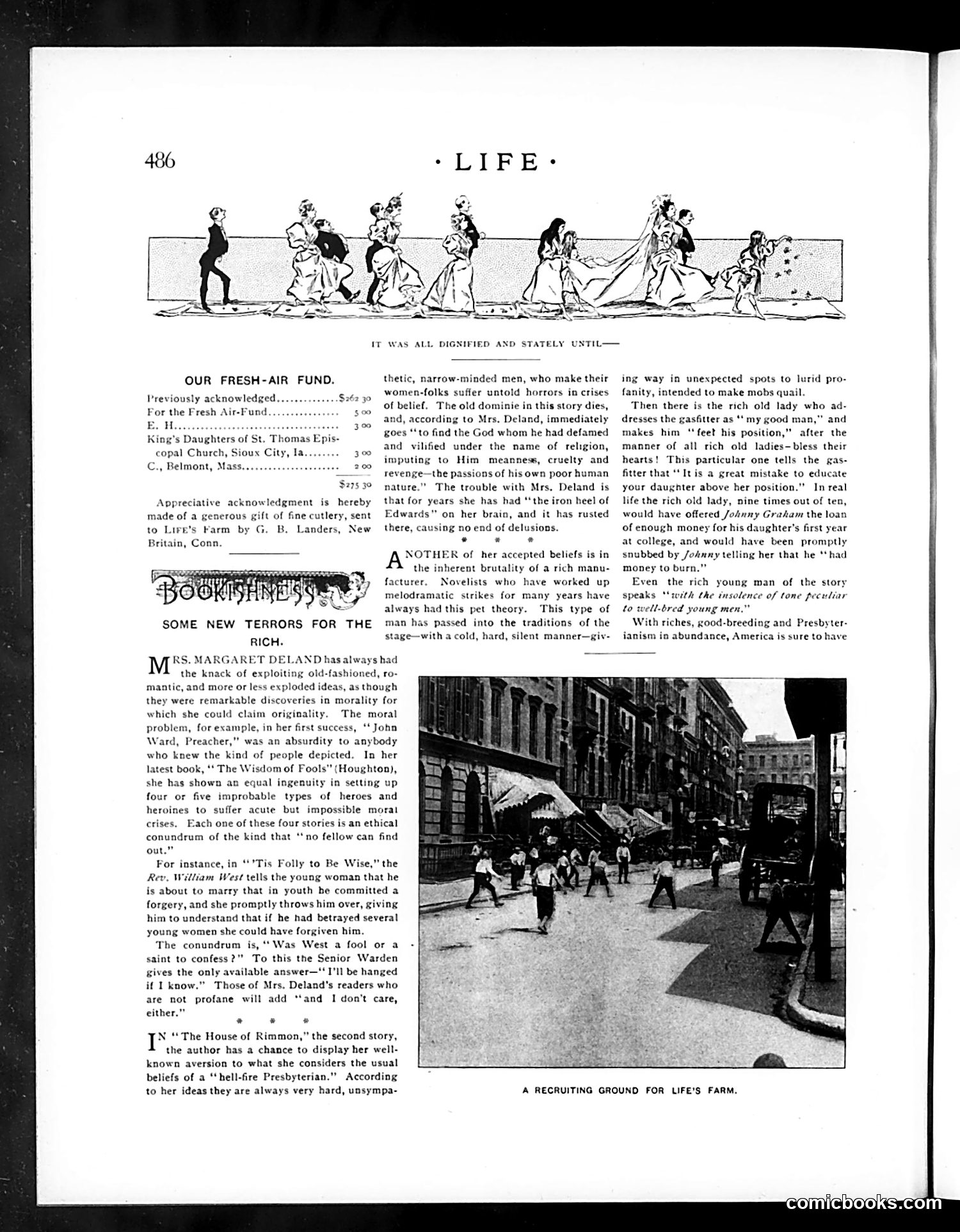
The decorative header illustration shows a line of figures in Victorian/Edwardian dress engaged in what appears to be a dignified procession or formal activity—the caption reads "IT WAS ALL DIGNIFIED AND STATELY UNTIL—" suggesting the humor derives from an implied breakdown of decorum that follows. The page primarily contains literary criticism by Margaret Deland, discussing moral themes in her short stories (including "John Ward, Preacher" and "The Folly to Be Wise"). The accompanying photograph shows "A Recruiting Ground for Life's Farm"—likely depicting a street scene related to agricultural or social recruitment efforts. The satire appears indirect, focused on critiquing Deland's narrative choices regarding morality rather than specific political figures or events. Without clearer visual caricatures, the primary humor seems literary rather than political.
📄 Transcribed text from this page (OCR, searchable)
Machine-transcribed from the original scan — historical spelling and the odd misread are preserved.
OUR FRESH-AIR Previously acknowledged For the Fresh Air-Funi King's Daughters of St, Thomas Epis- copal Church, Sioux City, Ia C., Belmont, Mass FUND. 300 209 Appreciative acknowledgment is hereby made of a generous gift of fine cutlery, sent to Lire’s Farm by G. B, Landers, New Britain, Conn. SOME NEW TERRORS FOR THE IT WAS ALL DIGNIFIED AND STATELY UNTIL— thetic, narrow-minded men, who make their women-folks suffer untold horrors in crises Of belief. The old dominie in this story dies, and, according to Mrs, Deland, immediately goes “to find the God whom he had defamed and vilified under the name of religion, imputing to Him meanness, cruelty and revenge—the passions of his own poor human nature.” The trouble with Mrs, Deland is that for years she has had “the iron heel of Edwards" on her brain, and it has rusted there, causing no end of delusions. 8 @ OTHER of her accepted beliefs is in the inherent brutality of a rich manu- facturer, ovelists who have worked up melodramatic strikes for many years have always had this pet theory. This type of man has passed into the traditions of the stage—with a cold, hard, silent manner—giv- ing way in unexpected spots to lurid pro- fanity, intended to make mobs quail. ‘Then there is the rich old lady who ad- dresses the gasfitter as * my good man," and makes him “feet his position,” after the manner of all rich old ladies—bless their hearts! This particular one tells the gas- fitter that ‘It is a great mistake to educate your daughter above her position.” In real life the rich old lady, nine times out of ten, would have offered Johnny Graham the loan of enough money for his daughter's first year at college, and would have been promptly snubbed by /oAnny telling her that he ‘had money to burn.” Even the rich young man of the story speaks ‘with the insolence of tone peculiar to well-bred young men.” With riches, good-breeding and Presbyter- ianism in abundance, America is sure to have RICH. RS. MARGARET DELAND has always had the knack of exploiting old-fashioned, ro- mantic, and more or less exploded ideas, as though they were remarkable discoveries in morality for which she could claim originality. The moral problem, for example, in her first success, “John Ward, Preacher," was an absurdity to anybody who knew the kind of people depicted. In her latest book, ‘' The Wisdom of Fools" (Houghton), she has shown an equal ingenuity in setting up four or five improbable types of heroes and heroines to suffer acute but impossible moral Each one of these four stories is an ethical conundrum of the kind that ‘no fellow can find out.” For instance, in “'Tis Folly to Be Wise,” the Rev, William West tells the young woman that he is about to marry that in youth he committed a forgery, and she promptly throws him over, giving him to understand that if he had betrayed several young women she could have forgiven him. The conundrum is, ‘* Was West a fool or a saint to confess?” To this the Senior Warden gives the only available answer—“ I'll be hanged if I know.” Those of Mrs, Deland’s readers who are not profane will add ‘and I don't care, either.” crises, * * * N “The House of Rimmon,” the second story, the author has a chance to display her well- known aversion to what she considers the usual beliefs of a ‘‘hell-fire Presbyteriat According to her ideas they are always very hard, unsympa- A RECRUITING GROUND FOR LIFE'S FARM.