
Life, 1897-06-10 · page 12 of 20
Life — June 10, 1897 — page 12: what you’re looking at
What you’re looking at
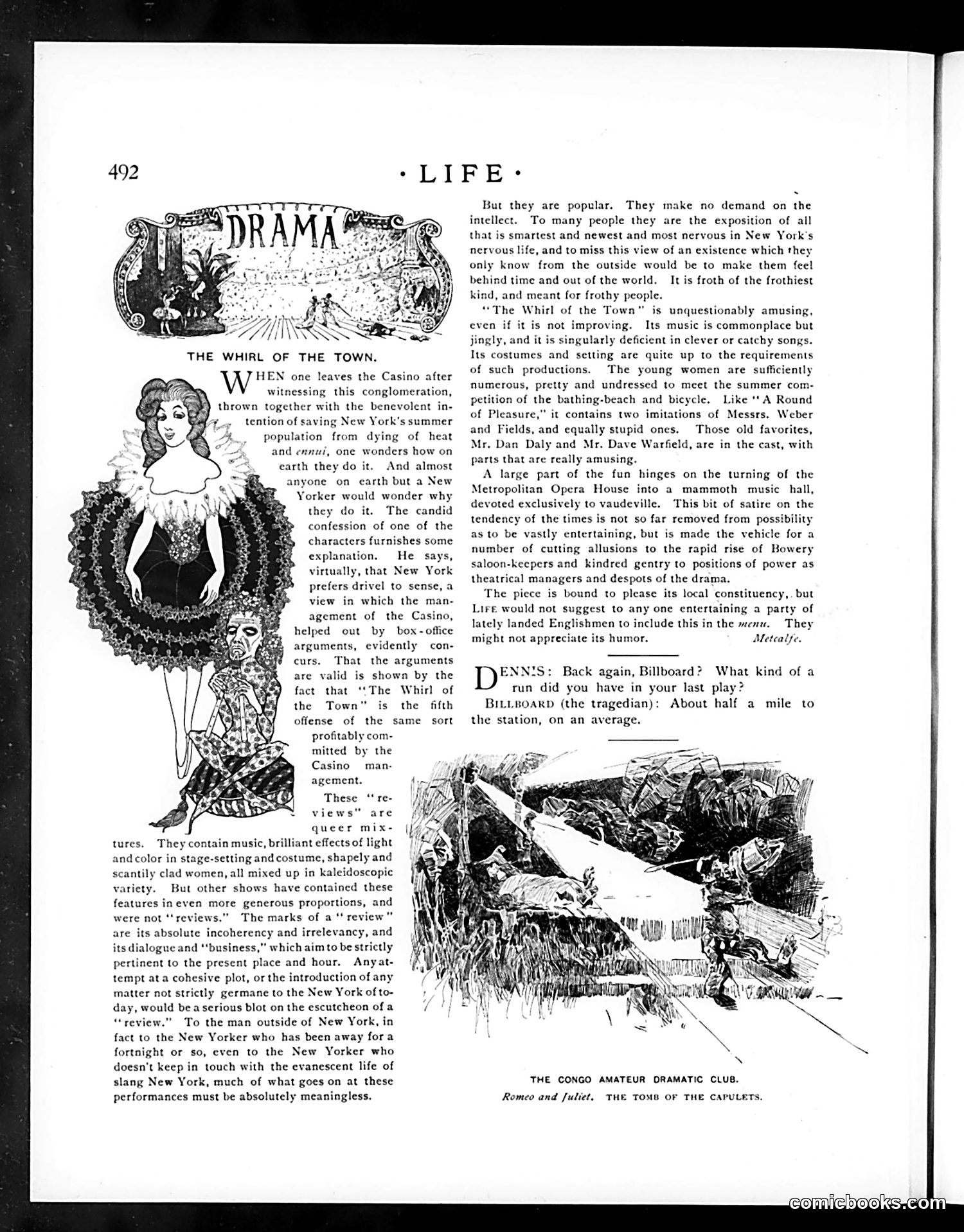
This page critiques New York's theatrical entertainment scene, specifically reviewing popular "revue" productions like "The Whirl of the Town" at the Casino theater. The satirist argues these shows appeal to people seeking escapism from "nervous life" rather than intellectual substance. The illustration depicts a fashionably dressed woman—representing the typical revue attendee—embodying the shallow sophistication the author mocks. The text condemns these productions as "queer mixtures" lacking coherent plot or meaningful dialogue, designed merely as vehicles for scantily-clad women, elaborate costumes, and rapid-fire jokes. The satire suggests revues represent frivolous entertainment for those avoiding serious engagement with contemporary issues, particularly during the World War I era when such escapism was widespread among New York's leisure class.
📄 Transcribed text from this page (OCR, searchable)
Machine-transcribed from the original scan — historical spelling and the odd misread are preserved.
*LIFE: ied eget Z/HN\ SNe THE WHIRL OF THE TOWN. HEN one leaves the Casino after witnessing this conglomeration, thrown together with the benevolent in- tention of saving New York's summer population from dying of heat and ennui, one wonders how on earth they do it. And almost anyone on carth but a New Yorker would wonder why they do it. The candid confession of one of the characters furnishes some explanation. He says, virtually, that New York prefers drivel to sense, a view in which the man- agement of the Casino, helped out by box-office arguments, evidently con- curs. That the arguments are valid is shown by the fact tha The Whirl of the Town" is the fifth offense of the same sort profitably com- mitted by the Casino agement. These ‘‘re- views" are queer mix- tures. They contain music, brilliant effects of light and color in stage-setting and costume, shapely and scantily clad women, all mixed up in kaleidoscopic variety. But other shows have contained these features ineven more generous proportions, and The marks of a“ review” are its absolute incoherency and irrelevancy, and its dialogue and “business,” which aim to be strictly pertinent to the present place and hour, Anyat- tempt ata cohesive plot, or the introduction of any matter not strictly germane to the New York of to- day, would bea serious blot on the escutcheon of a “review.” To the man outside of New York, in fact to the New Yorker who has been away fora fortnight or so, even to the New Yorker who doesn't keep in touch with the evanescent life of slang New York, much of what goes on at these performances must be absolutely meaningless. man- were not “reviews, But they are popular. They make no demand on the intellect. To many people they are the exposition of all that is smartest and newest and most nervous in New York's nervous life, and to miss this view of an existence which they only know from the outside would be to make them feel behind time and out of the world. It is froth of the frothiest kind, and meant for frothy people. “The Whirl of the Town” is unquestionably amusing, even if it is not improving. Its music is commonplace but jingly, and it is singularly deficient in clever or catchy songs. Its costumes and setting are quite up to the requirements of such productions. The young women are sufficiently numerous, pretty and undressed to meet the summer com- petition of the bathing-beach and bicycle. Like ‘tA Round of Pleasure,” it contains two imitations of Messrs. Weber and Fields, and equally stupid ones. Those old favorites, Mr. Dan Daly and Mr. Dave Warfield, are in the cast, with parts that are really amusing. A large part of the fun hinges on the turning of the Metropolitan Opera House into a mammoth music hall, devoted exclusively to vaudeville. This bit of satire on the tendency of the times is not so far removed from possibility as to be vastly entertaining, but is made the vehicle for a number of cutting allusions to the rapid rise of Bowery saloon-keepers and kindred gentry to positions of power as theatrical managers and despots of the drama. The piece is bound to please its local constituency,. but Lire would not suggest to any one entertaining a party of lately landed Englishmen to include this in the menu. They might not appreciate its humor. Metcalfe. What kind of a D* : Back again, Billboard ? run did you have in your last play? BILLBoarD (the tragedian): About half a mile to the station, on an average. THE CONGO AMATEUR DRAMATIC CLUB. Romeo and Juliet, THE TOMB OF THE CAPULETS.