
Life, 1897-06-10 · page 4 of 20
Life — June 10, 1897 — page 4: what you’re looking at
What you’re looking at
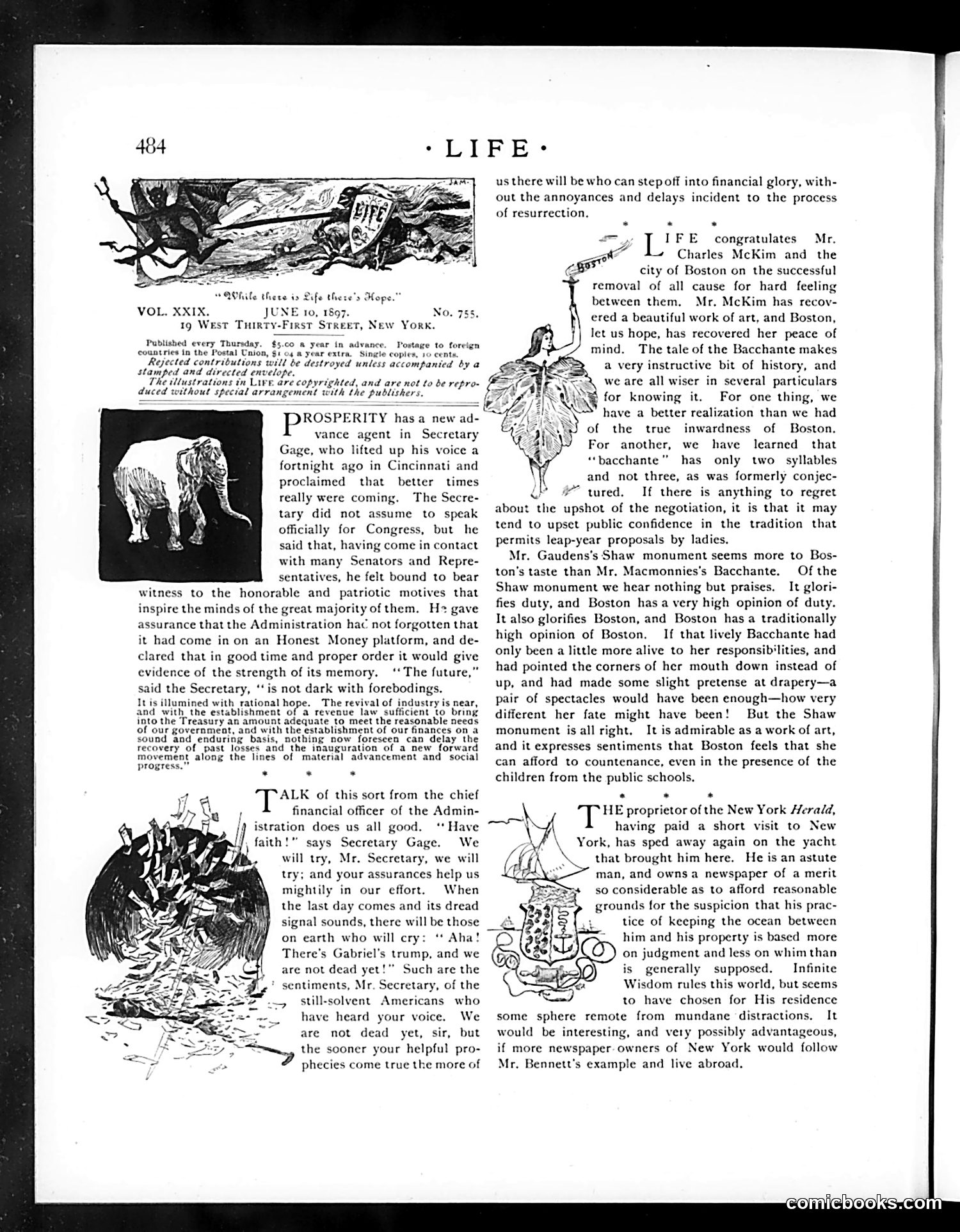
This page contains two satirical pieces about American politics and society: **Top cartoon**: Shows Secretary of the Treasury Gage speaking optimistically about economic recovery, claiming "better times are coming." The satire mocks his confident predictions despite ongoing financial difficulties—the text notes he spoke to Congress about the Administration's strength while actual economic hardship persisted. **Bottom cartoon**: Depicts what appears to be an allegorical scene related to political prophecy or Gabriel's trumpet (referencing apocalyptic imagery), accompanying text about economic sentiment and financial recovery hopes. The page also includes commentary congratulating Charles McKim and Boston on resolving disputes, and discusses the New York *Herald* proprietor's yacht activities. The overall theme ridicules government optimism disconnected from citizens' economic reality.
📄 Transcribed text from this page (OCR, searchable)
Machine-transcribed from the original scan — historical spelling and the odd misread are preserved.
LI While there oo L VOL. XXIX. JUNE 10, 97. > 19 West Tiirty-First Street, New York. Published every Thursday. $5.co a year in advan Postage to foreign countries in the Postal Union, $1 04 @ year extra. Single copies, 10 cents, Rejected contributions will be destroyed unless accompanied by a stamped and directed envelope, The illustrations in Live. are copyrighted, and are not to be repro- @= duced without special arrangement with the publishers, ROSPERITY has a new vance agent in Secre’ Gage, who lifted up his voice a fortnight ago in Cincinnati and proclaimed that better times really were coming. The Secre- tary did not assume to speak officially for Congress, but he said that, having come in contact with many Senators and Repre- sentatives, he felt bound to bear witness to the honorable and patriotic motives that inspire the minds of the great majority of them. Hz gave assurance that the Administration hac not forgotten that it had come in on an Honest Money platform, and de- clared that in good time and proper order it would give evidence of the strength of its memory, ‘‘ The future,” said the Secretary, ‘‘is not dark with forebodings. It is illumined with rational hope. The revival of industry is near, and with the establishment of a revenue law sufficient to bring into the Treasury an amount adequate to meet the reasonable neeas of our government, and with the establishment of our finances on a sound and enduring basis, nothing now foreseen can delay the recovery of past losses and the inauguration of a new forward movement along the lines of material advancement and social progress. . . . ALK of this sort from the chief financial officer of the Admin- istration does us all good. ‘ Have says Secretary Gage. We will try, Mr. Secretary, we will try; and your assurances help us mightily in our effort. When the last day comes and its dread signal sounds, there will be those on earth who will cry: ‘* Aha! There's Gabriel's trump, and we | are not dead ye Such are the * sentiments, Mr. Secretary, of the still-solvent Americans who have heard your voice. We are not dead yet, sir, but the sooner your helpful pro- phecies come true the more of FE us there will be who can step off into financial glory, with- out the annoyances and delays incident to the process of resurrection, “y IFE congratulates Mr. at 44 Charles McKim and the 505" city of Boston on the successful removal of all cause for hard feeling between them. Mr. McKim has recov ered a beautiful work of art, and Boston, ) let us hope, has recovered her peace of es mind. The tale of the Bacchante makes a very instructive bit of history, and we are all wiser in several particulars > for knowing it. For one thing, we have a better realization than we had of the true inwardness of Boston. For another, we have learned that “‘bacchante” has only two. syllables and not three, as was formerly conjec- *”” wred. If there is anything to regret about “the upshot of the negotiation, it is that it may tend to upset public confidence in the tradition that permits leap-year proposals by ladies. Mr. Gaudens’s Shaw monument seems more to Bos- ton’s taste than Mr, Macmonnies’s Bacchante. Of the Shaw monument we hear nothing but praises. It glori- fies duty, and Boston has a very high opinion of duty. It also glorifies Boston, and Boston has a traditionally high opinion of Boston. If that lively Bacchante had only been a little more alive to her responsibilities, and had pointed the corners of her mouth down instead of up, and had made some slight pretense at drapery—a pair of spectacles would have been enough—how very different her fate might have been! But the Shaw monument is all right, It is admirable as a work of art, and it expresses sentiments that Boston feels that she can afford to countenance, even in the presence of the children from the Public schools. . + HE proprietor of the New York Herald, having paid a short visit to New Ne has sped away again on the yacht that brought him here. He is an astute man, and owns a newspaper of a merit so considerable as to afford reasonable _Brounds for the suspicion that his prac- tice of keeping the ocean between him and his property is based more on judgment and less on whim than is generally supposed. Infinite Wisdom rules this world, but seems to have chosen for His residence some sphere remote from mundane distractions, It would be interesting, and vety possibly advantageous, if more newspaper-owners of New York would follow Mr. Bennett's example and live abroad. ak