
Life, 1897-06-10 · page 14 of 20
Life — June 10, 1897 — page 14: what you’re looking at
What you’re looking at
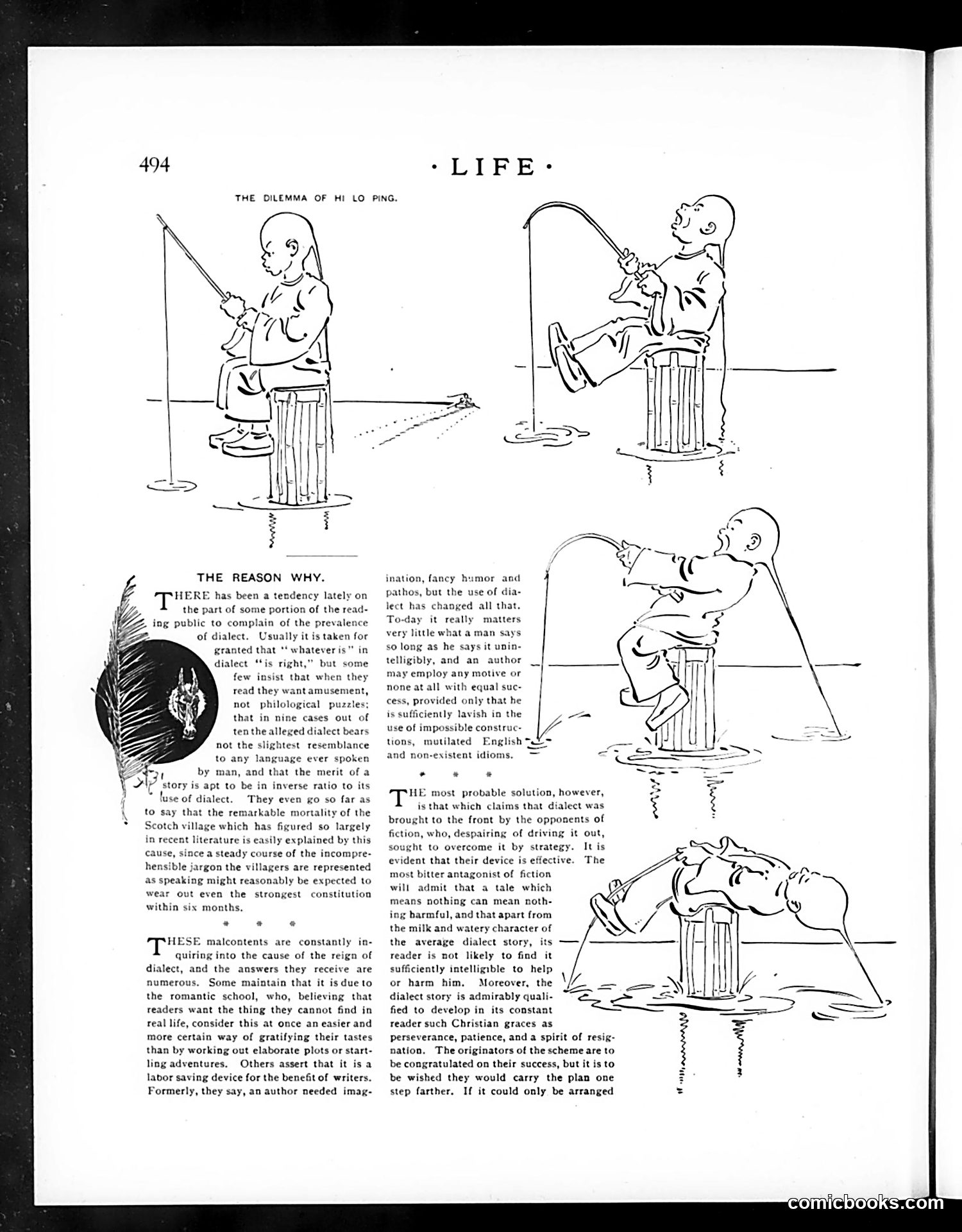
This page satirizes the widespread use of dialect in contemporary fiction. The cartoons show a character (Hi Lo Ping, apparently Chinese) sitting on a stool fishing, in progressively absurd positions—the visual joke illustrating how incomprehensible dialect writing is to readers. The accompanying essay argues that dialect has become a lazy literary device masking poor plotting and characterization. Writers use impenetrable, invented "dialect" instead of developing real stories. The text suggests dialect was introduced *by opponents of fiction* as a sabotage strategy—making stories so unintelligible they become harmless and unreadable. The satire targets both romantic writers who use dialect for supposed authenticity, and critics who embraced it. The author sarcastically notes that unreadable dialect stories do develop "Christian graces" like perseverance and resignation—in frustrated readers trying to understand them. This reflects genuine literary debates of the early 1900s about dialect's prevalence in popular fiction.
📄 Transcribed text from this page (OCR, searchable)
Machine-transcribed from the original scan — historical spelling and the odd misread are preserved.
THE DILEMMA OF HI LO PING. THE REASON WHY. HERE has been a tendency lately on the part of some portion of the read- ing public to complain of the prevalence of dialect. Usually it is taken for granted that ‘ whatever is” in dialect “is right,” but some few insist that when they read they wantamusement, not philological puzzle: that in nine cases out of ten the alleged dialect bears not the slightest resemblance to any language ever spoken by man, and that the merit of a story is apt to be in inverse ratio to its eof dialect. ‘They even go so far as to say that the remarkable mortality of the Scotch village which has figured so largely in recent literature is easily explained by this cause, since a steady course of the incompre- hensible jargon the villagers are represented as speaking might reasonably be expected to wear out even the strongest within six months, constitution * * « HESE malcontents are constantly in- quiring into the cause of the reign of dialect, and the answers they receive are numerous. Some maintain that it is due to the romantic school, who, believing that readers want the thing they cannot find in real life, consider this at once an easier and more certain way of gratifying their tastes than by working out elaborate plots or start- ling adventures, Others assert that it is a labor saving device for the benefit of writers. Formerly, they say, an author needed imag- ination, fancy humor and pathos, but the use of dia- lect has changed all that, To-day it really matters very little what a man says so long as he says it unin- telligibly, and an author may employ any motive or none at all with equal suc- cess, provided only that he is sufficiently lavish in the use of impossible construc- tions, mutilated English 22> and non-existent idioms. = * * * HE most probable solution, however, is that which claims that dialect was brought to the front by the opponents of fiction, who, despairing of driving it out, sought to overcome it by strategy. It is evident that their device is effective. The most bitter antagonist of fiction will admit that a tale which means nothing can mean noth- ing barmful, and that apart from the milk and watery character of the average dialect story, its reader is not likely to find it sufficiently intelligible to help or harm him, Moreover, the dialect story is admirably quali- fied to develop in its constant reader such Christian graces as perseverance, patience, and a spirit of resig- nation, The originators of the scheme are to be congratulated on their success, but it is to be wished they would carry the plan one step farther. If it could only be arranged