
A complete issue · 20 pages · 1897
Life — March 4, 1897
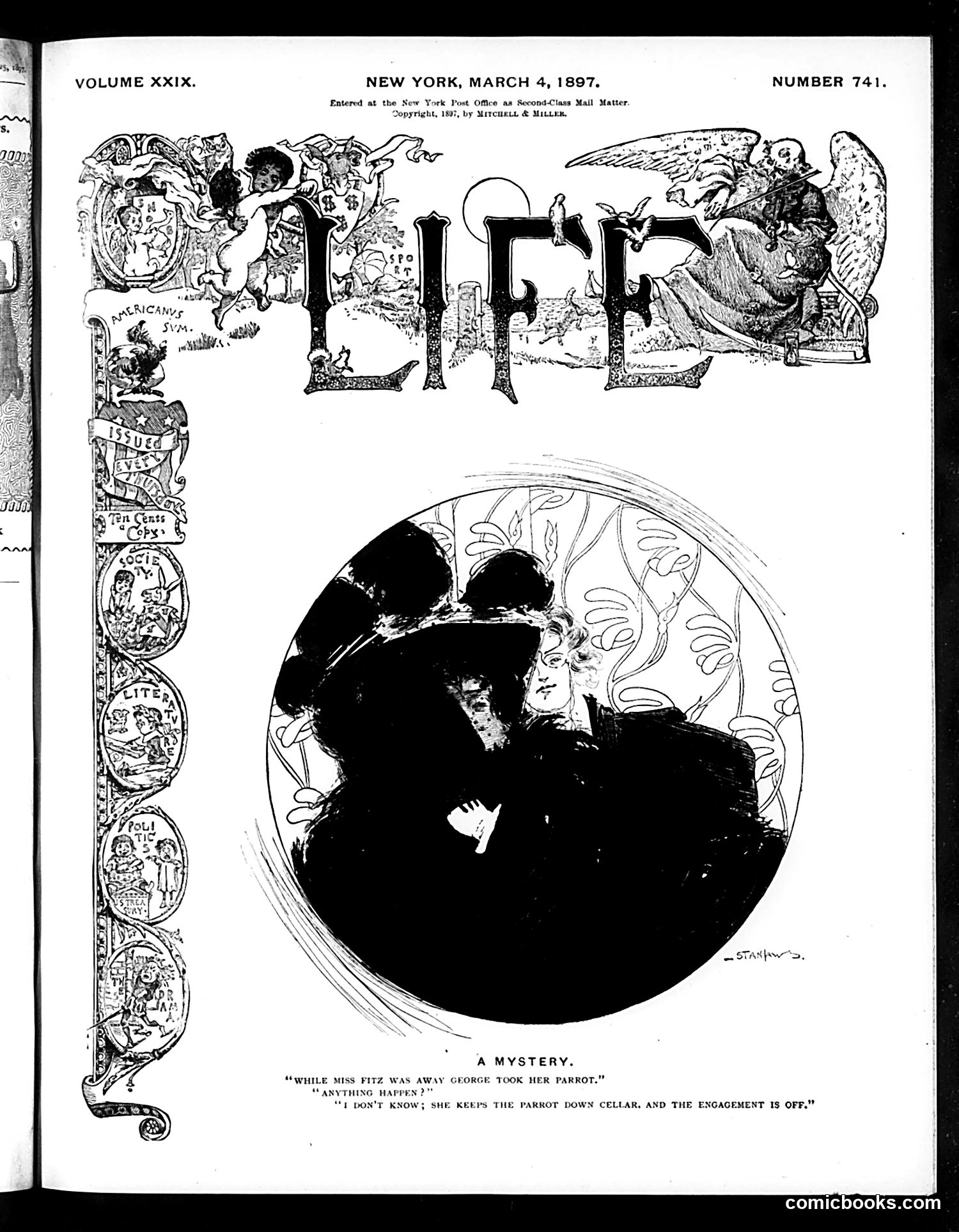
The main cartoon depicts two women in dark clothing and large hats examining something together, shown in silhouette within a circular frame. The caption reads: "While Miss Fitz was away George took her parrot. Anything happen? 'I don't know; she keeps the parrot down cellar, and the engagement is off.'" This appears to be a romantic scandal joke involving a woman named Miss Fitz. The humor hinges on a broken engagement apparently caused by the mysterious disappearance of her parrot while she was away—and her fiancé George's involvement in taking it. The "mystery" is whether something improper occurred, suggested by the parrot now being hidden "down cellar" and the engagement ending. It's a Victorian-era innuendo joke playing on social propriety and scandal.
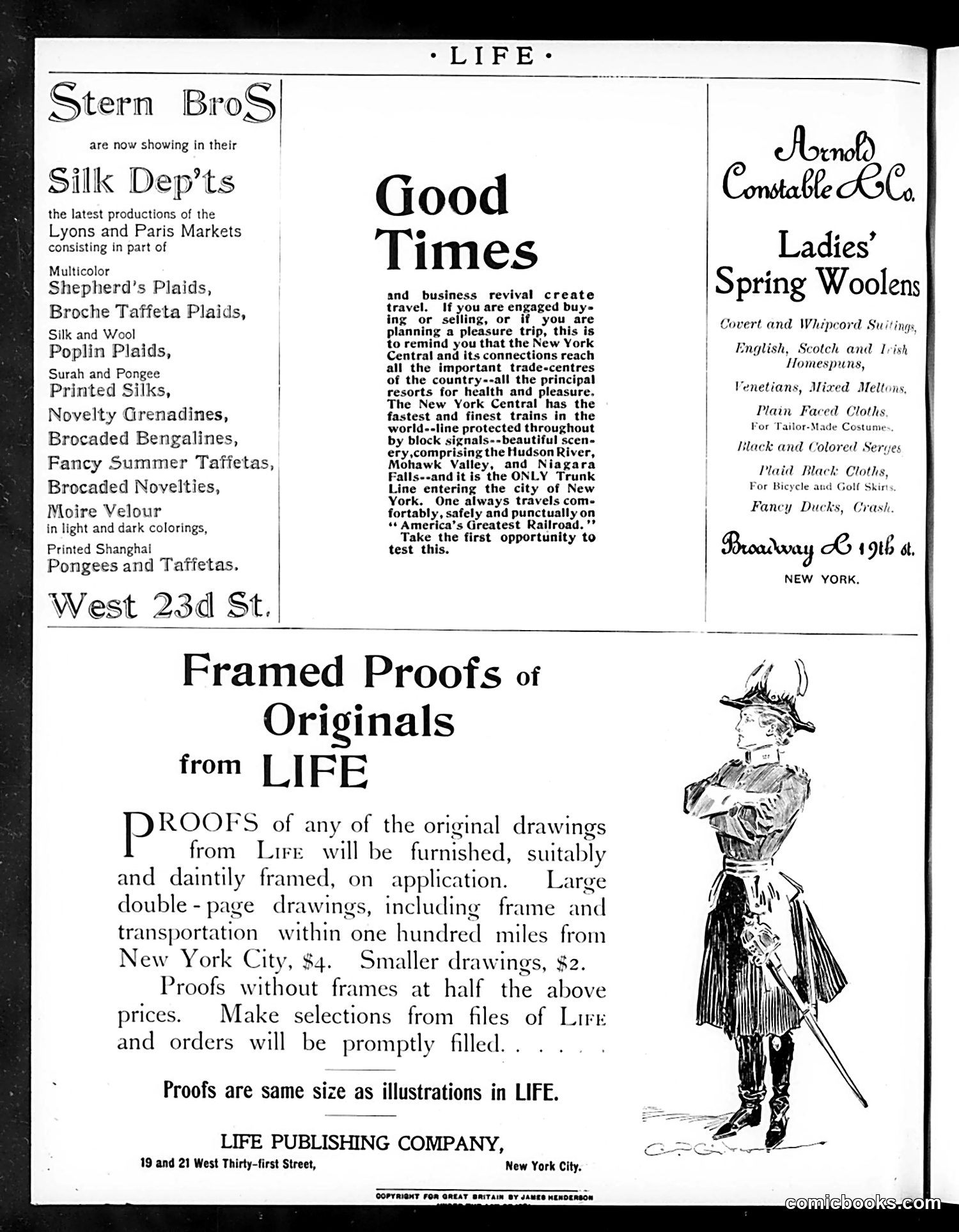
This page is primarily **advertising**, not political satire. It contains three commercial ads: 1. **Stern Bros** (left): Announces silk fabrics in their department stores on West 23rd Street, listing various textile types like plaids and brocades. 2. **"Good Times"** (center): Promotes the New York Central railroad line, emphasizing its safety, speed, and connections to major resorts and trade centers across America. 3. **Arnold Constable & Co** (right): Advertises ladies' spring woolens and fabrics for tailored costumes, located on Broadway at 19th Street. The only illustration is a **fashion sketch** of a woman in Edwardian-era clothing (hat, corset, long skirt), typical of early 1900s commercial art. There is **no political cartoon or satire** on this page—it's a standard advertising section from Life magazine.
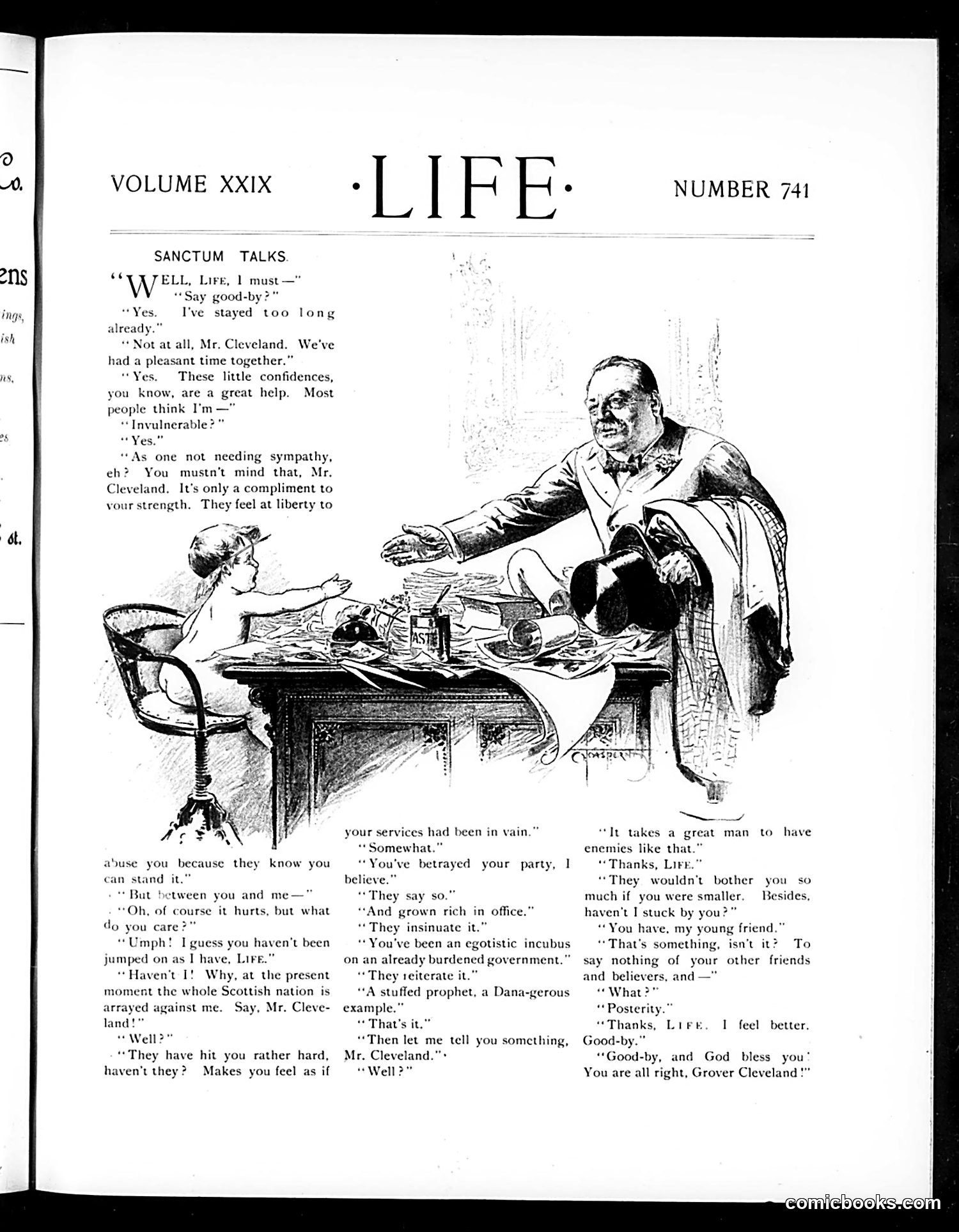
This page features a satirical dialogue between two figures at a dining table. The conversation depicts what appears to be a political figure (likely Cleveland, referenced by name) being confronted about allegations of betrayal, corruption, and growing rich in office. The cartoon mocks the subject for: - Abusing power and claiming invulnerability - Betraying his political party - Insinuating himself into an already-burdened government - Enriching himself while in office The satirist's point is that powerful figures dismiss criticism by claiming strength, while their "enemies" (critics) actually serve a useful purpose in keeping them honest. The dialogue structure allows Life magazine to present accusations directly while maintaining plausible deniability about their truth-value.
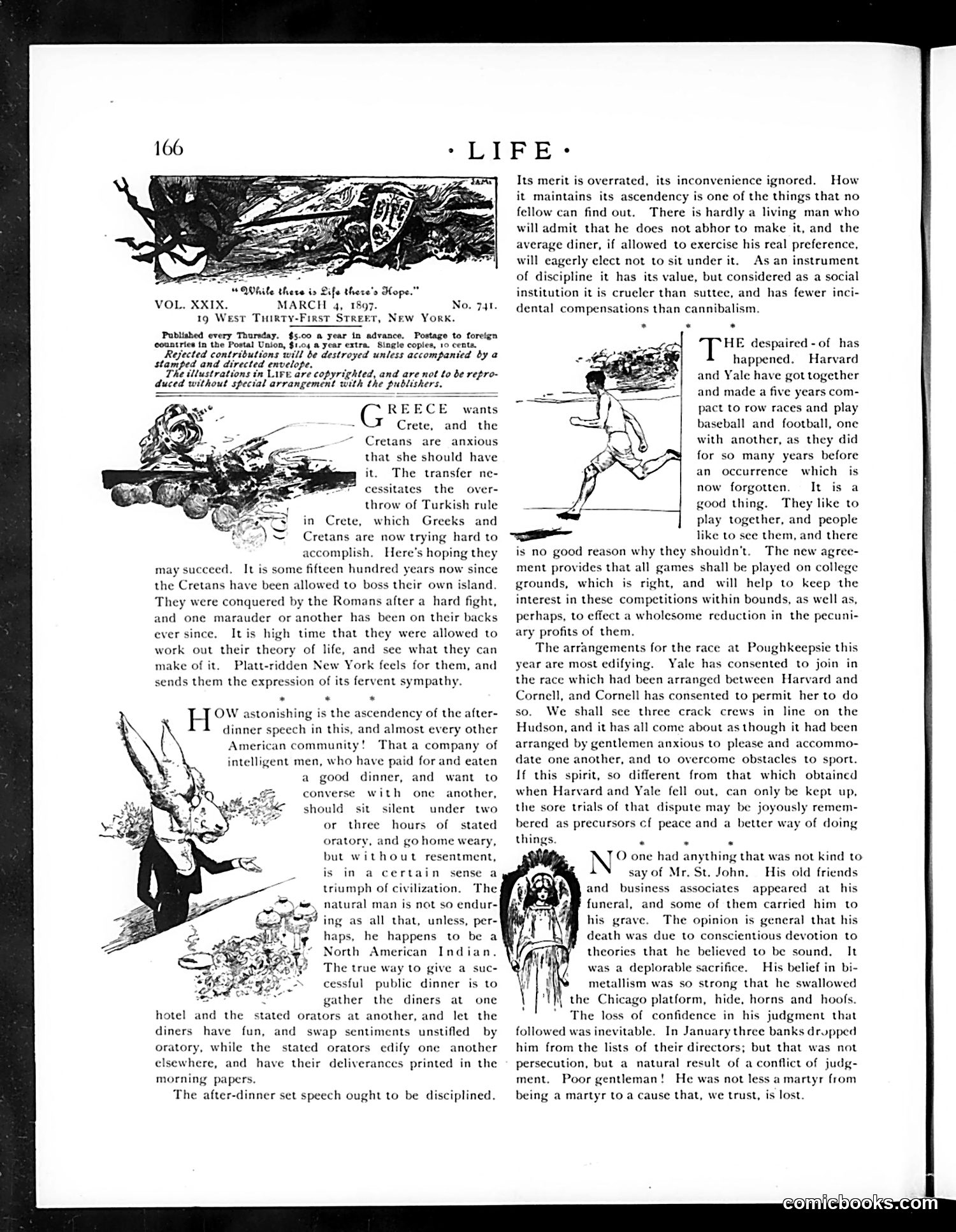
This page contains two distinct satirical pieces: **Upper cartoon**: Depicts a figure (unclear who) lying horizontally with text "While there is Life there's Hope," satirizing someone's persistent but likely futile optimism or resilience despite adversity. **Main article**: Discusses the "after-dinner speech" as a social phenomenon, mocking its prevalence in American culture. The text satirizes how dinner speakers endlessly drone on—describing it as "a triumph of civilization" that the natural man (compared unfavorably to "a North American Indian") would find absurd. The satire critiques the pretension and tedium of formal dinner oratory, where multiple speakers deliver lengthy remarks that guests suffer through silently. The author argues this ritual, while considered refined, actually represents social excess rather than genuine sophistication.
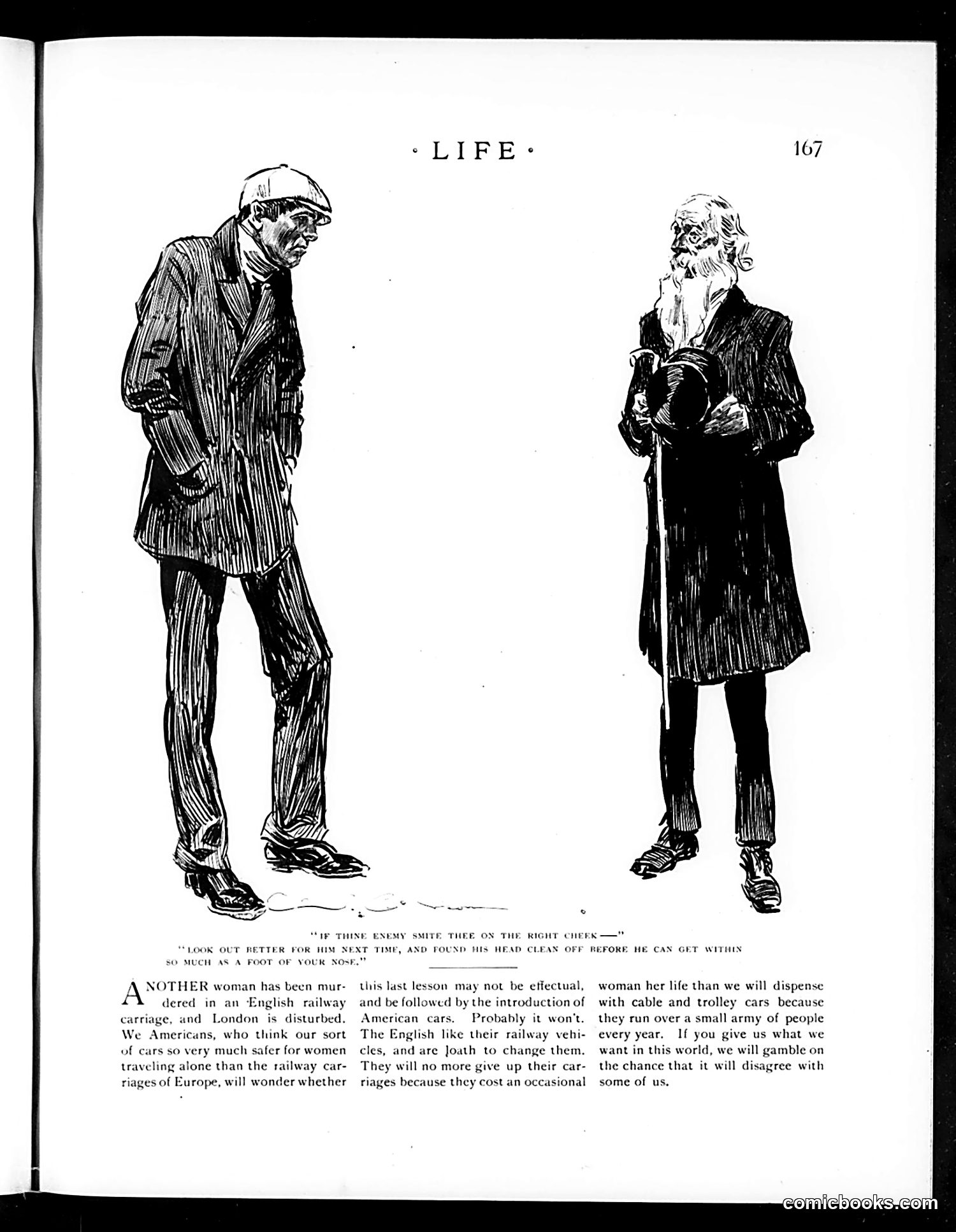
This page satirizes British resistance to American automobile innovation. The two illustrated figures represent contrasting attitudes: a younger man in modern dress (left) and an older, traditional gentleman (right), appearing to debate transportation methods. The caption references a railway carriage accident in England and jokes about an enemy's head being "clean off" before reaching someone's nose—dark humor about the dangers of outdated British rail travel. The accompanying text criticizes British attachment to their existing railway system despite safety concerns. The satire suggests Americans, who embrace "safer" automobiles, find it ironic that the English stubbornly cling to traditional carriages and railways rather than adopt modern American cars. This reflects early 20th-century American confidence in automotive progress versus perceived British conservatism.
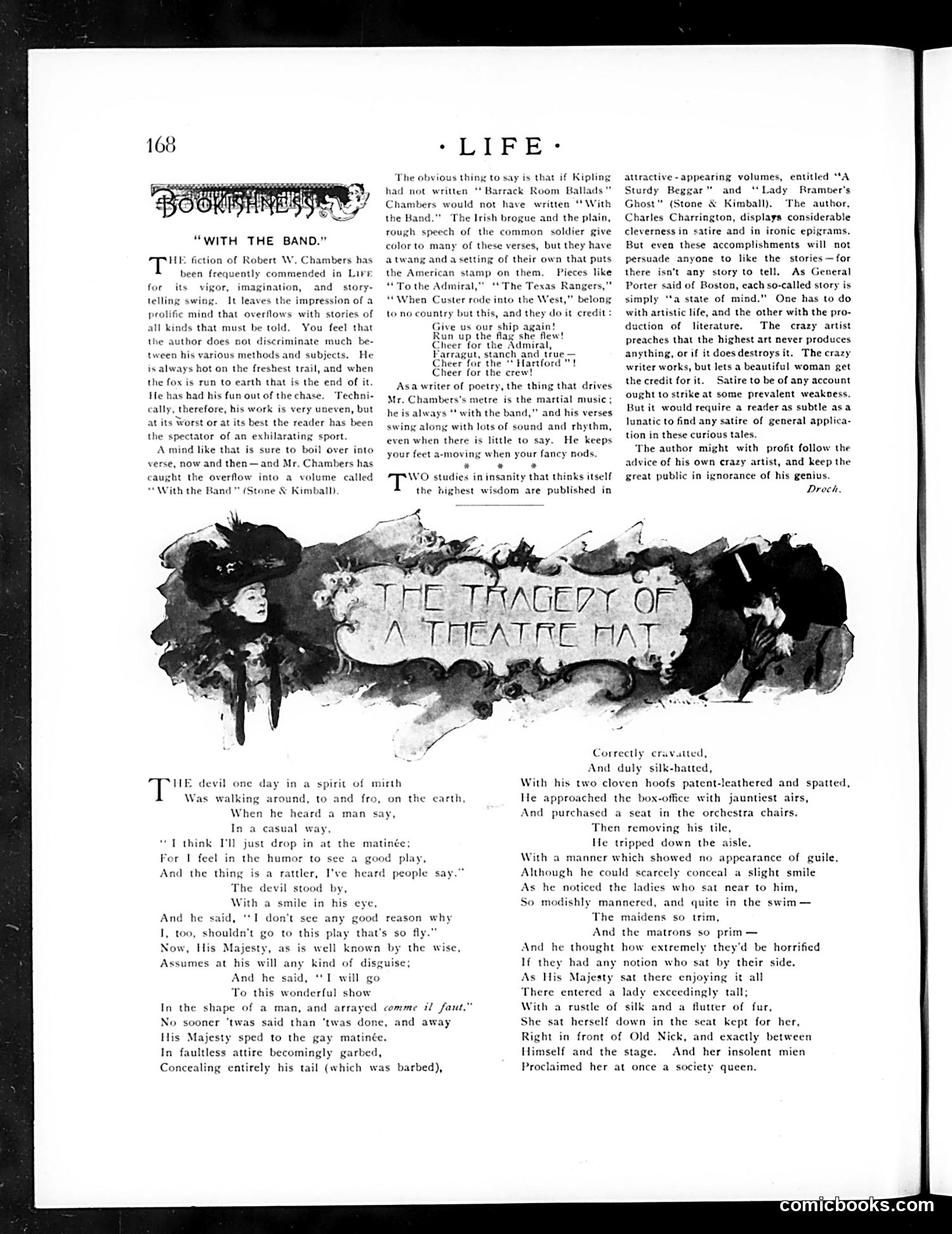
This page contains two satirical pieces. The top section reviews Robert W. Chambers's book "With the Band," praising his vigorous storytelling while gently mocking his overwrought style and tendency to overload volumes with narrative. The main illustration and poem, "The Tragedy of a Theatre Hat," satirizes a devil attending a matinee performance. The joke concerns the devil's elaborate, fashionable hat—so elaborate that other theater-goers cannot see the stage behind it. The satire targets the vanity and poor theater etiquette of well-dressed women whose oversized hats, a genuine social nuisance of the era, obstructed other patrons' views during performances. This was a common complaint in early 20th-century theaters.
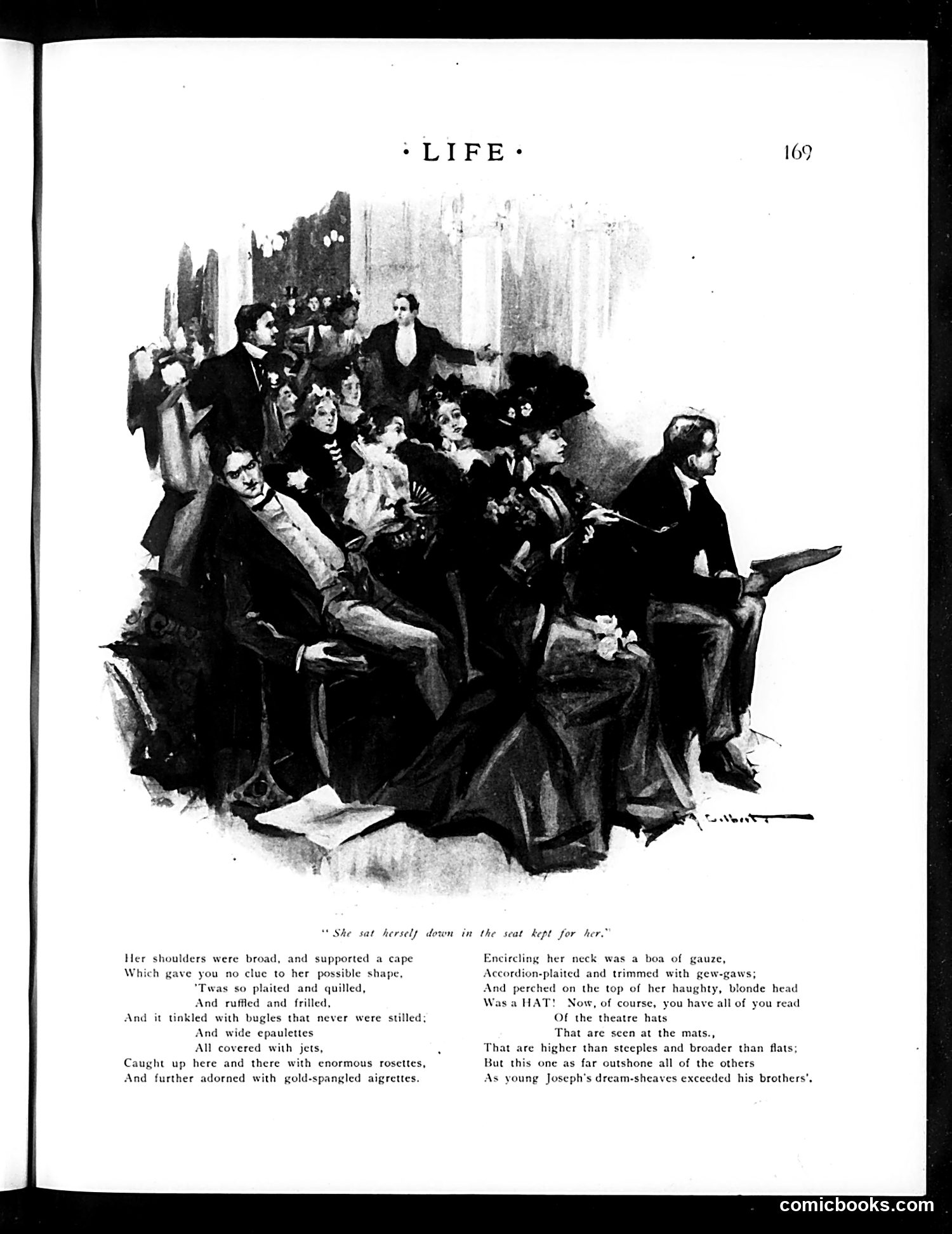
This is a satirical illustration depicting a formal theatrical or social gathering, likely from the late 19th or early 20th century. The accompanying verse mocks an elaborately dressed woman seated prominently, describing her extravagant attire—particularly a theatrical hat described as exceeding "all of the theatre hats / That are higher than steeples and broader than flats." The satire targets upper-class women's excessive fashion, especially the ostentatious oversized hats that were fashionable during this era. The reference to "young Joseph's dreamsheaves" suggests the hat's absurd proportions rival biblical imagery. The illustration ridicules both the wearer's vanity and the social pretension of high society gatherings where such costume displays occurred.
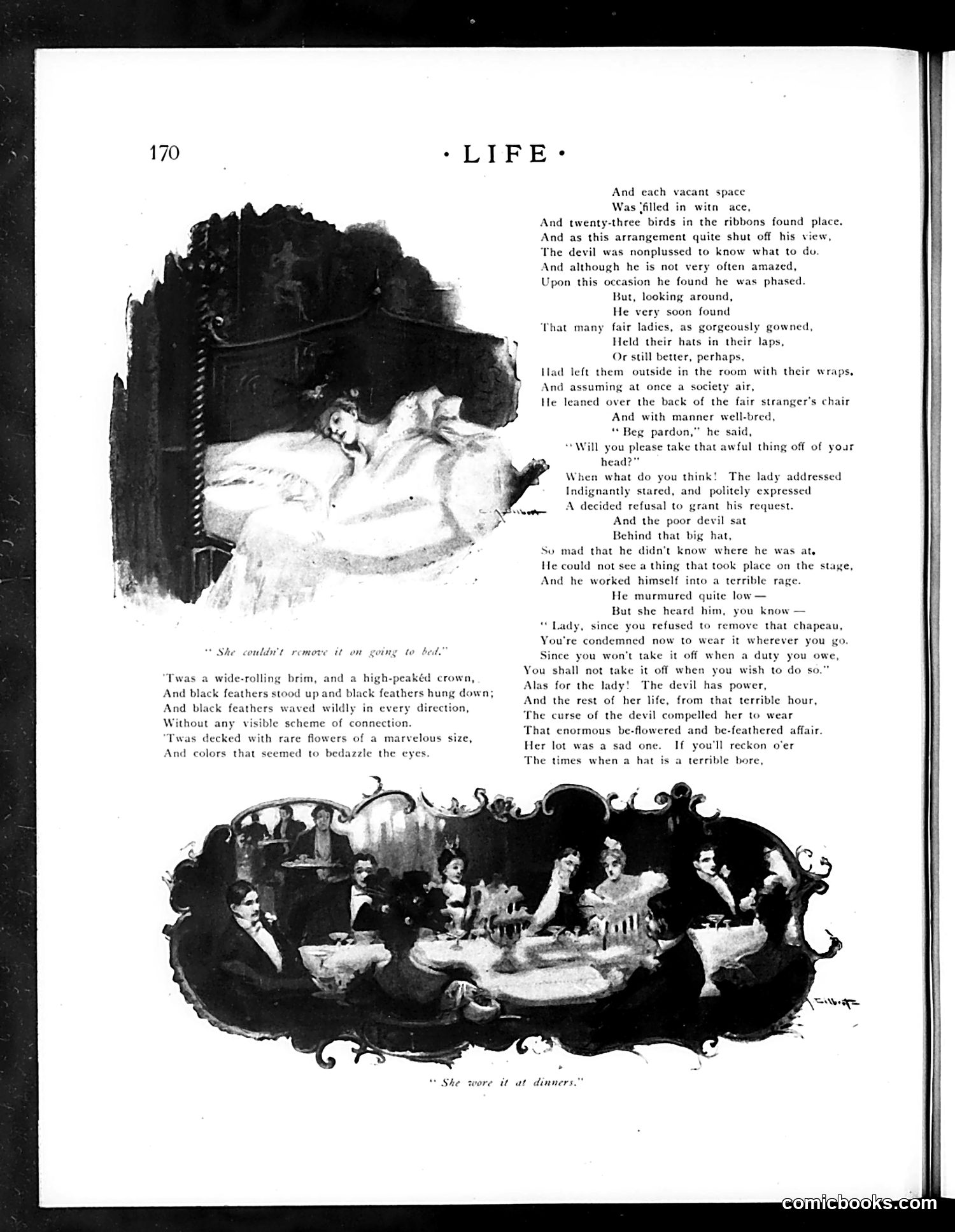
This page presents a humorous narrative about a devil attending a theater performance. The top illustration shows a woman in bed wearing an enormous, ornate feathered hat—the story's central joke. The devil demands she remove it, but she refuses, cursing him to wear it permanently as punishment. The satire targets the absurd fashion of oversized women's hats that were apparently common in the era when this was published. The bottom illustration shows a dinner scene, suggesting the hat's social prominence. The joke relies on period readers' familiarity with excessively large, decorated hats as a real fashion problem—so ridiculous that even the devil finds them unbearable. The punishment humorously inverts the fashion excess back onto the wearer.
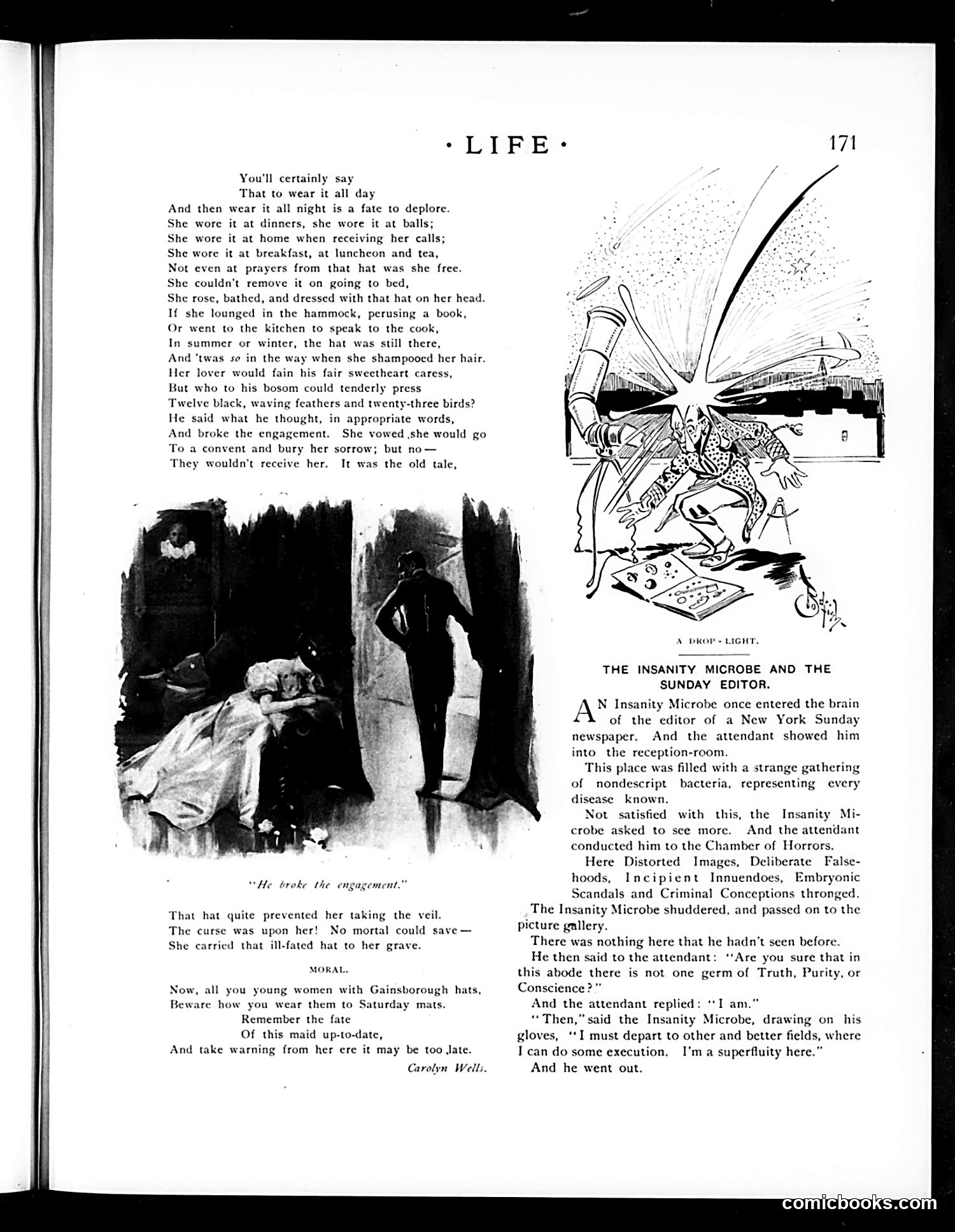
This satirical piece mocks newspaper editors through whimsical fiction. An "Insanity Microbe" visits a New York Sunday newspaper editor's brain, finding it filled with "nondescript bacteria, representing every disease known." The joke targets the sensationalism and poor judgment of Sunday newspaper editors—a common complaint in early 20th-century satire. When the microbe tours the editor's "Chamber of Horrors" containing distorted images and scandal coverage, it finds nothing new to corrupt. The microbe concludes the editor is already so morally compromised ("a superfluity here") that even insanity cannot worsen him. The accompanying poem on the left satirizes women's fashion obsession with elaborate hats, warning of consequences.
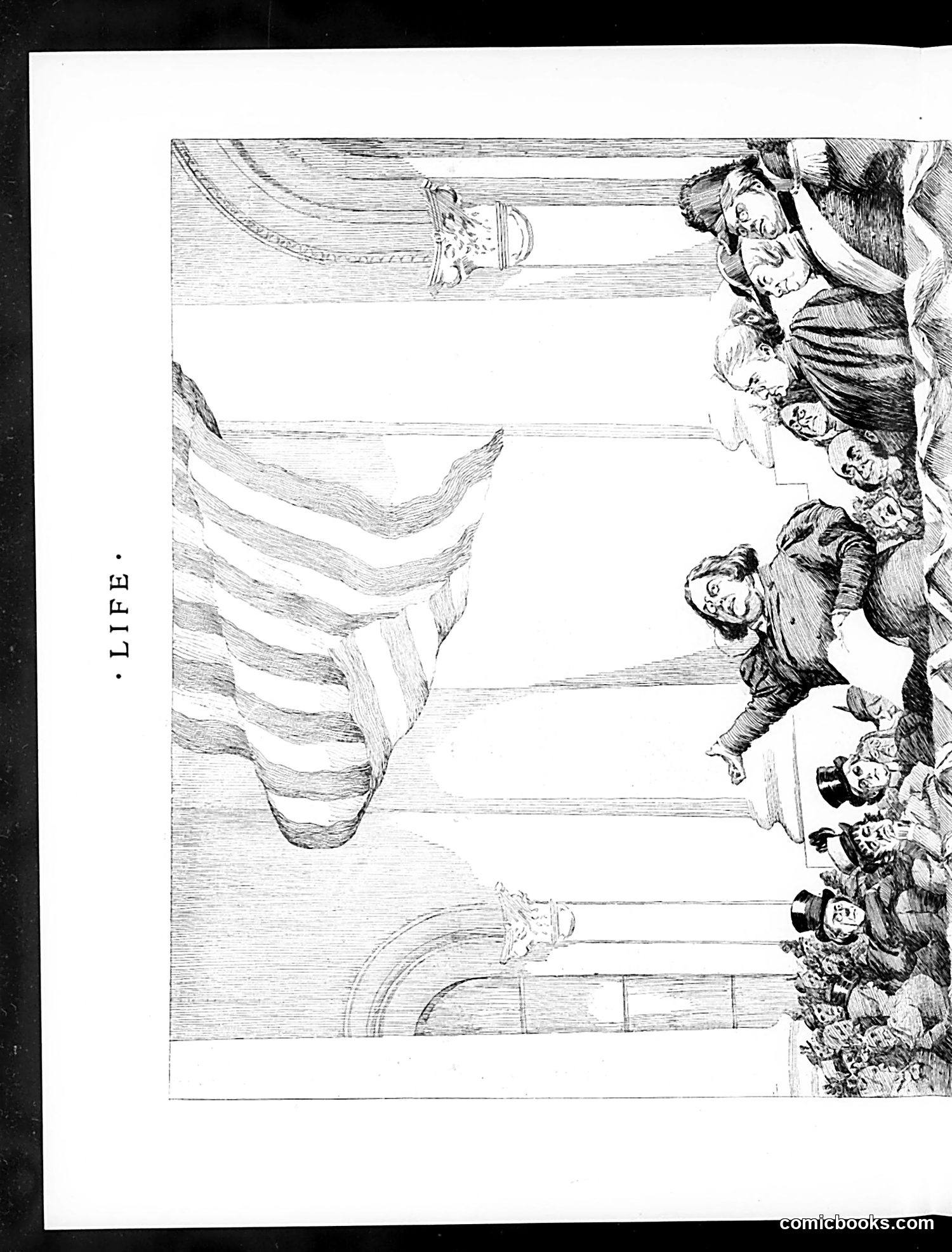
This page appears to be a title page or section header for *Life* magazine, labeled "LIFE:" on the left margin. The main illustration is an etching or engraving showing a group of figures gathered on the right side of the page, rendered in classical satirical style with cross-hatching typical of 19th-century political cartoons. On the left side is a separate illustration of what appears to be a grotesque or exaggerated figure—possibly representing a caricatured person or social type. Without additional context (date, caption text, or clearer identification of the figures), I cannot definitively identify the specific political figures, events, or satirical points this page references. The artistic style suggests late 19th-century American satire, but the specific subjects remain unclear from the image alone.
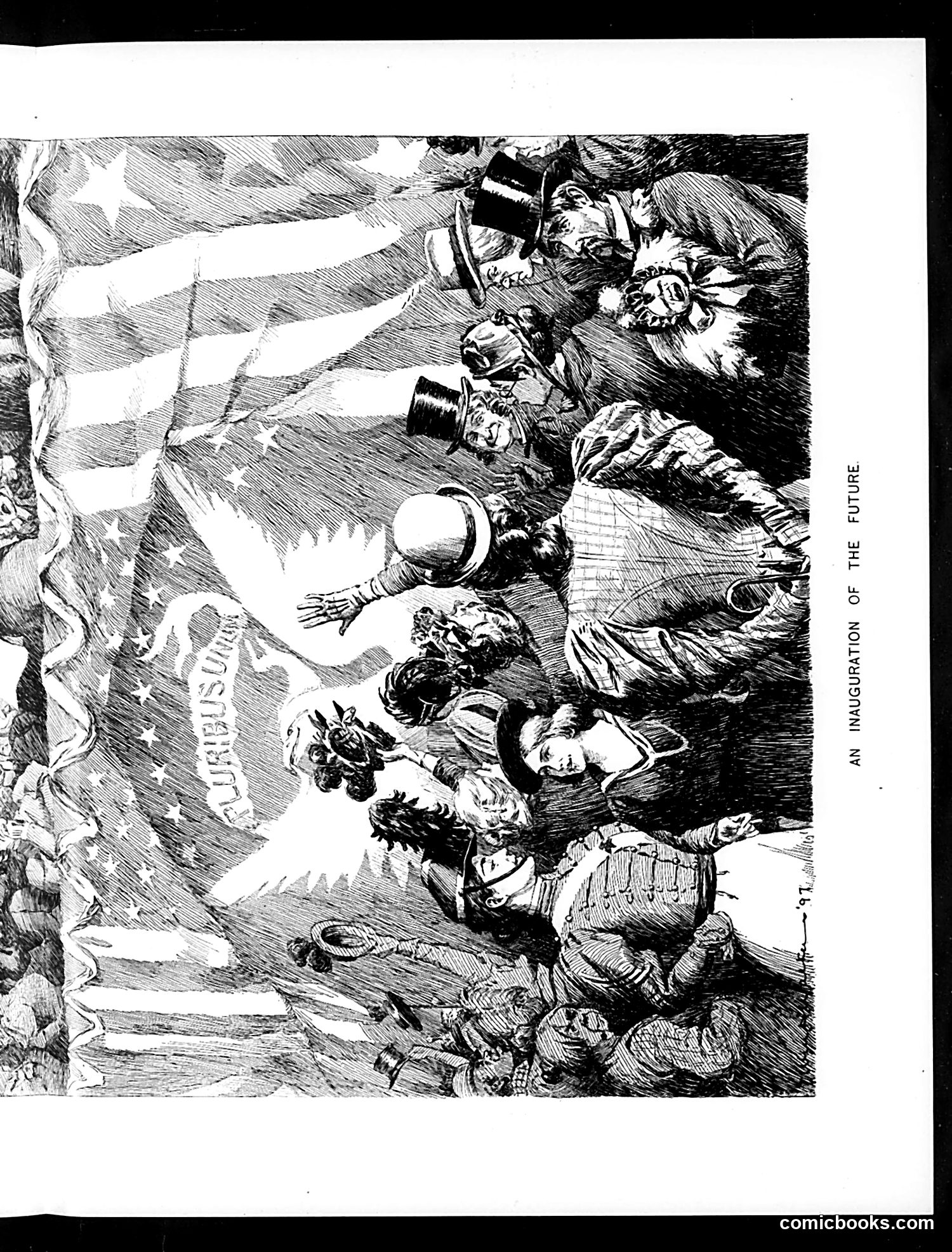
This satirical engraving depicts a chaotic, fantastical inaugural ceremony. The title suggests it's speculative political satire about a future inauguration—likely commenting on concerns about American democracy or leadership at the time of publication. The scene shows multiple figures in formal dress and military uniforms amid confusion and disorder. There's an American flag visible on the left. The detailed cross-hatching and engraving style suggests this is 19th-century satirical commentary. Without the publication date or additional context, I cannot definitively identify which specific political figures or events are being mocked. The satire appears to critique the dignity or competence of a future political leadership, but the precise target remains unclear from the image alone.
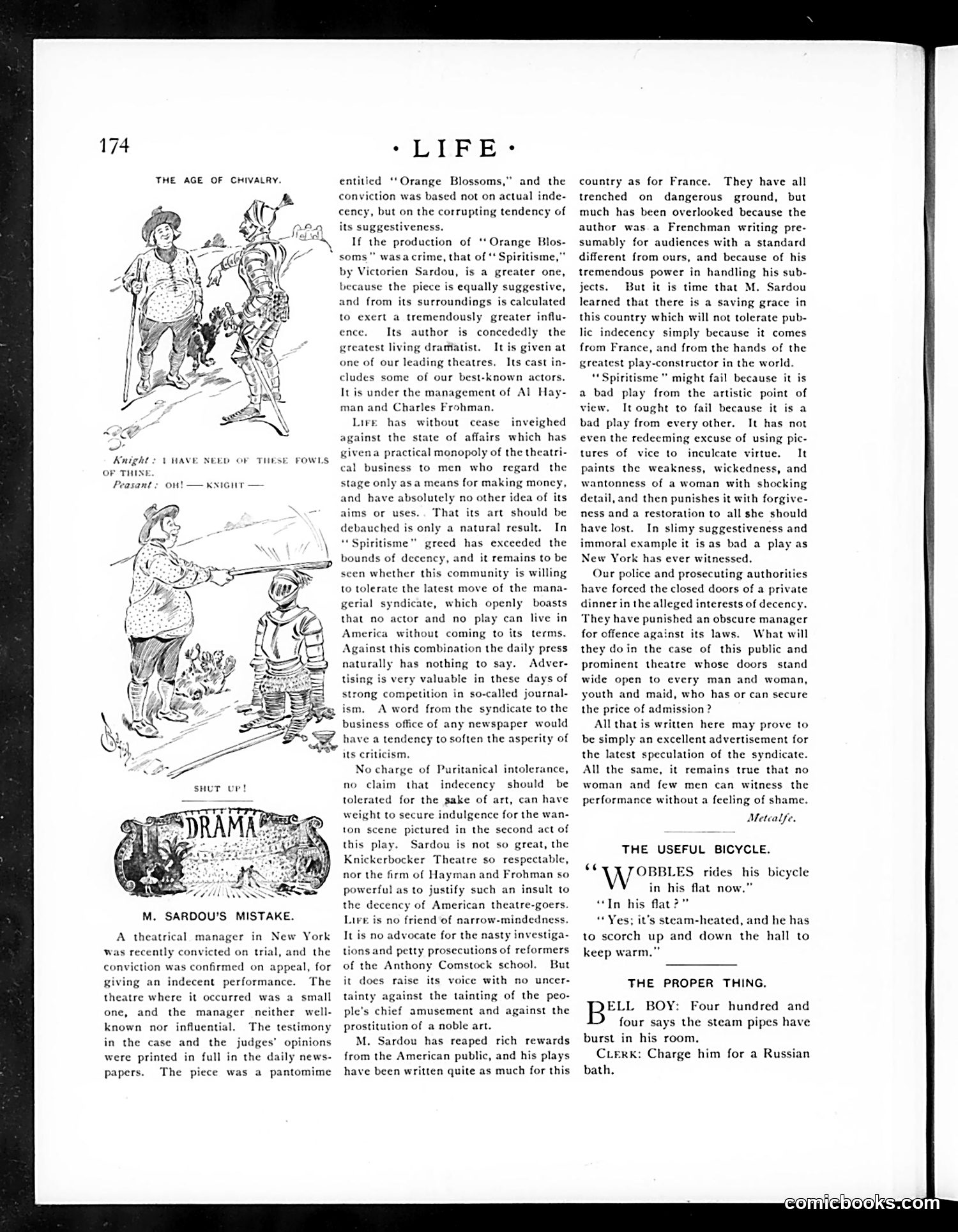
This page satirizes theatrical management and censorship in early American theater. The main article criticizes a theatrical manager convicted of indecent performance for staging a pantomime titled "Orange Blossoms." The cartoons depict a Knight and Peasant character, illustrating the article's central complaint: that theater syndicates monopolize stage production and suppress artistic freedom while claiming moral authority. The text argues this represents hypocrisy—the same authorities who restrict "indecent" plays freely advertise spectacles for profit. The article defends French dramatist Sardou's work against prudish American censorship, contrasting European theatrical sophistication with American narrow-mindedness. The satire targets both self-righteous moral policing and commercial interests disguised as virtue.
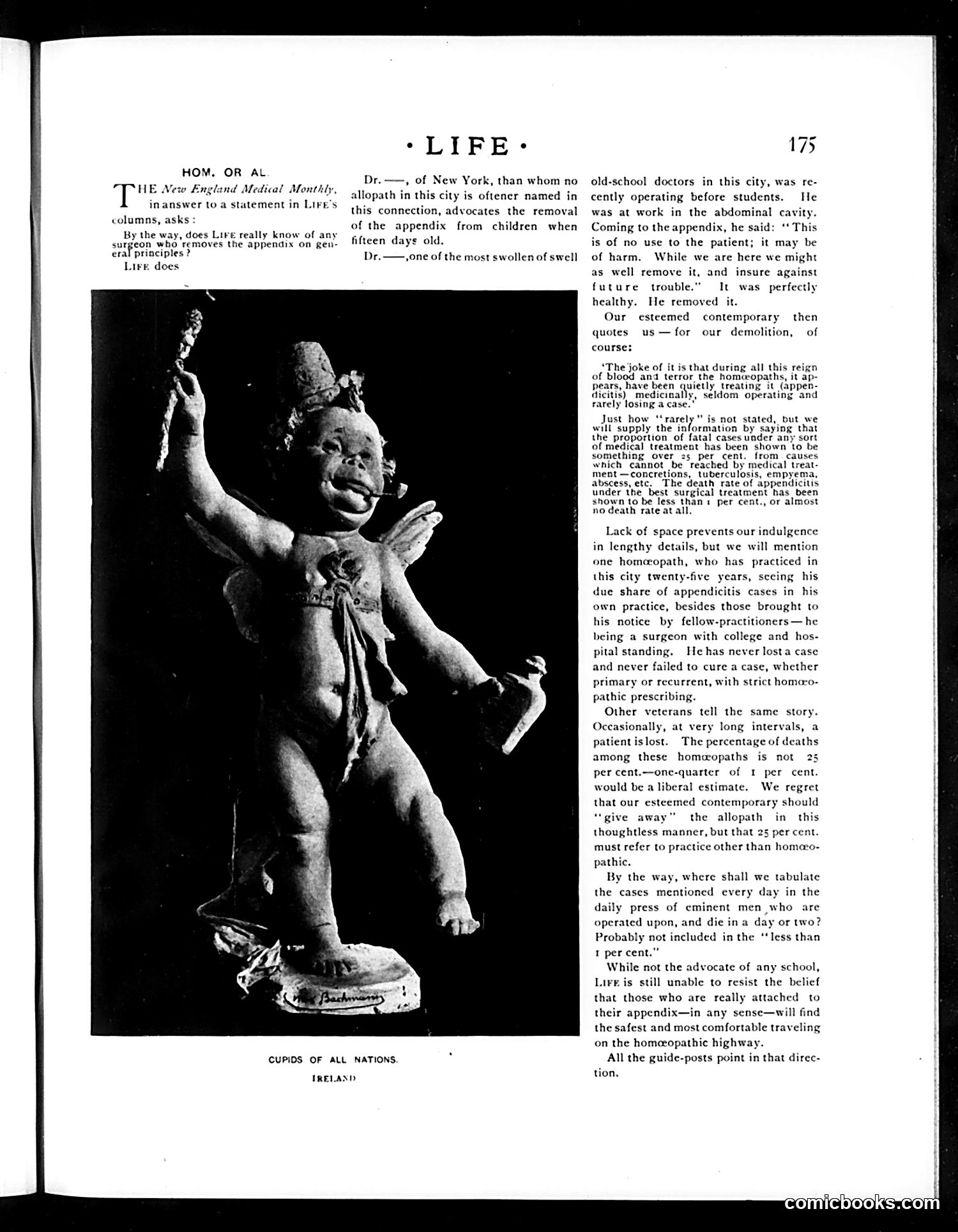
This page debates medical treatment of appendicitis between conventional ("allopath") and homeopathic doctors. The sculpture pictured—labeled "Cupids of All Nations: Ireland"—appears unrelated to the text debate, serving as decorative filler typical of Life magazine. The article critiques a medical journal's claim that homeopaths rarely lose appendicitis patients. Life's editors defend surgical removal, citing a 25% death rate under medical (non-surgical) treatment versus under 1% with surgery. They challenge the homeopaths' reported success rates as implausibly low, suggesting these figures either exclude fatal cases or apply only to homeopathic practice. The satire mocks homeopathic medicine's apparent superiority claims while endorsing surgical intervention—reflecting early 20th-century tensions between emerging scientific surgery and older, non-surgical medical traditions.
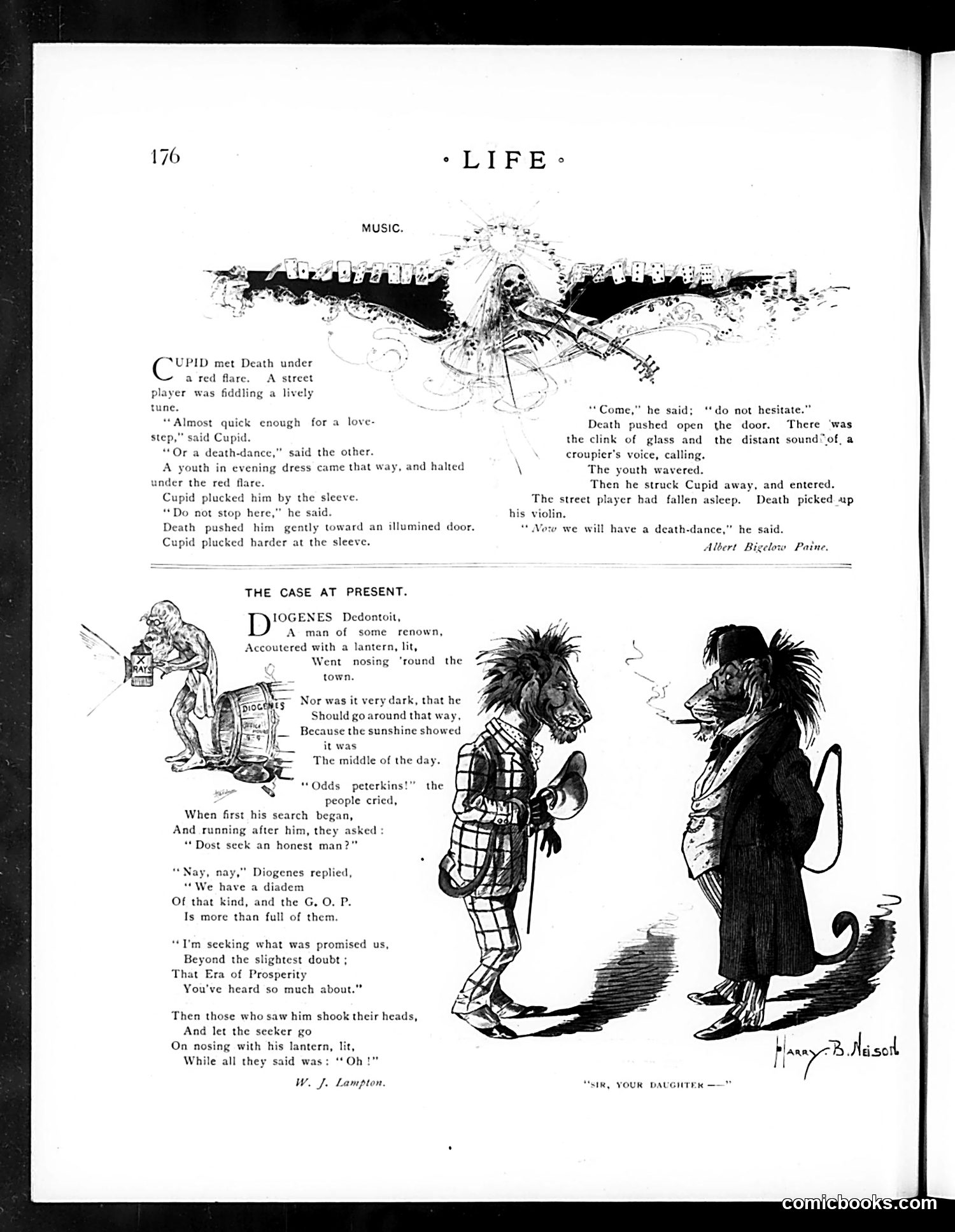
This page contains two satirical pieces lampooning Republican politics circa early 1900s. **"The Case at Present"** parodies Diogenes (the ancient Greek philosopher who famously searched for an honest man). Here, Diogenes searches through town with a lantern for the promised "Era of Prosperity"—a Republican campaign slogan. The satire suggests the GOP is full of dishonest men and that the promised prosperity never materialized. The comic relief comes from Diogenes searching in broad daylight, absurdly using a lantern, mirroring the futility of seeking Republican prosperity promises. **The upper narrative** uses allegorical figures—Cupid and Death—to satirize temptation and moral decay. A young man in evening dress is pulled between Cupid (love/pleasure) and Death toward an illuminated door revealing gambling ("clink of glass," "croupier's voice"). He chooses vice over virtue, illustrating social anxieties about urban moral corruption. Both pieces critique failed promises and moral decline in contemporary society.
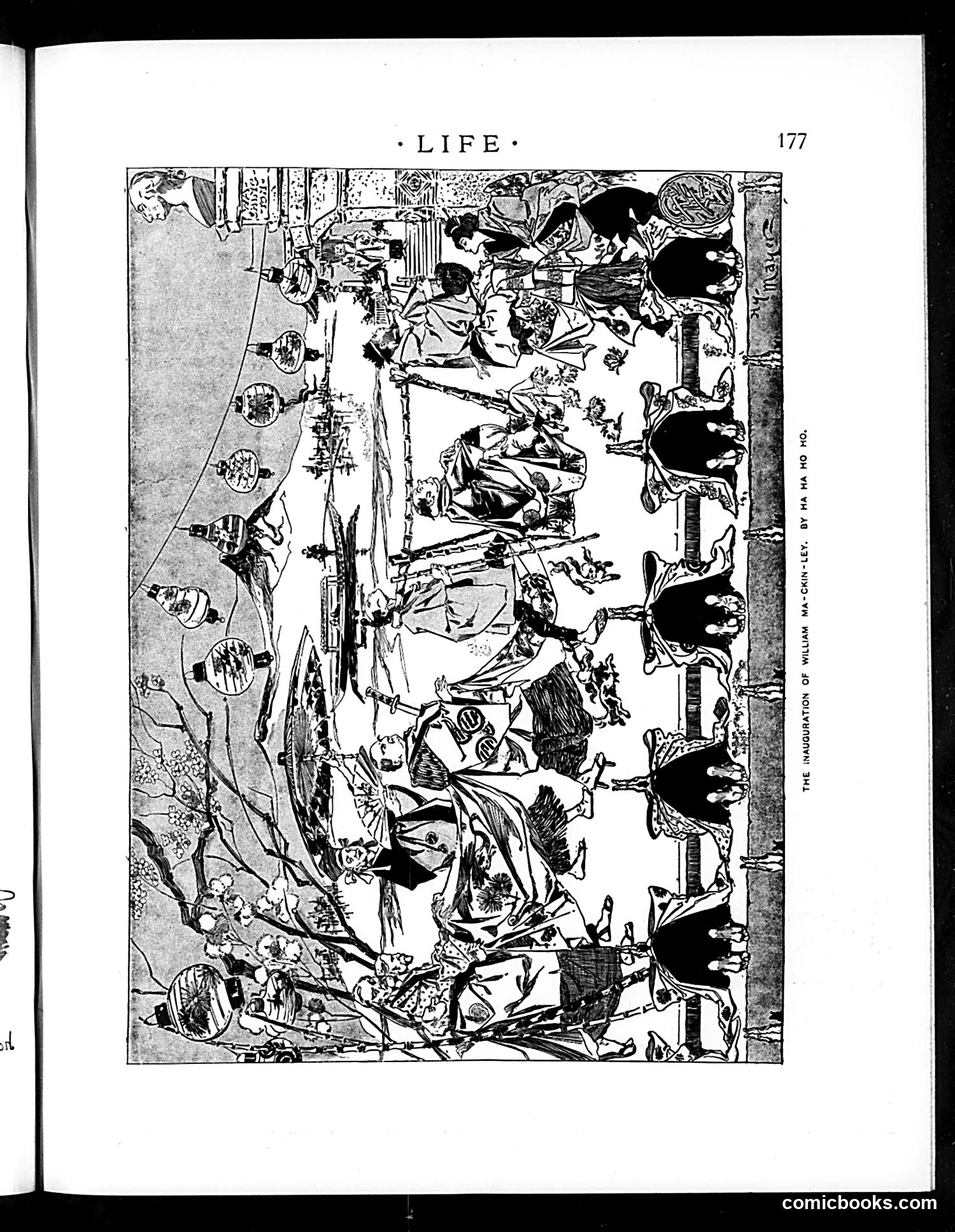
This page from *Life* magazine (page 177) contains a single large satirical illustration that appears to be rotated 90 degrees. The image depicts a chaotic street or public scene with multiple figures in period dress (appearing 19th century based on clothing styles). The illustration shows various characters engaged in what seems social commentary or political satire, though without a visible caption or title on this page, the specific subject matter remains unclear. The densely packed composition with numerous interacting figures and architectural elements suggests commentary on urban life, social disorder, or political conflict of the era. The artistic style and black-and-white engraving technique are consistent with *Life*'s satirical approach, but the particular target of this satire cannot be definitively determined from the image alone.
This page from *Life* magazine features a satirical poem titled "A Carol of 'Cocaine'" that mocks the growing drug epidemic among fashionable society. The poem, attributed to Henry Labouchere writing in *London Truth*, employs classical literary references (Anacreon, Horace, Bacchus) to highlight the absurdity of modern vice replacing traditional wine-drinking culture. The satire targets upper-class addiction to cocaine, morphine, chloral, and other substances—noting these are now "Society's" preferred intoxicants. The poet ironically suggests these drugs cannot inspire great literature like wine once did, since their effects (sight/hearing damage, neurological harm) are antithetical to poetic creation. The surrounding content includes brief anecdotes about musical amateurs and artist Hans von Bülow, plus period advertisements (Ivory Soap, Knox Hats, Hunter Rye Whiskey—ironic given the cocaine critique), typical of *Life's* magazine format blending commentary with commerce.
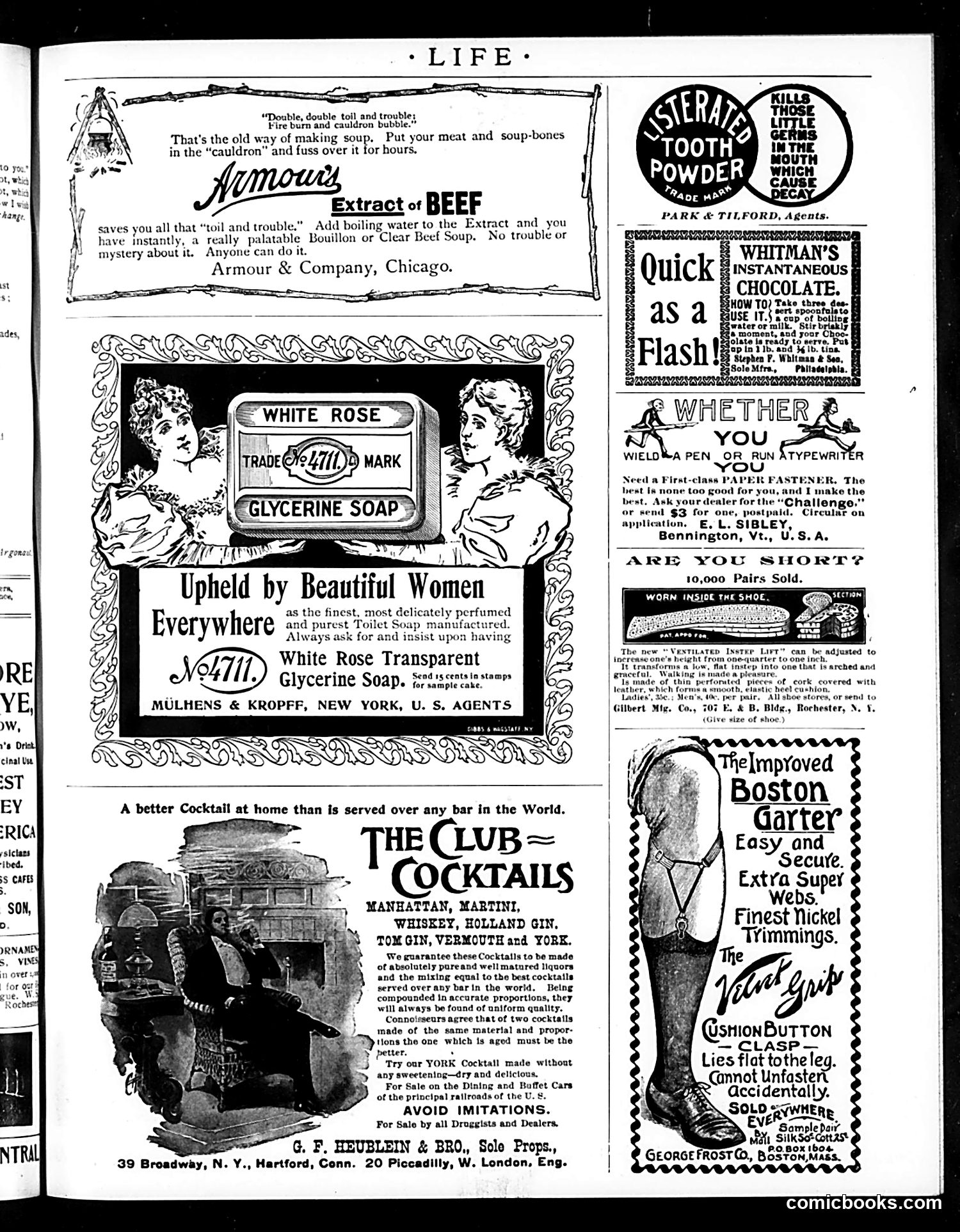
This page is primarily **advertising**, not political satire. It's a collection of early 20th-century product ads using period marketing techniques: **Notable ads:** - **Armour's Beef Extract** uses a Macbeth quote ("Double, double toil and trouble") to position instant soup as modern convenience versus old-fashioned labor—a common "time-saving" pitch of the era. - **White Rose Glycerine Soap** features idealized female figures, appealing to beauty standards and cleanliness anxieties typical of Victorian/Edwardian advertising. - **The Club Cocktails** guarantees quality spirits for home consumption—noteworthy because this predates Prohibition (1920-1933), when such ads were still legal. - Smaller ads hawk typewriter ribbons, shoe inserts, and garters using exaggerated claims ("10,000 Pairs Sold"). The page reflects early advertising's focus on **convenience, beauty, and modernity**, targeting middle-class consumers with disposable income. No political cartoons appear here—it's straightforward commercial content.
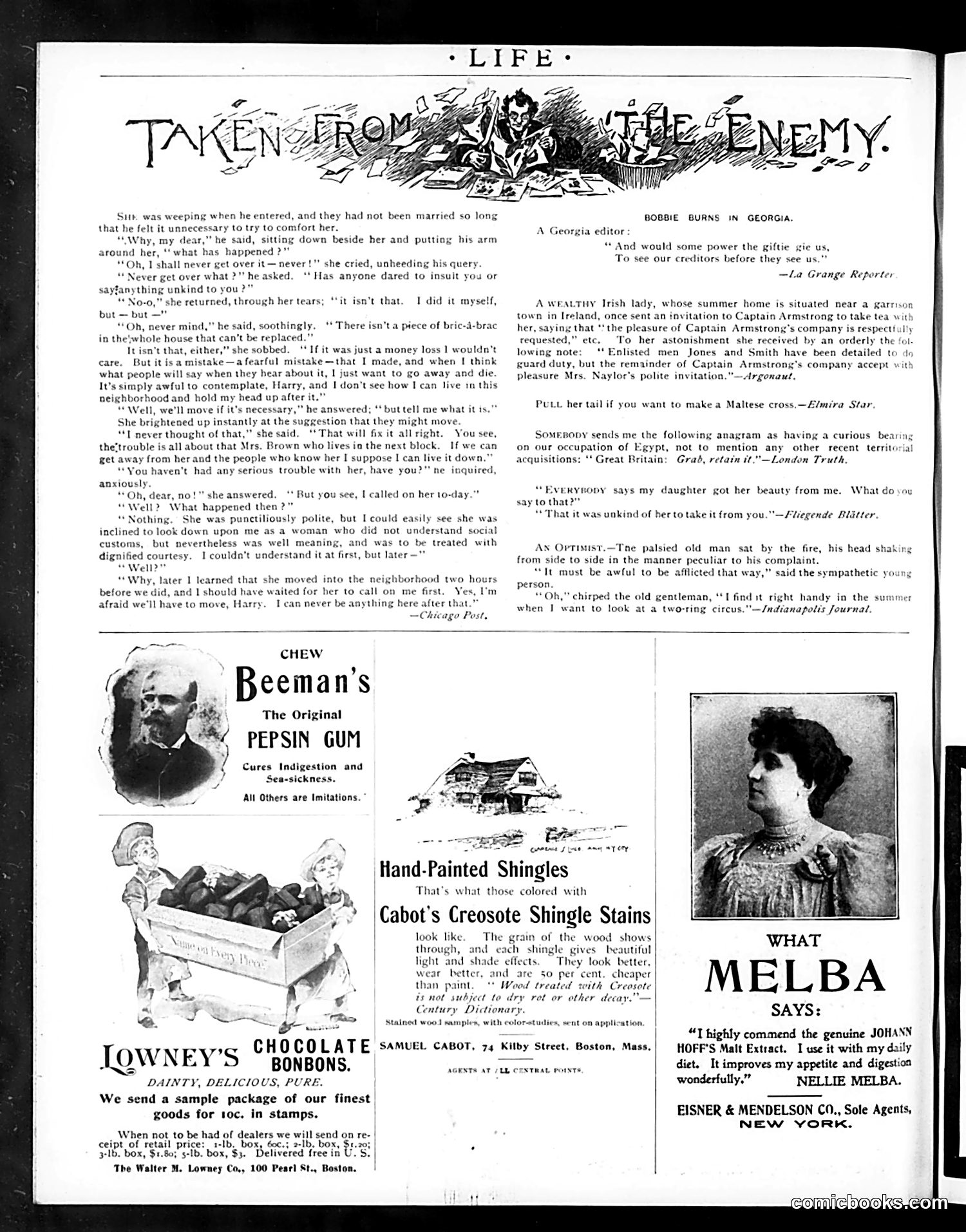
This page is primarily **advertising with a framing story**, not a political cartoon. The main narrative—headlined "Taken from the Enemy"—is a domestic humor piece about a wife distressed after calling on her neighbor Mrs. Brown. The joke: the wife violated an unwritten social rule by failing to wait for Mrs. Brown to call first, establishing proper etiquette hierarchy in the neighborhood. The satire mocks rigid Victorian social conventions and their paralyzing effect on women, with the absurd resolution being to simply move rather than face social disgrace. The page includes several brief humor snippets poking fun at social pretension, military protocol, and courtship rules—typical of *Life*'s satirical approach to American manners. The bulk of the page consists of period advertisements: Beeman's Pepsin Gum, Cabot's Creosote Shingle Stains, Lowney's Chocolate Bonbons, and a testimonial from "Melba" (likely opera singer Nellie Melba) endorsing malt extract.
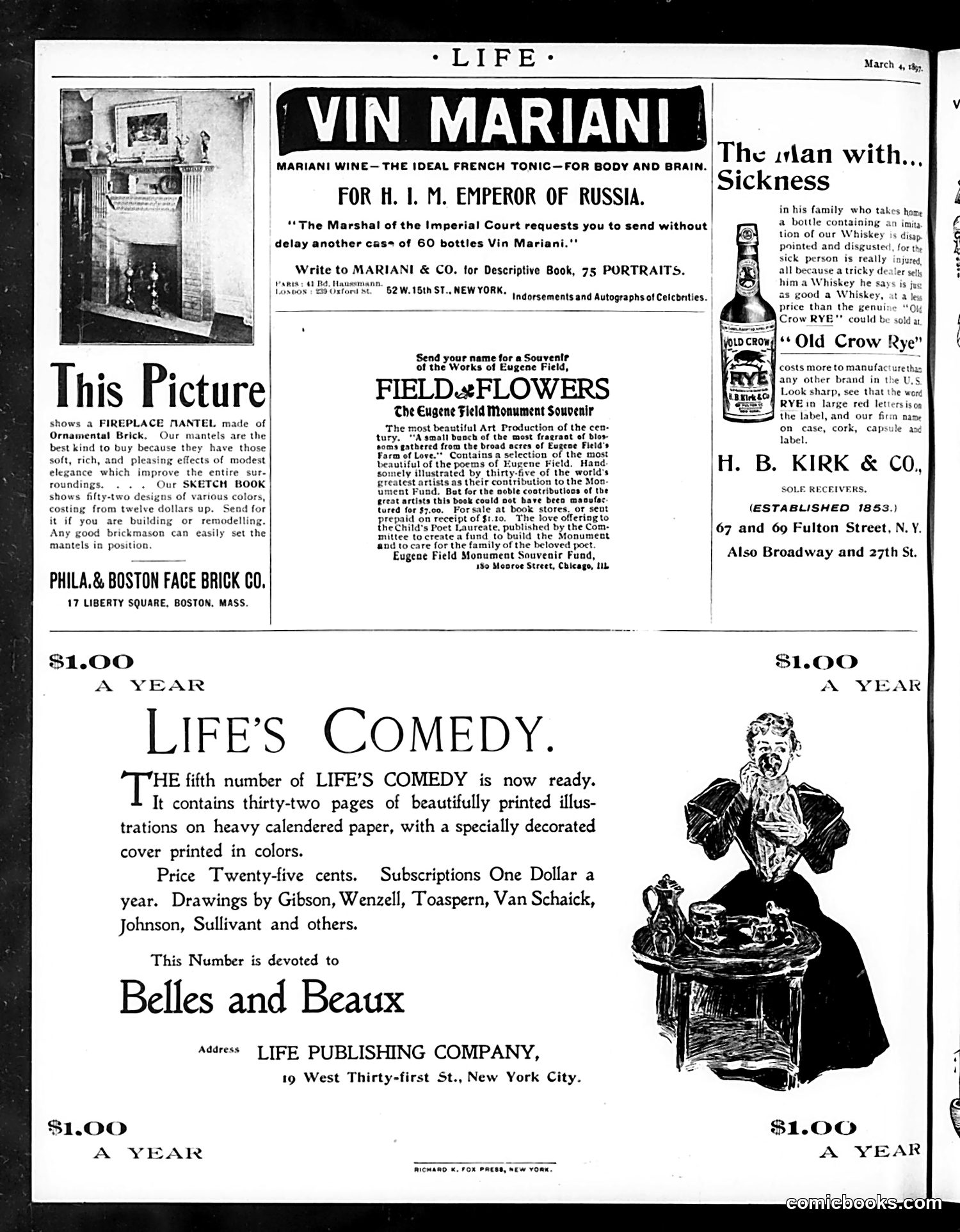
This is primarily an **advertising page** with no political cartoons. The content reflects early 1900s consumer culture and includes: **Notable Advertisements:** 1. **Vin Mariani Wine** — marketed as a medicinal "tonic for body and brain," allegedly endorsed by the Russian Emperor. This reflects the era's patent medicine culture, when alcohol-based tonics were widely advertised with celebrity endorsements (real or fabricated). 2. **Old Crow Rye Whiskey** — addresses counterfeit concerns, warning consumers about inferior imitations. This indicates widespread product fraud was a recognized problem. 3. **Life's Comedy** — the magazine's own publication featuring illustrated humor by well-known artists (Gibson, Wenzell, etc.). 4. **Fireplace mantels and Eugene Field Monument souvenir** — typical period advertisements. The page reflects **early-20th-century consumer anxieties**: fake products, unregulated "medicinal" alcohol, and brand authenticity—issues that resonate today but in a vastly different regulatory environment.