
Life, 1897-03-04 · page 13 of 20
Life — March 4, 1897 — page 13: what you’re looking at
What you’re looking at
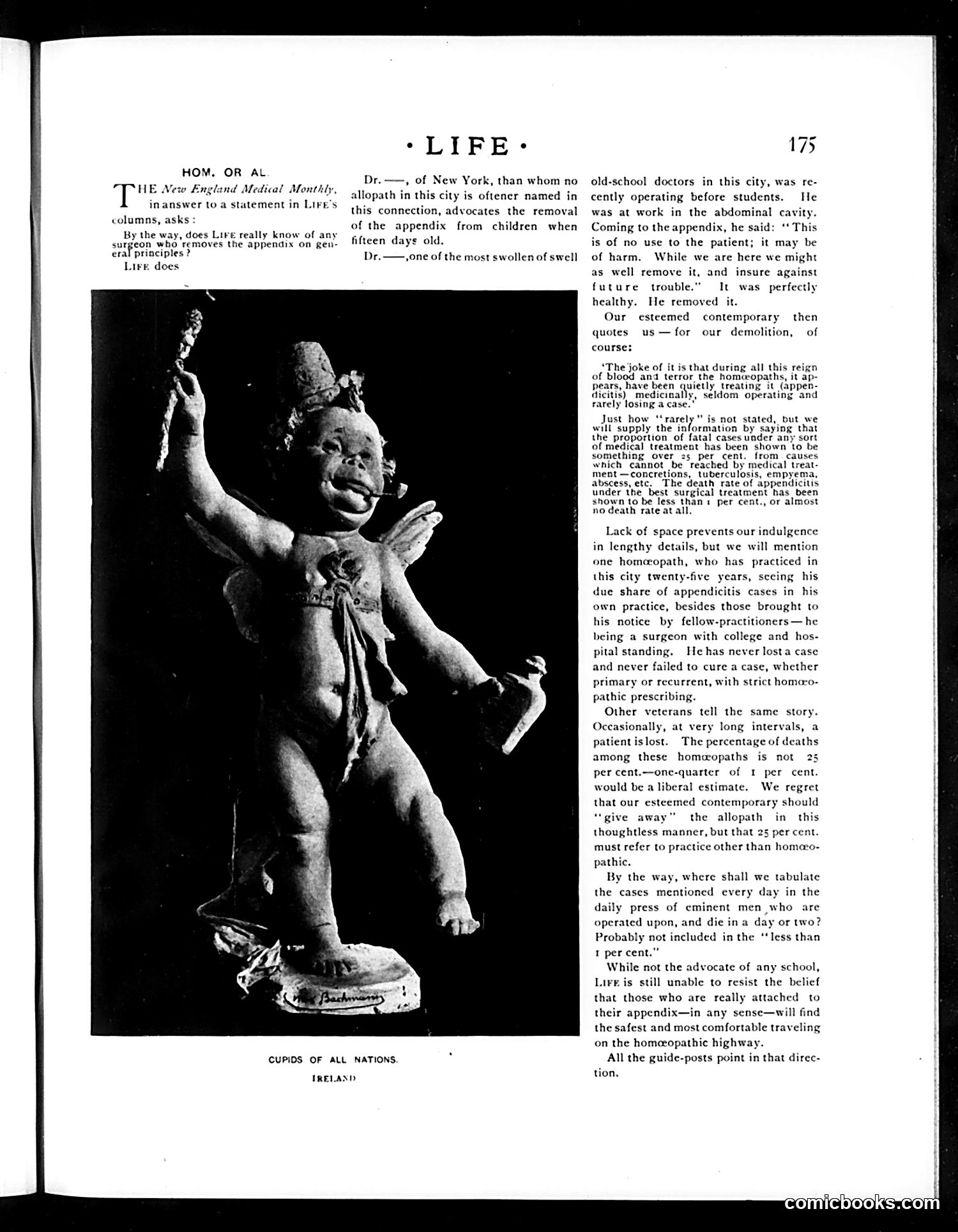
This page debates medical treatment of appendicitis between conventional ("allopath") and homeopathic doctors. The sculpture pictured—labeled "Cupids of All Nations: Ireland"—appears unrelated to the text debate, serving as decorative filler typical of Life magazine. The article critiques a medical journal's claim that homeopaths rarely lose appendicitis patients. Life's editors defend surgical removal, citing a 25% death rate under medical (non-surgical) treatment versus under 1% with surgery. They challenge the homeopaths' reported success rates as implausibly low, suggesting these figures either exclude fatal cases or apply only to homeopathic practice. The satire mocks homeopathic medicine's apparent superiority claims while endorsing surgical intervention—reflecting early 20th-century tensions between emerging scientific surgery and older, non-surgical medical traditions.
📄 Transcribed text from this page (OCR, searchable)
Machine-transcribed from the original scan — historical spelling and the odd misread are preserved.
HOM. OR AL HE New England Medical Monthly, in answer to a statement in Lire’s columns, asks: By the way, does Lire really know of any surgeon who removes the appendix on gen- eral principles ? Lire does *LIFE: Dr. —, of New York, than whom no allopath in this city is oftener named in this connection, advocates the removal of the appendix fifteen days old. from children when Dr.—, one of the most swollen of swell CUPIDS OF ALL NATIONS. IRELAND old-school doctors in this city, was re- cently operating before students. He was at work in the abdominal cavity. Coming to the appendix, he said: ‘* This is of no use to the patient; it may be of harm, While we are here we might as well remove it, and insure against future trouble.” It healthy. He removed it. Our esteemed contemporary then us — for demolition, of was perfe quotes. our course: ‘The joke of it is that during all this reign of blood and terror the homcopaths, it ap- pears, have been quietly treating it (appen- dicitis) medicinally, seldom operating and rarely losing a cas Just how “rarely” is not stated, but we will supply the information by saying that the proportion of fatal cases under any sort of medical treatment has been shown to be something over 25 per cent. from causes which cannot be reached by medical treat- ment —concretions, tuberculosis, empyema, abscess, etc. The death rate of appendici under the best surgical treatment has been shown to be less than t per cent., or almost no death rate at all. Lack of space prevents our indulgence in lengthy details, but we will mention one homaopath, who has practiced in this city twenty-five years, secing his due share of appendicitis cases in his own practice, besides those brought to his notice by fellow-practitioners— he being a surgeon with college and hos- pital standing. He has never losta case and never failed to cure a case, whether primary or recurrent, with strict homo-o- pathic prescribing. Other veterans tell the same story. Occasionally, at very long intervals, a patientislost. The percentage of deaths among these homaopaths is not 2 per cent.—one-quarter of 1 per would be a liberal estimate. W: cent. regret that our esteemed contemporary should “give the allopath in this thoughtless manner, but that 25 per cent. must refer to practice other than homao- pathic. By the way, where sh the cases mentioned every day in the daily press of eminent men who are operated upon, and die in a day or two? Probably not included in the ‘‘less than 1 per cent.” While not the advocate of any school, Lire is still unable to resist the belief that those who are really attached to their appendix—in any sense—will find the safest and most comfortable traveling on the homeropathic highway All the guide-posts point in that diree- tion. away”