
Life, 1897-03-04 · page 12 of 20
Life — March 4, 1897 — page 12: what you’re looking at
What you’re looking at
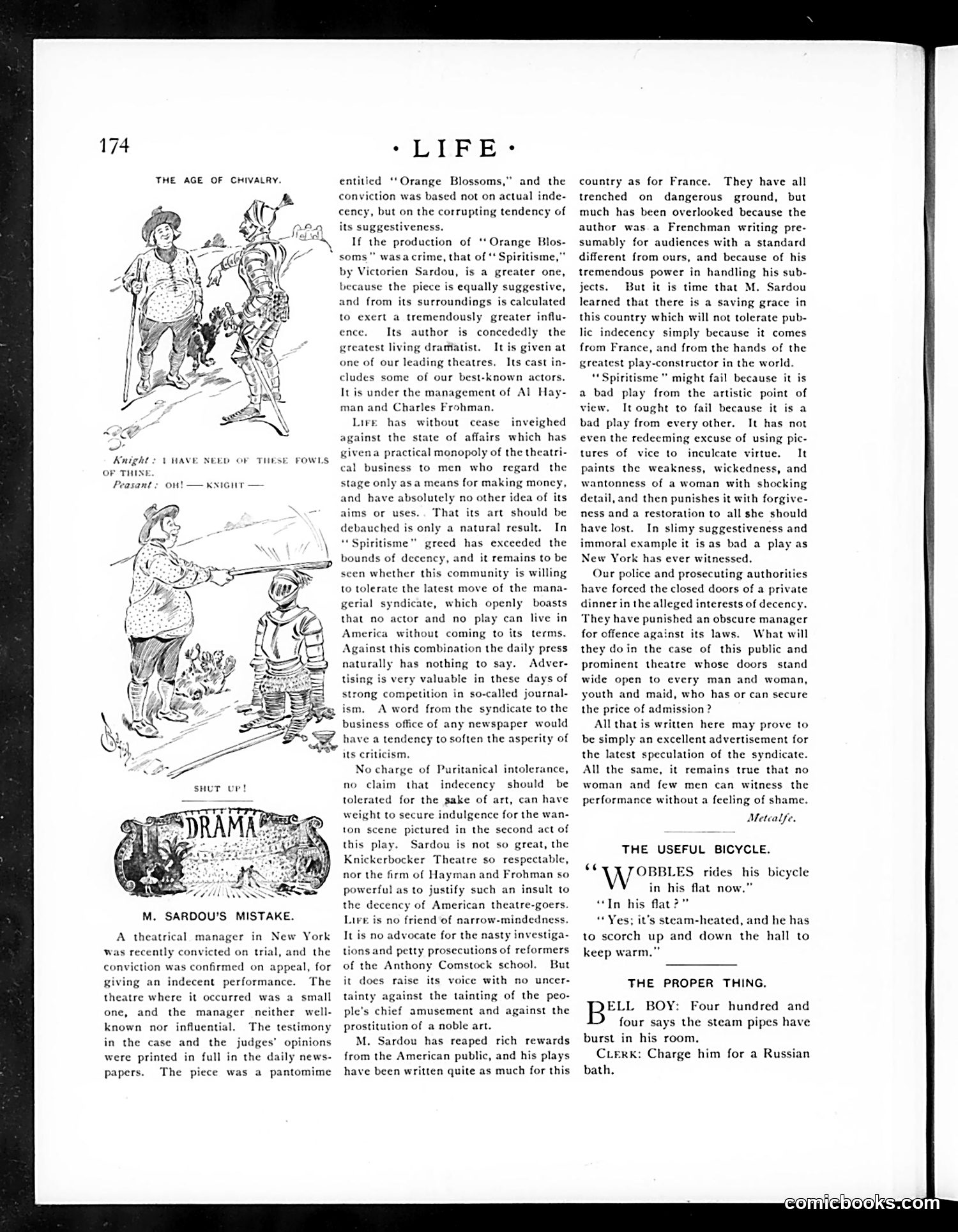
This page satirizes theatrical management and censorship in early American theater. The main article criticizes a theatrical manager convicted of indecent performance for staging a pantomime titled "Orange Blossoms." The cartoons depict a Knight and Peasant character, illustrating the article's central complaint: that theater syndicates monopolize stage production and suppress artistic freedom while claiming moral authority. The text argues this represents hypocrisy—the same authorities who restrict "indecent" plays freely advertise spectacles for profit. The article defends French dramatist Sardou's work against prudish American censorship, contrasting European theatrical sophistication with American narrow-mindedness. The satire targets both self-righteous moral policing and commercial interests disguised as virtue.
📄 Transcribed text from this page (OCR, searchable)
Machine-transcribed from the original scan — historical spelling and the odd misread are preserved.
THE AGE OF CHIVALRY. Knight : WAVE NEED OF oF THINE Peasant: THESE FOWLS ou! — Kxiguy — * LIFE: entitied ‘Orange Blossoms,” and the conviction was based not on actual inde- cency, but on the corrupting tendency of its suggestiveness. If the production of ‘Orange Blos- soms" wasacrime, that of ‘* Spiritisme,” by Victorien Sardou, is a greater one, because the piece is equally suggestive, and from its surroundings is calculated to exert a tremendously greater influ- ence. Its author is concededly the greatest living dramatist. It is given at one of our leading theatres. Its cast in- cludes some of our best-known actors. It is under the management of Al Hay- man and Charles Frohman. Lire without cease inveighed against the state of affairs which has givena practical monopoly of the theatri- cal business to men who regard the stage only asa means for making moncy, and have absolutely no other idea of its That its art should be debauched is only a natural result, In “ Spiritisme” greed has exceeded the bounds of decency, and it remains to be has aims or uses. scen whether this community is willing to tolerate the latest move of the mana- gerial syndicate, which openly boasts that no actor and no play can live in America without coming to its terms. Against this combination the daily press naturally has nothing to tising is very valuable in th days of strong competition in so-called journal- A word from the syndicate to the business office of any newspaper would Adver- e Z, have a tendency to soften the asperity of Ars M. SARDOU’S MISTAKE. A theatrical manager in New York was recently convicted on trial, and the conviction was confirmed on appeal, for giving an indecent performance. The theatre where it occurred was a small and the manager neither known nor influential. The testimony one, well- in the case and the judges’ opinions were printed in full in the daily news- papers. The piece was a pantomime its criticism, No charge of Puritanical intolerance, that should be tolerated for the sake of art, can have weight to secure indulgence for the wan- no claim indecency ton scene pictured in the second act of this play. Sardou is not so great, the Knickerbocker Theatre so respectable, nor the firm of Hayman and Frohman so powerful as to justify such an insult to the decency of American theatre-goers. Lire is no friend of narrow-mindedness. It is no advocate for the nasty investiga- tions and petty prosecutions of reformers of the Anthony Comstock school. But it does raise its voice with no uncer- tainty inst the tainting of the peo- ple's chief amusement and against the prostitution of a noble art. M. Sardou has reaped rich rewards from the American public, and his plays have been written quite as much for this country as for France. They have all trenched on dangerous ground, but much has been overlooked because the author was a Frenchman writing pre- sumably for audiences with a standard different from ours, and because of his tremendous power in handling his sub- jects. But it is time that M. Sardou learned that there is a saving grace in this country which will not tolerate pub- lic indecency simply because it comes from France, and from the hands of the greatest play-constructor in the world. piritisme " might fail because it is a bad play from the artistic point of view. It ought to fail because it is a bad play from every other. It has not even the redeeming excuse of using pic- tures of vice to inculcate virtue. It paints the weakness, wickedness, and wantonness of a woman with shocking detail, and then punishes it with forgive- ness and a restoration to all she should have lost. In slimy suggestiveness and immoral example it isas bad a play as New York has ever witnessed. Our police and prosecuting authorities have forced the closed doors of a private dinner in the alleged interests of decency. They have punished an obscure manager for offence against its laws. What will they doin the case of this public and prominent theatre whose doors stand wide open to every man and woman, youth and maid, who has or can secure the price of admission ? All that is written here may prove to be simply an excellent advertisement for the latest speculation of the syndicate. All the same, it remains true that no woman and few men can witness the performance without a feeling of shame. Metcalf THE USEFUL BICYCLE. “V OBBLES rides his bicycle in his flat now.” “In his flat?” “Yes; it’s stcam-heated, and he has to scorch up and down the hall to keep warm.” THE PROPER THING. ELL BOY: Four hundred and four says the steam pipes have burst in his room, Cuerk: Charge him for a Russian bath,