
Life, 1897-03-04 · page 6 of 20
Life — March 4, 1897 — page 6: what you’re looking at
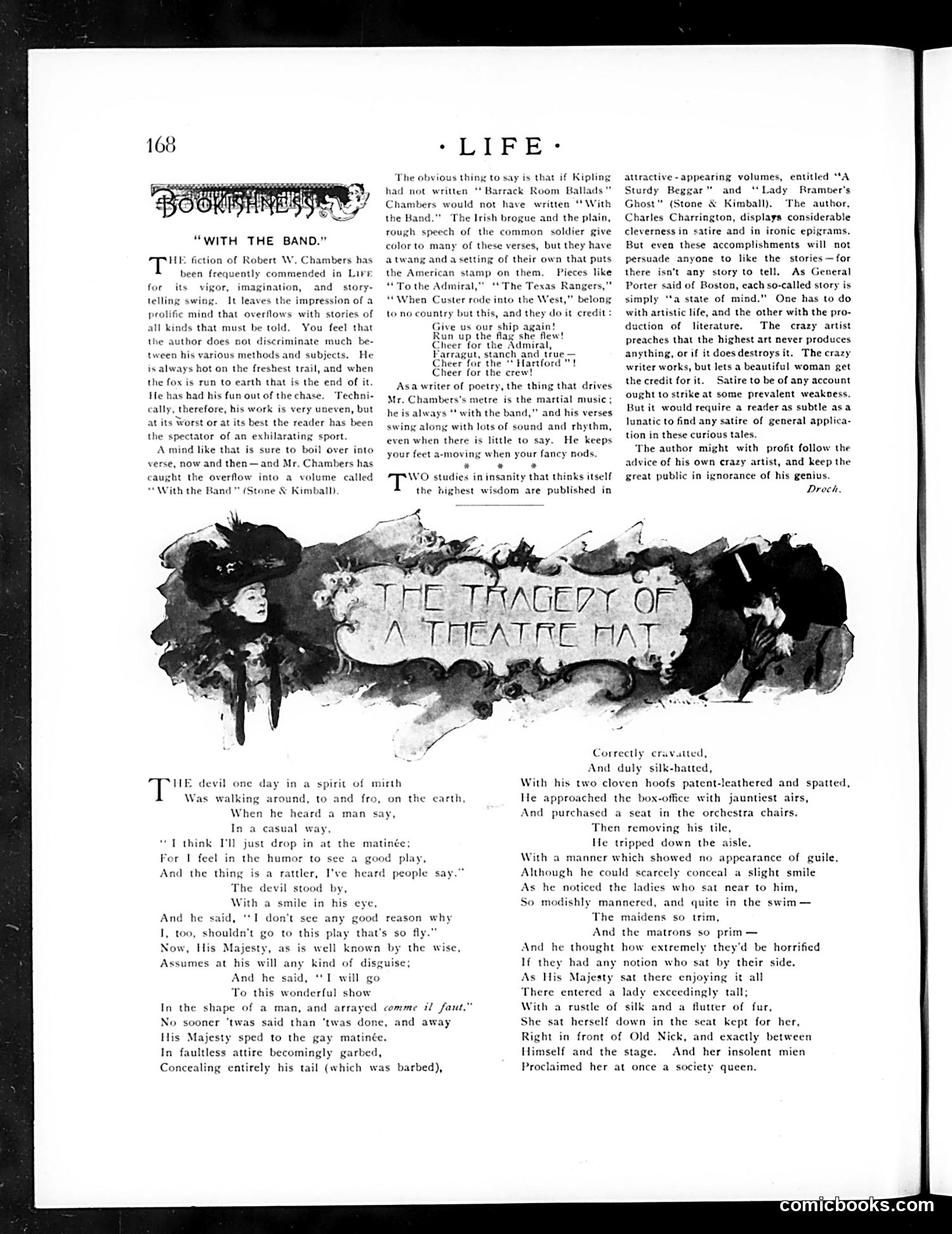
What you’re looking at
This page contains two satirical pieces. The top section reviews Robert W. Chambers's book "With the Band," praising his vigorous storytelling while gently mocking his overwrought style and tendency to overload volumes with narrative. The main illustration and poem, "The Tragedy of a Theatre Hat," satirizes a devil attending a matinee performance. The joke concerns the devil's elaborate, fashionable hat—so elaborate that other theater-goers cannot see the stage behind it. The satire targets the vanity and poor theater etiquette of well-dressed women whose oversized hats, a genuine social nuisance of the era, obstructed other patrons' views during performances. This was a common complaint in early 20th-century theaters.
📄 Transcribed text from this page (OCR, searchable)
Machine-transcribed from the original scan — historical spelling and the odd misread are preserved.
“WITH THE BAND.” HE fiction of Robert W. Chambers has been frequently commended in Lirr for its imagination, and It leaves the impression of a prolific mind that overflows with stories of all kinds that must be told. You feel that he author does not discriminate much be- tween his various methods and subjects. He is always hot on the freshest trail, and when the fox is run to earth that is the end of it He has had his fun out of the chase. ‘Techni- vigor, story: telling swing. cally, therefore, his work is very uneven, but at its Worst or at its best the reader has been the spectator of an exhilarating sport A mind like that is sure to boil over into verse, now and then —and Mr. Chambers has caught the overflow into a volume called “With the Band " (Stone & Kimball) HE devil one day in a spirit of Was walking around, to and fro, When he heard a man s. In a casual way “To think I'll just drop in at the matin mirth ‘LIFE: The obvious thing to say is that if Kipling had not written “ Barrack Room Ballads" Chambers would not have written “With the Band.” The Irish brogue and the plain, rough speech of the common soldier give color to many of these verses, but they have a twang and a setting of their own that puts Pieces like “The Texas Rangers,” into the West,” belong to no country but this, and they do it credi Give us our ship again! Run up the flag she flew! Cheer for the Admiral, Farragut, stanch and true Cheer for the © Hartfor Cheer for the crew! Asa writer of poetry, the thing that drives Mr. Chambers’s metre is the martial music ; with the band,” and his verses th lots of sound and rhythm, even when there is little to say. He keeps your feet a-moving when your fancy nods. «8 @ WO studies in insanity that thinks itself the highest wisdom are published in the American stamp on them. “To the Admiral,” “When Custer rod he is always swing along « attractive - appearing volumes, entitled ‘A Sturdy Beggar” and ‘Lady Rramber's Ghost” (Stone & Kimball). The author, Charles Charrington, displays considerable cleverness in satire and in ironic epigrams. But even these accomplishments will not persuade anyone to like the stories —for there isn't any story to tell, As General Porter said of Boston, each so-called story is simply ‘ta state of mind." One has to do with artistic life, and the other with the pro- duction of literature, The crazy artist preaches that the highest art never produces anything, or if it does destroys it. The crazy writer works, but lets a beautiful woman get the credit for it. Satire to be of any account ought to strike at some prevalent weakness. But it would require a reader as subtle asa lunatic to find any satire of general applica- tion in these curious tales. ‘The author might with profit follow the advice of his own crazy artist, and keep the great public in ignorance of his genius. Droch. Correctly cravatted, And duly silk With his two cloven hoofs patent-leathered and spatted, He approached the box-office with jauntiest airs, on the earth, hatted, And purchased a seat in the orchestra chairs. Then removing his tile, ; He tripped down the aisle, For I feel in the humor to see a ¢ And the thing is a rattler, I've heard people say The devil stood by, od play, With a smile in his eye, And he said, “1 don't see any good reason why I, too, shouldn't go to this play that’s so fly.” Now, His Majesty, as is well known by the wise, s at his will any kind of disguise; And “1 will go To this wonderful show In the shape of a man, and arrayed comme il fant,” No sooner ‘twas said than ‘twas done, and away His Majesty sped to the gay matince. In faultless attire becomingly garbed, Concealing entirely his tail (which was barbed), Assum he said, With a manner which showed no appearance of guile, Although he could scarcely conceal a slight smile As he noticed the ladies who sat near to him, So modishly mannered, and quite in the swim — The maidens so trim, And the matrons so prim — And he thought how they'd be horrified If they had any notion who sat by their side. As His Majesty sat there enjoying it all There entered a lady exccedingly tall; With a rustle of silk and a flutter of fur, She sat herself down in the seat kept for her, Right in front of Old Nick, and exactly between Himself and the stage. And her insolent mien Proclaimed her at once a society queen. xtreme Ccomicbooks.com