
A complete issue · 20 pages · 1897
Life — February 25, 1897
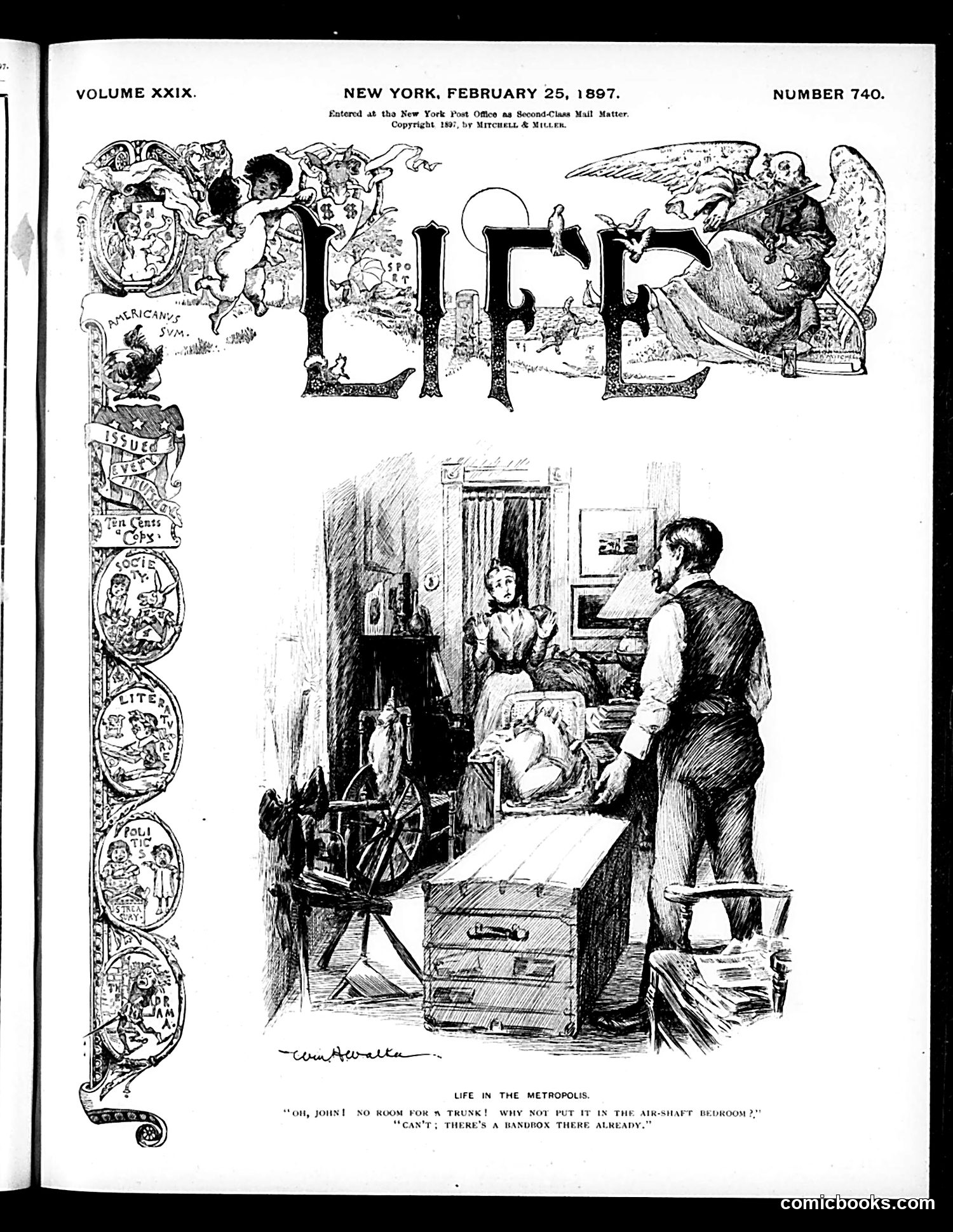
This cartoon depicts a domestic scene in a cramped urban apartment. A man stands with a trunk, while a woman sits nearby in what appears to be a small bedroom. The caption reads: "Oh, John! No room for a trunk! Why not put it in the air-shaft bedroom?" / "Can't; there's a bandbox there already." **The satire:** This mocks the absurdly tight living conditions of metropolitan apartment dwellers in 1890s New York. The joke relies on the ironic suggestion of storing a trunk in an "air-shaft bedroom"—a tiny, windowless space that served as a bedroom in tenement housing. The couple's resigned acceptance of such cramped quarters satirizes the housing crisis affecting urban middle-class renters of the era.
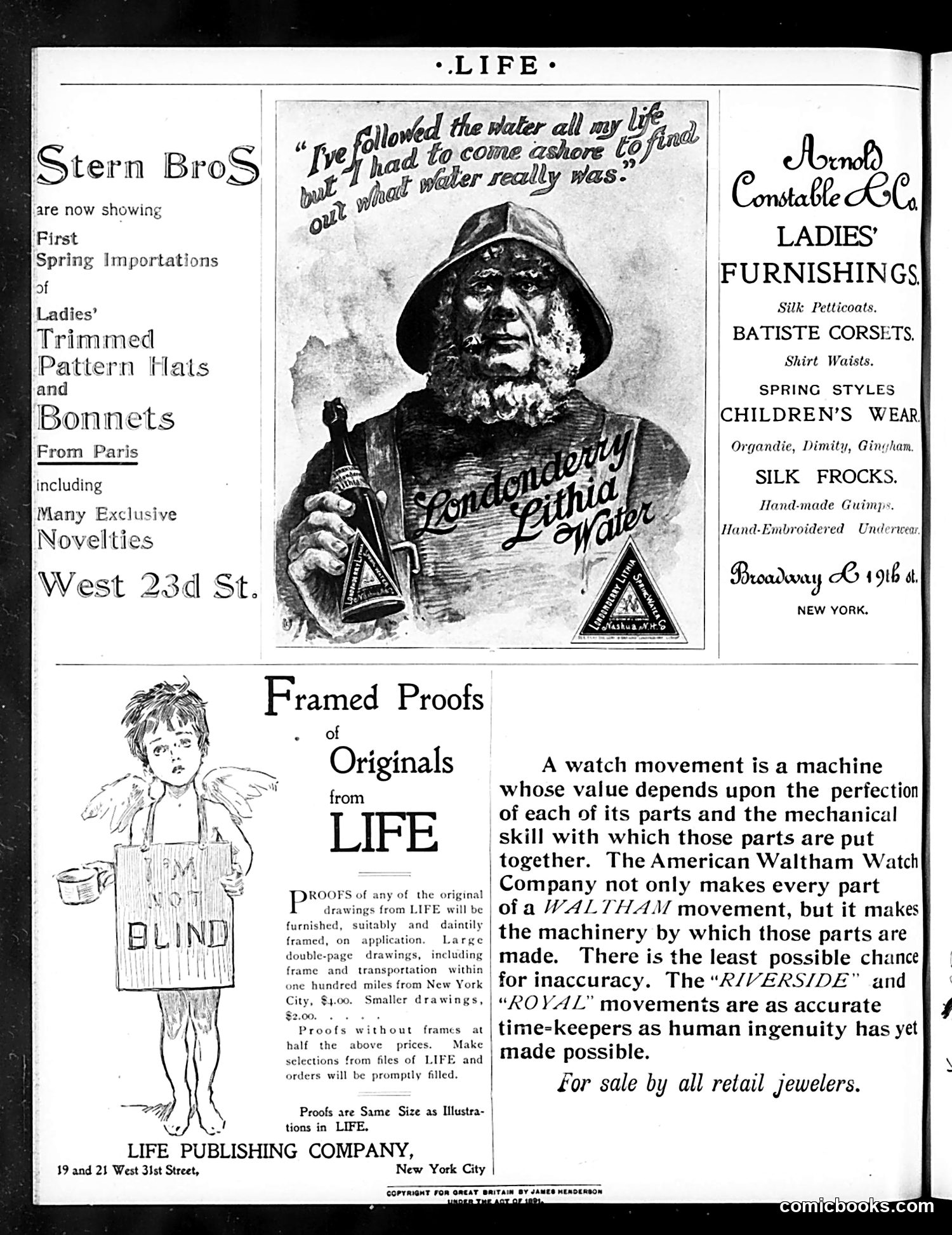
This page is primarily **advertising**, not satire. The main central image advertises "Londonderry Lithia Water" with a bearded sailor or seafaring figure holding a bottle. The caption—"I've followed the water all my life but I had to come ashore to find out what water really was"—is a testimonial claiming the product's superiority. Surrounding advertisements promote ladies' fashions (Stern Bros hats and bonnets from Paris), ladies' furnishings by Arnold Constable & Co, framed proofs of original LIFE drawings, and Waltham Watch Company movements. The small cartoon of a winged child labeled "BLIND" appears unrelated to the water advertisement—its purpose unclear without additional context.
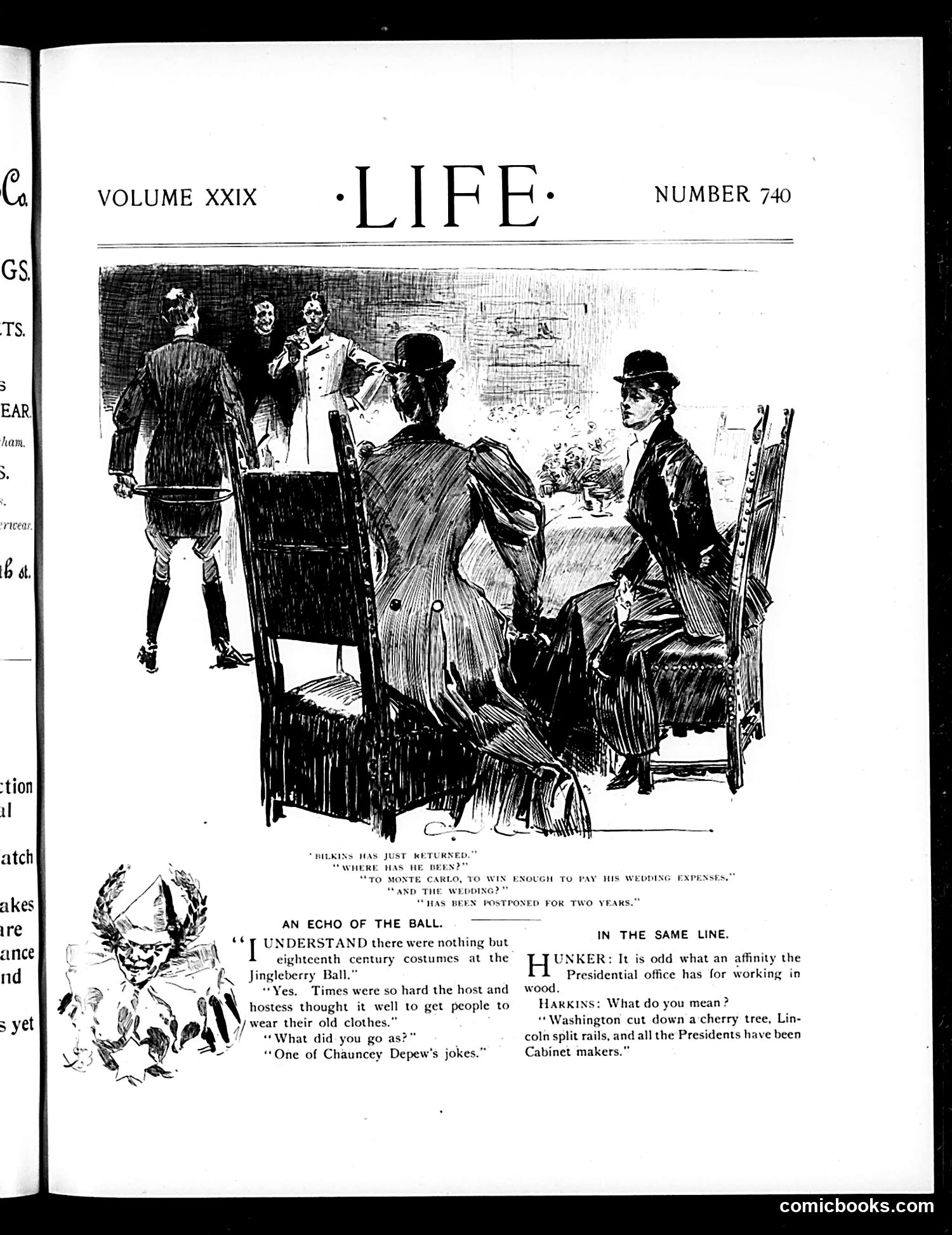
**Main Cartoon:** The illustration depicts a social scene where "Bilkins has just returned" from Monte Carlo, where he apparently won enough money to pay his wedding expenses. The wedding has been postponed two years. **Two Joke Sections:** **"An Echo of the Ball":** References an "Ingoldsby ball" where guests wore eighteenth-century costumes. The humor mocks the artificiality—hosts needed old clothes as an excuse to get people to attend social events (suggesting the party itself wasn't appealing enough). **"In the Same Line":** A dialogue joke where Hunker and Harkins discuss Presidential cabinet members as "Cabinet makers," playing on Washington's cherry-tree legend and the metaphor of presidents "making" their cabinets through appointments. The page satirizes wealthy society's pretensions and puns on contemporary political appointments.
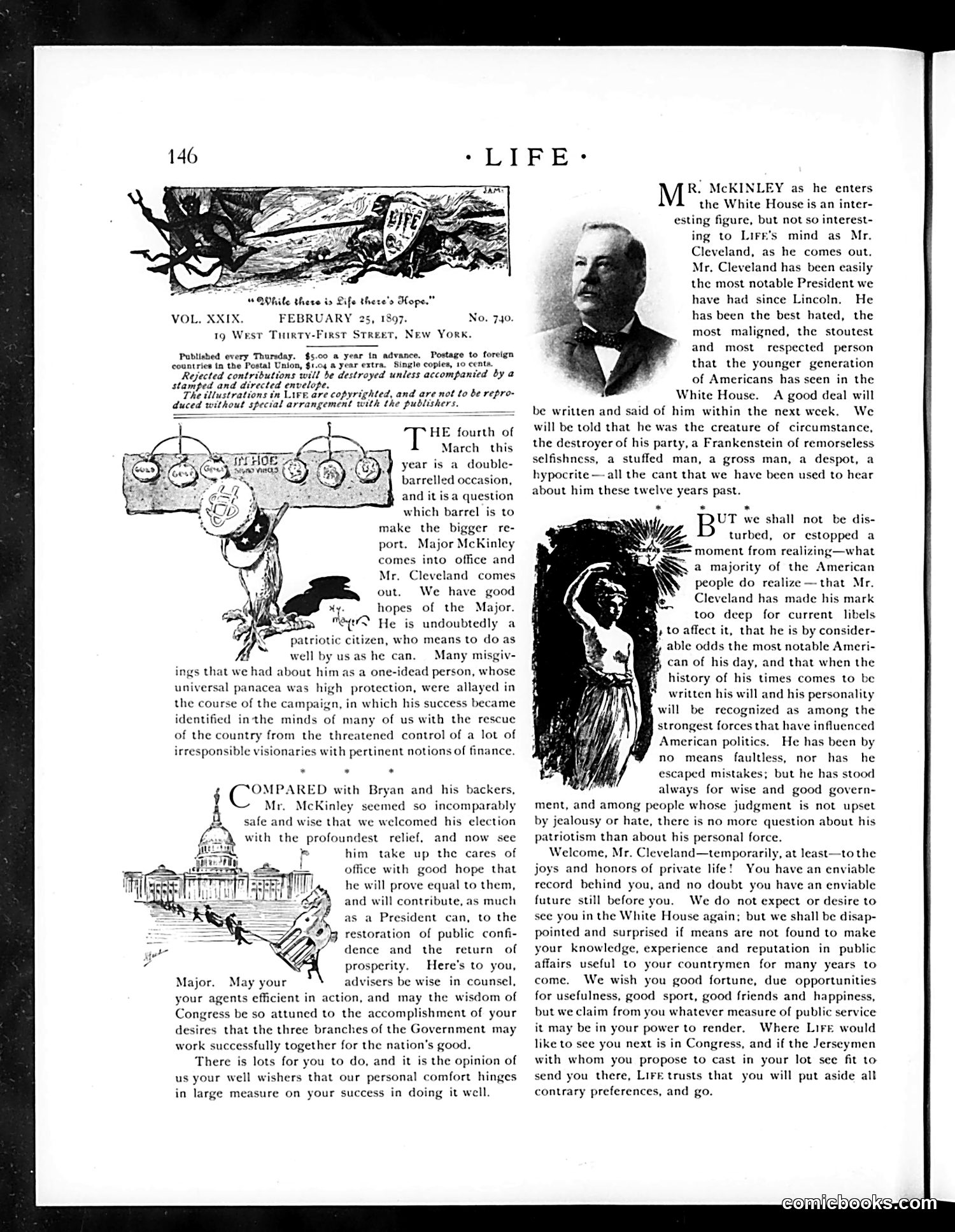
This page welcomes William McKinley into the White House following his recent presidential election victory over William Jennings Bryan. The text offers cautious congratulations, acknowledging McKinley as "comparatively safe and wise" compared to Bryan, whom Life opposed. The cartoons satirize the transition of power. The top illustration shows barrels labeled with McKinley and Cleveland, questioning "which barrel is to make the bigger report"—comparing their relative political influence. The Capitol building cartoon below depicts McKinley taking office. The editorial tone is notably reserved, suggesting Life supported McKinley's election primarily as the *lesser* of two evils rather than enthusiastically. The page reflects the magazine's satirical approach to contemporary politics through visual metaphor and cautious commentary.
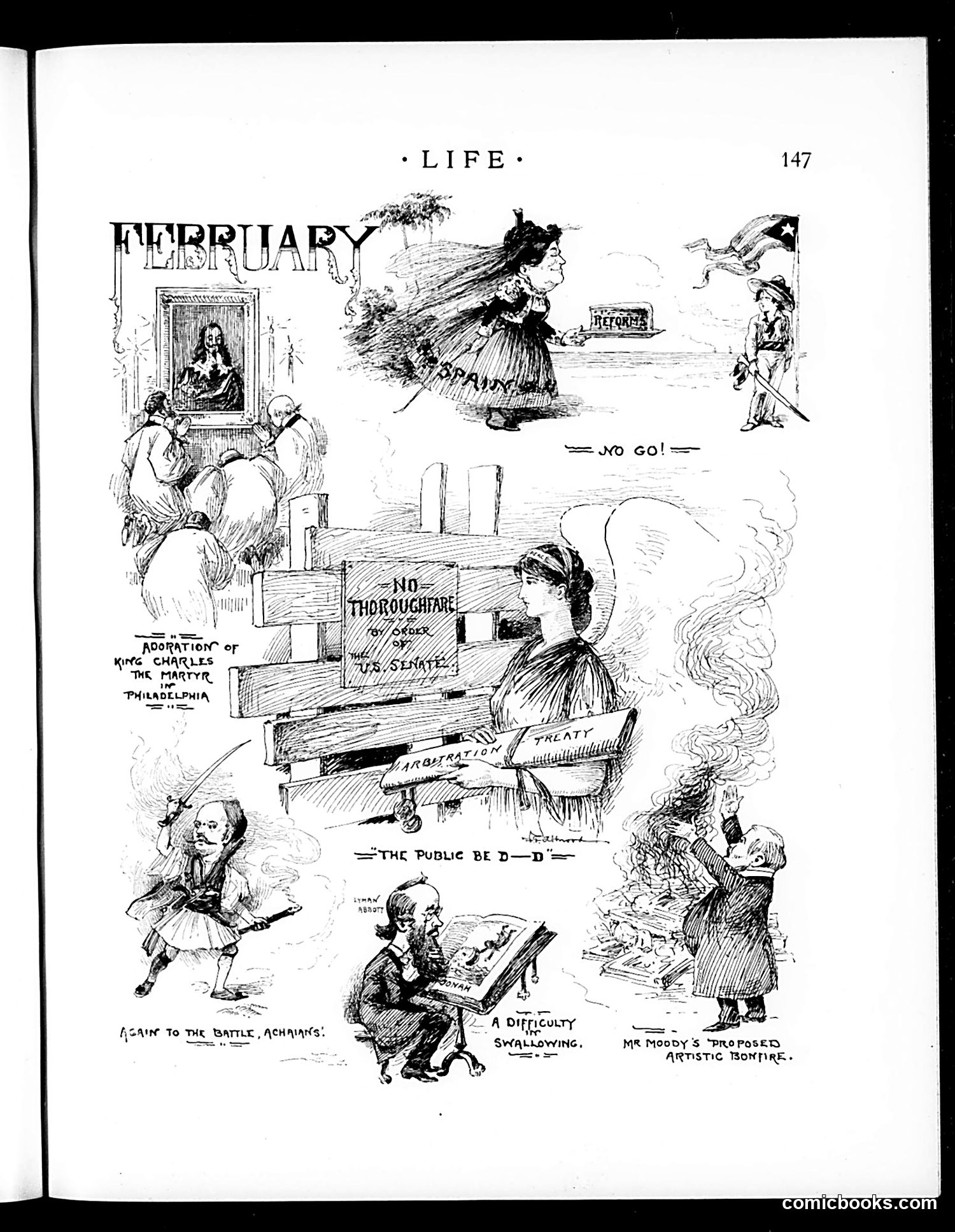
This satirical page mocks early-20th-century British politics and social issues. The central image shows a woman confronting barriers labeled "No Thoroughfare" and "Arbitrary Treaty," likely referencing women's suffrage struggles. The caption "The Public Be D—d" suggests frustration with government indifference to public welfare. Surrounding vignettes satirize various targets: one depicts "Adoration of King Charles the Martyr Philadelphia" (mocking historical reverence), another shows "A Difficulty Swallowing" (unclear reference), and "Mr. Moody's Proposed Artistic Torture" (likely political commentary on a contemporary figure). The sketches employ caricature and wordplay typical of Life's satirical style, addressing barriers to reform—whether legal, political, or social—with characteristic irreverent humor.
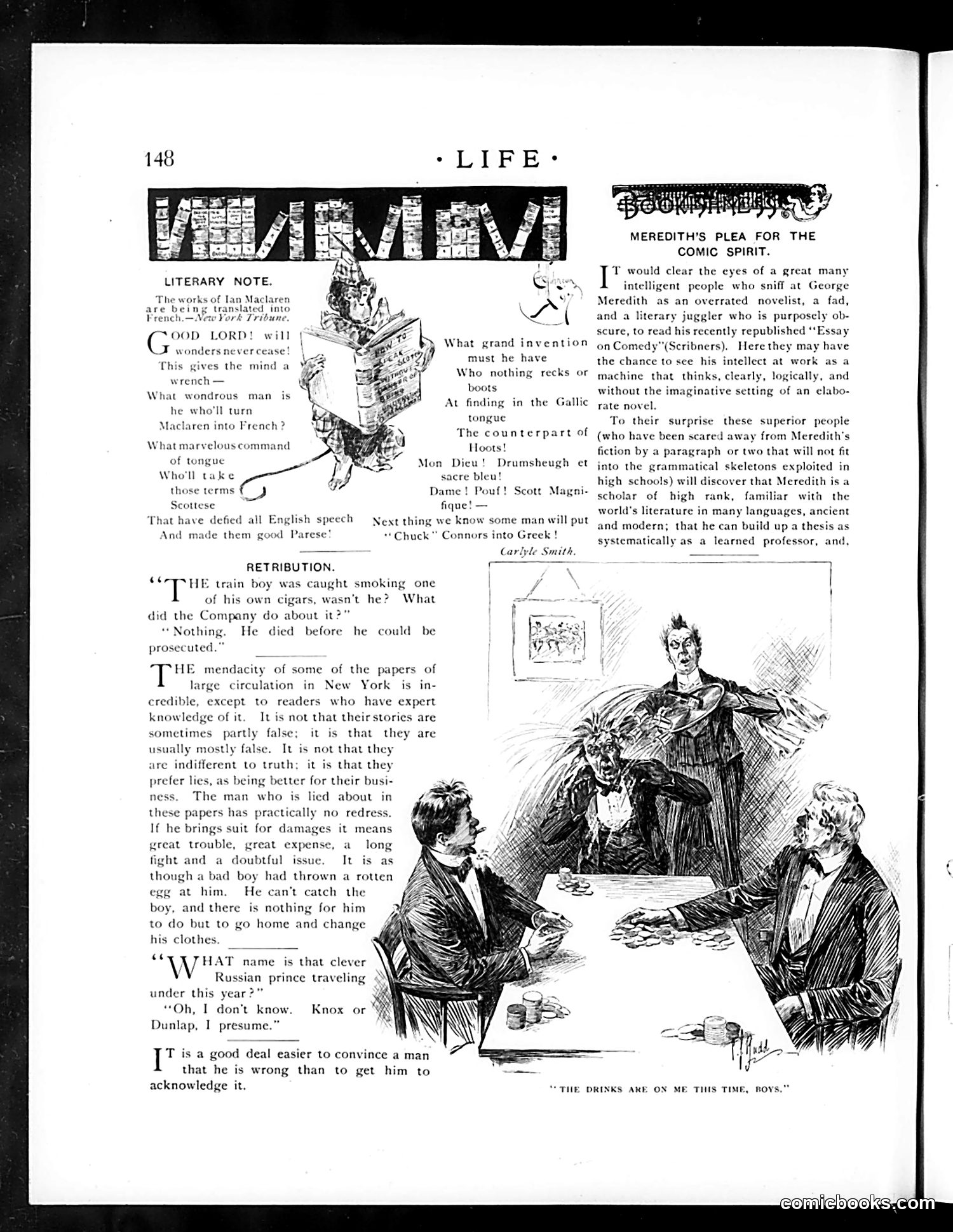
This page contains several satirical pieces about George Meredith, a prominent Victorian novelist and literary figure. The "Literary Note" mocks the translation of Meredith's works into French, using exaggerated praise of his linguistic complexity as a joke—suggesting his writing is so convoluted it requires special effort to translate. "Retribution" and the other brief items are disconnected quips about mendacious newspapers, Russian princes, and human nature—typical of Life's miscellaneous humor format. The main illustration shows three men in what appears to be a casual social setting, with the caption "The drinks are on me this time, boys"—likely a joke about social obligation or unexpected generosity, though the specific context is unclear without additional information.
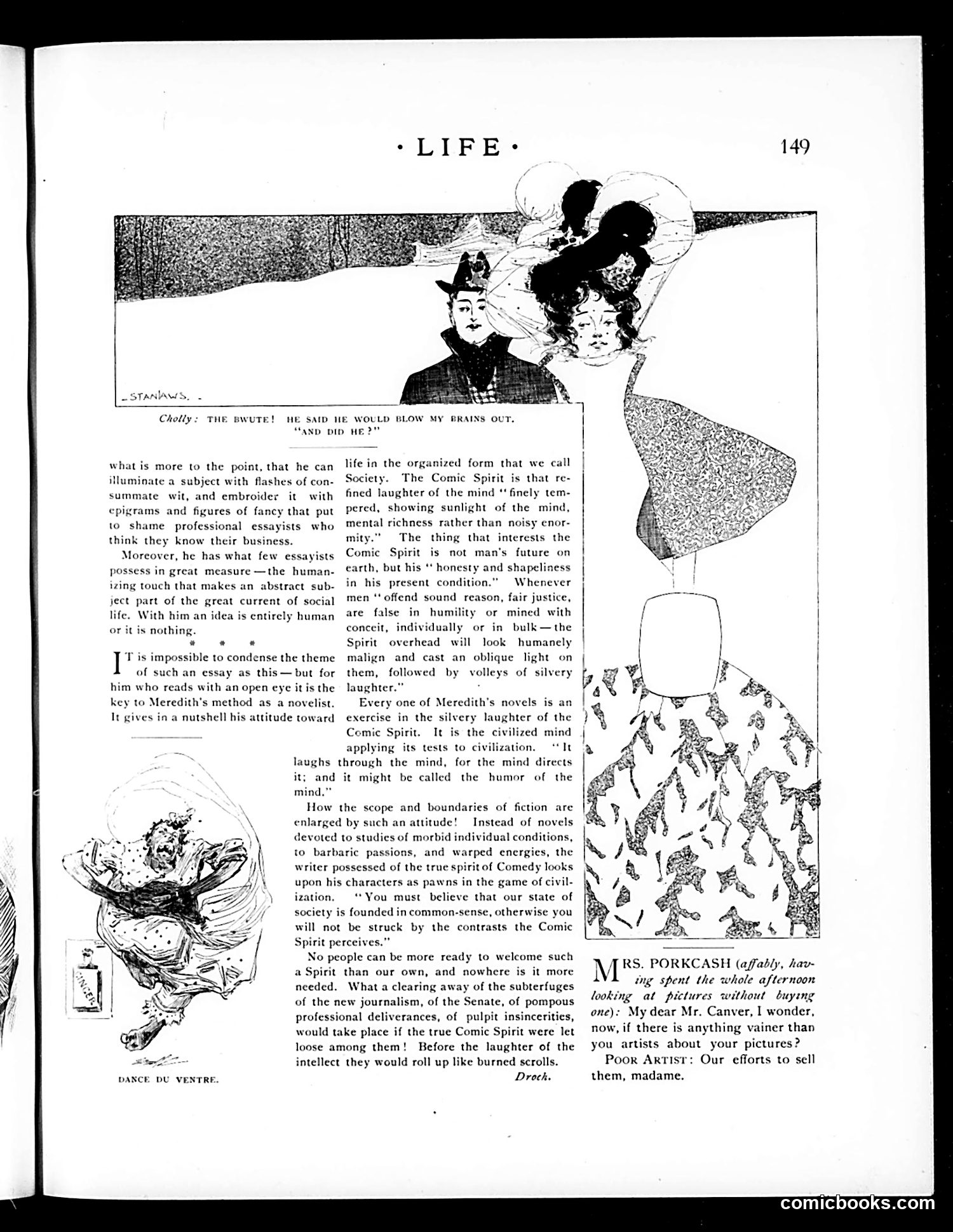
This page contains two satirical cartoons and literary discussion about George Meredith's comic writing style. **Top cartoon** ("The Brute"): Shows a man threatened by a woman with an umbrella, with the caption "He said he would blow my brains out. Vain did he!" The joke mocks domestic quarrels and male bravado—the woman's threat proves empty, inverting expected gender dynamics. **Bottom cartoon** ("Dance du Ventre"): A grotesque sketch of a rotund figure, likely satirizing fashionable dance crazes or social pretension popular among wealthy society. The accompanying text discusses Meredith's use of "Comic Spirit"—refined intellectual humor targeting social hypocrisy and affectation rather than crude buffoonery. The page exemplifies Life magazine's mission: witty social commentary aimed at educated readers.
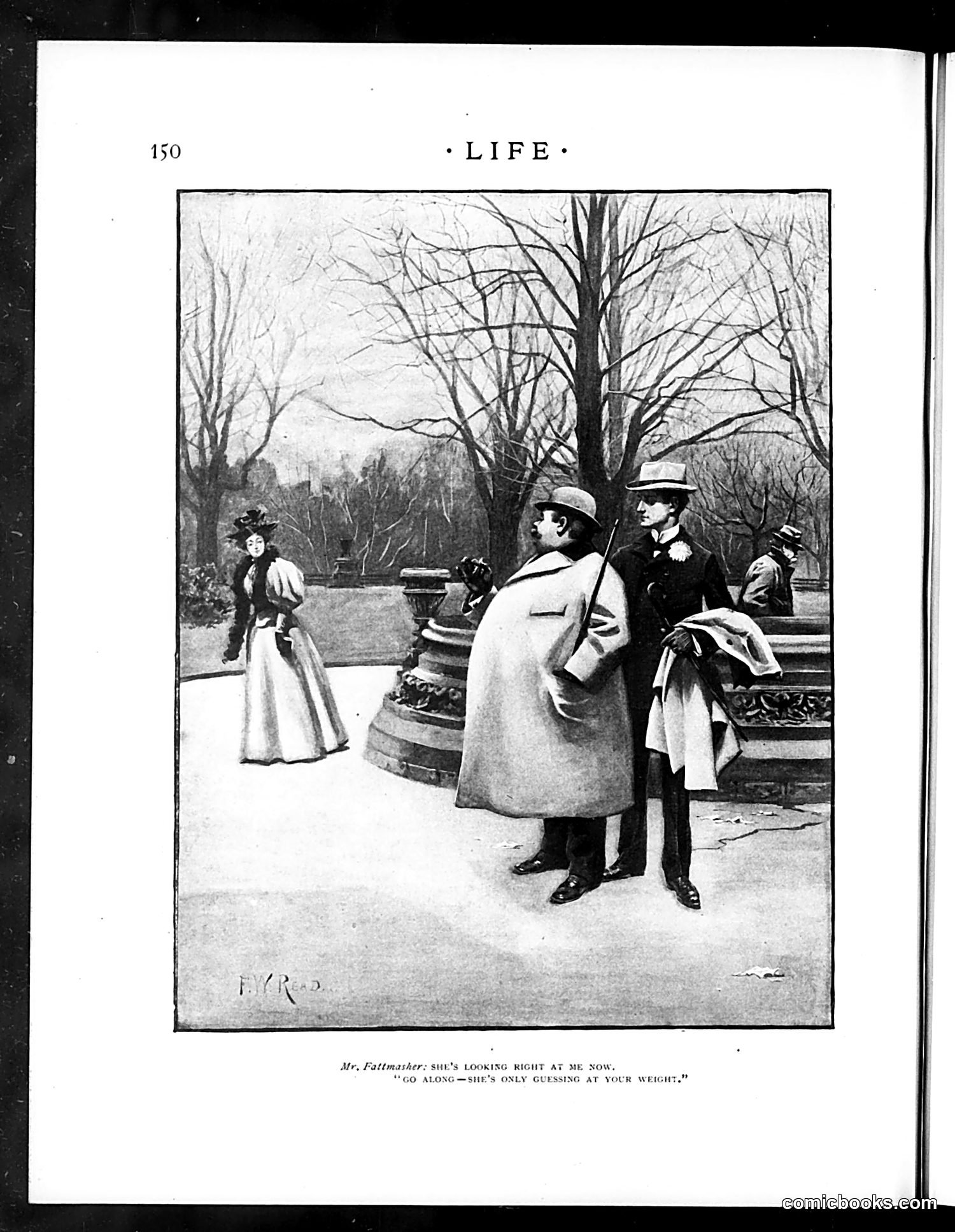
This is a single cartoon from *Life* magazine (page 150) depicting a social scene in what appears to be a public park. The caption reads: "Mr. Fattmacher: She's looking right at me now. 'Go along—she's only guessing at your weight.'" The satire targets a common social awkwardness: a heavyset man (Mr. Fattmacher) is self-conscious about his weight, imagining that a woman observing him is judging his appearance. His companion attempts to reassure him by suggesting she's merely guessing, implying his weight is so obviously excessive that precision is unnecessary—a cruel joke at his expense. The humor derives from the man's vanity and insecurity, the companion's backhanded "reassurance," and the period's casual mockery of physical appearance.
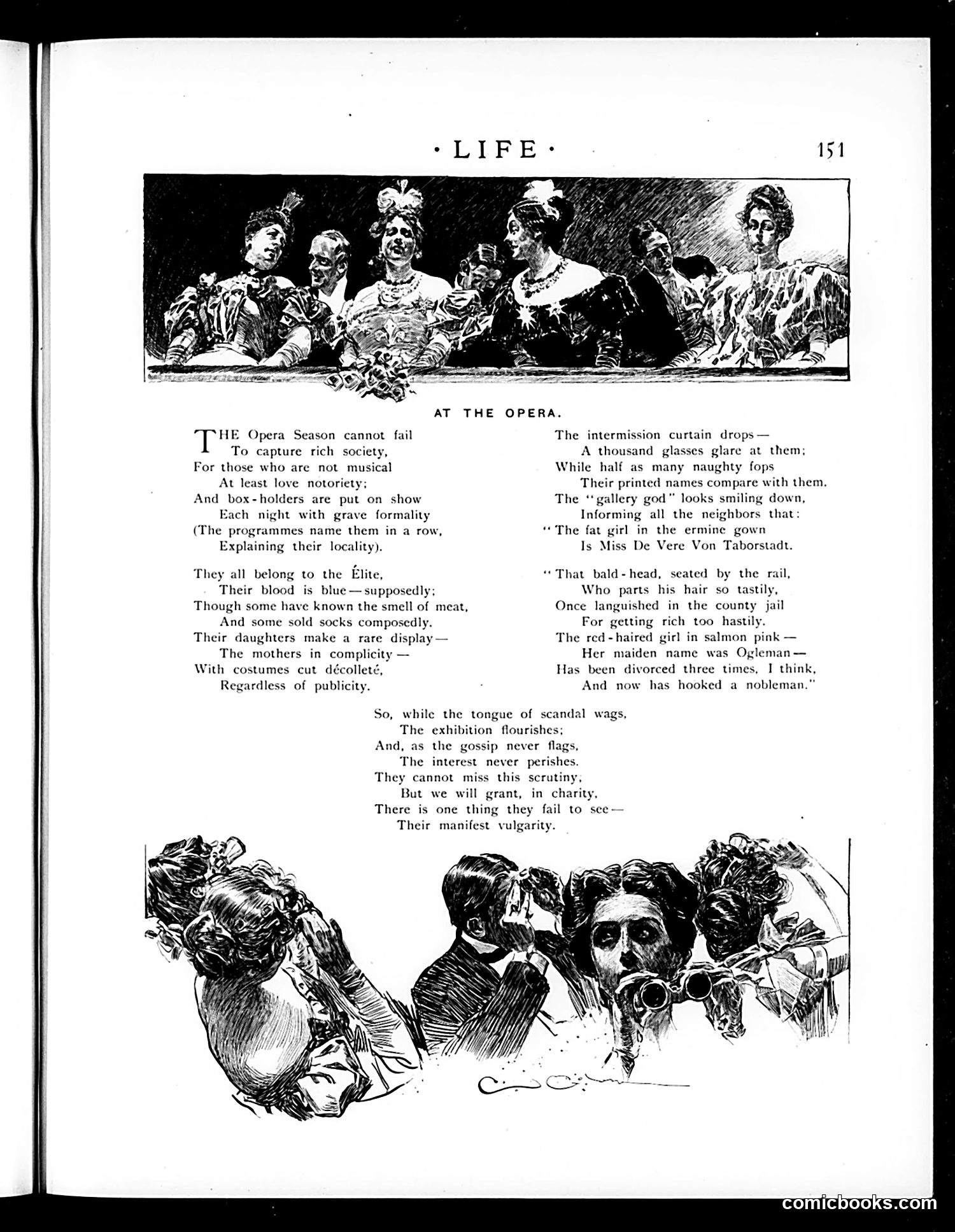
This satirical poem mocks high society's opera attendance as performative rather than genuine appreciation. The upper illustration shows fashionably dressed attendees—the social elite who frequent opera to be seen rather than to enjoy music. The text attacks their pretentiousness: they're "not musical," attend for "notoriety," and use the event as social display. The poem catalogs specific scandal and gossip about attendees (references to divorces, affairs, and social climbing), suggesting opera season functions primarily as a venue for society gossip and status-seeking. The lower sketch depicts audience members—some appearing crude or bored—emphasizing the gap between opera's refined reputation and the actual caliber of attendees. The satire's point: wealthy opera patrons lack genuine cultural sophistication and use attendance purely for social advancement.
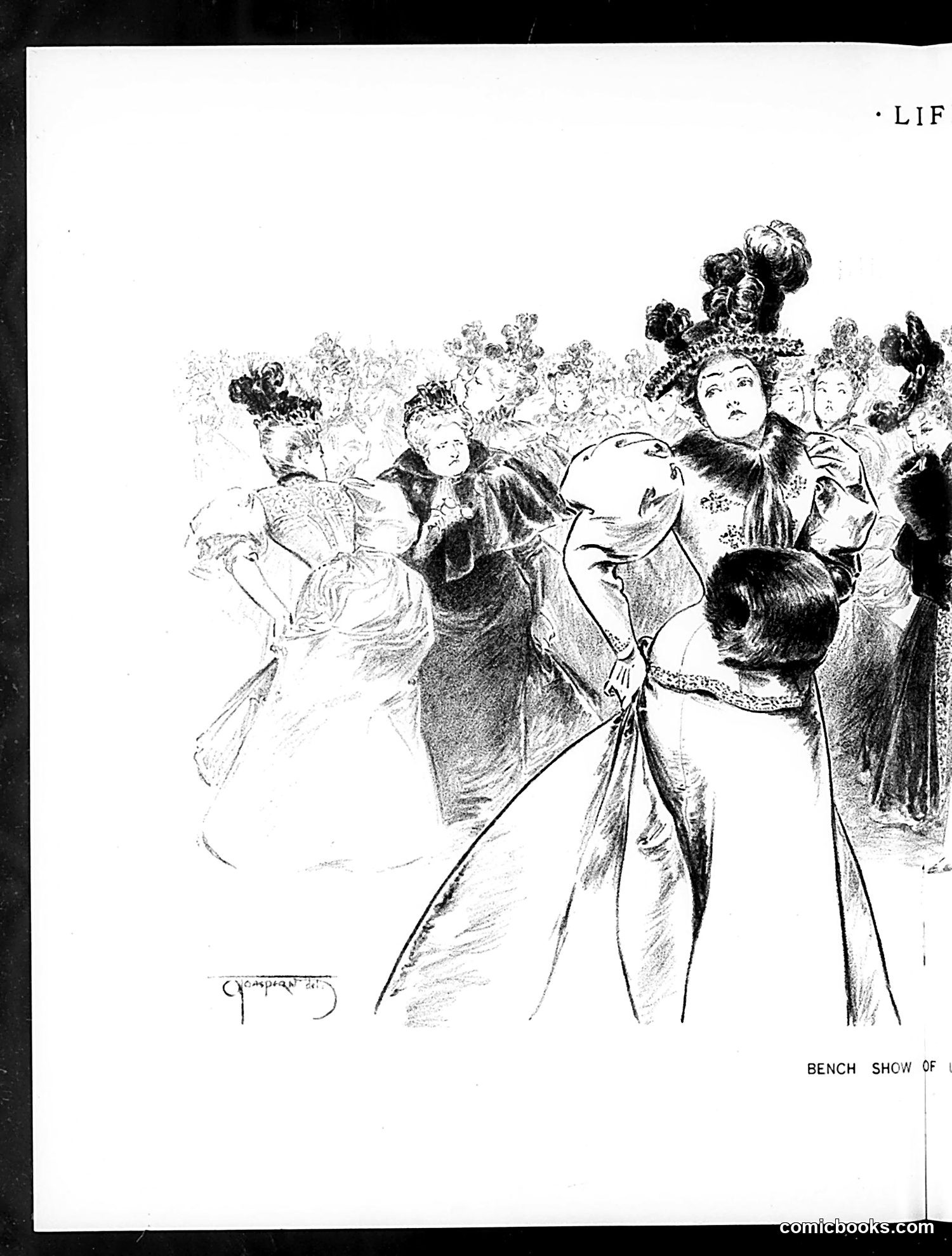
This appears to be a satirical sketch depicting fashionable women at what the caption suggests is a "Bench Show"—likely a dog show. The humor relies on comparing the elegantly dressed society women to show dogs being evaluated and displayed. The women sport elaborate Edwardian-era fashions: elaborate hairstyles with feathers and plumes, corseted silhouettes, and ornate clothing. They're positioned as if on display, mirroring how pedigree dogs would be presented at a bench show. The satire critiques the vanity and superficiality of high society—suggesting these fashionable women are as concerned with their appearance and social ranking as prize dogs are with winning competitions. It's a commentary on aristocratic pretension and the commodification of female beauty in early 20th-century American society.
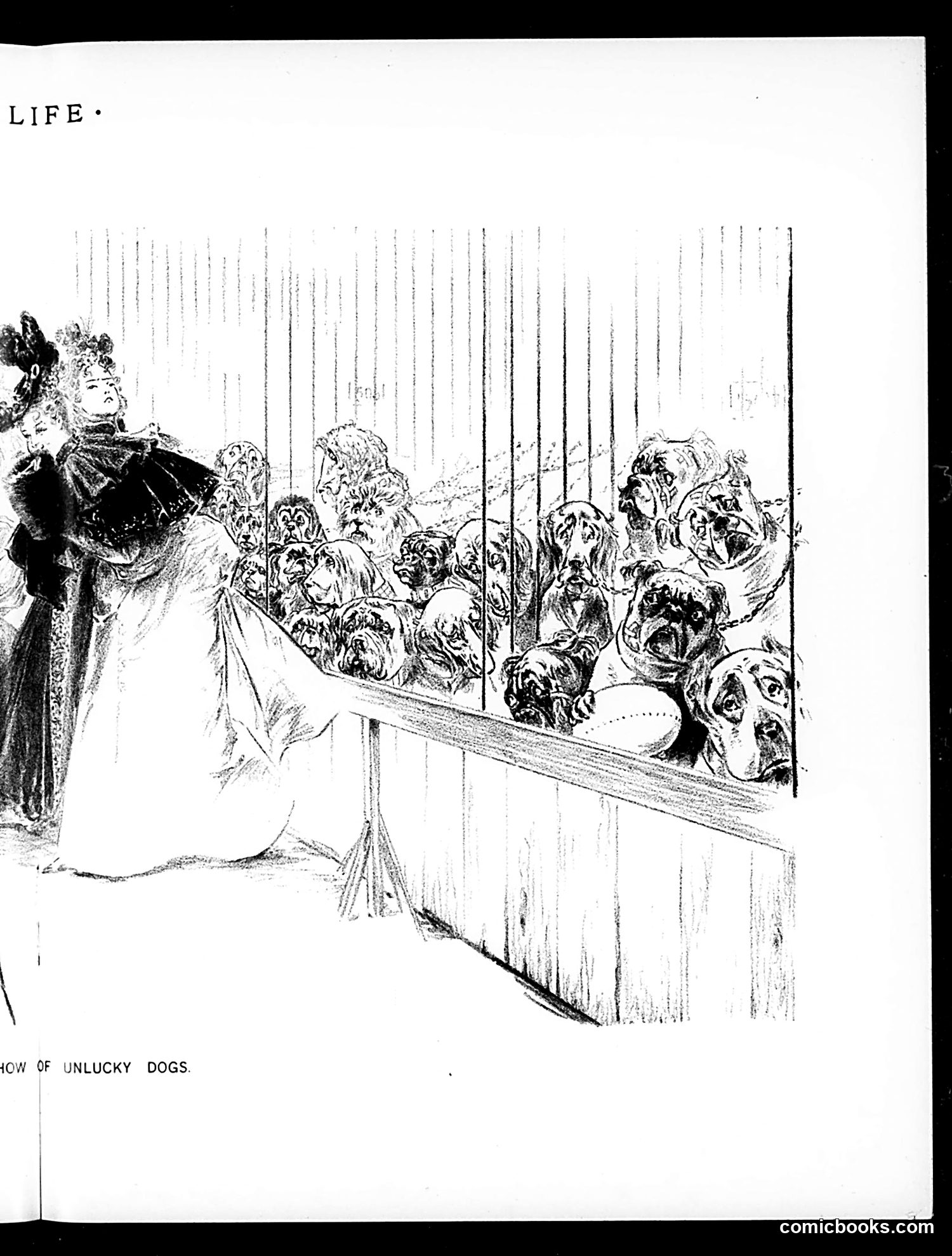
This satirical illustration depicts a woman in elaborate Edwardian dress presenting a large group of dogs to an audience, presumably at a dog show. The caption "A Show of Unlucky Dogs" suggests social satire rather than literal commentary on canines. The "unlucky dogs" likely refers metaphorically to men—a common satirical device in Life magazine. The elegantly dressed woman appears to be "showing off" or parading these male figures, inverting traditional gender power dynamics. This reflects early 20th-century anxieties about women's increasing social independence and authority, particularly regarding courtship and marriage prospects. The cartoon humorously depicts men as commodities being displayed and judged, mocking both masculine insecurity and evolving gender relations of the era.
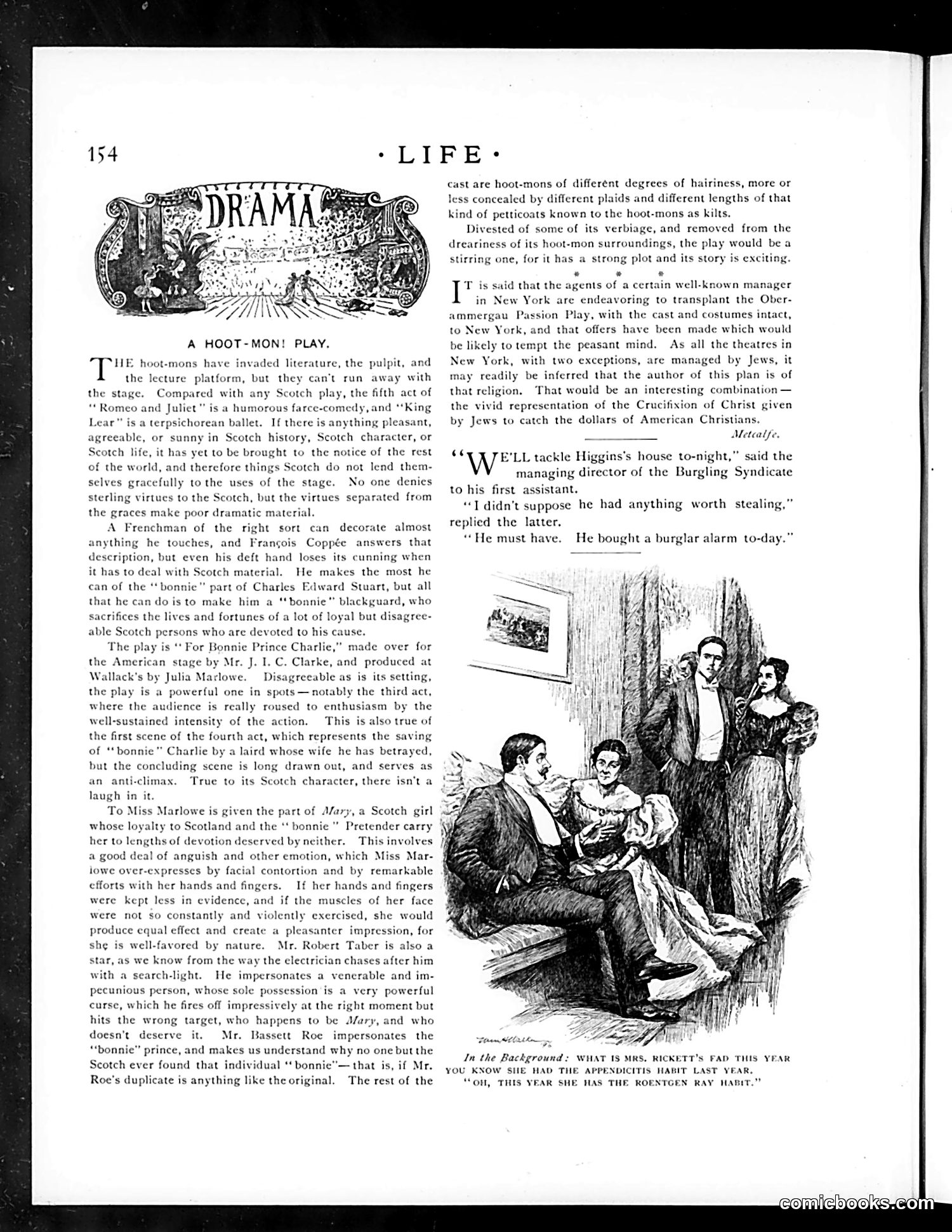
This page discusses theater productions, specifically hoot-mon plays featuring Scottish characters. The illustrated scene shows what appears to be a domestic drama about burglary—a managing director and assistant discuss breaking into "Higgins's house to-night," with one character mentioning the target recently bought a burglar alarm. The text critiques Scottish theatrical stereotypes, discussing plays like "For Bonnie Prince Charlie" and analyzing performances by actors including Miss Marlowe and Robert Taber. The satire targets how American theater exploits Scottish "bonnie" imagery and dialect humor for entertainment value. The illustration's caption references Mrs. Rickett's "roentgen ray habit"—a contemporary reference to newly-discovered X-ray technology, joking that she's grown accustomed to it.
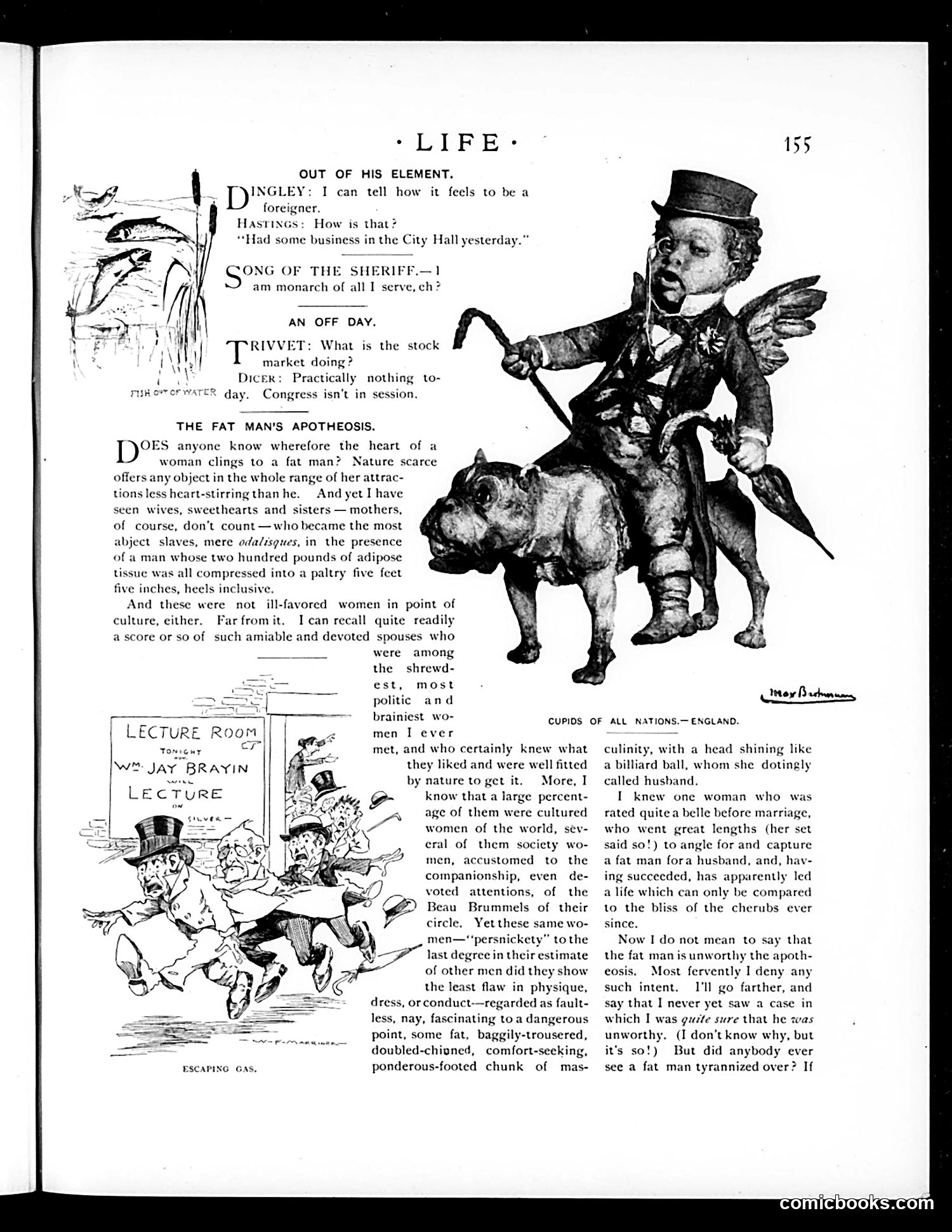
This page contains several brief satirical sketches mocking American social and political life: **"Out of His Element"** mocks a foreigner's confusion about American civic culture—specifically that City Hall business seems strange to outsiders. **"Song of the Sheriff"** is a self-aggrandizing quote from a local official claiming authority. **"An Off Day"** jokes that the stock market does nothing when Congress isn't in session—satirizing the market's dependence on political activity. **"The Fat Man's Apotheosis"** is the main piece: a lengthy satirical essay praising fat men's mysterious romantic power over intelligent women. The accompanying cartoon "Cupids of All Nations—England" shows a portly, well-dressed man with his dog, illustrating the essay's claim that women inexplicably prefer corpulent husbands. The satire targets both male vanity and female judgment. Minor sketches include a lecture announcement and "Escaping Gas," showing chaotic figures fleeing. The overall tone is genteel mockery of American pretension and social absurdity.
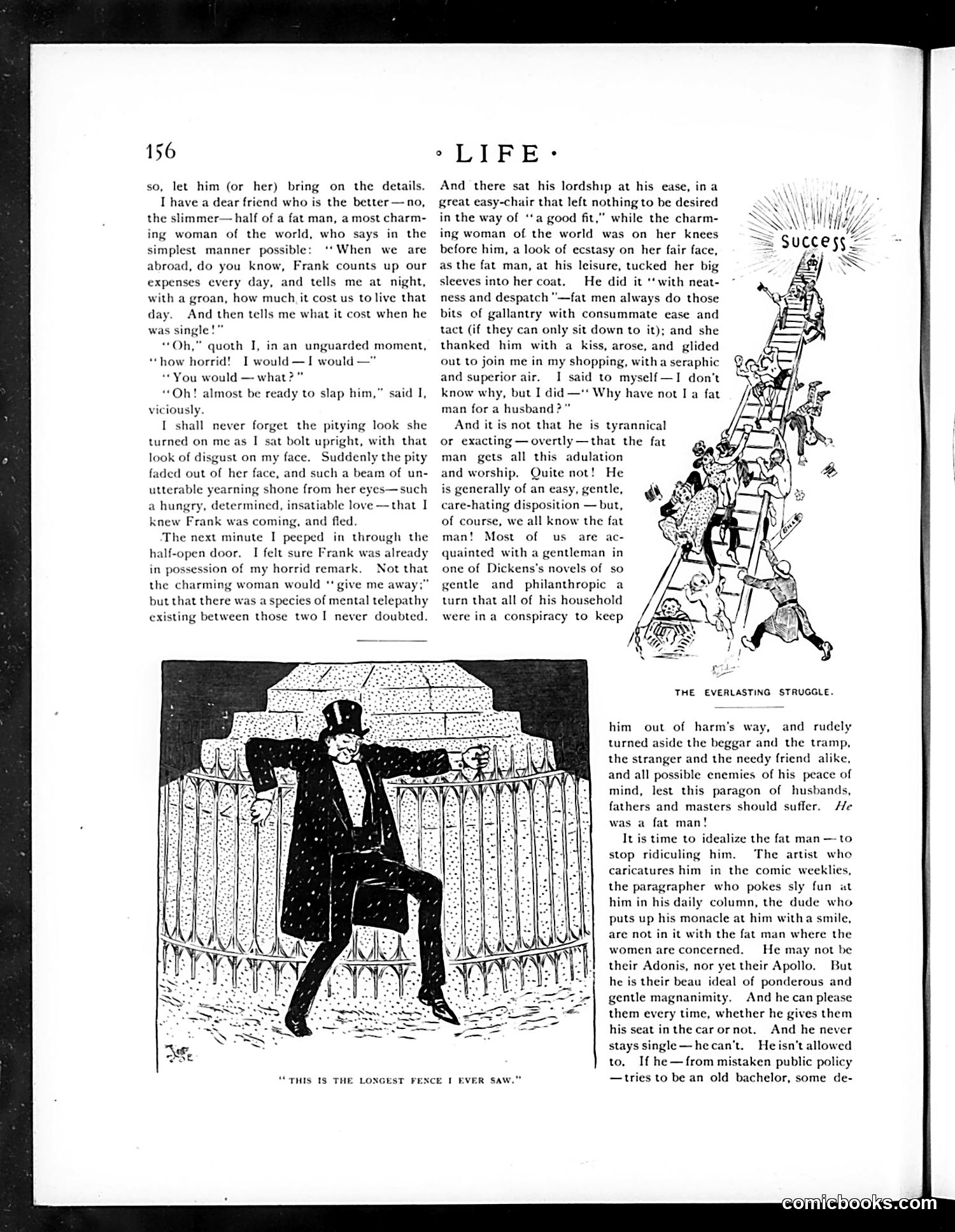
This page satirizes the cultural idealization of corpulent men in early 20th-century American society. The two illustrations mock contrasting attitudes: the left cartoon shows a man laboriously climbing an enormous fence ("This is the longest fence I ever saw"), suggesting the physical struggle of an overweight person. The right illustration, titled "The Everlasting Struggle," depicts a fat man ascending a ladder of success while women swoon and assist him. The accompanying essay argues that fat men receive disproportionate adulation and worship from women, who treat them as ideals of "ponderous and gentle magnanimity." The author critiques how fat men are romanticized as inherently gallant, generous, and masterful—protected by their households and always pampered. The satire suggests this cultural preference is irrational, yet observes that fat men never remain single because society (particularly women) demands they marry. The humor relies on the tension between the fat man's physical limitations and his social elevation—a commentary on how appearance-based class and gender dynamics operate independent of actual merit.
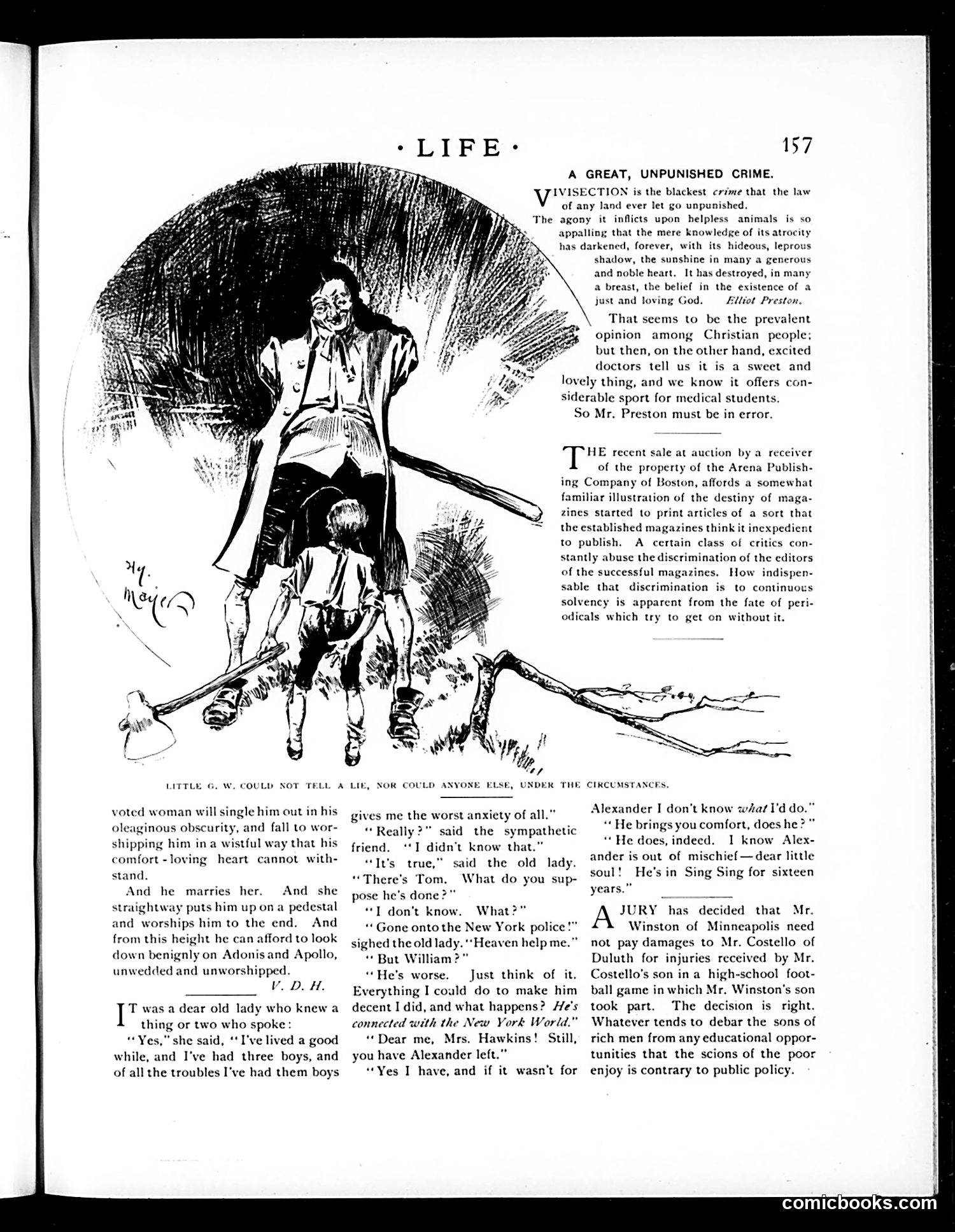
This page contains three distinct satirical pieces from *Life* magazine: **1. The Main Cartoon** depicts vivisection (animal experimentation). The illustration shows a skeletal figure wielding a sword over helpless animals. The satire mocks the moral outrage some express about animal testing while noting that doctors actually support it for medical education—pointing out the hypocrisy in the debate. **2. "A Great, Unpunished Crime"** discusses a Boston publishing company's auction. It satirizes how magazines that print "unconventional" articles fail commercially, while successful magazines discriminate in what they publish. The joke is that this discrimination, though criticized, is actually necessary for survival. **3. The Anecdote** features an old lady whose three sons represent different disgraces: one joined the police, one works for the *New York World* newspaper, and the third is imprisoned at Sing Sing prison for sixteen years. The humor comes from equating police work and journalism with serious criminality—a sharp jab at both institutions' reputations. **4. "A Jury Decision"** satirizes a lawsuit outcome protecting wealthy families' sons' access to dangerous sports, arguing such protection is "public policy."
This page satirizes theatrical figures of the era through verse sketches titled "Play-House Patchwork." Each character type—the Manager, Actor, Agent, Critic, Chorus Girls, and Dead-head—is lampooned for predictable professional behaviors. The Manager obsesses over finances and controlling actresses' mothers. The Actor's ego inflates with applause. The Agent generates manufactured publicity. The Critic pretends expertise while guessing plot details. The Chorus Girls perform for audience attention rather than art. The Dead-head (someone who attends performances without paying) talks constantly but contributes nothing. The accompanying anecdote about a society couple marrying for love without wealth satirizes romantic idealism versus practical class concerns. A South American lady's boast about having "seventeen" Revolutionary ancestors mocks both American pretension and questionable genealogical claims. This is light satirical commentary on theater culture and social pretension, typical of *Life* magazine's humorous social criticism.
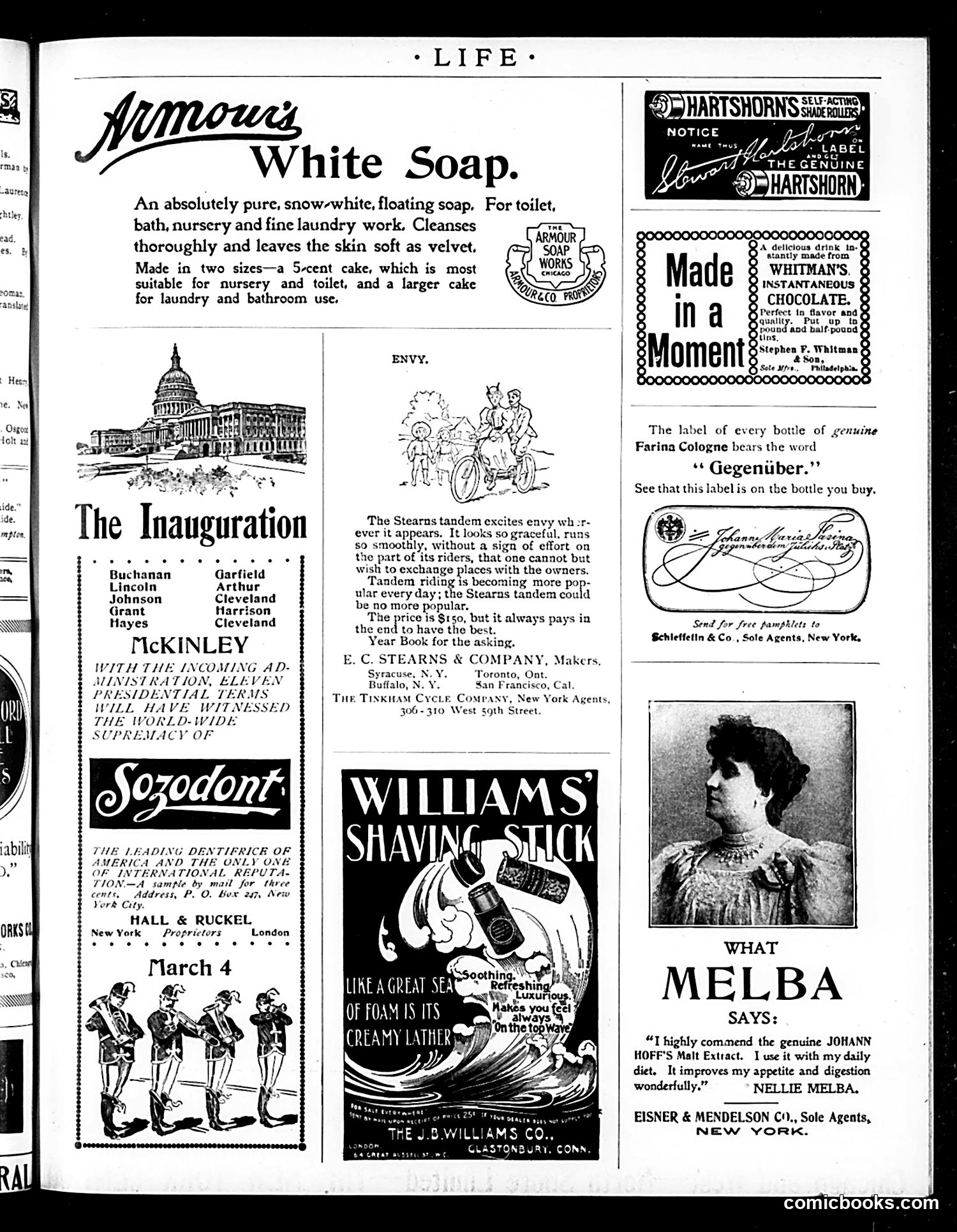
This is primarily a **product advertisement page**, not a satirical cartoon page. The main content consists of period advertisements for consumer goods (soap, bicycles, shaving cream, chocolate, cologne, malt extract). The only cartoon element is a small illustration accompanying the "Inauguration" soap ad, which lists U.S. presidents from Buchanan through McKinley. The cartoon appears to show figures in a celebratory or processional context, likely referencing McKinley's 1901 inauguration (suggested by "March 4" date reference). The "Envy" section includes a modest tandem bicycle advertisement with accompanying illustration showing riders—typical product marketing rather than satire. Celebrity endorsement appears in the Nellie Melba advertisement for malt extract, common advertising practice of the era. **This page reflects turn-of-the-century consumer culture and presidential commemoration rather than political satire.**
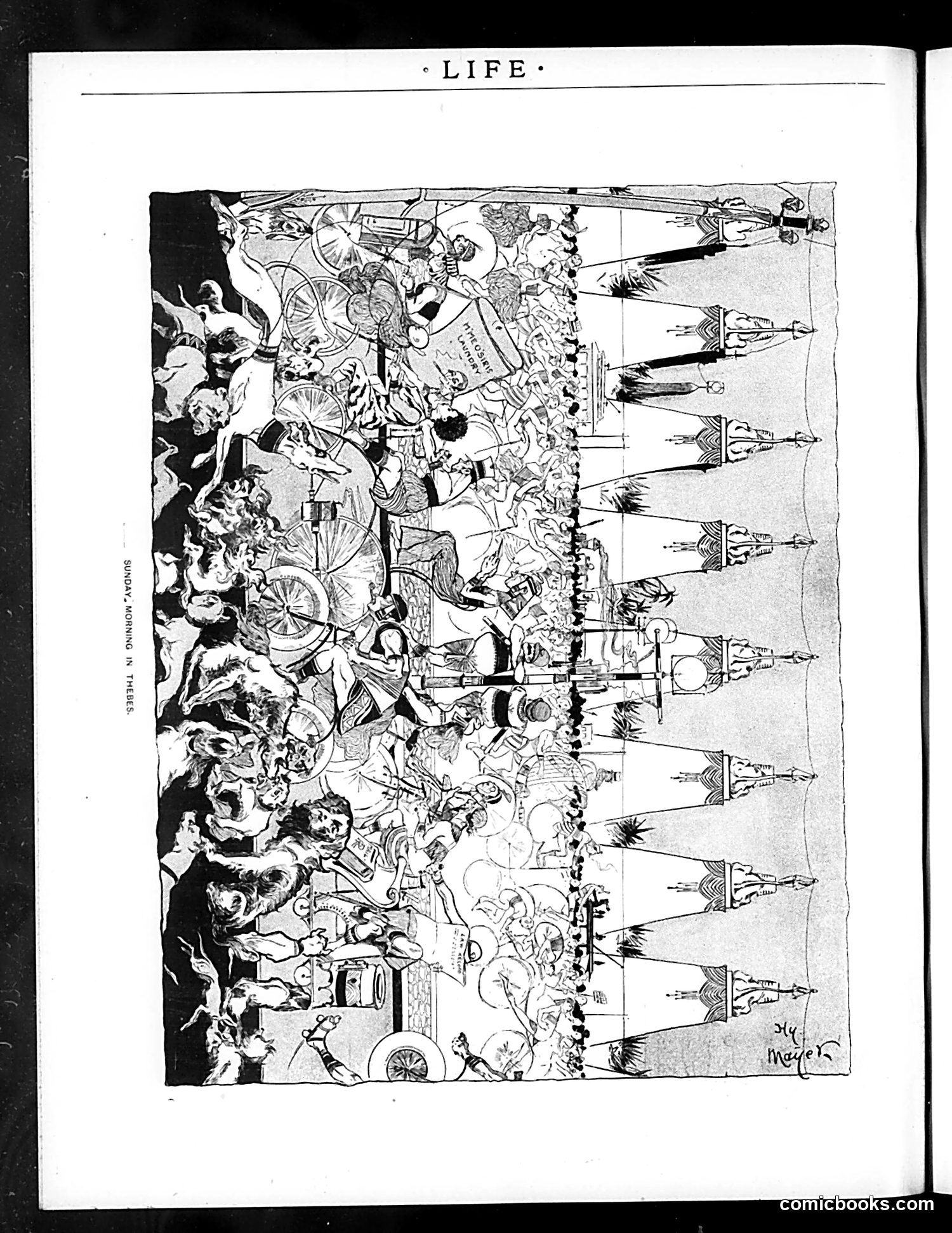
This appears to be a satirical illustration showing an elaborate classical Greek or Roman scene, rotated 90 degrees, depicting what seems to be a busy public gathering or marketplace. The title references Thebes, an ancient Greek city, suggesting the cartoon uses classical antiquity as satirical backdrop for contemporary social commentary. The image contains numerous figures engaged in various activities—some appearing chaotic or absurd. The detailed, intricate linework and crowded composition suggest satire of modern urban life or social disorder, using classical setting as ironic contrast. Without clearer OCR text identifying specific figures or events, the precise political target remains unclear. The style and complexity suggest commentary on contemporary American social conditions, but the exact reference point cannot be determined from the image alone.
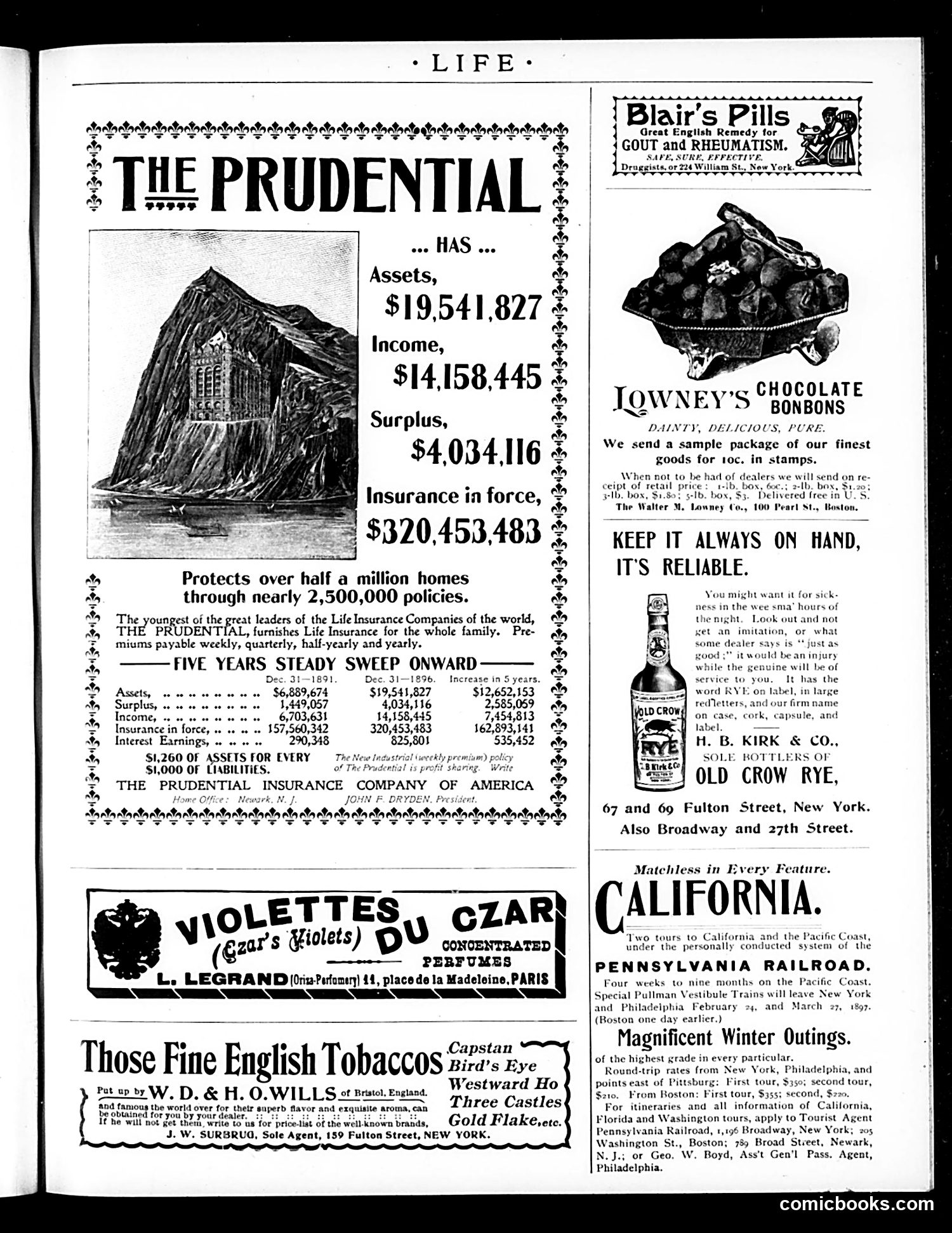
This page is **primarily advertising**, not satire or political cartooning. It's a standard magazine ad section from Life magazine circa 1897. The main feature is a **Prudential Insurance Company advertisement** showcasing financial statistics and growth ("Five Years Steady Sweep Onward"). The company emphasizes its assets, income, and policies protecting "over half a million homes." Surrounding this are **typical period advertisements** for: - English tobacco brands (Wills) - Chocolate bonbons (Lowney's) - Medicinal products (Blair's Pills for gout/rheumatism; Old Crow Rye whiskey, marketed as "reliable" medicine) - Railroad travel to California The page reflects **late-19th-century consumer culture**: insurance companies aggressively marketing to families, medicines with dubious health claims, and luxury goods like chocolates and fine tobaccos positioned as desirable goods. There's no political cartoon or satire visible—just standard period commercial content designed to reach Life's educated, middle-class readership.
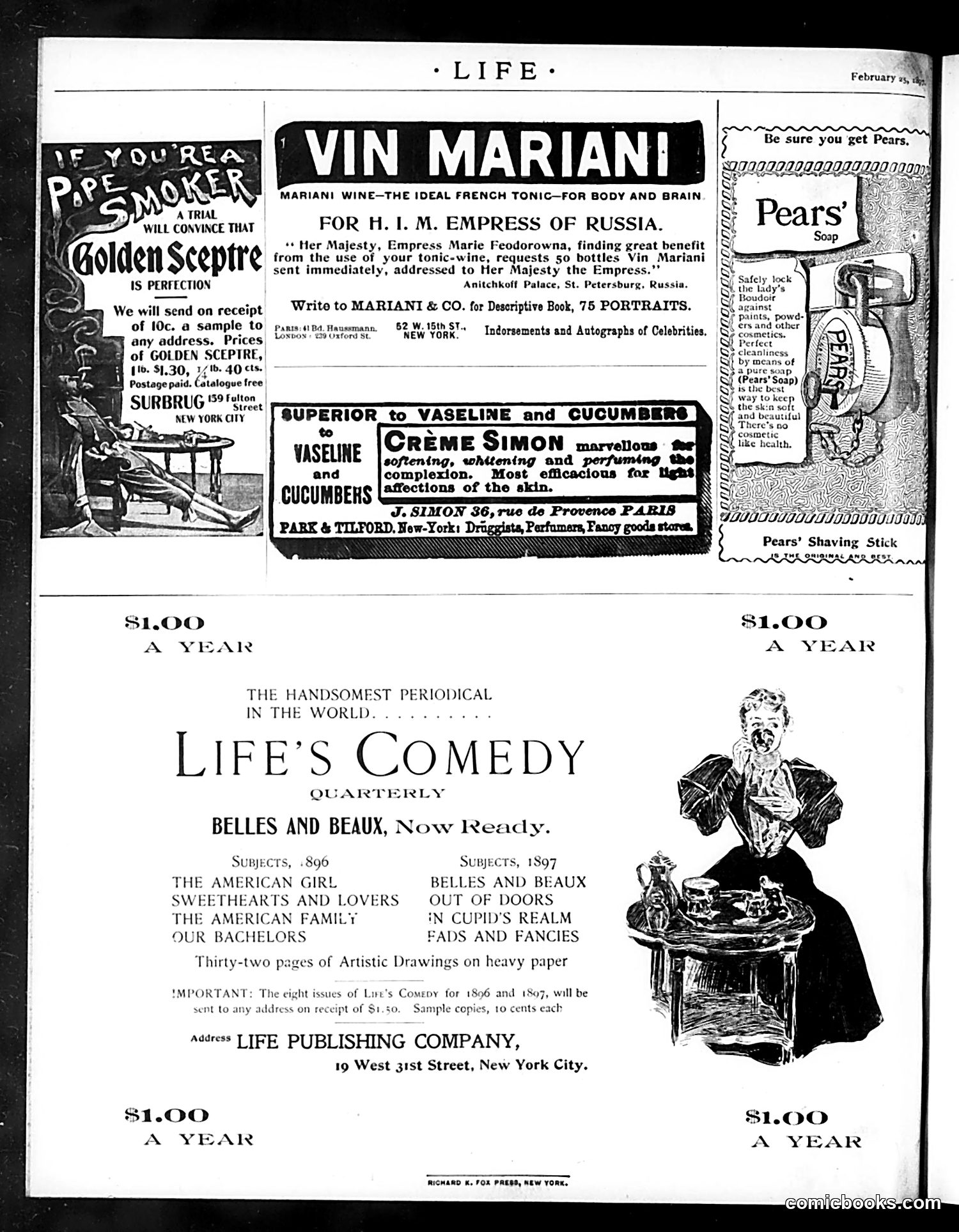
This page is primarily advertising rather than political satire. It features Victorian-era product advertisements interspersed with a promotional section for *Life's Comedy Quarterly*. The ads showcase period remedies and luxuries: Vin Mariani (a wine tonic claiming health benefits), Golden Sceptre pipe tobacco, Crème Simon skin cream, and Pears' Soap. Notably, one ad references the Empress of Russia requesting Vin Mariani, using celebrity endorsement as marketing—a common Victorian advertising tactic. The *Life's Comedy* section advertises an art quarterly featuring drawings on subjects like "The American Girl," "Sweethearts and Lovers," and "Belles and Beaux"—typical genteel entertainment topics for the 1890s readership. The page reflects late-19th-century consumer culture and advertising conventions rather than containing satirical commentary. The magazine itself was primarily humorous/satirical, but this particular page functions mainly as a revenue-generating advertisement spread.