
Life, 1897-02-25 · page 12 of 20
Life — February 25, 1897 — page 12: what you’re looking at
What you’re looking at
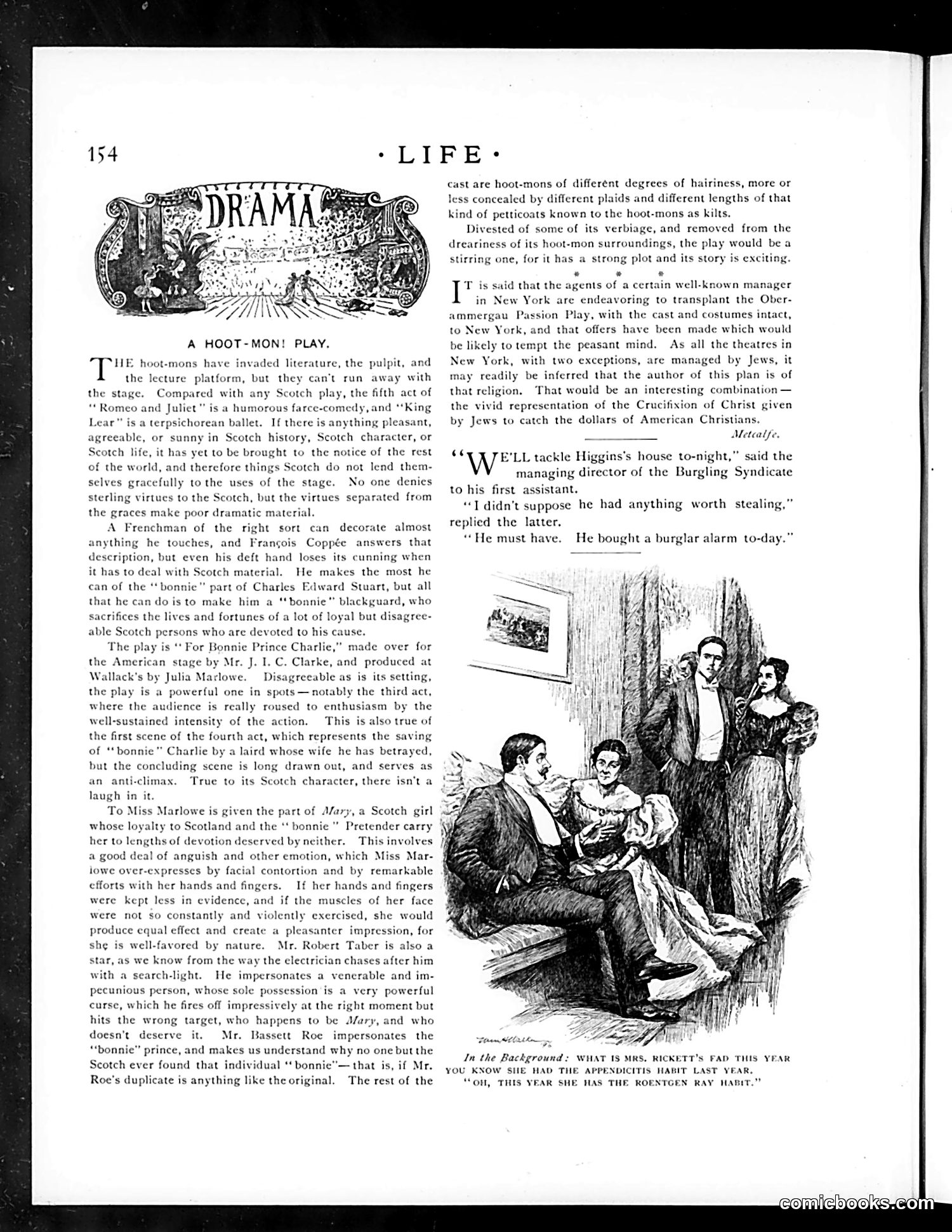
This page discusses theater productions, specifically hoot-mon plays featuring Scottish characters. The illustrated scene shows what appears to be a domestic drama about burglary—a managing director and assistant discuss breaking into "Higgins's house to-night," with one character mentioning the target recently bought a burglar alarm. The text critiques Scottish theatrical stereotypes, discussing plays like "For Bonnie Prince Charlie" and analyzing performances by actors including Miss Marlowe and Robert Taber. The satire targets how American theater exploits Scottish "bonnie" imagery and dialect humor for entertainment value. The illustration's caption references Mrs. Rickett's "roentgen ray habit"—a contemporary reference to newly-discovered X-ray technology, joking that she's grown accustomed to it.
📄 Transcribed text from this page (OCR, searchable)
Machine-transcribed from the original scan — historical spelling and the odd misread are preserved.
*LIFE: SIN HOOT-MON! PLAY. HE hoot-mons have invaded lite the lecture platform, but they can’t ran away with ct of -comedy,and “King ature, the pulpit, and the stage. Compared with any Scotch play, the fifth “Romeo and Juliet” is a humorous fare Lear” is a terpsichorean ballet. If there is anything pleasant, agreeable, or sunny in Scotch history, Scotch character, or Scotch life, it has yet to be brought to the notice of the rest of the world, and therefore things Scotch do not lend them- selves gracefully to the uses of the stage. sterling virtues to the Scotch, but the virtues separated from No one denies the graces make poor dramatic material. A Frenchman of the right sort can decorate almost anything he touches, and Francois Coppée answers that description, but even his deft hand loses its cunning when it has to deal with Scotch material. He makes the most he can of the **bonnic" part of Charles Edward Stuart, but all that he can do is to make him a bonnie" blackguard, who sacrifices the lives and fortunes of a lot of lo: able Sco but disagree- ch persons who are devoted to his caus The play is ‘* For Bonnie Prince Charlie,” the American stage by Mr. J. I. C. Clarke, and produced at Wallack’s by Julia Marlowe. Disagreeable as is the play is a powerful one in spots—notably the third act, made over for s setting, where the audience is really roused to enthusiasm by the well-sustained intensity of the action, This is also true of the first scene of the fourth act, which represents the saving of **bonnie"™ Charlie by a laird whose wife he has betrayed, but the concluding scene is long drawn out, and serves as an anti-climax. True to its Scotch character, there isn't a laugh in it. To Mi whose loyalty to Scotland and the * bonnie her to lengths of devotion deserved by neither. a good de: iowe over-expresses by facial contortion and by re: Pretender carr lof anguish and other emotion, which Miss Mar- rkable efforts with her hands and fingers. If her hands and fingers evidence, and if the muscles of her face were not So constantly and violently exercised, she would produce equal effect and create a pleasanter impre: were kept less ion, for Mr. Robert Taber is also a star, as we know from the way the electrician ch with a search-light. He impersonates a venerable and im- pecunious person, whose sole possession is a very powerful curse, which he fires off impressively at the right moment but hits the wrong target, who happens to be J/ary, and who doesn't Mr. impersonates the “bonnie” prince, and makes us understand why no one but the Scotch ever found that individual * bonnie"— that is, if Mr. Roe’s duplicate is anything like the original. The rest of the sh¢ is well-favored by nature. after him deserve it. Bassett Roe This involves / cast are hoot-mons of different degrees of hairines: ss concealed by different plaids and different lengths kind of petticoats known to the hoot-mons as kilts. Divested of some of its verbiage, and removed from the dreariness of its hoot-mon surroundings, the play would be a stirring one, for it has a strong plot and its story is exciting. more or of that * * * I is said that the agents of a certain well-known manager in New York are endeavoring to transplant the Ober- ammergau Passion Play, with the cast and costumes intact, y York, and that offers have been made which would cly to tempt the peasant mind. As all the theatres in to N bel New York, with two exceptions, are managed by Jews, it may readily be inferred that the author of this plan is of that religion. That would be an interesting combination — the vivid representation of the Crucifixion of Christ given by Jews to catch the dollars of American Christians. Metcalfe. “ LL tackle Higgins’s house to-night,” said the managing director of the Burgling Syndicate to his first assistant. “I didn't suppose he had anything worth stealing,” replied the latter, “He must have. He bought a burglar alarm to-day.” Marlowe is given the part of Afary, a Scotch girl In the Background: WUNT 13 MRS. RICKETT’S FAD THIS YEAR YOU KNOW SHE HAD THE APPENDICITIS HABIT LAST YEAR, OH, THIS YEAR SHE HAS THE ROENTGEN RAY HapiT.””