
Life, 1897-02-25 · page 15 of 20
Life — February 25, 1897 — page 15: what you’re looking at
What you’re looking at
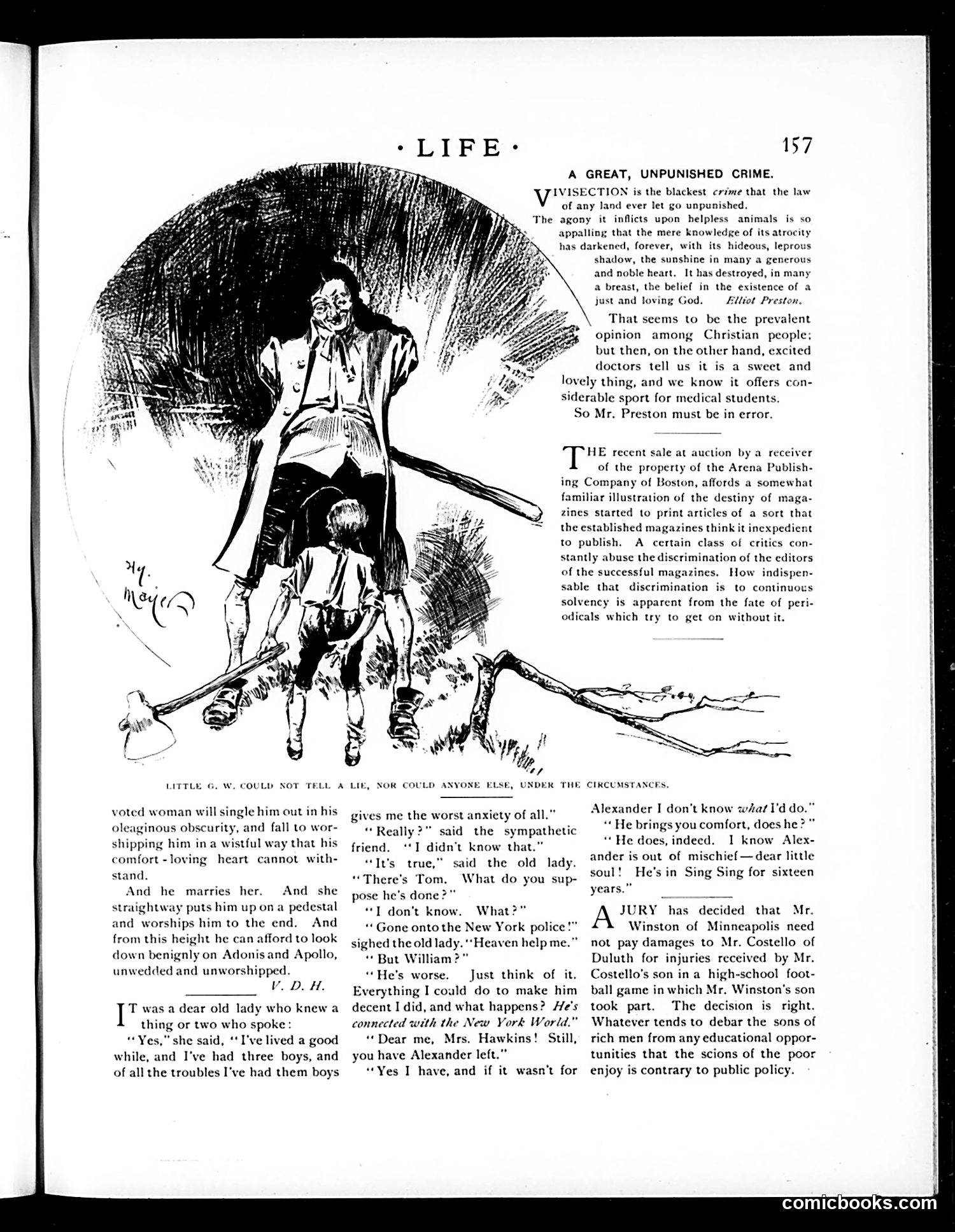
This page contains three distinct satirical pieces from *Life* magazine: **1. The Main Cartoon** depicts vivisection (animal experimentation). The illustration shows a skeletal figure wielding a sword over helpless animals. The satire mocks the moral outrage some express about animal testing while noting that doctors actually support it for medical education—pointing out the hypocrisy in the debate. **2. "A Great, Unpunished Crime"** discusses a Boston publishing company's auction. It satirizes how magazines that print "unconventional" articles fail commercially, while successful magazines discriminate in what they publish. The joke is that this discrimination, though criticized, is actually necessary for survival. **3. The Anecdote** features an old lady whose three sons represent different disgraces: one joined the police, one works for the *New York World* newspaper, and the third is imprisoned at Sing Sing prison for sixteen years. The humor comes from equating police work and journalism with serious criminality—a sharp jab at both institutions' reputations. **4. "A Jury Decision"** satirizes a lawsuit outcome protecting wealthy families' sons' access to dangerous sports, arguing such protection is "public policy."
📄 Transcribed text from this page (OCR, searchable)
Machine-transcribed from the original scan — historical spelling and the odd misread are preserved.
LITTLE 6. W. COULD NOT TELL voted woman will single him out in his oleaginous obscurity, and fall to wor- shipping him ina wistful way that his comfort -loving heart cannot with- stand. And he marries her. And she straightway puts him up on a pedestal and worships him to the end. And from this height he can afford to look down benignly on Adonis and Apollo, unwedded and unworshipped. Ue EB 2 & T was a dear old lady who knew a thing or two who spoke: “Yes,” she said, ‘‘I've lived a good while, and I've had three boys, and of all the troubles I've had them boys 157 A GREAT, UNPUNISHED CRIME. IVISECTION is the blackest crime that the law of any land ever let go unpunished. The agony it inflicts upon helpless animals is so appalling that the mere knowledge of its atrocity has darkened, forever, with its hideous, leprous shadow, the sunshine in many a generous and noble heart. It has destroyed, in many a breast, the belief in the existence of a just and loving God. Flot Preston, That seems to be the prevalent opinion among Christian people; but then, on the other hand, excited doctors tell us it is a sweet and lovely thing, and we know it offers con- siderable sport for med students, So Mr. Preston must be in error. ing Company of Boston, affords a somew HE recent sale at auction by a receiver of the property of the Arena Publish- at familiar illustration of the destiny of maga- zines started to print articles of a sort that the established magazines think it inexpedient to publish. A certain class of critics con- stantly abuse the discrimination of the editors of the successful magazines. How indispen- sable that discrimination is to continuous solvency is apparent from the fate of peri- odicals which try to get on without it. Coy A LIE, gives me the worst anxiety of all.” “ Really?" said the sympathetic friend. ‘*I didn’t know that.” “It's true,” said the old lady. “There's Tom, What do you sup- pose he's done?” “T don't know. What?” “Gone onto the New York police!” sighed the old lady. “Heaven help me.” * But William?" ‘He's worse. Just think of it. Everything I could do to make him decent I did, and what happens? He's connected with the New York World.” “Dear me, Mrs. Hawkins! Still, you have Alexander left.” “Yes I have, and if it wasn’t for NOK COULD ANVONE ELSE, UNDER THE CIRCUMSTANCES. Alexander I don't know what I'd do.” ‘He brings you comfort, does he?” “He does, indeed. I know Alex- ander is out of mischief —dear little soul! He's in Sing Sing for sixteen years.” JURY has decided that) Mr. Winston of Minneapolis need not pay damages to Mr. Costello of Duluth for injuries received by Mr. Costello's son in a high-school foot- ball game in which Mr, Winston's son took part. The decision is right. Whatever tends to debar the sons of rich men from any educational oppor- tunities that the scions of the poor enjoy is contrary to public policy. comicbooks.com