
Life, 1897-02-25 · page 6 of 20
Life — February 25, 1897 — page 6: what you’re looking at
What you’re looking at
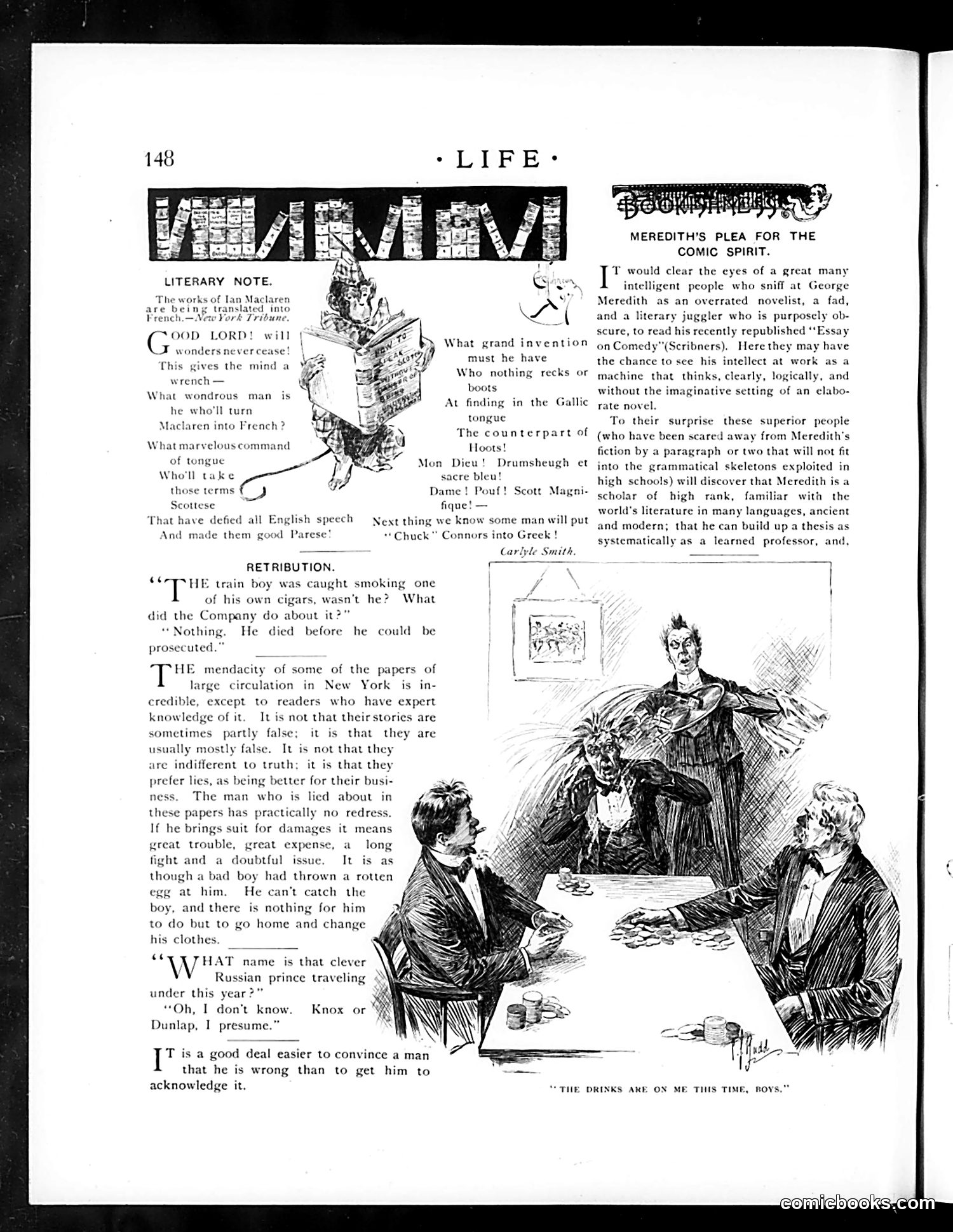
This page contains several satirical pieces about George Meredith, a prominent Victorian novelist and literary figure. The "Literary Note" mocks the translation of Meredith's works into French, using exaggerated praise of his linguistic complexity as a joke—suggesting his writing is so convoluted it requires special effort to translate. "Retribution" and the other brief items are disconnected quips about mendacious newspapers, Russian princes, and human nature—typical of Life's miscellaneous humor format. The main illustration shows three men in what appears to be a casual social setting, with the caption "The drinks are on me this time, boys"—likely a joke about social obligation or unexpected generosity, though the specific context is unclear without additional information.
📄 Transcribed text from this page (OCR, searchable)
Machine-transcribed from the original scan — historical spelling and the odd misread are preserved.
LITERARY NOTE. The works of lan Maclar are b nstated into French. — York Tribune LORD! J wonders never cease oop will What grand invention must he have Who nothing recks or boots At finding in the Gallic This gives the mind a wrench — What he who'll turn Maclaren into French? wondrous man is tongue The counterpart of Hoots! Mon Dicu! Drumsheugh et sacre bleu! ! Pouf! Scott Ma What marvelous command Oo fied all E them good Parese of tongue Who'll take those terms nie Scottese ‘That have And n Next thing we know some man will put **Chuck ” Connors into Greek ! RETRIBUTION. “THE train boy was caught smoking one n't he? What pout it?” Smith, of his own ci did the Company de “Nothing. He died could be before he prosecuted.” HE mendacity of some of the papers of New York is credible, except to readers who have expert knowledge of it. It is not that their stories are sometimes partly false; it is that they are usually mostly false. It is not that they are indifferent to truth; it is that they prefer lies, as being better for their busi- The man large circulation in in- about in these papers has practically no redress. If he brings suit for damages it means great trouble, great expense, a ness. who is lied long fight and a doubtful issue. It is as though a bad boy had thrown a rotten egg at him. He can’t catch the boy, and there is nothing for him to do but to go home and change his clothes. “wrat name is that clever yh Russian prince traveling under this year?” “Oh, | don’t know. Dunlap, I presume.” Knox or T is a good deal easier to convince a man that he is wrong than to get him to acknowledge it. “THE DRINKS ARE aH OS EREDITH’S PLEA FOR THE COMIC SPIRIT. if would clear the intelligent people who s George Meredith an overrated novelist, a fad, and a literary juggler who is purposely ob- scure, to read his recently republished "E on Comedy"(Scribners). Here they may have the chance to sce his intellect at work as a machine that thinks, clearly, logically, and without the imaginative setting of an clabo- rate novel. To their surprise these superior people (who ha y from Meredith's fiction by a paragraph or two that will not fit ‘¢ been scared aw. into the grammatical skeletons exploited in high schools) will discover that Meredith is a scholar of high rank, the world's literature in many languages, ancient and modern; that he can build up a thesis as systematically familiar with s a learned professor, and, = ee ON ME THIS TIME, BOYS."