
A complete issue · 20 pages · 1897
Life — February 11, 1897
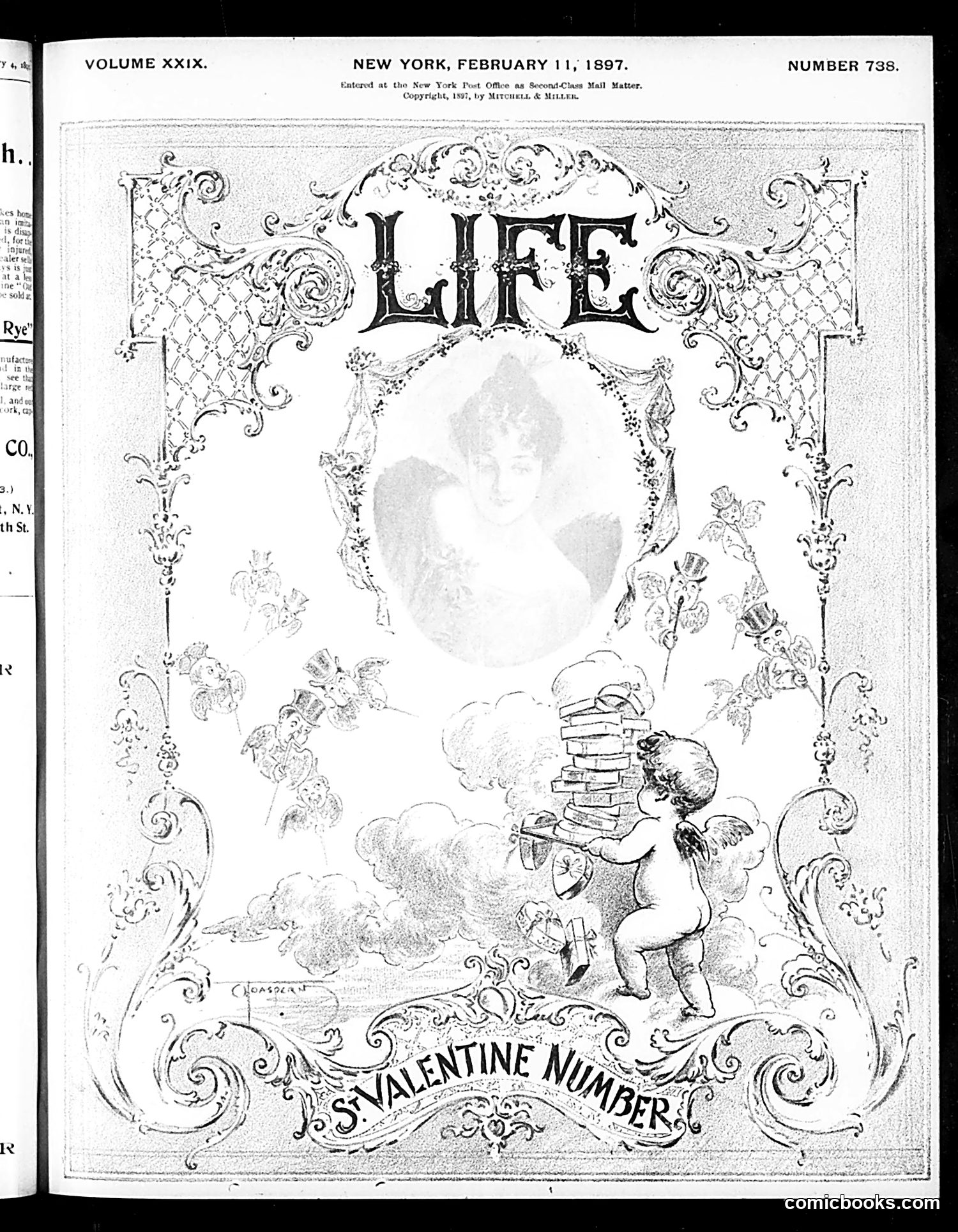
This is the **St. Valentine's Number** cover of *Life* magazine from February 11, 1897. The cover features a cherub (Cupid) carrying an enormous stack of books or letters, floating among clouds within an ornate decorative frame. The cherub appears to struggle under the weight of this load. The satire likely plays on Valentine's Day traditions—specifically the exchange of romantic letters and valentines. By depicting Cupid overwhelmed by a massive pile of correspondence, the illustration humorously suggests the sheer volume of valentine mail circulating during this holiday season. The joke appears to mock either the commercialization of Valentine's Day or the absurdity of romantic letter-writing conventions of the era.
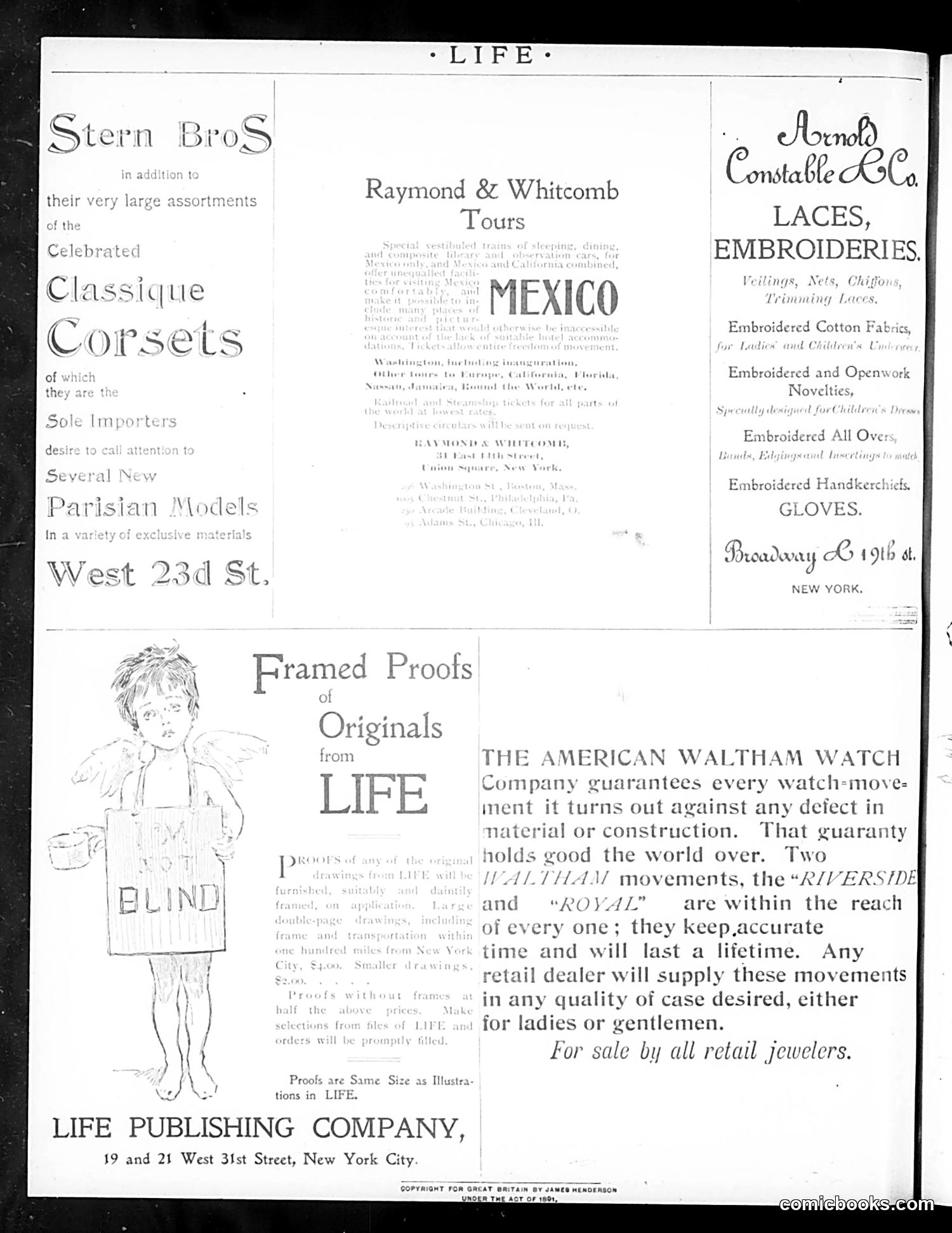
This page is primarily **advertising**, not political satire. It contains four distinct ads: 1. **Stern Bros** (corsets) - West 23rd Street, New York 2. **Raymond & Whitcomb Tours** - Mexico travel packages 3. **Arnold Constable & Co** - laces and embroidered goods 4. **Life Publishing Company** - framed proofs of original LIFE drawings The only visual element is a sketch of a blind child labeled "BLIND" advertising framed proofs from LIFE magazine. This appears to be a straightforward commercial offering rather than satire—customers could purchase original artwork from the magazine. The American Waltham Watch Company ad promotes their "Riverside" and "Royal" watch movements. This is a typical early 20th-century magazine page of commercial advertisements with minimal editorial content.
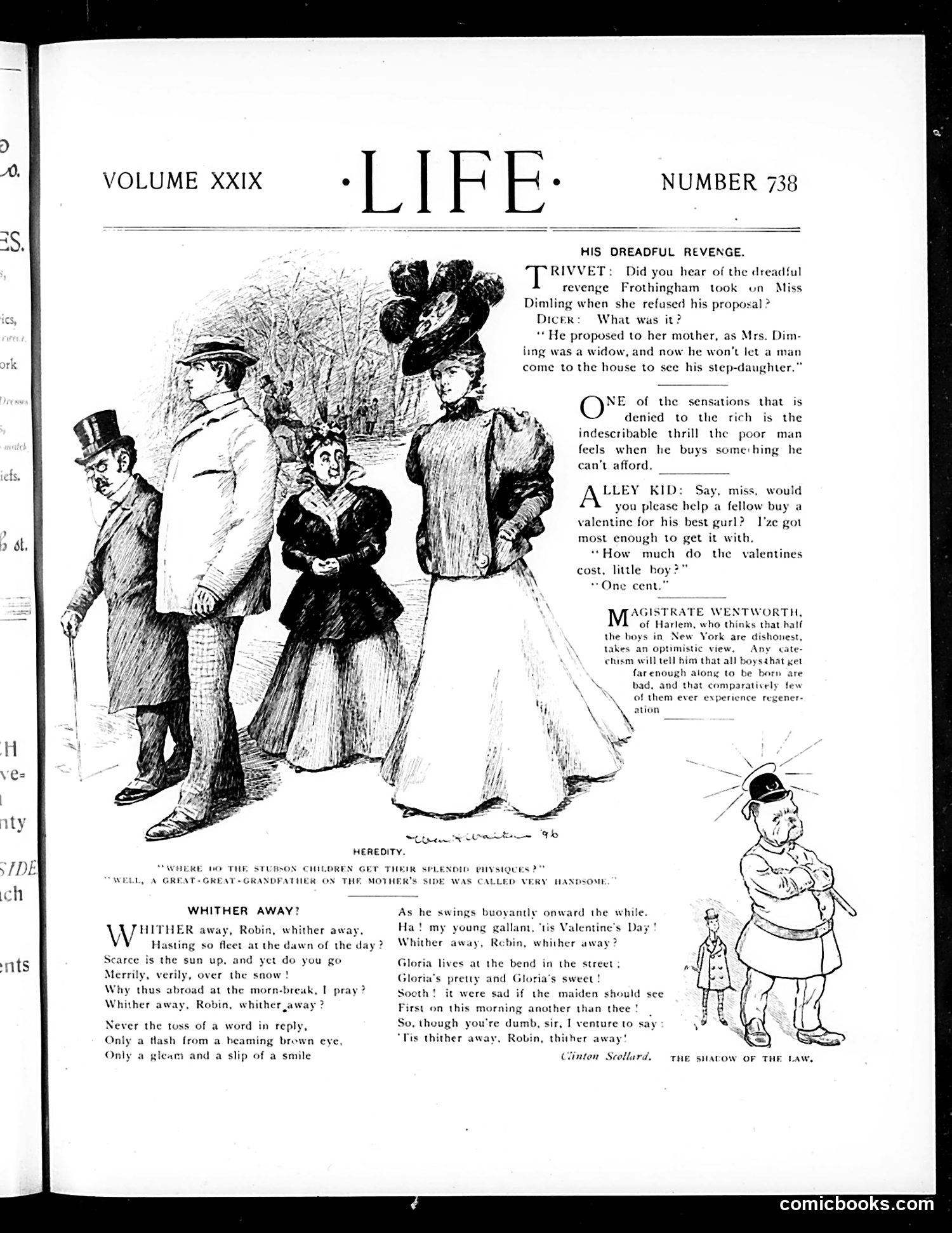
This page contains three separate humorous pieces: 1. **"His Dreadful Revenge"** – A dialogue-based cartoon mocking class pretensions. A wealthy man proposes to a widow solely to gain access to her step-daughter, suggesting shallow motivations among the rich. 2. **"Alley Kid"** – Satire on poverty. A street boy asks a woman to buy him a Valentine, noting they cost only one cent—highlighting economic disparity and children's deprivation in urban areas. 3. **"Whither Away?"** – A poem (attributed to Clinton Scollard) about a boy named Robin, apparently addressing romantic idealization versus reality. The accompanying small illustrations depict working-class children and street scenes. Overall, the page satirizes class divisions, poverty, and sentimental romanticism in turn-of-the-century America.
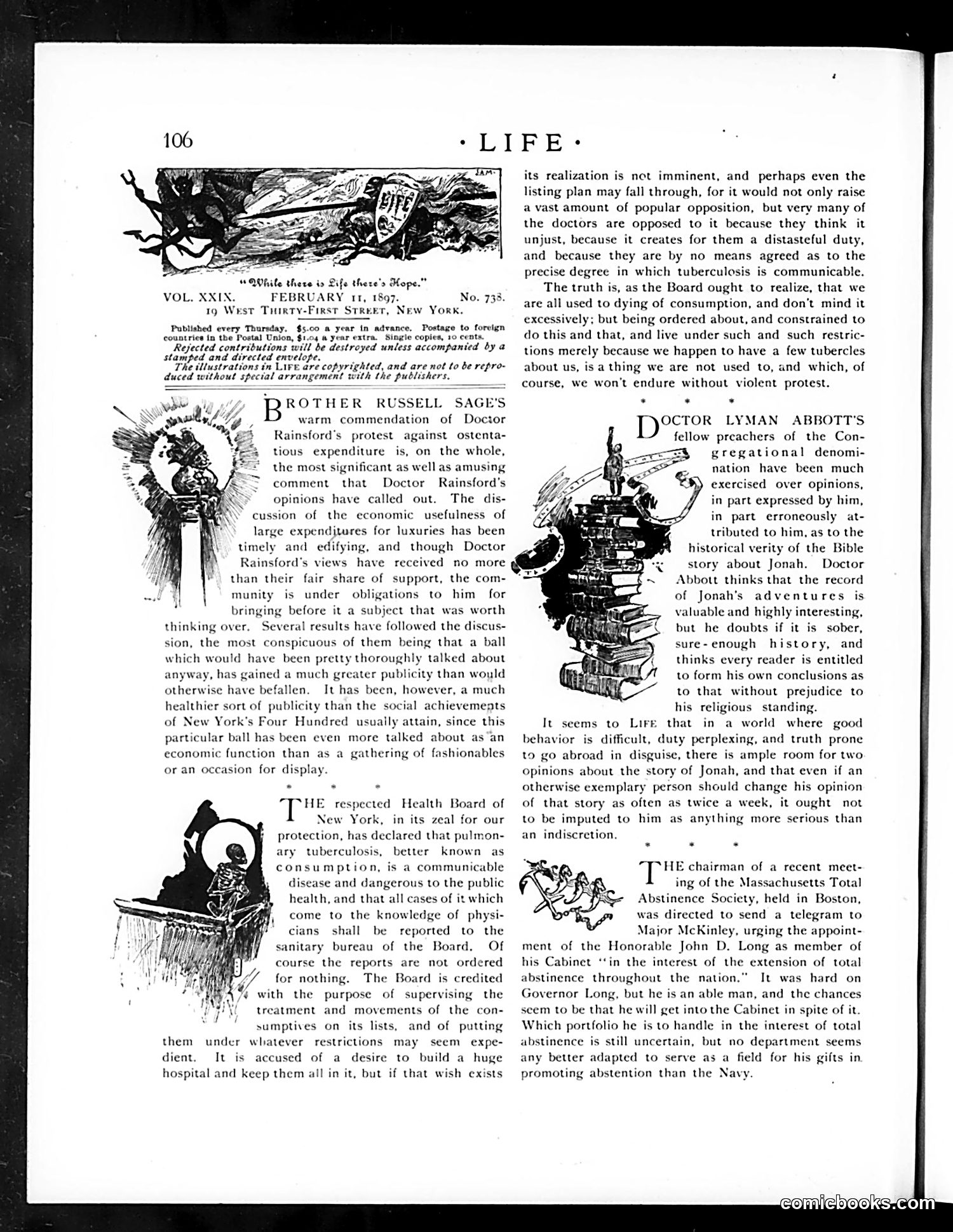
The page contains three editorial cartoons critiquing public health and moral reform debates of the 1890s. The left cartoon illustrates the Health Board's tuberculosis reporting policy—officials are depicted aggressively pursuing cases, suggesting the board's zealous but potentially heavy-handed approach to disease management. The center cartoon shows a towering stack of books labeled "Jonah," addressing Doctor Lyman Abbott's defense of the Biblical story's historical accuracy against critics who questioned its reliability. The right cartoon depicts chaos at what appears to be a government meeting, likely referencing Governor John D. Long's cabinet appointment of Major McKinley—a figure controversial among temperance advocates who questioned whether the Navy was appropriate for promoting abstinence campaigns. All three cartoons satirize contemporary debates over government overreach, religious authority, and moral reform.
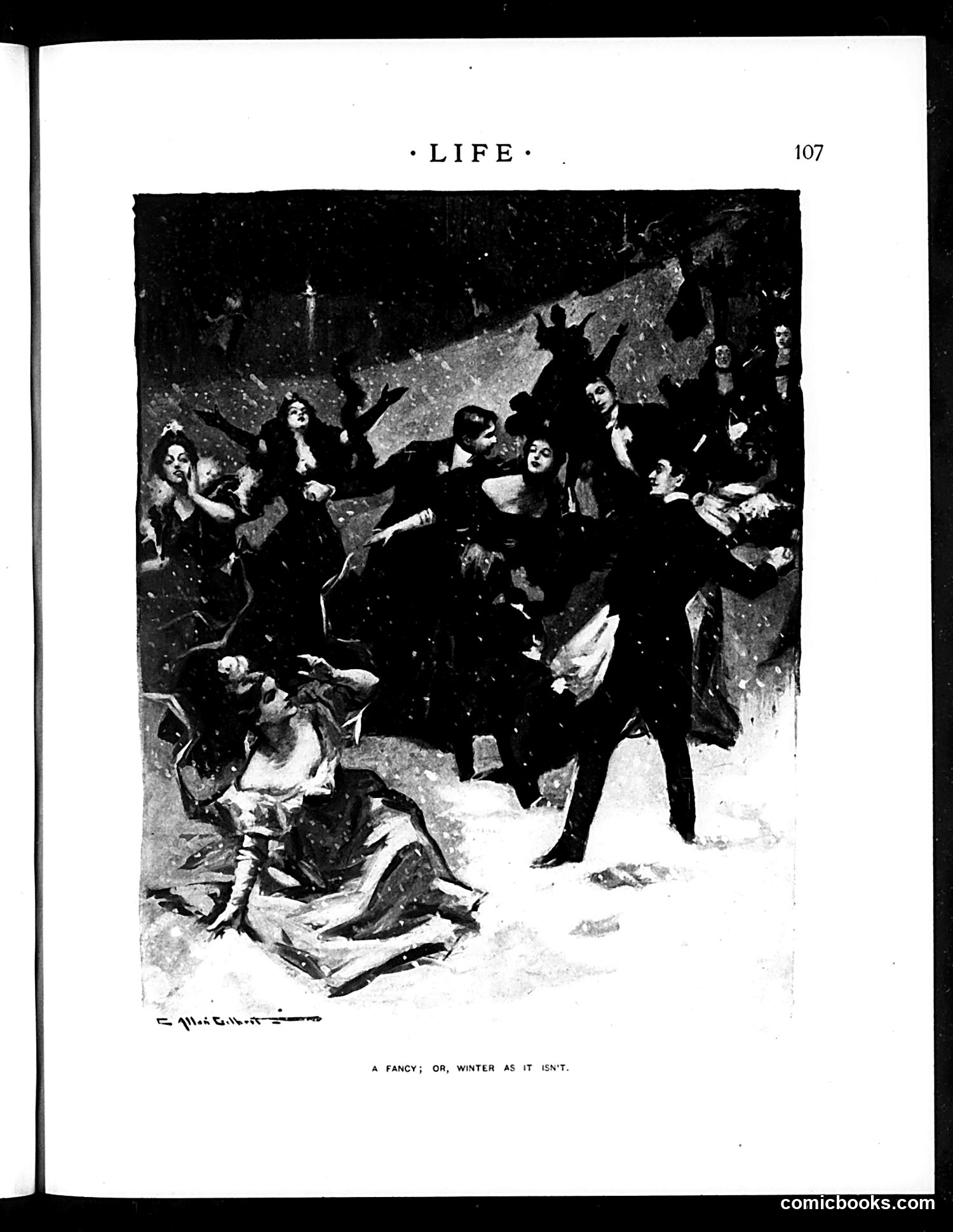
This satirical illustration depicts an absurdist winter fantasy. The scene shows fashionably dressed people in formal Victorian/Edwardian attire gathered in what appears to be snow or winter conditions, yet engaging in behavior contradictory to actual winter weather—likely dancing, socializing, or relaxing as if at a pleasant summer gathering. The joke hinges on the caption's irony: "Winter as it isn't" mocks either unrealistic expectations people have about winter socializing, or perhaps critiques romanticized artistic depictions of winter that ignore its actual harsh conditions. The contrast between formal dress, winter setting, and summery leisure activities creates the satirical humor, suggesting the gap between winter's reality and popular fantasy representations of the season.
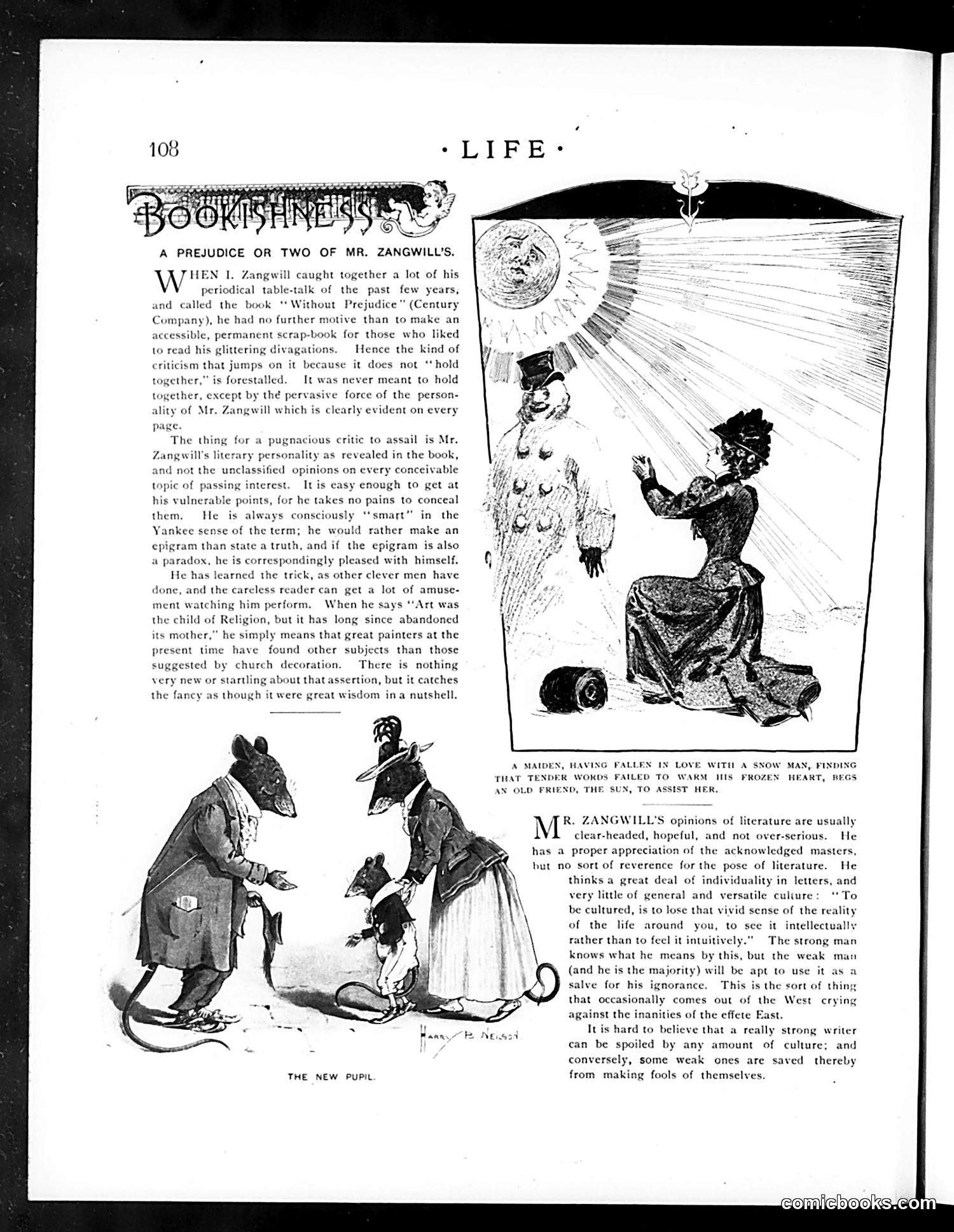
This page critiques Mr. Zangwill's literary personality and writing style. The text argues that while Zangwill presents himself as "smart" and clever, he prioritizes witty epigrams over substantive truth, and is "consciously pleased with himself" about this approach. The two cartoons illustrate this critique: 1. **"The New Pupil"** (bottom): Shows anthropomorphic rats/mice in clothing, likely satirizing Zangwill's characters or writing subjects as trivial or small-minded. 2. **Upper cartoon**: Depicts a maiden in snow attempting to warm a snowman using the sun's help—a whimsical, impractical scenario that appears to mock the sentimental or absurd nature of Zangwill's literary subject matter. The satire suggests Zangwill prioritizes style over substance and treats serious topics frivolously.
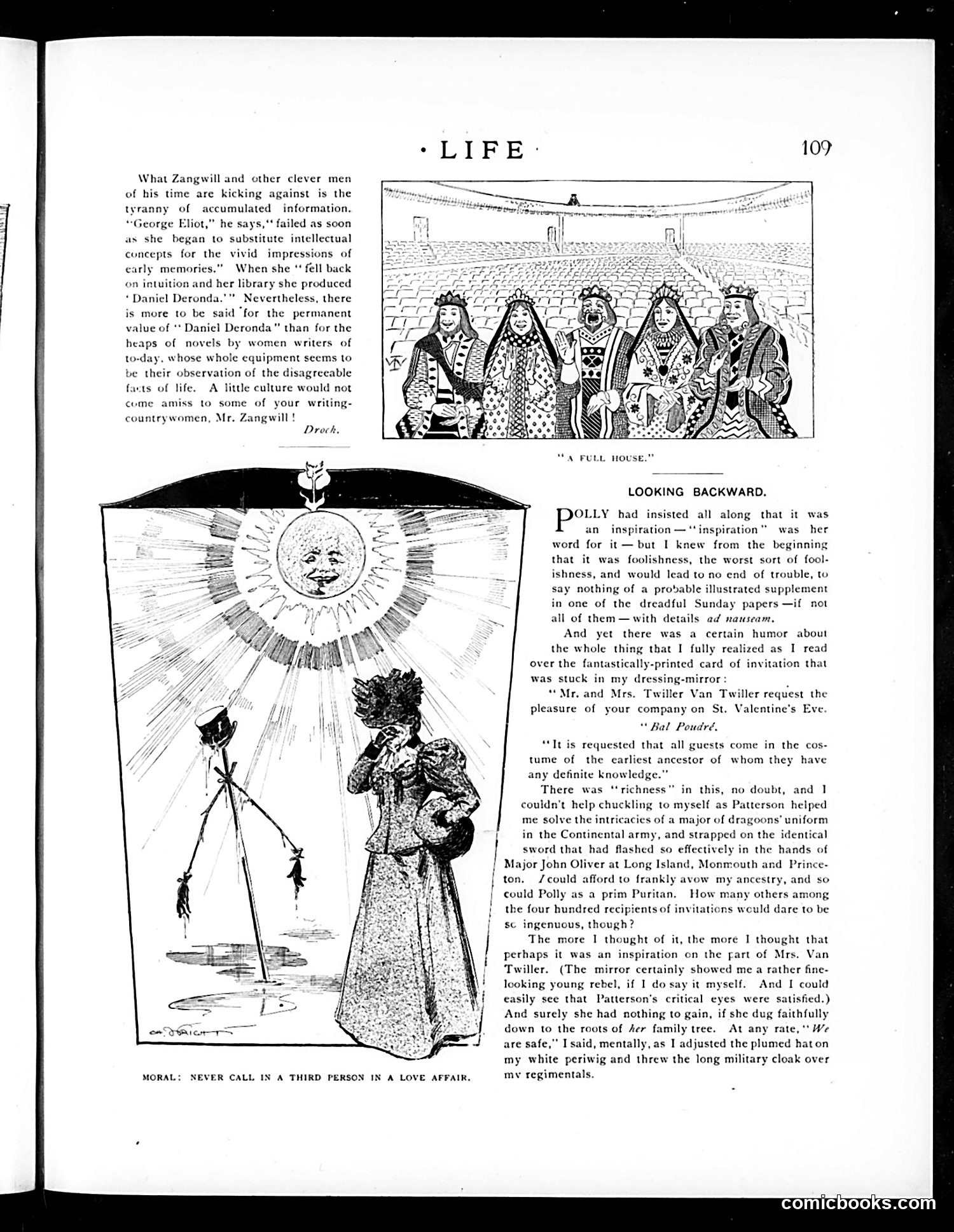
This page contains two distinct illustrations with accompanying text. **Top illustration ("A Full House"):** Shows four women in elaborate period costumes and headdresses in a flat landscape. This illustrates a discussion of female novelists, apparently critiquing their work as relying on "intuition" rather than careful observation of actual life. The text references George Eliot and Daniel Deronda, suggesting the debate concerns whether women writers produce authentic social commentary. **Bottom illustration and moral:** Depicts a woman holding a scale with figures, with the sun above. The caption reads: "MORAL: NEVER CALL IN A THIRD PERSON IN A LOVE AFFAIR." This is a straightforward cautionary illustration about romantic entanglements—a satirical commentary on relationship advice, warning against involving outsiders in personal matters. The page's overall tone is satirical commentary on literature, gender, and social behavior typical of Life magazine's approach.
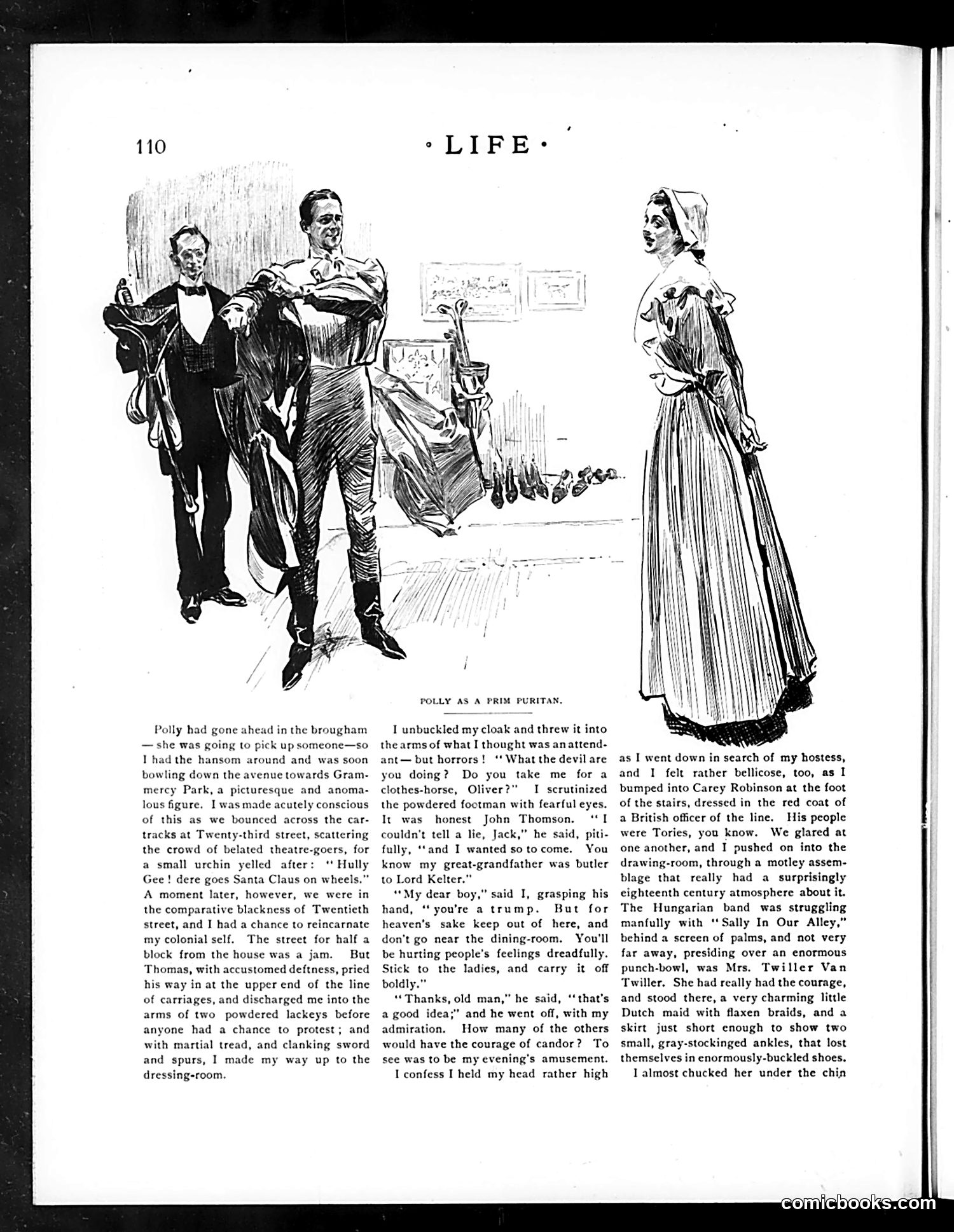
This satirical illustration depicts a social scene where the narrator encounters a woman named Polly at what appears to be a theatrical or formal gathering. The joke centers on Polly's contradictory behavior: she presents herself as prim and proper (hence "Puritan"), yet the narrator's account reveals her actually engaging in improper conduct—flirting, physical contact, and attending questionable venues. The satire targets the Victorian-era hypocrisy of women who maintain respectable public appearances while behaving less virtuously in private. The illustration shows Polly in a long, modest dress with a bonnet, embodying conventional propriety, while the text exposes the gap between her outward presentation and actual conduct. This is typical of *Life* magazine's social commentary on middle-class pretense.
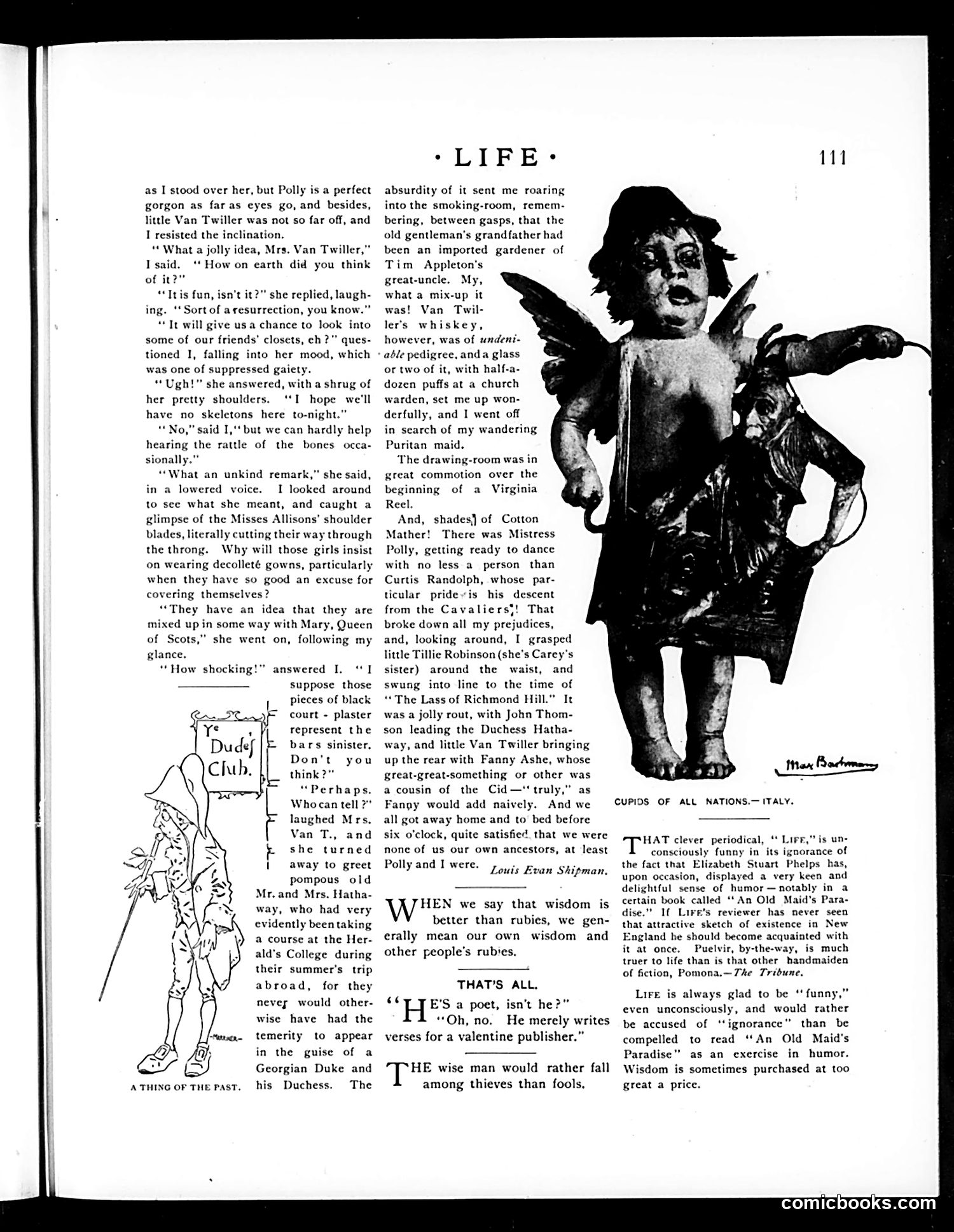
This page contains a humorous narrative about a Virginia Reel dance and society gossip, illustrated with two cartoons. **Left cartoon** ("A Thing of the Past"): Shows a thin, old-fashioned gentleman labeled as representing outdated social conventions—likely mocking obsolete aristocratic pretension. **Right cartoon** ("Cupids of All Nations—Italy"): Depicts a cherub or cupid figure in exaggerated Italian style, part of an apparent series showing national character stereotypes through romanticized imagery. The text discusses social embarrassments at a dance—specifically references to people wearing "décolleté gowns" and genealogical pretensions (mentions of "Cavaliers" descent). The humor targets upper-class vanity, particularly women's fashion choices and ancestors' social status claims. The overall tone mocks genteel society's self-importance and rigid propriety.
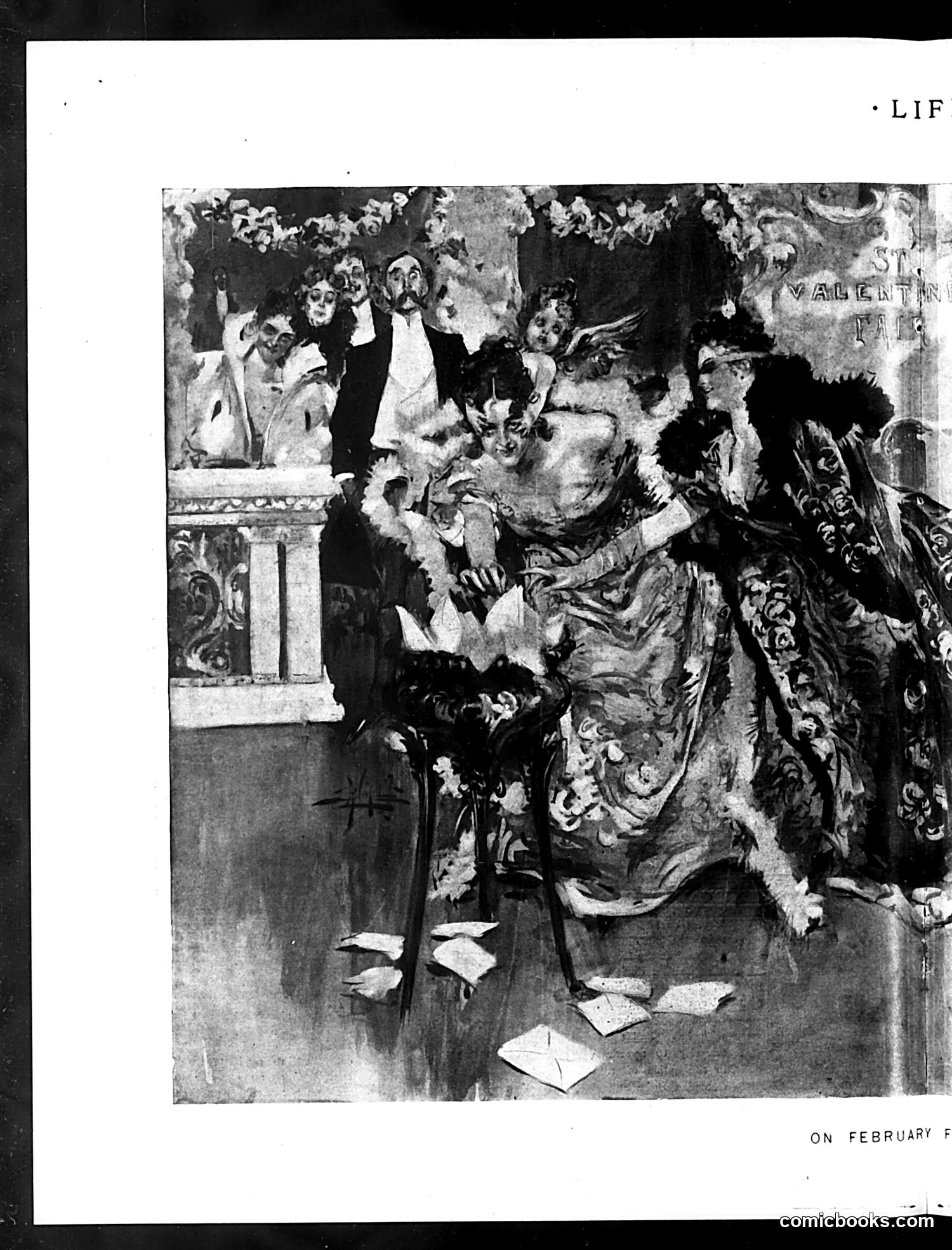
This appears to be a Valentine's Day-themed satirical illustration (text indicates "ON FEBRUARY" at bottom, suggesting Valentine's Day context). The image depicts figures in elaborate period costumes exchanging valentines at what appears to be a formal social gathering, with decorative garlands overhead. The satire likely mocks Victorian-era courtship rituals and romantic conventions through exaggerated costumes and theatrical staging. The scattered letters/cards on the floor suggest the abundance or frivolity of Valentine exchanges among high society. However, without clearer text or identifying labels on the figures themselves, I cannot definitively name specific individuals being caricatured. The page appears to be making social commentary on romance and dating customs rather than targeting particular political figures.
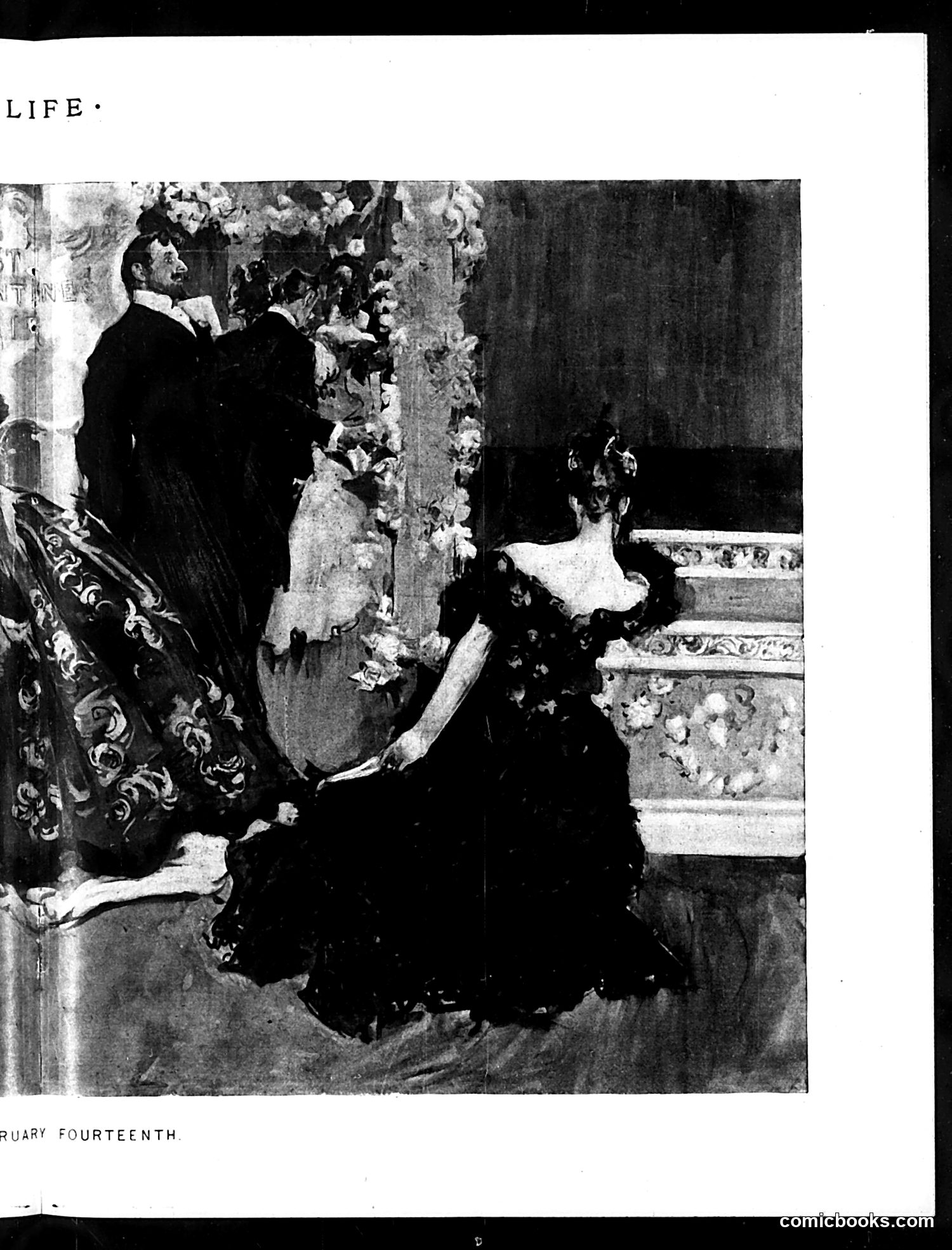
This appears to be a page from *Life* magazine titled "FEBRUARY FOURTEENTH" (Valentine's Day). The black-and-white illustration depicts an elegant interior scene with decorative floral arrangements. A woman in dark formal dress sits prominently in the foreground, while two men in dark suits stand in the background near the flowers, appearing to converse or interact with the floral displays. The satirical point likely relates to Valentine's Day customs—possibly mocking elaborate romantic gestures, courtship rituals, or the commercialization of the holiday through expensive flower arrangements. The woman's composed posture contrasts with the men's focused attention to the flowers, potentially satirizing gendered expectations around romance and gift-giving during this period. Without additional context or visible bylines, the specific targets remain unclear.
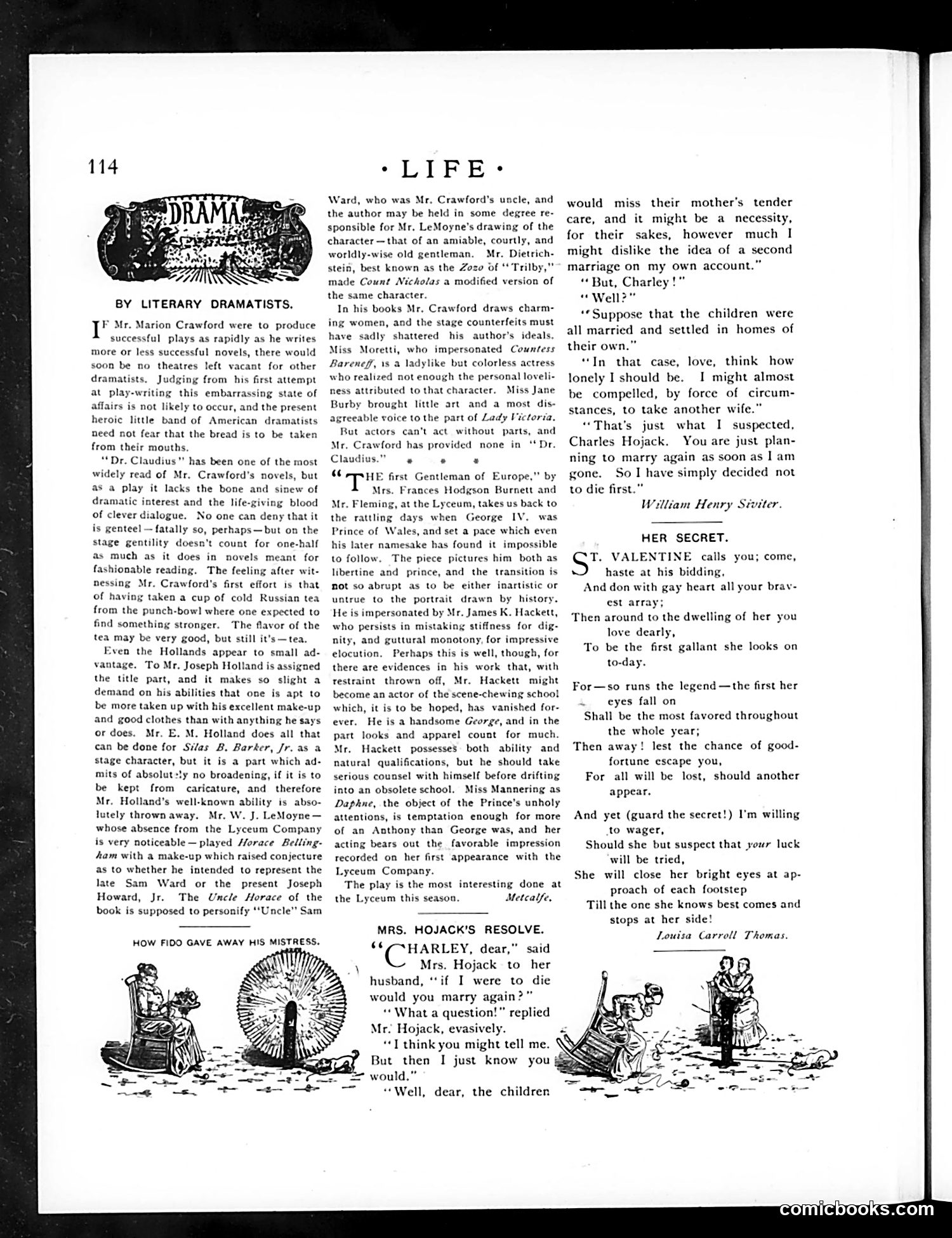
This page contains literary drama criticism and humorous fictional pieces rather than political cartoons. The main content includes: 1. **"Drama by Literary Characters"** - a critique of Mr. Marion Crawford's theatrical works, discussing how his stage characterizations fail to match his written ones. The critic notes Crawford's dialogue is clever but his dramatic construction is weak. 2. **Two illustrated comedic vignettes** with captions: - "How Fido Gave Away His Mistress" - showing a woman with a parasol (appears to be about a dog compromising someone) - "Mrs. Hojack's Resolve" - depicting a domestic conversation about remarriage These are lighthearted domestic humor pieces typical of *Life* magazine's satirical content, focusing on social conventions and marital relations rather than political commentary.
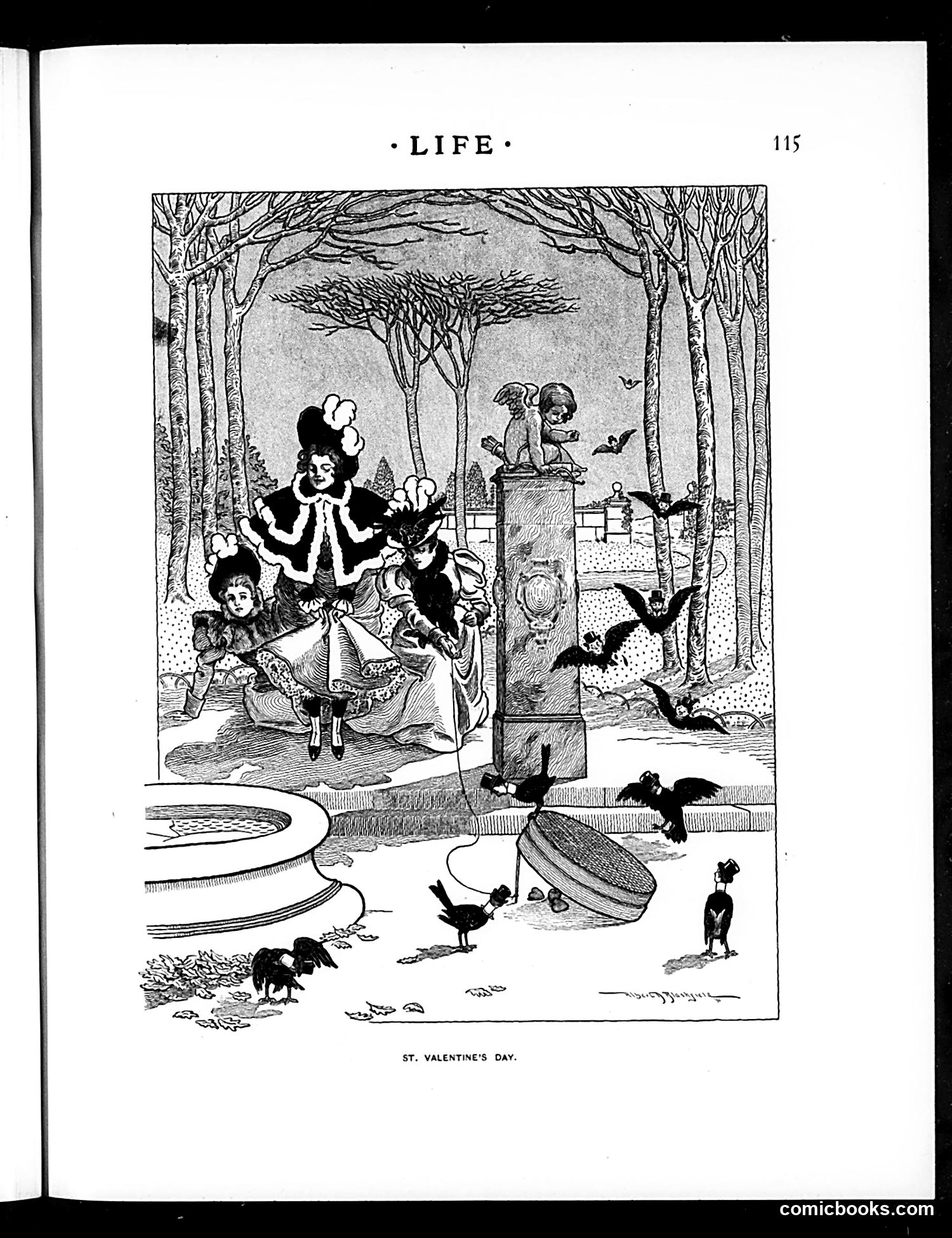
This is a whimsical illustration titled "St. Valentine's Day" from *Life* magazine (page 115). The image depicts a fantastical woodland scene where elegantly dressed figures—a woman in Victorian dress with an elaborate hat and children—are surrounded by anthropomorphized animals and creatures engaged in romantic or playful activities. The cartoon appears to be a satirical take on the sentimentalization of St. Valentine's Day, showing the holiday's romantic ideals extended absurdly to nature itself. Various animals (birds, insects, possibly a dog) are positioned as if courting or interacting in human-like ways, with the refined human figures observing this "natural" romance. The satire likely mocks Victorian-era romantic excess and the tendency to project human romantic emotions onto animals and nature. The elaborate staging suggests ironic commentary on elaborate Valentine's Day customs and pageantry of the period.
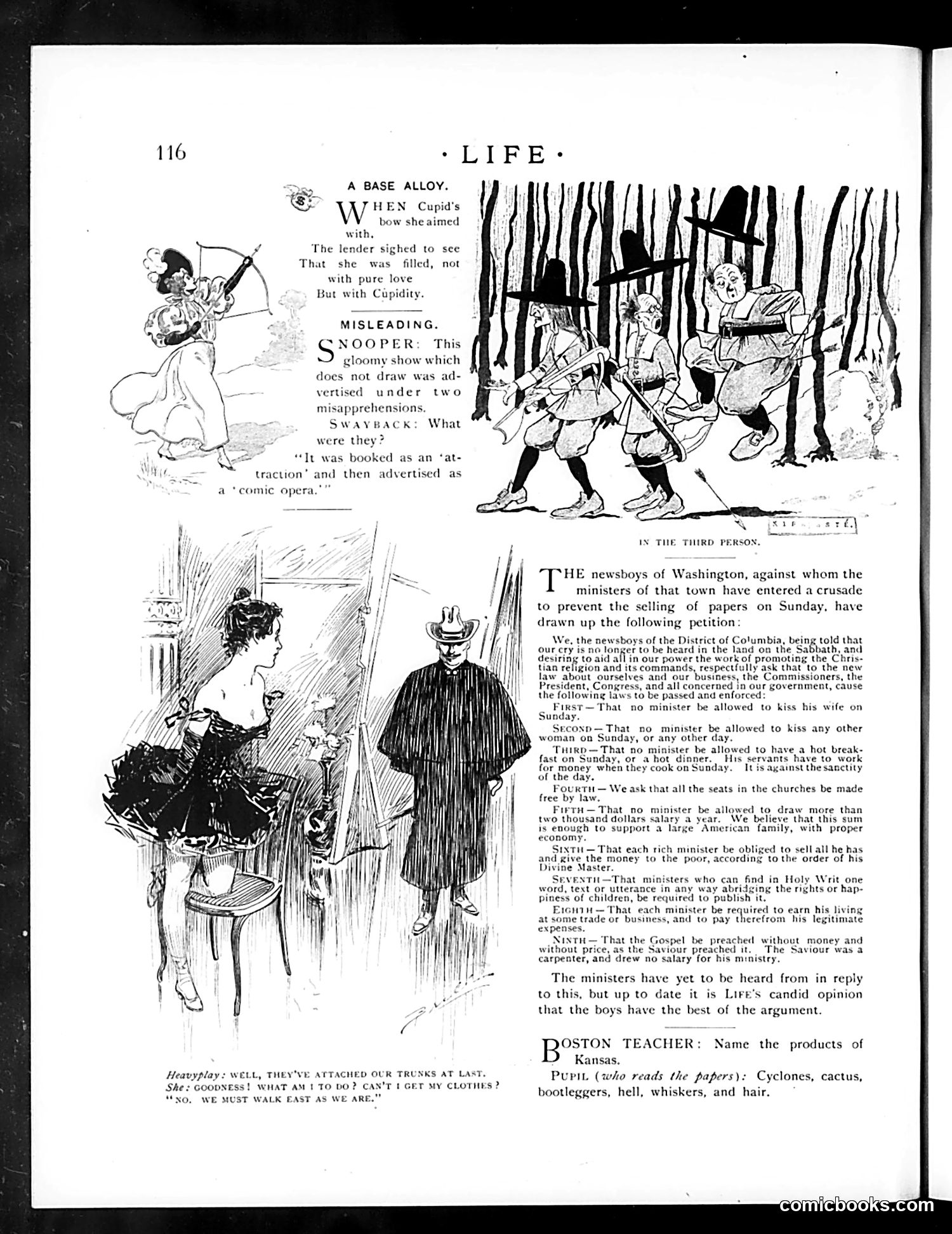
This page contains several distinct satirical pieces mocking American hypocrisy and social issues circa early 20th century. **Top section:** Three brief jokes about love, theater advertising, and perspective. **Main content:** A "petition" from Washington newsboys responds sarcastically to ministers' crusade against Sunday newspaper sales. The newsboys expose clerical hypocrisy by proposing ministers follow their own moral standards—no kissing wives on Sunday, no hot meals (servants would work), free church seats, modest salaries, charity to the poor, and unpaid preaching like Jesus. The satire's point: ministers demand sacrifice from working-class newsboys while violating these principles themselves. **Bottom left:** A couple's domestic dispute about laundry—likely referencing wartime rationing or economic hardship. **Bottom right:** A teacher asks about Kansas's products; a newspaper-reading student answers with contemporary stereotypes: natural disasters, cacti, and bootleggers (Prohibition-era illegal alcohol)—mocking Kansas as culturally backward.
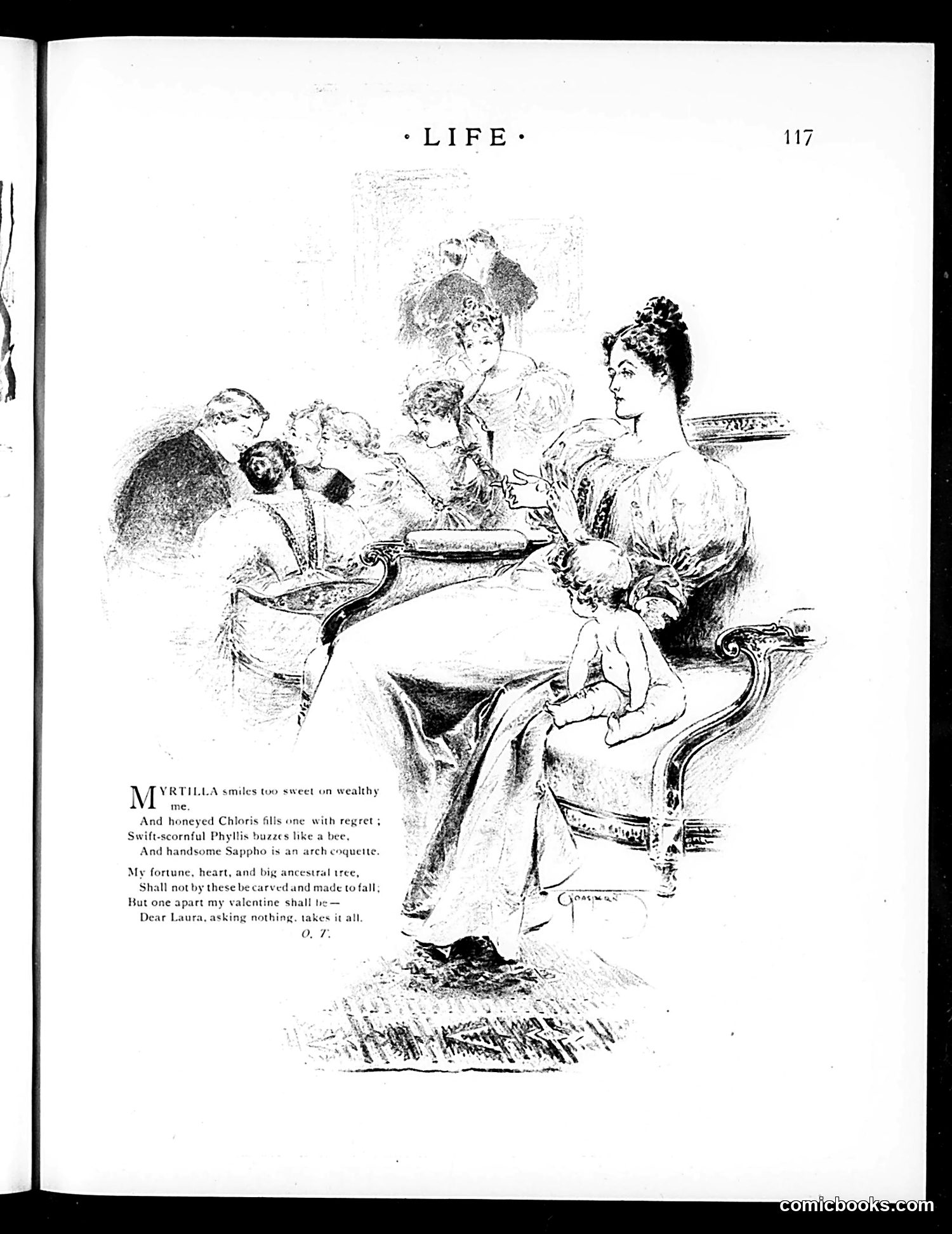
This page presents a satirical poem about romantic entanglements. A wealthy man lists four women—Myrtilla, Chloris, Phyllis, and Sappho—each representing a different romantic type (the sweet flatterer, the regretful temptress, the sharp-tongued critic, the coquette). He declares that despite their efforts to compromise his fortune, heart, and social status, only "Laura" remains his true valentine because she asks nothing of him. The accompanying illustration shows an elegant woman serving refreshments to seated guests in a drawing room, likely depicting the scene described. The satire targets both the shallow romanticism and mercenary attitudes of Gilded Age courtship, where women were often portrayed as either gold-diggers or manipulative, while the idealized woman asks for nothing—a commentary on unrealistic expectations of female virtue and selflessness in that era.
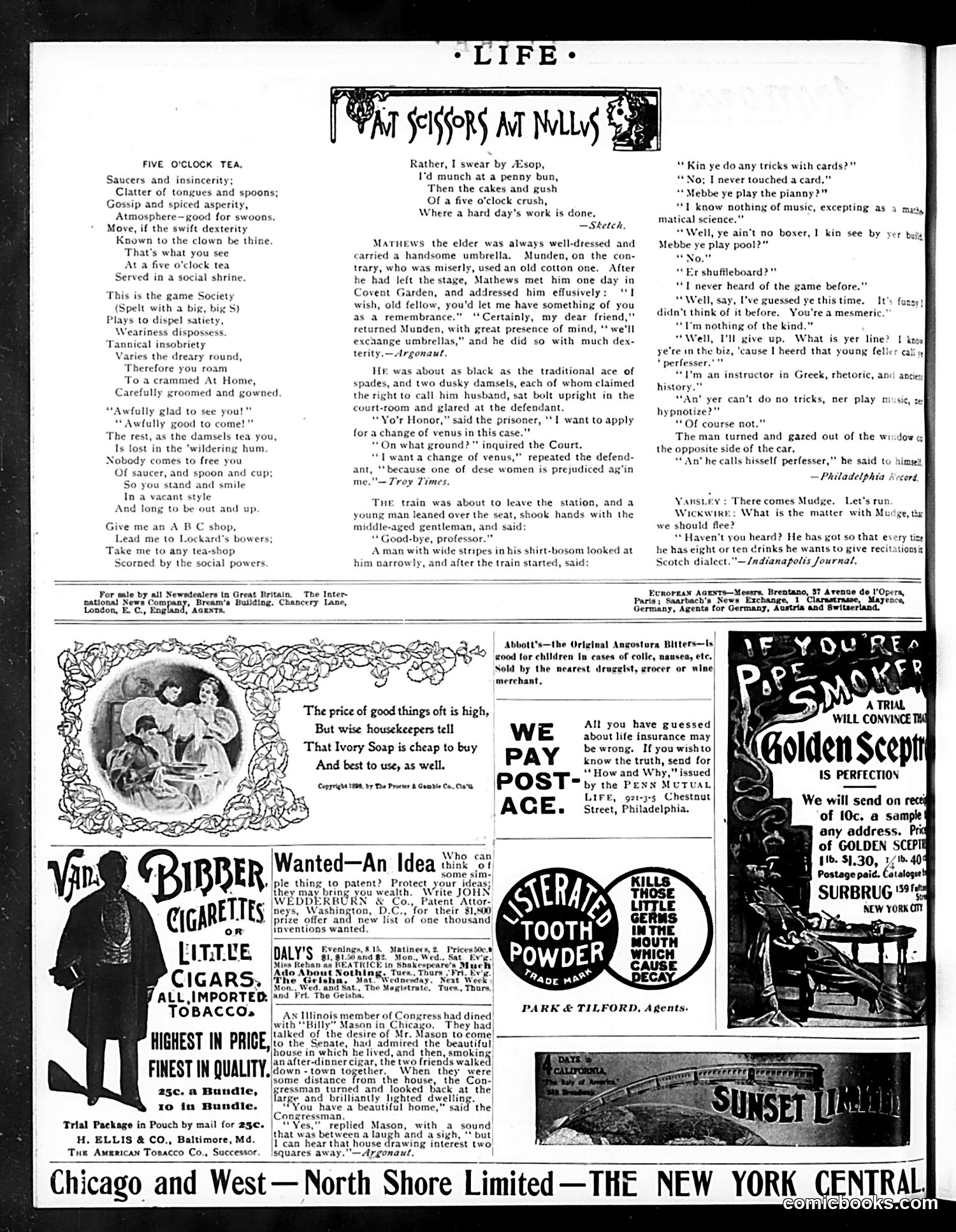
This page from Life magazine (a satirical weekly) contains primarily **humorous anecdotes and advertising** rather than political cartoons. The main content includes: 1. **"Five O'Clock Tea"** — A poem satirizing the tedious social ritual of afternoon tea among the upper classes, mocking the forced pleasantries, gossip, and affected behavior ("Awfully glad to see you") that accompanies these gatherings. The speaker prefers cheap tea shops to these pretentious social events. 2. **Several short joke pieces** about mistaken identities and social misunderstandings—including a story about umbrellas being exchanged, a courtroom scene with dialect humor, and a train encounter where a man tries to guess a professor's profession, unsuccessfully. 3. **Advertisements** dominate the lower half, promoting products like Van Bibber cigarettes, tooth powder, and insurance—typical of Life's revenue model. The satire targets **Victorian-era upper-class affectation and social pretension**, themes common to Life's editorial voice of this period.
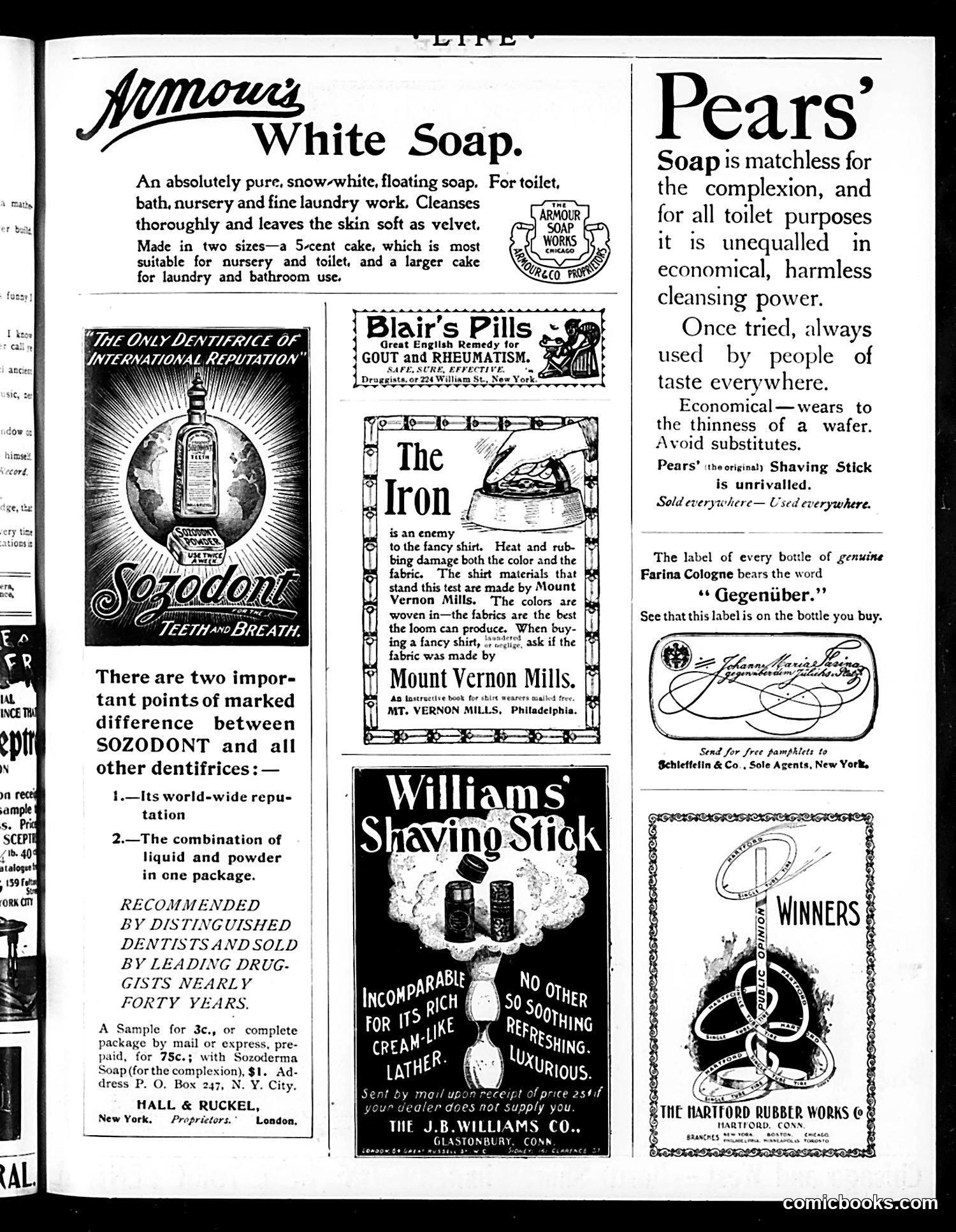
This page is **primarily advertising**, not editorial satire. It displays product ads for toiletries and household goods typical of early 20th-century American commerce. The advertisements shown include: - **Armour's White Soap** — pitched as pure and suitable for nurseries - **Sozodont Dentifrice** — claiming international reputation and unique liquid-powder combination, endorsed by dentists - **Blair's Pills** — a patent medicine for gout and rheumatism - **Mount Vernon Mills Shirts** — emphasizing durable fabric that withstands laundering - **Pears' Soap** — marketed for complexion care and economy - **Farina Cologne** — with emphasis on genuine labeling ("Gegenüber") - **Williams' Shaving Stick** and **Hartford Rubber Works** — additional grooming products These ads reflect consumer concerns of the era: purity claims (important before FDA regulation), patent medicines' prominence, and emphasis on product durability and gentlemen's grooming. The page documents period advertising strategies rather than containing political or social satire.
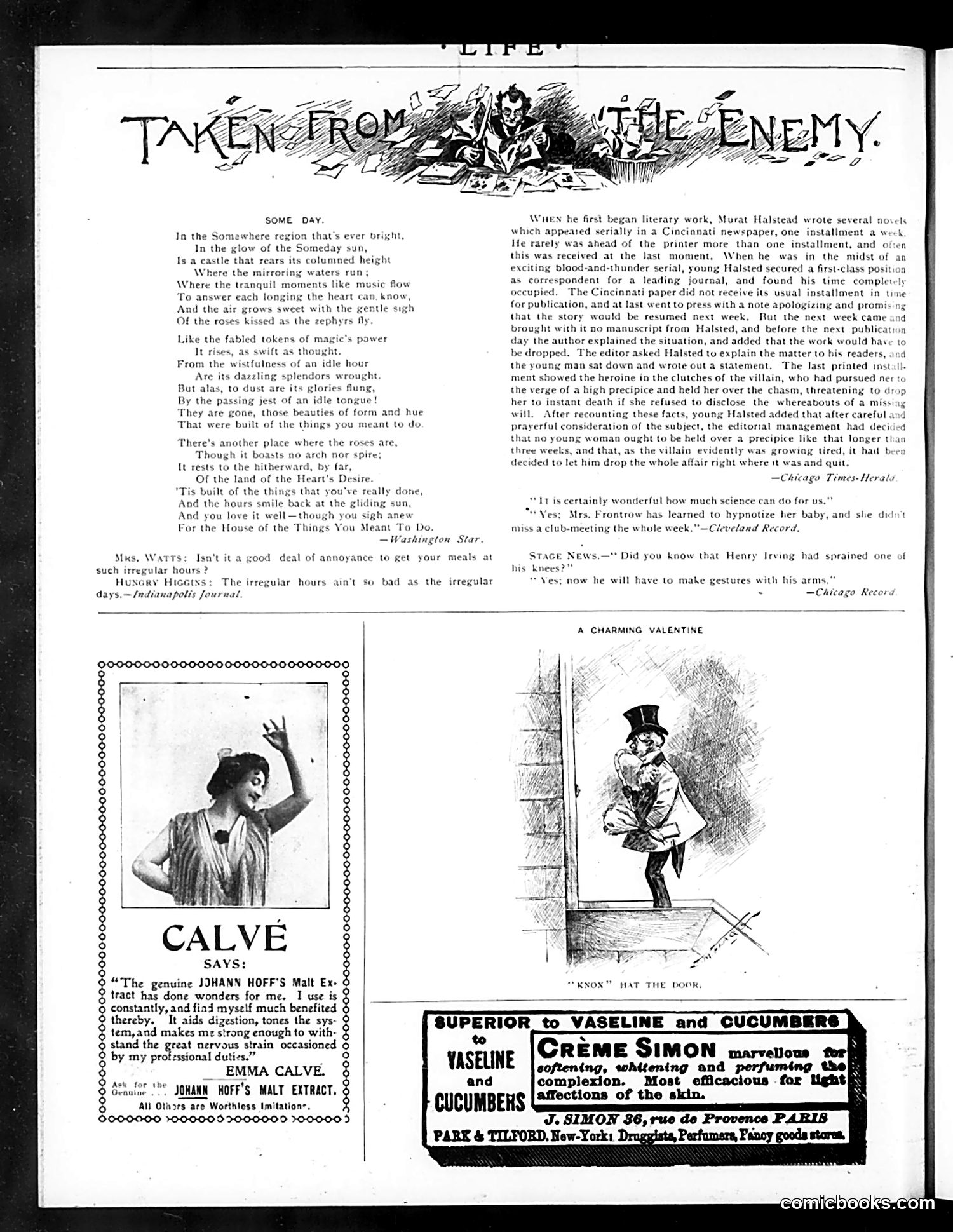
This page contains primarily **poetry, short anecdotes, and advertisements** rather than political cartoons. The content includes: **Literary pieces:** A sentimental poem ("Some Day") contrasting dreams with accomplishments, and humorous newspaper anecdotes about irregular work schedules and theatrical gossip. **Advertisements:** Testimonials from performer Emma Calve endorsing Johann Hoff's Malt Extract, and an ad for Crème Simon cosmetics. **Illustrations:** A small sketch labeled "A Charming Valentine" showing a man in a top hat at a doorway—likely a courtship or romantic scene typical of the era's genteel humor. The page reflects **turn-of-century American life**: concerns about work-life balance, endorsements by celebrities (Calve was a famous opera singer), and Victorian-era romantic sensibilities. The overall tone is lighthearted rather than satirical or political. This appears to be a lifestyle/entertainment page rather than commentary on current events.
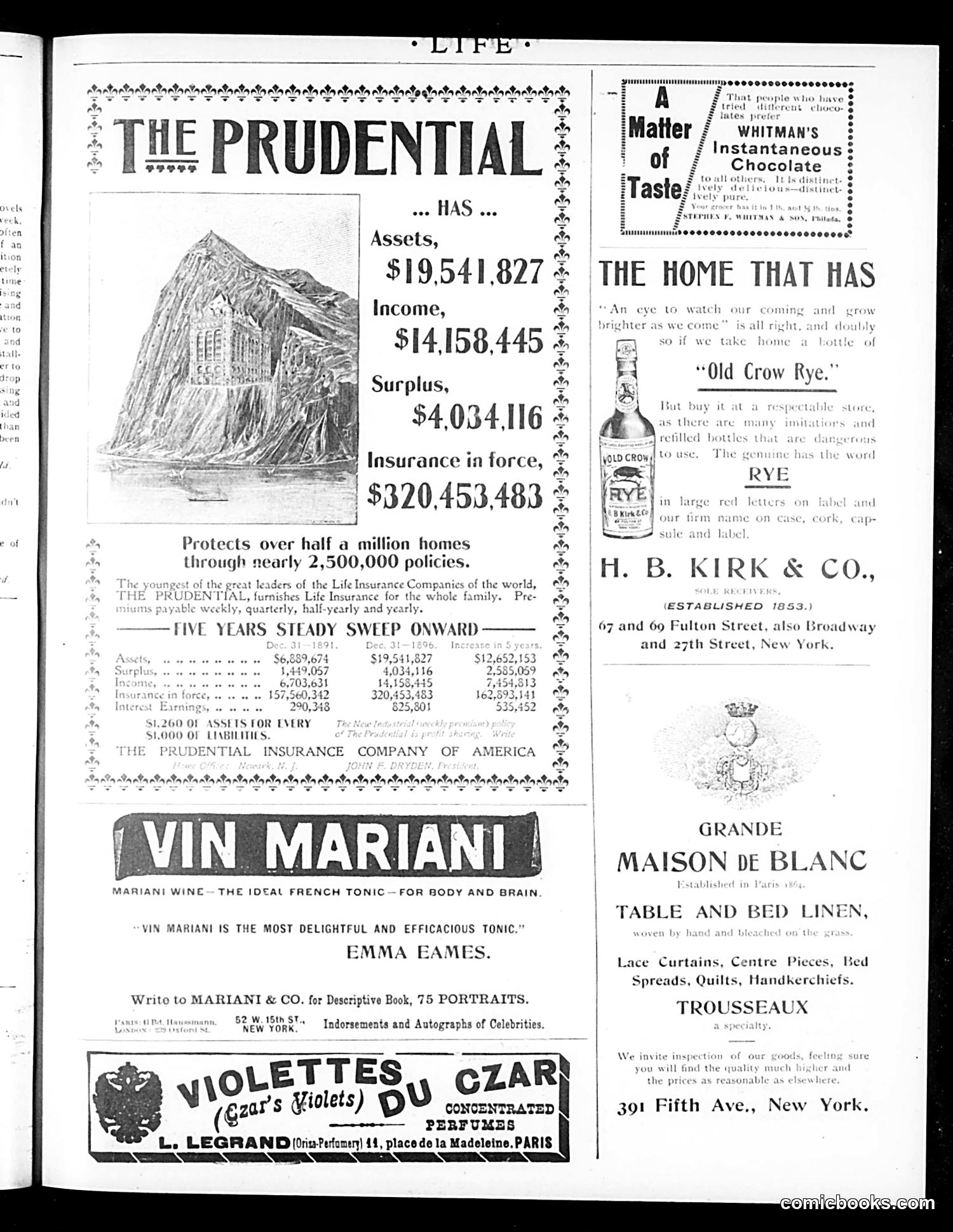
This page is primarily **advertising**, not political satire or cartooning. It features: **Main content:** The Prudential Insurance Company advertisement, displaying financial statistics (assets, income, surplus, insurance in force) and claiming to protect over half a million homes through nearly 2.5 million policies. The company's financial strength is the sales pitch. **Surrounding ads:** High-end consumer products—Whitman's chocolate, Vin Mariani (a French wine tonic), violets perfume, H.B. Kirk whiskey, and Maison de Blanc linens—target affluent readers. **Historical context:** This appears to be from the late 19th/early 20th century, when Life was a satirical weekly but also carried substantial advertising. The ads reflect period concerns: life insurance as a novel financial product, cocaine-containing tonics (Mariani), and luxury European goods as status symbols. There is no discernible political cartoon or satirical commentary on this page.
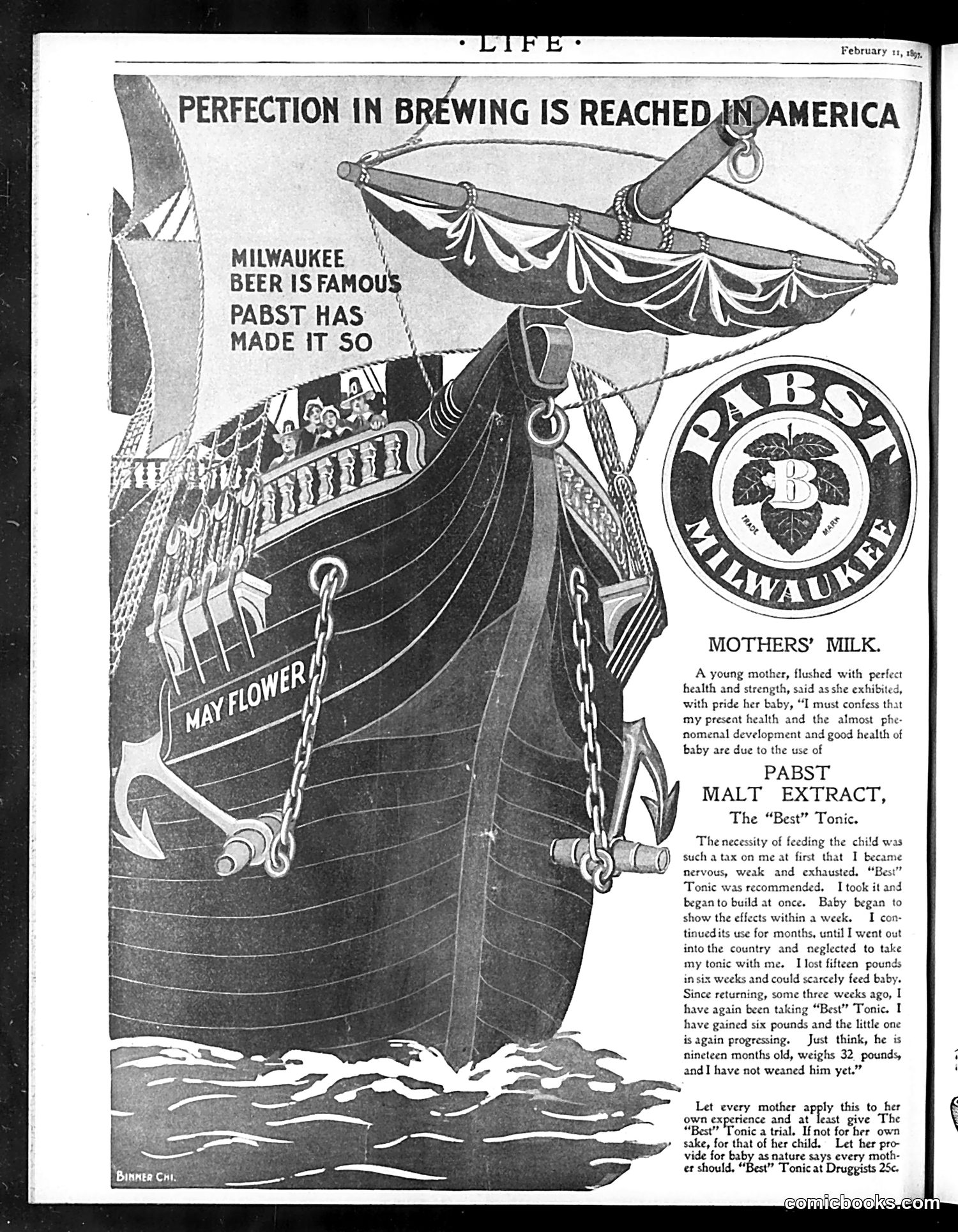
This is primarily an **advertisement**, not satire. The page uses the Mayflower ship and patriotic imagery to promote Pabst Malt Extract as a health tonic for mothers and infants. The central claim: a young mother credits her robust health and her 19-month-old baby's exceptional development (32 pounds) to Pabst Malt Extract. She describes becoming weak while nursing, recovering through the tonic, losing health when traveling without it, and regaining strength upon resuming use. **Historical context**: In the 1890s, malt extract was marketed as legitimate medical nutrition—not yet understood as ineffective. The advertisement exploits maternal anxiety about childrearing and infant health. The patriotic framing ("Perfection in Brewing is Reached in America") appeals to nationalist pride while positioning Milwaukee beer byproducts as essential maternal medicine. By modern standards, this represents dubious health claims marketed directly to vulnerable mothers—practices now regulated by the FDA.