
Life, 1897-02-11 · page 12 of 20
Life — February 11, 1897 — page 12: what you’re looking at
What you’re looking at
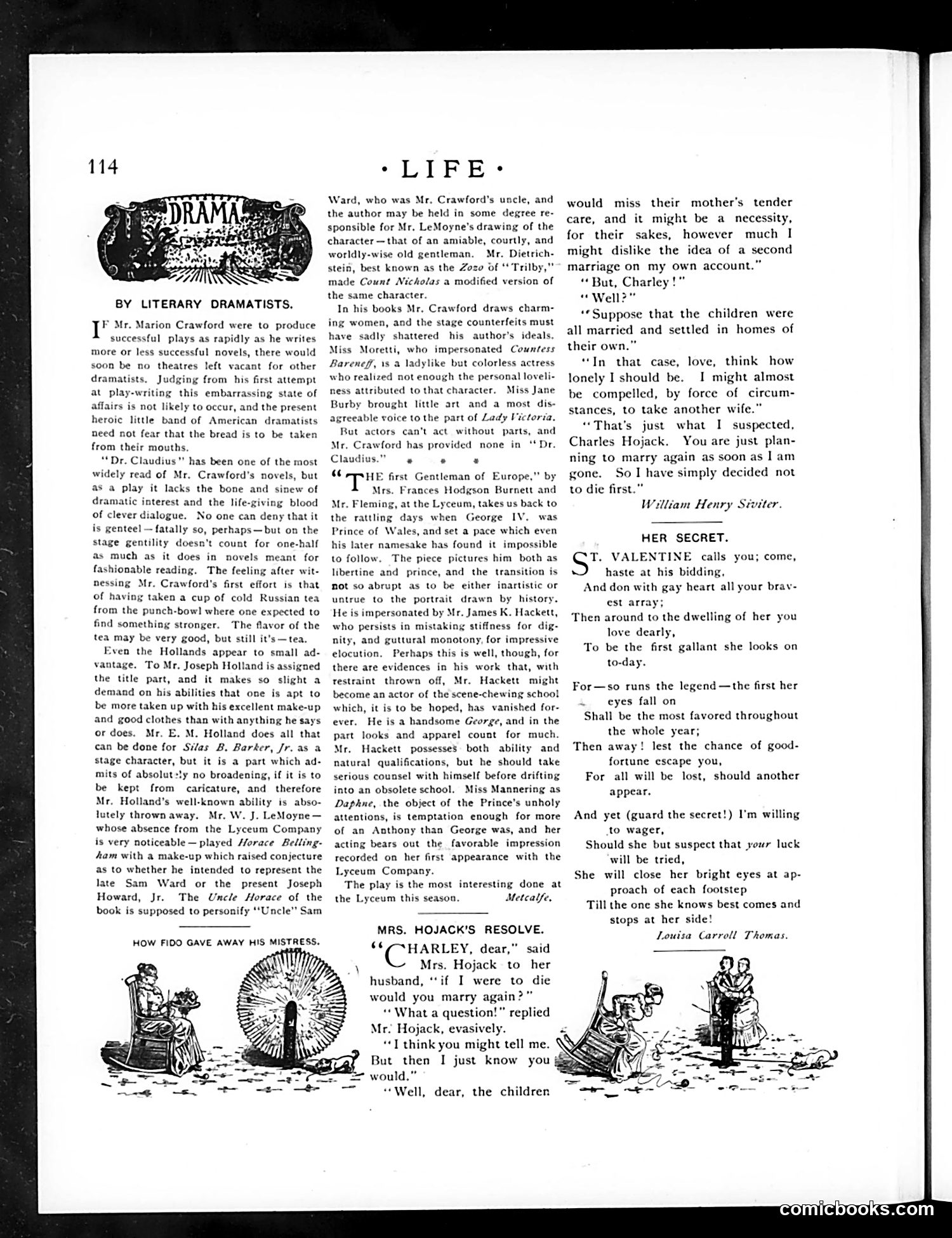
This page contains literary drama criticism and humorous fictional pieces rather than political cartoons. The main content includes: 1. **"Drama by Literary Characters"** - a critique of Mr. Marion Crawford's theatrical works, discussing how his stage characterizations fail to match his written ones. The critic notes Crawford's dialogue is clever but his dramatic construction is weak. 2. **Two illustrated comedic vignettes** with captions: - "How Fido Gave Away His Mistress" - showing a woman with a parasol (appears to be about a dog compromising someone) - "Mrs. Hojack's Resolve" - depicting a domestic conversation about remarriage These are lighthearted domestic humor pieces typical of *Life* magazine's satirical content, focusing on social conventions and marital relations rather than political commentary.
📄 Transcribed text from this page (OCR, searchable)
Machine-transcribed from the original scan — historical spelling and the odd misread are preserved.
BY LITERARY DRAMATISTS. JP Mr Marion Crawford were to produce successful plays as rapidly as he writes more or less successful novels, there would soon be no theatres left vacant for other dramatists. Judging from his first attempt at play-writing this embarrassing state of affairs is not likely to occur, and the present heroic little band of American dramatists need not fear that the bread is to be taken from their mouths. “Dr. Claudius” has been one of the most widely read of Mr. Crawford's novels, but as a play it lacks the bone and sinew of dramatic interest and the life-giving blood of clever dialogue. No one can deny that it is genteel —fatally so, perhaps—but on the stage gentility doesn't count for one-half as much as it does in novels meant for fashionable reading. The feeling after wit- nessing Mr. Crawford's first effort is that of having taken a cup of cold Russian tea from the punch-bow! where one expected to find something stronger. The flavor of the tea may be very good, but still it's —tea. Even the Hollands appear to small ad- vantage. To Mr, Joseph Holland is assigned the title part, and it makes so slight a demand on his abilities that one is apt to be more taken up with his excellent make-up and good clothes than with anything he says or does. Mr. E. M, Holland does all that can be done for Silas B. Barker, Jr. as a stage character, but it is a part which ad- mits of absolut:!y no broadening, if it is to be kept from caricature, and therefore Mr, Holland’s well-known ability is abso- lutely thrown away. Mr. W. J. LeMoyne— whose absence from the Lyceum Company is very noticeable — played Horace Belling- Aam with a make-up which raised conjecture as to whether he intended to represent the late Sam Ward or the present Joseph Howard, Jr. The Uncle Horace of the book is supposed to personify “Uncle” Sam HOW FIDO GAVE AWAY HIS MISTRESS. > LIFE: Ward, who was Mr, Crawford's uncle, and the author may be held in some degree re- sponsible for Mr. LeMoyne's drawing of the character —that of an amiable, courtly, and worldly-wise old gentleman. Mr. Dietrich- stein, best known as the Zozo of ‘ Trilby,” made Count Nicholas a modified version of the same character. In his books Mr, Crawford draws charm- ing women, and the stage counterfeits must have sadly shattered his author's ideals, Miss Moretti, who impersonated Countess Bareneff, 13 a ladylike but colorless actress who realized not enough the personal loveli- ness attributed to that character. Miss Jane Burby brought little art_ and a most dis- agreeable voice to the part of Lady Victoria, Rut actors can't act without parts, and Mr. Crawford has provided none in ‘Dr. Claudius." . . * SC FRHE first Gentleman of Europe,” by Mrs. Frances Hodgson Burnett and Mr. Fleming, at the Lyceum, takes us back to the rattling days when George IV. Prince of Wales, and set a pace which even his later namesake has found it impossible to follow. The piece pictures him both as libertine and prince, and the transition is not so abrupt as to be either inartistic or untrue to the portrait drawn by history. He is impersonated by Mr. James K. Hackett, who persists in mistaking stiffness for dig- nity, and guttural monotony, for impressive elocution. Perhaps this is well, though, for there are evidences in his work that, with restraint thrown off, Mr. Hackett might become an actor of the scene-chewing school which, it is to be hoped, has vanished for- ever. He is a handsome George, and in the part looks and apparel count for much. Mr. Hackett possesses both ability and natural qualifications, but he should take serious counsel with himself before drifting into an obsolete school. Miss Mannering as Daphne, the object of the Prince's unholy attentions, is temptation enough for more of an Anthony than George was, and her acting bears out the favorable impression recorded on her first appearance with the Lyceum Company. ‘The play is the most interesting done at the Lyceum this season. Metcalfe, was MRS. HOJACK’S RESOLVE. 66 /->HARLEY, dear,” Mrs. Hojack to her husband, ‘if I were to would you marry again?” «*What a question!” replied said Mr. Hojack, evasively. “I think you might tell me. But then I just know you “Well, dear, the children would miss their mother’s tender care, and it might be a_ necessity, for their sakes, however much I might dislike the idea of a second marriage on my own account.” “But, Charley! ‘ Well?” “‘Suppose that the children were all married and settled in homes of their own.” “In that case, love, think how lonely I should be. I might almost be compelled, by force of circum- stances, to take another wife.” “That's just what I suspected, Charles Hojack. You are just plan- ning to marry again as soon as 1 am gone. Sol have simply decided not to die first.” William Henry Siviter. HER SECRET. T. VALENTINE calls you; come, haste at his bidding, And don with gay heart all your brav- est array; Then around to the dwelling of her you love dearly, To be the first gallant she looks on to-day. For—so runs the legend —the first her eyes fall on Shall be the most favored throughout the whole year; Then away! lest the chance of good- fortune escape you, For all will be lost, should another appear. And yet (guard the secret!) I'm willing to wager, Should she but suspect that your luck will be tried, e will close her bright eyes at ap- proach of each footstep Till the one she knows best comes and stops at her side! Louisa Carroll Thomas.