
Life, 1897-02-11 · page 8 of 20
Life — February 11, 1897 — page 8: what you’re looking at
What you’re looking at
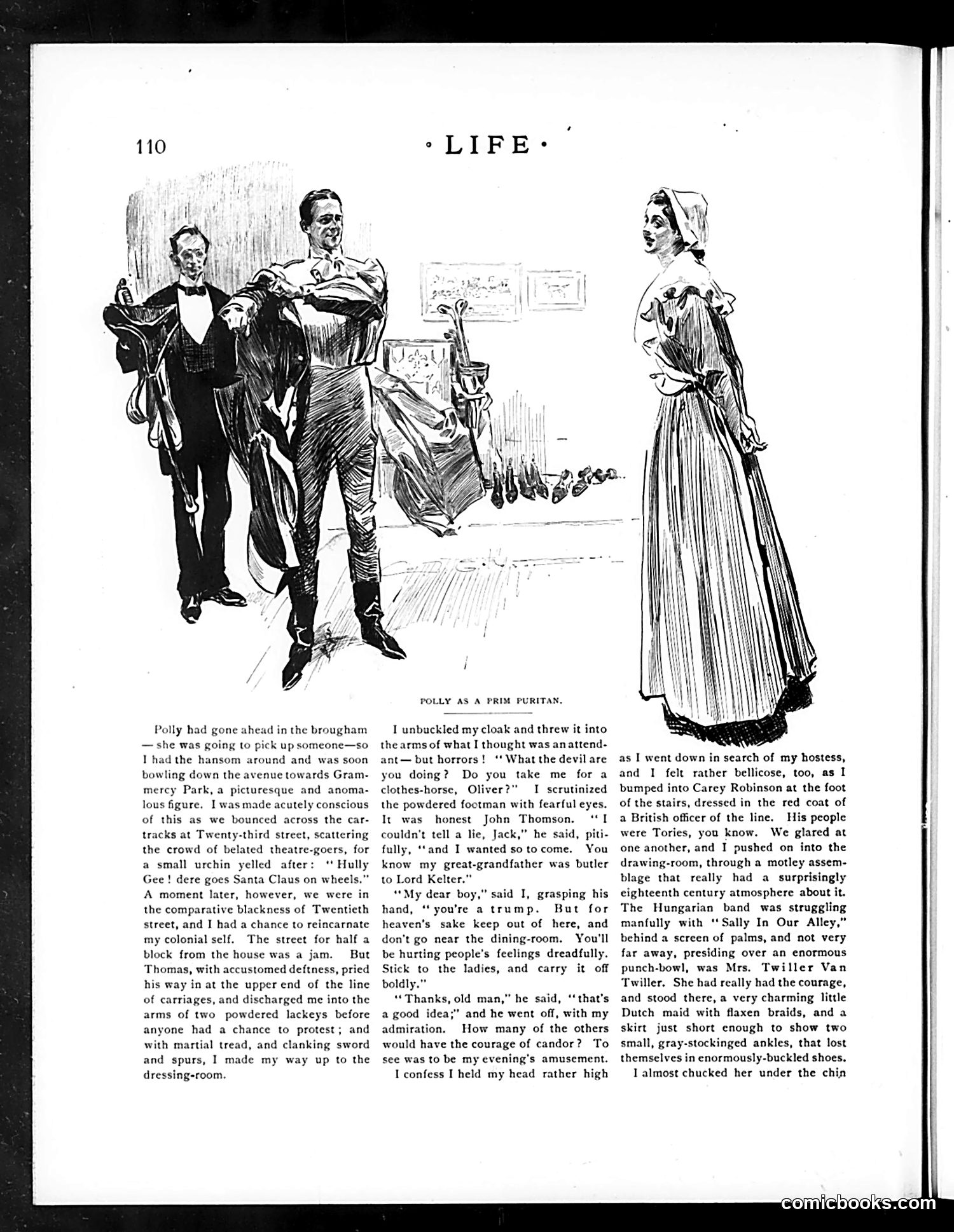
This satirical illustration depicts a social scene where the narrator encounters a woman named Polly at what appears to be a theatrical or formal gathering. The joke centers on Polly's contradictory behavior: she presents herself as prim and proper (hence "Puritan"), yet the narrator's account reveals her actually engaging in improper conduct—flirting, physical contact, and attending questionable venues. The satire targets the Victorian-era hypocrisy of women who maintain respectable public appearances while behaving less virtuously in private. The illustration shows Polly in a long, modest dress with a bonnet, embodying conventional propriety, while the text exposes the gap between her outward presentation and actual conduct. This is typical of *Life* magazine's social commentary on middle-class pretense.
📄 Transcribed text from this page (OCR, searchable)
Machine-transcribed from the original scan — historical spelling and the odd misread are preserved.
NS Y q % Polly had gone ahead in the brougham — she was going to pick up someone—so I had the hansom around and was soon bowling down the avenue towards Gram- mercy Park, a picturesque and anoma- lous figure. I was made acutely conscious of this as we bounced across the car- tracks at Twenty-third street, scattering the crowd of belated theatre-goers, for a small urchin yelled after: ‘ Hully Gee! dere goes Santa Claus on wheels.” A moment later, however, we were in the comparative blackness of Twentieth street, and I had a chance to reincarnate my colonial self. The street for half a block from the house was a jam. But Thomas, with accustomed deftness, pried his way in at the upper end of the line of carriages, and discharged me into the arms of two powdered lackeys before anyone had a chance to protest; and with martial tread, and clanking sword and spurs, I made my way up to the dressing-room. POLLY AS A PRIM PURITAN, I unbuckled my cloak and threw it into the arms of what I thought was anattend- ant— but horrors! ‘* What the devil are you doing? Do you take me for a clothes-horse, Oliver?” I scrutinized the powdered footman with fearful eyes. It was honest John Thomson. * couldn't tell a lie, Jack,” he said, piti- fully, ‘‘and I wanted soto come. You know my great-grandfather was butler to Lord Kelter.” said I, grasping his , “you're a trump. But for heaven's sake keep out of here, and don’t go near the dining-room. You'll be hurting people’s feelings dreadfully. Stick to the ladies, and carry it off boldly.” “Thanks, old man,” he said, ‘‘that's a good idea; and he went off, with my admiration. How many of the others would have the courage of candor? To see was to be my evening's amusement. I confess I held my head rather high as I went down in search of my hostess, and I felt rather bellicose, too, as I bumped into Carey Robinson at the foot of the stairs, dressed in the red coat of a British officer of the line. His people were Tories, you know. We glared at one another, and I pushed on into the drawing-room, through a motley assem- blage that really had a_ surprisingly eighteenth century atmosphere about it. The Hungarian band was struggling manfully with ‘Sally In Our Alley,” behind a screen of palms, and not very far away, presiding over an enormous punch-bowl, was Mrs. Twiller Van Twiller, She had really had the courage, and stood there, a very charming little Dutch maid with flaxen braids, and a skirt just short enough to show two small, gray-stockinged ankles, that lost themselves in enormously-buckled shoes. I almost chucked her under the chin