
Life, 1897-02-11 · page 6 of 20
Life — February 11, 1897 — page 6: what you’re looking at
What you’re looking at
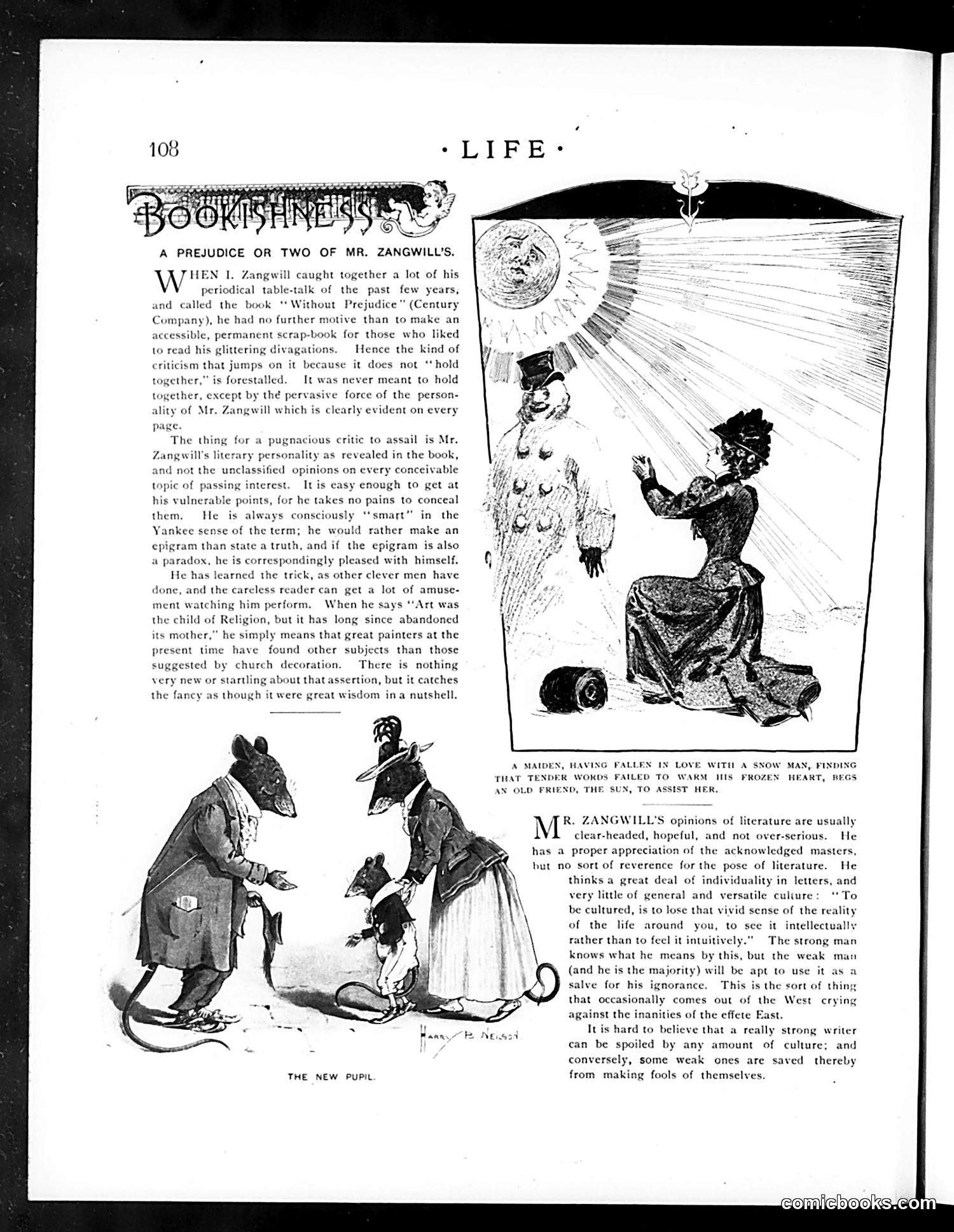
This page critiques Mr. Zangwill's literary personality and writing style. The text argues that while Zangwill presents himself as "smart" and clever, he prioritizes witty epigrams over substantive truth, and is "consciously pleased with himself" about this approach. The two cartoons illustrate this critique: 1. **"The New Pupil"** (bottom): Shows anthropomorphic rats/mice in clothing, likely satirizing Zangwill's characters or writing subjects as trivial or small-minded. 2. **Upper cartoon**: Depicts a maiden in snow attempting to warm a snowman using the sun's help—a whimsical, impractical scenario that appears to mock the sentimental or absurd nature of Zangwill's literary subject matter. The satire suggests Zangwill prioritizes style over substance and treats serious topics frivolously.
📄 Transcribed text from this page (OCR, searchable)
Machine-transcribed from the original scan — historical spelling and the odd misread are preserved.
A PREJUDICE OR TWO OF MR. ZANGWILL’S. WwW" N I. Zangwill caught together a lot of his periodical table-talk of the past few years, nd called the book ‘* Without Prejudice” (Century Company), he had no further motive than to make an accessible, permanent scrap-book for those who liked to read his glittering divagations. Hence the kind of criticism that jumps on it because it does not “hold together,” is forestalled. It was never meant to hold together, except by thé pervasive force of the person- ality of Mr. Zangwill which is clearly evident on every page. The thing for a pugnacious critic to assail is Mr. Zangwill’s literary personality as revealed in the book, 1 not the unclassified opinions on every conceivable topic of passing interest. It is easy enough to get at his vulnerable points, for he takes no pains to conceal them. He is always consciously “smart” in the Yankee sense of the term; he would rather make an epigram than state a truth, and if the epigram is also a paradox, he is correspondingly pleased with himself. He has learned the tr as other clever men have ne, and the careless reader can get a lot of amuse- ment watching him perform. When he says ‘Art was the child of Religion, but it has long since abandoned its mother,” he simply means that great painters at the present time have found other subjects than those suggested by church decoration. There is nothing very new or startling about that assertion, but it catches the fancy as though it were great wisdom ina nutshell. THE NEW PUPIL. HAVING FALLEN IN LOVE WITH A SNOW Mal R WOKDS FAILED TO WARM IIIS FROZEN HEART, REGS D, THE SUN, TO ASSIST HER. M R. NGWILL’S opinions of literature are usually clear-headed, hopeful, and not over-serious. He has a proper appreciation of the acknowledged masters, hut no sort of reverence for the pose of literature. He thinks a great deal of individuality in letters, and very little of general and versatile culiure To be cultured, is to lose that vivid sense of the reality of the life around you, to see it intellectually rather than to feel it intuitively.” The strong man knows what he means by this, but the weak man (and he is the majority) will be apt to use it as a salve for his ignorance. This is the sort of thing that occasionally comes out of the West crying against the inanities of the effete te It is hard to believe that a really strong writer can be spoiled by any amount of culture; and conversely, some weak ones are saved thereby from making fools of themselves.