
A complete issue · 20 pages · 1897
Life — February 4, 1897
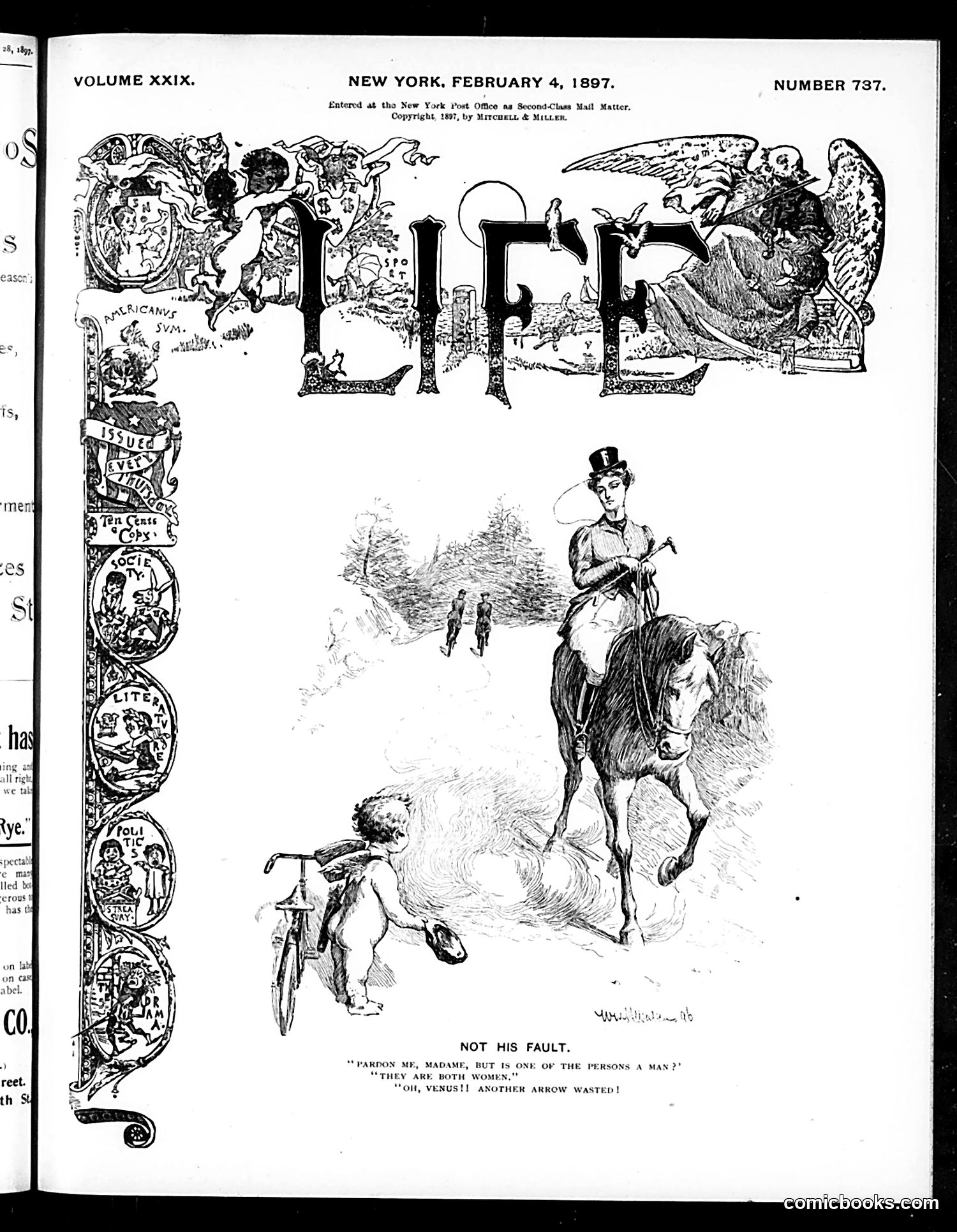
**The Cartoon: "Not His Fault"** This illustration satirizes a collision between a cyclist and an equestrian rider. The caption reads: "Pardon me, Madame, but is one of the persons a man?" "They are both women." "Oh, Venus! Another arrow wasted!" The joke references the late-19th-century "bicycle craze" and emerging "New Woman" phenomenon—women increasingly riding bicycles and adopting more independent lifestyles. The cartoon mocks this social shift by depicting two women colliding, with the male rider lamenting that his romantic "arrow" (Cupid's arrow, implying flirtation) was "wasted" on women rather than a potential female conquest. The satire reflects contemporary anxieties about changing gender roles and women's autonomy during this period.
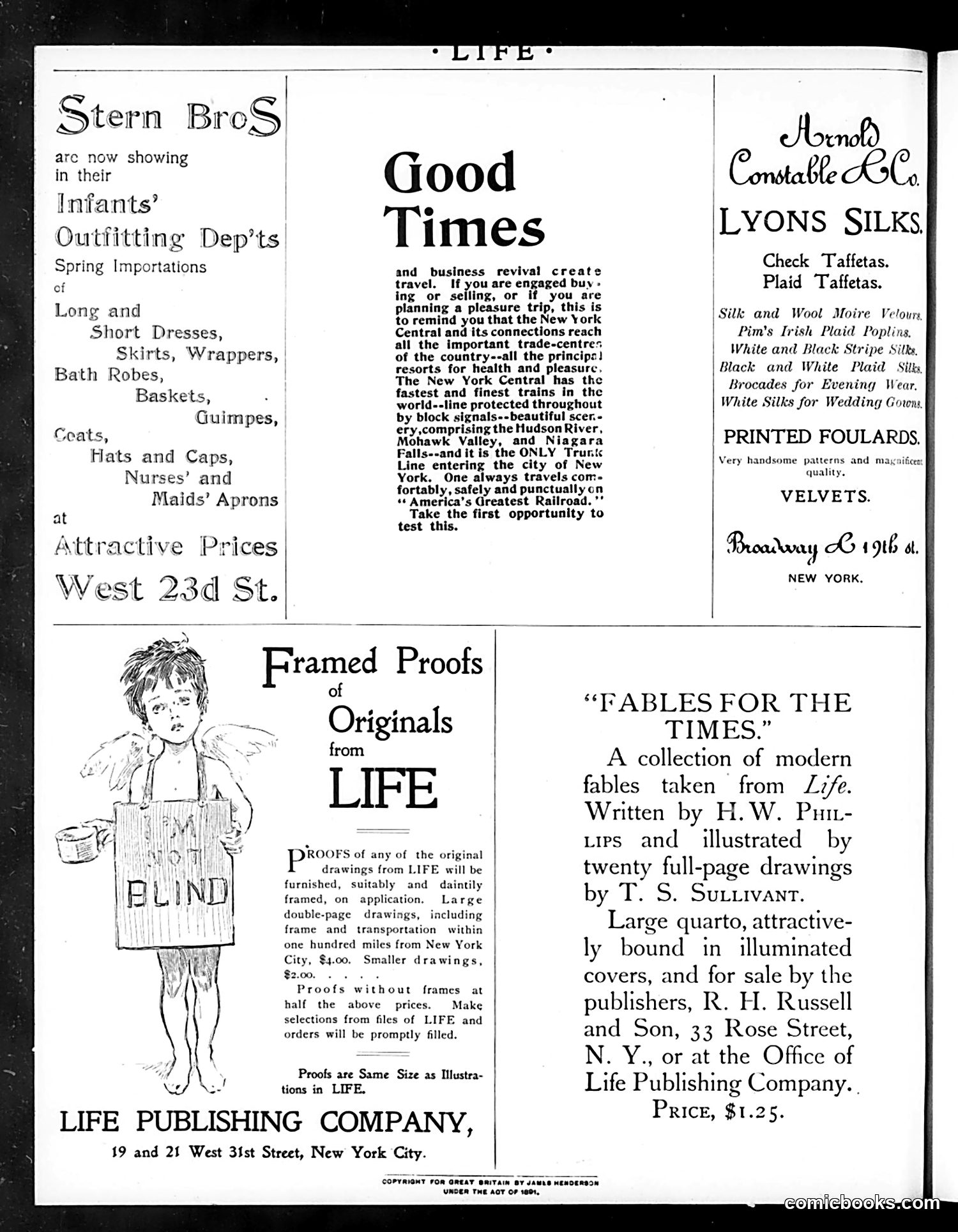
This page is primarily **advertising content** from Life magazine, not political satire. It contains four separate ads: 1. **Stern Bros.** — department store ad for children's clothing and accessories 2. **"Good Times"** — New York Central railroad ad promoting travel and business revival 3. **Arnold Constable & Co.** — silk and fabric merchant ad 4. **Life Publishing Company** — ad for framed artwork proofs and a book called "Fables for the Times" by H.W. Phillips, illustrated by T.S. Sullivant The only cartoon element is an illustration of a blindfolded figure holding a cane, accompanying the "Framed Proofs of Originals from LIFE" advertisement. The blindfold likely references the common "blind" figure used in satirical art, though without additional context, the specific satirical meaning is unclear.
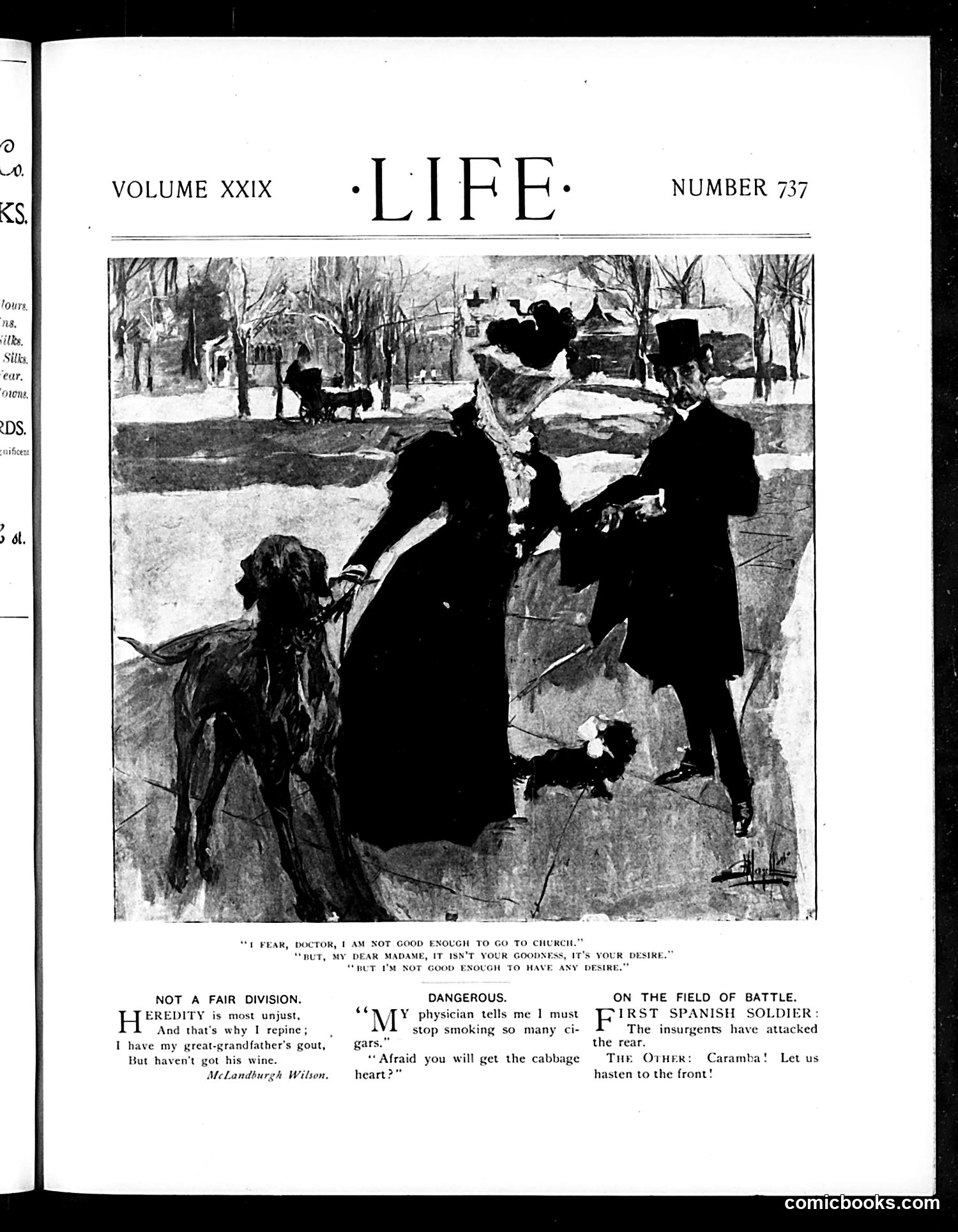
This Life magazine page (Volume XXIX, Number 737) contains three separate satirical vignettes about social behaviors: **"Not a Fair Division"**: Satirizes hereditary aristocracy—a man complains he inherited his great-grandfather's gout but not his wealth, referencing Scottish writer McLandrugh's Wilson. The joke targets the unfairness of inheriting only disadvantages. **"Dangerous"**: A doctor warns a patient to stop smoking cigars; the patient fears stopping will cause heartbreak. This mocks vanity and addiction. **"On the Field of Battle"**: Spanish soldiers debate whether to attack insurgents. The caption is unclear without historical context, but appears to reference colonial conflict. The main illustration depicts a Victorian-era park scene with well-dressed figures and dogs—likely illustrating one of these satirical scenarios about class, health, or social propriety.
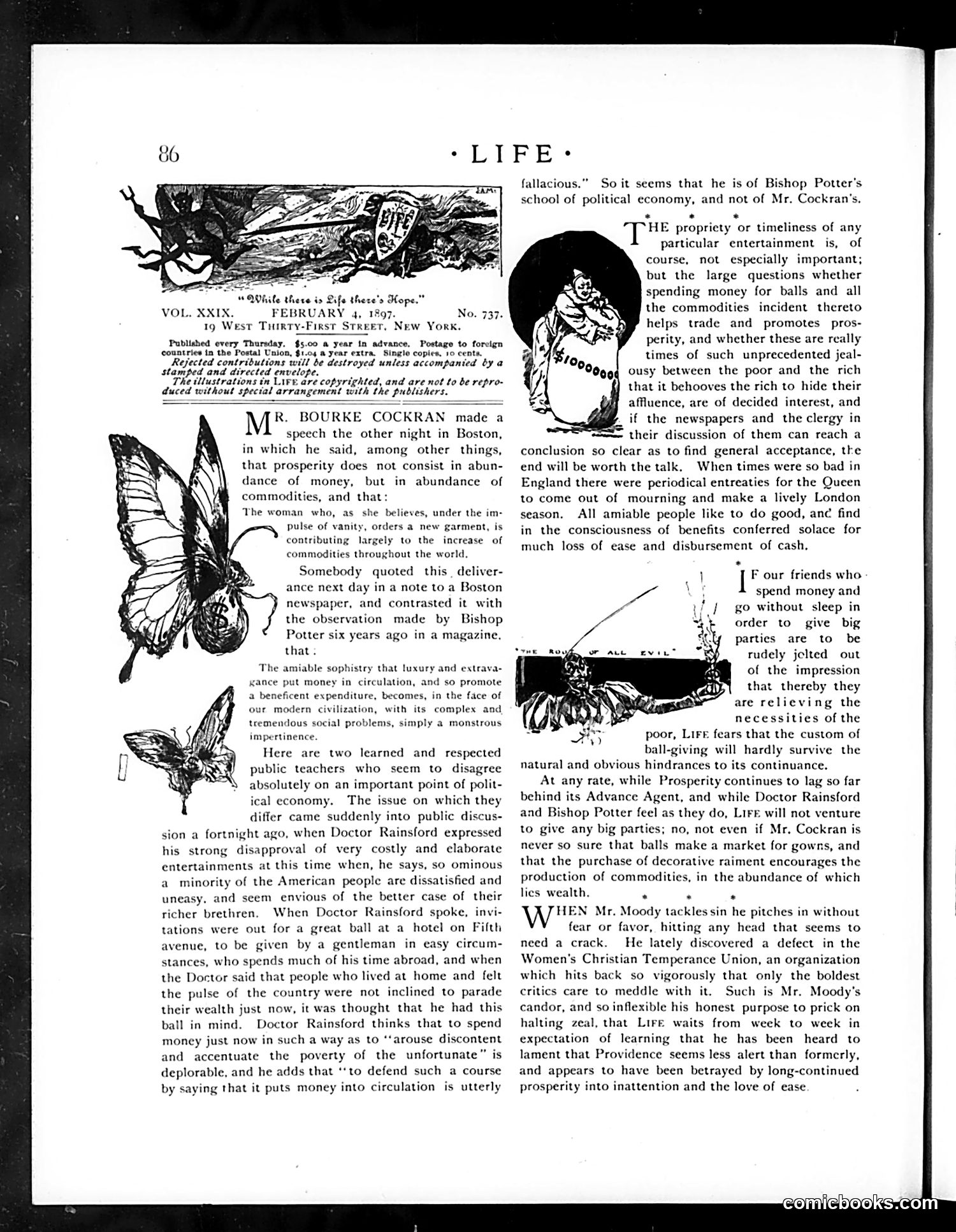
This page satirizes a debate about wealthy Americans' spending habits and social responsibility. Mr. Bourke Cockran made a Boston speech defending luxurious consumption as beneficial to commerce and workers. Bishop Potter contradicted him six years earlier, opposing elaborate entertainments as morally wrong during economic hardship. The article mocks both positions while targeting Mr. Moody's recent criticism of the Women's Christian Temperance Union for opposing ball-giving. Life suggests that excessive parties don't genuinely help the poor—they merely circulate wealth among the wealthy while creating false justification for inequality. The satirical insects decorating the margins emphasize the trivial nature of these elite debates about consumption ethics.
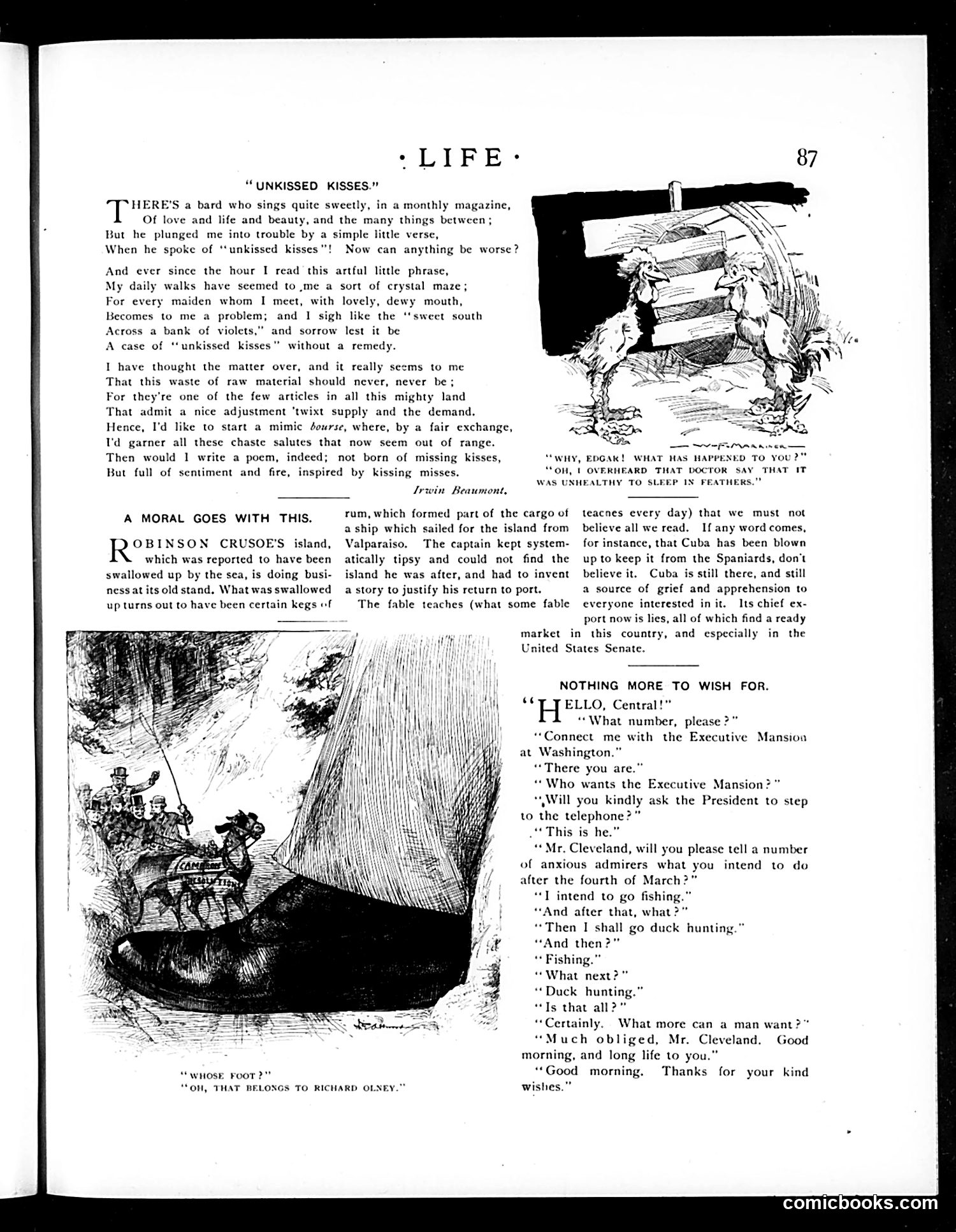
This page contains three distinct pieces: 1. **"Unkissed Kisses"** - A poem satirizing romantic frustration, complaining that unmarried women have become unapproachable problems. 2. **"A Moral Goes With This"** - A brief fable about Robinson Crusoe's island being swallowed by sea, with an unclear moral lesson (the OCR text is incomplete). 3. **"Nothing More to Wish For"** - A humorous dialogue with President Cleveland, where a caller asks the President's plans after March 4th. Cleveland replies he intends to fish, then duck hunt, then fish again—depicting him as singularly focused on leisure activities. The joke satirizes either Cleveland's retirement ambitions or his priorities as trivial. The cartoons appear early-to-mid 19th century in style.
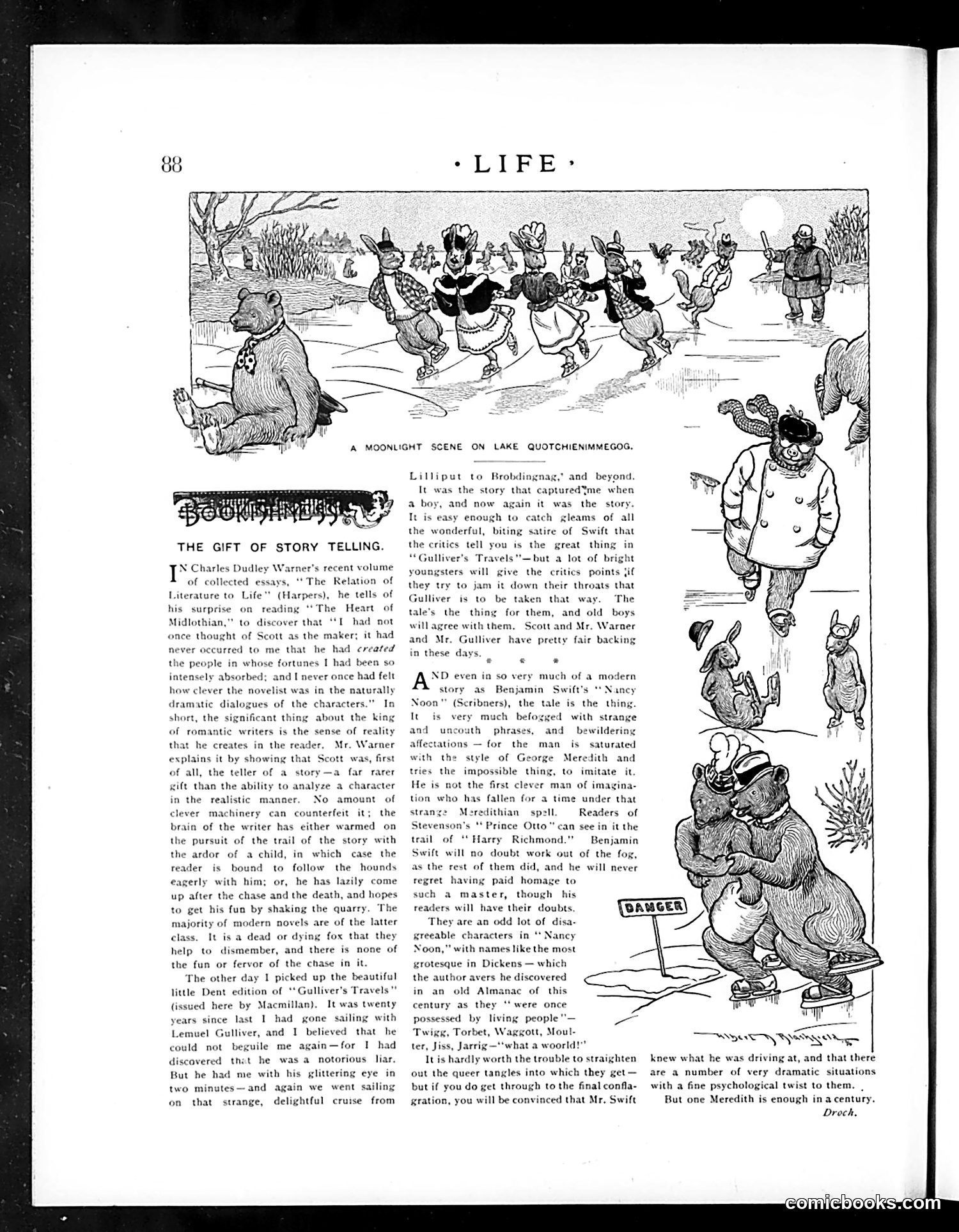
This page discusses "The Gift of Story Telling," reviewing Charles Dudley Warner's collected essays on literature. The main illustration shows "A Moonlight Scene on Lake Quotchienimmegog" — an apparently fictional lake name used for comedic effect. The cartoon depicts anthropomorphic animals ice skating on a frozen lake, likely satirizing popular winter recreation and literary sentimentality. The accompanying text praises Warner's ability to create realistic characters and analyze their psychological complexity, contrasting this with other contemporary writers like Benjamin Swift (author of "Nancy Noon"). The humor seems directed at overwrought romantic fiction and the pretensions of literary critics, celebrating Warner's more grounded approach to character development and storytelling.
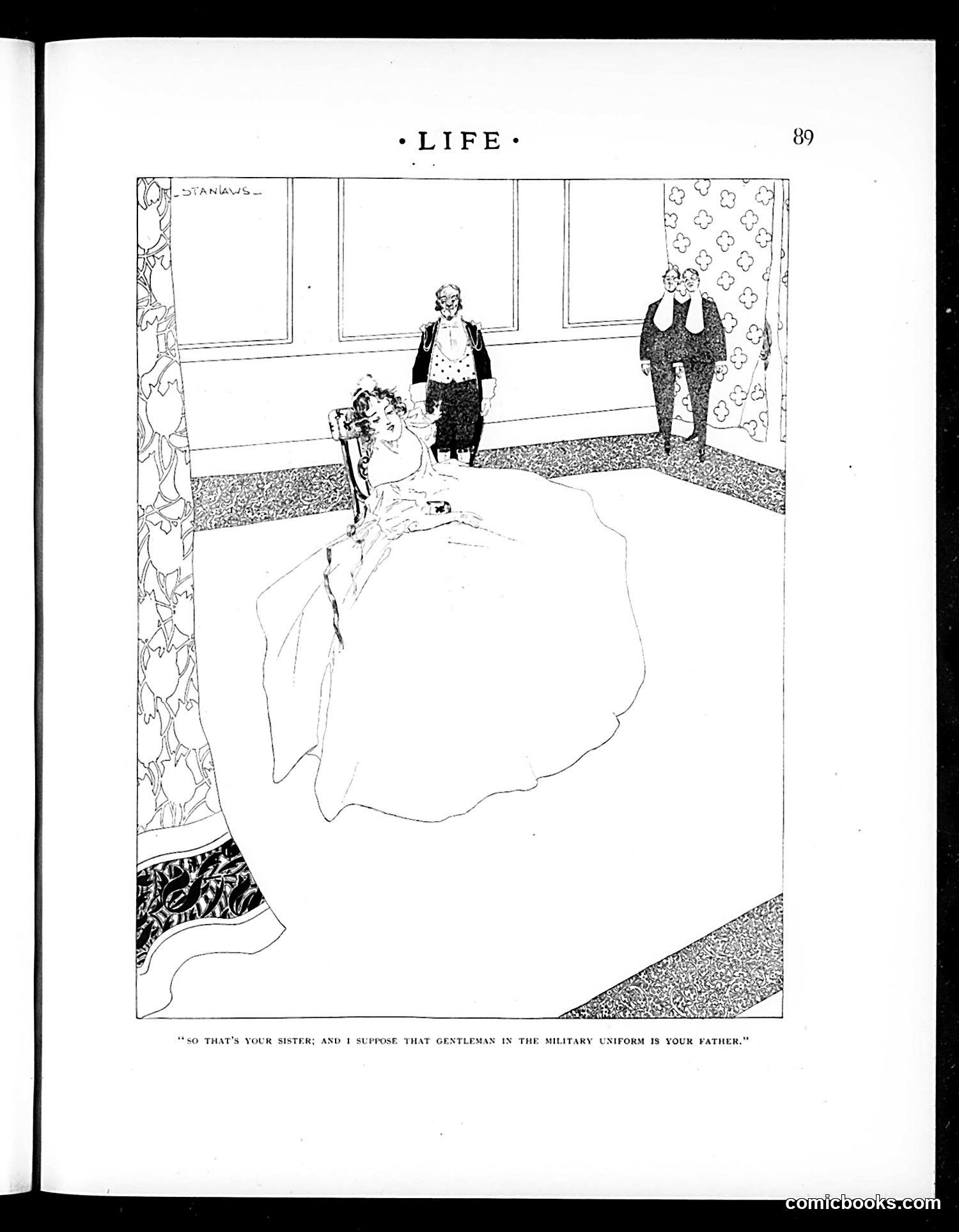
This cartoon satirizes paternity and family legitimacy. A young woman in an elaborate white wedding dress sits prominently in the foreground, while three adults (appearing to be older relatives or guardians) stand in the background of what seems to be a formal interior. The caption reads: "So that's your sister; and I suppose that gentleman in the military uniform is your father." The joke hinges on the implication that the woman's claimed family relationships are false or improvised—specifically suggesting she's fabricating connections to appear respectable. The military uniform detail adds a layer of satire about using impressive-sounding credentials to gain social standing. This reflects early 20th-century anxieties about social climbing, authenticity, and the performative nature of respectability.
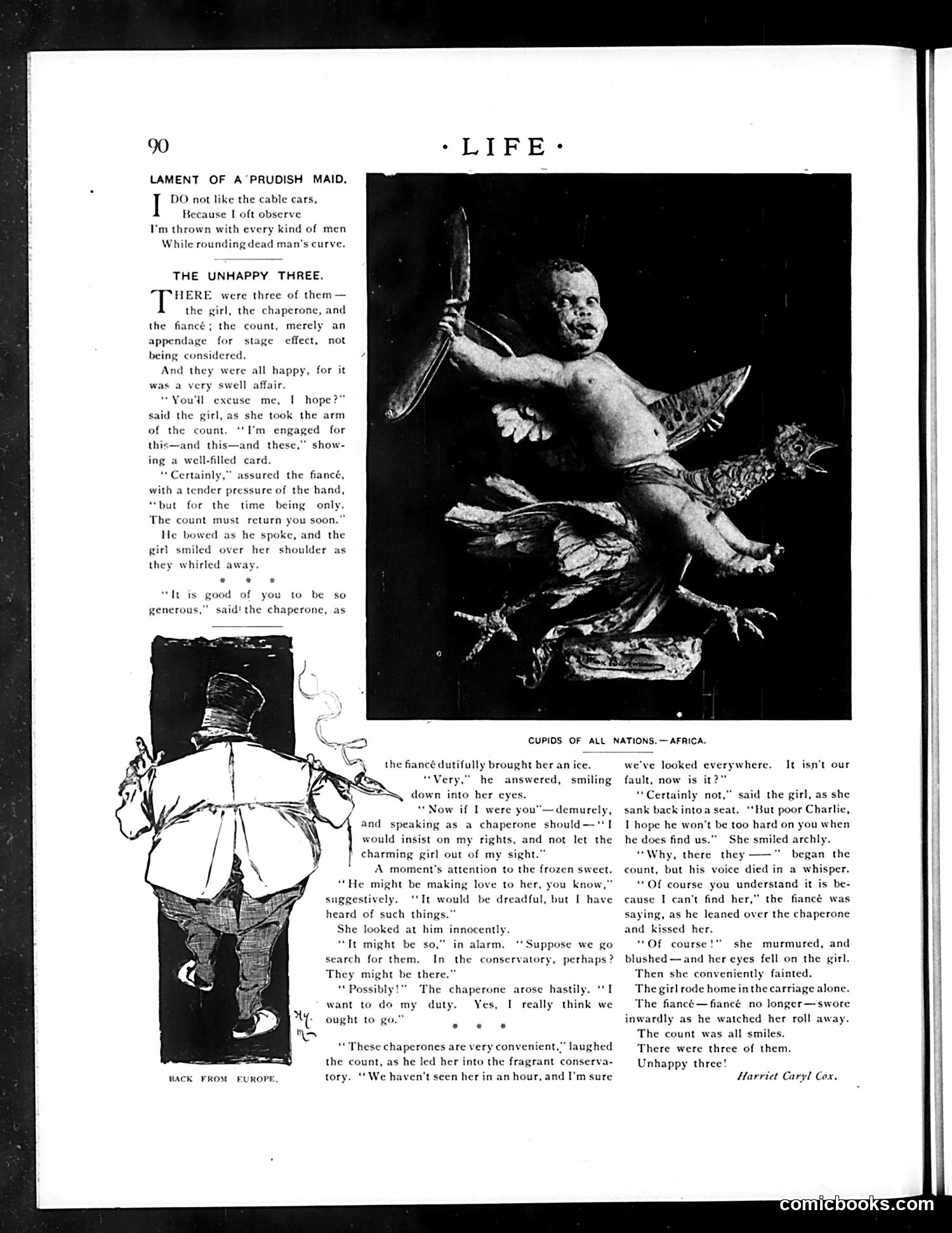
This page contains two pieces of satirical fiction rather than political cartoons: **"Lament of a Prudish Maid"** — a short poem mocking a proper woman's complaints about working conditions (observing cable cars and dead men's curves). **"The Unhappy Three"** — a romantic story satirizing social pretense. It depicts three characters: a girl, a chaperone (an older woman hired to supervise young women's behavior), and a count posing as nobility. The satire targets the absurdity of rigid Victorian courtship conventions, where a chaperone's presence supposedly preserves propriety while enabling deception. The count uses flattery and fake engagement announcements; the chaperone conveniently enables secret moments; and the girl faints conveniently. The accompanying illustrations—one showing a man from behind (captioned "Back from Europe") and another labeled "Cupids of All Nations—Africa"—mock both European sophistication and colonial attitudes.
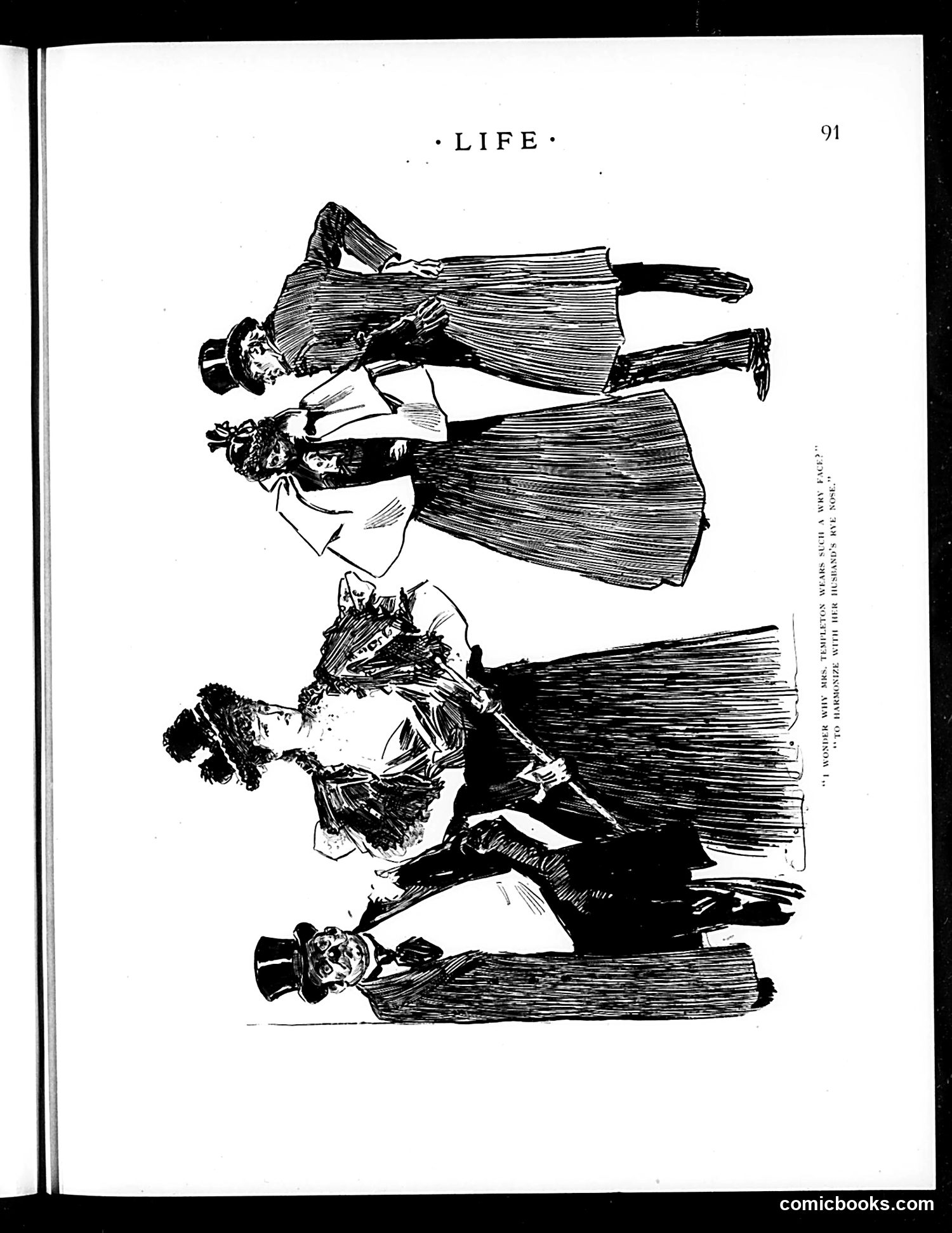
This page contains a single vertical illustration showing four figures arranged in a stack, each wearing period clothing and appearing to be rotated or inverted relative to each other. The drawing style uses heavy cross-hatching typical of early-to-mid 20th century satirical illustration. Without visible captions or clear identifying text on this page itself, the specific subjects and satirical point remain unclear. The formal dress and hierarchical stacking arrangement suggest social commentary—possibly about class structure, institutional power, or political relationships—but identifying the particular figures or historical event referenced would require additional context from surrounding pages or the magazine's publication date, which isn't legible here.
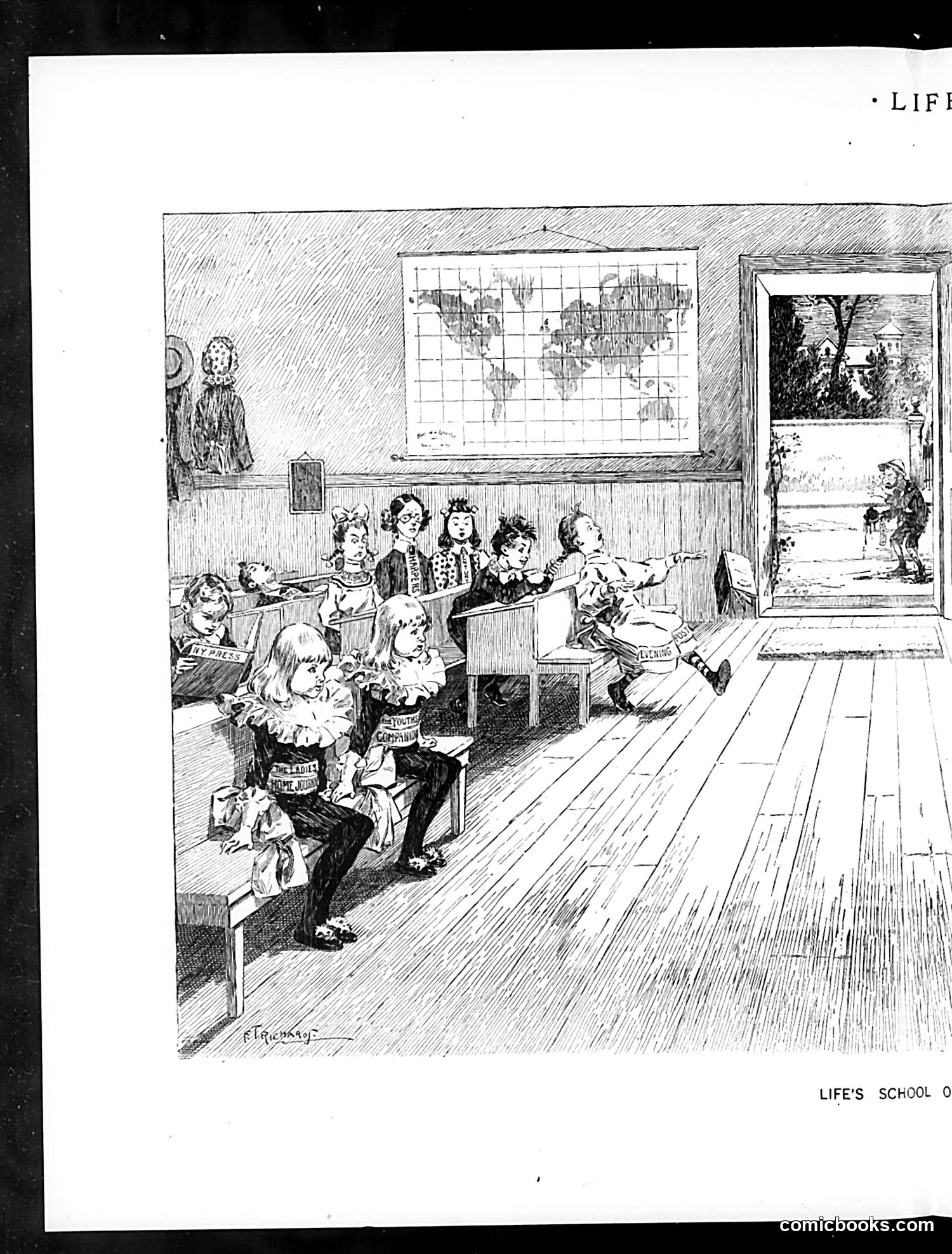
This illustration depicts a schoolroom scene titled "Life's School of..." (text cut off). The cartoon shows children of various ages seated at desks in what appears to be a chaotic classroom setting. A world map hangs on the wall behind them, and a skeleton or death figure looms in the upper left corner—a stark, ominous presence. The satire appears to critique what "life" actually teaches children, contrasted with formal education. The skeleton's prominent placement suggests the cartoon comments on harsh realities—possibly mortality, hardship, or life's darker lessons—that children encounter outside classroom walls. The mixed ages and apparent disorder reinforce the idea that real-world "schooling" is chaotic and uncontrolled, unlike orderly institutional education. Without the complete title, the precise target remains unclear, but the tone is darkly satirical about childhood experience.
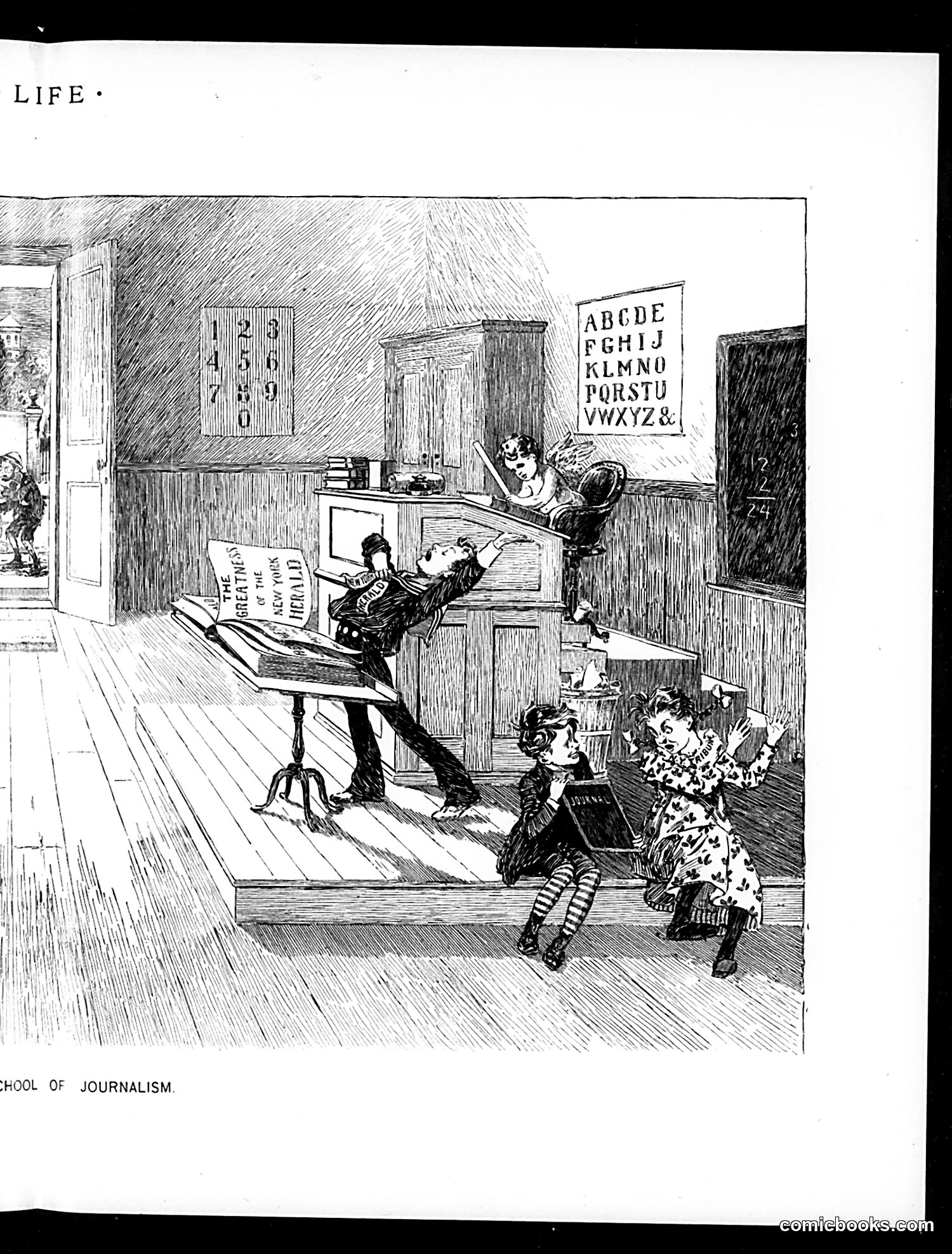
This satirical cartoon depicts a schoolroom scene labeled "School of Journalism" at the bottom. A teacher sits at a desk while students sit on the floor in what appears to be an undisciplined, chaotic classroom. The visible educational materials—an alphabet chart and numbers on the wall—suggest this is meant to mock journalism education as elementary and disorganized. The satire critiques journalism training or journalists themselves as lacking proper education or professionalism. The students' casual, sprawled positions and the teacher's apparent indifference suggest incompetence or frivolity in how journalism is taught or practiced. This reflects early 20th-century skepticism about whether journalism could be legitimately "schooled" as a profession.
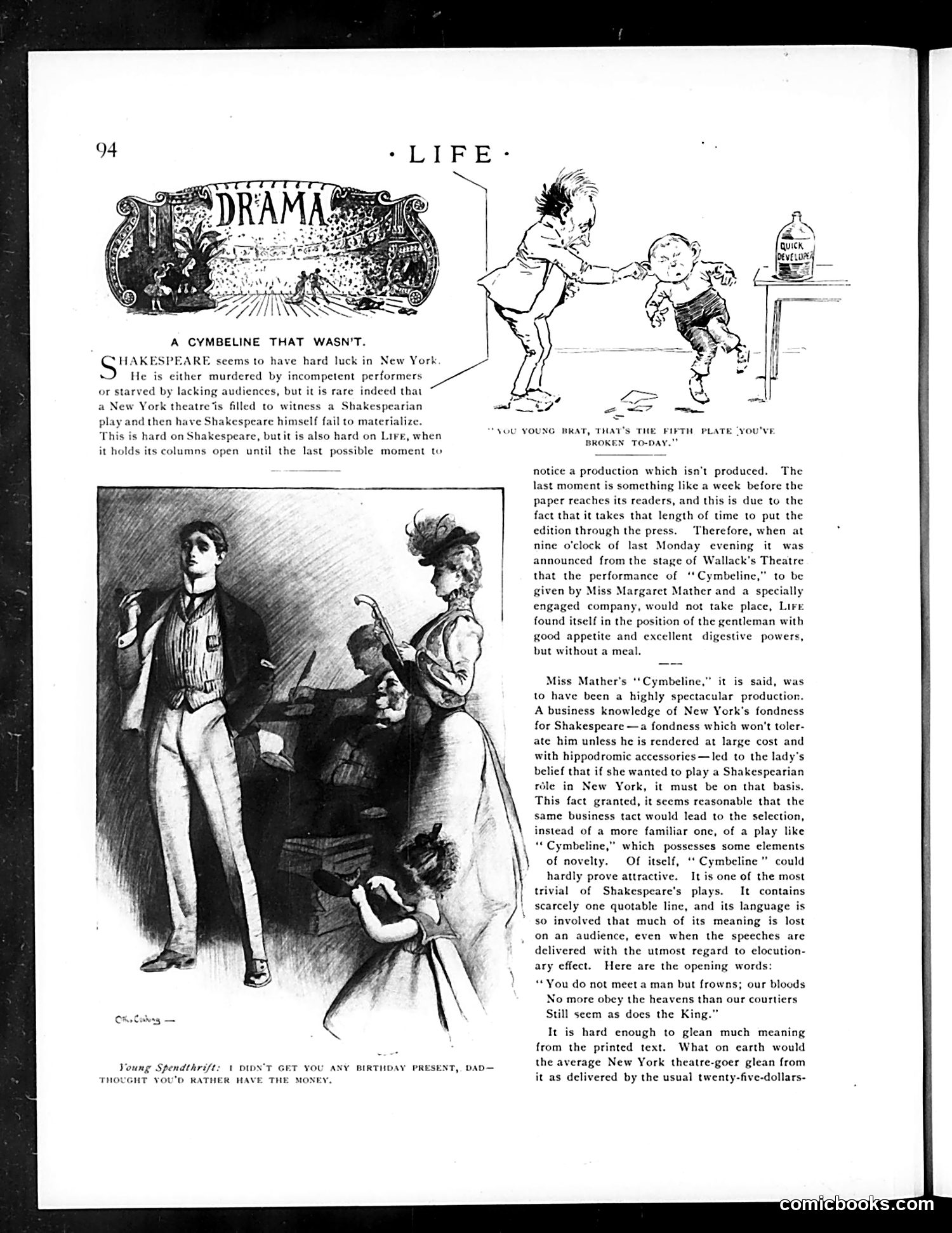
This satirical article critiques a failed New York Shakespeare production. The text explains that Shakespeare performances in New York rarely materialize due to insufficient audiences or funding. Life is specifically mocking an announced production of "Cymbeline" by Miss Margaret Mather that was cancelled at the last moment—the magazine humorously notes it went to press without knowing if the show would happen. The article argues that New York's fondness for Shakespeare only extends to lavish, expensive productions with elaborate staging. The lower cartoon depicts a spendthrift (likely a wealthy patron) refusing to give a birthday present to his son, preferring to spend money on expensive theater instead. The satire targets both theatrical pretension and wealthy New Yorkers' misguided priorities.
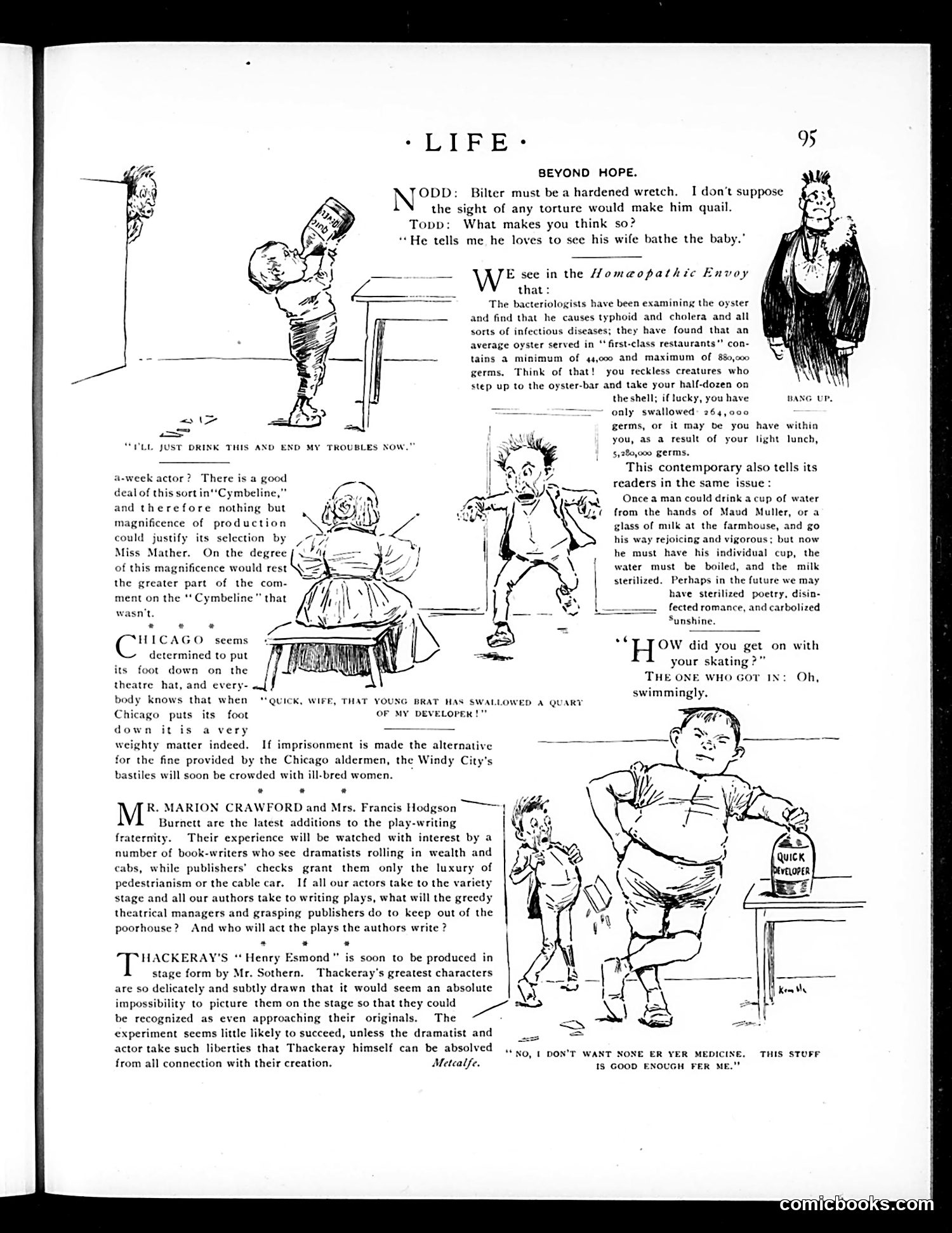
This page contains multiple short satirical pieces typical of Life's format: **"Beyond Hope"** presents a joke about a man named Bitter who enjoys watching his wife bathe the baby—portrayed as evidence of depravity. **The oyster cartoon** mocks urban consumers' obliviousness to hygiene. It references bacteriologists' findings that oysters contain thousands of disease-causing germs, yet people continue eating them raw at oyster bars. The satire targets both the reckless diners and the contemporary anxiety about infectious disease. **Chicago theater hats commentary** ridicules Chicago's ordinance against large women's hats in theaters—suggesting enforcement through imprisonment would overcrowd jails with "ill-bred women." **The skating joke** is a simple pun about getting in "swimmingly." **The final section** criticizes authors abandoning literature for lucrative playwriting, leaving publishers impoverished while theatrical managers worry about actor shortages. Throughout, Life uses humor to critique consumer carelessness, municipal overreach, and economic anxieties of the era.
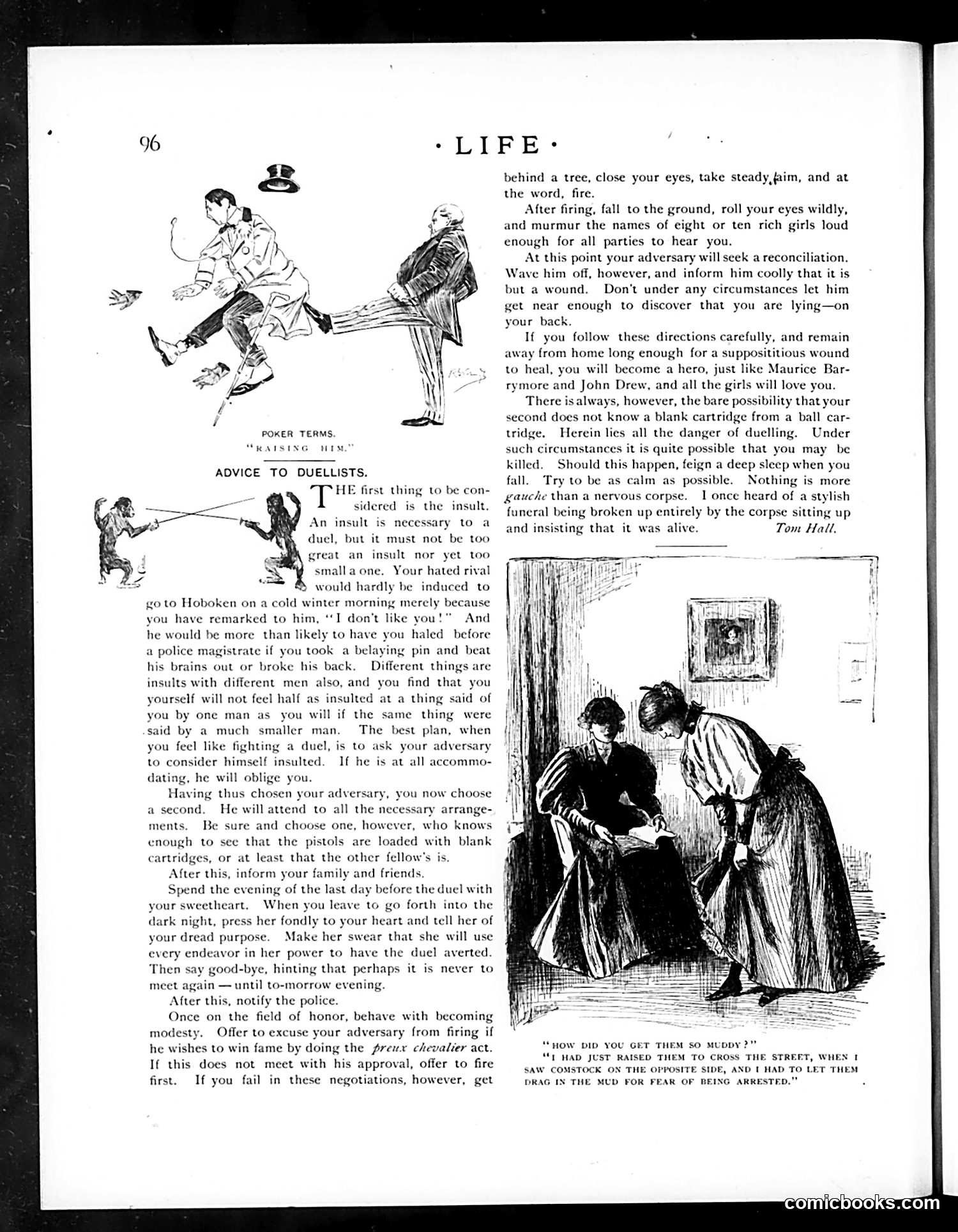
This page contains two satirical pieces mocking dueling customs and moral censorship. **"Advice to Duelists"** parodies the elaborate, absurd etiquette surrounding 19th-century duels. The text humorously outlines how to stage a fake duel—choosing appropriately-sized insults, ensuring blank cartridges, notifying police beforehand, and feigning death to become a "hero." It references actors Maurice Barrymore and John Drew, suggesting dueling was romanticized in popular culture. The satire exposes dueling as theatrical posturing rather than honorable combat. **The bottom cartoon** references "Comstock"—likely Anthony Comstock, the famous (or infamous) anti-obscenity crusader who led moral policing efforts in the 1870s-1900s. The joke shows children dragging their muddy clothes in street muck specifically to avoid Comstock's scrutiny, suggesting his censorship campaigns were so oppressive that people modified their behavior absurdly to escape his notice. Both pieces mock rigid social conventions: one ridiculing violent "honor," the other mocking excessive moral regulation.
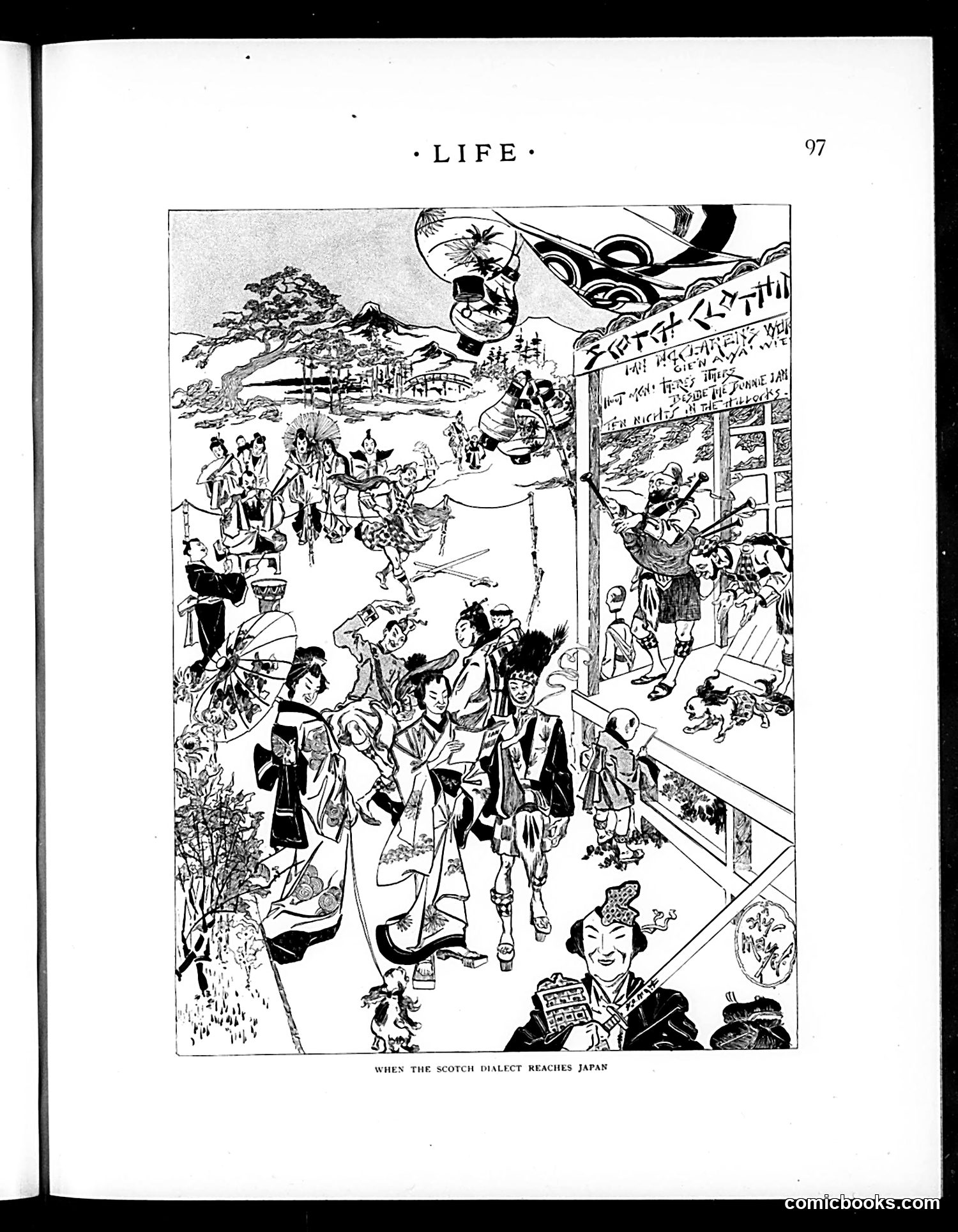
This is a satirical cartoon imagining what would happen if Scottish dialect were introduced to Japan. The illustration shows Japanese figures in traditional dress adopting Scottish clothing and mannerisms—some wear kilts and Scottish attire while maintaining Japanese architectural elements and cultural settings visible in the background. The humor relies on the incongruity of blending two distinct cultures: Scottish Highland dress and dialect meeting Japanese tradition. This appears to reflect early 20th-century *Life* magazine's style of satirizing cultural mixing and "exotic" combinations for comedic effect. The caption suggests amusement at the absurdity of Scottish speech patterns reaching and being adopted by Japan—likely referencing Scotland's cultural distinctiveness and recognizable dialect as something unexpected in a Japanese context. The cartoon exemplifies period attitudes toward cultural difference treated as inherently funny or ridiculous.
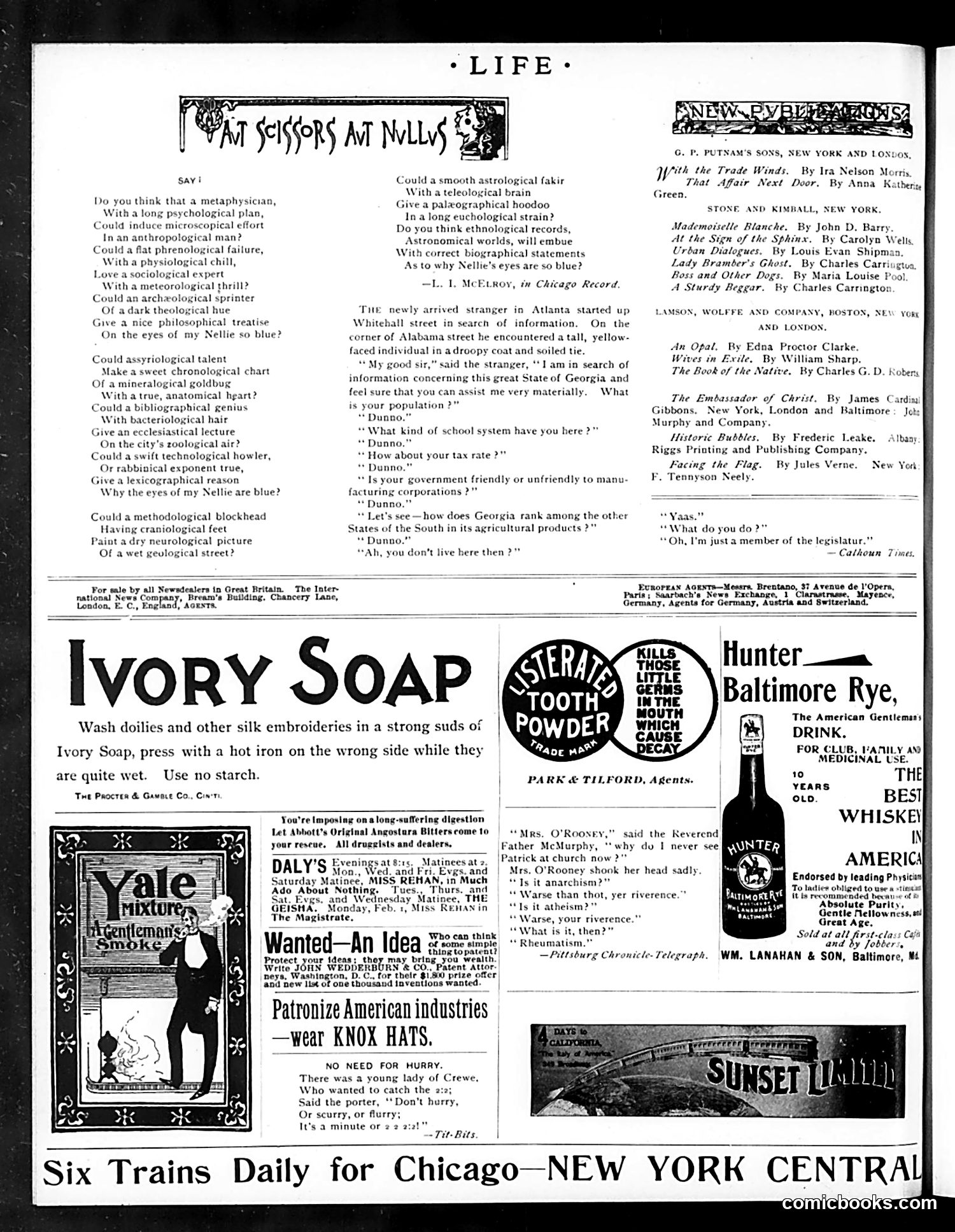
The left column features a poem by L. I. McElroy mocking overwrought academic language. The title itself—"I'm Scissors at Nulls"—appears nonsensical, setting the satirical tone. The poem strings together absurd compound adjectives (metaphysician, anthropological, phrenological, etc.) to ask increasingly ridiculous questions, all culminating in the trivial question: why are Nellie's eyes blue? The satire targets the late-19th-century fashion for pseudo-scientific terminology and overly complex vocabulary in intellectual circles. By piling these "-ological" and "-ical" words into nonsensical constructions, McElroy mocks scholars and thinkers who obscured simple ideas behind jargon. The accompanying anecdote about an Atlanta stranger reinforces this theme: a man asks an ignorant legislator detailed questions about Georgia, receiving only "Dunno" as replies—suggesting that even those in positions of authority lacked substance beneath their titles. The humor lies in exposing intellectual pretense.
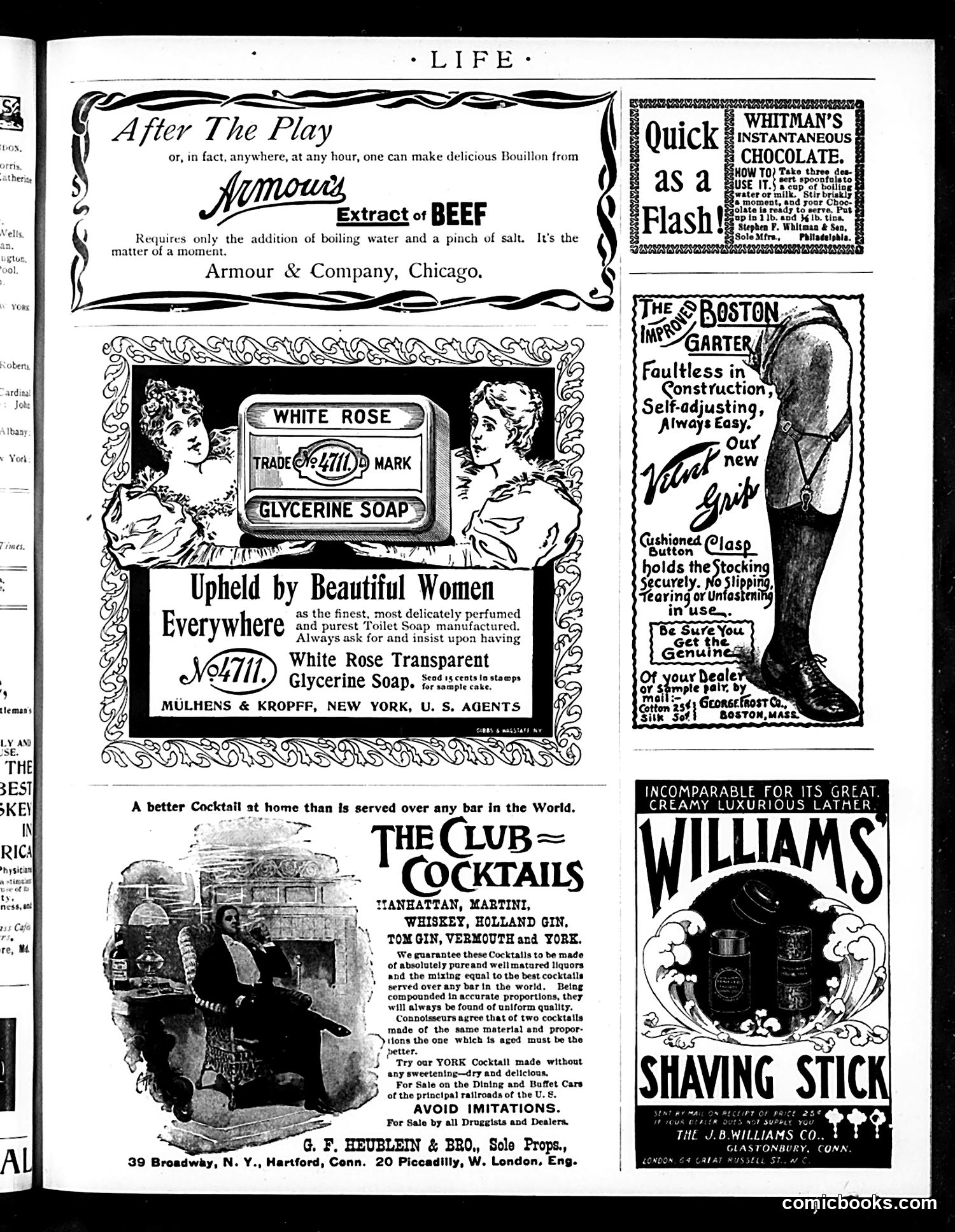
This page is **primarily advertising**, not political satire. It contains four product advertisements typical of early 20th-century magazines: 1. **Armour Extract of Beef** — a convenient bouillon product requiring only hot water and salt 2. **White Rose Glycerine Soap** — marketed to women as refined and luxurious 3. **The Imported Boston Garter** — a women's stocking supporter with a "cushioned button clasp" 4. **Williams Shaving Stick** — for men's grooming The top banner "After The Play" frames these as products for leisure and self-care after entertainment. There is **no political cartoon or satire evident** on this page. The "Beautiful Women Everywhere" heading uses period marketing rhetoric emphasizing femininity and social status, but this reflects commercial messaging rather than commentary. The page demonstrates how Life magazine, despite its satirical reputation, relied heavily on advertising revenue with minimal editorial content.
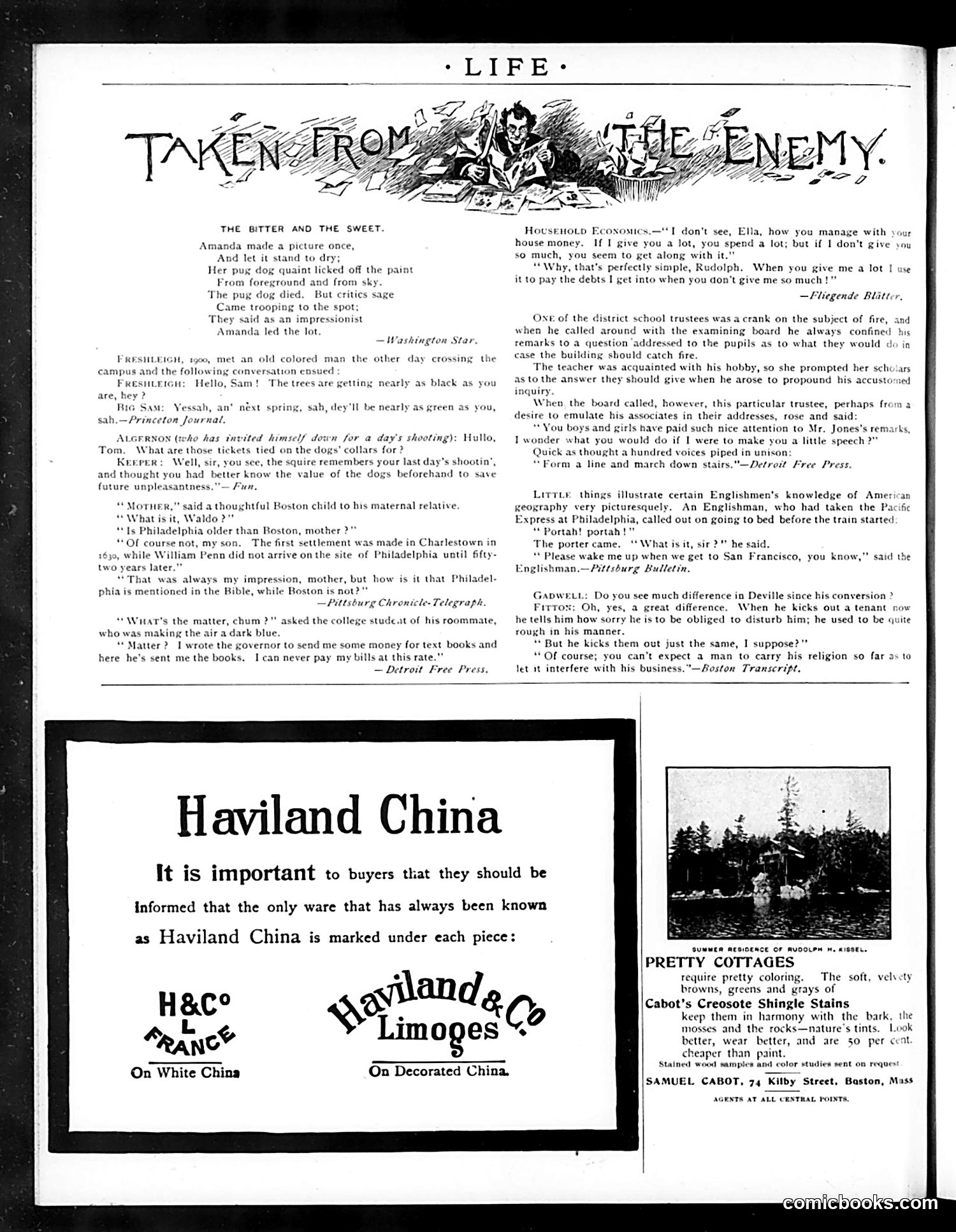
This page collects brief satirical anecdotes mocking various social types and situations. The header illustration depicts a figure amid scattered papers, setting a comedic tone. The jokes target: pretentious art critics (praising a dog-damaged painting as "impressionist"), racial stereotypes (a dialogue between a white student and a Black man), class anxieties (a student's complaint about receiving textbooks instead of money), marital dynamics (a wife's circular logic about spending), and English ignorance of American geography (an Englishman expecting to sleep through a train journey from Philadelphia to San Francisco). Most prominently, these anecdotes mock hypocrisy and social pretension—particularly a wealthy man's selective religiosity: converting to Christianity doesn't stop him from evicting tenants; he's just ruder about it now. The humor relies on absurdity and period stereotypes that would offend modern readers, particularly the racial material. The page also contains unrelated Haviland China advertisement and cottage imagery.
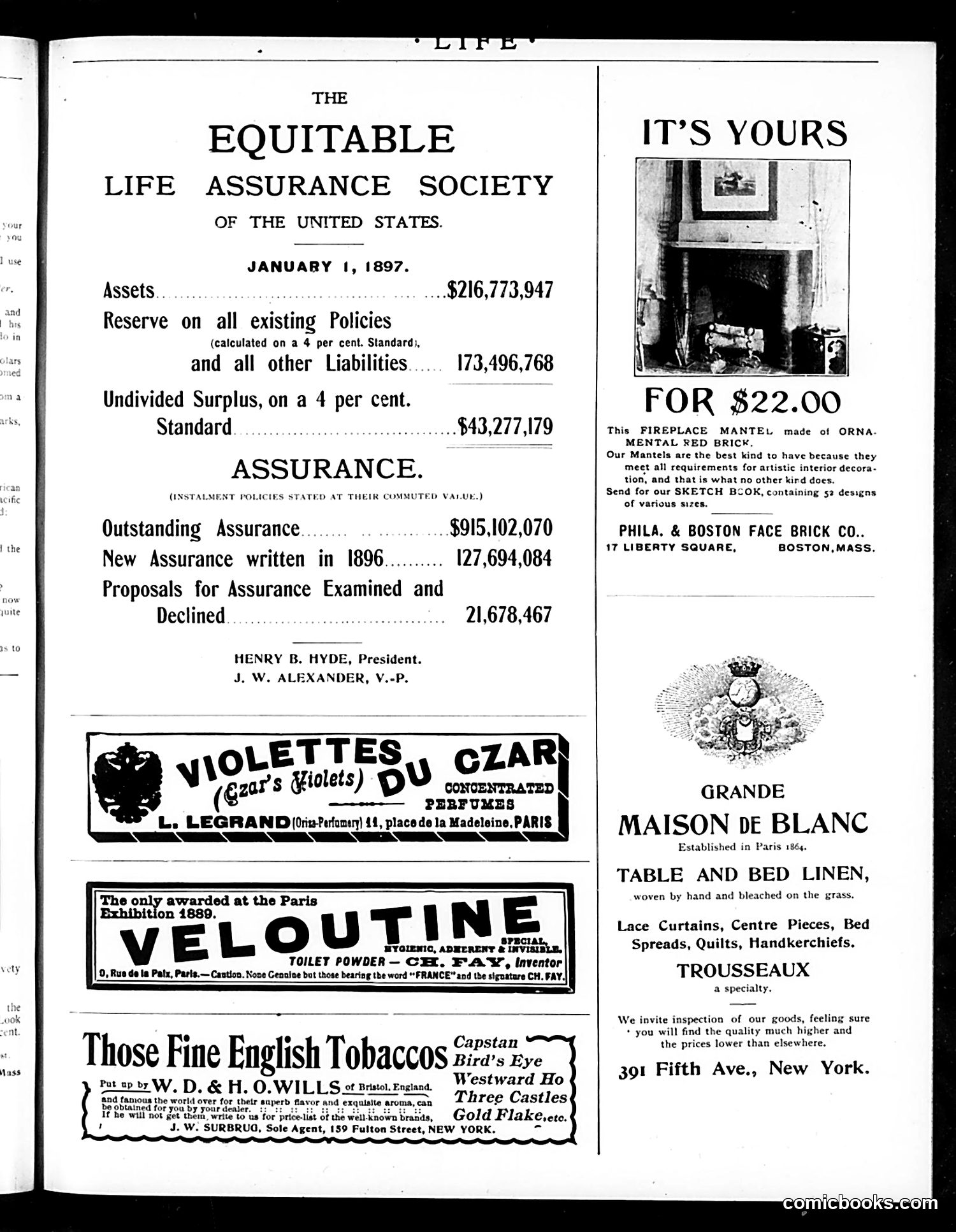
This page is **primarily advertising**, not satire or political commentary. It's from Life magazine's January 1, 1897 issue. The top half features financial data from the Equitable Life Assurance Society—a major American insurance company—displaying its assets, reserves, and policy information as a corporate announcement. The remaining space contains period advertisements: a fireplace mantel for $22, French perfume and linens, English tobacco products, and luxury goods. These ads reflect the magazine's affluent readership. **There is no political cartoon on this page.** The only visual element besides advertisements is a small decorative illustration accompanying the Maison de Blanc linen company ad—a standard commercial logo, not satirical commentary. This appears to be a typical revenue-generating page from a 19th-century magazine, mixing institutional announcements with luxury product advertising aimed at wealthy readers.
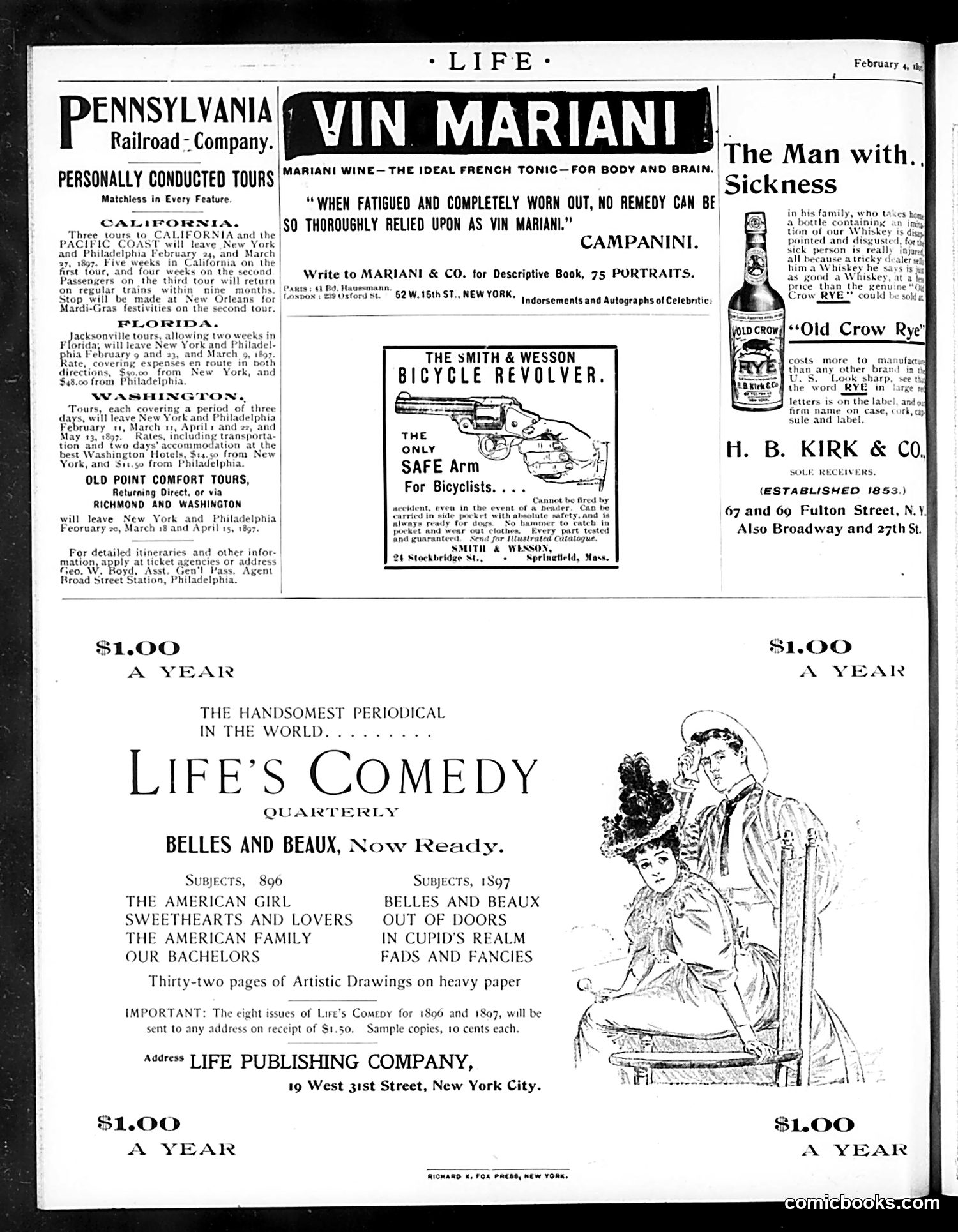
This is primarily **an advertising page** with little editorial content or satirical cartoons in the traditional sense. The major advertisements include: **Vin Mariani wine** — a tonic marketed as remedying fatigue and weakness, featuring a testimonial from "Campanini" (likely an opera singer). This product exploited the late-19th-century craze for patent medicines and tonics claiming miraculous health benefits. **Pennsylvania Railroad tours** to California, Florida, and Washington — promoting leisure travel to increasingly accessible destinations. **Smith & Wesson bicycle revolver** — a firearm disguised as a bicycle accessory, marketed as "safe" protection for cyclists. **H.B. Kirk & Co., gun receivers** — established 1853, a weapons manufacturer. **Life's Comedy Quarterly** — self-promotion for the magazine's sister publication. The page reflects Gilded Age consumer culture: dubious medical products, firearms marketed casually to civilians, and the leisure travel industry emerging for affluent Americans.