
Life, 1897-02-04 · page 4 of 20
Life — February 4, 1897 — page 4: what you’re looking at
What you’re looking at
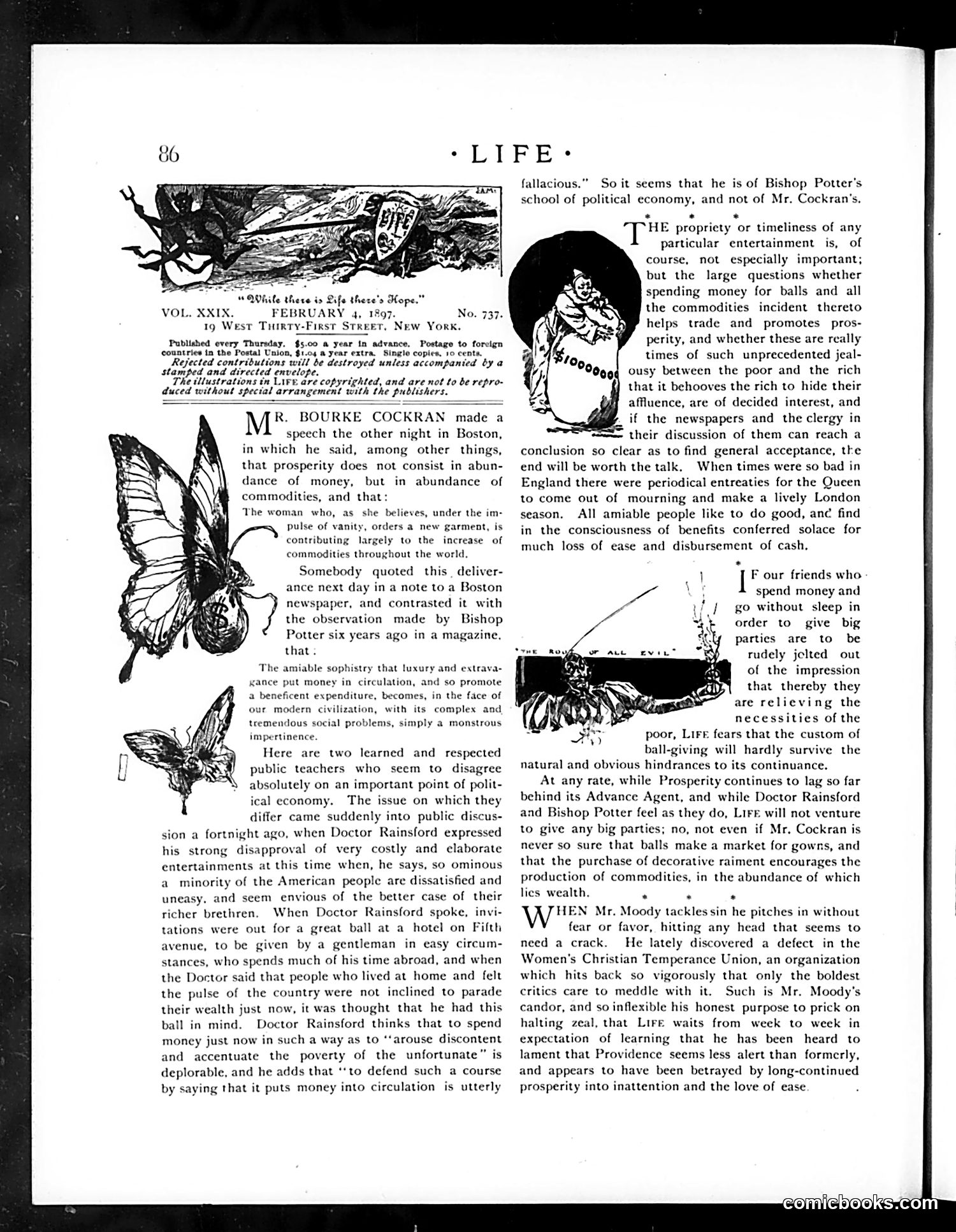
This page satirizes a debate about wealthy Americans' spending habits and social responsibility. Mr. Bourke Cockran made a Boston speech defending luxurious consumption as beneficial to commerce and workers. Bishop Potter contradicted him six years earlier, opposing elaborate entertainments as morally wrong during economic hardship. The article mocks both positions while targeting Mr. Moody's recent criticism of the Women's Christian Temperance Union for opposing ball-giving. Life suggests that excessive parties don't genuinely help the poor—they merely circulate wealth among the wealthy while creating false justification for inequality. The satirical insects decorating the margins emphasize the trivial nature of these elite debates about consumption ethics.
📄 Transcribed text from this page (OCR, searchable)
Machine-transcribed from the original scan — historical spelling and the odd misread are preserved.
*> LIFE: “While there is Life there's Hope.” VOL. XXIX FEBRUARY 4, 1897. 19 West Tiiety-First STREET, Published every Thursday. $5.00 a year in advance. Postage to foreign countries in the Postal Union, $1.04 a year extra. Single copies, 10 cents. Rejected contributions will be destroyed unless accompanied by a stamped and directed envelope. The illustrations in Live are copyrighted, and are not to be repro- duced without special arrangement with the publishers. M* BOURKE COCKRAN made a A speech the other night in Boston, in which he said, among other things, that prosperity does not consist in abun- dance of money, but in abundance of commodities, and that: The woman who, as she believes, under the im- pulse of vanity, orders a new garment, is contributing largely to the increase of commodities throughout the world, Somebody quoted this. deliver- ance next day in a note to a Boston newspaper, and contrasted it with the observation made by Bishop Potter six years ago in a magazine, that. The amiable sophistry that luxury and extrava- ance put money in circulation, and so promote a beneficent expenditure, becomes, in the face of our modern civilization, with its complex and tremendous social problems, simply a monstrous impertinence. Here are two learned and respected public teachers who seem to disagree absolutely on an important point of polit- ical economy. The issue on which they differ came suddenly into public di: sion a fortnight ago, when Doctor Rainsford expressed his strong disapproval of very costly and elaborate entertainments at this time when, he says, so ominous a minority of the American people are dissatisfied and . and seem envious of the better case of their richer brethren, When Doctor Rainsford spoke, invi- tations were out for a great ball at a hotel on th avenue, to be given by a gentleman in easy circum- stances, who spends much of his time abroad, and when the Doctor said that people who lived at home and felt the pulse of the country were not inclined to parade their wealth just now, it was thought that he had this ball in mind. Doctor Rainsford thinks that to spend money just now in such a way as to ‘‘arouse discontent and accentuate the poverty of the unfortunate” is deplorable, and he adds that ‘‘to defend such a course by saying that it puts money into circulation is utterly fallaciou: So it seems that he is of Bishop Potter's school of political economy, and not of Mr. Cockran’s. . . . HE propriety or timeliness of any particular entertainment is, of course, not especially important; but the large questions whether spending money for balls and all the commodities incident thereto helps trade and promotes pros- perity, and whether these are really times of such unprecedented jeal- ousy between the poor and the rich that it behooves the rich to hide their affluence, are of decided interest, and if the newspapers and the clergy in “sass their discussion of them can reach a conclusion so clear as to find general acceptance, the end will be worth the talk. When times were so bad in England there were periodical entreaties for the Queen to come out of mourning and make a lively London season. All amiable people like to do good, ane find in the consciousness of benefits conferred solace for much loss of ease and disbursement of cash. F our friends who spend money and go without sleep in order to give big partics are to be rudely jelted out of the impression that thereby they are relieving the necessities of the poor, Lirr fears that the custom of ball-giving will hardly survive the natural and obvious hindrances to its continuance. At any rate, while Prosperity continues to lag so far behind its Advance Agent, and while Doctor Rainsford and Bishop Potter feel as they do, Lire will not venture to give any big parties; no, not even if Mr. Cockran is never so sure that balls make a market for gowns, and that the purchase of decorative raiment encourages the production of commodities, in the abundance of which lics wealth. ‘ ‘ 4 HEN Mr. Moody tackles sin he pitches in without fear or favor, hitting any head that seems to need a crac’ He lately discovered a defect in the Women's Christian Temperance Union, an organization which hits back so vigorously that only the boldest critics care to meddle with it. Such is Mr. Moody's candor, and so inflexible his honest purpose to prick on halting zeal, that Lire waits from week to week in expectation of learning that he has been heard to lament that Providence seems less alert than formerly, and appears to have been betrayed by long-continued prosperity into inattention and the love of ease