
Life, 1897-02-04 · page 6 of 20
Life — February 4, 1897 — page 6: what you’re looking at
What you’re looking at
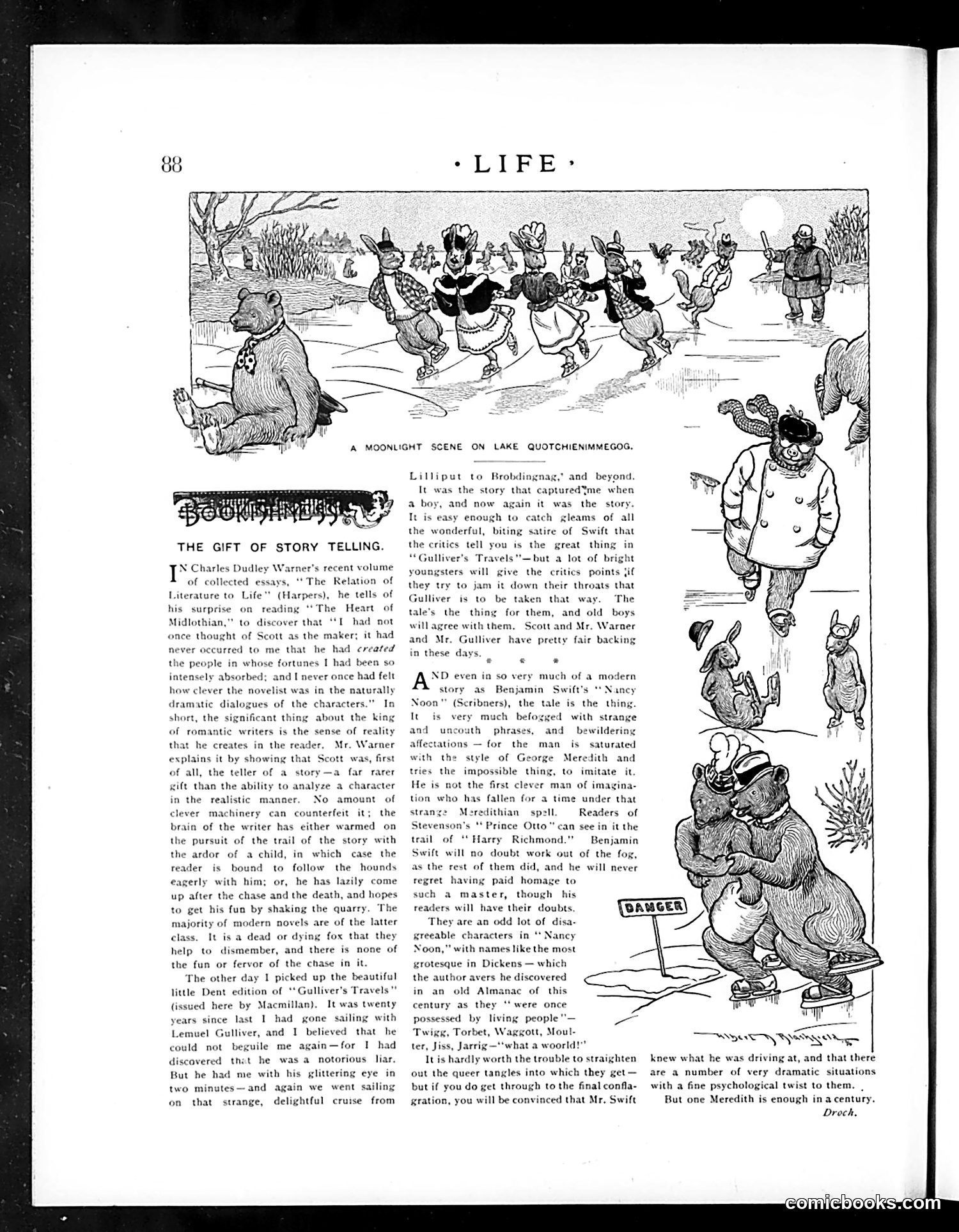
This page discusses "The Gift of Story Telling," reviewing Charles Dudley Warner's collected essays on literature. The main illustration shows "A Moonlight Scene on Lake Quotchienimmegog" — an apparently fictional lake name used for comedic effect. The cartoon depicts anthropomorphic animals ice skating on a frozen lake, likely satirizing popular winter recreation and literary sentimentality. The accompanying text praises Warner's ability to create realistic characters and analyze their psychological complexity, contrasting this with other contemporary writers like Benjamin Swift (author of "Nancy Noon"). The humor seems directed at overwrought romantic fiction and the pretensions of literary critics, celebrating Warner's more grounded approach to character development and storytelling.
📄 Transcribed text from this page (OCR, searchable)
Machine-transcribed from the original scan — historical spelling and the odd misread are preserved.
A MOONLIGHT SCENE ON LAKE QUOTCHIENIMMEGOG. THE GIFT OF STORY TELLING. N Charles Dudley Warner's recent volume of collected essays, ‘* The Relation of Literature to Life (Harpers), he tells of surprise reading ‘The Heart of Midlothian,” to discover that “I had not once thought of Scott as the maker; it had he had created s I had been so his on never occurred to me that the people in whose fortun intensely absorbed; and I never once had felt how clever the novelist was in the naturally dramatic dialogues of the characters.” In short, the significant thing about the king of romantic writers is the sense of reality that he creates in the reader, Mr. Warner explains it by showing that Scott was, first of all, the teller of a gift than the ability to analyze a character in the realistic manner. No amount of machinery it; the brain of the writer has either warmed on the pursuit of the trail of the story with of a child, in which case the bound to follow the hounds with him; or, he has lazily come story —a far rarer clever can counterfeit the ardor reader is eagerly up after the chase and the death, and hopes to get his fun by shaking the quarry. The majority of modern novels are of the latter class. It is a dead or dying fox that they help to the fun or fervor of the chase in it. ‘The other day I picked up the beautiful little Dent edition of ‘Gulliver's Travels” {issued here by Macmillan), It was twenty had gone sailing with Lemuel Gulliver, and Ib that he could not beguile me again—for I had discovered thot he was a notorious liar. But he had me with his glittering eye in two minutes—and again we went sailing that strange, delightful cruise from dismember, and there is none of years since last I ieved on Lilliput to Brobdingnag,’ and beyond. It was the story that captured%me when a boy, and now again it the It is easy enough to catch gleams of all the wonderful, biting satire of Swift that the critics tell you is the great thing in “Gulliver's Travels"—but a lot of bright youngsters will give the critics points jif they try to jam it down their throats that Gulliver is to be taken that The tale’s the thing for them, and old boys willagree with them, Scott and Mr. Warner and Mr. Gulliver have pretty fair backing in these days. ® « * was story. way, D even in so very much of a modern Swift's ‘Nancy Noon" (Scribners), the tale is the thing. It is much befogged with strange and and bi man is story as Benjamin very uncouth phrases, the wildering affectations — for saturated the style of Meredith and tries the impossible thing, to imitate it. He is not the first clever man of imagina- tion who has fallen for a time under that stran. Meredithian spell. Readers of Stevenson's * Prince Otto” can see in it the trail of “Harry Richmond.” — Benjamin Swift will no doubt work out of the fog, as the rest of them did, and he will never regret having paid homage to such a master, though his readers will have their doubts. They are an odd lot of disa- greeable characters in ‘ Nancy Noon,” with names like the most with ree grotesque in Dickens — which the author avers he discovered old Almanac of this century as the possessed by living people "— Twigg, Torbet, Waggott, Moul- ter, Jiss, Jarrig—"what a woorld!” It is hardly worth the trouble to straighten out the queer tangles into which they get— but if you do get through to the final confla- gration, you will be convinced that Mr. Swift in an were once — — a MOET YEO knew what he was driving at, and that there are a number of very dramatic situations with a fine psychological twist to them. , But one Meredith is enough ina century. Droch.