
Life, 1897-02-04 · page 12 of 20
Life — February 4, 1897 — page 12: what you’re looking at
What you’re looking at
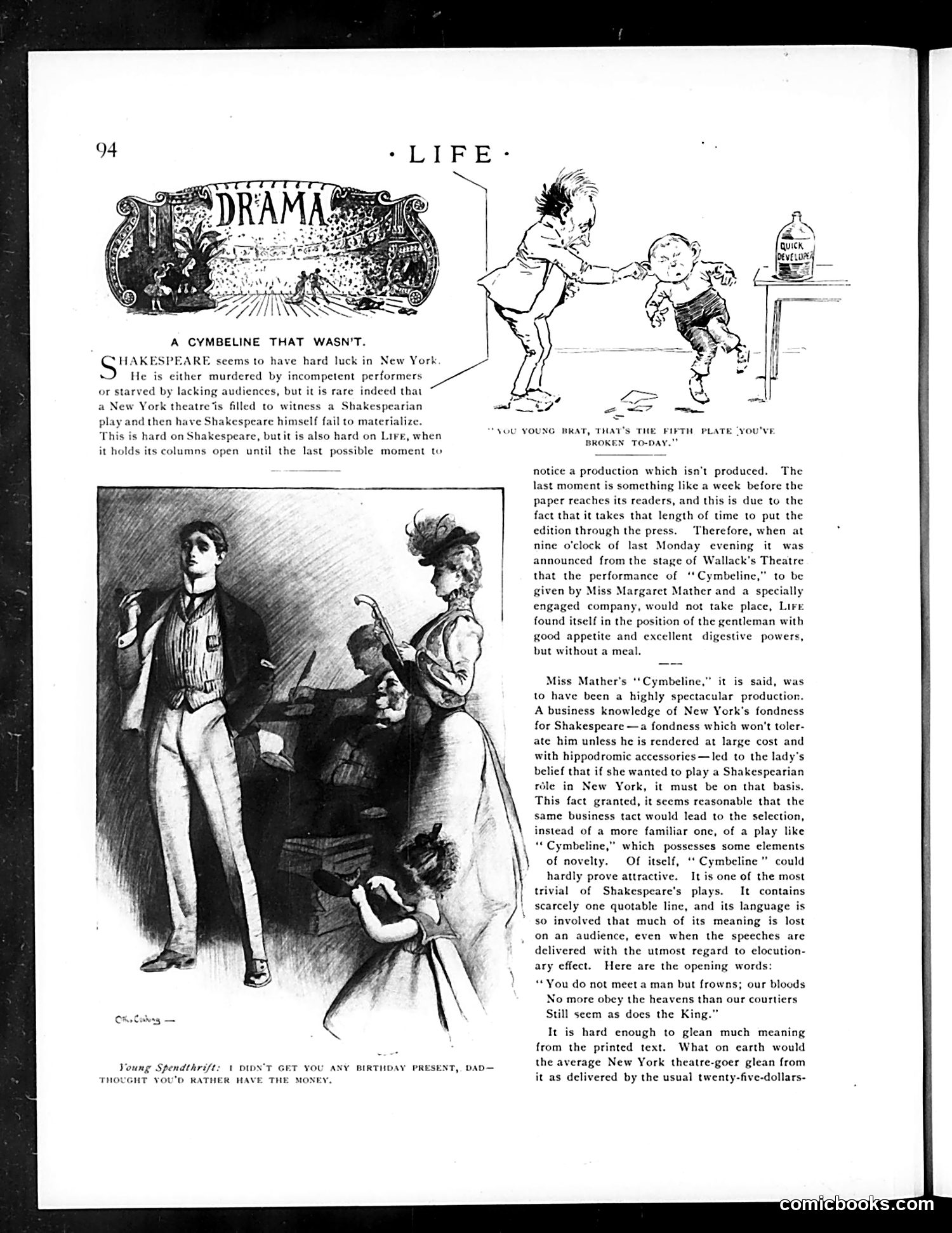
This satirical article critiques a failed New York Shakespeare production. The text explains that Shakespeare performances in New York rarely materialize due to insufficient audiences or funding. Life is specifically mocking an announced production of "Cymbeline" by Miss Margaret Mather that was cancelled at the last moment—the magazine humorously notes it went to press without knowing if the show would happen. The article argues that New York's fondness for Shakespeare only extends to lavish, expensive productions with elaborate staging. The lower cartoon depicts a spendthrift (likely a wealthy patron) refusing to give a birthday present to his son, preferring to spend money on expensive theater instead. The satire targets both theatrical pretension and wealthy New Yorkers' misguided priorities.
📄 Transcribed text from this page (OCR, searchable)
Machine-transcribed from the original scan — historical spelling and the odd misread are preserved.
A CYMBELINE THAT WASN'T. JAKESPEARE seems to have hard luck in New York He is either murdered by incompetent performers we or starved by lacking audiences, but it is rare indeed that a New York theatre‘s filled to witness a Shakespearian play and then have Shakespeare himself fail to materialize. This is hard on Shakespeare, butit is also hard on Lire, when it holds its columns open until the last possible moment to ‘oung Spendthri/t: 1 DIDN'T GET YOU ANY BIRTHDAY PRESENT, DAD— T YOU'D RATHER HAVE THE MONEY. notice a production which isn't produced. The last moment is something like a week before the paper reaches its readers, and this is due to the fact that it takes that length of time to put the edition through the press. Therefore, when at nine o'clock of last Monday evening it was announced from the stage of Wallack's Theatre that the performance of ‘Cymbeline,” to be given by Miss Margaret Mather and a specially engaged company, would not take place, Lire found itself in the position of the gentleman with good appetite and excellent digestive powers, but without a meal. d Mather's ‘*Cymbeline,” it is said, was to have been a highly spectacular production. A business knowledge of New York's fondness for Shakespeare —a fondness which won't toler- ate him unless he is rendered at large cost and with hippodromic accessories —led to the lady's belief that if she wanted to play a Shakespearian role in New York, it must be on that basi: This fact granted, it seems reasonable that the same business tact would lead to the selection, instead of a more familiar one, of a play like ‘*Cymbeline,” which possesses some elements of novelty. Of itself, ‘‘ Cymbeline ” could hardly prove attractive. It is one of the most trivial of Shakespeare's plays. It contains scarcely one quotable line, and its language is so involved that much of its meaning is lost on an audience, even when the speeches are delivered with the utmost regard to elocution- ary effect. Here are the opening words: “You do not meet a man but frowns; our bloods No more obey the heavens than our courtiers Still seem as does the King.” It is hard enough to glean much meaning from the printed text. What on earth would the average New York theatre-goer glean from it as delivered by the usual twenty-five-dollars-