
A complete issue · 21 pages · 1896
Life — December 31, 1896
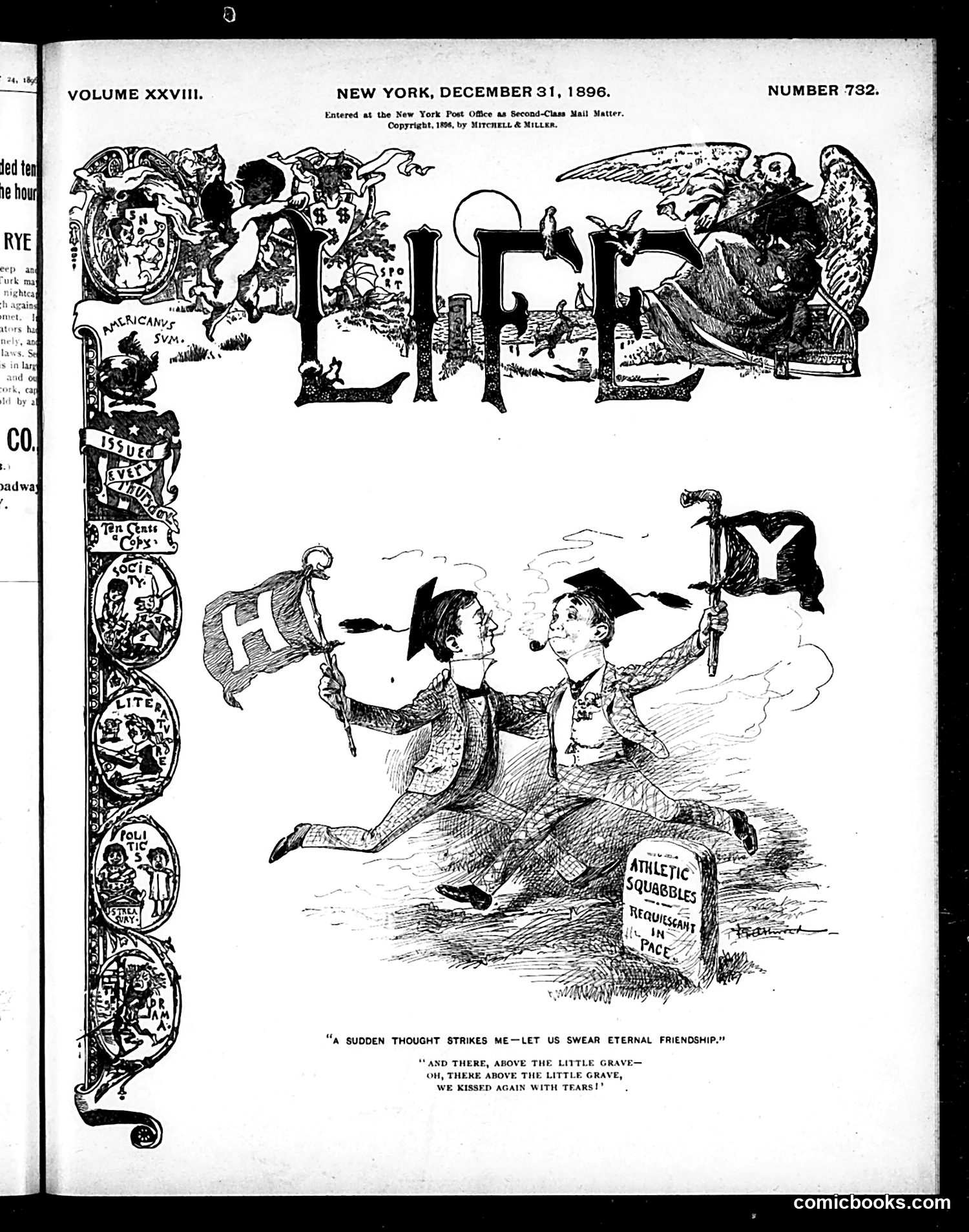
The main cartoon depicts two men at a gravestone marked "ATHLETIC SQUABBLES REQUIREM[ENT] IN PEACE," swearing eternal friendship. The quoted text references reconciliation "above the little grave"—suggesting a bitter athletic rivalry or dispute that has ended. The figures appear to represent competing athletic organizations or clubs, though the specific identities aren't entirely clear from the image alone. The gravestone symbolizes the death of their conflict, and the men raising flags suggest a truce or peace agreement. This likely satirizes a real athletic dispute from 1896—possibly between rival universities, sports organizations, or athletic clubs—that had become contentious enough to warrant mockery in Life's satirical pages. The elaborate border decoration typical of Life's design frames the commentary.
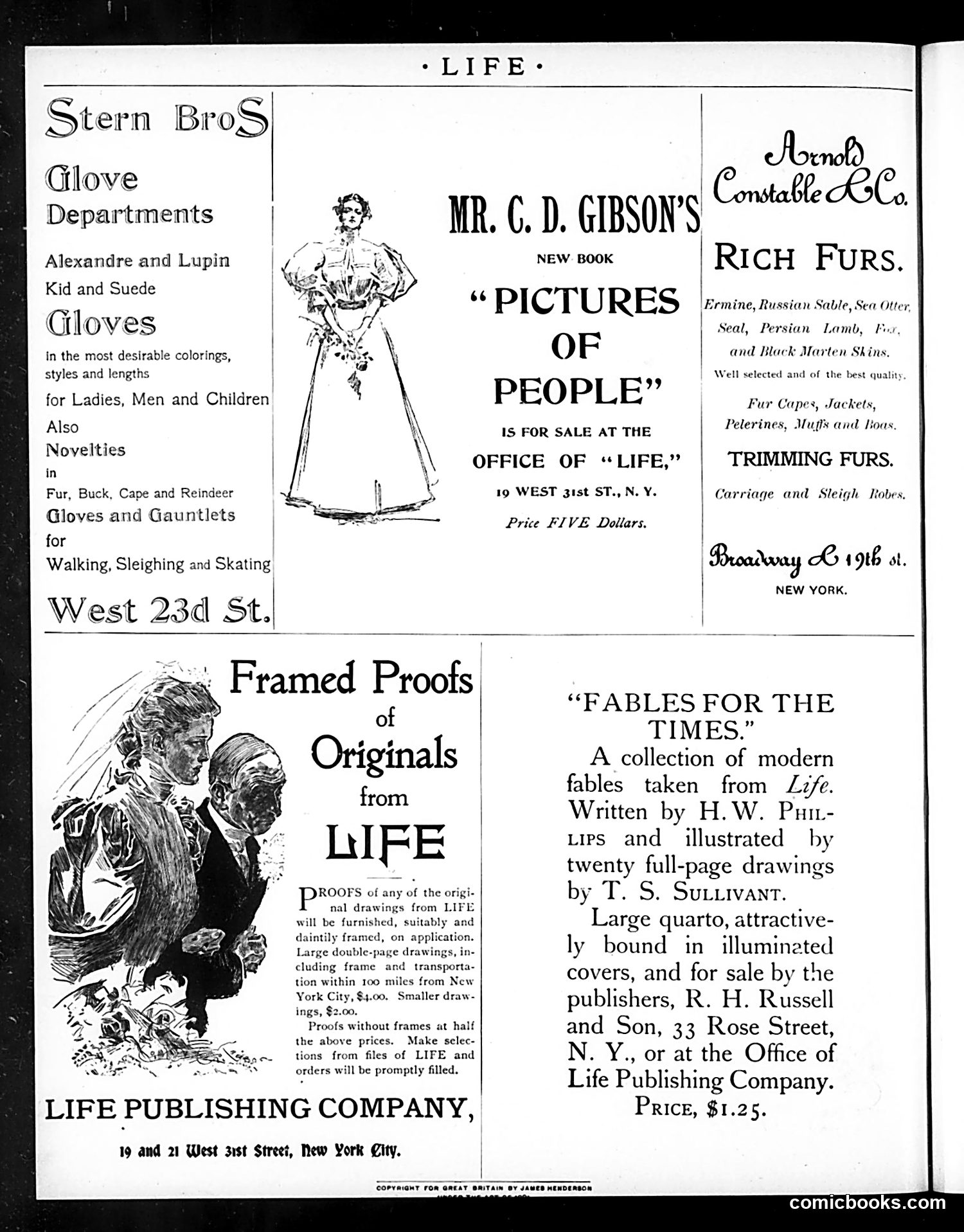
This page is primarily **advertising**, not political satire. It contains four advertisements: 1. **Stern Bros** (gloves) - West 23rd St. 2. **Mr. C.D. Gibson's new book** "Pictures of People" - sold at Life's office, $5 3. **Arnold Constable & Co.** (furs) - Broadway & 19th St. 4. **Life Publishing Company** - framed proofs of original Life drawings available 5. **"Fables for the Times"** - book by H.W. Phillips, illustrated by T.S. Sullivant, $1.25 The Gibson illustration shows a fashionably-dressed woman, typical of his "Gibson Girl" style—idealized female figures popular in early 20th-century American illustration. The lower left sketch appears to be sample artwork available for purchase from Life's archives. No clear political satire or social commentary is evident on this page.
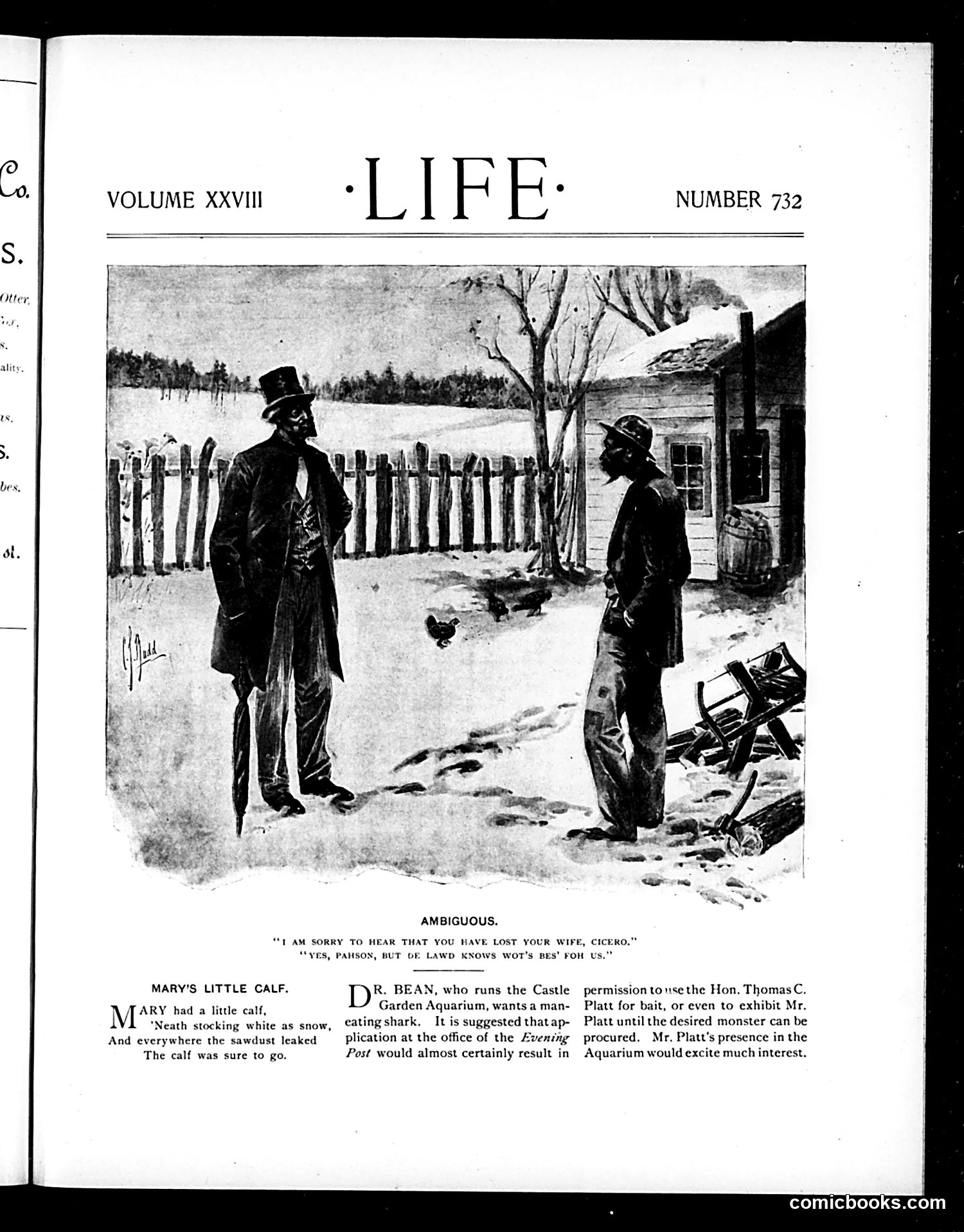
The page contains two separate items: 1. **"Ambiguous" cartoon**: Two men in formal attire and hats meet at a rural homestead. The caption reveals dark humor about frontier mortality—one expresses condolences about the other losing his wife "Cicero," but the reply "Yes, pardons, but de lawd knows wot's bes' for us" suggests resignation to death as commonplace. The crude dialect and rural setting suggest satirical commentary on frontier life's harshness. 2. **"Mary's Little Calf"**: A brief humorous poem about Mary's calf that leaks, playing on the children's nursery rhyme "Mary Had a Little Lamb." It's lighthearted doggerel. 3. **Text item about Dr. Bean**: A brief note regarding a Castle Garden Aquarium attraction and the Evening Post, apparently unrelated commentary. This appears to be miscellaneous filler content typical of period satirical magazines.
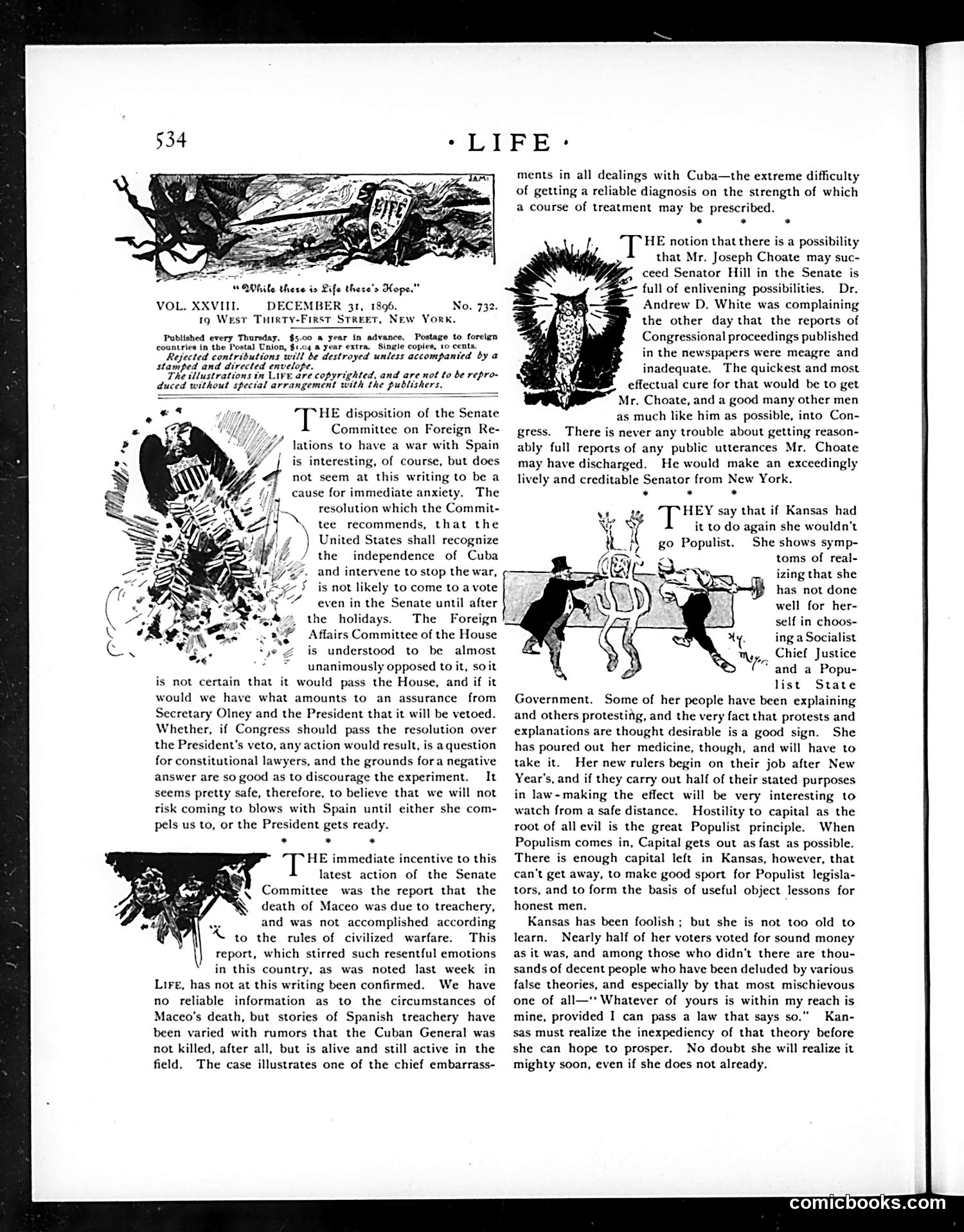
This *Life* magazine page contains satirical commentary on two contemporary political issues: **Cuba Crisis**: The left illustration depicts the Senate Foreign Relations Committee debating whether to recognize Cuban independence and intervene to stop Spain's war there. The text expresses skepticism that Congress will act decisively before the holidays, suggesting political paralysis over the intervention question. **Kansas Populism**: The right cartoon mocks Kansas for its recent Populist political movement. The illustration shows figures being pulled in different directions (representing competing political factions). The text sarcastically suggests Kansas foolishly embraced Populism and now faces consequences from its inexperienced "rulers" taking office in the new year, predicting the experiment will fail. Both pieces employ *Life*'s characteristic mocking tone toward political instability and reformist movements.
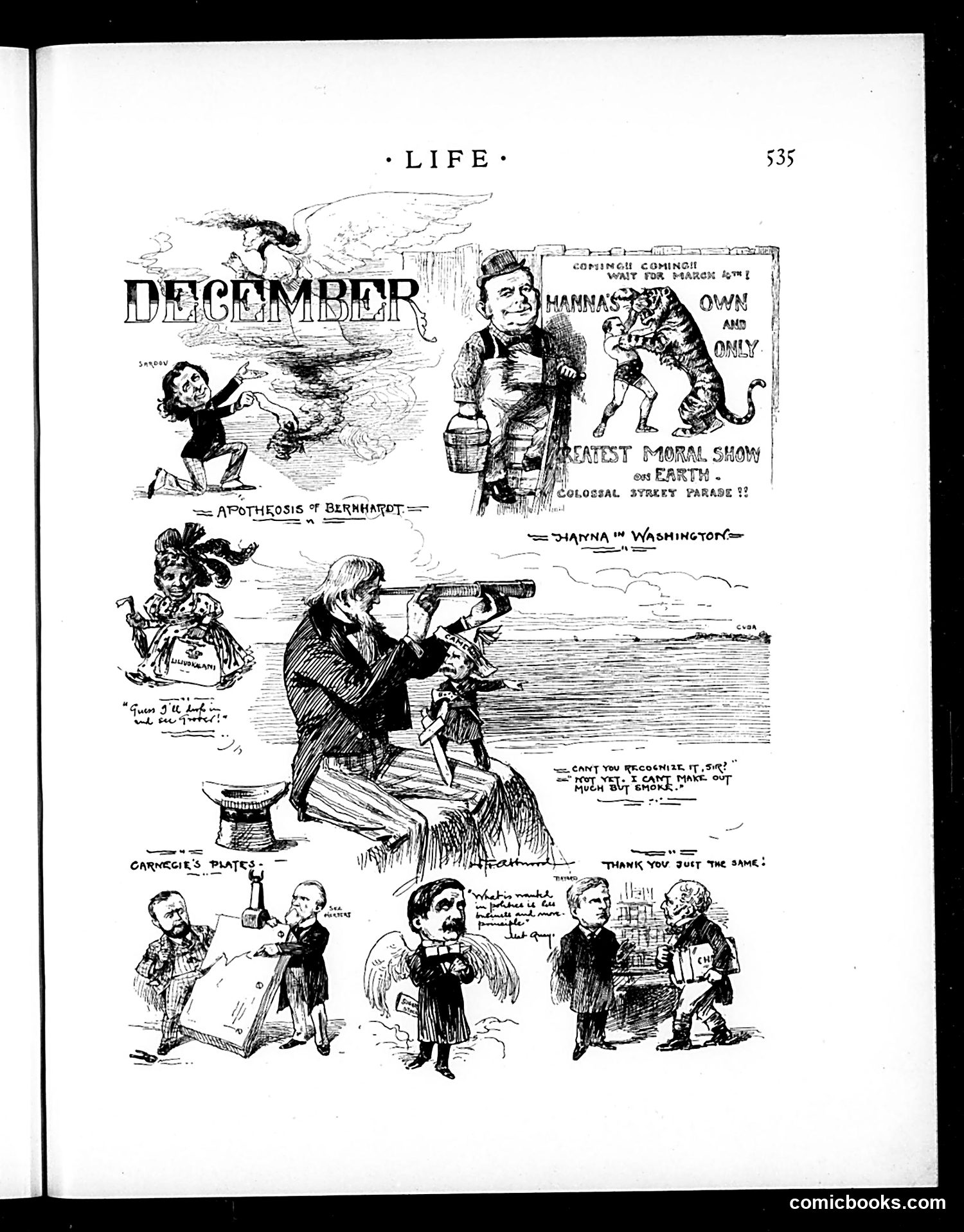
This page presents December-themed satirical cartoons. The top section titled "Apotheosis of Bernhardt" appears to mock actress Sarah Bernhardt, likely referencing a contemporary scandal or theatrical controversy. The central illustration "Manna in Washington" shows a figure with a telescope observing what appears to be political activity, suggesting commentary on government observation or scrutiny during this period. The bottom section "Carnegie's Plate" and "Thank You Just the Same" depict what appear to be wealthy industrialists or politicians in various situations, likely satirizing the behavior or pretensions of the wealthy and powerful during the Gilded Age. The caricature style and positioning suggest these are critiques of public figures or social issues contemporary to the magazine's publication, though specific identities and events would require additional historical context to confirm with certainty.
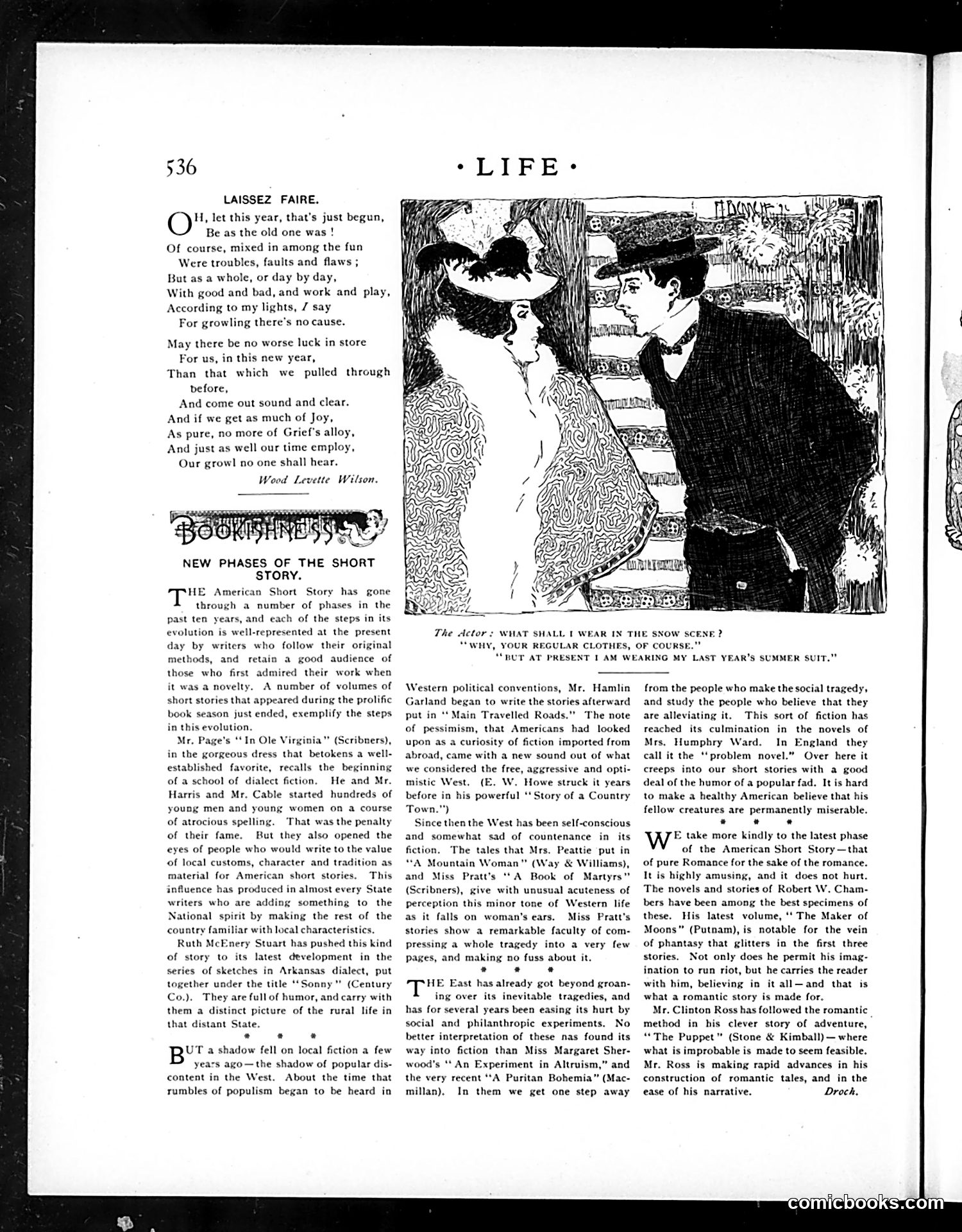
The main illustration shows three figures in what appears to be a theater or dressing room setting. A man in dark clothing asks an actress about her costume for a snow scene. She responds that she's wearing "your regular clothes, of course—but at present I am wearing my last year's summer suit." This is a **satirical commentary on economic hardship**, likely from the post-WWI recession era (the page is numbered 536). The joke hinges on the actress's inability to afford new winter clothing, forcing her to wear inadequate summer garments instead. The humor is dark—highlighting genuine poverty and the gap between theatrical illusion and economic reality. The accompanying text discusses the American short story's evolution, suggesting this may relate to broader discussions of social realism in literature and society.
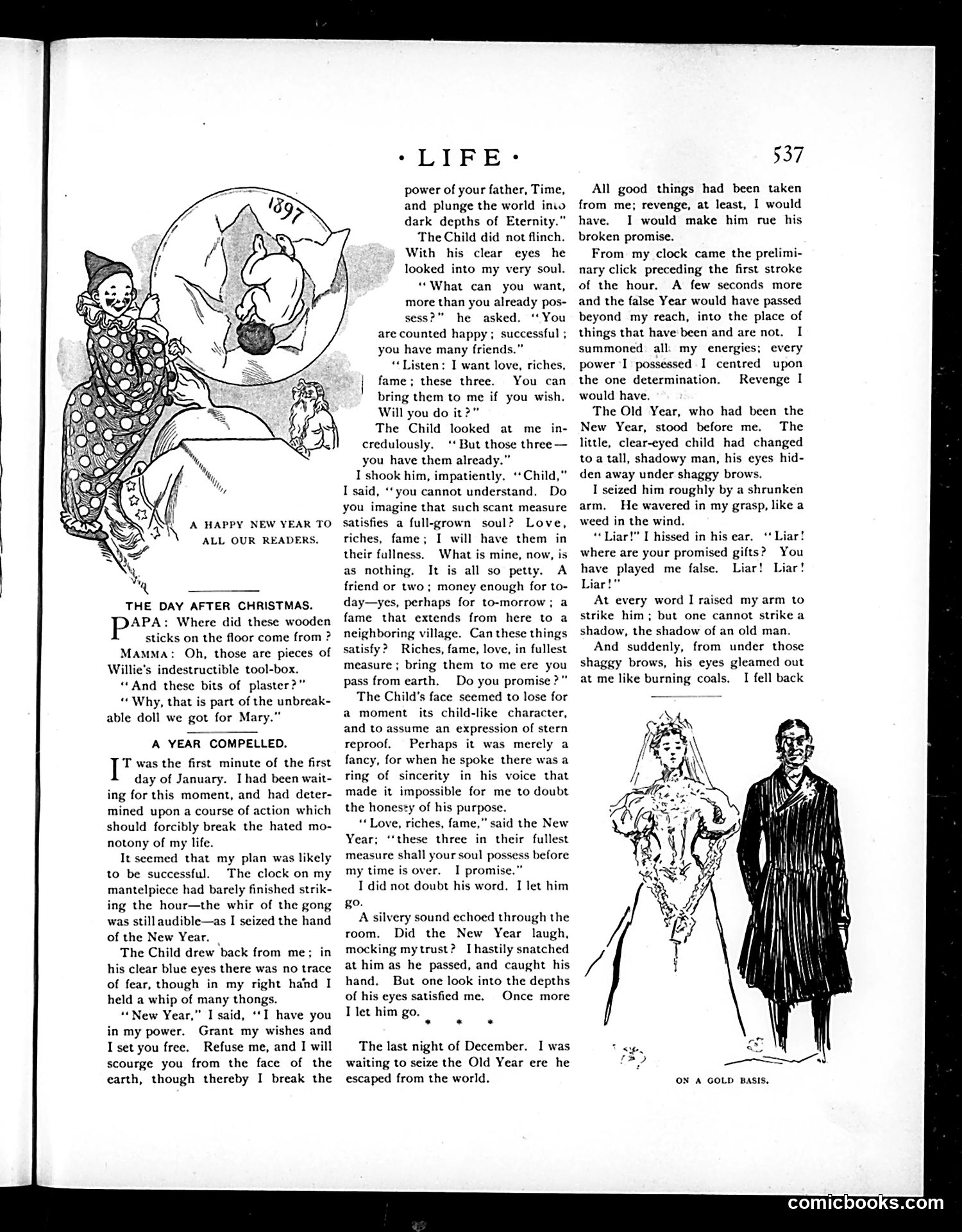
This page contains a **allegorical New Year's story** rather than political satire. The narrative depicts a confrontation between the narrator and personified figures of Time and the New Year—a common literary device in 19th-century publications. The illustrations show: - Left: A decorative "1897" medallion with cherubs, labeled "A HAPPY NEW YEAR TO ALL OUR READERS" - Right: Two figures labeled "ON A GOLD BASIS" (likely the Old Year and New Year) The text explores philosophical themes about desire (love, riches, fame) and temporal inevitability. The narrator attempts to bargain with Time personified as a child, demanding promises about future happiness. This represents **typical fin-de-siècle sentimental morality literature**—reflective rather than satirical—common in American magazines of this era.
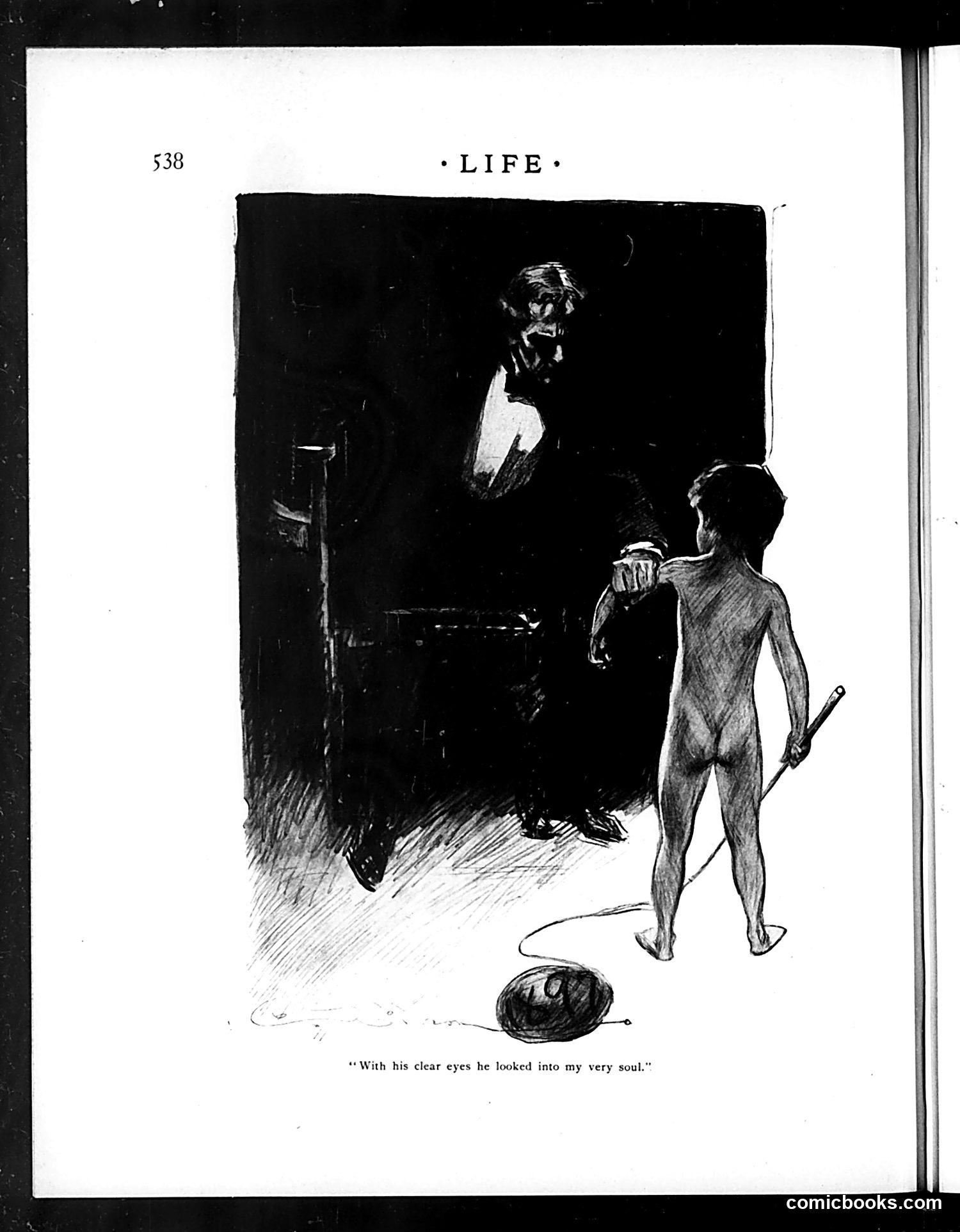
This illustration depicts a naked child confronting an adult authority figure in a darkened doorway, with the caption: "With his clear eyes he looked into my very soul." The image appears to be satirical social commentary on adult hypocrisy and moral scrutiny. The child's nakedness and directness contrast with the clothed, shadowed adult figure—suggesting innocence versus corruption or pretense. The child holds what appears to be a stick or switch, possibly referencing punishment or discipline. The satire likely critiques how adults judge children's behavior while their own moral failings go unexamined. The phrase about "clear eyes" and "soul" emphasizes the piercing honesty of childhood perspective that exposes adult dishonesty. Without additional context about Life's publication date or specific social issues, the exact target of satire remains unclear, though it addresses universal themes of moral judgment and innocence versus experience.
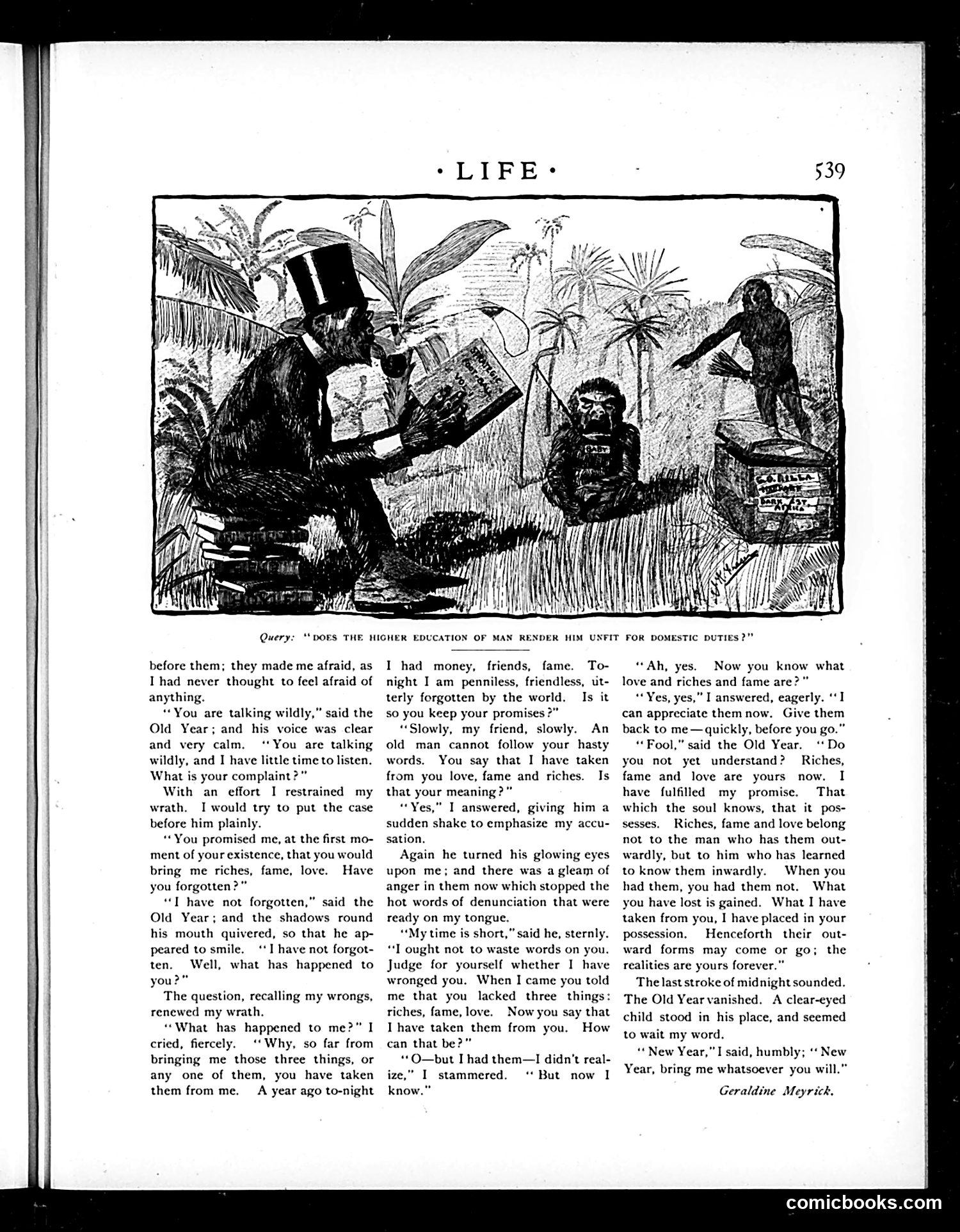
**The Cartoon:** The illustration depicts an anthropomorphized ape in formal dress (top hat, reading materials) conversing with smaller apes in a tropical setting. The caption reads: "DOES THE HIGHER EDUCATION OF MAN RENDER HIM UNFIT FOR DOMESTIC DUTIES?" **Meaning:** This is satirical commentary on education and gender roles. The cartoon appears to mock the contemporary debate about whether educated people—particularly women—become unsuited for household responsibilities. By depicting an educated ape questioning its own fitness for "domestic duties," the cartoonist satirizes anxieties about how education might make individuals overly refined or intellectually preoccupied, thereby neglecting traditional domestic obligations. **Context:** This reflects early-20th-century concerns about women's education and its perceived threat to traditional family structures—a common anxiety during the women's suffrage and education expansion era.
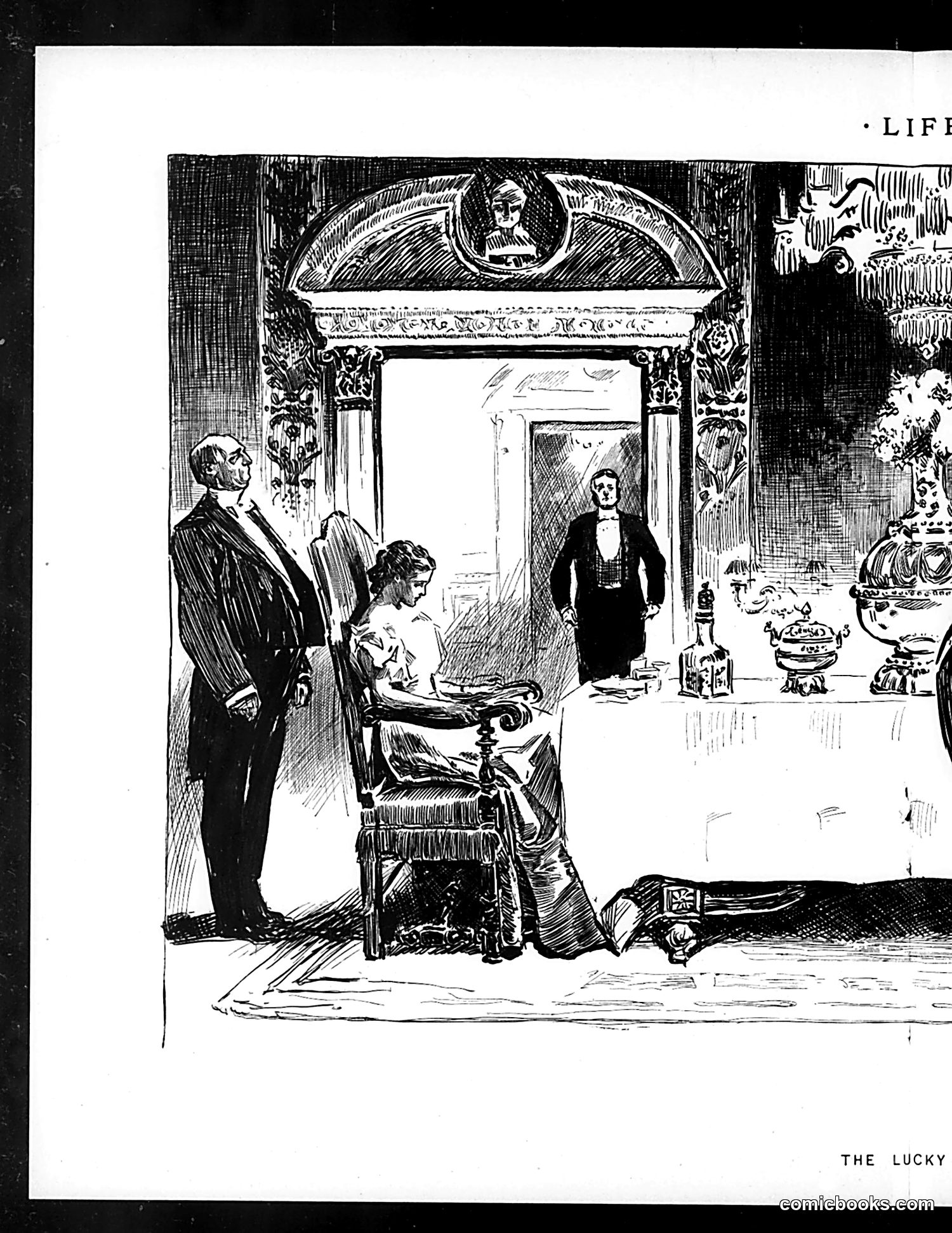
This appears to be a satirical illustration from Life magazine depicting a domestic servant or working-class woman at the center of attention in what seems to be an upper-class home. The title "THE LUCKY" suggests ironic commentary on her supposed good fortune. The scene shows well-dressed gentlemen observing the woman, who sits amid ornate furnishings and decorative objects. The satire likely critiques either: 1. The exploitation of domestic workers under the guise of employment "luck" 2. Class disparities and the objectification of working-class women in wealthy households 3. Hypocrisy about the supposed benefits of servitude The ornate architectural framing emphasizes the wealth surrounding this figure, contrasting sharply with her likely low wages and servile position—making the title's "lucky" designation deeply ironic.
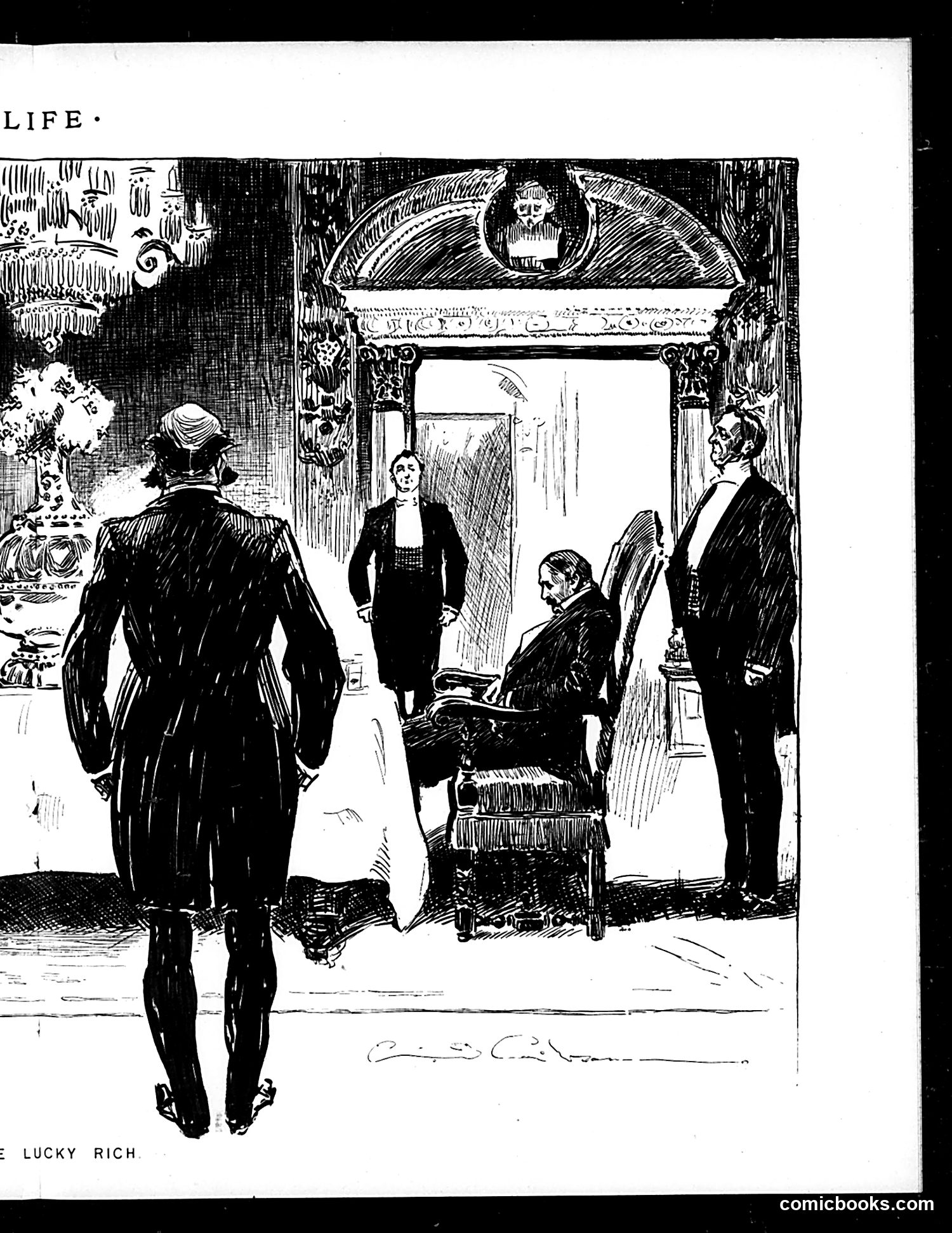
This appears to be a satirical cartoon titled "Lucky Rich" from *Life* magazine. The image depicts a formal interior scene with several well-dressed men in evening wear observing a seated gentleman who appears to be the central figure. The ornate architectural details—decorative molding, elaborate doorframe, and refined furnishings—emphasize wealth and high society. The caption "LUCKY RICH" suggests ironic commentary on affluence. The composition, with multiple observers watching one wealthy man, implies satire about either inherited fortune, undeserved privilege, or the absurdity of society's deference to the rich. Without additional context or visible date, the exact social/political reference remains unclear, but the tone mocks upper-class pretension and the arbitrary nature of wealth and status.
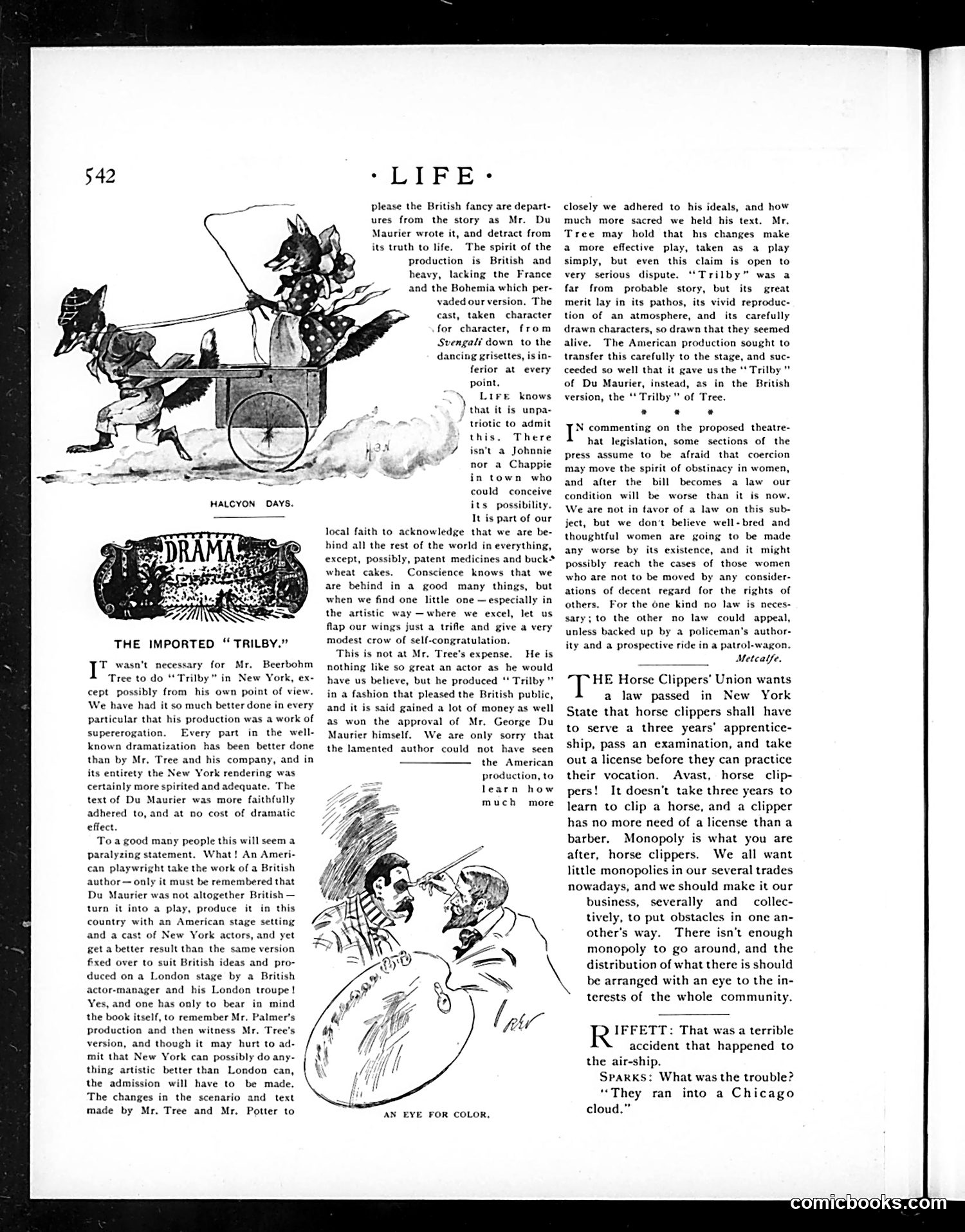
This page critiques British actor-manager Beerbohm Tree's New York production of "Trilby" (adapted from George Du Maurier's novel). Life argues that an *American* stage adaptation by Palmer was superior to Tree's British version. The satire targets American cultural inferiority complex: Life notes it's "unpatriotic" to admit Americans do anything better than the British, yet insists the American production more faithfully captured Du Maurier's original spirit—its French Bohemian atmosphere and emotional depth—while Tree's British version made heavy-handed changes that sacrificed authenticity for commercial appeal. The illustrations (titled "Halcyon Days" and "An Eye for Color") appear to reference the play's characters and aesthetic, though specifics are unclear. The piece's broader point: sometimes American artists deserve credit when genuinely superior, despite cultural prejudices favoring British productions.
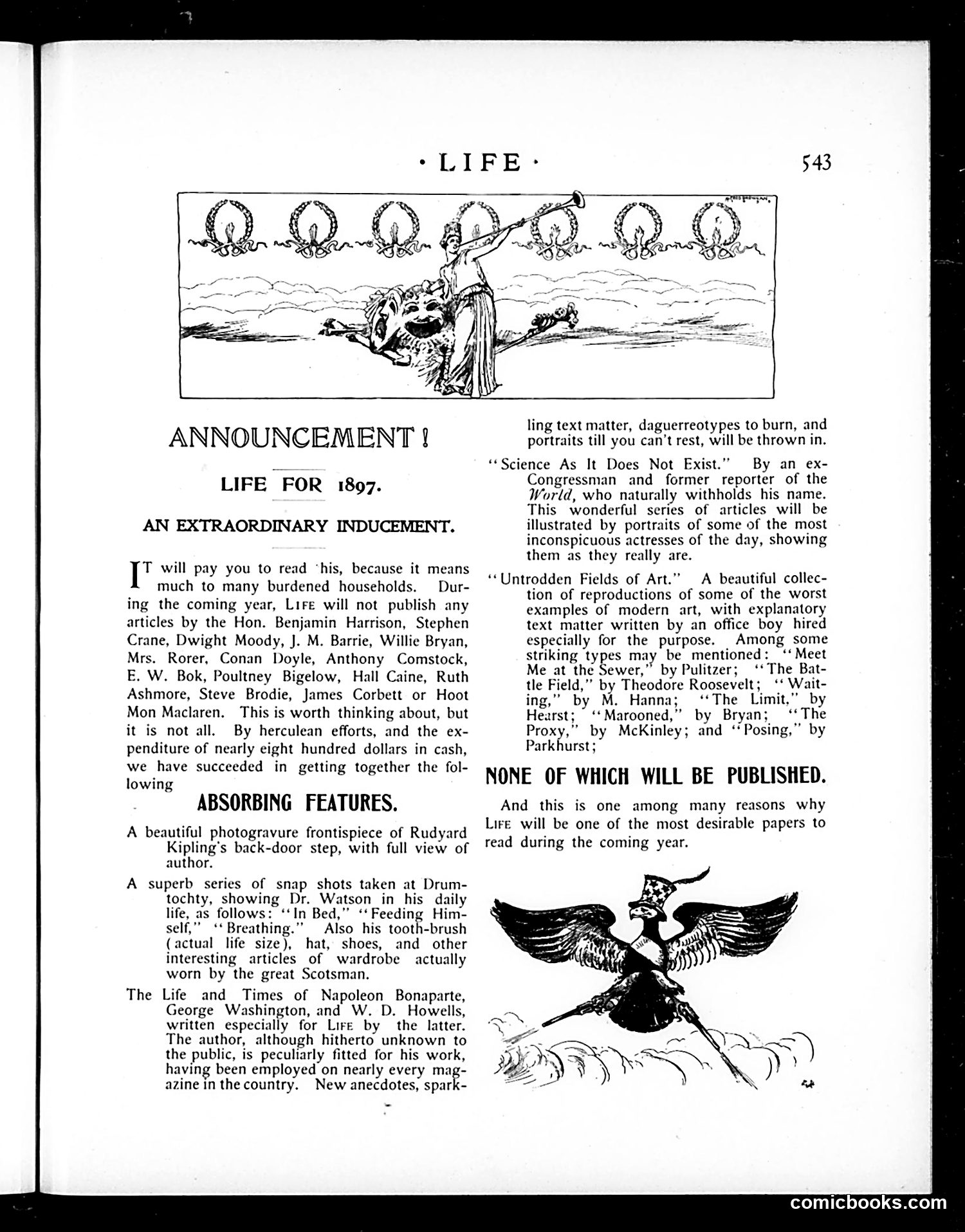
This is a mock promotional page where *Life* satirizes itself by advertising absurdly worthless content for 1897. The joke operates on multiple levels: **The Setup:** Life announces it will *not* publish articles by famous contemporaries (Benjamin Harrison, Rudyard Kipling, Conan Doyle, Willie Bryan, etc.)—then lists deliberately ridiculous "features" instead, like Kipling's "back-door step" and Dr. Watson's actual tooth-brush. **The Punchline:** The final section, "NONE OF WHICH WILL BE PUBLISHED," reveals the entire announcement as tongue-in-cheek—Life is mocking its own (and competitors') tendency toward sensationalism and trivial celebrity content. **The Satire's Target:** The page ridicules the magazine industry's obsession with celebrity gossip, pseudo-intellectual articles, and low-quality reproductions—all marketed as "extraordinary." The decorative header illustration (woman with telescope and harvested figures) reinforces the theme of surveying or collecting cultural output. This is essentially *Life* making fun of itself and its rivals' editorial practices.
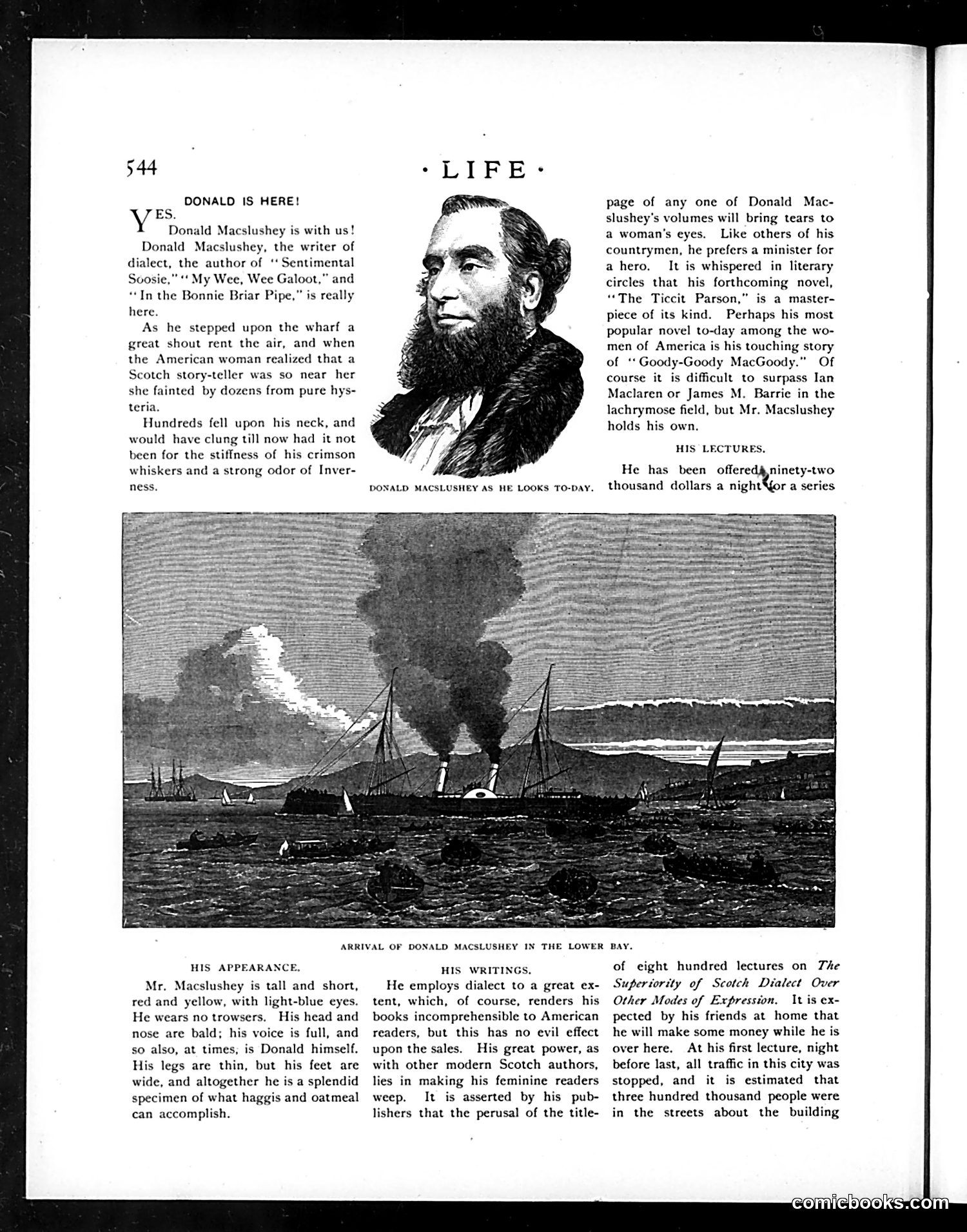
This is satirical coverage of a visiting Scottish author, presented as breathless celebrity journalism. The piece mocks both the writer himself and American readers' obsession with sentimental Scottish dialect literature. **The Target**: "Donald Macslushey" appears to be a fictional composite satirizing real popular Scottish authors of the era (the text references comparisons to Jan Maclaren and James M. Barrie). These writers specialized in emotionally manipulative stories written in heavy Scots dialect. **The Satire's Points**: - American women's hysteria over Scottish sentiment and "touching" stories - The absurdity of incomprehensible dialect literature that sells anyway - Macslushey's ridiculous physical description (simultaneously contradictory traits) and his unconventional appearance - The massive commercial success and lecture fees despite—or because of—the work's artistic questionability The engraving shows his ship's arrival; the accompanying image depicts crowds during his lecture. The satire targets both the manufactured celebrity worship and the uncritical American appetite for tearful Scottish narratives.
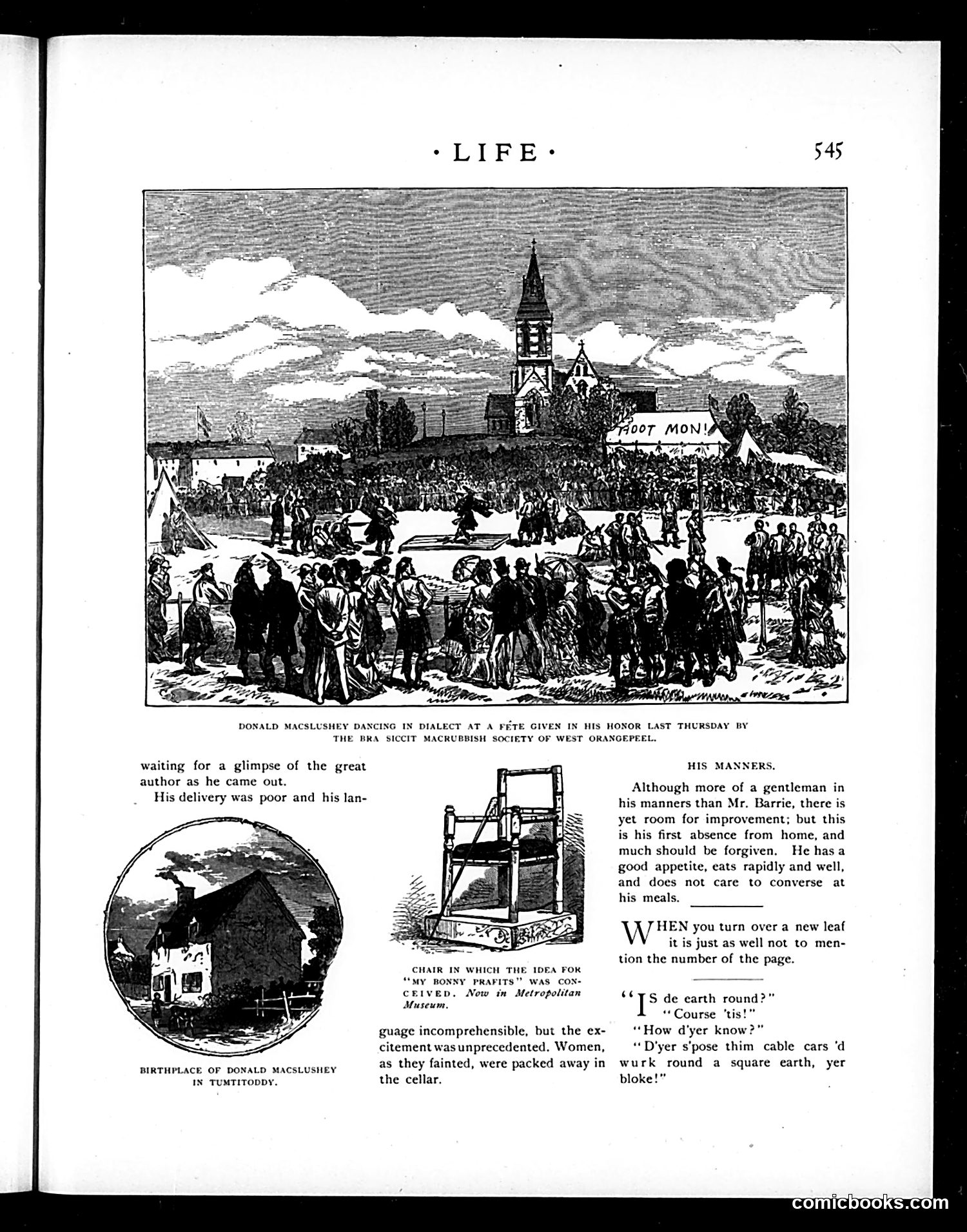
This page from *Life* magazine satirizes Scottish literary pretension and dialect writing. "Donald MacSlushey" appears to be a fictional parody of a Scottish author (possibly referencing J.M. Barrie, mentioned in the text), mocking the reverence afforded to such figures despite their poor public speaking and incomprehensible Scottish dialect. The satire operates on multiple levels: the absurdly named "Bra Siccit Macrubbish Society of West Orangepeel" ridicules Scottish cultural societies; women fainting and being "packed away in the cellar" exaggerates the hysteria surrounding literary celebrity; and the note about his poor manners and rapid eating deflates the author's pretensions. The final dialogue joke about Earth's shape is unrelated political/intellectual humor, mocking working-class reasoning about geography. Overall, the page lampooned both Scottish literary culture and the cult of celebrity surrounding writers.
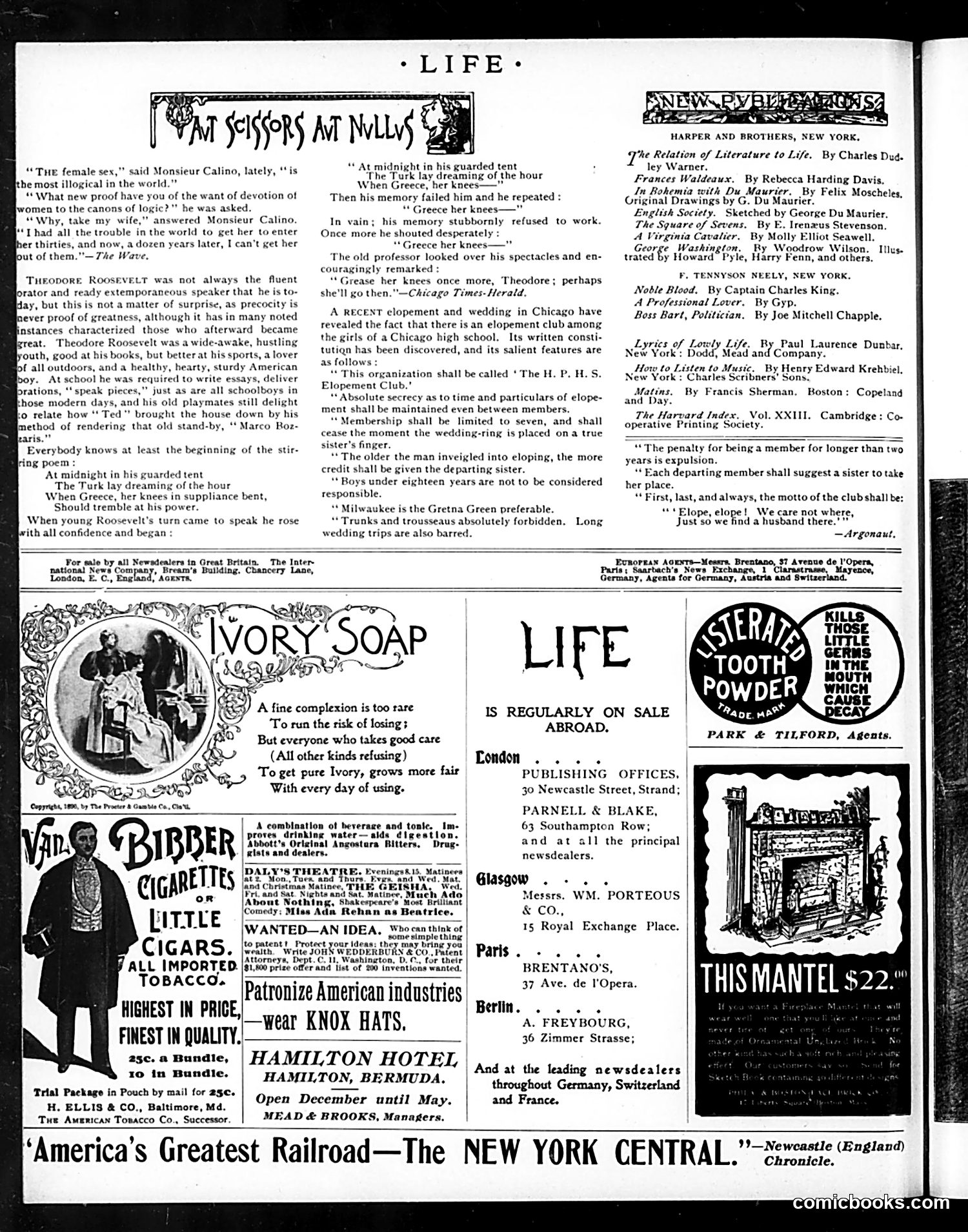
This page contains satirical commentary on contemporary social topics rather than political cartoons. The main content includes: **"Am Scissors at Nullus"** — A humorous anecdote mocking women's logic, featuring Monsieur Calino complaining that he couldn't convince his wife to leave her thirties, and she won't leave them now. **The Theodore Roosevelt anecdote** — A story about young Roosevelt's school speech where he repeatedly stumbled over the line "Greece her knees" from the poem "Marco Rozzaris," with the professor encouragingly suggesting he try once more. This gently satirizes Roosevelt's supposed oratorical gifts by showing his youthful inexperience. **The "H.P.H.S. Elopement Club"** — A satirical piece about a discovered constitution of Chicago high school girls organizing secret elopements, with rules limiting membership, preferring older men, and favoring Milwaukee as their elopement destination. The page is primarily **advertisements** (Ivory Soap, Bibber Cigarettes, Knox Hats, Hamilton Hotel) with book announcements filling the remainder. The satire targets women's logic, youthful inexperience, and teenage rebelliousness.
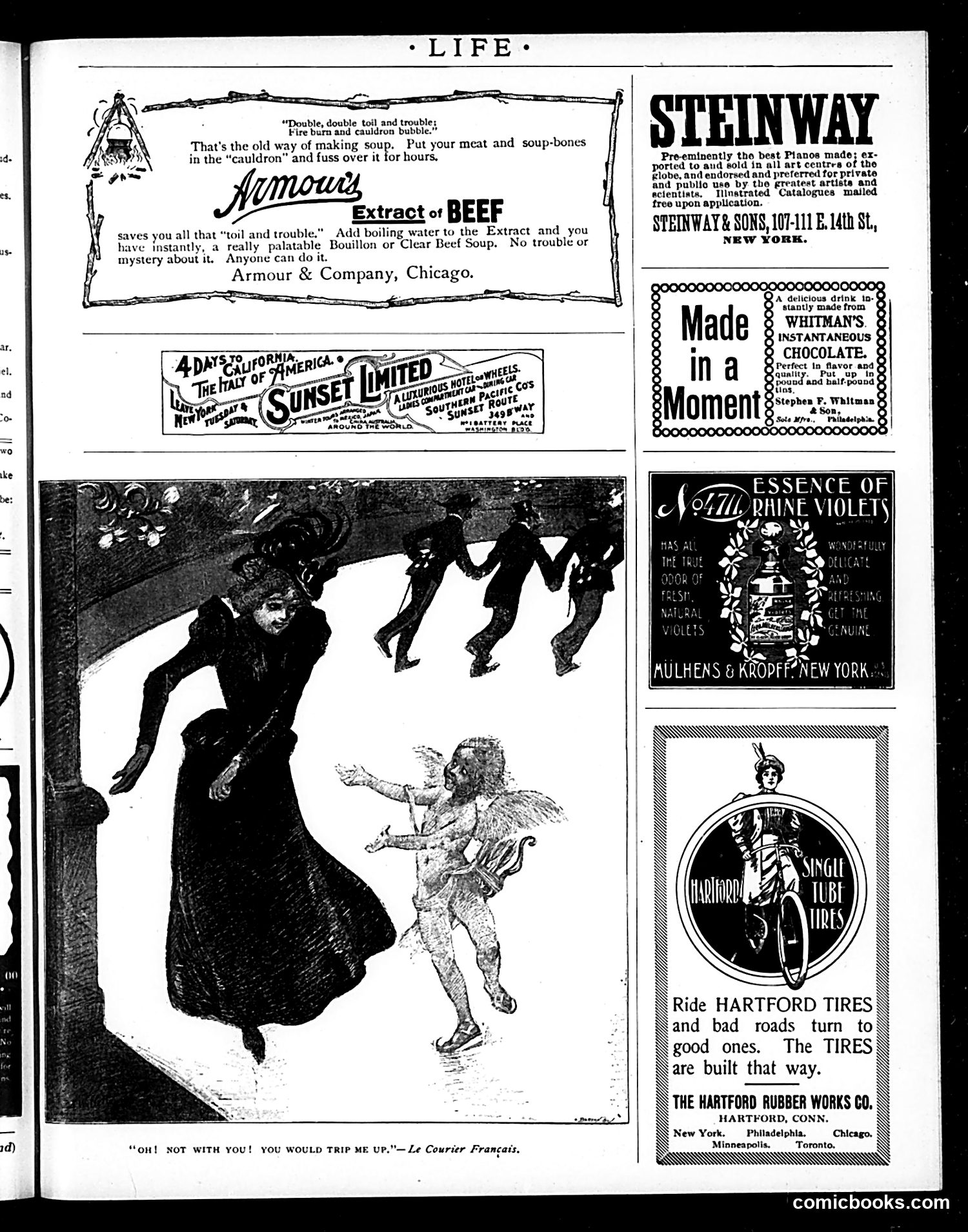
This page is primarily **advertisements** interspersed with a single cartoon. The main visual is a French satirical cartoon (credited to *Le Courier Francais*) depicting a woman in dark clothing appearing to reject or push away a cherub-like figure, with the caption "Oh! Not with you! You would trip me up." **The cartoon's meaning**: Without additional context about the specific historical moment, the image appears to be social commentary—likely about a woman rejecting unwanted advances or interference, with the cherub symbolizing either love, fate, or some other force she views as an obstacle. The French origin suggests it may reference contemporary Franco-American relations or social dynamics. **The advertisements** promote typical early-20th-century products: Armour's beef extract (emphasizing convenience), Steinway pianos, Whitman's chocolate, Hartford tires, and a violet essence fragrance—all targeting middle-class consumers with promises of quality and ease. Without knowing the magazine's publication date, the specific political context remains unclear, though the overall tone is light and commercial rather than overtly political.
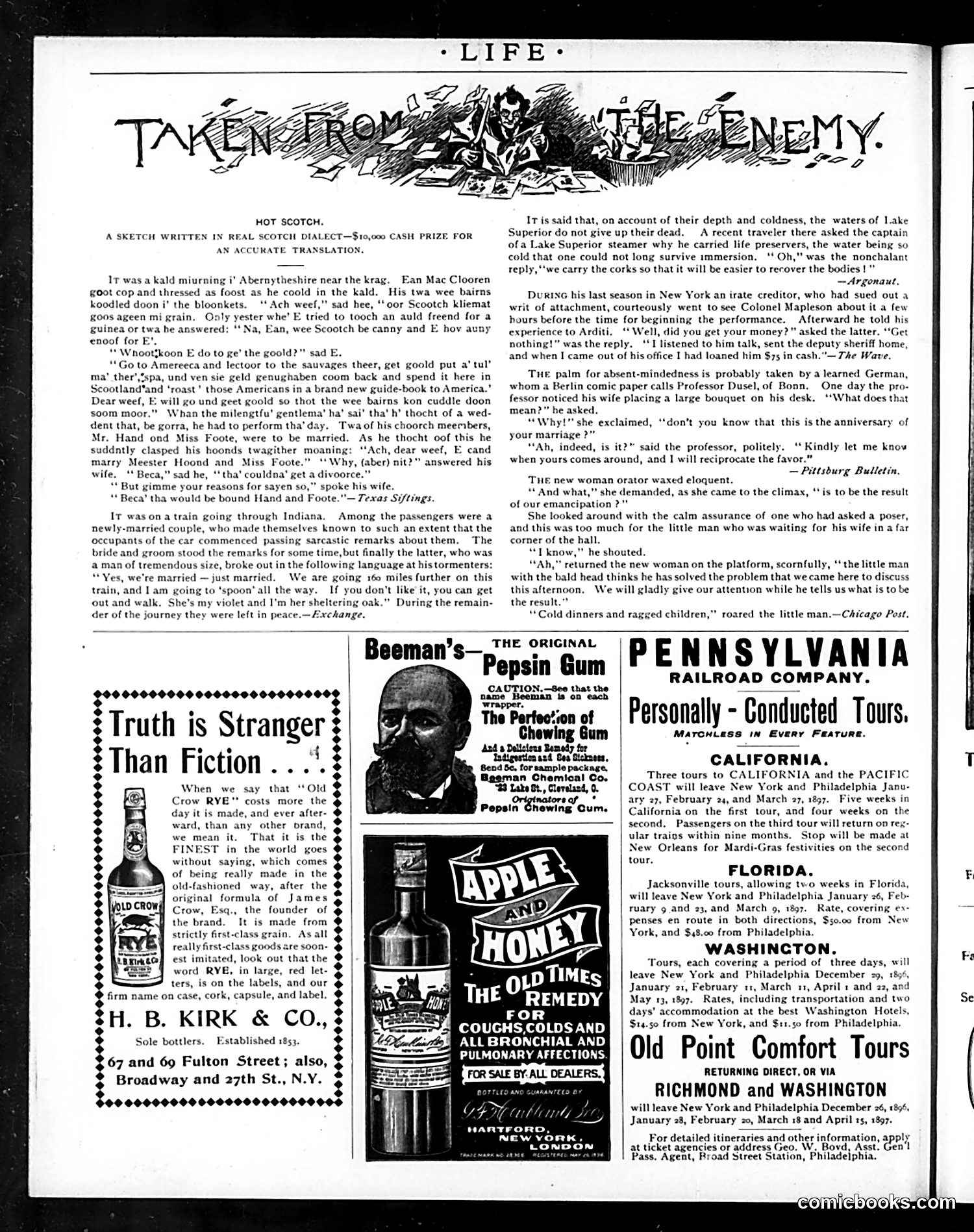
This page contains **humorous short stories and anecdotes** rather than political cartoons. The content reflects turn-of-the-century American comedy sensibilities: **"Hot Scotch"**: A story in exaggerated Scottish dialect about a poor Scotsman planning to lecture Americans and write a disparaging guidebook about them to earn money. The humor relies on ethnic stereotype and the irony that he'll profit by insulting his audience. The $10,000 prize offered for "accurate translation" is itself the joke—the dialect is intentionally impenetrable. **Other anecdotes** mock: newlyweds on trains, absent-minded German professors, and Irish steamer captains. These brief jokes perpetuate common ethnic caricatures of the period. The advertisements (Beeman's Gum, Old Times Remedy, Pennsylvania Railroad tours) and travel notices fill the remaining space. This is typical **turn-of-century Life magazine content**—lightweight social satire relying heavily on ethnic humor that would be considered offensive today.
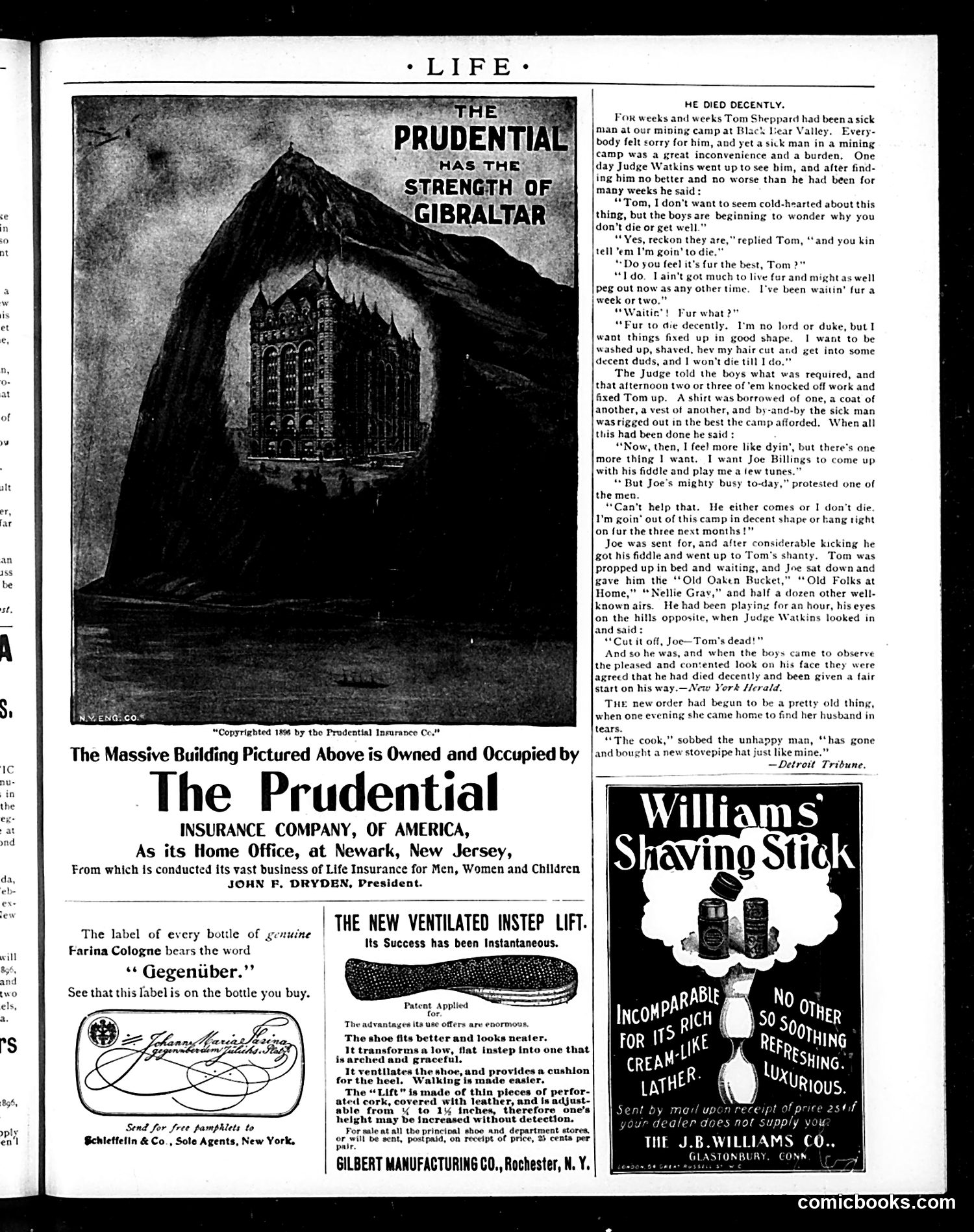
This page contains primarily **advertising and a sentimental short story**, not political satire. The main narrative, "He Died Decently," reprinted from the *New York Herald*, tells of Tom Sheppard, a dying miner at a remote camp. When informed his illness burdens the other workers, Tom agrees to die—but insists on doing so "decently." He demands to be cleaned up, dressed properly, and have a musician play familiar folk songs before his death. The story celebrates working-class dignity and community solidarity; Tom's final wish is granted, and he dies contentedly. A brief humorous tag follows about a cook who buys an expensive hat, upsetting his employer. The page also features **advertisements** for The Prudential Insurance Company (showing the company's Newark headquarters), Farina Cologne, and the "Ventilated Instep Lift" (a shoe insert). These ads reflect typical early-20th-century product marketing and corporate messaging.
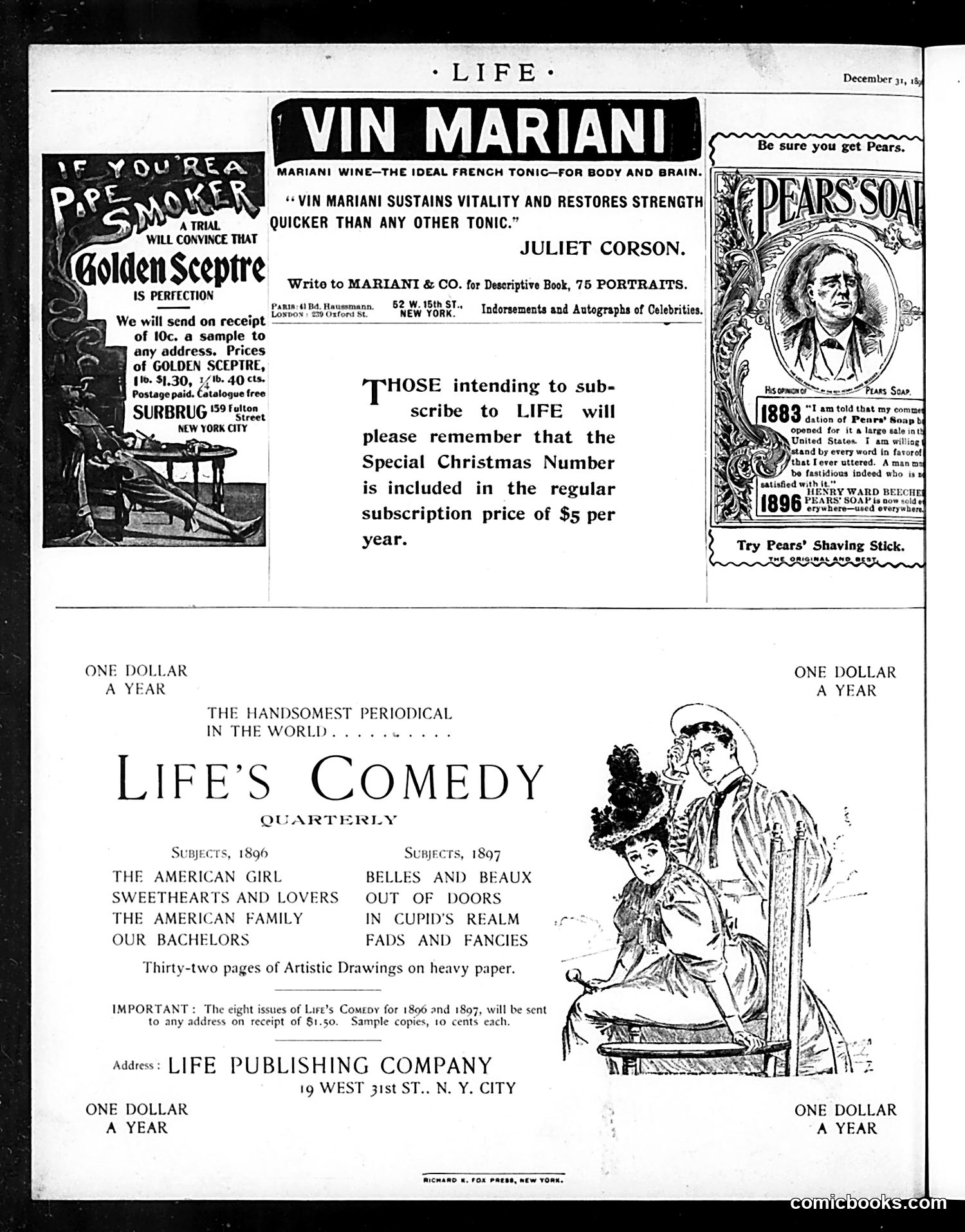
This is primarily an **advertising and promotional page** from Life magazine (December 31, 1898), not a political cartoon. The page contains advertisements for commercial products (Vin Mariani wine tonic, Pears' Soap, Golden Sceptre pipe tobacco) interspersed with promotional material for Life's own publications. The central content advertises **Life's Comedy Quarterly**—a humor periodical featuring artistic drawings on topics like "The American Girl," "Sweethearts and Lovers," and "Fads and Fancies" from 1896-1897. The small illustration shows a fashionably-dressed couple in period clothing, typical of the magazine's comedic social commentary on contemporary manners and romance. The page emphasizes that Life magazine's Special Christmas Number comes included with a $5 annual subscription—a sales pitch to potential subscribers. There is **no political satire or cartoon** here; this is essentially a 19th-century magazine advertisement section.
I can see this is a page from Life magazine, but the image quality and contrast make it difficult to read the specific text or clearly identify cartoon content. What is visible appears to be mostly blank white space with some text fragments along the left margin that are too blurry to read with confidence. Without being able to reliably read the OCR text or see distinct cartoon imagery, I cannot accurately identify the figures, political references, or satirical intent as you've requested. To provide you with the careful historical analysis you're asking for, I would need either a clearer image or confirmation of the specific date and issue of Life magazine this page comes from.