
Life, 1896-12-31 · page 6 of 21
Life — December 31, 1896 — page 6: what you’re looking at
What you’re looking at
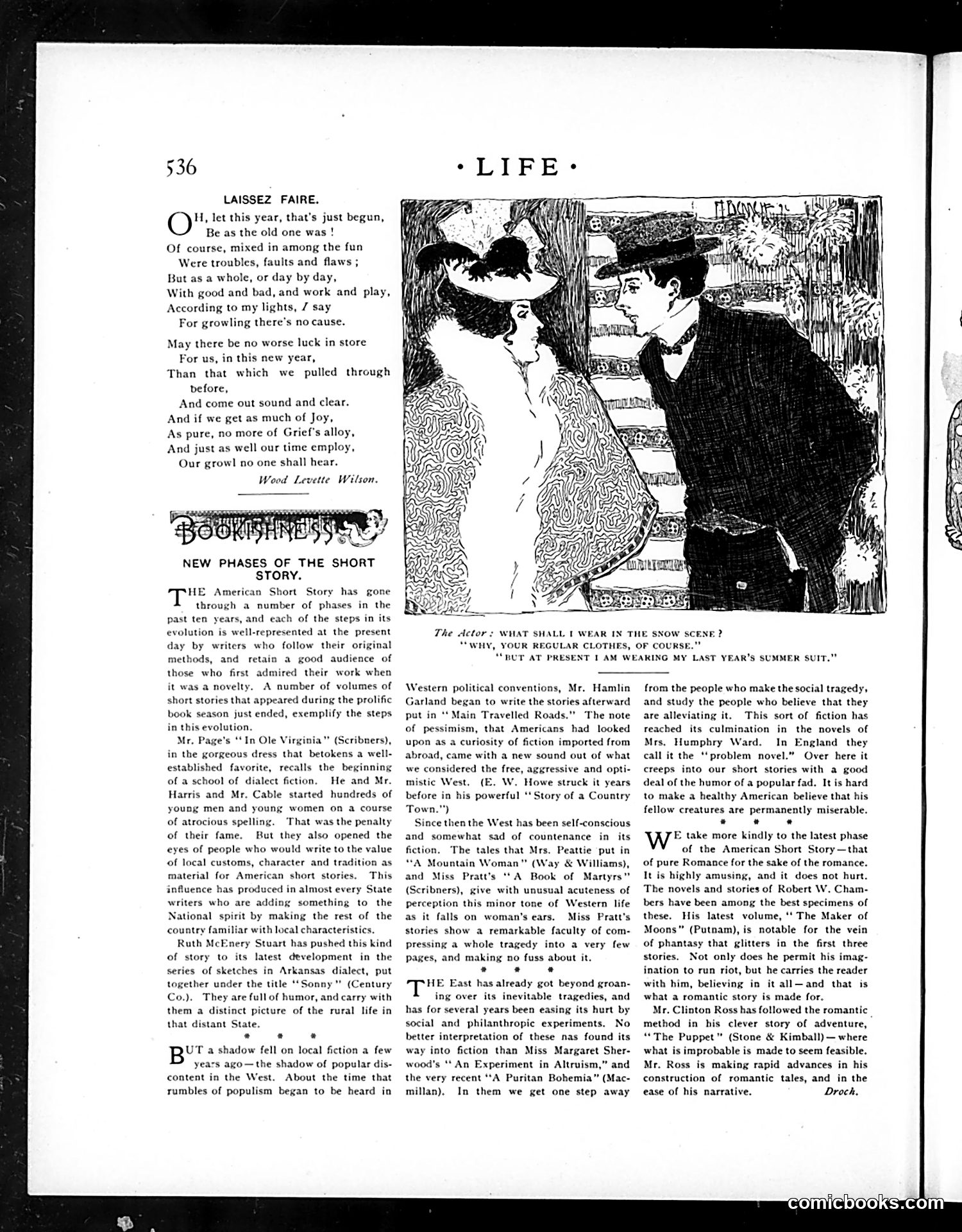
The main illustration shows three figures in what appears to be a theater or dressing room setting. A man in dark clothing asks an actress about her costume for a snow scene. She responds that she's wearing "your regular clothes, of course—but at present I am wearing my last year's summer suit." This is a **satirical commentary on economic hardship**, likely from the post-WWI recession era (the page is numbered 536). The joke hinges on the actress's inability to afford new winter clothing, forcing her to wear inadequate summer garments instead. The humor is dark—highlighting genuine poverty and the gap between theatrical illusion and economic reality. The accompanying text discusses the American short story's evolution, suggesting this may relate to broader discussions of social realism in literature and society.
📄 Transcribed text from this page (OCR, searchable)
Machine-transcribed from the original scan — historical spelling and the odd misread are preserved.
536 LAISSEZ FAIRE. H, let this year, that’s just begun, Be as the old one was ! Of course, mixed in among the fun Were troubles, faults and flaws ; But as a whole, or day by day, With good and bad, and work and play, According to my lights, 7 say For growling there's no cause. May there be no worse luck in store ‘or us, in this new year, Than that which we pulled through before, And come out sound and clear. And if we get as much of Joy, As pure, no more of Grief's alloy, And just as well our time employ, Our growl no one shall hear. Wood Levette Wilson. NEW PHASES OF THE SHORT STORY. HE American Short through a number of phases in the past ten years, and each of the steps in its evolution is well-represented at the present day by writers who follow their original methods, and retain a good audience of those who first admired their work when it was a novelty. A number of volumes of short stories that appeared during the prolific book season just ended, exemplify the steps in this evolution. Mr, Page's ‘In Ole Virginia” (Scribners), in the gorgeous dress that betokens a well- established favorite, recalls the beginning of a school of dialect fiction. He and Mr. Harris and Mr. Cable started hundreds of young men and young women on a course of atrocious spelling. ‘That was the penalty of their fame. But they also opened the eyes of people who would write to the value of local customs, character and tradition as material for American short stories. This influence has produced in almost every State writers who are adding something to the National spirit by making the rest of the country familiar with local characteristics. Ruth McEnery Stuart has pushed this kind of story to its latest development in the series of sketches in Arkansas dialect, put together under the title “Sonny " (Century Co.). They are full of humor, and carry with them a distinct picture of the rural life in that distant State. ° . * Story has gone UT a shadow fell on local fiction a few years ago—the shadow of popular dis- content in the West. About the time that rumbles of populism began to be heard in NOW SCENE? AR CLOTHES, OF COURSE. “RUT AT PRESENT I AM WEARING MY LAST YEAR'S SUMMER SUIT.” Western political conventions, Mr. Hamlin Garland began to write the stories afterward put in “Main Travelled Roads.” The note of pessimism, that Americans had looked upon as a curiosity of fiction imported from abroad, came with a new sound out of what we considered the free, aggressive and opti- mistic West. (E. W. Howe struck it years before in his powerful * Story of a Country Town.) Since then the West has been self-conscious and somewhat sad of countenance in its fiction, The tales that Mrs. Peattie put in “A Mountain Woman" (Way & Williams} and Miss Pratt's “A Book of Marty (Scribners), give with unusual acuteness of perception this minor tone of Western life as it falls on woman's ears. Miss Pratt's stories show a remarkable faculty of com- pressing a whole tragedy into a very few pages, and making no fuss about it. * * * HE East has already got beyond groan- ing over its inevitable tragedies, and has for several years been easing its hurt by social and philanthropic experiments. No better interpretation of these nas found its way into fiction than Miss Margaret Sher- wood's “An Experiment in Altruism,” and the very recent “A Puritan Bohemia” (Mac- millan). In them we get one step away from the people who make the social tragedy, and study the people who believe that they are alleviating it. This sort of fiction has reached its culmination in the novels of Mrs, Humphry Ward. In England they call it the “problem novel.” Over here it creeps into our short stories with a good deal of the humor of a popular fad. It is hard to make a healthy American believe that his fellow creatures are permanently miserable. * * * Ww take more kindly to the latest phase of the American Short Story—that of pure Romance for the sake of the romance. It is highly amusing, and it does not hurt. The novels and stories of Robert W. Cham- bers have been among the best specimens of these. His latest volume, ‘‘ The Maker of Moons” (Putnam), is notable for the vein of phantasy that glitters in the first three stories. Not only does he permit his imag- ination to run riot, but he carries the reader with him, believing in it all—and that is what a romantic story is made for. Mr. Clinton Ross has followed the romantic method in his clever story of adventure, “The Puppet" (Stone & Kimball) — where what is improbable is made to seem feasible. Mr. Ross is making rapid advances in his construction of romantic tales, and in the ease of his narrative. Droch,