
Life, 1896-12-31 · page 12 of 21
Life — December 31, 1896 — page 12: what you’re looking at
What you’re looking at
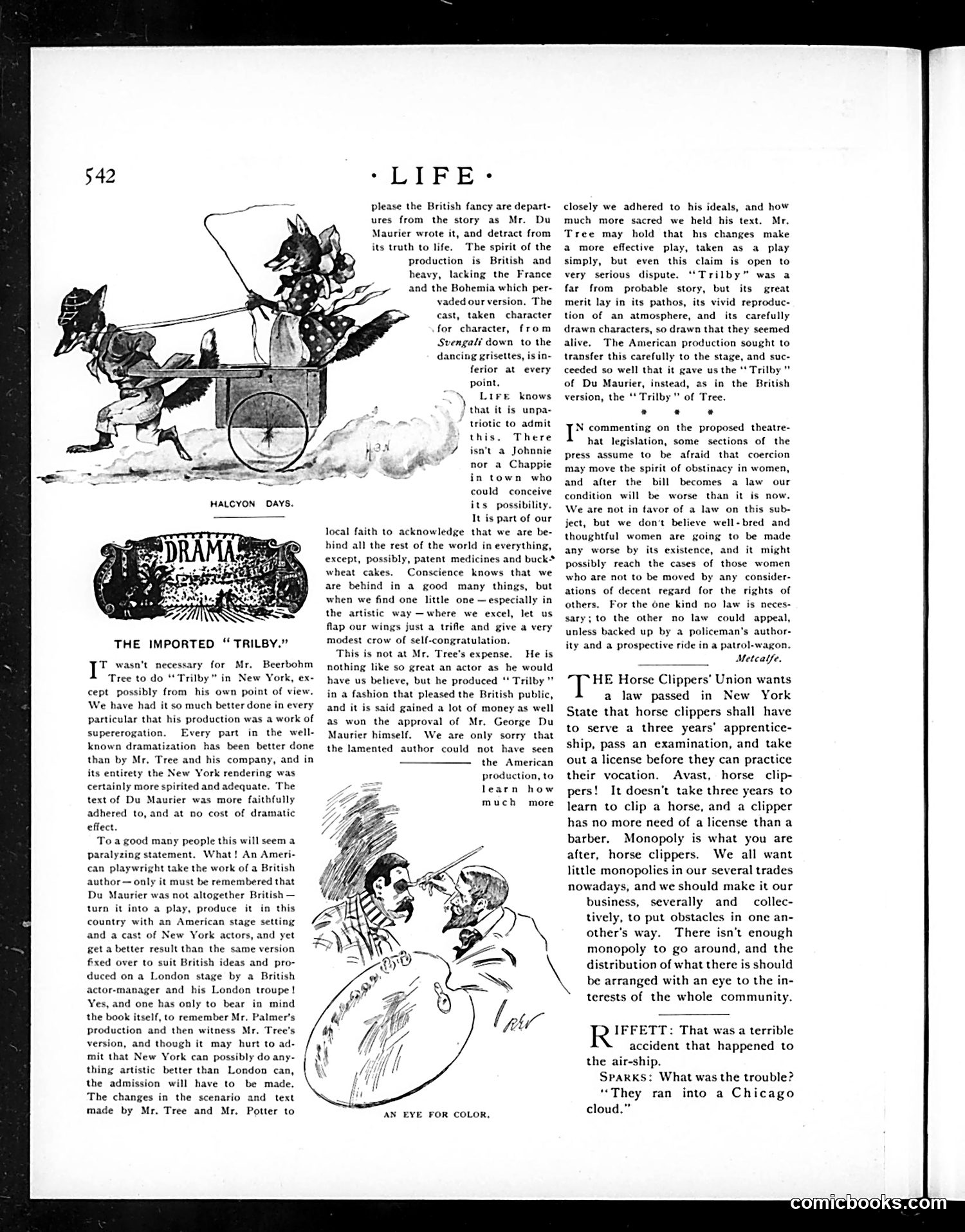
This page critiques British actor-manager Beerbohm Tree's New York production of "Trilby" (adapted from George Du Maurier's novel). Life argues that an *American* stage adaptation by Palmer was superior to Tree's British version. The satire targets American cultural inferiority complex: Life notes it's "unpatriotic" to admit Americans do anything better than the British, yet insists the American production more faithfully captured Du Maurier's original spirit—its French Bohemian atmosphere and emotional depth—while Tree's British version made heavy-handed changes that sacrificed authenticity for commercial appeal. The illustrations (titled "Halcyon Days" and "An Eye for Color") appear to reference the play's characters and aesthetic, though specifics are unclear. The piece's broader point: sometimes American artists deserve credit when genuinely superior, despite cultural prejudices favoring British productions.
📄 Transcribed text from this page (OCR, searchable)
Machine-transcribed from the original scan — historical spelling and the odd misread are preserved.
THE IMPORTED “ TRILBY.” T wasn't necessary for Mr. Beerbohm Tree to do “ Trilby” in New York, ex- cept possibly from his own point of view. We have had it so much better done in every particular that his production was a work of supererogation. Every part in the well- known dramatization has been better done than by Mr, Tree and his company, and in its entirety the New York rendering was certainly more spirited and adequate. The text of Du Maurier was more faithfully adhered to, and at no cost of dramatic effect. To a good many people this will seem a paralyzing statement. What ! An Ameri- can playwright take the work of a British author —only it must be remembered that Du Maurier was not altogether British — turn it into a play, produce it in this country with an American stage setting and a cast of New York actors, and yet get a better result than the same version fixed over to suit British ideas and pro- duced on a London stage by a British actor-manager and his London troupe ! Yes, and one has only to bear in mind the book itself, to remember Mr. Palmer's Production and then witness Mr. Tree's version, and though it may hurt to ad- mit that New York can possibly do any- thing artistic better than London can, the admission will have to be made. The changes in the scenario and text made by Mr. Tree and Mr. Potter to > LIFE: please the British fancy are depart ures from the story as Mr. Du Maurier wrote it, and detract from its truth to life. The spirit of the production is British and heavy, lacking the France and the Bohemia which per- vaded our version, The cast, taken character for character, from Svengali down to the dancing grisettes, is in- ferior at every point, LiFe knows that it is unpa- triotic to admit this. There isn’t a Johnnie nor a Chappie in town who could conceive its possibility It is part of our local faith to acknowledge that we are be- hind all the rest of the world in everything, except, possibly, patent medicines and buck* wheat cakes. Conscience knows that we are behind in a good many things, but when we find one little one —especially in the artistic way —where we excel, let us flap our wings just a trifle and give a very modest crow of self-congratulation. This is not at Mr. Tree's expense. He is nothing like so great an actor as he would have us believe, but he produced * Trilby in a fashion that pleased the British public, and it is said gained a lot of money as well as won the approval of Mr. George Du Maurier himself, We are only sorry that the lamented author could not have seen the American production, to learn how much more = AN EYE FOR COLOR, closely we adhered to his ideals, and how much more sacred we held his text. Mr. Tree may hold that his changes make a more effective play, taken as a play simply, but even this claim is open to very serious dispute. “Trilby” was a far from probable story, but its great merit lay in its pathos, its vivid reproduc- tion of an atmosphere, and its carefully drawn characters, so drawn that they seemed alive. The American production sought to transfer this carefully to the stage, and suc- ceeded so well that it gave us the ‘Trilby of Du Maurier, instead, as in the British version, the “ Trilby " of Tree. * 8 @ J commenting on the proposed theatre- hat legislation, some sections of the press assume to be afraid that coercion may move the spirit of obstinacy in women, and after the bill becomes a law condition will be than it is now. We are not in favor of a law on this sub- ject, but we don't believe well-bred and thoughtful women are going to be made any worse by its existence, and it might possibly reach the cases of those women who are not to be moved by any consider- ations of decent regard for the rights of others. For the one kind no law is neces- sary; to the other no law could appeal, unless backed up by a policeman’s author- ity and a prospective ride in a patrol-wagon. Metcalfe. TH Horse Clippers’ Union wants a law passed in New York State that horse clippers shall have to serve a three years’ apprentice- ship, pass an examination, and take out a license before they can practice their vocation. Avast, horse clip- pers! It doesn’t take three years to learn to clip a horse, and a clipper has no more need of a license thana barber. Monopoly is what you are after, horse clippers. We all want little monopolies in our several trades nowadays, and we should make it our business, severally and collec- tively, to put obstacles in one an- other's way. There isn’t enough monopoly to go around, and the distribution of what there is should be arranged with an eye to the in- terests of the whole community. our worse IFFETT: That was a terrible accident that happened to the air-ship. Sparks: What was the trouble? “They ran into a Chicago cloud.”