
Life, 1896-12-31 · page 4 of 21
Life — December 31, 1896 — page 4: what you’re looking at
What you’re looking at
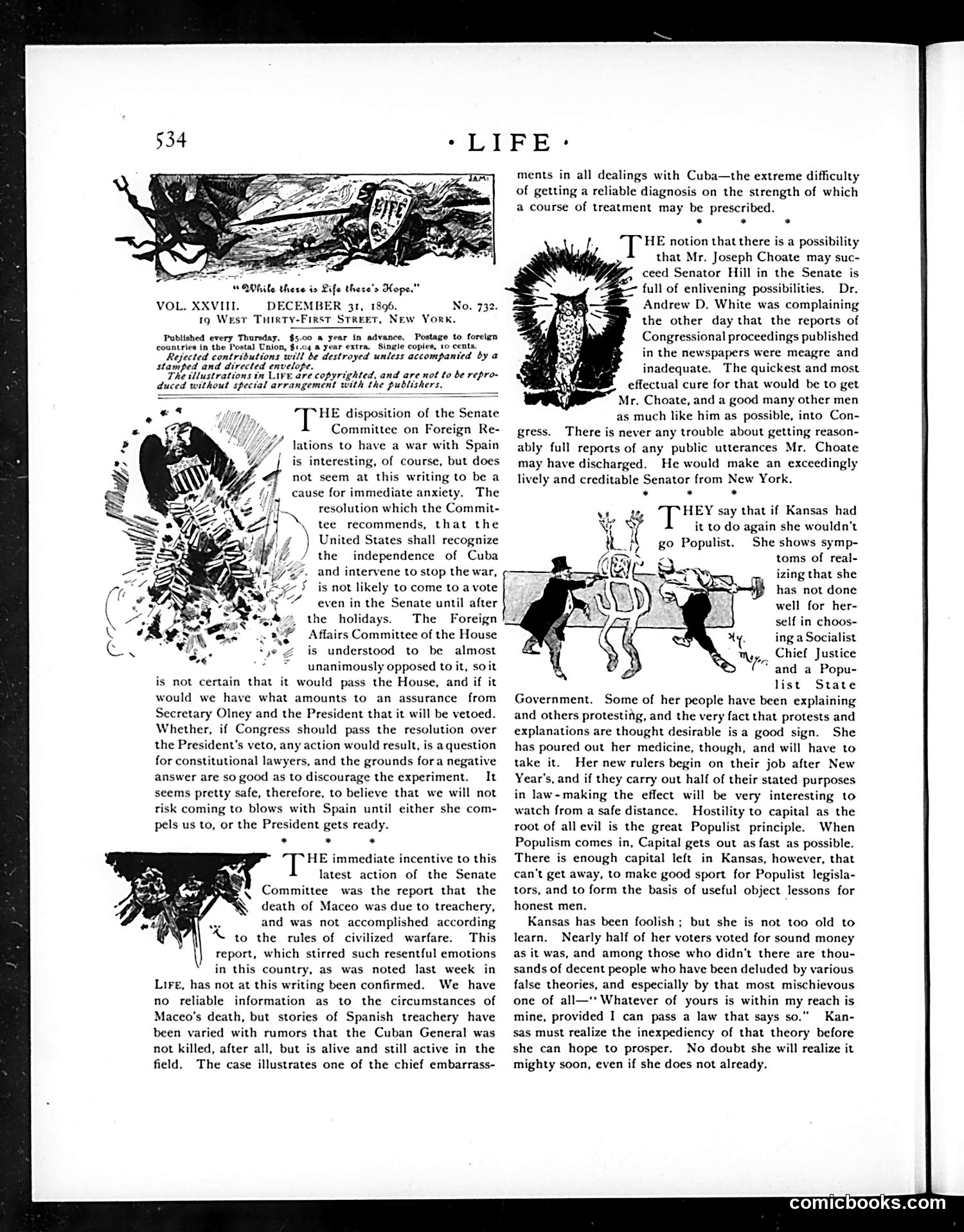
This *Life* magazine page contains satirical commentary on two contemporary political issues: **Cuba Crisis**: The left illustration depicts the Senate Foreign Relations Committee debating whether to recognize Cuban independence and intervene to stop Spain's war there. The text expresses skepticism that Congress will act decisively before the holidays, suggesting political paralysis over the intervention question. **Kansas Populism**: The right cartoon mocks Kansas for its recent Populist political movement. The illustration shows figures being pulled in different directions (representing competing political factions). The text sarcastically suggests Kansas foolishly embraced Populism and now faces consequences from its inexperienced "rulers" taking office in the new year, predicting the experiment will fail. Both pieces employ *Life*'s characteristic mocking tone toward political instability and reformist movements.
📄 Transcribed text from this page (OCR, searchable)
Machine-transcribed from the original scan — historical spelling and the odd misread are preserved.
*LIFE> " WOMhile there is Life there's Hope.” VOL. XXVIII DECEMBER 31, 1896. STR! New York. Published every Thursday. $5 rin advance, Postage to foreign countries in the Postal Union, $1.04 a year extra. Single copies, 10 cents. Rejected contributions will be destroyed unless accompanied by a stamped and directed envelope. The illustrations in Live are copyrighted, and are not to be repro- duced without special arrangement with the publishers. HE disposition of the Senate Committee on Foreign Re- lations to have a war with Spain is interesting, of course, but does not seem at this writing to be a cause for immediate anxiety. The resolution which the Commit- tee recommends, that the United States shall recognize the independence of Cuba and intervene to stop the war, is not likely to come to a vote even in the Senate until after the holidays. The Foreign Afiairs Committee of the House is understood to be almost unanimously opposed to it, soit is not certain that it would pass the House, and if it would we have what amounts to an assurance from Secretary Olney and the President that it will be vetoed. Whether, if Congress should pass the resolution over the President's veto, any action would result, is aquestion for constitutional law , and the grounds fora negative answer are so good as to discourage the experiment. It seems pretty safe, therefore, to believe that we will not risk coming to blows with Spain until either she com- pels us to, or the President gets ready. . . . HE immediate incentive to this latest action of the Senate Committee was the report that the death of Maceo was due to treachery, and was not accomplished according to the rules of civilized warfare. This report, which stirred such resentful emotions in this country, as was noted last week in Lire, has not at this writing been confirmed. We have no reliable information as to the circumstances of Maceo’s death, but stories of Spanish treachery have been varied with rumors that the Cuban General was not killed, after all, but is alive and still active in the field, The case illustrates one of the chief embarrass- ments in all dealings with Cuba—the extreme difficulty of getting a reliable diagnosis on the strength of which a course of treatment may be prescribed. . * THE notion that there is a possibility that Mr. Joseph Choate may suc- ceed Senator Hill in the Senate is full of enlivening possibilities. Dr. Andrew D, White was complaining the other day that the reports of Congressional proceedings published in the newspapers were meagre and inadequate. The quickest and most effectual cure for that would be to get Mr. Choate, and a good many other men as much like him as possible, into Con- gress. There is never any trouble about getting reason- ably full reports of any public utterances Mr. Choate may have discharged. He would make an exceedingly lively and creditable Senator from New York. . . HEY say that if Kansas had it to do again she wouldn't go Populist. She shows symp- toms of real- izing that she has not done well for her- self in choos- ing a Socialist Chief Justice “and a Popu- list State Government. Some of her people have been explaining and others protesting, and the very fact that protests and explanations are thought desirable isa good sign. She has poured out her medicine, though, and will have to take it. Her new rulers begin on their job after New Year's, and if they carry out half of their stated purposes in law-making the effect will be very interesting to watch from a safe distance. Hostility to capital as the root of allevil is the great Populist principle. When Populism comes in, Capital gets out as fast as possible. There is enough capital left in Kansas, however, that can't get away, to make good sport for Populist legisla- tors, and to form the basis of useful object lessons for honest men. Kansas has been foolish; but she is not too old to learn. Nearly half of her voters voted for sound money as it was, and among those who didn’t there are thou- sands of decent people who have been deluded by various false theories, and especially by that most mischievous one of all—‘t Whatever of yours is within my reach is mine, provided I can pass a law that says so." Kan- sas must realize the inexpediency of that theory before she can hope to prosper. No doubt she will realize it mighty soon, even if she does not already. comicbooks.com