
A complete issue · 20 pages · 1896
Life — December 24, 1896
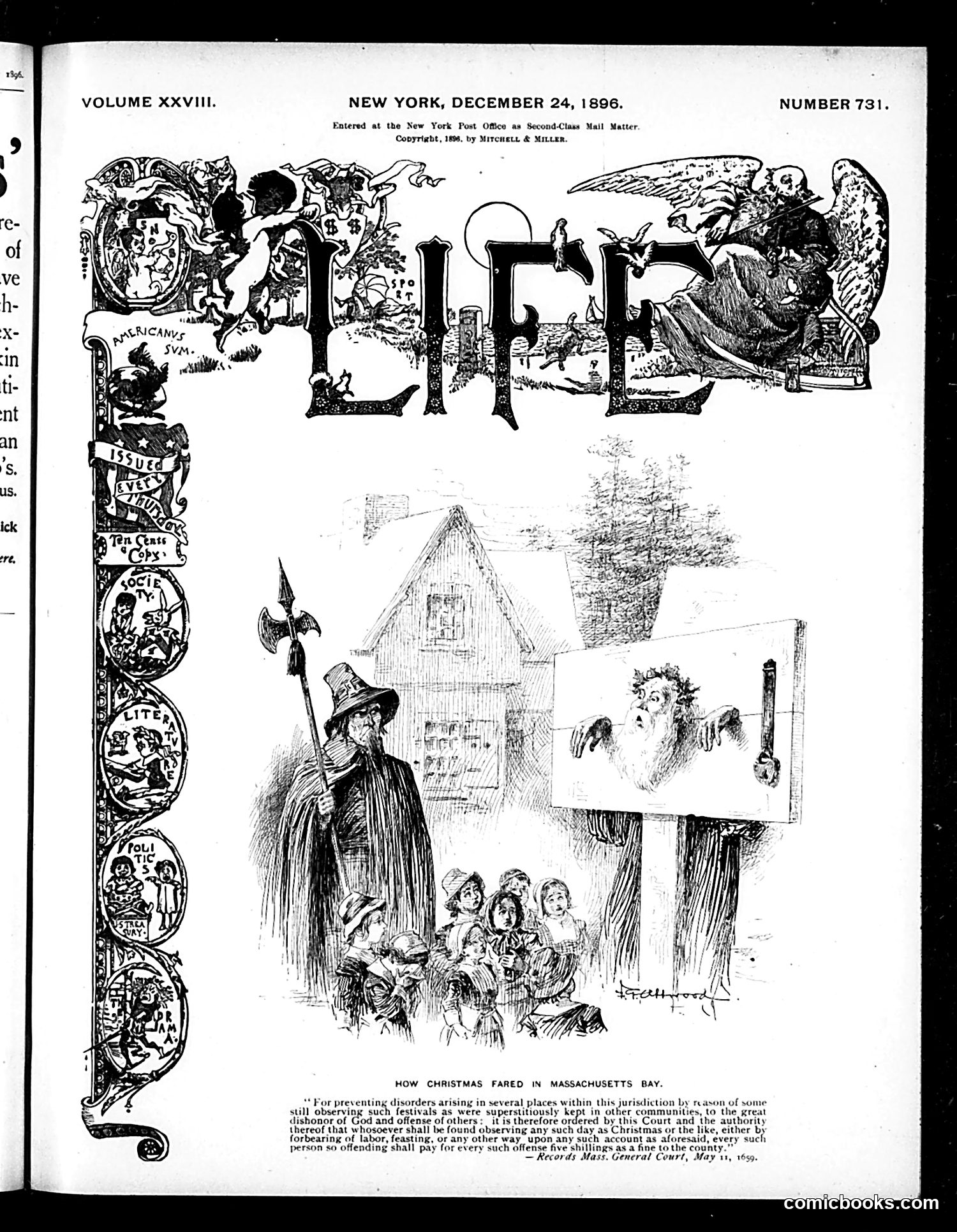
This 1896 *Life* magazine cartoon satirizes Massachusetts's strict Puritan-era laws against celebrating Christmas. The image depicts a stern, axe-wielding Puritan confronting children gathered near a decorated house during Christmas, referencing historical Massachusetts Bay Colony ordinances that prohibited Christmas observance. The quoted text below the cartoon cites an actual 1659 Massachusetts court record forbidding Christmas celebrations, labor stoppages, or festive gatherings. Violators faced five-shilling fines. The cartoon humorously contrasts the harsh Puritan past with the 1890s present, mocking the historical severity of these restrictions while noting their eventual disappearance from law. The joke invokes nostalgia for Puritan austerity while celebrating modern religious freedom.
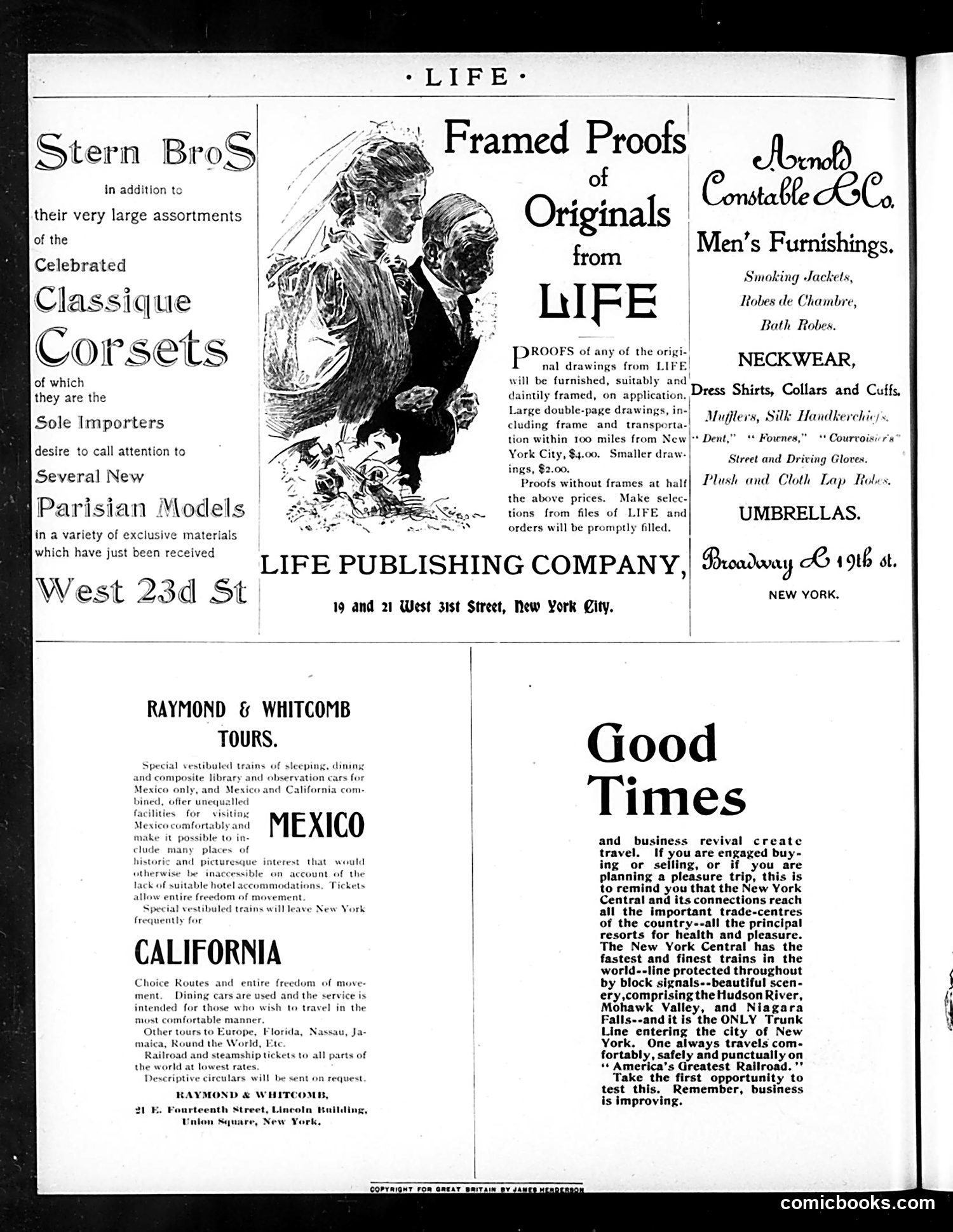
This page is primarily **advertising**, not political satire or editorial content. The central illustration shows two men in period dress examining what appears to be artwork or documents—this advertises LIFE Publishing Company's service offering framed proofs of original drawings from the magazine. The surrounding ads promote consumer goods: Stern Bros. corsets, Arnold Constable men's furnishings, Raymond & Whitcomb travel tours to Mexico and California, and New York Central Railroad service. The "Good Times" section briefly encourages business travel via the New York Central, highlighting its speed and comfort as "America's Greatest Railroad." **No political satire is evident here.** This is a commercial page typical of early 20th-century magazine advertising.
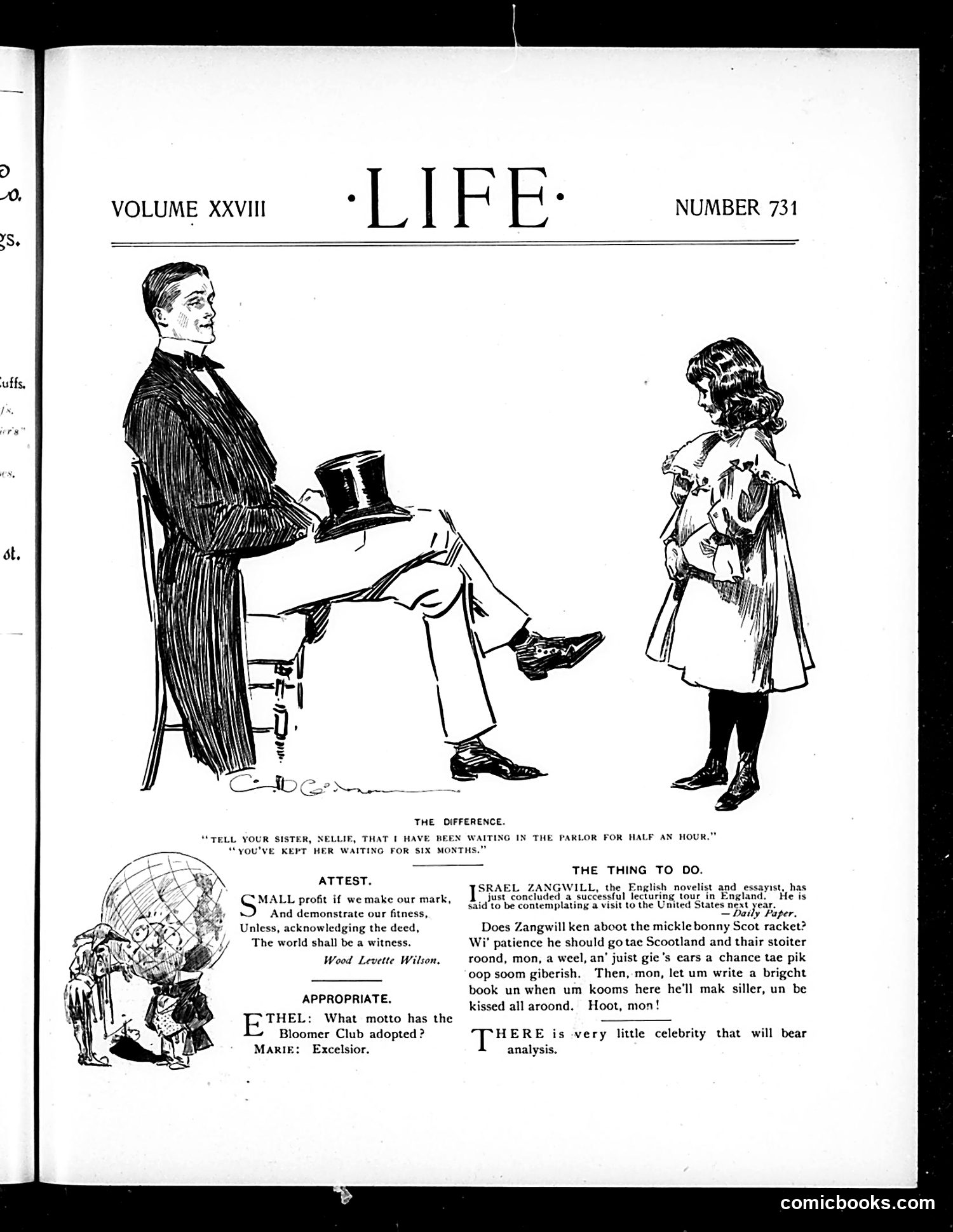
This page contains three separate humor pieces: **"The Difference"** depicts a man telling his sister he's been waiting in the parlor "for half an hour," while she's kept her waiting "six months"—satirizing the double standard in courtship patience between genders. **"Attest"** is a brief joke about the Bloomer Club, likely referencing the women's dress reform movement of the era, with a Wood Lewitte Wilson quote about bearing witness. **"The Thing to Do"** discusses Israel Zangwill, an English novelist and essayist who had recently lectured in England and the United States. The text humorously suggests he should visit Scotland and write a book, using dialect humor typical of the period. The page exemplifies Life's satirical approach to social customs, gender relations, and contemporary literary figures.
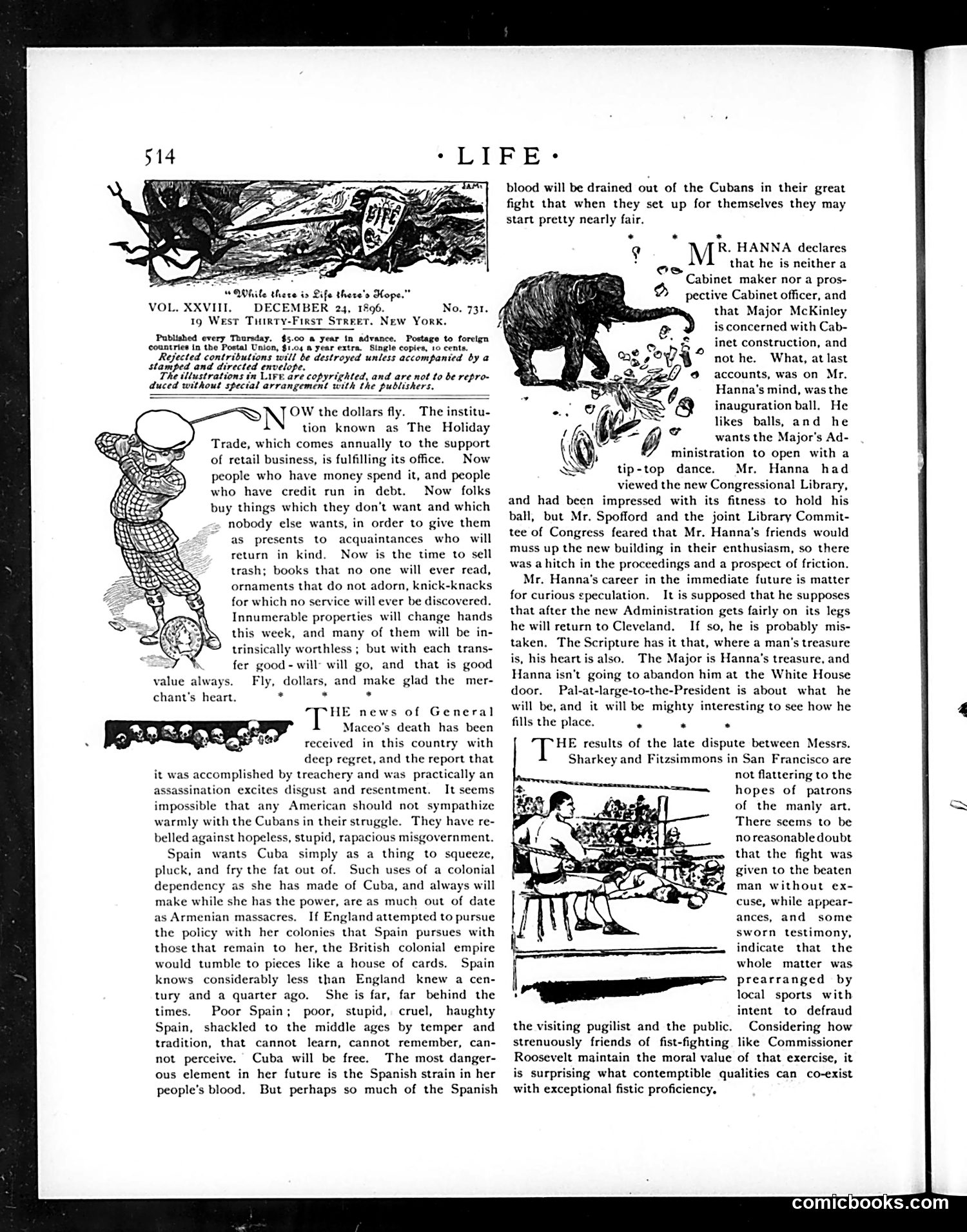
This page contains commentary on Cuban independence and American politics. The text criticizes Spain's colonial rule over Cuba, arguing Spain is "poor, stupid, cruel" and unable to govern effectively. It references General Maceo's death and suggests Cuban rebellion against "hopeless, stupid, rapacious misgovernment." The elephant illustration (likely Uncle Sam) appears in a political context about American foreign policy toward Cuba, though the specific meaning requires more context. A separate section discusses Mr. Hanna (likely Mark Hanna, McKinley's political operative) and his views on Congressional library construction and Cabinet appointments—satirizing his political influence. The final section mocks a dispute between Sharkey and Fitzsimmons (prize fighters) in San Francisco, suggesting the fight was rigged for gambling purposes while Commissioner Roosevelt defended it as morally valuable exercise.
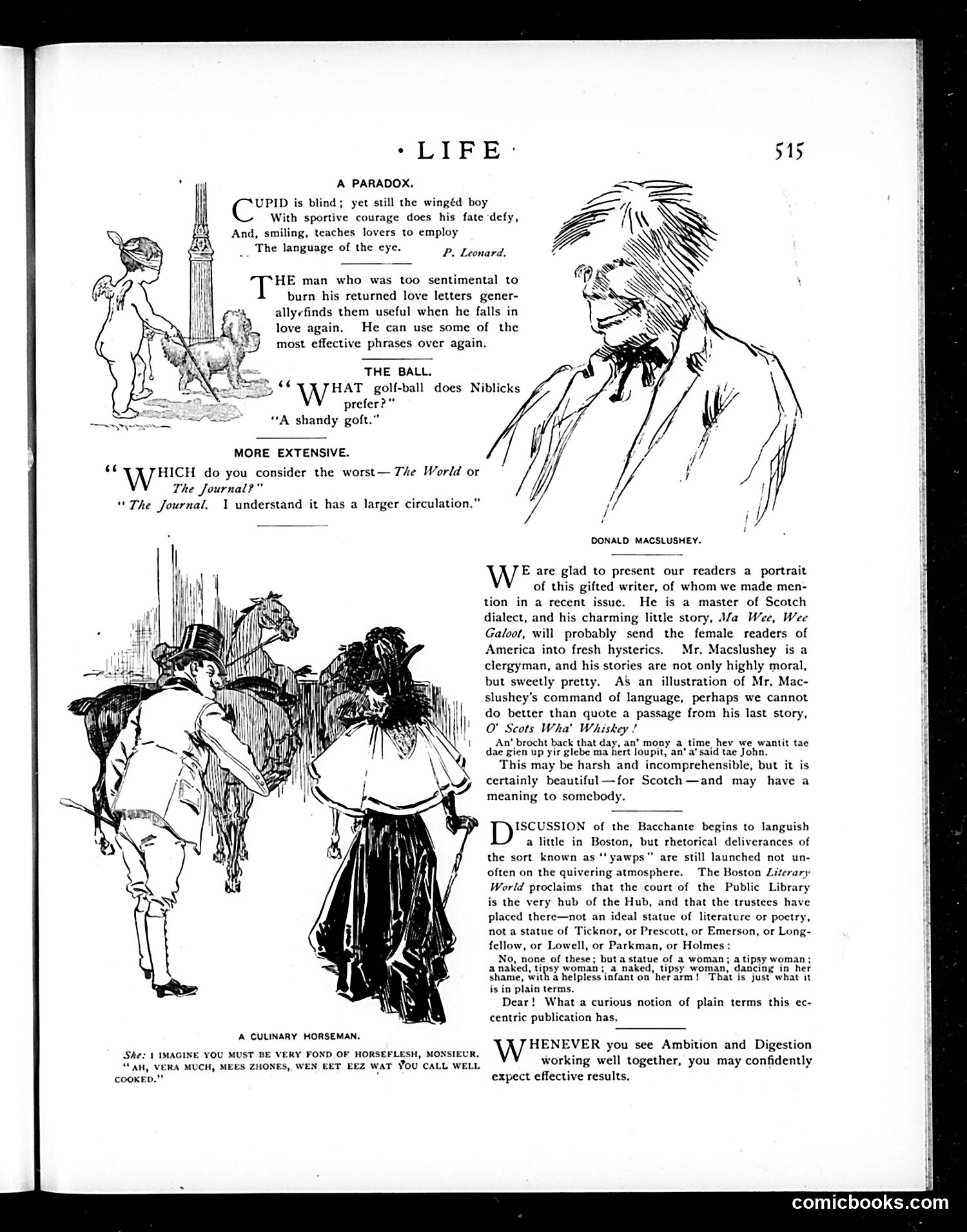
This page contains several short humor pieces and a portrait of writer Donald Maclushey. The cartoons employ gentle satire on everyday topics: **"A Paradox"** jokes about Cupid being blind yet still effective at romance—a play on the classical contradiction. **"The Ball"** features a pun on golf terminology, with "shady goft" (apparently "golf") as wordplay. **"More Extensive"** contrasts *The World* and *The Journal* newspapers, satirizing their relative circulation sizes and significance. **"A Culinary Horseman"** shows a man on horseback, with French text making an untranslatable joke about horsemeat cuisine. The page mainly showcases Maclushey's writing talent through a biographical note praising his Scottish dialect stories. These are light, domesticated humor pieces typical of *Life's* early 20th-century satirical approach.
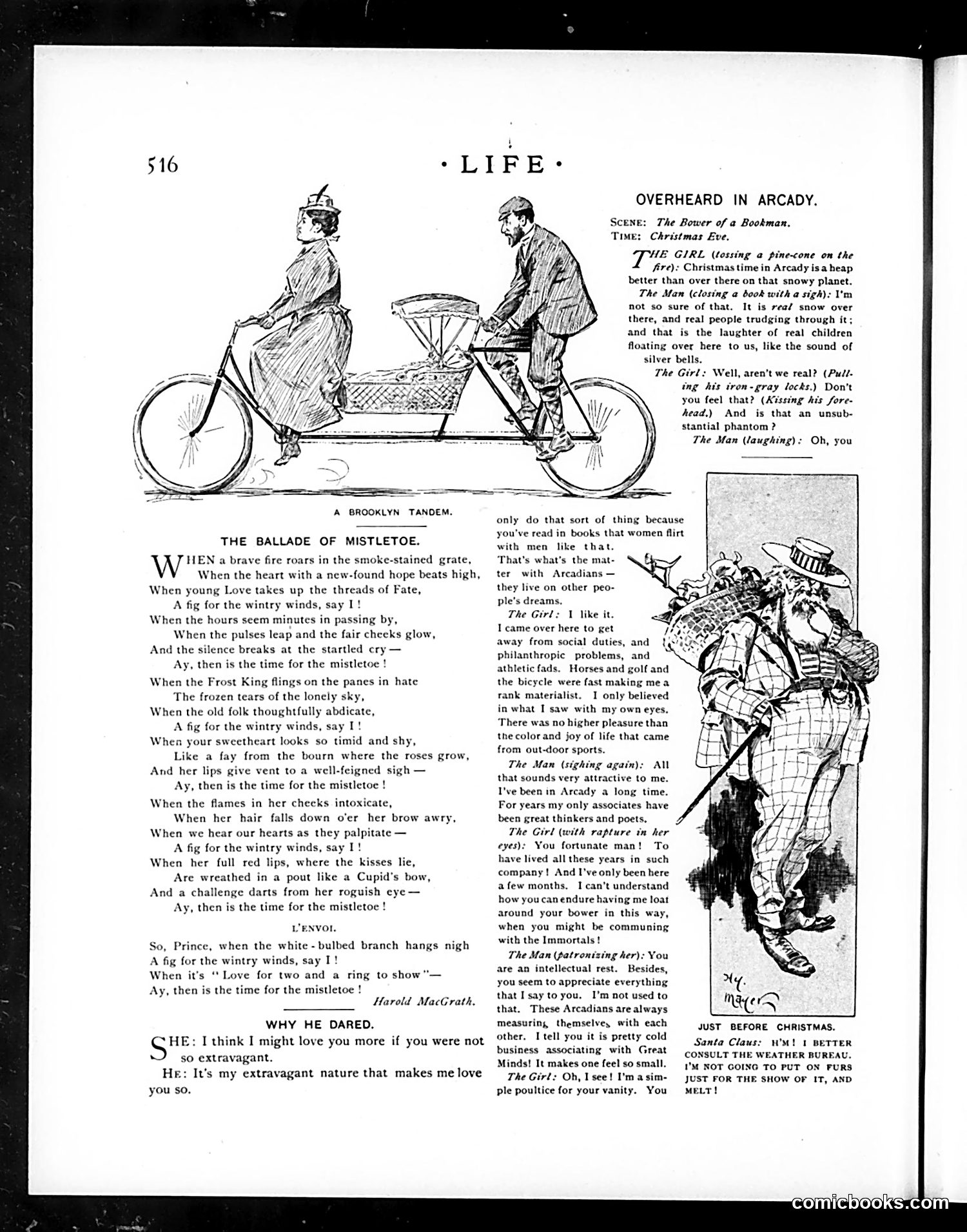
This page contains three separate literary and illustrative pieces, not political cartoons: 1. **"A Brooklyn Tandem"** - An illustration of two people on a tandem bicycle, accompanying a poem titled "The Ballade of Mistletoe" about Christmas romance and kissing under mistletoe. 2. **"Why He Dared"** - A brief dialogue between a man and woman where he justifies his extravagant nature as what makes him lovable. 3. **"Overheard in Arcady"** - A longer dialogue between a man and girl discussing Arcadian (idealized pastoral) life, real vs. imaginary experiences, and outdoor sports. 4. **"Just Before Christmas"** - A small illustration with a caption about Santa Claus and weather forecasts. These are humorous literary sketches and romantic vignettes typical of Life magazine's satirical content, not political commentary. The satire targets romantic pretension and idealized notions of love and nature.
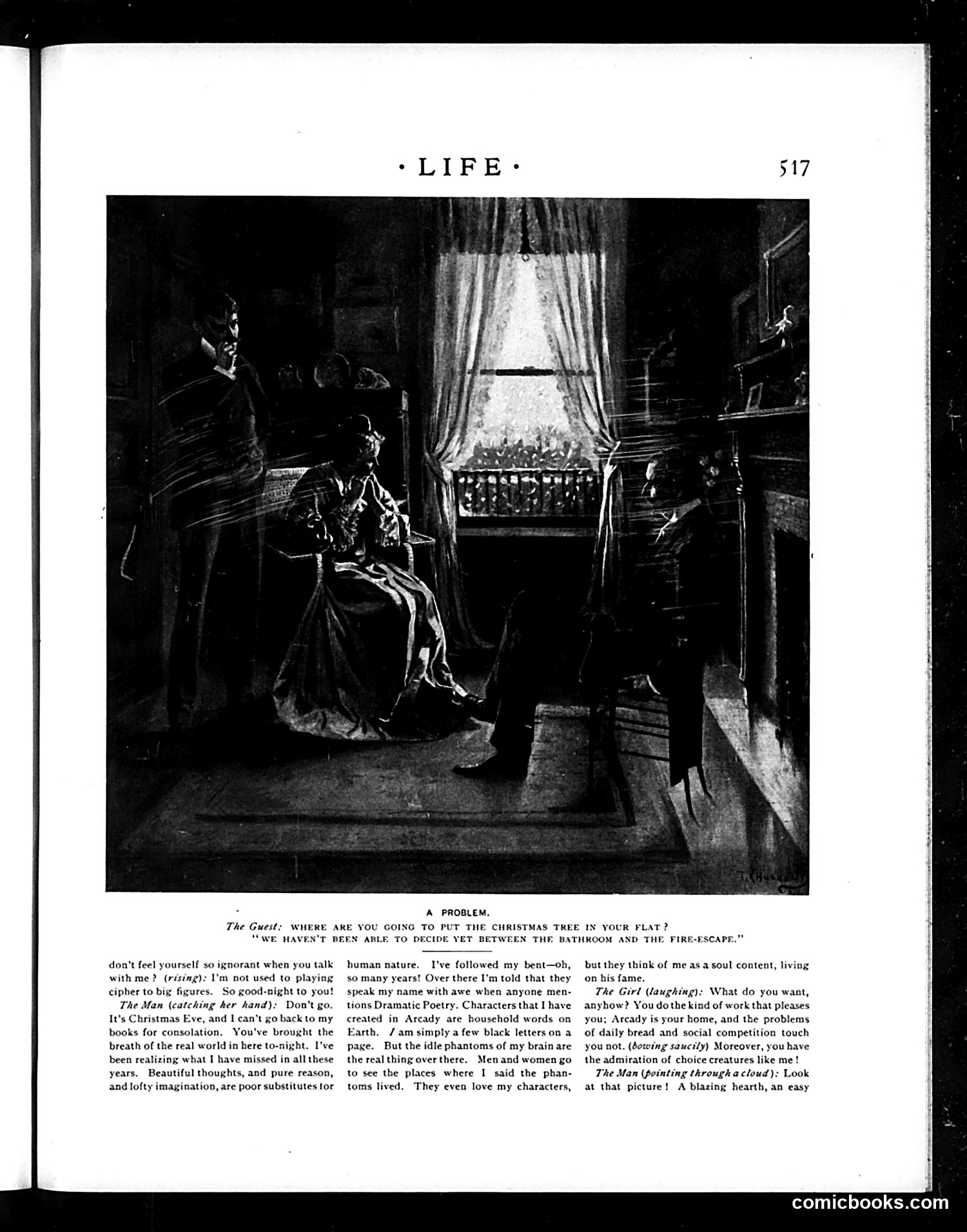
This illustration depicts a domestic dispute during Christmas season. The caption reads: "WHERE ARE YOU GOING TO PUT THE CHRISTMAS TREE IN YOUR FLAT? 'WE HAVEN'T BEEN ABLE TO DECIDE YET BETWEEN THE BATHROOM AND THE FIRE-ESCAPE.'" The satire mocks urban apartment living, specifically the cramped conditions faced by middle-class city dwellers. The dialogue reveals the couple's dilemma: their apartment is so small that the only available spaces for a Christmas tree are the bathroom or fire escape—neither suitable or dignified locations. This reflects early 20th-century concerns about urban housing density and the challenges of maintaining traditional holiday customs in modest urban homes. The humor lies in the absurdity of the limited options available to apartment residents.
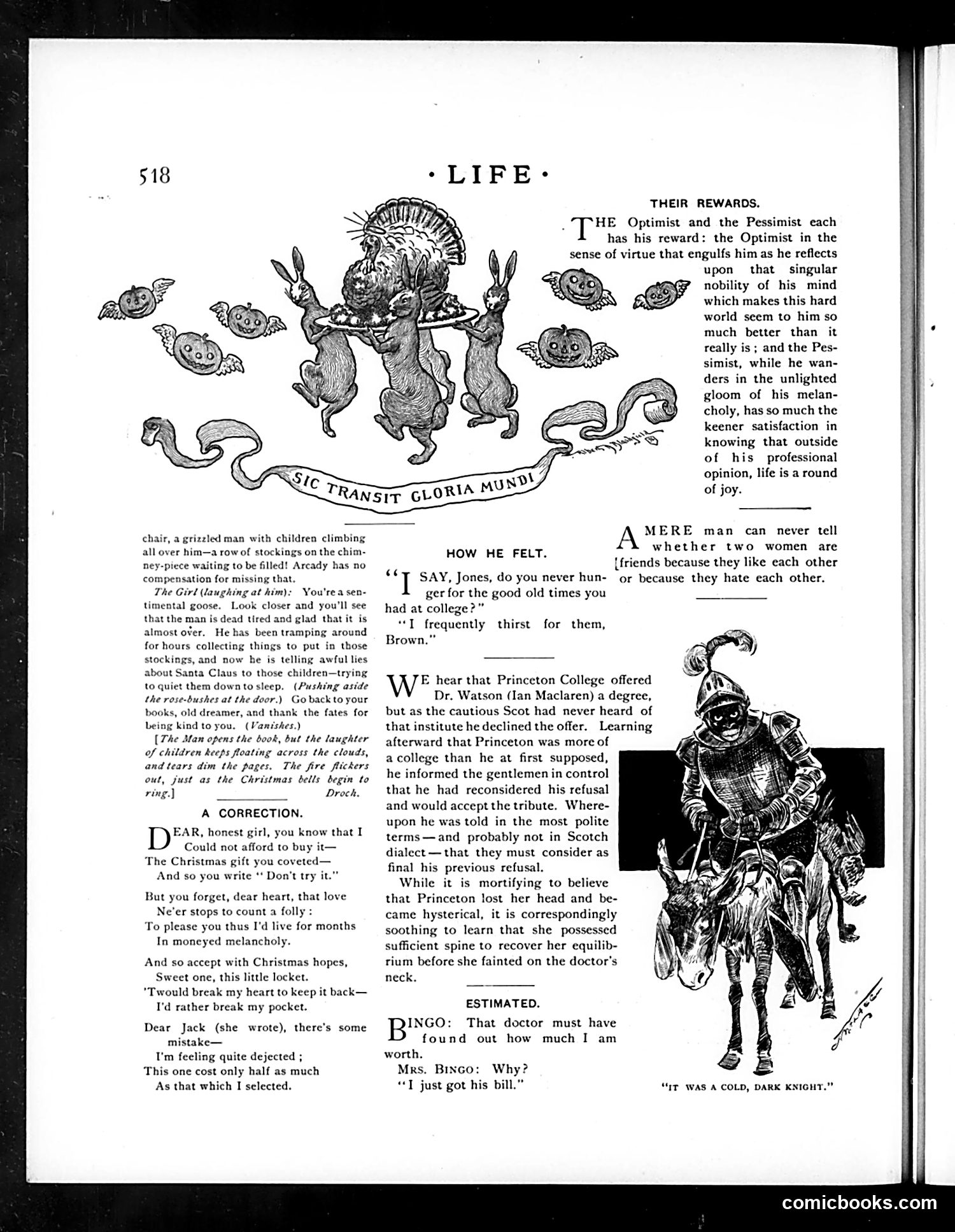
This page contains multiple satirical pieces rather than a single cartoon. **"Their Rewards"** (top): An illustrated philosophical essay contrasting optimists and pessimists, showing anthropomorphic rabbits and turtles—likely representing these worldviews—with a Latin motto ("Sic Transit Gloria Mundi"—"Thus passes the glory of the world"). **"How He Felt"** and subsequent sections: Humorous anecdotes about college life, a Scot's cautious rejection of a Princeton degree offer, and romantic/social commentary. **"It Was a Cold, Dark Knight"** (right illustration): Shows a figure on horseback in medieval armor—appears to be visual wordplay on "knight/night." The page reflects early 20th-century Life magazine's format: mixing philosophical humor, social observation, and puns for educated American readers.
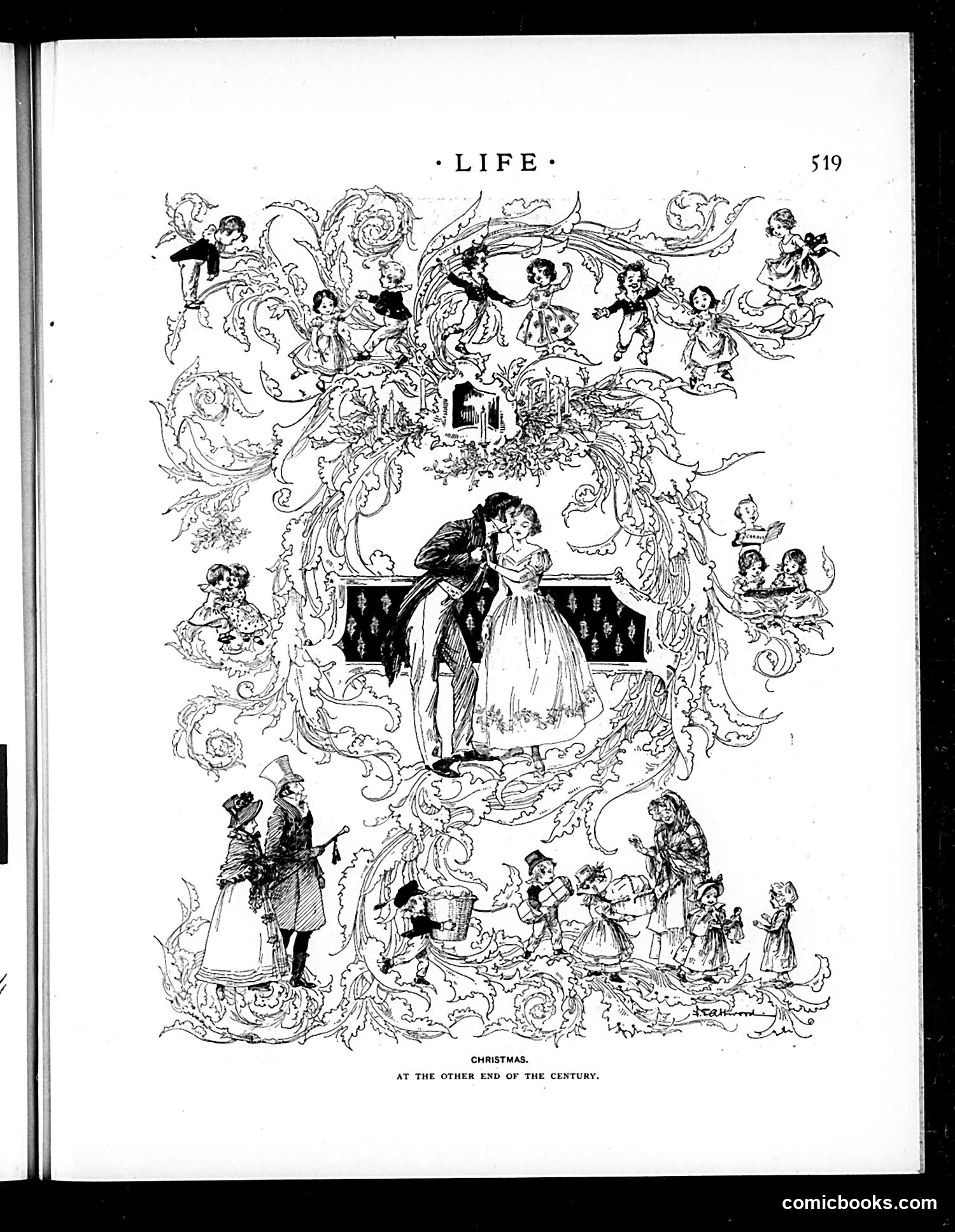
This illustration depicts an idealized vision of Christmas in the 1900s (the "other end" of the 19th century from Life's 1890s publication). The ornate, decorative composition frames various Christmas scenes: wealthy couples embrace near a fireplace at the center; cherubs and angels float among elaborate floral scrollwork above; children play and celebrate below. The satire likely comments on *anticipated* future prosperity and domestic happiness. The lavish artistic treatment—with its abundance of decorative elements, fashionably-dressed figures, and cherubic abundance—suggests optimistic predictions about how Christmas and family life would improve as the new century approached. It's essentially a hopeful, if somewhat sentimental, satirical vision of fin-de-siècle dreams.
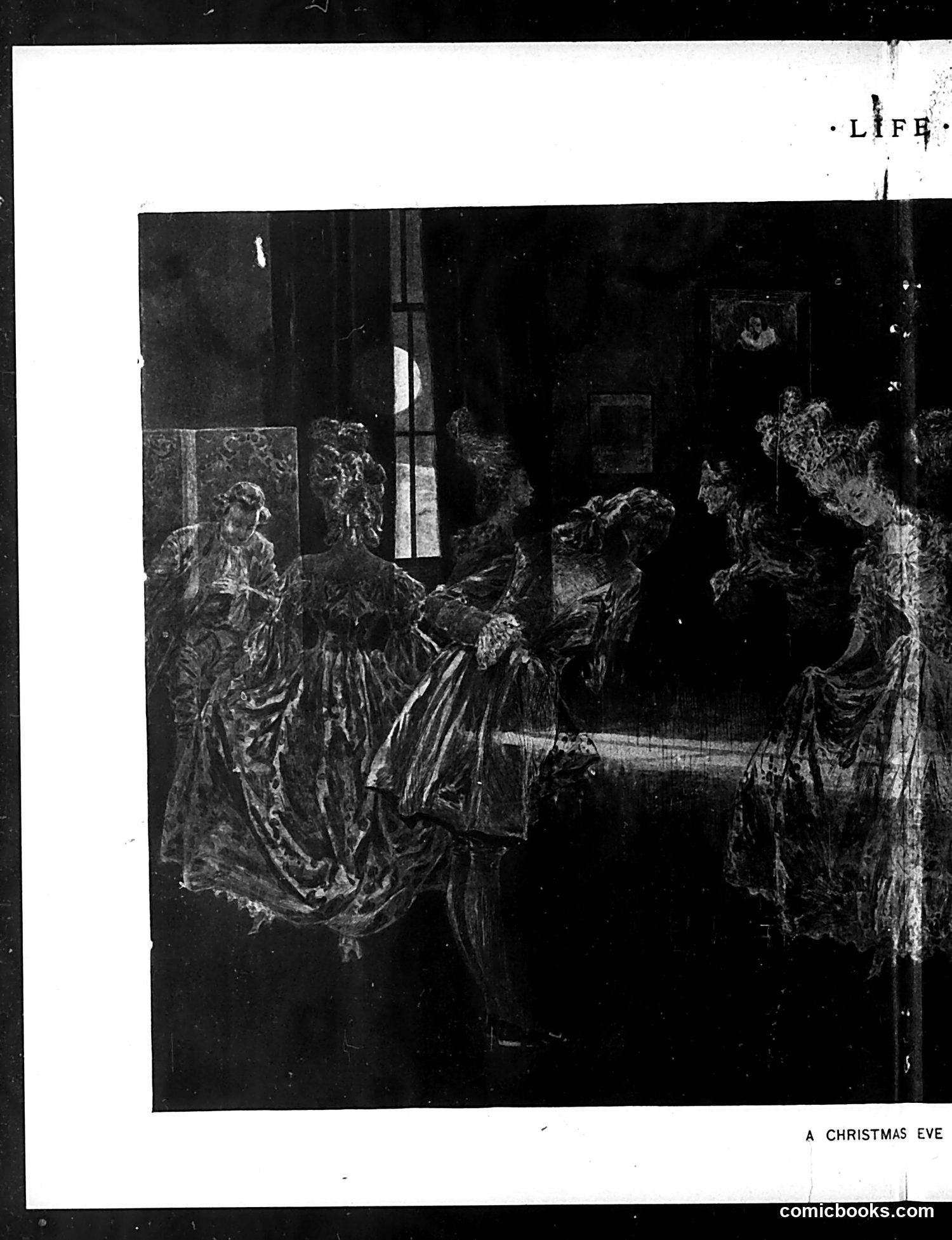
This appears to be a satirical illustration titled "A Christmas Eve" from *Life* magazine. The image depicts an interior scene with multiple figures in elaborate period dress gathered in what seems to be a formal or theatrical setting. The heavily shadowed, dramatic black-and-white rendering suggests this may be commentary on social pretension or theatrical artificiality. The composition shows figures in ornate clothing arranged in conversation, with architectural elements like doorways visible. Without additional context or clearer text identifying specific individuals or events referenced, I cannot definitively state what political or social satire this targets. The Christmas Eve setting may reference holiday hypocrisy or social performance during festive occasions, but the specific point of critique remains unclear from the image alone.
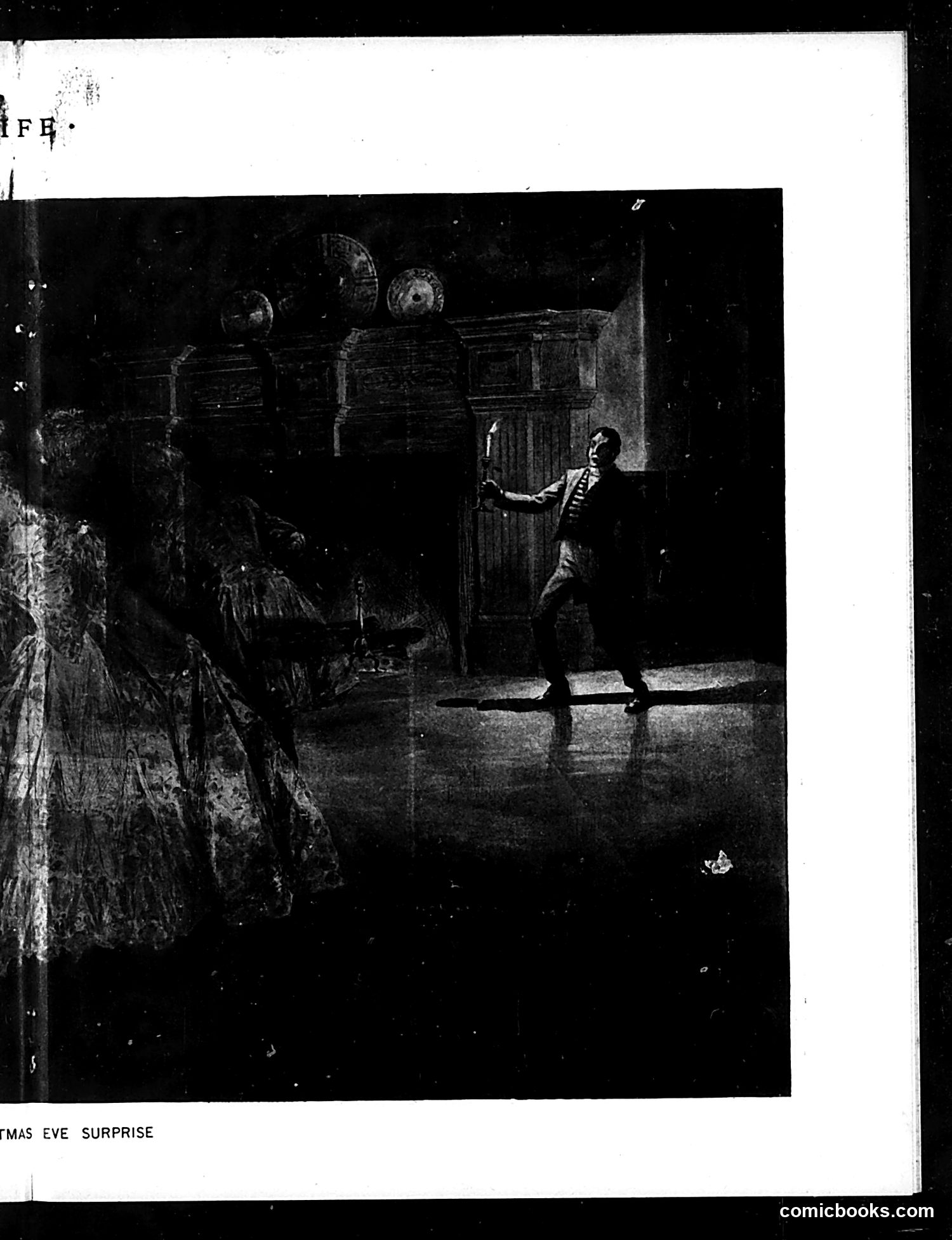
This black-and-white theatrical or film scene depicts a dramatic Christmas Eve moment. A man in dark clothing stands center-stage with raised arms in a gesture of shock or alarm, addressing a figure on the left (partially visible, appearing to wear lighter clothing). The setting appears to be an interior space with wooden furniture or storage visible in the background, and decorative circular objects (possibly wreaths or plates) mounted on the upper wall. The caption "Christmas Eve Surprise" suggests this depicts a dramatic domestic confrontation or revelation timed for the holiday. Without additional context identifying the specific play, film, or historical event referenced, the exact satirical or comedic point remains unclear, though the scene captures a moment of theatrical surprise or conflict.
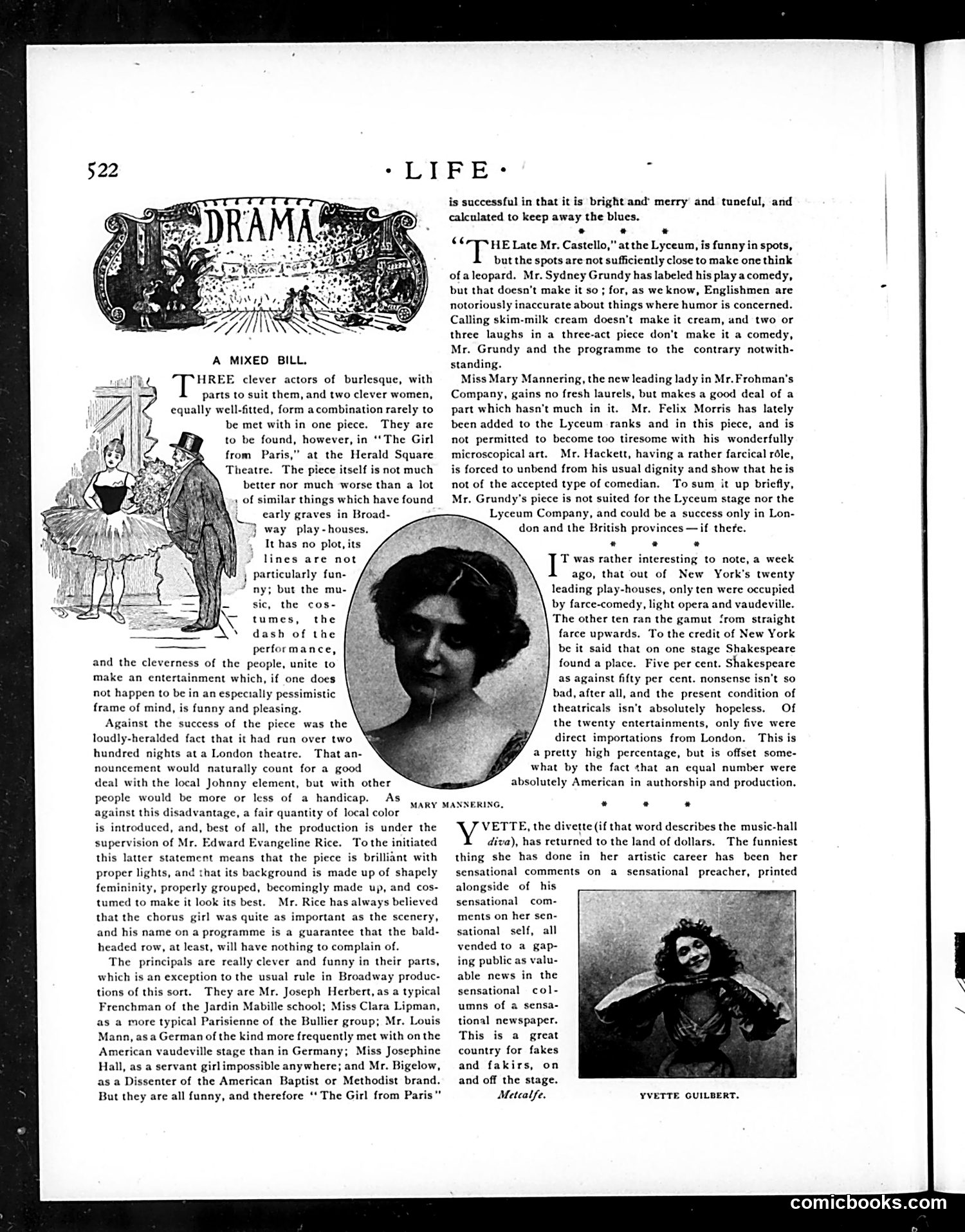
This page from *Life* contains theater reviews of three Broadway productions. The main illustration depicts a burlesque dancer from "The Girl from Paris" at Herald Square Theatre—a musical comedy that, while lacking plot and witty dialogue, succeeds through music, costumes, and performer charm. The reviewer notes the cast includes character types (a Frenchman, Parisienne, German, and American Baptist) meant to represent different nationalities for comedic effect. The second review criticizes "The Late Mr. Castello" at the Lyceum, dismissing it as poorly labeled—calling it a "comedy" when it contains insufficient laughs. The reviewer employs a cutting analogy: labeling something doesn't change its nature, comparing false comedy-labeling to calling "skim-milk cream." A photograph of actress **Mary Mannering** accompanies discussion of her performance, and a separate item about **Yvette Guilbert** (the actress shown in the second photograph) notes her return from Europe and her sensationalist newspaper coverage. The satire targets theatrical marketing deception and critic-resistant impresarios.
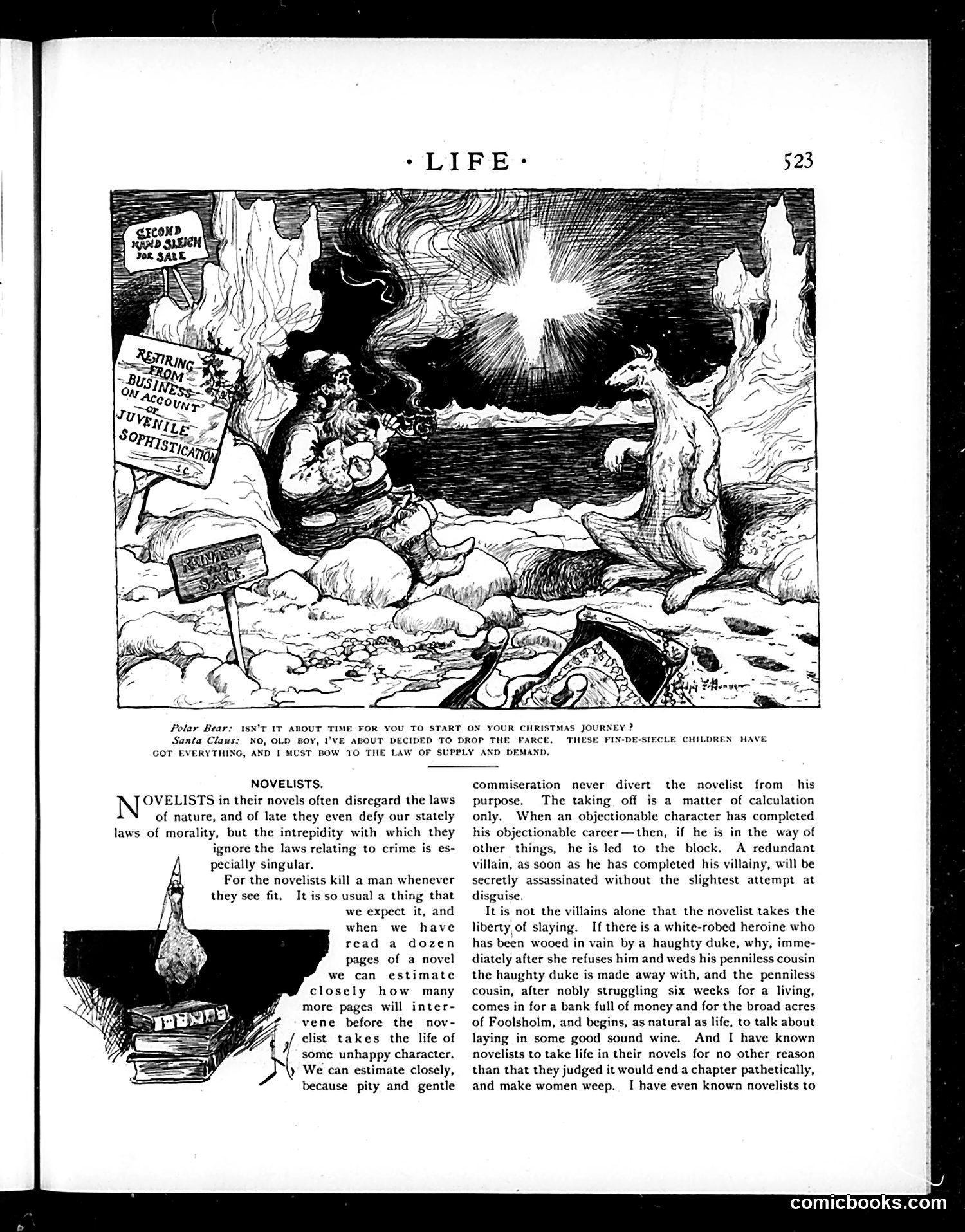
**The Cartoon (top):** Santa Claus tells a Polar Bear he's quitting Christmas delivery because modern "fin-de-siècle children have got everything" and he must "bow to the law of supply and demand." This satirizes turn-of-the-century consumer excess and childhood materialism—the joke being that Santa's traditional role becomes obsolete when children already possess all possible gifts. **The Article (bottom):** Critiques novelists for casually killing off characters without regard to logic or morality. The author argues writers treat murder as a mere plotting device: they eliminate "objectionable" characters once their usefulness ends, kill heroines for emotional effect ("make women weep"), or dispose of characters simply to end chapters dramatically. The satire targets the artificiality and moral carelessness of contemporary fiction, where death serves narrative convenience rather than authentic character development. Both pieces mock late-19th-century excess and superficiality—consumer culture and sensationalist literature.
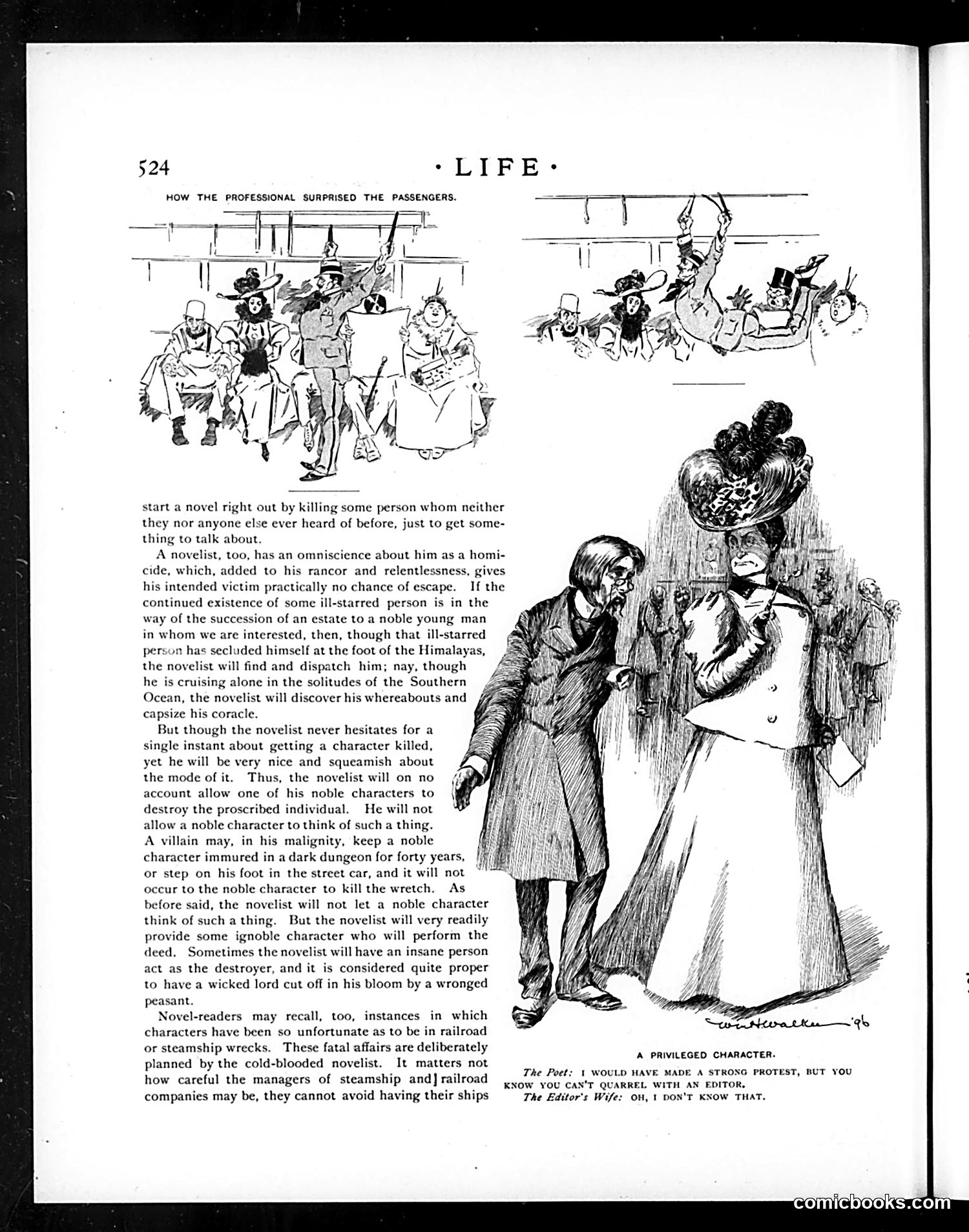
This page satirizes novelists' plotting conventions. The article criticizes how authors conveniently kill off minor characters to create drama, manipulate estates and inheritances, and orchestrate disasters (steamship wrecks, railroad accidents) regardless of real-world logistics. The key irony: novelists obsessively kill characters yet impose strict moral codes—noble characters won't commit murder themselves, so authors deploy "ignoble" or insane characters to do the dirty work. The cartoon "A Privileged Character" shows a fashionably dressed couple with the poet complaining he'd protest something to an editor, but his wife (the "privileged character") notes she doesn't quarrel with editors. This likely mocks how literary connections and social standing allow certain writers exemptions from normal criticism or accountability—tying to the article's broader point about novelists' arbitrary authorial privileges.
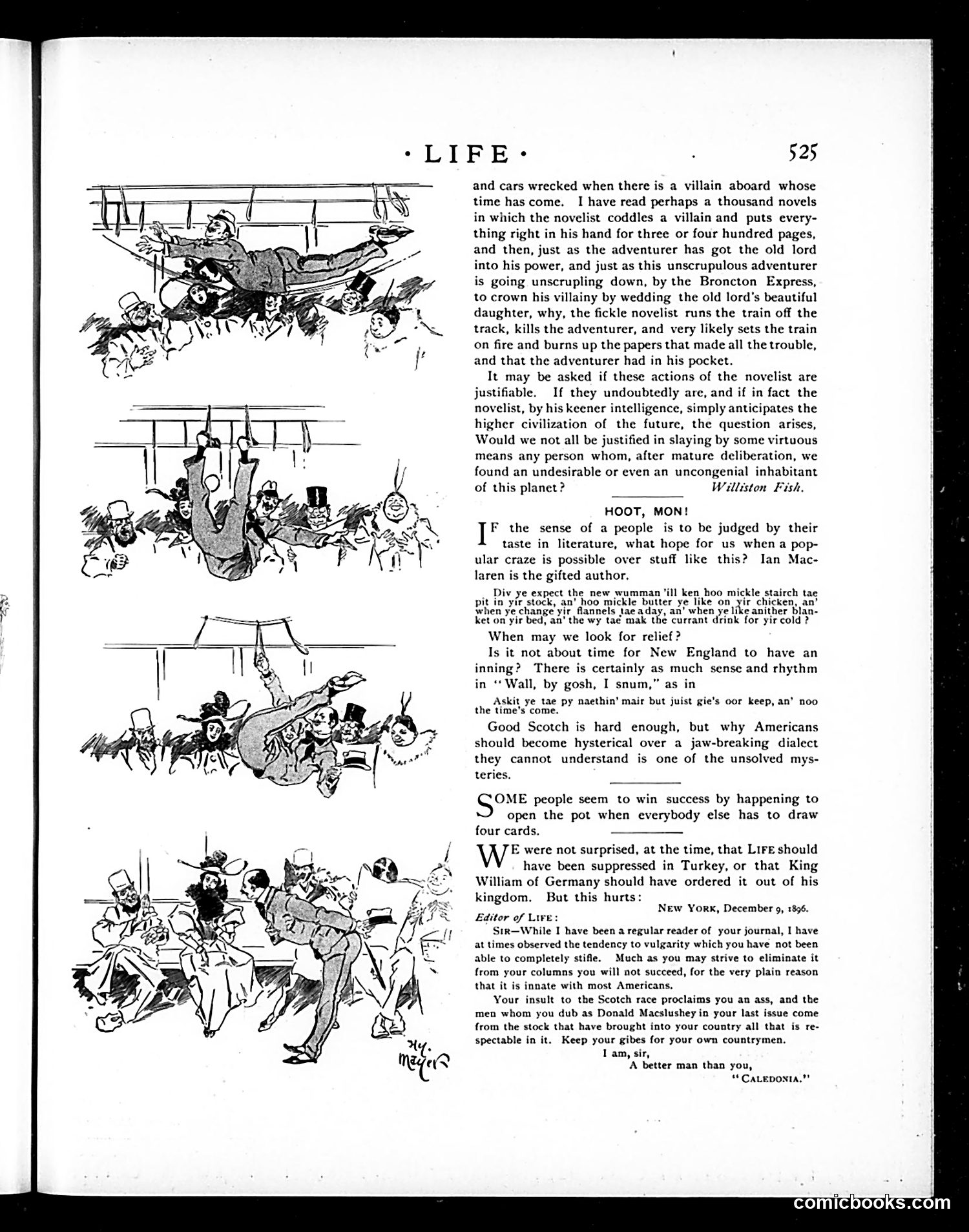
This page satirizes the popular craze for Scottish dialect literature, particularly works by Ian Maclaren (a bestselling author of sentimental Scottish stories). The four cartoon panels on the left—apparently unrelated train-wreck scenes—serve as visual counterpoint to the written critique. The main attack comes through a reader's letter (likely written by Life's editors themselves) mocking Americans' enthusiasm for impenetrable Scottish dialect passages. The letter sarcastically asks when New England writers will provide equally incomprehensible content, then insults the Scottish by questioning why Americans worship "a jaw-breaking dialect they cannot understand." The response letter from "Caledonia" defends Scottish immigrants as bringing respectability to America, calling Life's mockery vulgar and the editors "an ass." The satire targets: (1) literary fashion—the fad for Scottish regionalism; (2) American cultural insecurity and herd mentality in taste; (3) ethnic tensions in 1890s America. The joke assumes educated readers shared Life's contempt for both the trend and its working-class appeal.
This page features a humorous poem about the bicycle craze that swept America in the 1890s. The narrative follows a young woman learning to ride a bicycle who careens uncontrollably down a boulevard, unable to steer, hitting pedestrians and eventually crashing into a pile of stones. The satire targets both the bicycle-riding fad itself and the perceived recklessness of (particularly female) novice riders. Contemporary readers would recognize this as commentary on the "New Woman" phenomenon—women gaining independence through cycling, which some viewed as scandalous. The poem's tone is lighthearted mockery: the maiden's obliviousness ("Don't you think I'm doing well?") after destroying property and endangering lives exemplifies the satirical exaggeration of cyclists' perceived menace. The accompanying short prose piece about a child's three wishes uses similar logic—outsmarting fate through clever thinking—creating thematic resonance with the poem's hapless cyclist who cannot control her destiny.
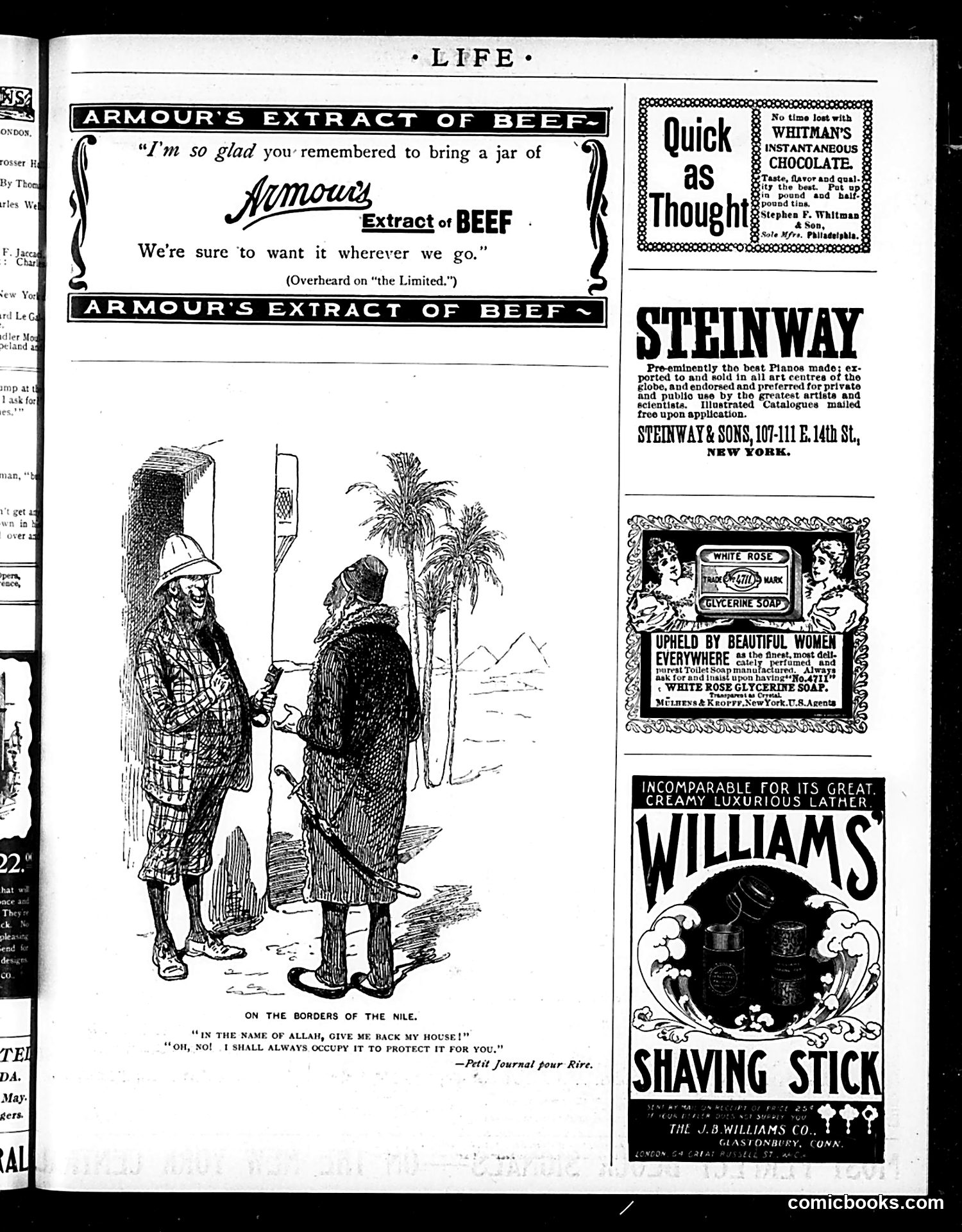
This cartoon satirizes British colonial occupation of Egypt. Two figures stand in a desert setting with palm trees: a robed Egyptian man demands his house back in the name of Allah, while a British soldier (identifiable by his pith helmet and uniform) refuses, claiming he'll "always occupy it to protect it for you." The satire targets the paternalistic justification British imperialism used for occupying Egypt—the claim that occupation was for the natives' own protection and benefit, not exploitation or conquest. The cartoon mocks this rhetoric by showing the absurdity: the Egyptian's legitimate property claim is dismissed with a patronizing assertion of permanent occupation disguised as guardianship. The attribution to *Petit Journal pour Rire* (a French satirical publication) suggests this reflects wider European criticism of British imperialism during a period of active colonial tensions.
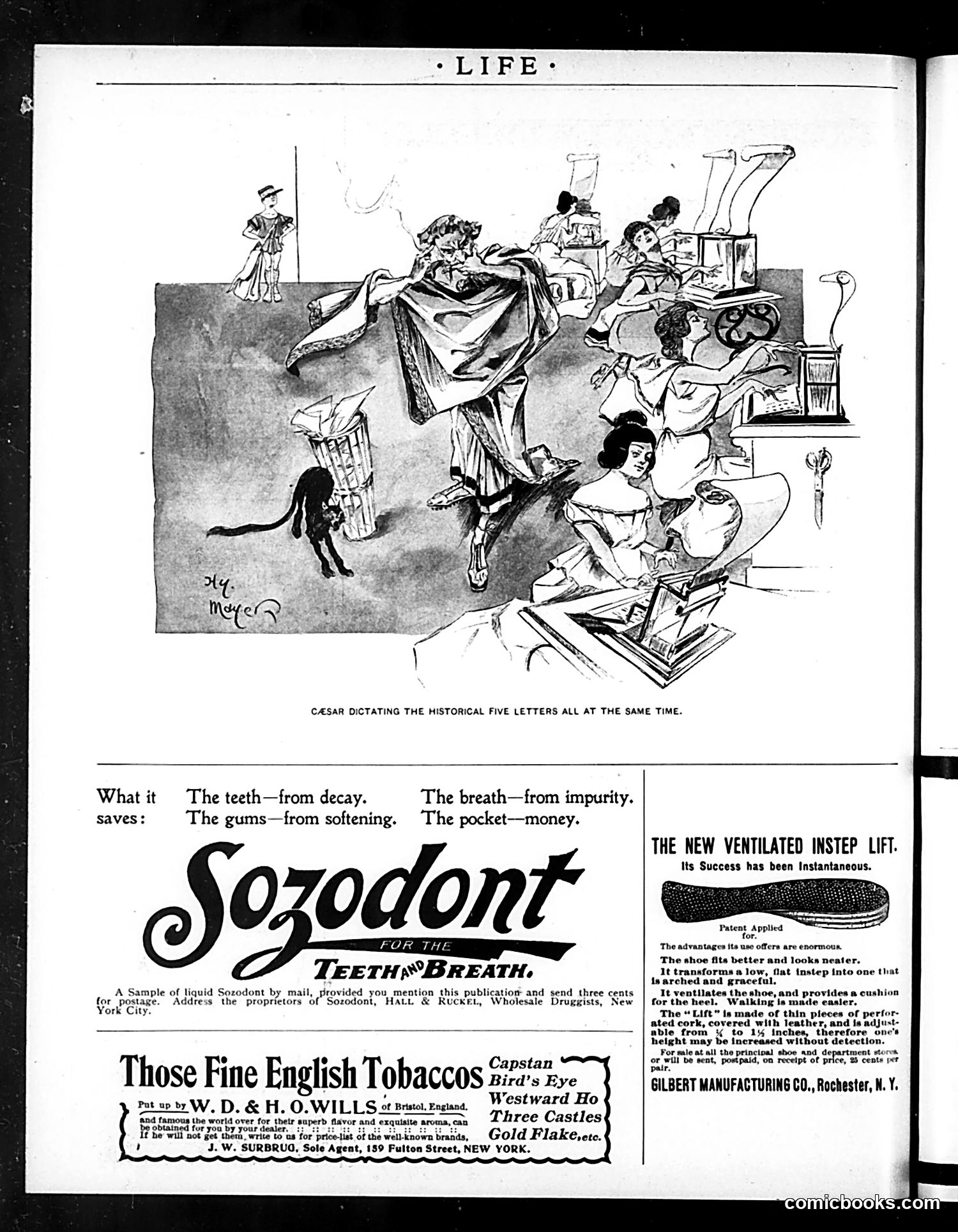
The main cartoon depicts a figure labeled "Caesar" simultaneously dictating "five historical letters" to multiple scribes. This is a satirical reference to Julius Caesar's legendary ability to multitask—specifically his reputed capacity to dictate several letters at once while managing state affairs. The joke mocks someone (likely a contemporary political figure or public personality) for attempting to imitate Caesar's famous efficiency, shown here as comically chaotic rather than impressive. A small dog and scattered papers emphasize the disorder of the scene. The cartoon appears to satirize pretension—someone overestimating their own administrative capabilities by comparing themselves to historical greatness. The specific identity of "Caesar" remains unclear without additional context about Life magazine's publication date.
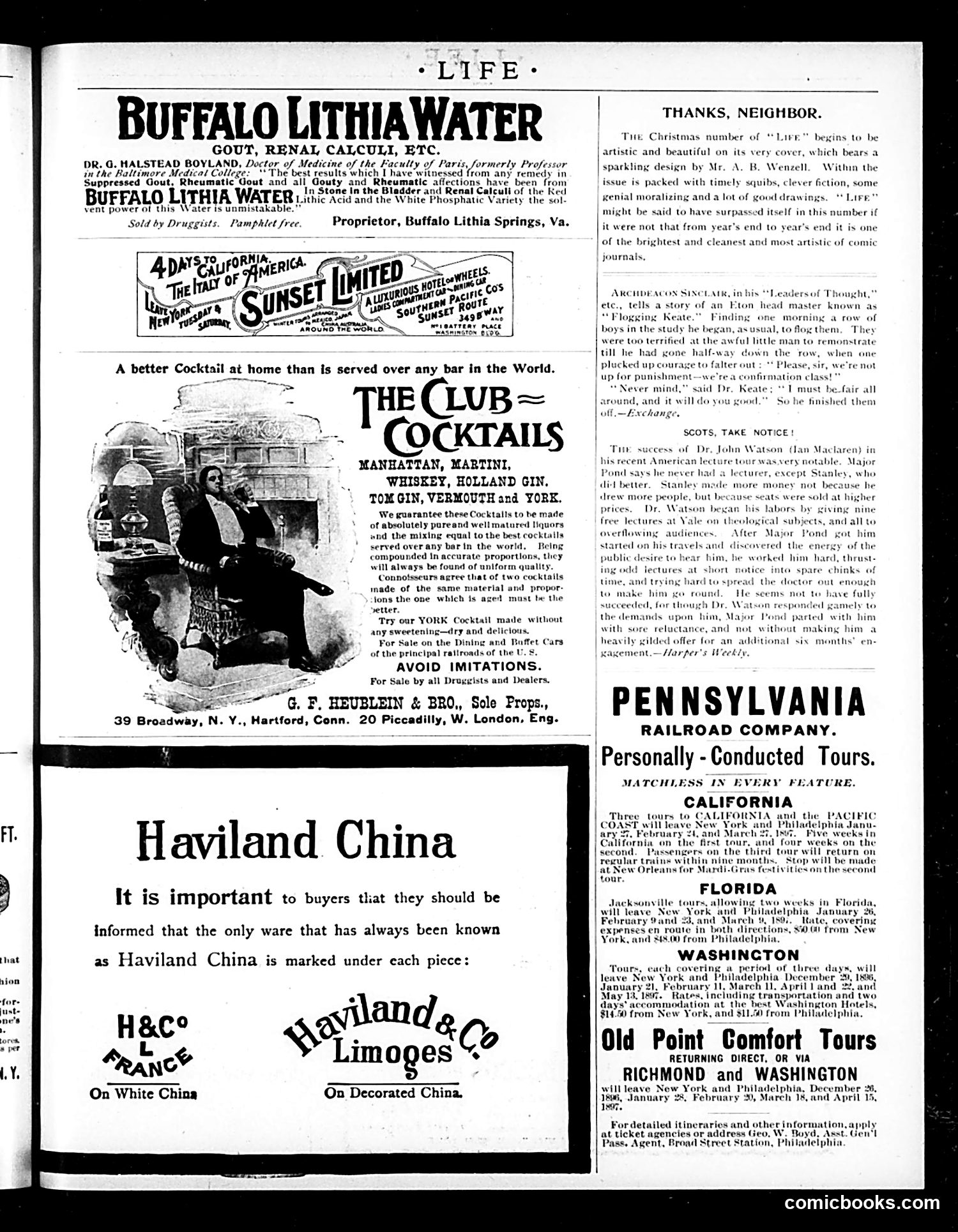
This page is primarily **advertising and travel notices**, not political satire. The main content includes: **Advertisements:** - Buffalo Lithia Water (a patent medicine claiming to cure gout and kidney stones) - "The Club Cocktails" by Heublein & Bro., emphasizing quality ingredients and proper aging - Haviland China, distinguishing genuine pieces by maker's marks **Editorial Content (right column):** Brief notes praising Life's artistic cover design and mentioning anecdotes about Dr. John Watson (Ian Maclaren), a Scottish lecturer touring America, and a story about "Flogging Keate" (a schoolmaster). These are light humor pieces rather than political commentary. **Travel Advertisements:** Pennsylvania Railroad's personally-conducted tours to California, Florida, and Washington. The page reflects late-19th-century American consumer culture—patent medicines, refined cocktails, fine china, and leisure travel for the affluent. There is no significant political cartoon or satirical commentary visible on this page.
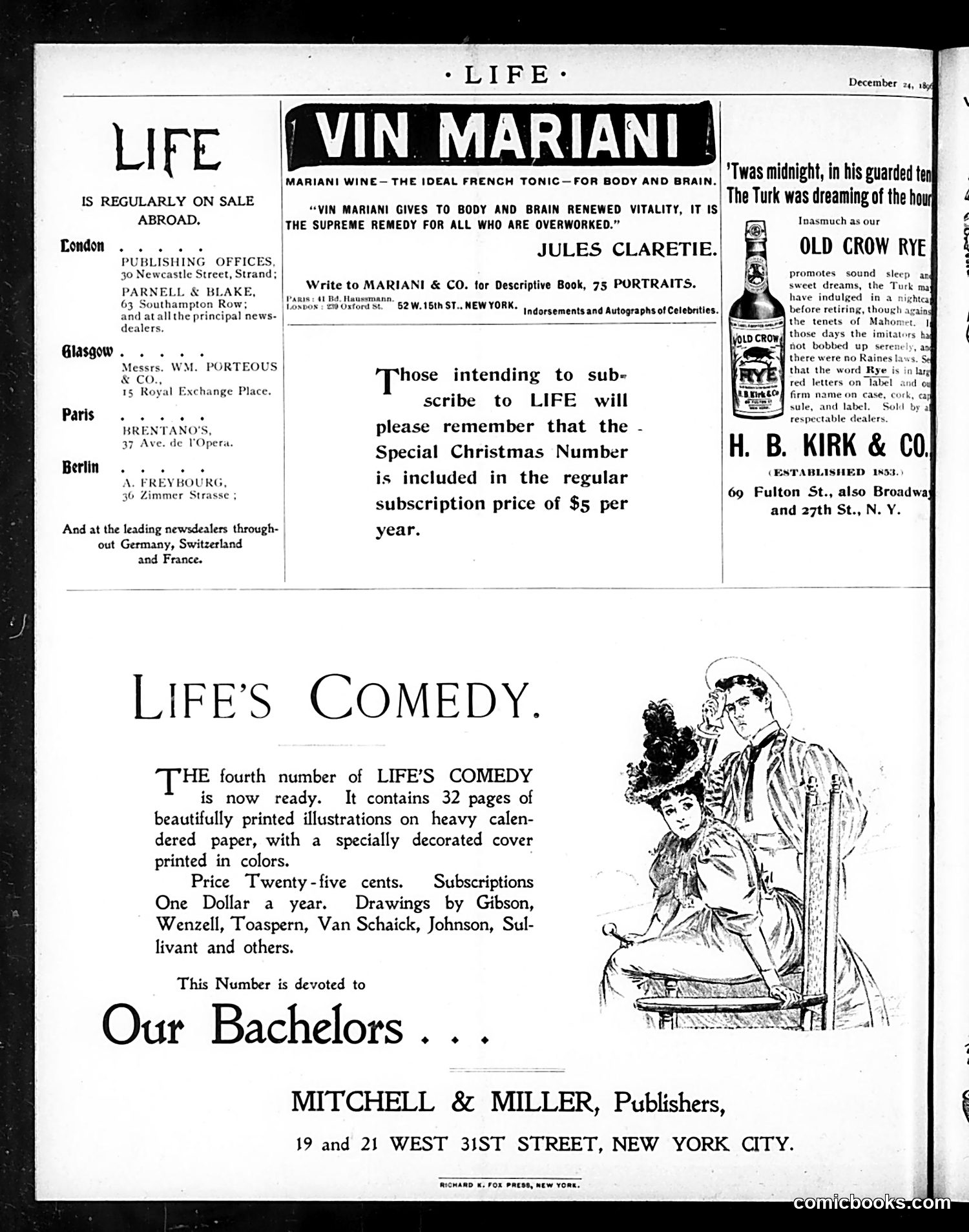
This is primarily a **advertisements and subscription page** rather than satirical content. The page announces: 1. **Life magazine's availability** internationally (London, Paris, Berlin) 2. **Vin Mariani advertisement** — a wine tonic marketed as a brain and body stimulant for the "overworked," endorsed by celebrity testimonials. This was a legitimate (if dubious) patent medicine of the era. 3. **Old Crow Rye whiskey ad** — promoting alcohol for sleep and dreams, with an unclear reference to "the Turk" and "Raines" (likely a New York legal reference, possibly the Raines Law regulating alcohol sales). 4. **Life's Comedy publication** — the fourth issue, featuring illustrations by notable cartoonists Gibson, Wenzell, and others, devoted to "Our Bachelors" (bachelor life humor). The page reflects late-19th-century magazine publishing: advertising patent medicines and alcohol alongside literary content targeting educated, affluent readers.