
Life, 1896-12-24 · page 13 of 20
Life — December 24, 1896 — page 13: what you’re looking at
What you’re looking at
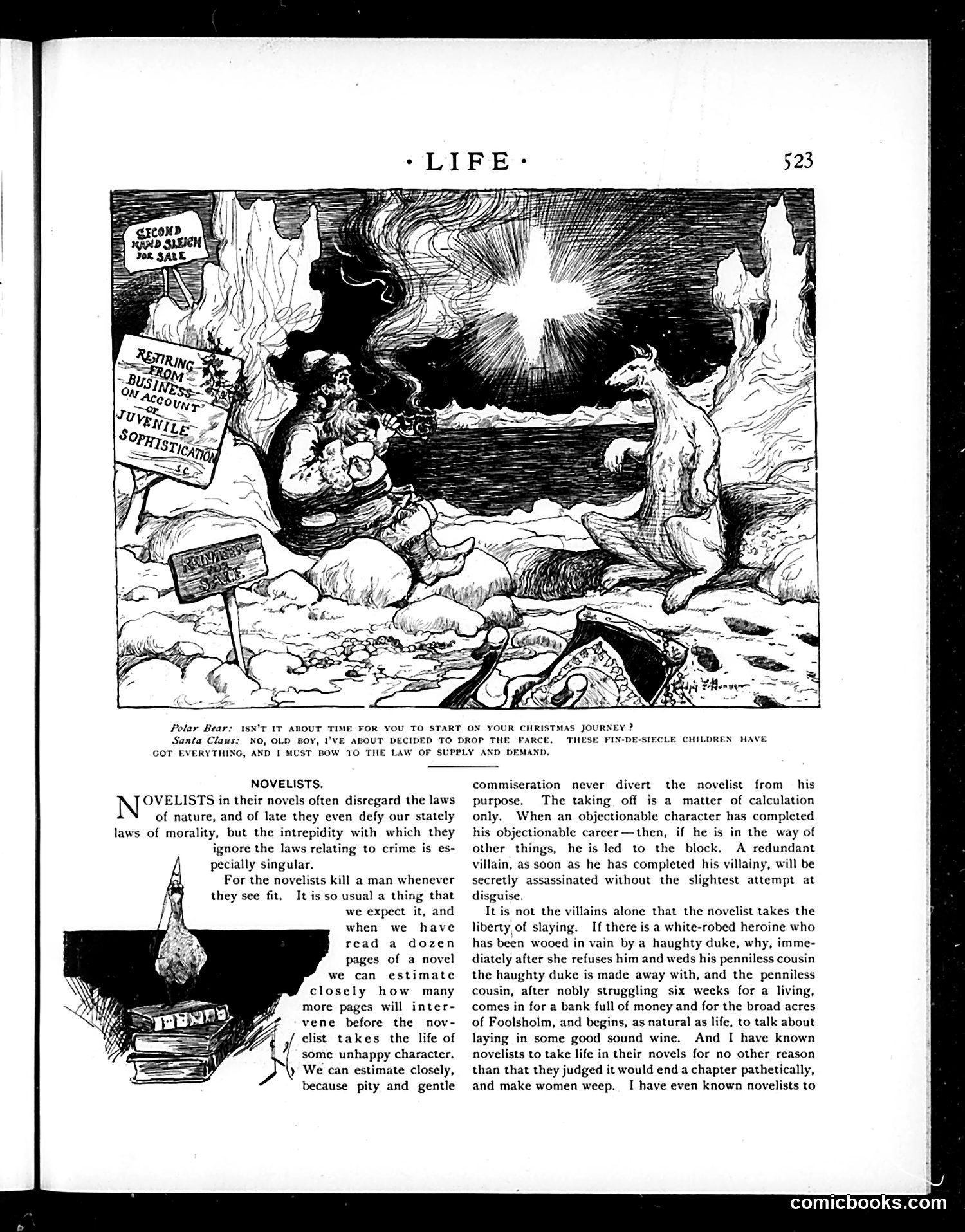
**The Cartoon (top):** Santa Claus tells a Polar Bear he's quitting Christmas delivery because modern "fin-de-siècle children have got everything" and he must "bow to the law of supply and demand." This satirizes turn-of-the-century consumer excess and childhood materialism—the joke being that Santa's traditional role becomes obsolete when children already possess all possible gifts. **The Article (bottom):** Critiques novelists for casually killing off characters without regard to logic or morality. The author argues writers treat murder as a mere plotting device: they eliminate "objectionable" characters once their usefulness ends, kill heroines for emotional effect ("make women weep"), or dispose of characters simply to end chapters dramatically. The satire targets the artificiality and moral carelessness of contemporary fiction, where death serves narrative convenience rather than authentic character development. Both pieces mock late-19th-century excess and superficiality—consumer culture and sensationalist literature.
📄 Transcribed text from this page (OCR, searchable)
Machine-transcribed from the original scan — historical spelling and the odd misread are preserved.
Polar Bear: Santa Clau ISN'T IT ABOUT TIME FOR YOU TO START ON YOUR CHRISTMAS JOU NO, OLD BOY, I'VE ABOUT DECIDED TO DROP THE FARCE. THESE FIN-DE-SIECLE CHILDREN HAVE GOT EVERYTHING, AND I MUST BOW YO THE LAW OF SUPPLY AND DEMAND. NOVELISTS. OVELISTS in their novels often disregard the laws of nature, and of late they even defy our stately laws of morality, but the intrepidity with which they ignore the laws relating to crime is es- pecially singular. For the novelists kill a man whenever they see fit. It is so usual a thing that we expect it, and when we have read a dozen pages of a novel we can estimate closely how many more pages will inter- vene before the nov- / elist takes the life of | some unhappy character. » We can estimate closely, because pity and gentle commiseration never divert the novelist from his purpo: The taking off is a matter of calculation only. When an objectionable character has completed his objectionable career—then, if he is in the way of other things, he is led to the block. A redundant villain, as soon as he has completed his villainy, will be secretly assassinated without the slightest attempt at disguise. It is not the villains alone that the novelist takes the liberty, of slaying. If there is a white-robed heroine who has been wooed in vain by a haughty duke, why, imme- diately after she refuses him and weds his penniless cousin the haughty duke is made away with, and the penniless cousin, after nobly struggling six weeks for a living, comes in for a bank full of money and for the broad acres of Foolsholm, and begins, as natural as life, to talk about laying in some good sound wine. And I have known novelists to take life in their novels for no other reason than that they judged it would end a chapter pathetically, and make women weep. I have even known novelists to comicbooks.com