
Life, 1896-12-24 · page 14 of 20
Life — December 24, 1896 — page 14: what you’re looking at
What you’re looking at
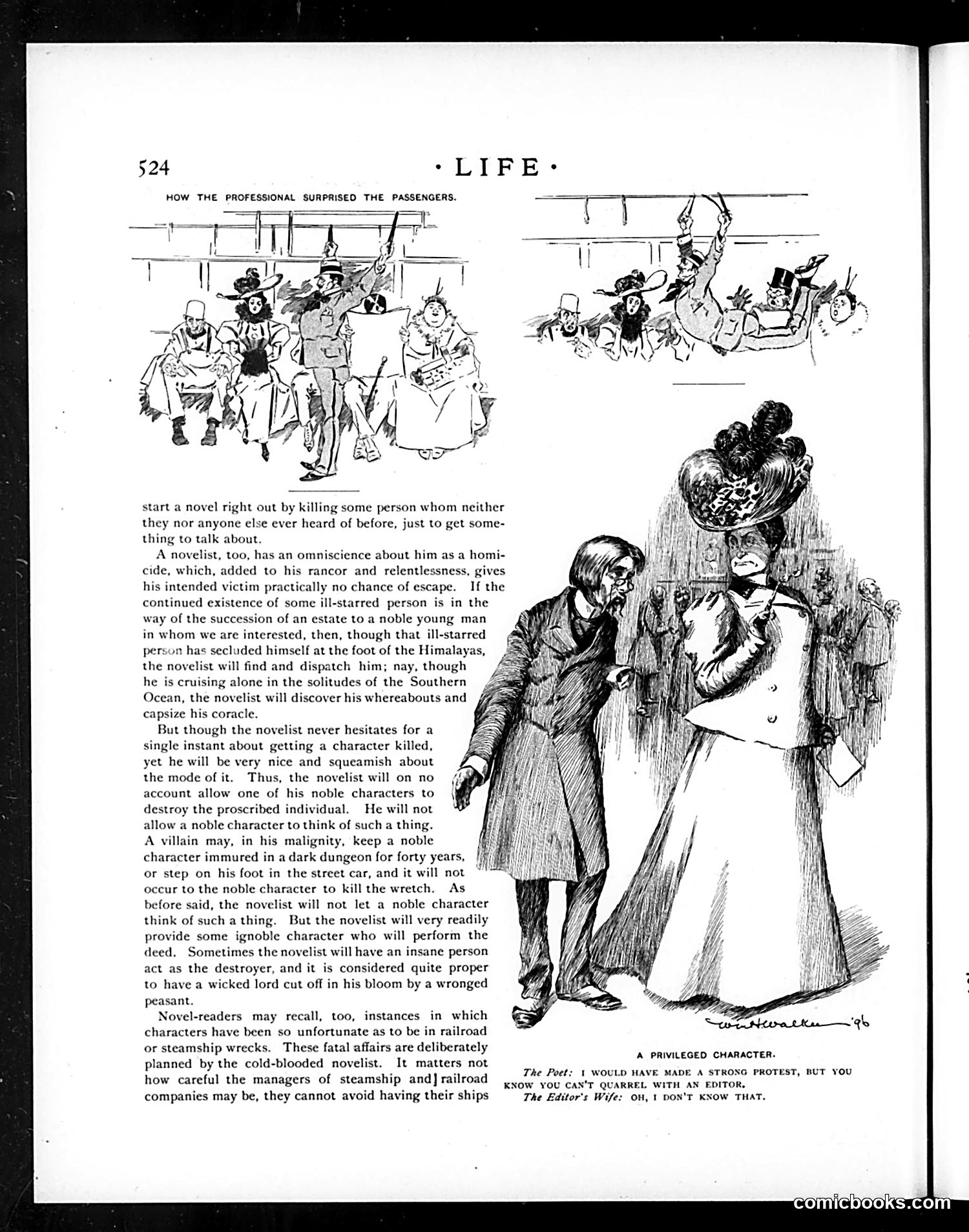
This page satirizes novelists' plotting conventions. The article criticizes how authors conveniently kill off minor characters to create drama, manipulate estates and inheritances, and orchestrate disasters (steamship wrecks, railroad accidents) regardless of real-world logistics. The key irony: novelists obsessively kill characters yet impose strict moral codes—noble characters won't commit murder themselves, so authors deploy "ignoble" or insane characters to do the dirty work. The cartoon "A Privileged Character" shows a fashionably dressed couple with the poet complaining he'd protest something to an editor, but his wife (the "privileged character") notes she doesn't quarrel with editors. This likely mocks how literary connections and social standing allow certain writers exemptions from normal criticism or accountability—tying to the article's broader point about novelists' arbitrary authorial privileges.
📄 Transcribed text from this page (OCR, searchable)
Machine-transcribed from the original scan — historical spelling and the odd misread are preserved.
> LIFE: PROFESSIONAL SURPRISED THE PASSENGERS. start a novel right out by killing some person whom neither they nor anyone else ever heard of before, just to get some- thing to talk about. A novelist, too, has an omniscience about him as a homi- cide, which, added to his rancor and relentlessness, gives his intended victim practically no chance of escape. If the continued existence of some ill-starred person is in the way of the succession of an estate to a noble young man in whom we are interested, then, though that ill-starred has secluded himself at the foot of the Himalayas, ist will find and dispatch him; nay, though he is cruising alone in the solitudes of the Southern Ocean, the novelist will discover his whereabouts and capsize his coracle. But though the novelist never hesitates for a single instant about getting a character killed, yet he will be very nice and squeamish about the mode of it. Thus, the novelist will on no account allow one of his noble characters to destroy the proscribed individual. He will not allow a noble character to think of such a thing. A villain may, in his malignity, keep a noble character immured in a dark dungeon for forty years, or step on his foot in the street car, and it will not occur to the noble character to kill the wretch. As before said, the novelist will not let a noble character think of such a thing. But the novelist will very readily provide some ignoble character who will perform the deed, Sometimes the novelist will have an insane person act as the destroyer, and it is considered quite proper to have a wicked lord cut off in his bloom by a wronged peasant. Novel-readers may recall, too, instances in which characters ¢ been so unfortunate as to be in railroad or steamship wrecks. These fatal affairs are deliberately planned iby the (cold; blooded: nowelise. . Juiraviers) 20: The Poet: | WOULD MAVE MADE A STRONG PROTEST, BUT YOU how careful the managers of steamship and] railroad ow you can'T QUARREL WITH AN Paka ' companies may be, they cannot avoid having their ships The Editor's Wife: OW, 1 DON'T KNOW THAT. A PRIVILEGED CHARACTER.