
Life, 1896-12-24 · page 15 of 20
Life — December 24, 1896 — page 15: what you’re looking at
What you’re looking at
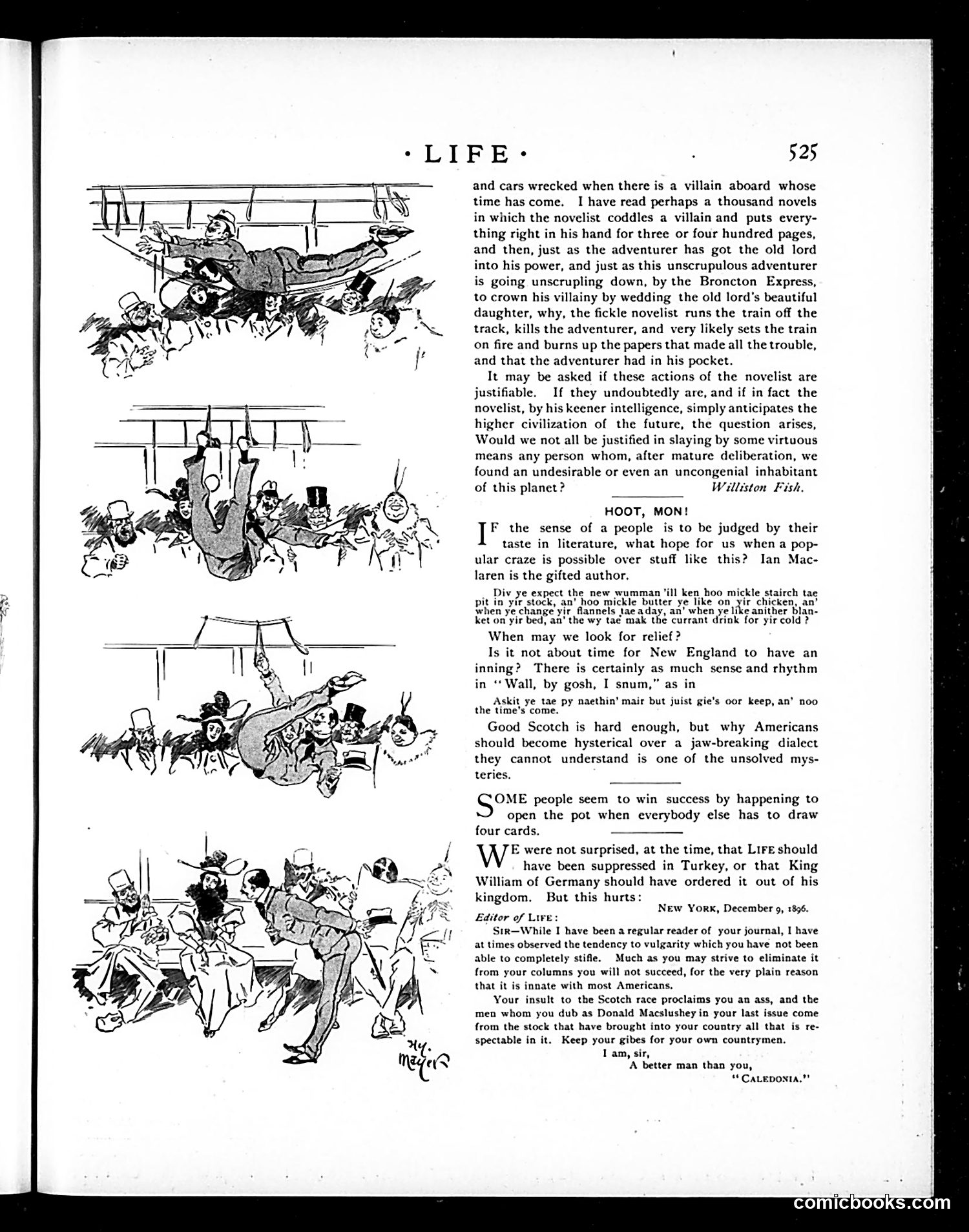
This page satirizes the popular craze for Scottish dialect literature, particularly works by Ian Maclaren (a bestselling author of sentimental Scottish stories). The four cartoon panels on the left—apparently unrelated train-wreck scenes—serve as visual counterpoint to the written critique. The main attack comes through a reader's letter (likely written by Life's editors themselves) mocking Americans' enthusiasm for impenetrable Scottish dialect passages. The letter sarcastically asks when New England writers will provide equally incomprehensible content, then insults the Scottish by questioning why Americans worship "a jaw-breaking dialect they cannot understand." The response letter from "Caledonia" defends Scottish immigrants as bringing respectability to America, calling Life's mockery vulgar and the editors "an ass." The satire targets: (1) literary fashion—the fad for Scottish regionalism; (2) American cultural insecurity and herd mentality in taste; (3) ethnic tensions in 1890s America. The joke assumes educated readers shared Life's contempt for both the trend and its working-class appeal.
📄 Transcribed text from this page (OCR, searchable)
Machine-transcribed from the original scan — historical spelling and the odd misread are preserved.
> LIFE: 525 and cars wrecked when there is a villain aboard whose time has come. I have read perhaps a thousand novels in which the novelist coddles a villain and puts every- thing right in his hand for three or four hundred pages, and then, just as the adventurer has got the old lord into his power, and just as this unscrupulous adventurer is going unscrupling down, by the Broncton Express, to crown his villainy by wedding the old lord's beautiful daughter, why, the fickle novelist runs the train off the track, kills the adventurer, and very likely sets the train on fire and burns up the papers that made all the trouble, and that the adventurer had in his pocket. It may be asked if these actions of the novelist are justifiable. If they undoubtedly are, and if in fact the novelist, by his keener intelligence, simply anticipates the higher civilization of the future, the question arises, Would we not all be justified in slaying by some virtuous means any person whom, after mature deliberation, we found an undesirable or even an uncongenial inhabitant of this planet? Williston Fish, HOOT, MON! Le the sense of a people is to be judged by their taste in literature, what hope for us when a pop- ular craze is possible over stuff like this? Ian Mac- laren is the gifted author. iv ye expect the new wumman ‘ill ken hoo mickle stairch tae yir stock, an’ hoo mickle butter ye like on yir chicken, an’ when ye change yir flannels tae aday, an’ when ye like anither blan- ket on yir bed, an’ the wy taé mak the currant drink for yir cold ? When may we look for relief? Is it not about time for New England to have an inning? There is certainly as much sense and rhythm in ‘Wall, by gosh, I snum,” as in Askit ye tae py naethin’ mair but juist gie’s oor keep, an’ noo the time's come. Good Scotch is hard enough, but why Americans should become hysterical over a jaw-breaking dialect they cannot understand is one of the unsolved mys- teries. OME people seem to win success by happening to open the pot when everybody else has to draw four cards, —_—_. E were not surprised, at the time, that LIFE should have been suppressed in Turkey, or that King William of Germany should have ordered it out of his kingdom. But this hurts: New York, December 9, 1896. Editor of Live: Str—While I have been a regular reader of your journal, I have at times observed the tendency to vulgarity which you have not been able to completely stifle. Much as you may strive to eliminate it from your columns you will not succeed, for the very plain reason that it is innate with most Americans. Your insult to the Scotch race proclaims you an ass, and the men whom you dub as Donald Macslushey in your last issue come from the stock that have brought into your country all that is re- spectable in it. Keep your gibes for your own countrymen. 1am, sir, A better man than you, “*CaLeponta,”"