
A complete issue · 24 pages · 1896
Life — November 5, 1896
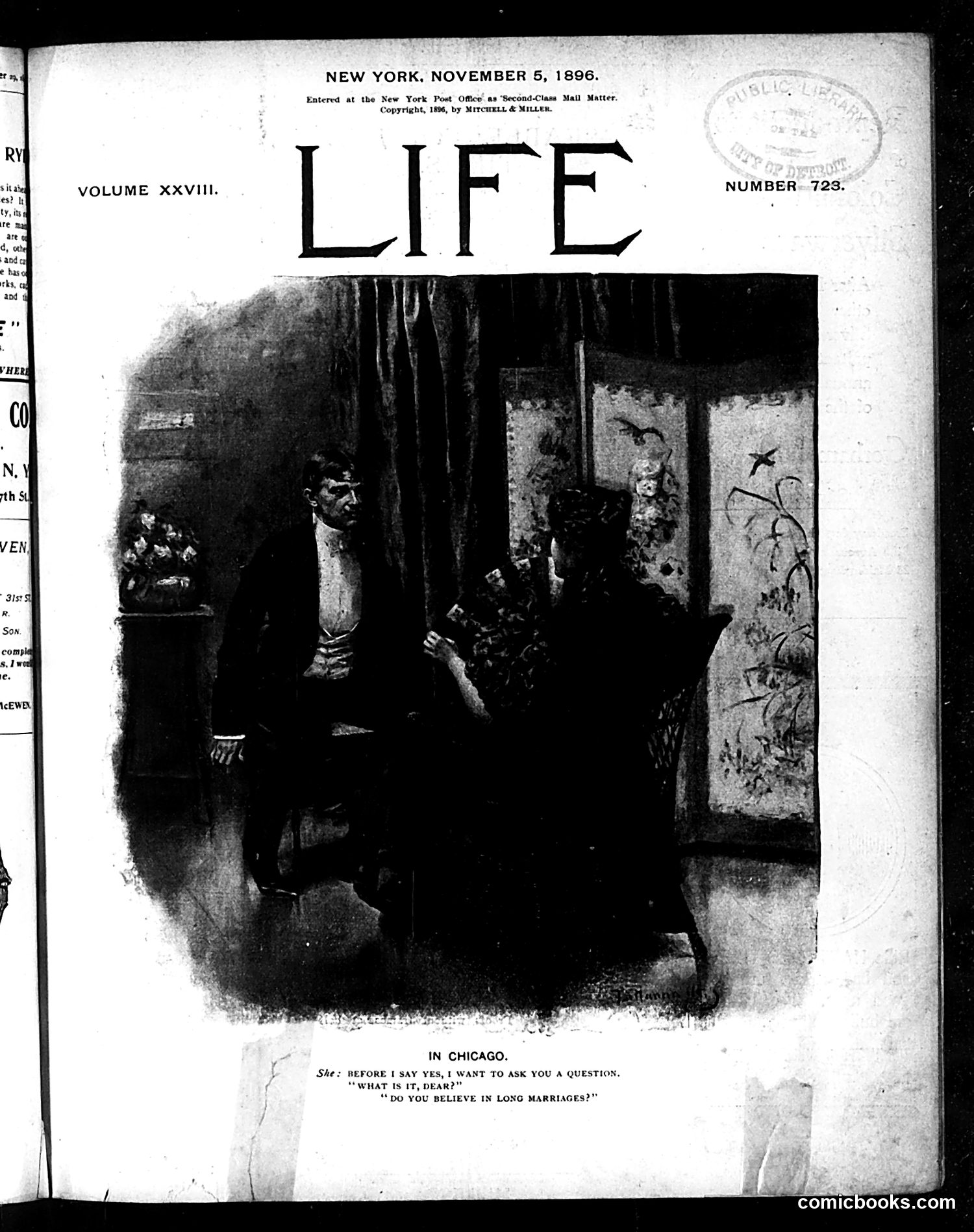
This page features a satirical illustration titled "In Chicago" depicting what appears to be an interior scene with well-dressed figures in conversation. The caption reads: "She: BEFORE I SAY YES, I WANT TO ASK YOU A QUESTION. 'WHAT IS IT, DEAR?' 'DO YOU BELIEVE IN LONG MARRIAGES?'" The humor appears to satirize marriage proposal etiquette and women's skepticism about matrimonial commitment. The woman's question subverts the traditional romantic proposal moment by introducing practical, even cynical concerns about marriage longevity. This reflects late-19th-century anxieties about marriage stability and possibly contemporary feminist questioning of traditional gender roles and marital expectations. The setting suggests urban, middle-class society of 1890s Chicago.
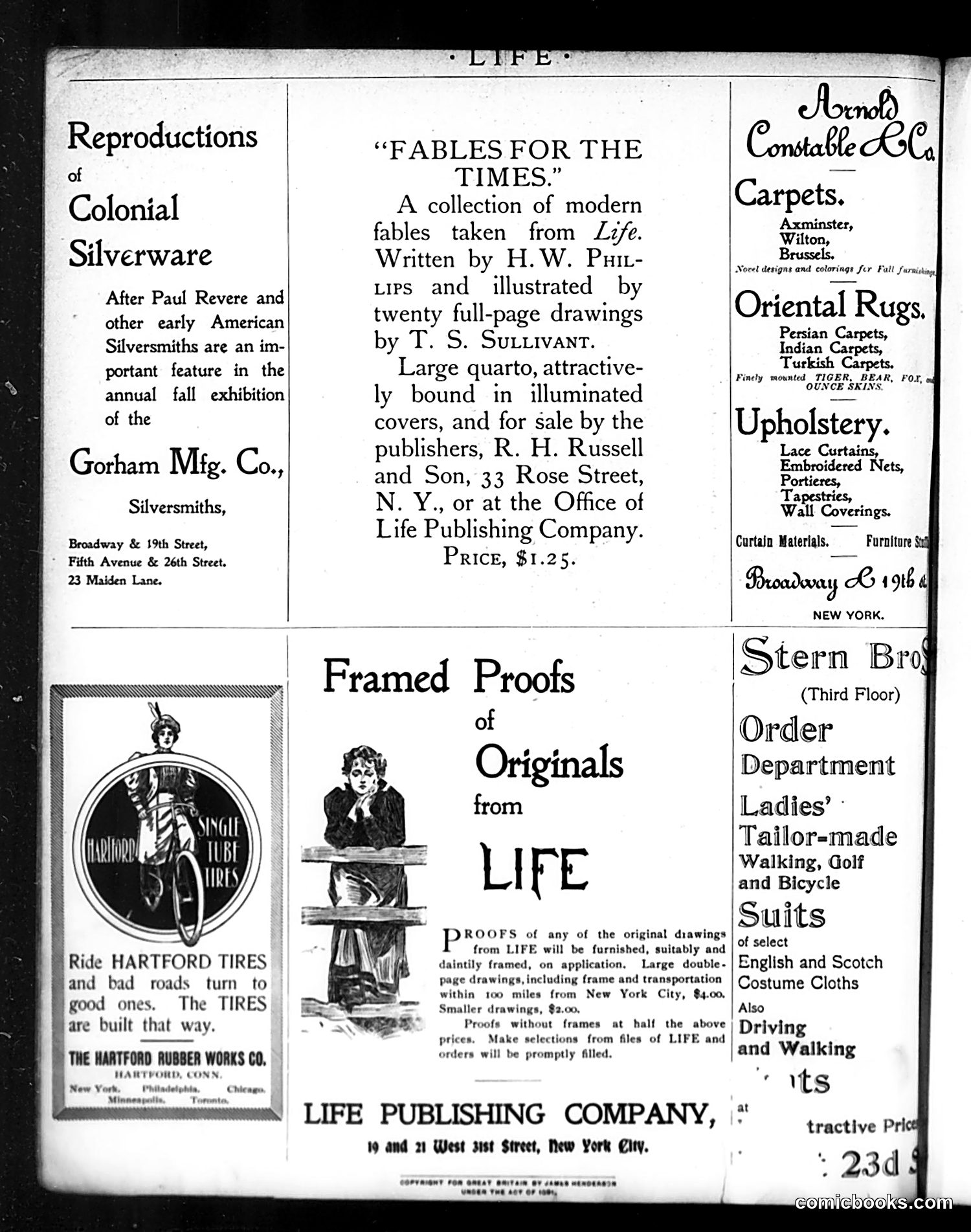
This page is primarily **advertising** from the early 1900s, not political satire. It contains advertisements for: - Gorham Manufacturing Company silverware - Hartford Rubber Works tires - Arnold Constable & Co. home furnishings - Stern Bros. department store clothing - Life Publishing Company's own products The only illustration with potential satirical content is the **Hartford Tires advertisement**, which shows a figure on a bicycle wheel. The accompanying text uses the humorous phrase "bad roads turn to good ones" — likely a playful exaggeration typical of period advertising rather than political commentary. The page primarily showcases how *Life* magazine sustained itself through lucrative advertisements rather than through editorial content alone.
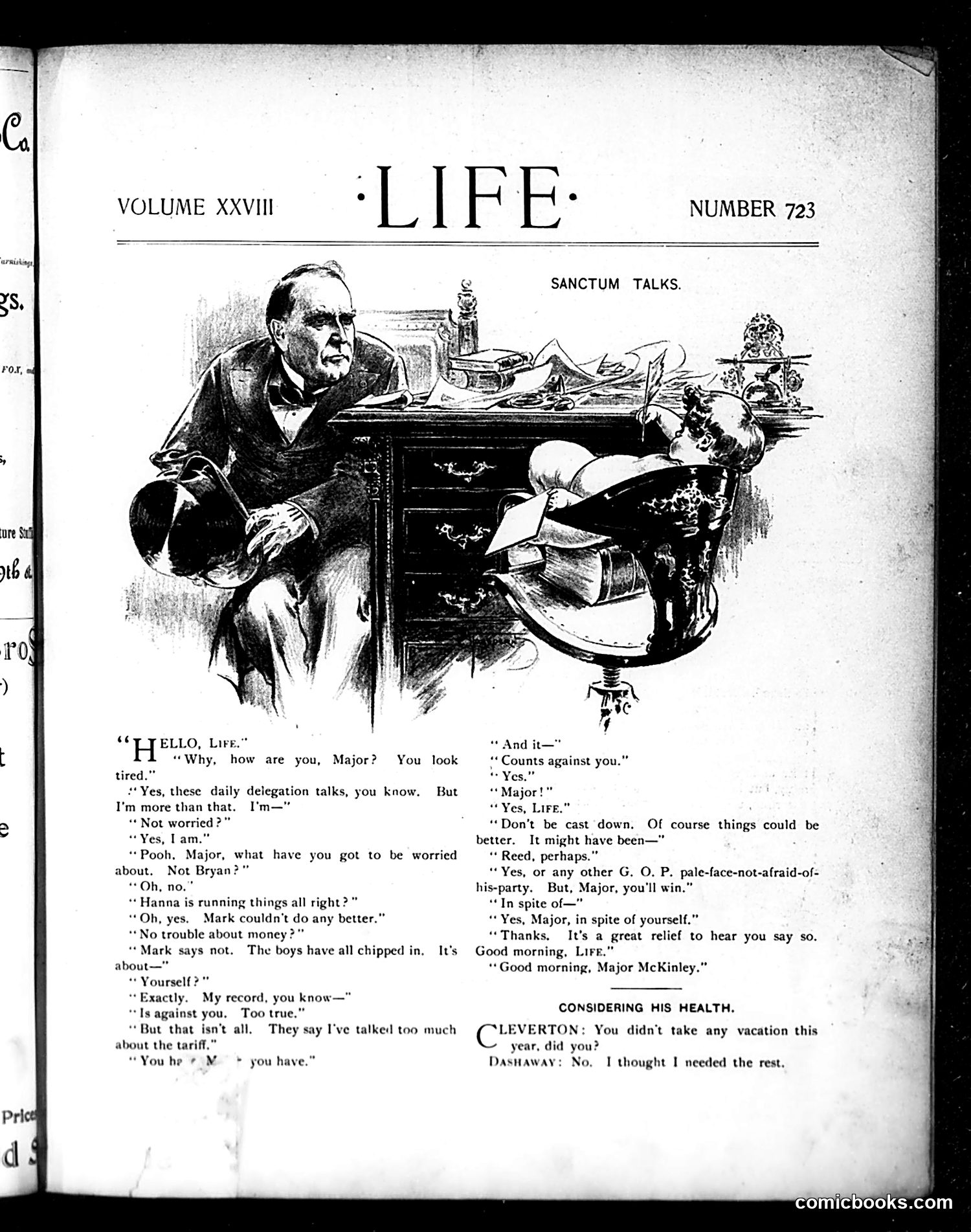
This page features a satirical dialogue between a weary Major (likely a political or military figure) and "Life" magazine personified. The cartoon depicts the Major at his desk, appearing exhausted from "daily delegation talks"—apparently referring to ongoing negotiations or political meetings. The satire mocks the Major's worried state despite assurances that things are "running all right." References to Bryan, the G.O.P. (Republican party), and financial concerns ("boys have all chipped in") suggest this addresses political turmoil, possibly from the early 1900s election cycle. The second dialogue ("Concerning His Health") briefly shows Cleverton and Dashaway discussing vacation—a lighter, complementary piece. The overall tone: gentle mockery of political exhaustion and ineffectual reassurance.
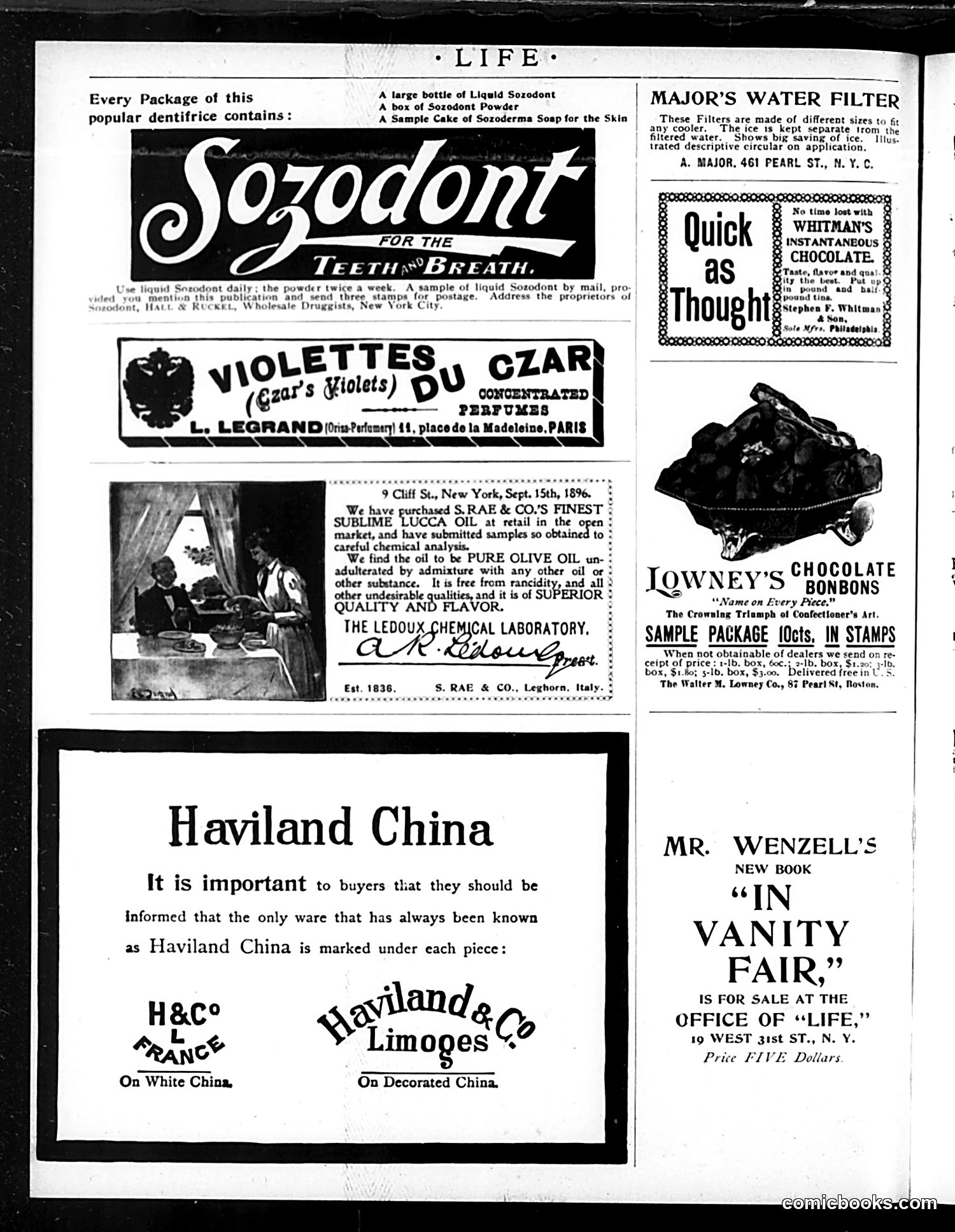
This page is **primarily advertisements**, not political satire or comics. It contains product ads from the 1890s, including: - **Sozodont** toothpaste and breath freshener - **Violettes du Czar** perfume - **Ledoux Chemical Laboratory's** Lucca oil - **Lowney's Chocolate Bonbons** - **Whitman's Instantaneous Chocolate** - **Major's Water Filter** - **Haviland China** (dishware from France and Limoges) - **Mr. Wenzel's book "In Vanity Fair"** There is one small illustration showing a woman at a window, likely promoting the Ledoux product, but it's decorative rather than satirical. The page represents typical late-19th-century American magazine advertising aimed at middle and upper-class consumers.
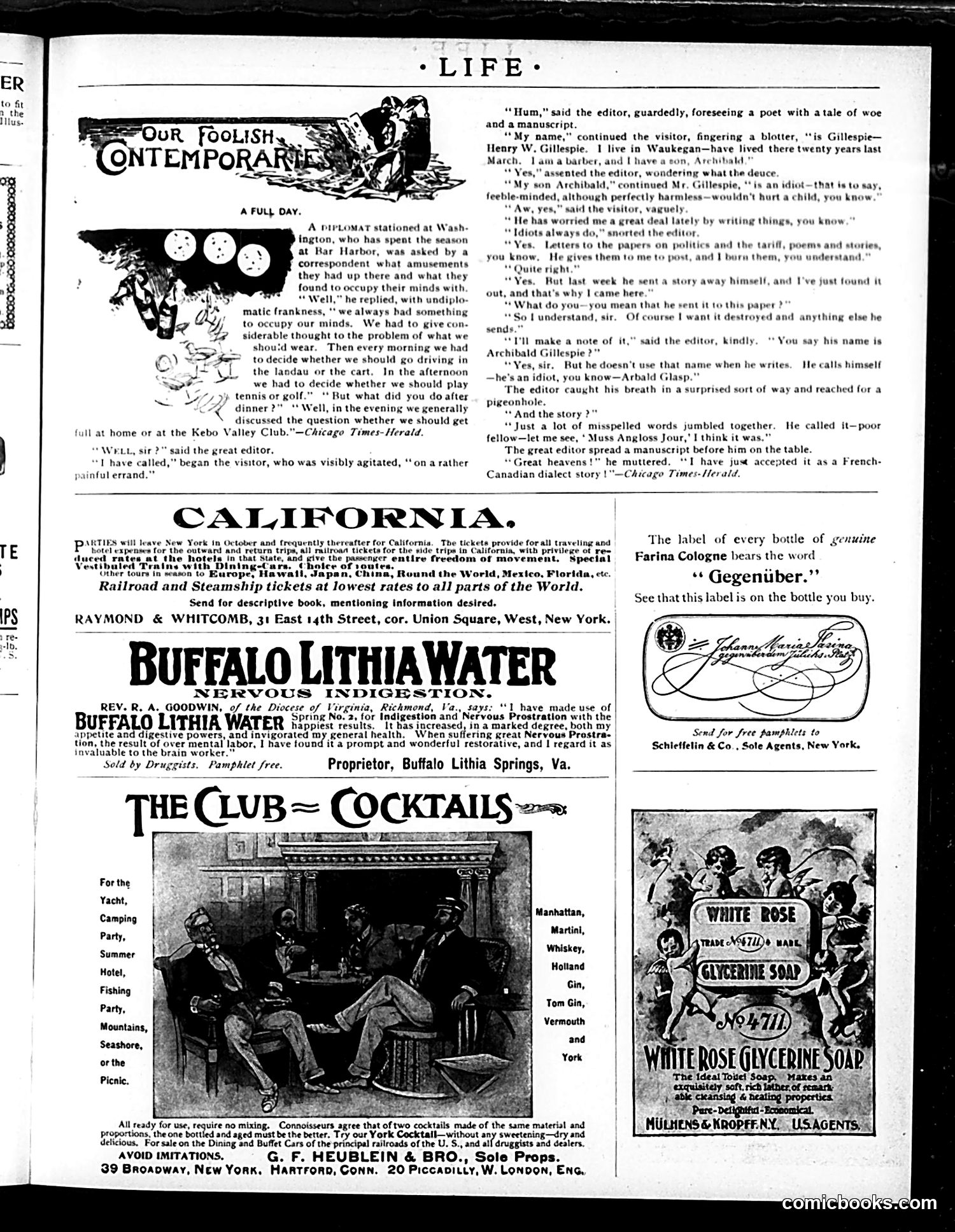
This satirical section mocks absent-minded poets. The cartoon depicts a writer so preoccupied with composing verses that he fails to notice everyday occurrences around him—a cart passes, children play, and people discuss whether to have dinner or golf, yet he remains oblivious, absorbed in his literary world. The accompanying text features editor Henry W. Gillespie describing an eccentric poet named Archibald Gilaspie who writes under the pseudonym "Arald Glasp" and submits poorly written manuscripts filled with misspellings and jumbled words. The satire targets the absent-minded, impractical nature of creative writers disconnected from reality—a common trope mocking literary pretension in early 20th-century American humor.
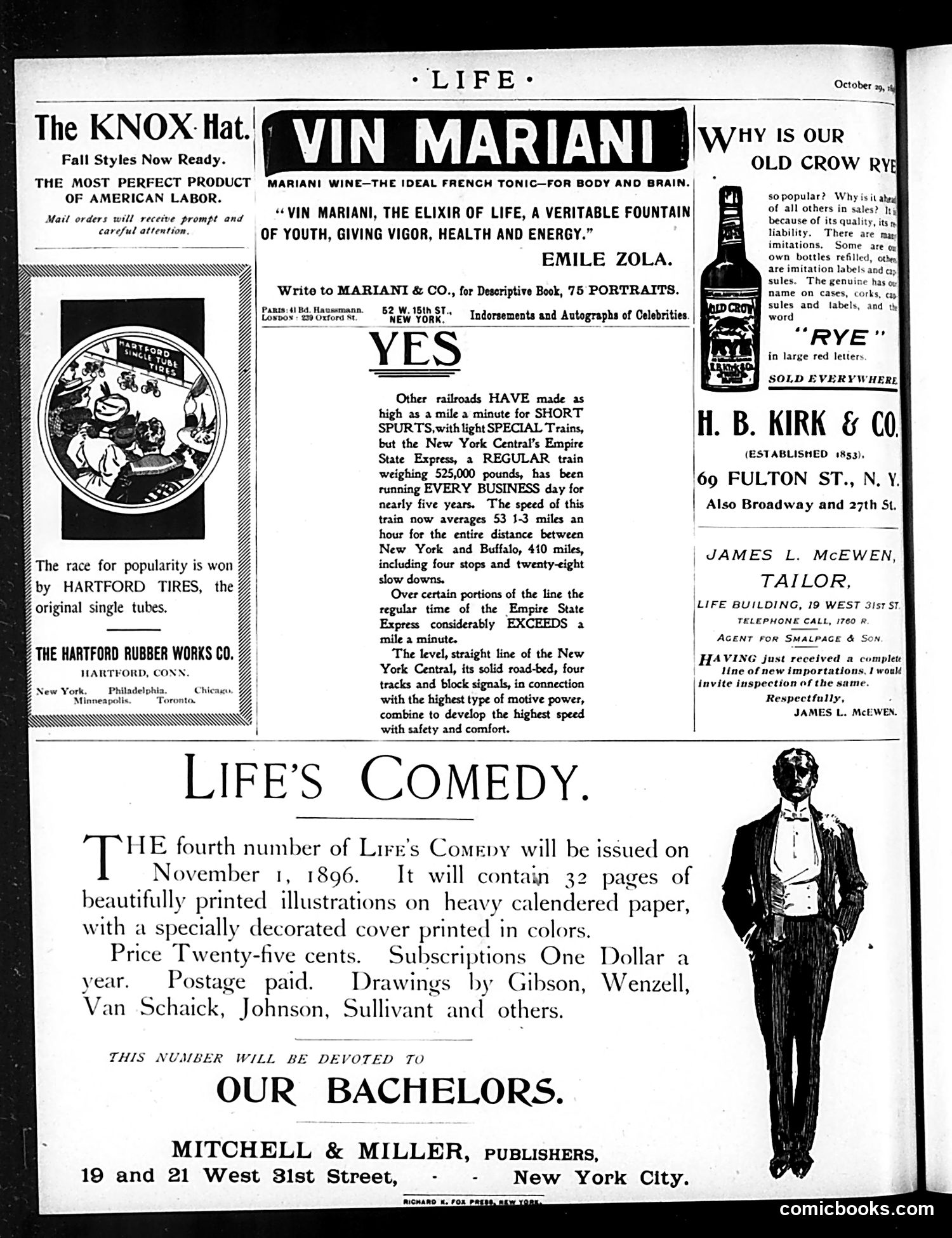
This page consists primarily of **period advertisements** rather than political satire. The dominant content includes: 1. **Vin Mariani advertisement**: A patent medicine claiming to provide "vigor, health and energy," endorsed with a quote attributed to Emile Zola. Such tonics were common in the 1890s, often containing alcohol and unregulated ingredients. 2. **Hartford Tires and H.B. Kirk & Co. advertisements**: Standard commercial promotions. 3. **Life's Comedy announcement**: Promoting the magazine's next issue (November 1, 1896), devoted to "Our Bachelors," featuring illustrations by notable artists Gibson and Wentzell. The page reflects **1890s consumer culture** and advertising practices rather than containing political commentary or social satire. The illustrated figure is a formal gentleman, consistent with the "bachelors" theme.
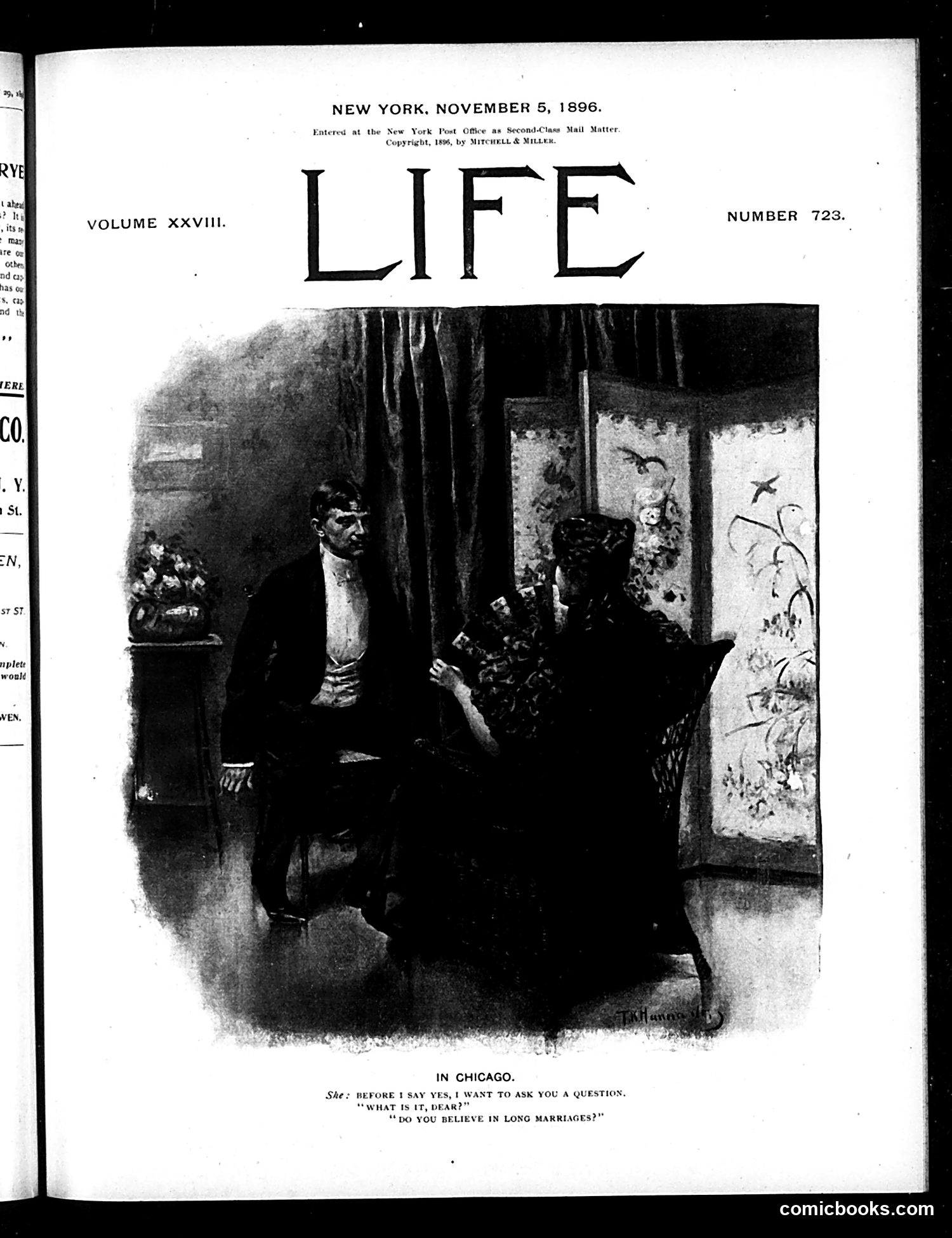
This cartoon depicts a domestic scene where a man sits while a woman leans toward him urgently. The caption reads: "Before I say yes, I want to ask you a question. 'What is it, dear?' 'Do you believe in long marriages?'" The satire appears to play on marriage anxieties of the 1890s. The woman's serious demeanor and pointed question suggest she's testing whether her suitor genuinely commits to lifelong marriage, or merely seeks a temporary arrangement. The man's somewhat uncomfortable posture hints at the pressure men felt from such interrogations. This reflects period anxieties about matrimonial stability and women's increasingly direct questioning of marital expectations—a notable social shift for the era.
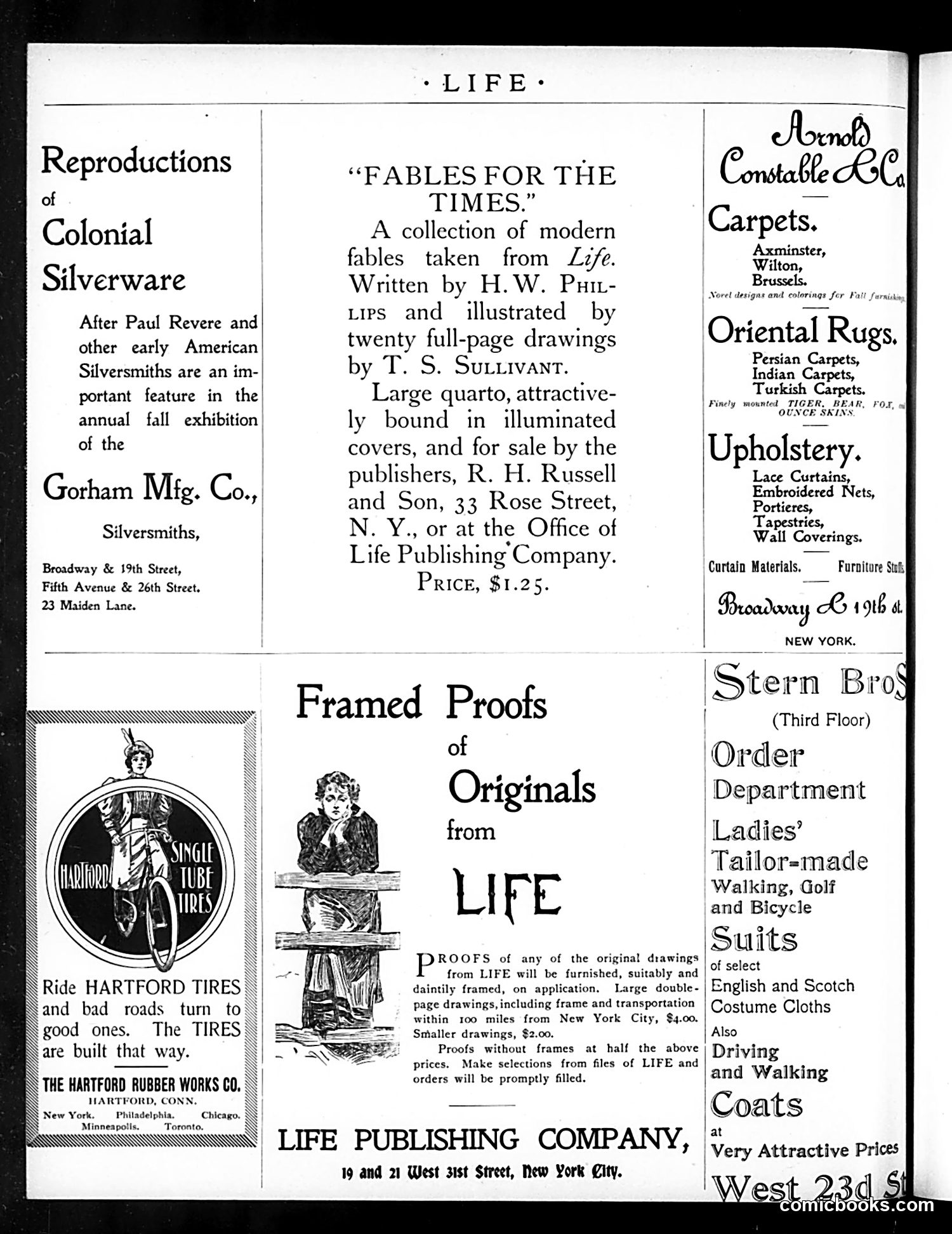
This page is primarily **advertising and announcements** from Life magazine, not political satire. The content includes: 1. **Colonial silverware ads** for Gorham Manufacturing Company 2. **"Fables for the Times"** — a book advertisement featuring modern fables by H.W. Phillips with illustrations by T.S. Sulvant 3. **Hartford Tires advertisement** with a circular logo showing a woman on a bicycle, promoting tire quality 4. **Framed proofs service** from Life Publishing Company, offering reproductions of original artwork 5. **Stern Bros. clothing advertisements** for women's suits and coats The Hartford Tires ad is the closest to humorous content, using the phrase "bad roads turn to good ones" as a selling point, but this is standard commercial messaging rather than political satire. The page primarily serves as a revenue-generating advertising section.
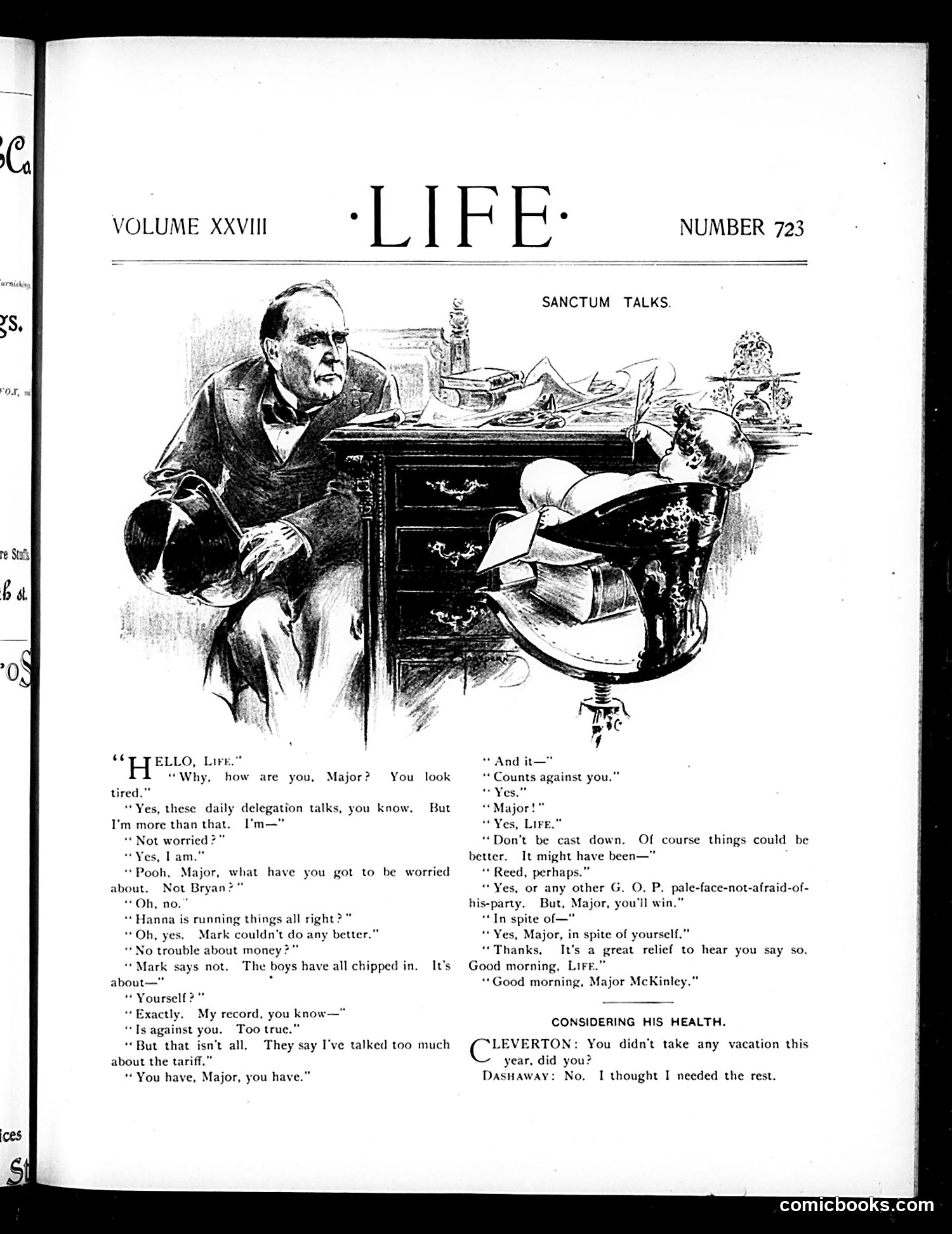
This page features a satirical dialogue cartoon titled "Sanctum Talks" showing an older man (likely a political figure or editor) conversing with a younger woman in his office. The conversation concerns political attacks on the man ("Major"), specifically about his record on tariffs. The woman ("Life" personified) reassures him that despite criticism and opponents ("Reed," "G.O.P. pale-face-not-afraid-of-his-party"), he will ultimately prevail. The second section, "Considering His Health," shows Cleverton and Dashaway discussing vacation time—Dashaway declined vacation, believing he didn't need rest. The cartoon appears to satirize political anxieties about public criticism and the stoicism (or stubbornness) of political figures facing scrutiny, likely from the early 20th century based on the magazine's style.
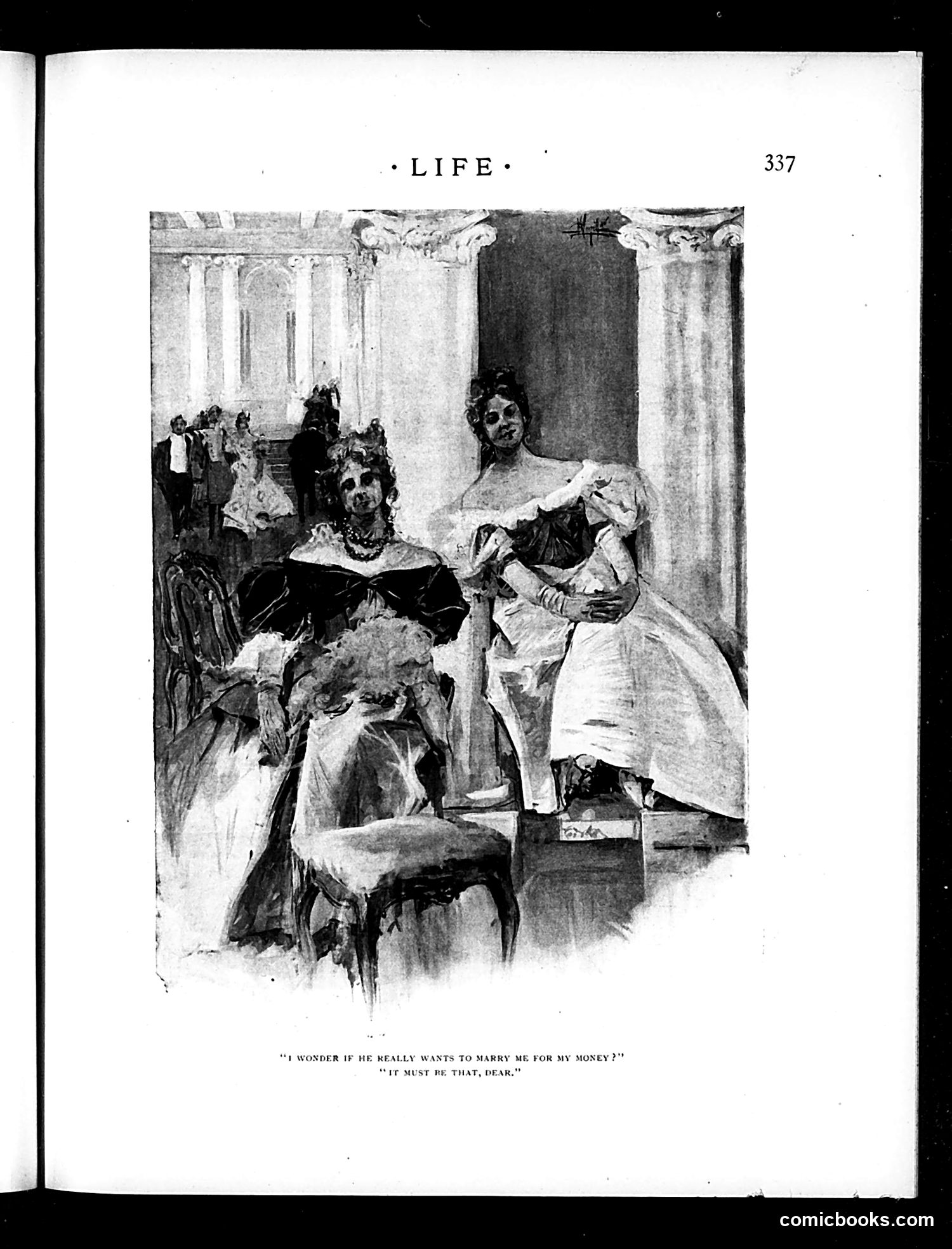
This is a satirical illustration depicting a social scene in what appears to be an elegant interior with classical columns. The caption reads: "I WONDER IF HE REALLY WANTS TO MARRY ME FOR MY MONEY!" / "IT MUST BE THAT, DEAR." The cartoon satirizes mercenary marriage among the wealthy. A woman expresses doubt about a suitor's motives, suggesting she suspects he's interested primarily in her money rather than genuine affection. Her companion's response cynically affirms this suspicion as inevitable—implying that in high society, marriages are transactional rather than romantic. The scene mocks the superficiality and materialism of the upper class, where wealth determines romantic partnerships. The elegance of the setting contrasts ironically with the mercenary nature of the relationship being discussed, emphasizing Life magazine's critique of gilded-age social conventions.
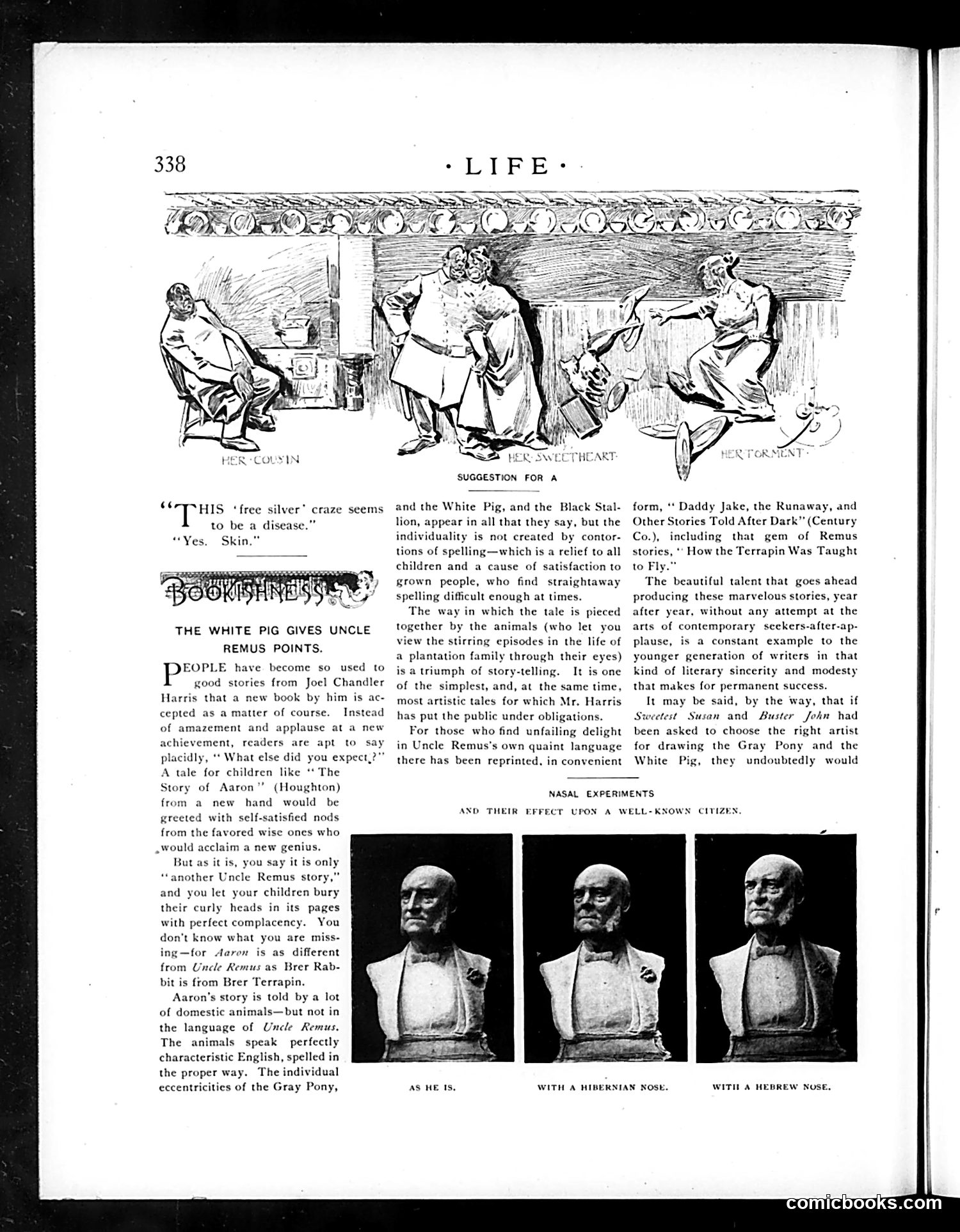
This page reviews Joel Chandler Harris's new children's book *Aaron*, which features animal characters telling stories about a plantation family. The text praises Harris's established reputation—readers automatically accept his work as quality—while highlighting that *Aaron* differs from his famous *Uncle Remus* tales because the animals speak "characteristic English" with proper spelling rather than dialect. The top illustration shows three female figures labeled "Her Cousin," "Her Sweetheart," and "Her Torment," though the connection to the review text is unclear. Below is a separate, unrelated section titled "Nasal Experiments and Their Effect Upon a Well-Known Citizen," featuring three photographic images showing the same man's face with different noses applied—labeled "As He Is," "With a Hibernian Nose," and "With a Hebrew Nose." This appears to be a crude racial/ethnic caricature typical of early 20th-century American humor, mocking different ethnic groups through nose shape stereotyping.
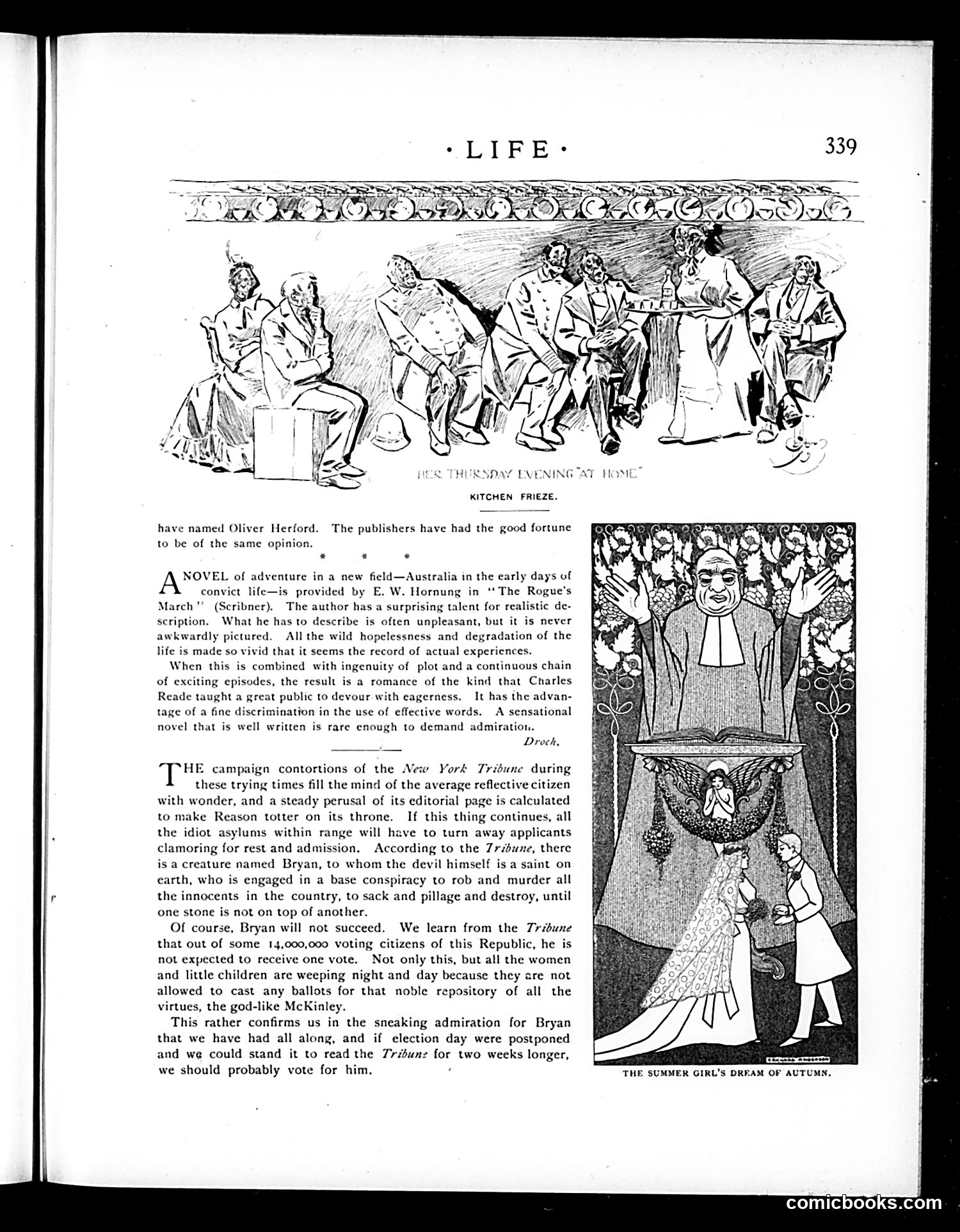
This page contains two distinct pieces of satire: **"Kitchen Frieze"** (top cartoon): A domestic scene showing a Thursday evening at home, likely depicting middle-class social interaction or entertainment of the period. **The Political Commentary** (main text): Life magazine mocks the *New York Tribune's* extreme anti-Bryan editorial stance during what appears to be the 1896 or 1900 presidential election. The satire targets the Tribune's hyperbolic attacks on William Jennings Bryan, portraying him as evil incarnate while lionizing Republican William McKinley as "god-like." Life sarcastically notes the Tribune claims Bryan will receive zero votes despite millions of citizens—and that women and children supposedly weep they can't vote for McKinley. The joke: Life's exaggerated recounting of the Tribune's hysterical rhetoric reveals how absurdly overwrought the editorial attacks are. The closing line—that reading two more weeks of this might make *Life* vote for Bryan—suggests the Tribune's propaganda is so ridiculous it backfires. The cartoons appear to be unrelated book reviews and illustrations.
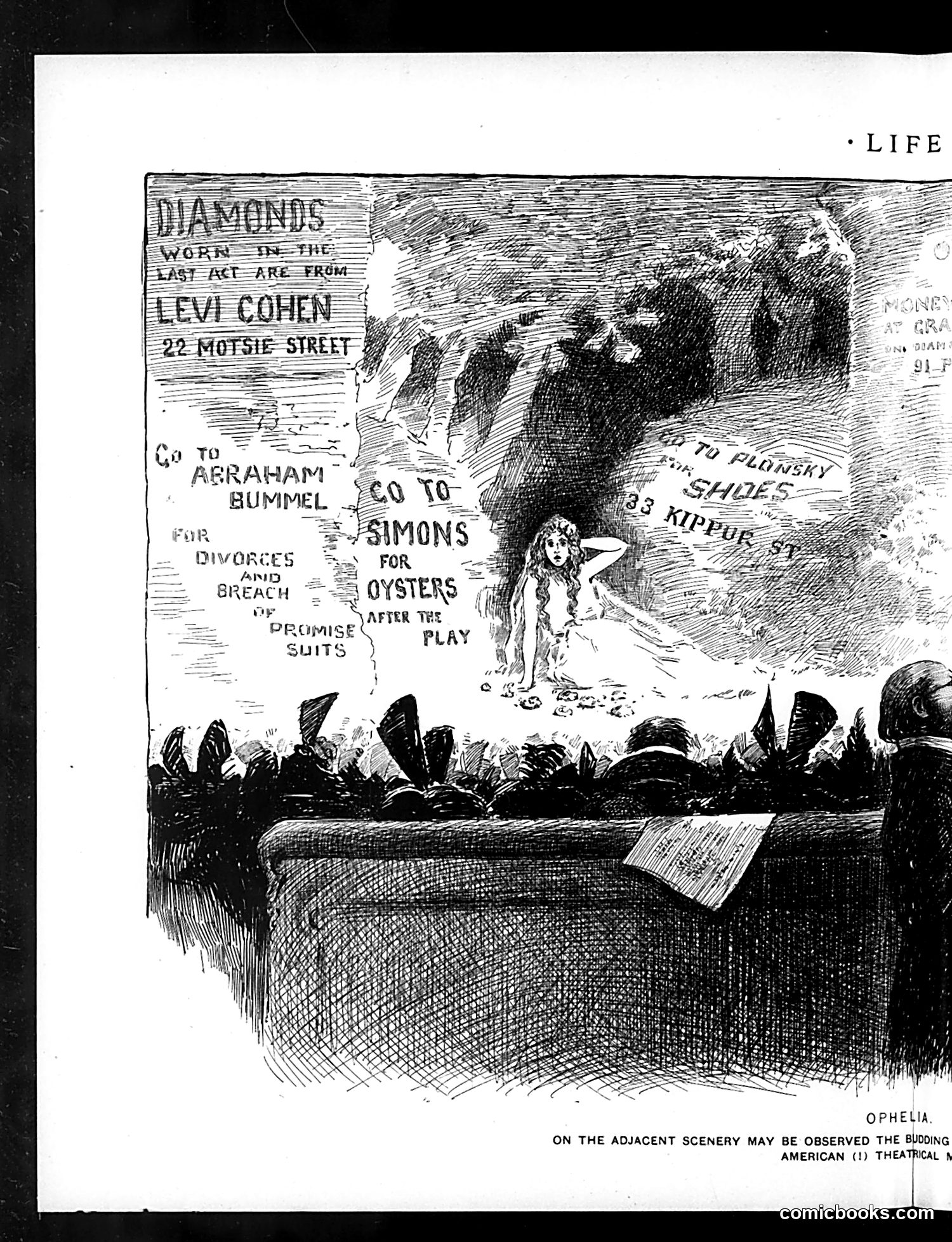
This is a satirical theatrical advertisement cartoon mocking New York businesses advertised through theater scenery. A female figure (labeled "Ophelia," referencing Shakespeare) sits amid exaggerated backdrop signs for various establishments: diamond merchant Levi Cohen, lawyer Abraham Bummel (specializing in divorces and breach of promise suits), oyster restaurant Simons, and Plonsky's shoe store. The joke critiques how American theater backdrops had become cluttered with commercial advertising rather than serving artistic purposes. The reference to "Ophelia" suggests this mocks the degradation of legitimate theater. The sardonic caption notes these "budding American theatrical" advertisements, satirizing how commercialism was invading cultural spaces. This reflects turn-of-the-century anxieties about American materialism overtaking artistic integrity.
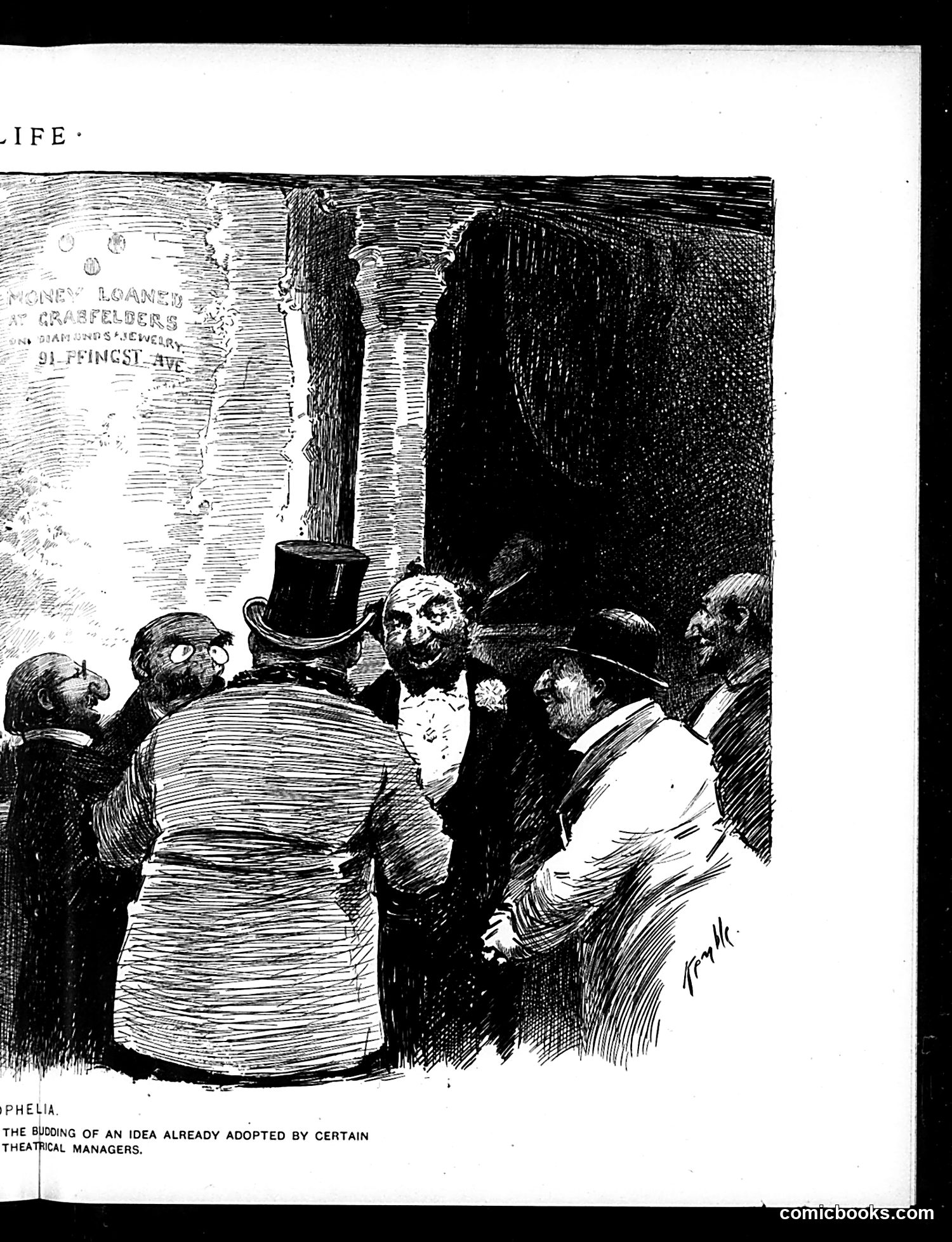
This sketch satirizes theatrical managers' tendency to imitate successful ideas. The caption "Ophelia" references Shakespeare's *Hamlet*, suggesting the cartoon comments on how stage producers copy proven concepts rather than developing original work. The scene depicts well-dressed men in formal attire (top hats, evening wear) in what appears to be a theatrical or social setting. The central figure in the top hat likely represents a theatrical manager or impresario observing or adopting someone else's creative concept—"the budding of an idea already adopted by certain theatrical managers." The satire targets the commercial theater world's practice of copying successful productions, suggesting a lack of originality among competing managers who chase profitable formulas rather than investing in new dramatic works.
This article critiques New York's competing opera houses and their audiences circa the 1880s-90s. The text compares the Metropolitan Opera House (associated with wealthy "Four Hundred" elites and their ornate private boxes) against the Academy of Music, which lacks boxes and allegedly offers better acoustics and democratic seating. The satire targets several points: wealthy patrons who attend opera for *social status* rather than artistic merit; British capitalists exploiting American wealth through operatic ventures; and newspaper critics who artificially elevate expensive Metropolitan singers while ignoring equally talented newcomers. The author argues the new Imperial Opera Company performs "Aida" competently with superior venue acoustics and democratic ticket pricing, yet struggles against the Metropolitan's entrenched social cachet. The joke is that operatic "success" in New York depends less on artistic excellence than on wealthy patrons' investment returns and social pretension.
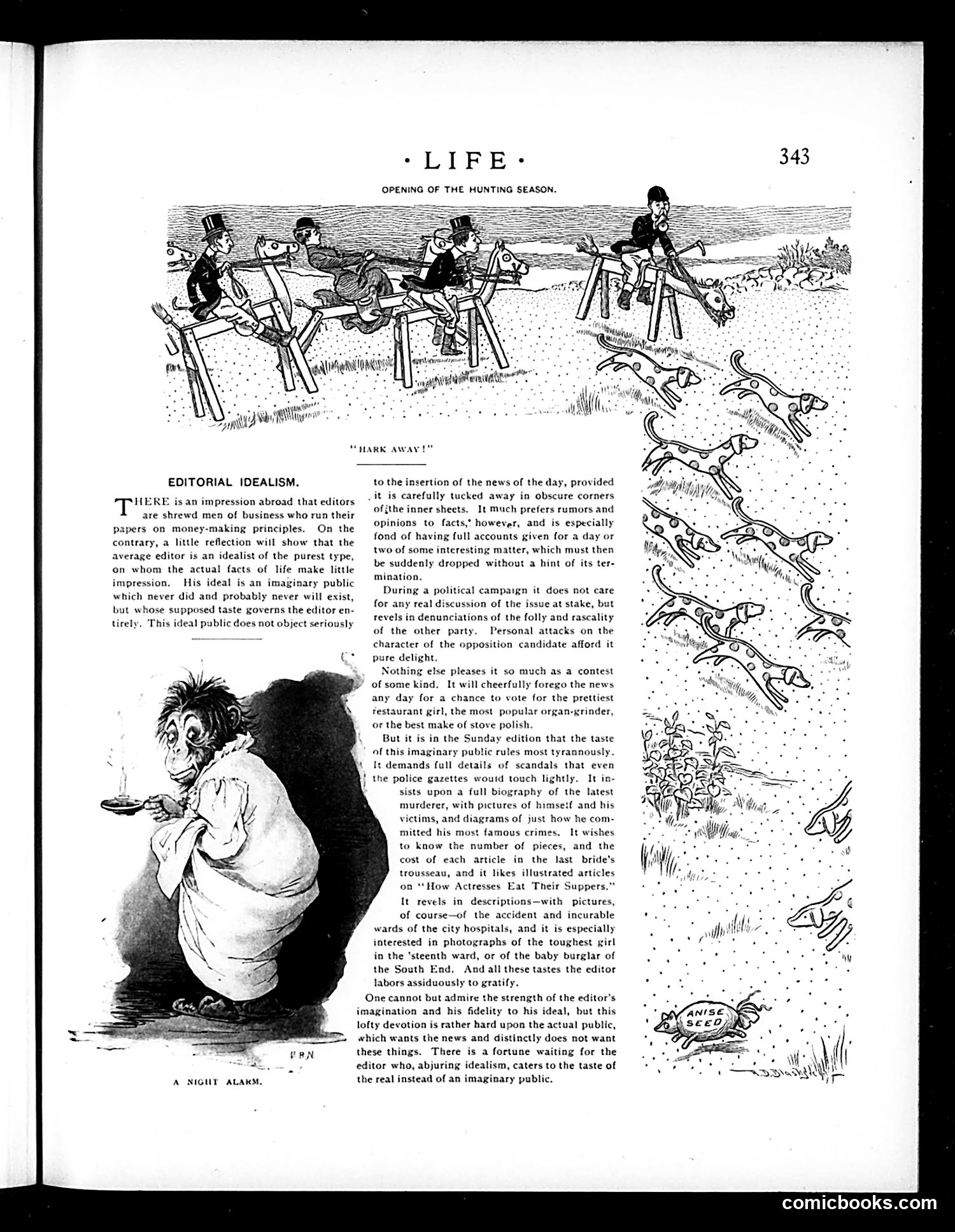
This page satirizes newspaper editors' claimed devotion to an imaginary "ideal public" rather than actual readers' needs. **Top cartoon** ("Hark Away!"): Shows hunters on stick horses chasing dogs, mocking the frivolous "Opening of the Hunting Season"—likely referencing editors' focus on trivial content. **Main editorial**: Argues editors claim to serve an imaginary public that loves scandals, rumors, personal attacks during campaigns, and sensational Sunday content (murder details, hospital wards, "toughest girl" photographs) while ignoring real news. The text sarcastically praises editors' "idealism" while condemning this approach as ignoring what actual readers want: genuine news coverage. **Left cartoon** ("A Night Alarm"): A caricatured figure with exaggerated features appears distressed—possibly representing an editor or public figure troubled by the magazine's criticism. The satire suggests newspapers prioritize sensationalism and scandal over substantive reporting, betraying their readers' actual interests.
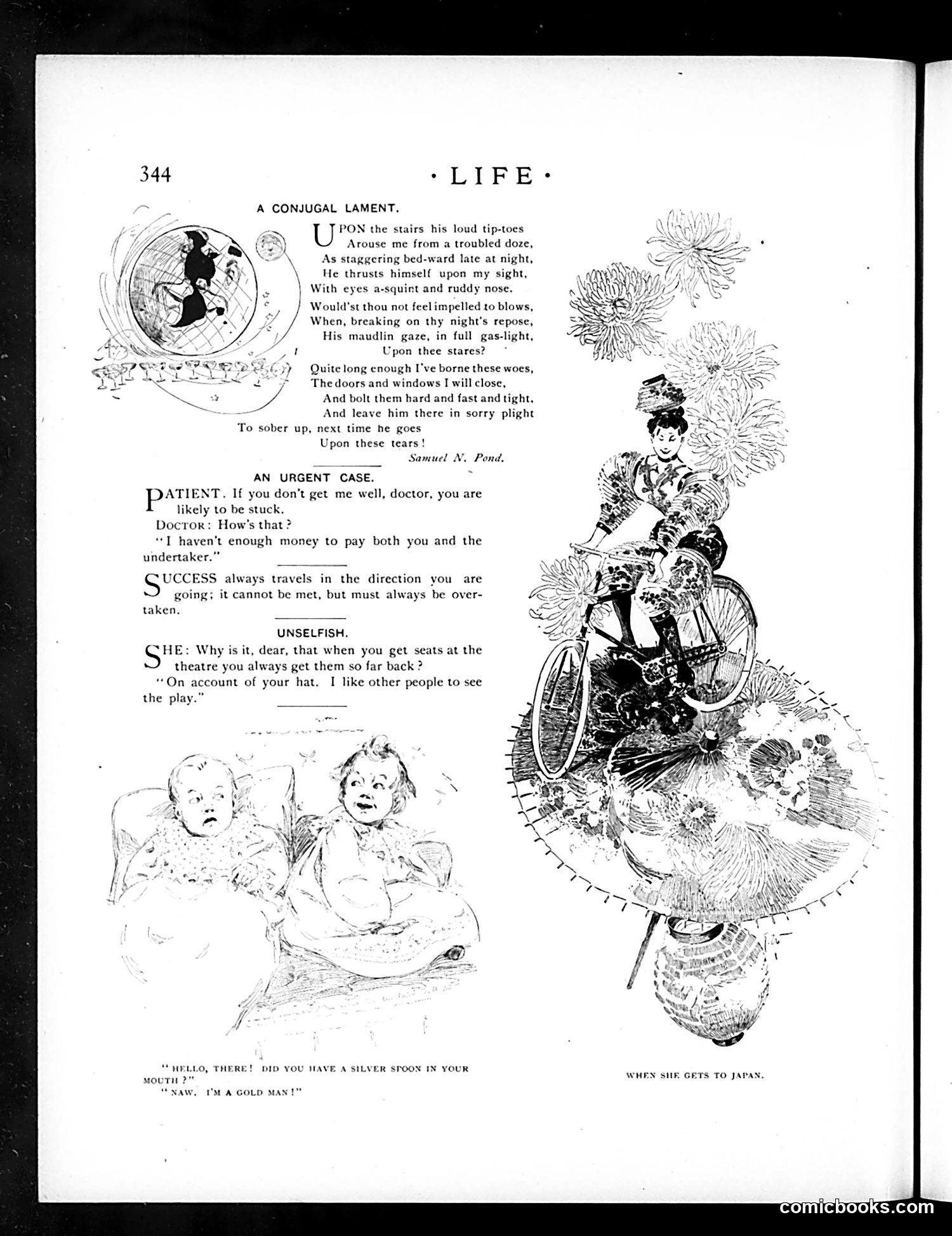
This page contains several short satirical pieces typical of Life magazine's format: **"A Conjugal Lament"** depicts a wife's frustration with her drunk husband stumbling home late at night—a common domestic complaint of the era. The verse mocks both his intoxication and her exasperation. **"An Urgent Case"** presents a dark joke: a patient tells his doctor he can't afford both medical fees and a funeral, implying the doctor might kill him—satirizing the high cost of medical care. **"Unselfish"** jokes about a woman's large hat blocking theater-goers' views, with her husband pretending concern for *others* seeing the play while really just tolerating her vanity. The illustrations include babies (one caption references "silver spoon" vs. "gold man" slang for class status) and a woman on a bicycle in elaborate dress heading to Japan—likely referencing early 1900s fascination with Japanese culture and the "New Woman" on bicycles. The humor targets domestic life, class anxieties, and social pretensions.
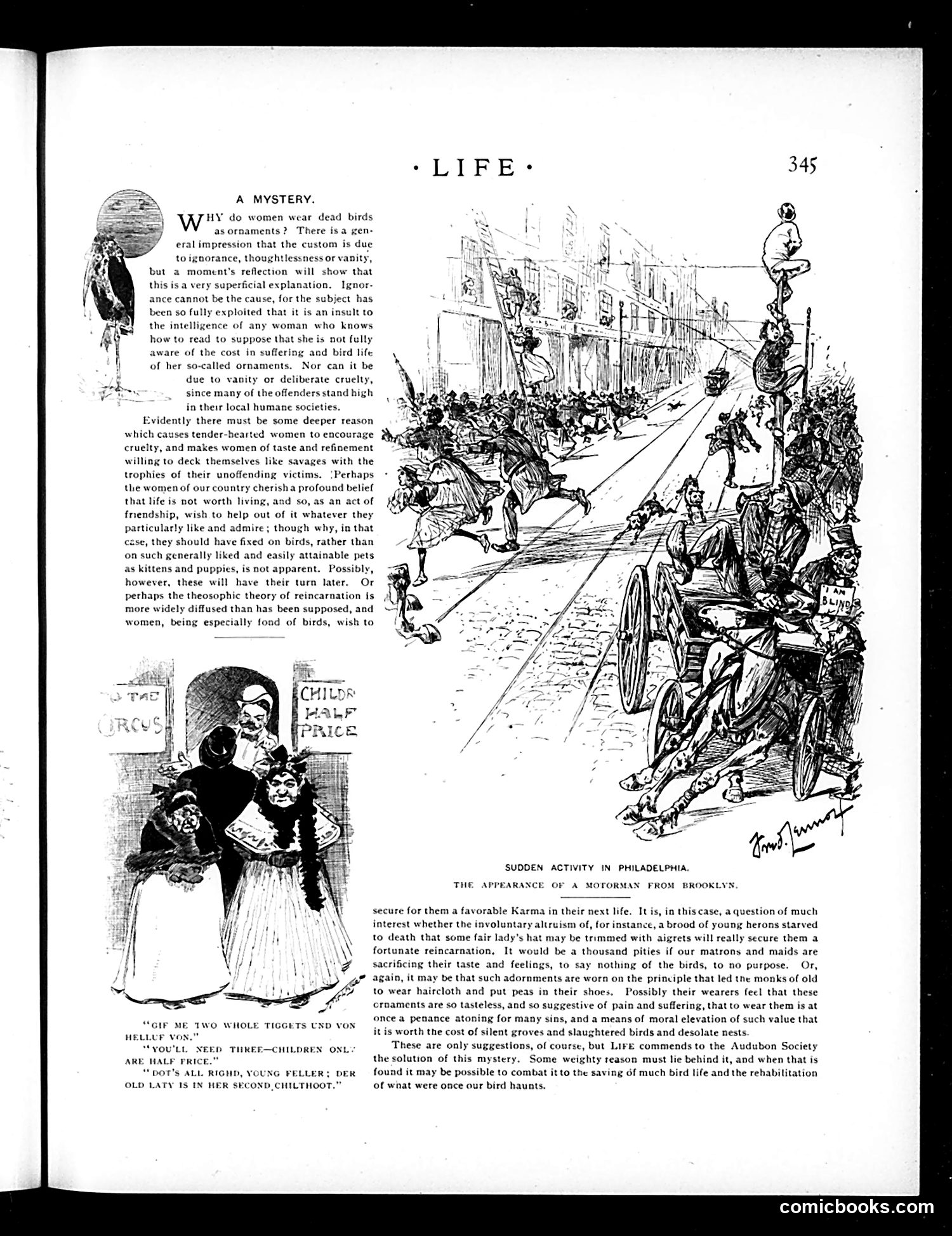
This article-cartoon satirizes the early 1900s fashion of adorning women's hats with dead birds and feathers. The text sarcastically examines why intelligent, refined women would wear such ornaments despite knowing the suffering involved. The piece mocks various explanations: ignorance (women read), vanity, or cruelty (many supporters belong to humane societies). It then offers tongue-in-cheek alternatives—perhaps women believe life isn't worth living, or they're practicing theosophy (reincarnation theory) to give birds "good karma," or wearing dead birds as self-mortification like monks wearing haircloth. The cartoon illustrations show fashionable women and children wearing elaborate bird-adorned hats in public settings. The satire's real point: condemning the hypocrisy of cultured society women who simultaneously support animal welfare while demanding feathered fashion. The article ends by appealing to the Audubon Society to solve this "mystery" and protect bird populations.
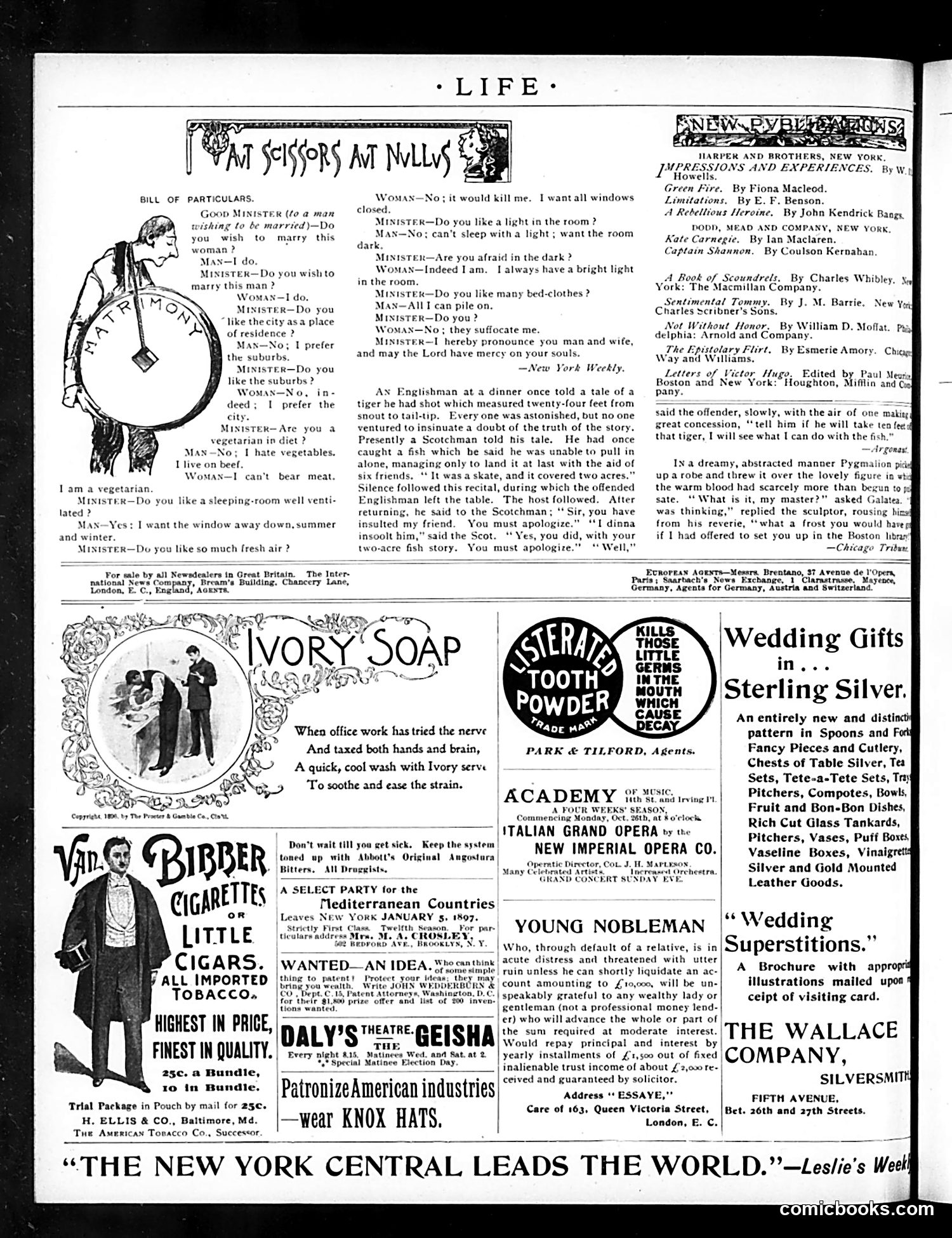
This cartoon satirizes incompatible couples by depicting a minister performing a wedding ceremony for a man and woman who disagree on virtually everything: windows (she wants all open; he wants them closed), lighting (opposite preferences), bedroom temperature and bedding (she wants light and minimal covers; he wants darkness and maximum blankets), and diet (she's vegetarian; he eats only meat). The joke builds through the "bill of particulars" format—each exchange reveals another fundamental incompatibility. The minister's final pronouncement—"I hereby pronounce you man and wife, and may the Lord have mercy on your souls"—provides the punchline, suggesting their marriage is doomed by these irreconcilable differences. The satire mocks both marriage itself (as potentially uniting hopelessly mismatched people) and the mechanical nature of wedding ceremonies that proceed regardless of obvious incompatibility. The accompanying anecdote about the Englishman's tiger and Scotchman's fish reinforces the theme of exaggerated tall tales and one-upmanship.
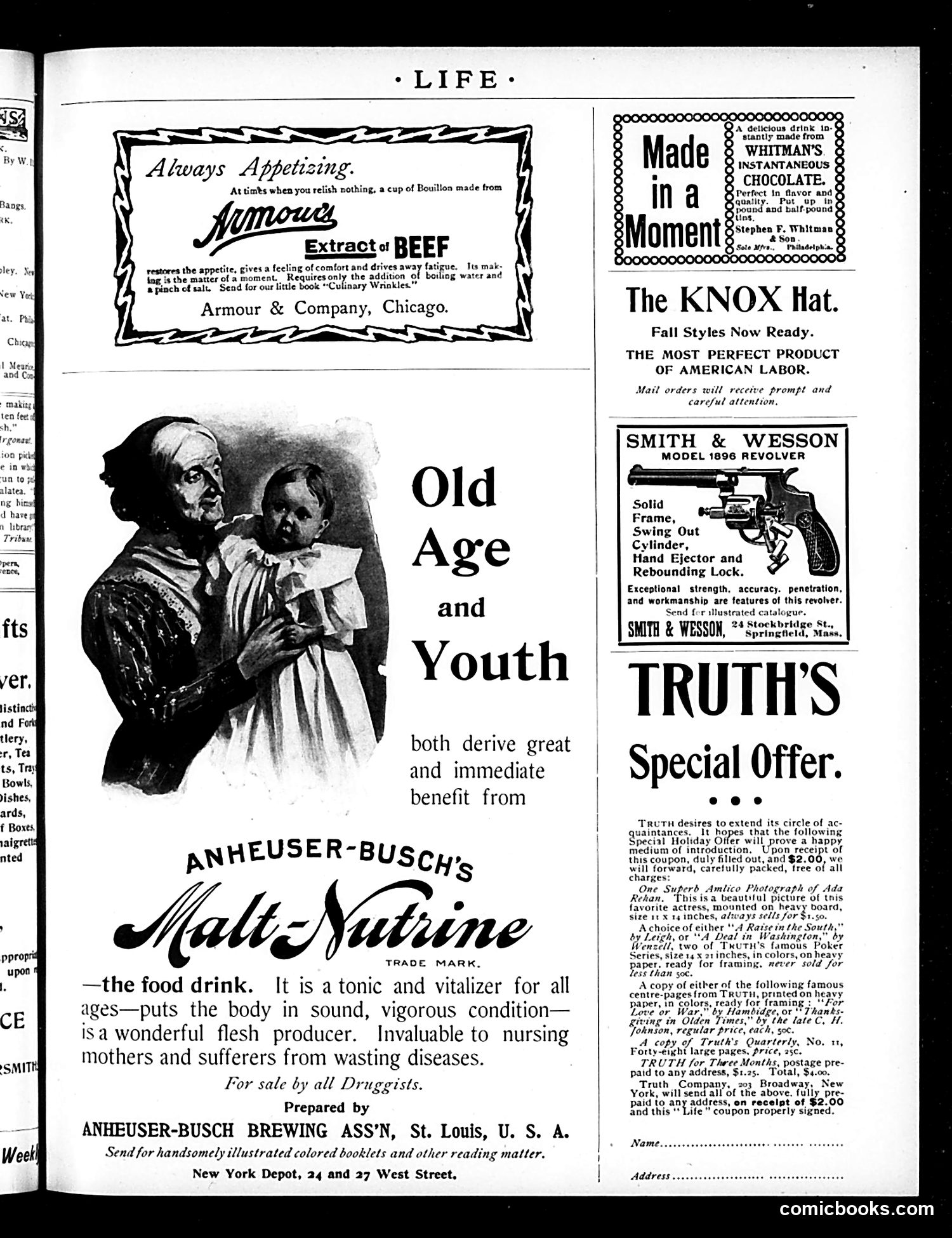
This page is primarily **advertising**, not satire or political commentary. It contains several product advertisements typical of early 20th-century magazines: The main illustrated advertisement features **Anheuser-Busch's Malt Nutrine**, a "food drink" marketed as a tonic for all ages. The image shows an elderly woman and child, suggesting the product's claimed universal health benefits. This reflects the era's patent medicine marketing—making broad health claims (appetite restoration, flesh production, treatment of "wasting diseases") that would be illegal today. Surrounding ads promote other products: Armour's Beef Extract, Whitman's chocolate, Knox hats, Smith & Wesson revolvers, and Truth magazine's subscription offer featuring actress Ada Rehan photographs. There is **no political cartoon or satire** visible. The "Old Age and Youth" heading simply anchors the Malt Nutrine advertisement's claim that both demographics benefit from the product. The page reflects consumer culture and unregulated advertising practices of the era rather than social commentary.
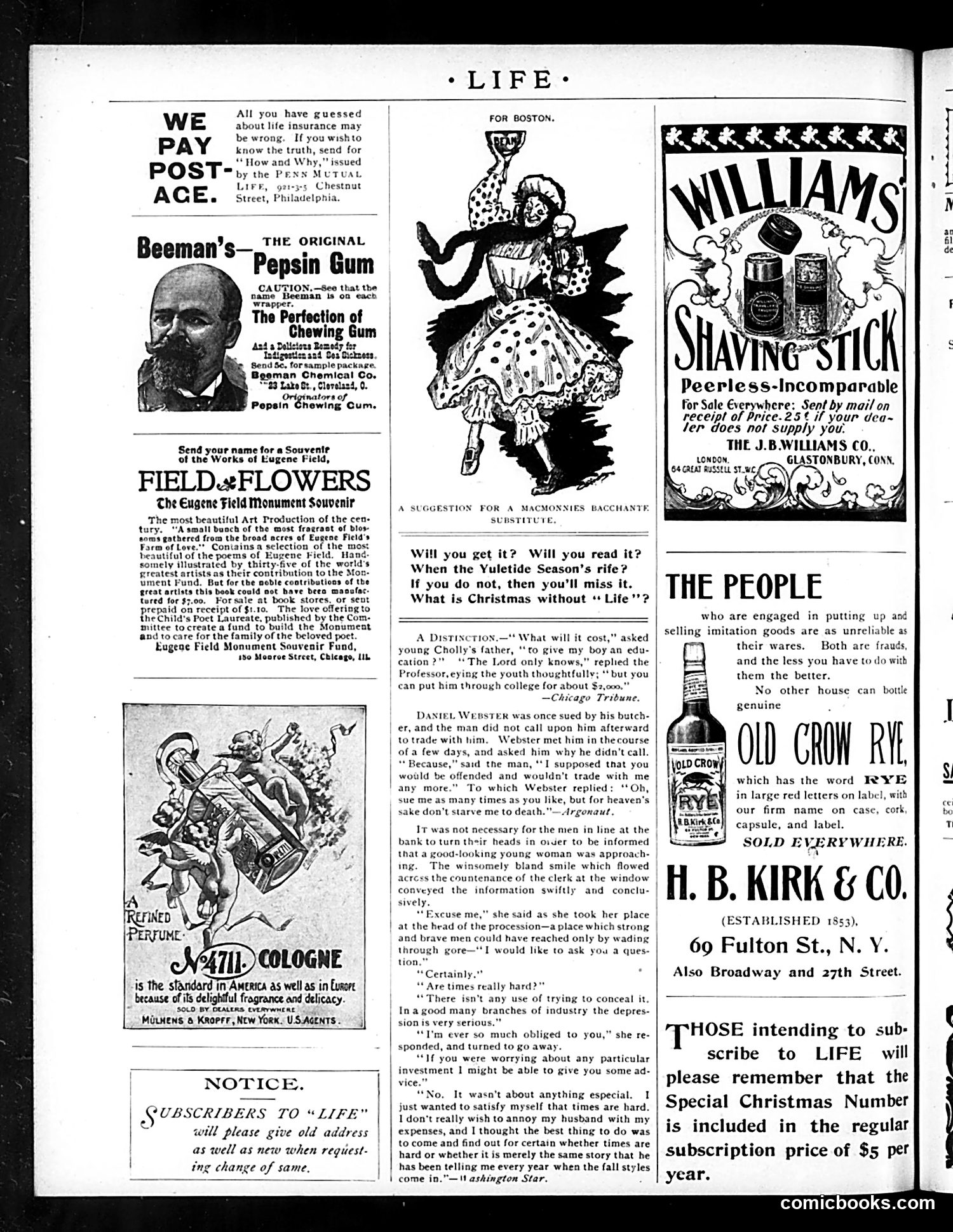
This is primarily a **advertising and notices page** from *Life* magazine, with one notable cartoon and several humorous anecdotes. **The main cartoon** ("A Suggestion for a Macmonnies Bacchante: Substitute") depicts a female figure in classical drapery holding a trophy, promoting *Life* magazine for Christmas. It's a light satire suggesting *Life* as a holiday gift alternative—the "Macmonnies Bacchante" reference is to a famous sculpture, making the joke that *Life* offers similar cultural sophistication. **The page content** includes: - Product advertisements (Pepsin Gum, perfume, shaving sticks, whiskey) - Notices to subscribers - Several brief humorous anecdotes about hard times, education costs, and a woman inquiring about economic depression **The humor** relies on everyday observations: a banker's wife pretending concern about finances to justify her spending, a famous statesman sued by his butcher, a professor's sardonic response about college costs. These are genteel, middle-class jokes reflecting early 20th-century anxieties about money and propriety.
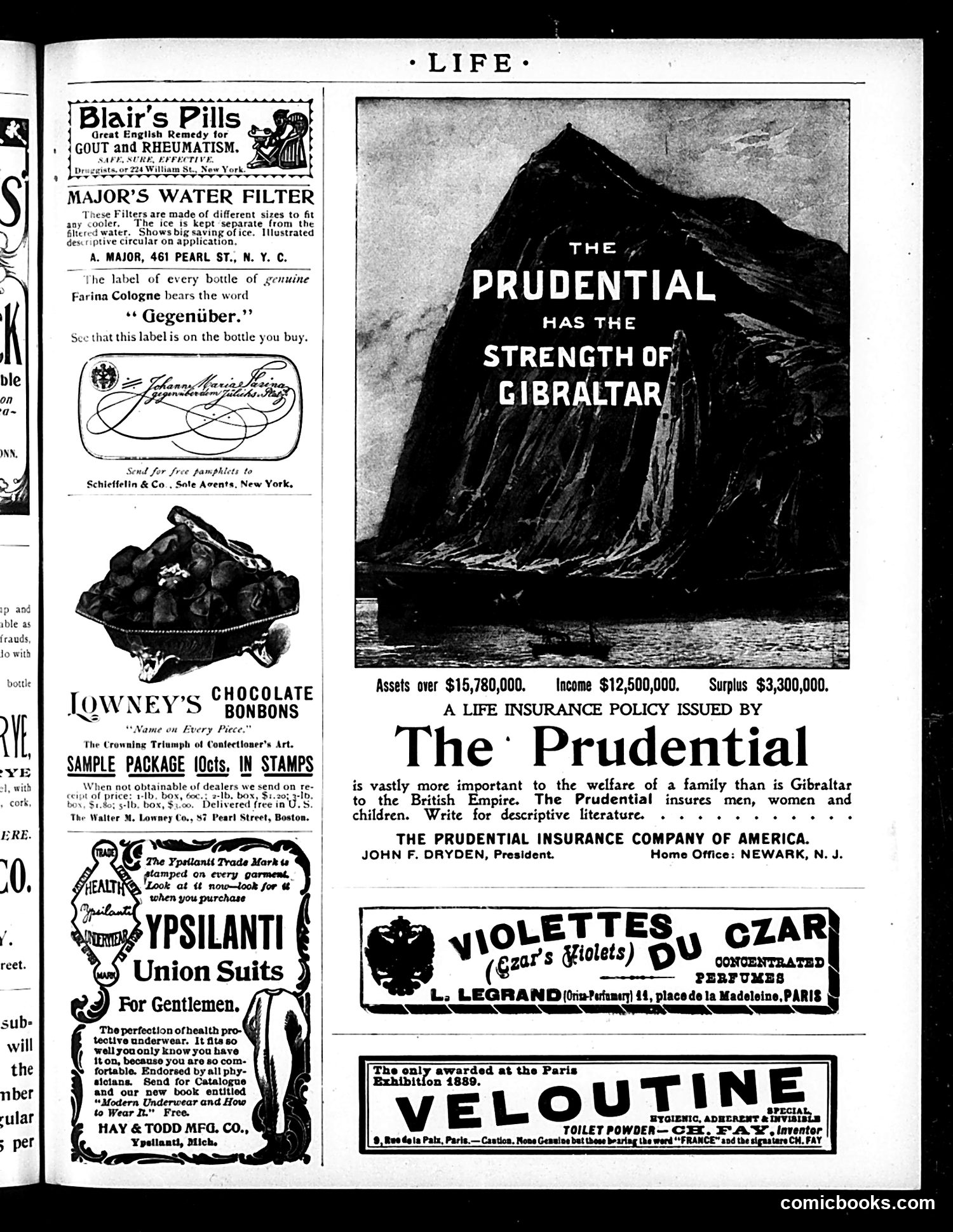
This is primarily a **advertisements page** from Life magazine, not a political cartoon or satirical content page. It contains various product ads typical of the era: **Key advertisements include:** - Patent medicines (Blair's Pills for gout/rheumatism) - Water filters and household goods - Chocolate candies and toiletries - **The Prudential Insurance Company** — the largest ad, featuring Gibraltar's Rock as a visual metaphor for strength and stability, promoting life insurance as essential family protection - French perfumes and cosmetics (Violettes du Czar, Veloutine powder) - Men's underwear (Ypsilanti Union Suits) **The satirical element**, if any, is subtle and implicit in the Prudential ad's comparison of insurance solidity to an immovable natural landmark — a common advertising strategy of the period to suggest reliability and permanence. The page reflects late 19th/early 20th-century consumer culture and marketing approaches rather than direct political satire.
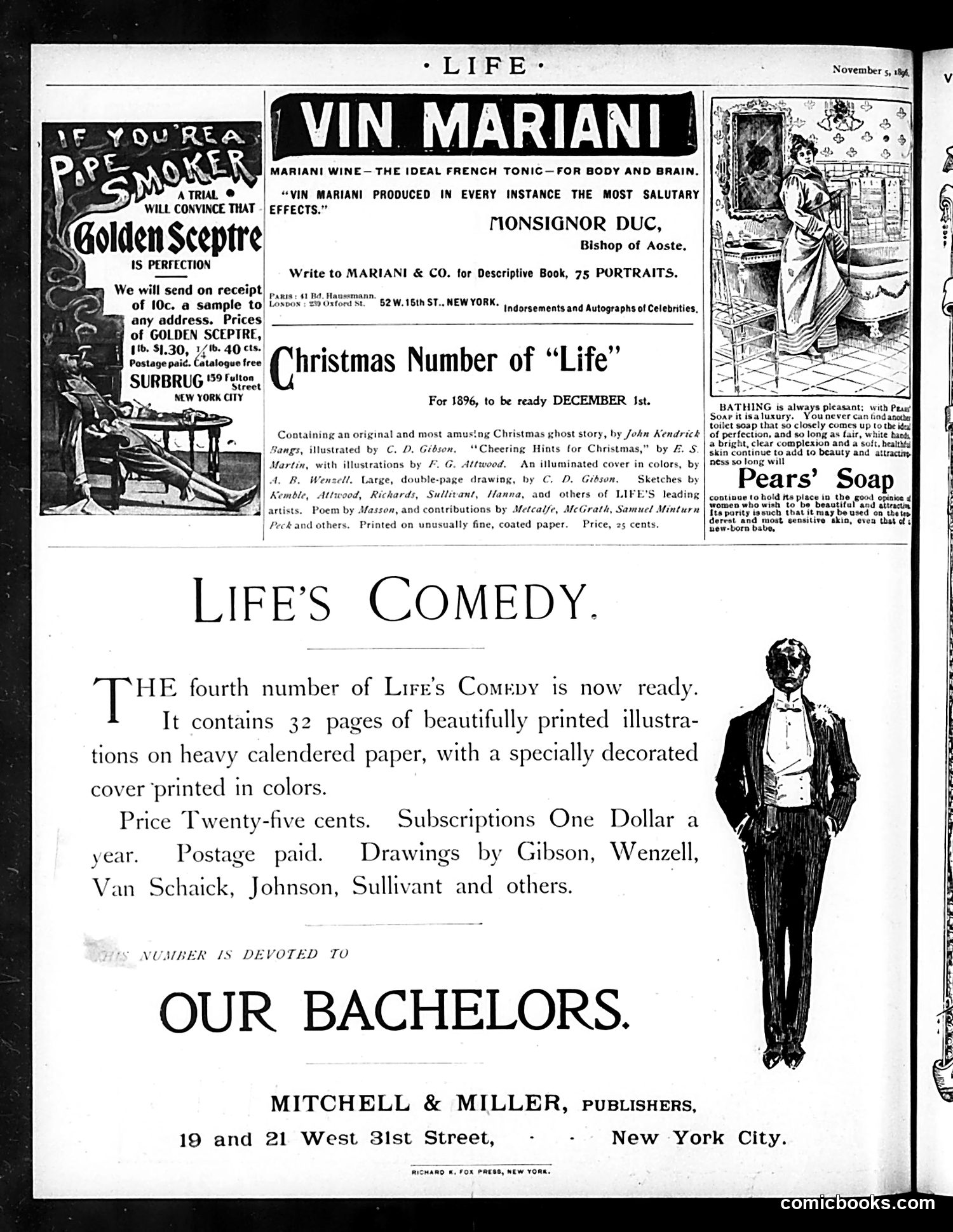
This is primarily an **advertising and promotional page** rather than political satire. The page showcases: **Main Content:** - **Vin Mariani advertisement**: A French wine tonic marketed as beneficial for "body and brain," endorsed by a bishop. This reflects late-Victorian patent medicine culture—tonics often contained cocaine or other substances and made dubious health claims. - **Life magazine promotions**: Advertisements for the Christmas 1896 issue of *Life* magazine and "Life's Comedy" series, featuring illustrated humor by prominent cartoonists (Gibson, Wenzell, Sullivan). - **Pears' Soap advertisement**: A beauty product ad targeting women, emphasizing complexion and attractiveness. **Historical Context:** The page reflects 1890s consumer culture: dubious medicinal products, illustrated humor magazines, and emerging consumer advertising. The endorsement by religious authority (the bishop) lent false credibility to the wine tonic—a common practice before modern FDA regulation. There is **no discernible political cartoon or satire** on this page.