
Life, 1896-11-05 · page 16 of 24
Life — November 5, 1896 — page 16: what you’re looking at
What you’re looking at
This article critiques New York's competing opera houses and their audiences circa the 1880s-90s. The text compares the Metropolitan Opera House (associated with wealthy "Four Hundred" elites and their ornate private boxes) against the Academy of Music, which lacks boxes and allegedly offers better acoustics and democratic seating. The satire targets several points: wealthy patrons who attend opera for *social status* rather than artistic merit; British capitalists exploiting American wealth through operatic ventures; and newspaper critics who artificially elevate expensive Metropolitan singers while ignoring equally talented newcomers. The author argues the new Imperial Opera Company performs "Aida" competently with superior venue acoustics and democratic ticket pricing, yet struggles against the Metropolitan's entrenched social cachet. The joke is that operatic "success" in New York depends less on artistic excellence than on wealthy patrons' investment returns and social pretension.
📄 Transcribed text from this page (OCR, searchable)
Machine-transcribed from the original scan — historical spelling and the odd misread are preserved.
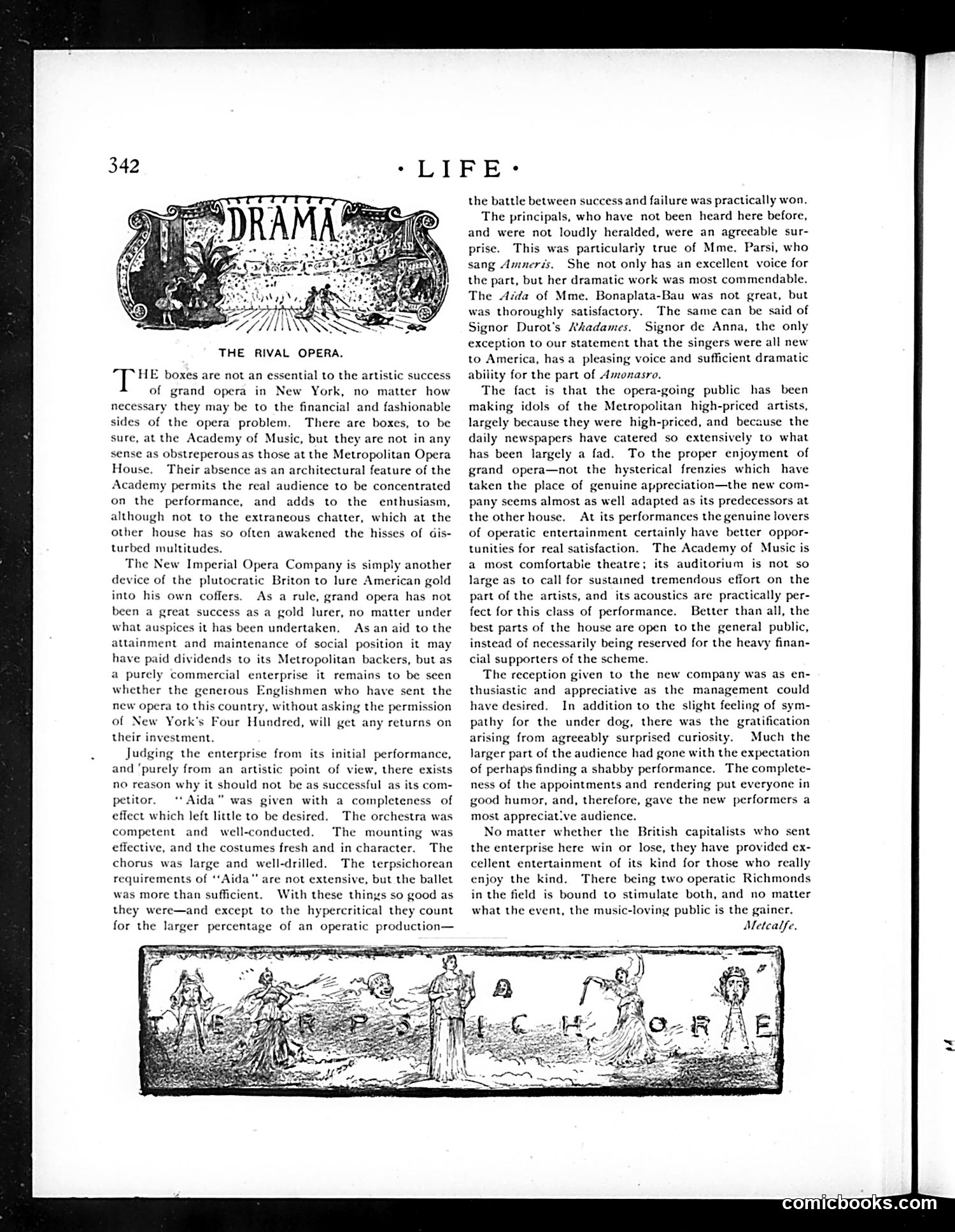
THE RIVAL OPERA. HE boxes are not an essential to the artistic success of grand opera in New York, no matter how necessary they may be to the financial and fashionable sides of the opera problem. There are boxes, to be sure, at the Academy of Music, but they are not in any sense as obstreperous as those at the Metropolitan Opera House, Their absence as an architectural feature of the Academy permits the real audience to be concentrated on the performance, and adds to the enthusiasm, although not to the extraneous chatter, which at the other house has so often awakened the b s of Gis- turbed multitudes. The New Imperial Opera Company is simply another device of the plutocratic Briton to lure American gold into his own coffers. As a rule, grand opera has not been a great success as a gold lurer, no matter under what auspices it has been undertaken, As an aid to the attainment and maintenance of social position it may have paid dividends to its Metropolitan backers, but as a purcly commercial enterprise it remains to be seen whether the generous Englishmen who have sent the new opera to this country, without asking the permission of New York's Four Hundred, will get any returns on their investment. Judging the enterprise from its initial performance, and ‘purely from an artistic point of view, there exists no reason why it should not be as successful as its com- petitor, ‘‘Aida" was given with a completeness of effect which left little to be desired. The orchestra was competent and well-conducted. The mounting was effective, and the costumes fresh and in character. The chorus was large and well-drilled. The terpsichorean requirements of ‘‘Aida"' are not extensive, but the ballet was more than sufficient. With these thinys so good as they were—and except to the hypercritical they count for the larger percentage ic production— the battle between success and failure was practically won. The principals, who have not been heard here before, and were not loudly heralded, were an agreeable sur- prise. This was particularly true of Mme. Parsi, who sang Amnerés, She not only has an excellent voice for the part, but her dramatic work was most commendable. The Ada of Mme. Bonaplata-Bau was not great, but s thoroughly satisfactory. The same can be said of ignor Durot's Rhadames. Signor de Anna, the only exception to our statement that the singers were all new to America, has a pleasing voice and sufficient dramatic ability for the part of Amonasro. The fact is that the opera-going public has been making idols of the Metropolitan high-priced artist largely because they were high-priced, and because the daily newspapers have catered so extensively to what has been largely a fad. To the proper enjoyment of grand opera—not the hysterical frenzies which have taken the place of genuine appreciation—the new com- pany scems almost as well adapted as its predecessors at the other house. At its performances the genuine lovers of operatic entertainment certainly have better oppor- tunities for real satisfaction. The Academy of Music is a most comfortable theatre; its auditorium is not so large as to call for sustained tremendous effort on the part of the artists, and its acoustics are practically per- fect for this class of performance. Better than all, the best parts of the house are open to the general public, instead of necessarily being reserved for the heavy finan- cial supporters of the scheme. The reception given to the new company was as en- thusiastic and appreciative as the management could have desired, In addition to the slight feeling of sym- pathy for the under dog, there was the gratification arising from agreeably surprised curiosity. Much the larger part of the audience had gone with the expectation of perhaps finding a shabby performance. The complete- ness of the appointments and rendering put everyone in good humor, and, therefore, gave the new performers a most appreciat:ve audience. No matter whether the British capitalists who sent the enterprise here win or lose, they have provided ex- cellent entertainment of its kind for those who really enjoy the kind. There being two operatic Richmonds in the field is bound to stimulate both, and no matter what the event, the music-loving public is the gainer, Metcalfe. Comicbooks.com od