
Life, 1896-11-05 · page 12 of 24
Life — November 5, 1896 — page 12: what you’re looking at
What you’re looking at
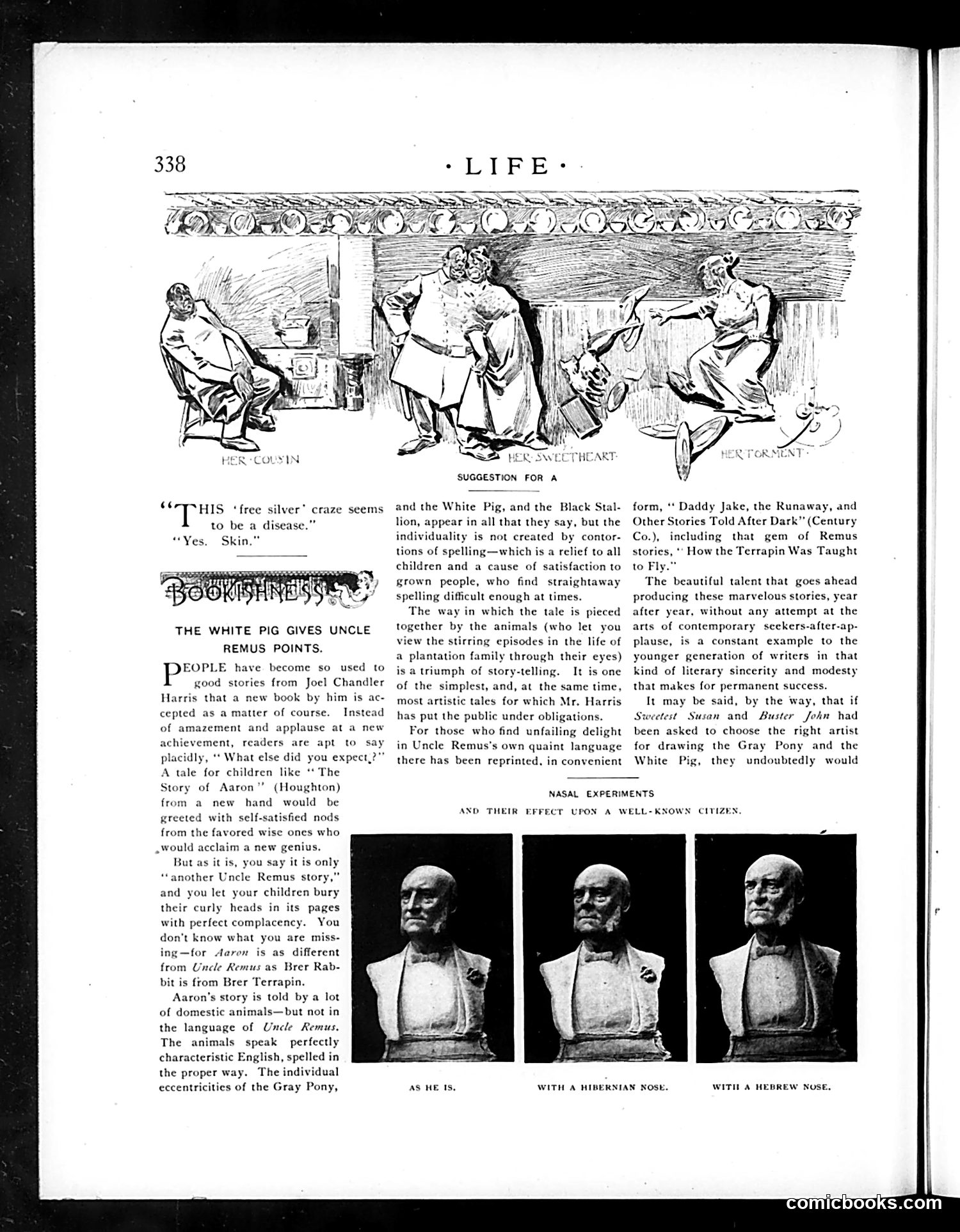
This page reviews Joel Chandler Harris's new children's book *Aaron*, which features animal characters telling stories about a plantation family. The text praises Harris's established reputation—readers automatically accept his work as quality—while highlighting that *Aaron* differs from his famous *Uncle Remus* tales because the animals speak "characteristic English" with proper spelling rather than dialect. The top illustration shows three female figures labeled "Her Cousin," "Her Sweetheart," and "Her Torment," though the connection to the review text is unclear. Below is a separate, unrelated section titled "Nasal Experiments and Their Effect Upon a Well-Known Citizen," featuring three photographic images showing the same man's face with different noses applied—labeled "As He Is," "With a Hibernian Nose," and "With a Hebrew Nose." This appears to be a crude racial/ethnic caricature typical of early 20th-century American humor, mocking different ethnic groups through nose shape stereotyping.
📄 Transcribed text from this page (OCR, searchable)
Machine-transcribed from the original scan — historical spelling and the odd misread are preserved.
to bead “Yes, Skin.” THE WHITE PIG GIVES UNCLE REMUS POINTS. EOPLE h good stories from Jocl Chandler Harris that a new book by him is ac- Instead zement and applause at a new e become so used to cepted as a matter of course. of am ement, readers ly, ** What else did you expec A tale for children like ** The Story of Aaron” (Houghton) from a new hand would greeted with self-satisfied nods are apt to say be from the favored wise ones who _would acclaim a new genius. But as it is, you say it is only ‘another Uncle Remus story,” and you let your children bury their curly heads in its pages with perfect complacency. You don't know what you are miss- ing—for Aaron is as different from Uncle Remus as Brer Rab- bit is from Brer Terrapin. Aaron's story is told by a lot of domestic animals—but not in the language of Uncle Remus, speak perfectly characteristic English, spelled in the proper way. The individual eccentricities of the Gray Pony, SUGGESTION FOR A and the White Pig, and the Black Stal- appear in all that they say, but the viduality is not created by contor- tions of spelling—which is a relief to all faction to grown people, who find straightaway spelling difficult enough at times. The way in which the tale is pieced children and a cause of s. together by the animals (who let you view the stirring episodes in the life of a plantation family through their eyes) is a triumph of story-telling. It is one of the simplest, and, at the same time, most artistic tales for which Mr. Harris has put the public under obligations. For those who find unfailing delight in Uncle Remus’s own quaint language there has been reprinted, in convenient form, * Daddy Jake, the Runaway, and Other Stories Told After Dark” (Century Co.), including that gem of Remus stories, ‘’ How the Terrapin Was Taught to Fly The beautiful talent that goes ahead producing these marvelous stories, year after year, without any attempt at the arts of contemporary seekers-after-ap- plause, is a constant example to the younger generation of writers in that kind of literary sincerity and modesty that makes for permanent success. It may be said, by the way, that if Sweetest Susan and Buster John had been asked to choose the right artist for drawing the Gray Pony and the White Pig, they undoubtedly would NASAL EXPERIMENTS AND THEIR EFFECT UPON A WELL-KNOWN CITIZEN, AS HE Is, WITH A HIBERNIAN NOSE. WITH A HEBREW