
A complete issue · 26 pages · 1896
Life — October 22, 1896
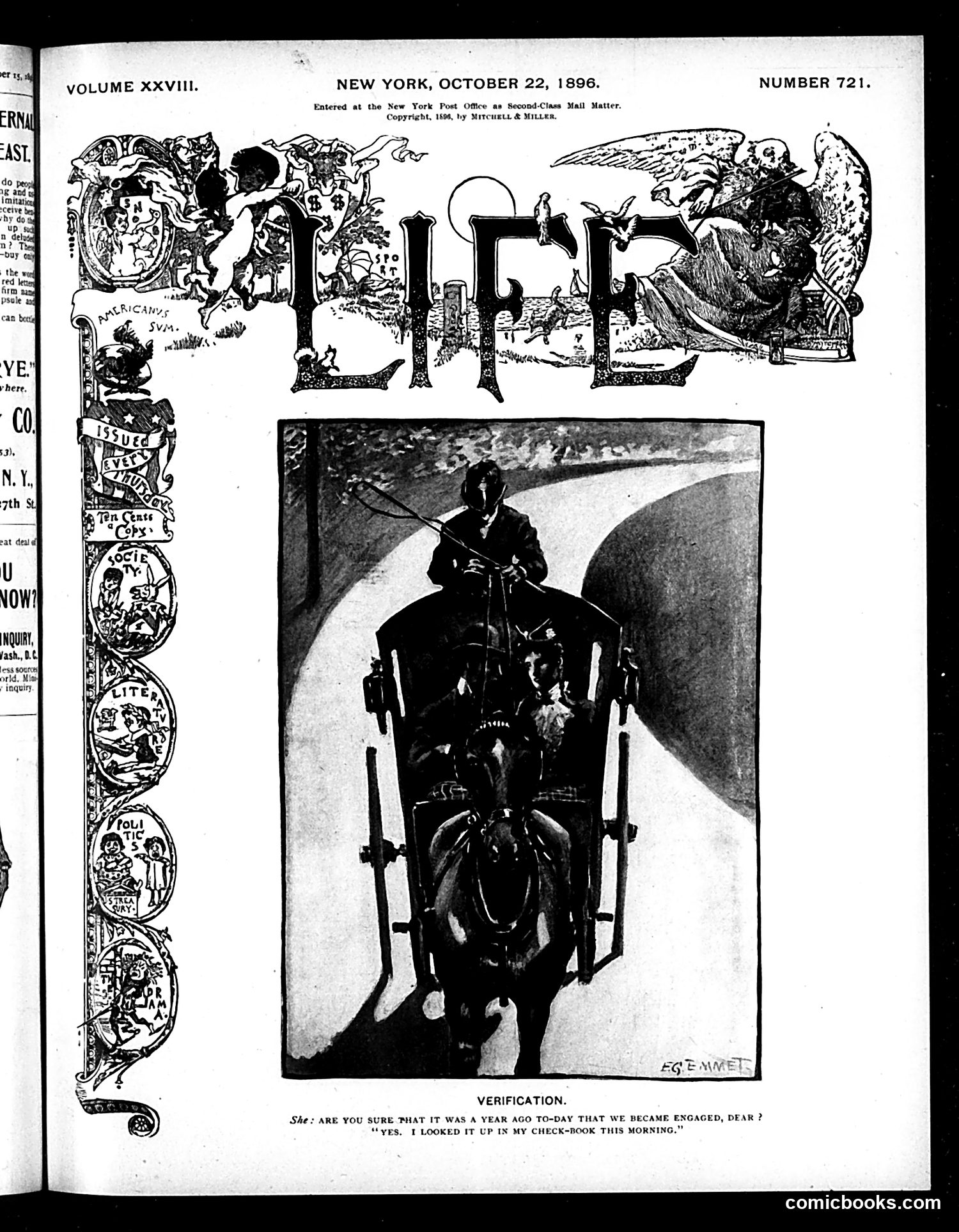
**Main Cartoon: "Verification"** This illustration shows a man in silhouette driving a horse-drawn sleigh through snow, viewed from above. The caption reads: "She: ARE YOU SURE THAT IT WAS A YEAR AGO TO-DAY THAT WE BECAME ENGAGED, DEAR? 'YES. I LOOKED IT UP IN MY CHECK-BOOK THIS MORNING.'" The joke satirizes a man's materialistic, business-like approach to romance. Rather than remembering their engagement anniversary emotionally, he consults his financial records—suggesting he treats even intimate relationships as mere transactions to be verified like accounts. This mocks the era's growing commercialization and men's supposed emotional detachment, positioning the woman as more sentimental than her unromantic suitor.
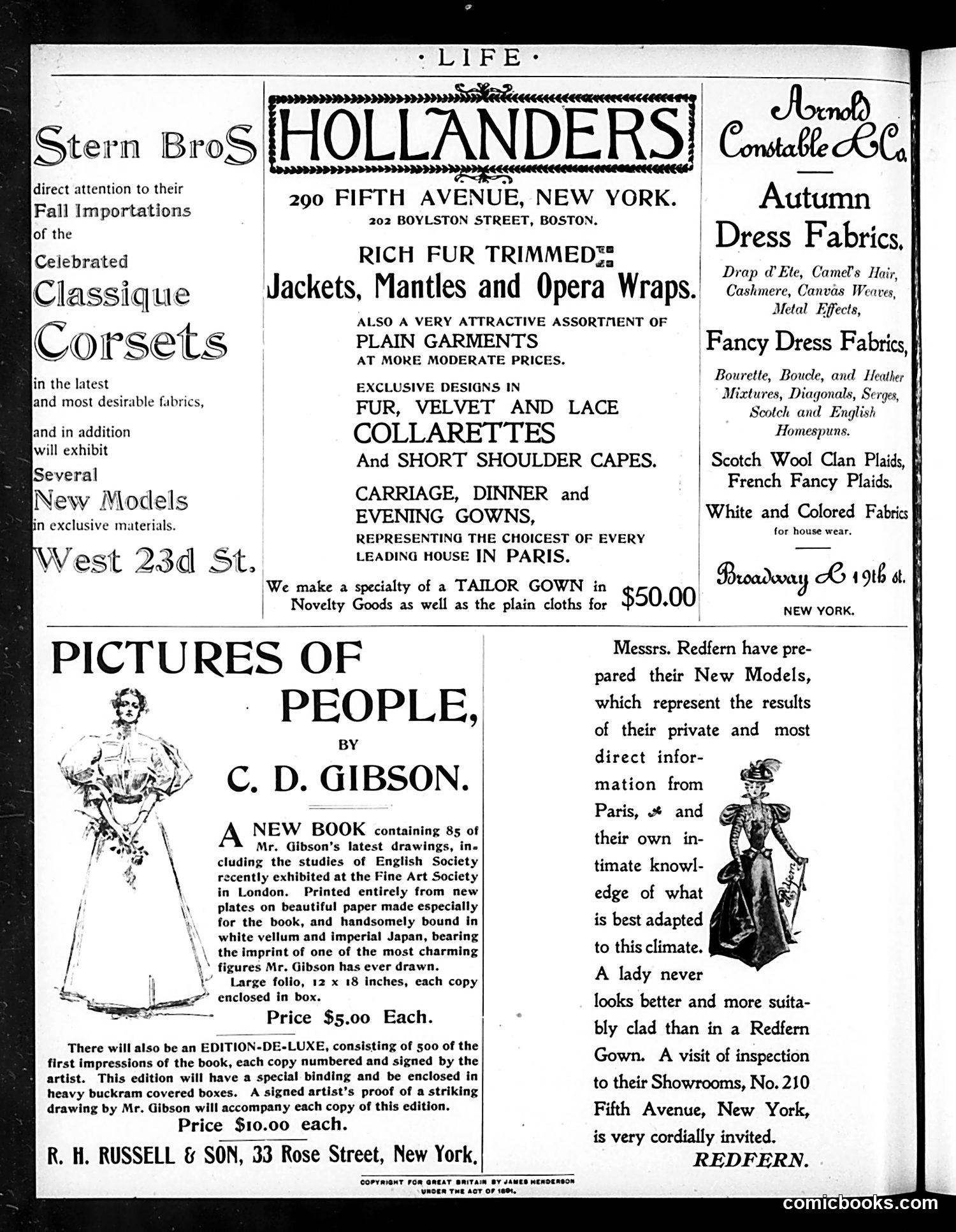
This page contains **no political cartoons or satirical content**. It is entirely **advertising** for high-end fashion and luxury goods circa 1916. The advertisements include: - **Stern Bros** corsets (West 23rd St, New York) - **Hollanders** fur-trimmed jackets and gowns (Fifth Avenue, New York and Boston) - **Arnold Constable & Co** dress fabrics (Broadway, New York) - **C.D. Gibson** "Pictures of People" book ($5–$10) - **Redfern** custom gowns ($50) - **R.H. Russell & Son** publisher The Gibson illustrations show fashionably dressed women in period clothing, representing his popular society portrait style. This is a straightforward commercial page targeting wealthy female readers interested in haute couture and fine art books.
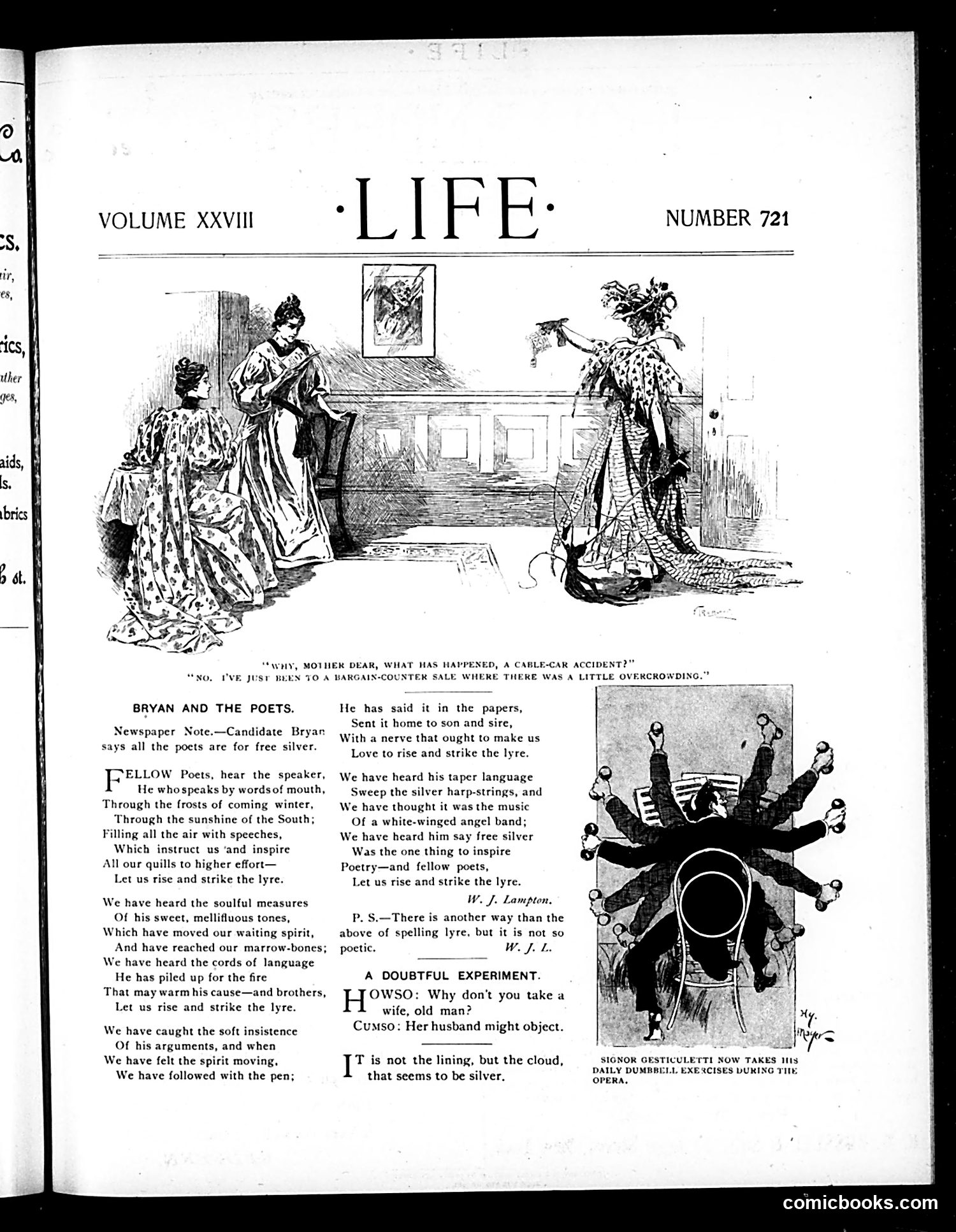
**Top Cartoon:** Shows three women in an interior, discussing a "cable-car accident." The humor concerns overcrowding at a "bargain-counter sale"—a social commentary on the era's retail shopping frenzies, particularly women's department store sales. The exaggerated costumes and fashion suggest early 20th-century consumerism. **"Bryan and the Poets":** A satirical poem about William Jennings Bryan (a prominent political figure of the era), praising his oratory and calling on poets to emulate his rhetorical power. The poem celebrates his speaking ability to inspire action. **"A Doubtful Experiment":** A brief humorous dialogue where a man asks another to take his wife; the response that "her husband might object" is the joke's punchline. **Right illustration:** Shows a mechanical device for opera exercise—satirizing health trends.
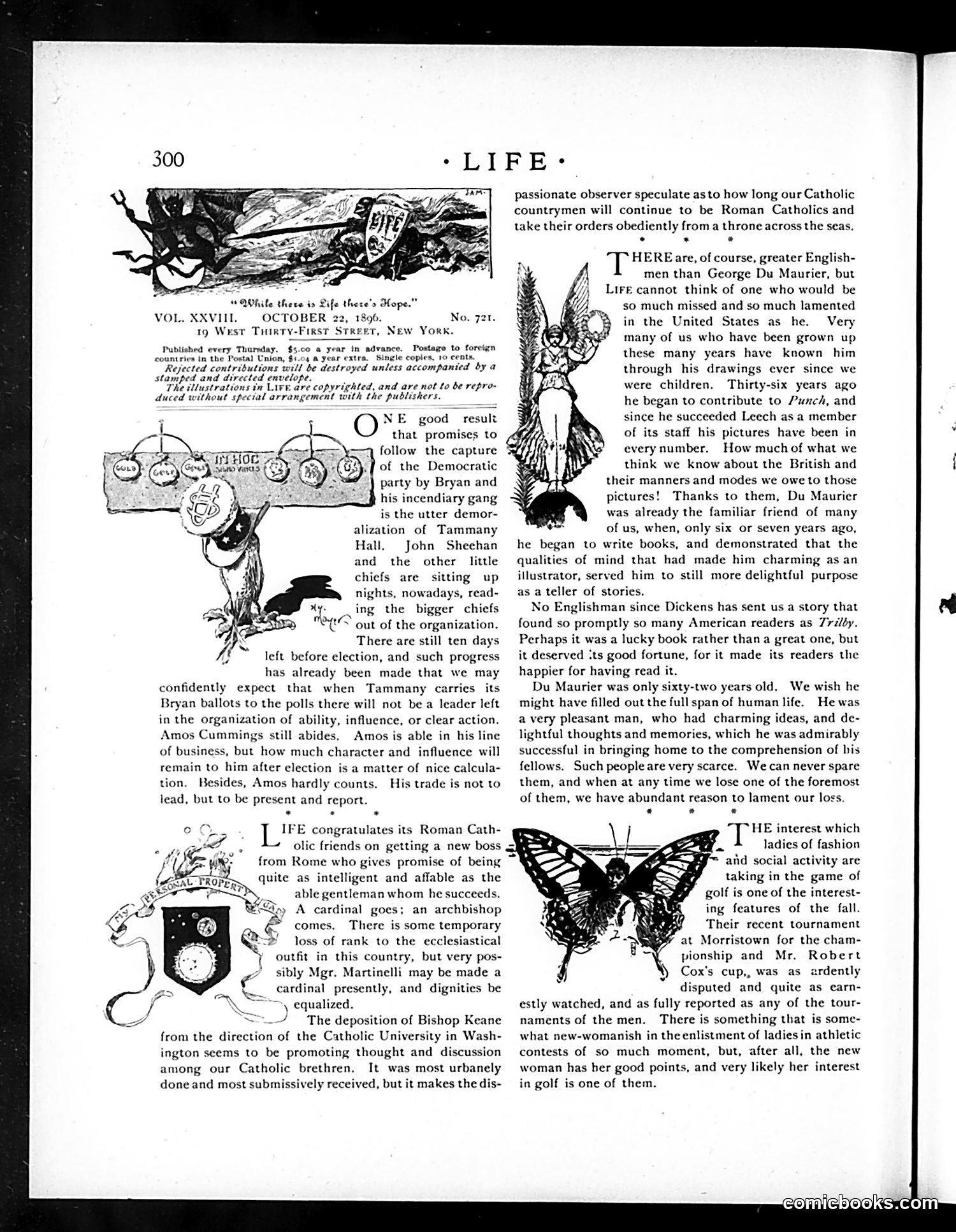
**Main Cartoon (Top Left):** This political cartoon satirizes Democratic party leadership during the 1896 election. The circular arrangement shows party figures (including references to Bryan, Tammany Hall bosses John Sheehan, and others) depicted as small "chiefs" sitting around a table. The satire mocks the party's internal disorganization and lack of unified leadership just before the election—suggesting they're chaotically squabbling rather than strategically campaigning. **Secondary Elements:** The page also contains editorial commentary praising English illustrator George Du Maurier (recently deceased), and brief mentions of golf tournaments gaining popularity among society women. The overall tone is typical of Life's Republican-leaning satirical approach to 1896 Democratic campaign failures.
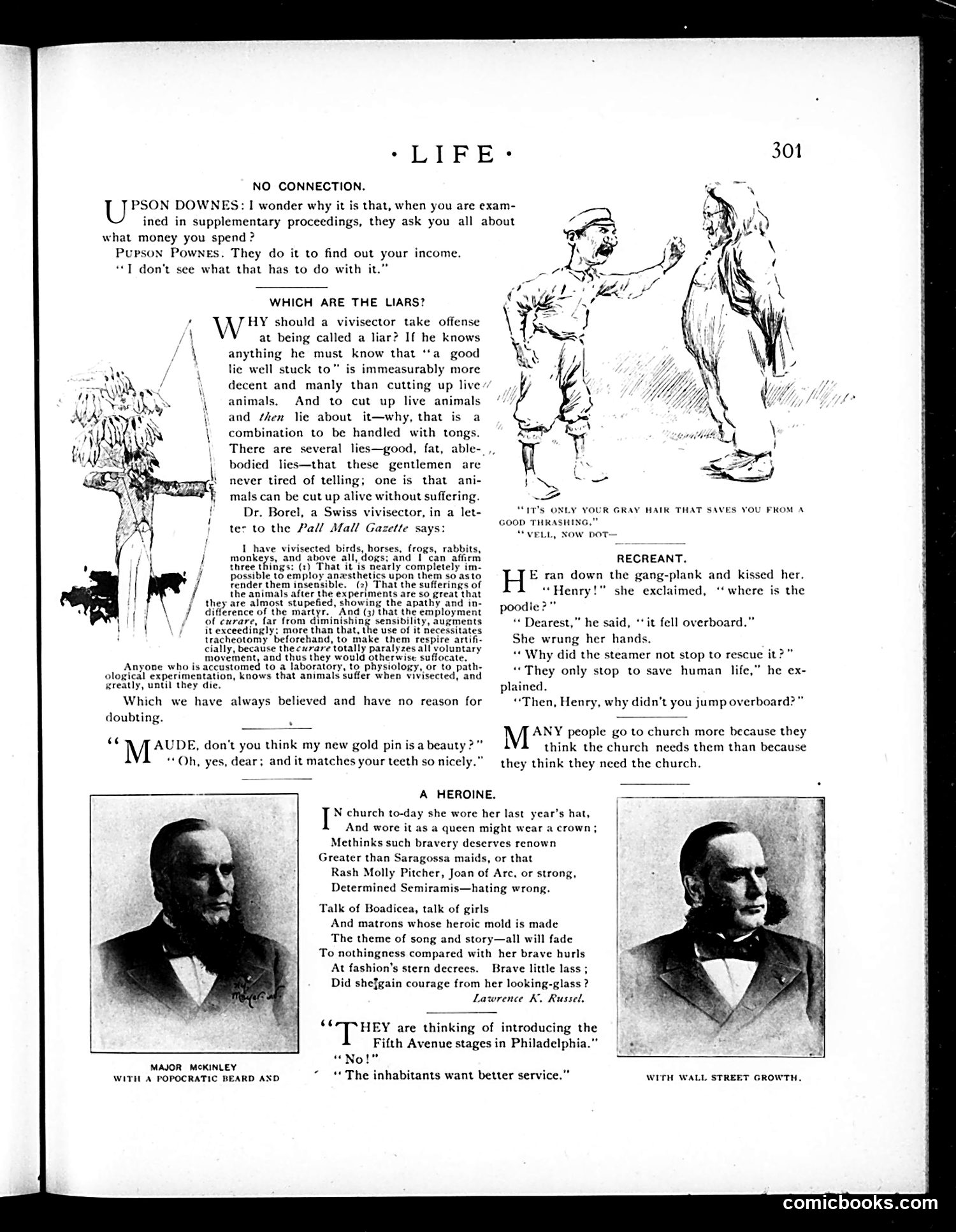
This page contains several unrelated satirical pieces typical of Life magazine's format: **"NO CONNECTION"** mocks supplementary legal proceedings that inquire about income under the guise of determining financial capacity. **"WHICH ARE THE LIARS?"** critiques vivissectionists (animal researchers) who rationalize cutting up live animals as "necessary science" while claiming animals don't suffer. The satire questions the moral contradiction between their claims and actions. **"A HEROINE"** is a poem praising a woman who wore last year's hat to church with dignity, comparing her bravery to historical heroines. It satirizes society's obsession with fashion and appearance. The two portrait photographs appear to be of public figures (possibly politicians based on the caption referencing "Major McKinley" and "Wall Street growth"), though the specific context is unclear without additional information.
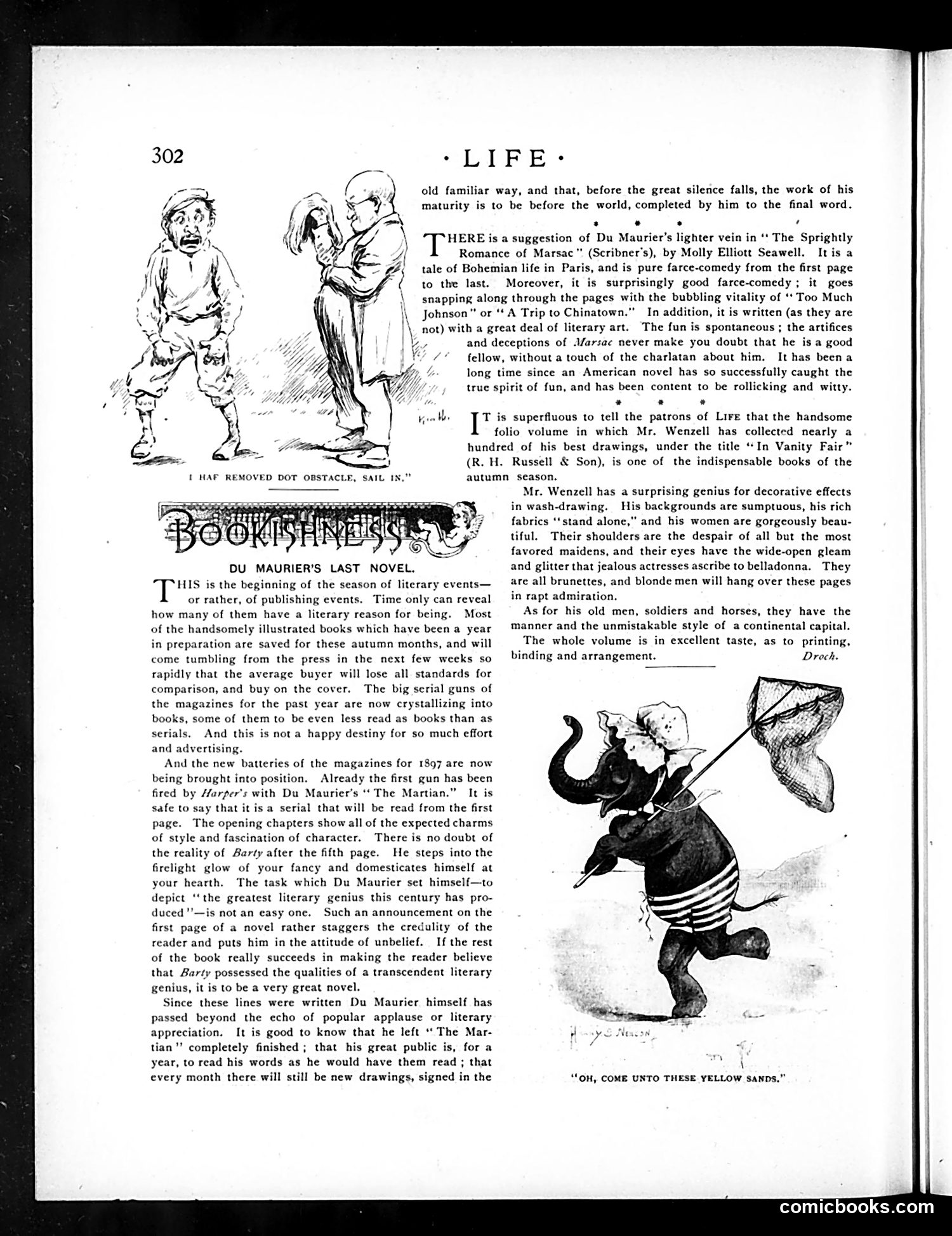
This page consists primarily of **book reviews** rather than political cartoons. The main content discusses Du Maurier's latest novel and praises a collection of drawings by Mr. Wenzel titled "In Vanity Fair." The two small **illustrations** are decorative rather than satirical: 1. Upper left: A sketch of two figures in conversation, captioned "I HAF REMOVED DOT OBSTACLE, SAIT IS" — appears to be generic character humor, possibly referencing a foreign accent. 2. Lower right: A figure jumping or leaping, captioned "OH, COME UNTO THESE YELLOW SANDS" — likely a literary reference or theatrical allusion. These are **artist samples** showcasing drawing styles rather than political commentary. The page focuses on literary and artistic merit of contemporary publications.
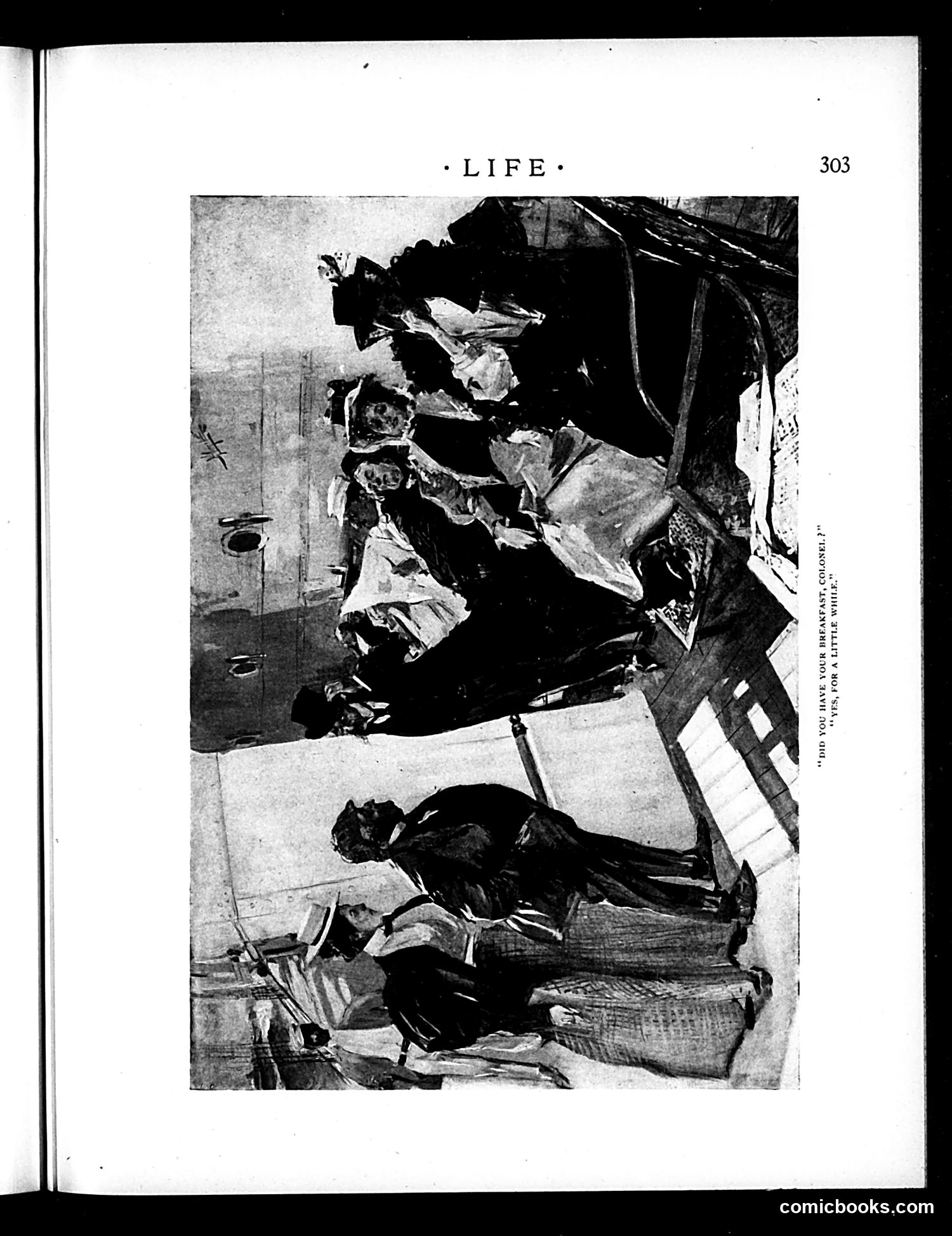
The image is rotated 90 degrees, making it difficult to read the caption text clearly. What is visible appears to be a black and white photograph rather than a cartoon, showing what looks like an interior domestic scene with figures and furniture. To accurately explain this page's satire and historical context to a modern reader, I would need: 1. **Legible caption text** - The OCR text provided appears incomplete or corrupted 2. **Proper image orientation** - Currently rotated, obscuring details 3. **Clear identification of subjects** - The photograph's subjects and their relevance aren't apparent from the rotated view I cannot reliably identify political figures, events, or satirical intent without being able to read the accompanying text clearly. If you could provide the legible caption or rotate the image, I could give you an accurate historical explanation.
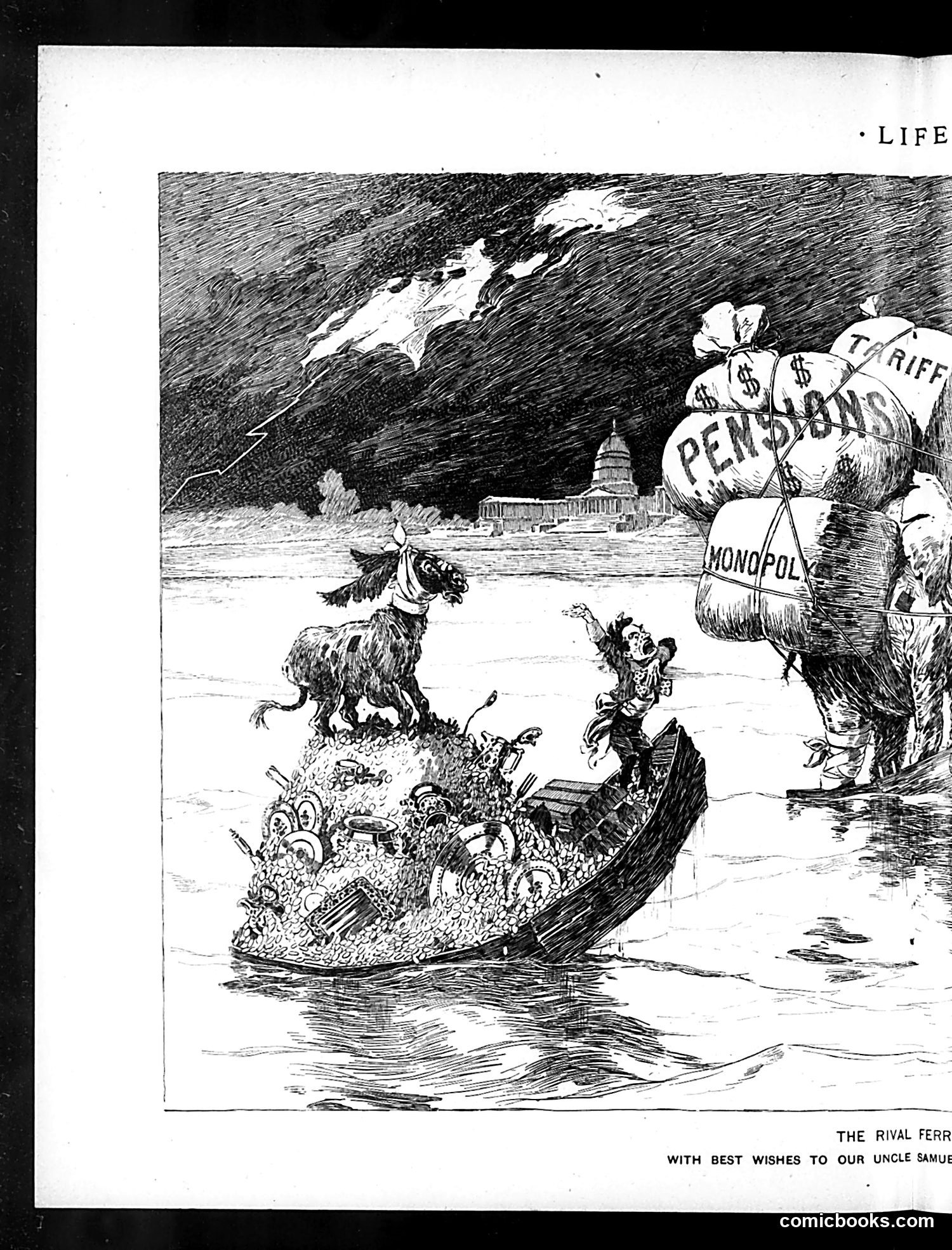
This is a satirical cartoon titled "The Rival Ferr[ies]" with a subtitle "With Best Wishes to Our Uncle Samue[l]" (Uncle Sam being America). The cartoon depicts a large figure representing monopolistic economic interests approaching Washington D.C. (visible Capitol building) laden with bags labeled "TARIFF," "PENDULUM," and "MONOPOLY"—representing protectionist trade policies and corporate consolidation. A smaller competing figure in a boat filled with machinery represents an alternative economic approach. The goat atop one vessel suggests stubbornness or obstruction. The satire critiques how competing business interests jockey for influence over American economic policy, particularly regarding tariffs and monopolistic practices. The "rival ferries" metaphor suggests these competing interests are both vying to transport America toward their preferred economic system.
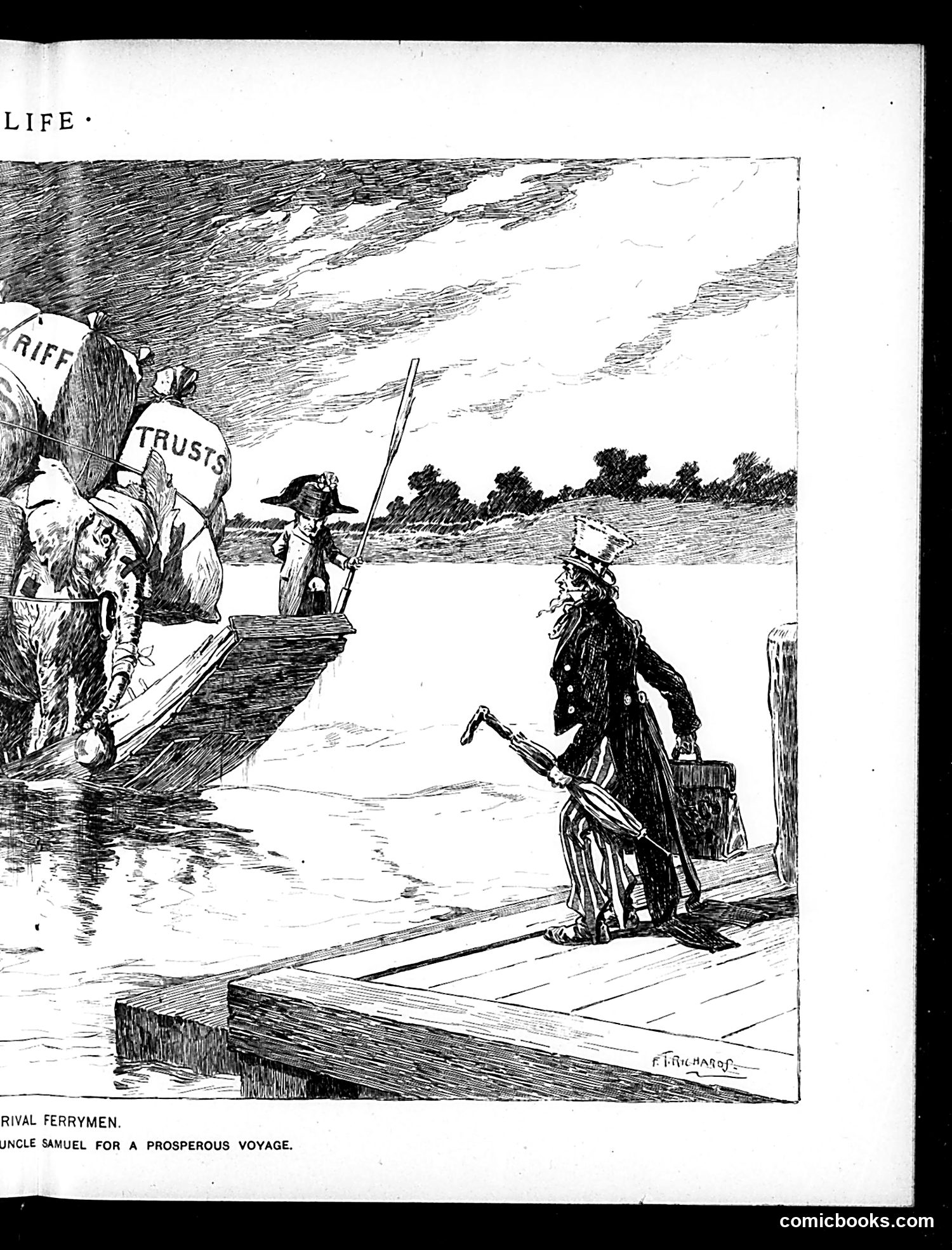
This political cartoon depicts two ferrymen at a riverbank. The figure on the left, labeled "RIFF" and "TRUSTS," represents monopolistic business interests or corporate trusts. The figure on the right, labeled "Uncle Samuel" (personifying the U.S. government), stands ready to depart on a boat. The satire suggests that Uncle Samuel is choosing to rely on or partner with the corrupt ferrymen (trusts/monopolies) for passage—likely criticizing government complicity with big business. The "prosperous voyage" reference suggests ironic skepticism about whether such an alliance would actually benefit the nation, playing on Progressive-era anxieties about trusts controlling American commerce and politics.
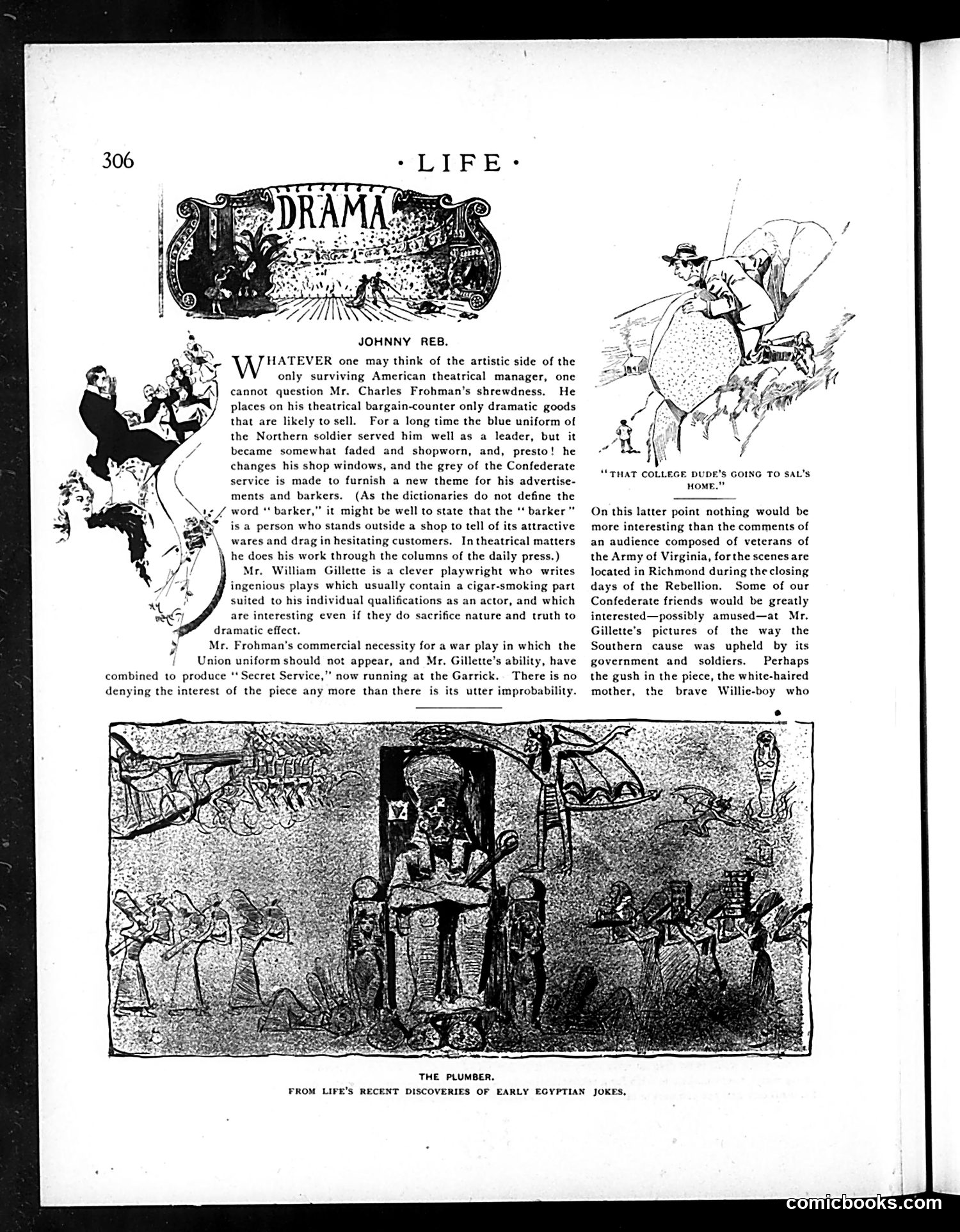
This page contains two theatrical satires: **"Johnny Reb"** critiques Charles Frohman, a prominent theatrical manager, for his commercial opportunism during the American Civil War era. The text mocks how Frohman changed his theater's uniform and marketing to match current fashions—switching from a Northern soldier theme to Confederate imagery to sell tickets. William Gillette, a contemporary playwright, is mentioned as writing more artistically honest war plays. The satire targets theatrical producers who exploit patriotic sentiment purely for profit rather than artistic integrity. **"The Plumber"** below appears to be a humorous illustration labeled as "Life's recent discoveries of early Egyptian jokes," presenting ancient Egyptian art with modern comedic reinterpretation—likely a joke about discovering old humor in archaeological discoveries.
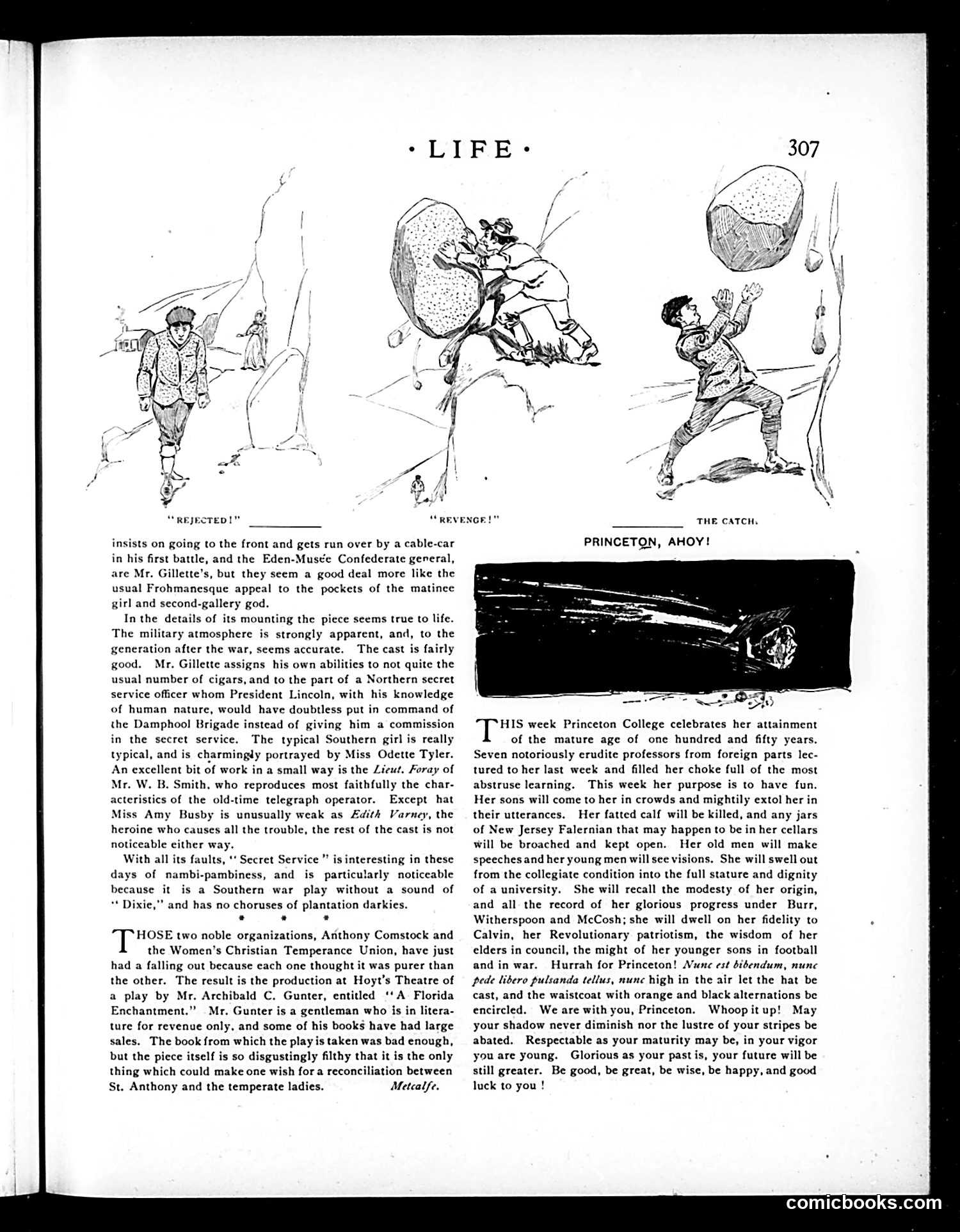
This page contains three cartoon vignettes depicting Civil War-era military scenes, labeled "REJECTED!", "REVENGE!", and "THE CATCH." The text discusses theatrical productions, particularly referencing Mr. Gillette's play and a production at Hoyt's Theatre of "A Florida Enchantment" by Mr. Gunter. The cartoons appear to satirize overly dramatic or unrealistic Civil War portrayals in contemporary theater. The accompanying commentary criticizes how theatrical productions romanticize or exaggerate military experiences for "matinee girl and second-gallery god" audiences. The text notes that while some details seem "true to life," the overall execution prioritizes entertainment value over historical accuracy—a common critique of popular entertainment's treatment of serious historical events.
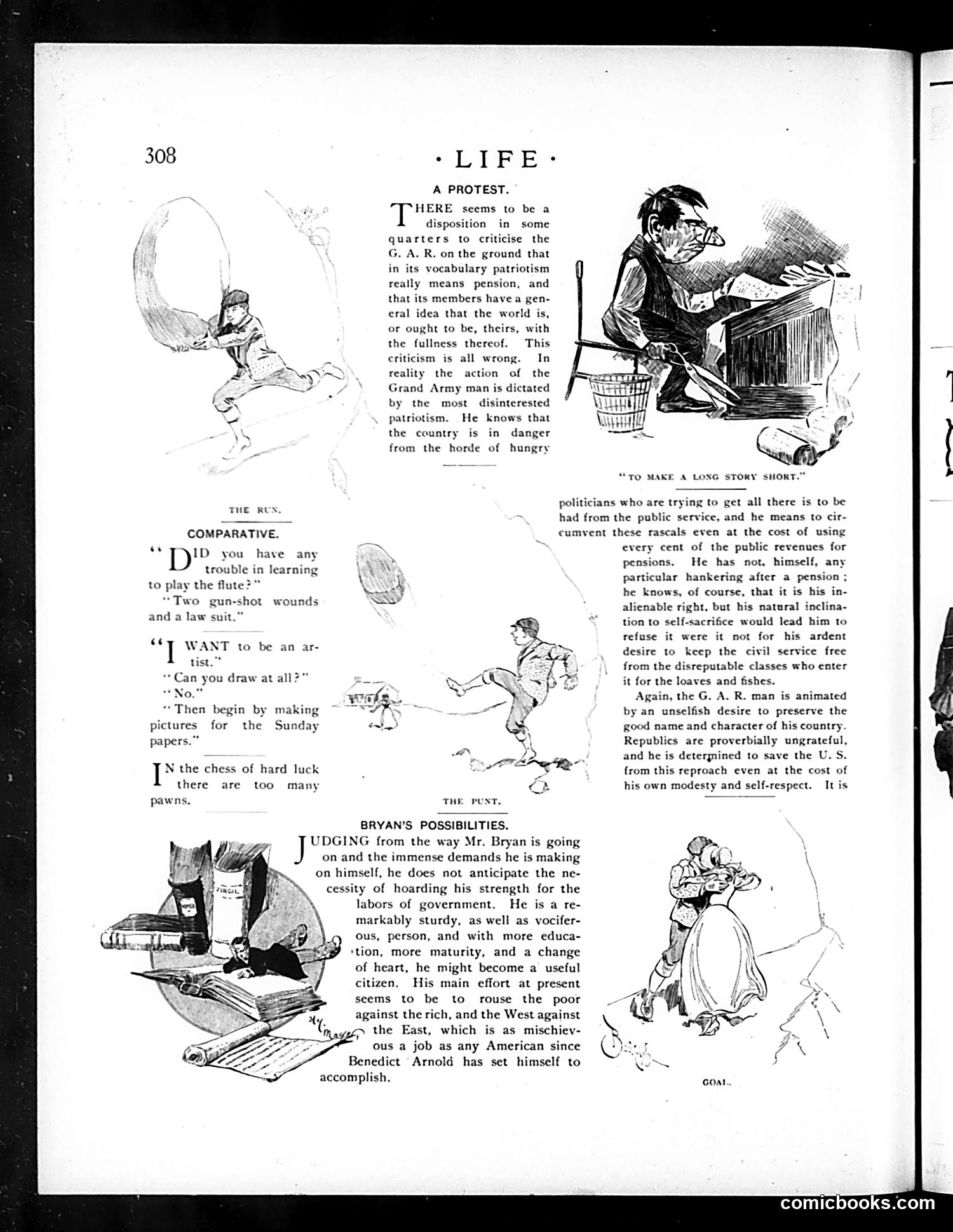
This satirical page from *Life* magazine contains three distinct pieces mocking American politics and social types circa the 1890s-1900s. **"A Protest"** defends the Grand Army of the Republic (G.A.R.)—Civil War veterans' organization—against accusations that they lobbied aggressively for pensions. The satire is *ironic*: the author claims the G.A.R. acts from pure patriotism while obviously describing self-interested pension-seeking disguised as national service. **"Bryan's Possibilities"** attacks William Jennings Bryan (three-time presidential candidate), caricatured as dangerously energetic and divisive. The criticism focuses on his class-warfare rhetoric ("rouse the poor against the rich, and the West against the East"), comparing him unfavorably to Benedict Arnold (Revolutionary War traitor). The piece doubts his maturity for high office. The scattered **short jokes** mock common types: the flute player with misfortunes, the aspiring artist with no skills, and chess players as hapless "pawns." All content reflects *Life's* conservative establishment viewpoint, skeptical of populist movements and veteran advocacy.
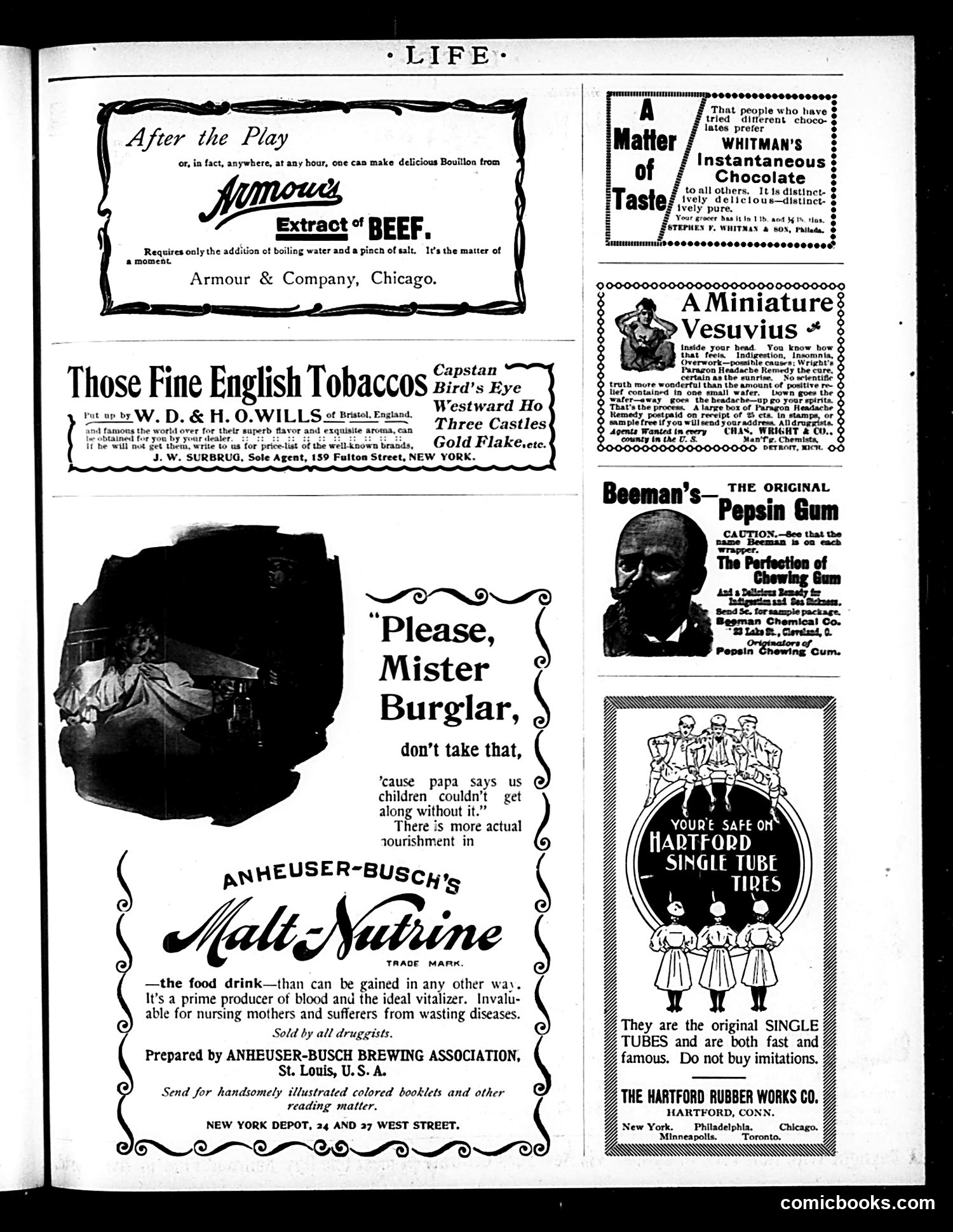
This page is primarily **advertisements**, not political satire. The central image shows a domestic robbery scene paired with a moral appeal. The cartoon depicts a **burglar confronting a family**, with a child pleading "Please, Mister Burglar, don't take that, 'cause papa says us children couldn't get along without it." The object being protected is **Anheuser-Busch's Malt-Nutrine**, a nutritional beverage. The advertisement's satire is **dark and ironic**: it uses a home invasion scenario to humorously emphasize the product's necessity. By having a child beg a burglar not to steal the drink, the ad argues that Malt-Nutrine is so essential to family health that it's worth protecting above other valuables. The beverage is marketed as vital nutrition—"the ideal vitalizer" for "nursing mothers and sufferers from wasting diseases"—making its protection from theft seem almost reasonable within the ad's absurdist logic. This reflects early-1900s advertising tactics that used exaggeration and comedy to promote patent medicines and nutritional tonics.
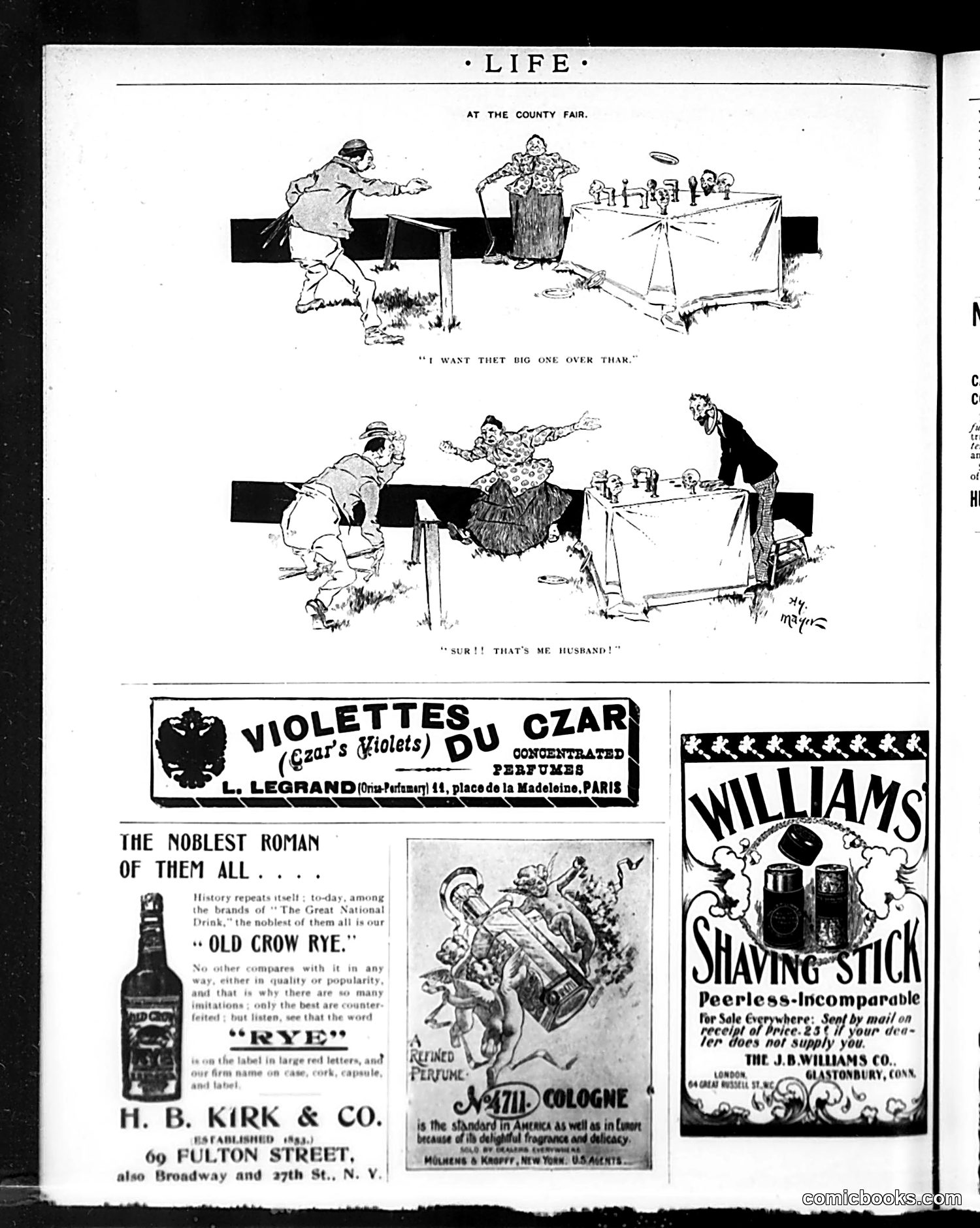
This page contains two satirical cartoon panels titled "At the County Fair," followed by period advertisements. **The Cartoons:** Both panels depict exaggerated domestic scenes. The first shows a woman at a fair display saying "I want that big one over there"—likely referring to a prize animal. The second, captioned "Sure! That's me, husband!" appears to show a woman identifying her husband among fair livestock or exhibits, making a crude joke equating the man to an animal. The humor relies on stereotypes about rural fair-goers and marital dissatisfaction common to early 20th-century American comedy. **The Advertisements:** The page also features period product ads for "Old Crow Rye" whiskey, "Violettes du Czar" perfume, "Williams Shaving Stick," and other goods—typical of Life magazine's revenue model at the time. The cartoons' satirical target appears to be rural/working-class culture and marriage dynamics, reflecting common prejudices of the era.
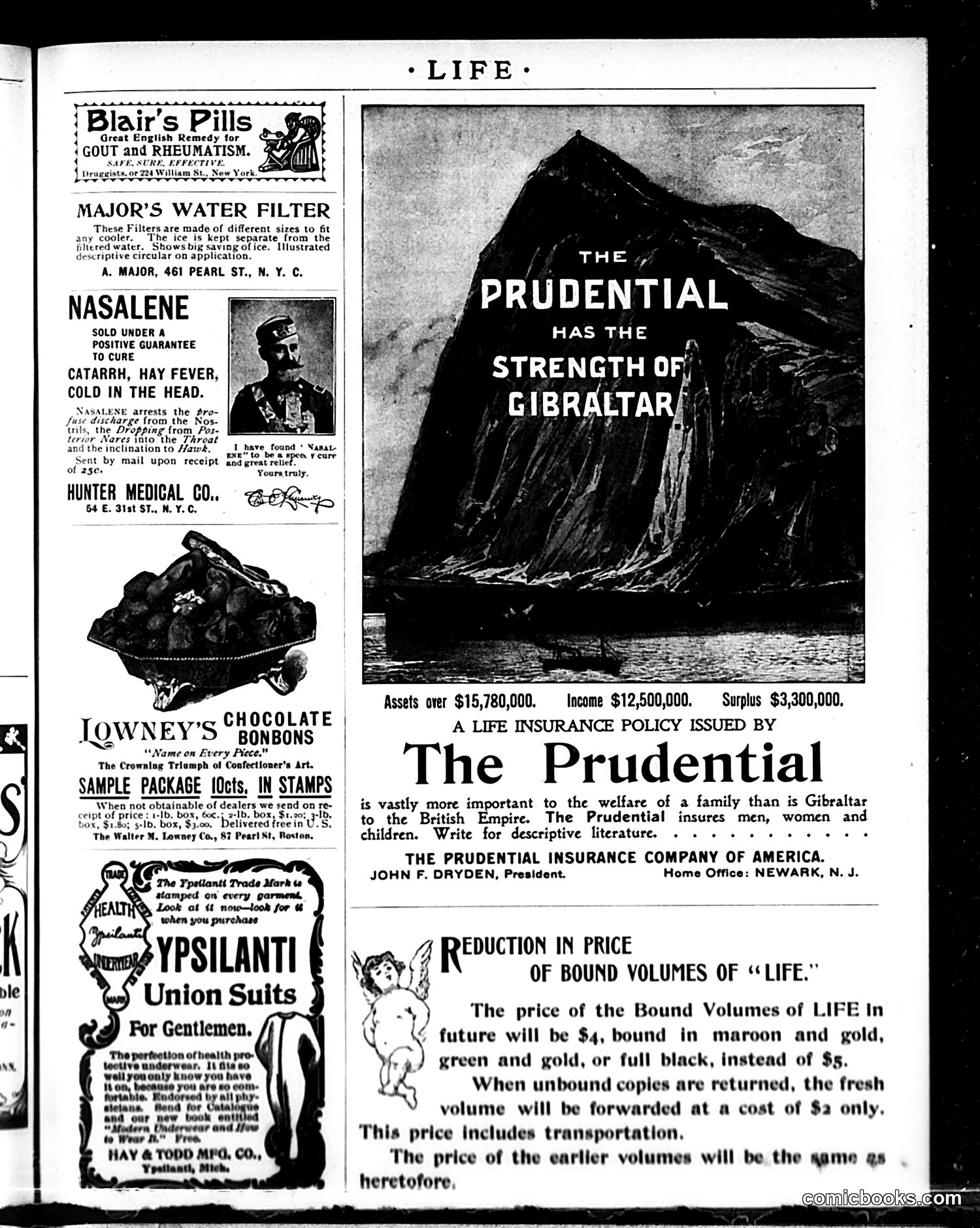
This page is primarily **advertising**, not satirical content. The large central image promoting Prudential Insurance contains the only notable messaging beyond product ads. The **Prudential advertisement** uses a patriotic comparison: it depicts Gibraltar (the famous British fortress) and argues that life insurance is "vastly more important to the welfare of a family than is Gibraltar to the British Empire." This is corporate advertising rhetoric rather than satire—it's attempting to persuade readers of insurance's importance through grandiose comparison. The surrounding ads are standard early-20th-century patent medicines and consumer goods (Blair's Pills for gout, Nasalene for catarrh, Lowney's chocolates, Ypsilanti Union Suits). These represent typical commercial advertising of the era. The bottom section announces a **price reduction** for bound volumes of Life magazine itself, from $5 to $4. There is no political cartoon or satire visible on this page—it functions primarily as a revenue-generating advertising section.
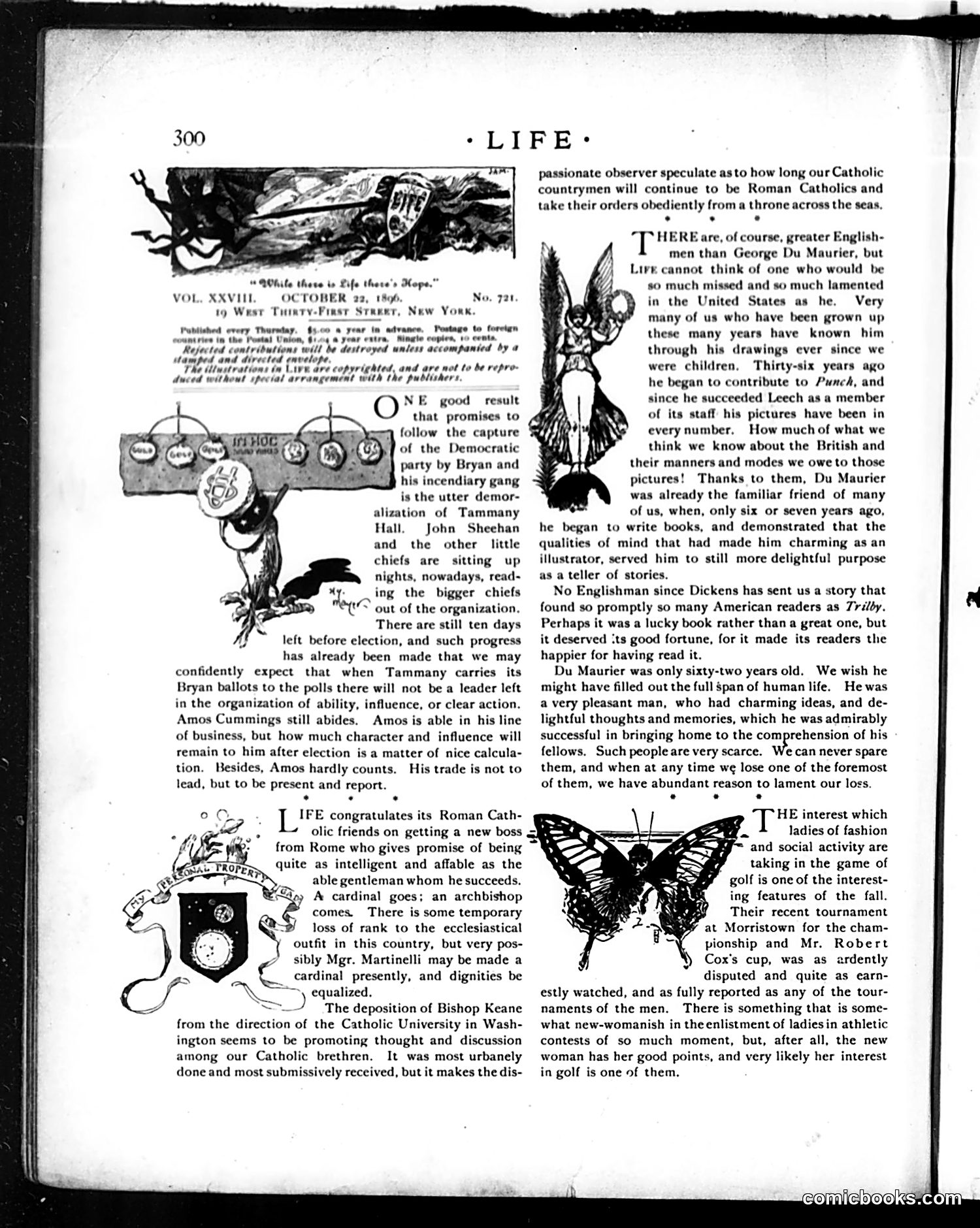
This page contains three distinct editorial commentaries with accompanying illustrations: **Tammany Hall cartoon**: Satirizes the Democratic Party's capture by William Jennings Bryan and his supporters, showing Tammany Hall (New York's powerful political machine) in disarray. The illustration depicts organizational chaos as leaders flee the party before the upcoming election. **Catholic Church commentary**: Discusses the Vatican's replacement of Bishop Keane at Catholic University in Washington, using the occasion to satirize American Catholics' obedience to Rome—questioning how long they'll accept orders "from a throne across the seas." **George Du Maurier tribute**: Mourns the recently deceased British illustrator and novelist (1834-1896), praising his *Punch* illustrations and his novel *Trilby*, which had found enormous American readership. The piece celebrates his influence on American understanding of British culture. The butterfly illustration appears decorative rather than satirical.
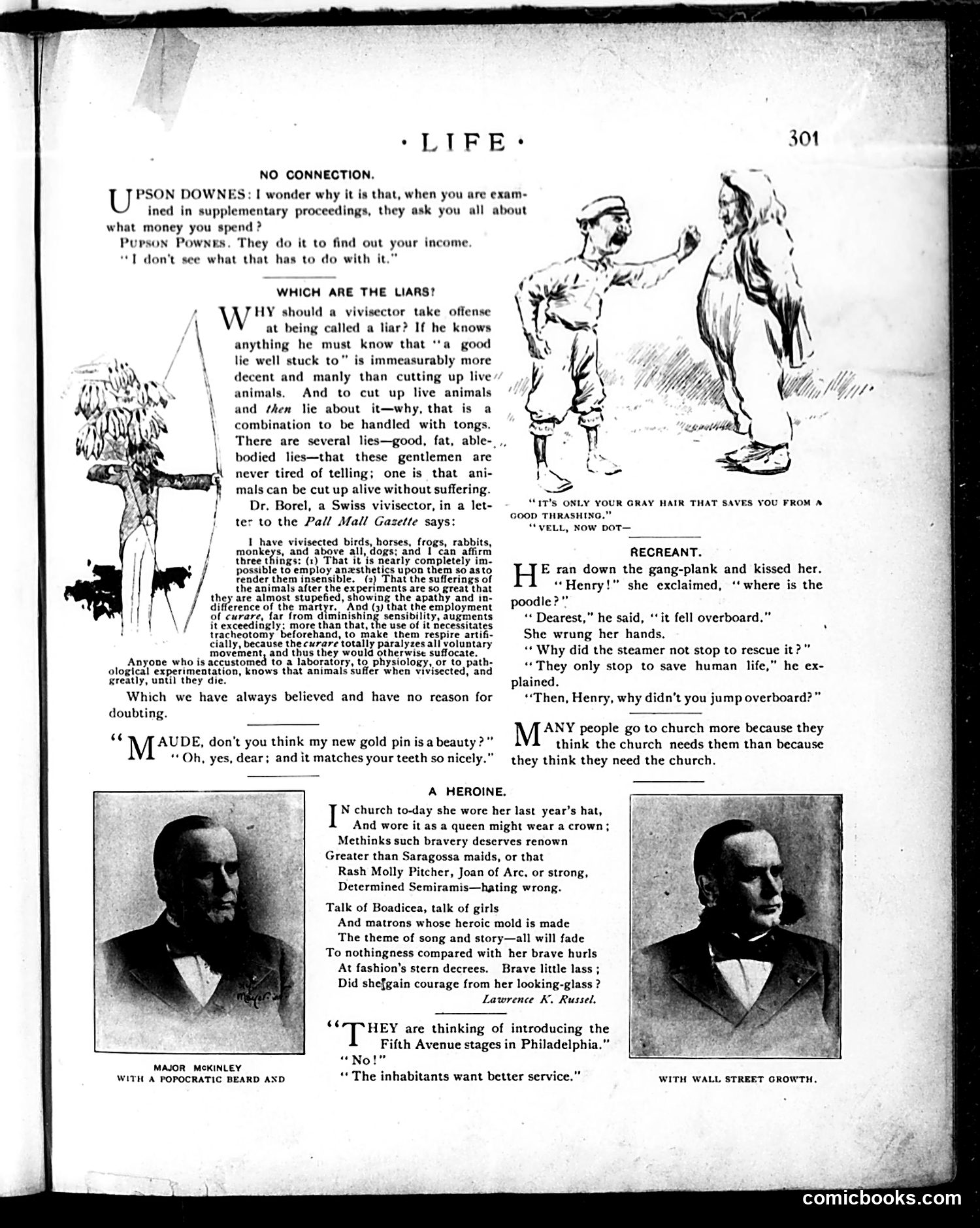
This page collects brief satirical pieces targeting different social hypocrisies: **"Which Are the Liars?"** attacks vivisectors (animal experimenters) who claim surgery on live animals causes no suffering, while quoting a Swiss vivisector's own admission that animals suffer greatly during procedures. The satire exposes the contradiction between their public claims and private knowledge. **"Recreant"** mocks upper-class priorities: a man loses his wife's poodle overboard but doesn't jump in because steamers "only stop to save human life." The humor undercuts wealthy concerns about pet dogs while accepting indifference to human life. **"A Heroine"** praises a woman wearing last year's hat to church as brave, comparing her defiance of fashion to historical heroines like Joan of Arc—satirizing both vanity culture and the triviality of "feminine courage." Two portrait photographs labeled "Major McKinley" reference political figures, though their specific meaning requires additional historical context. The page uses humor to critique animal cruelty, class priorities, and social pretension.
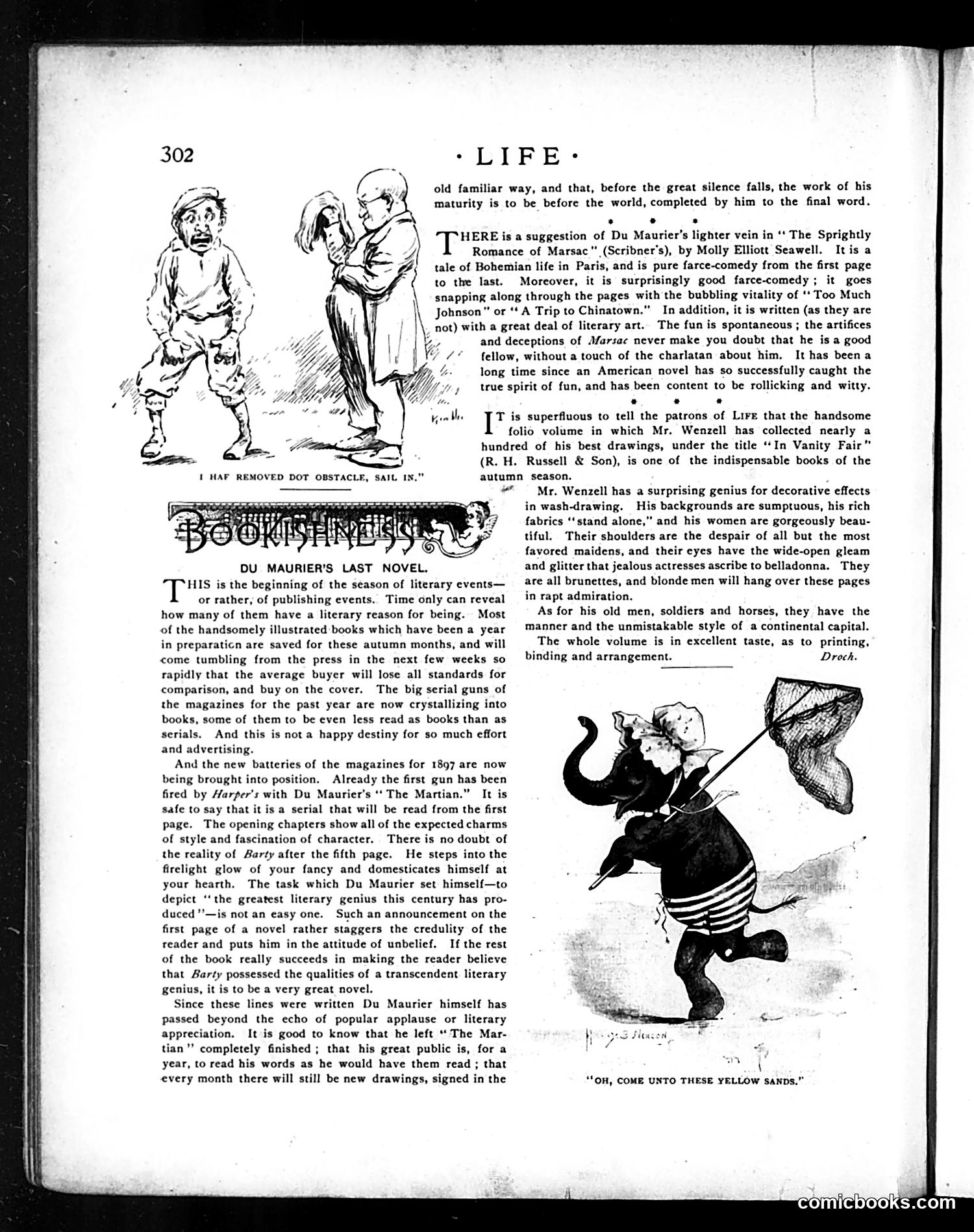
This page reviews literary and artistic publications for the autumn season. The two small sketches at top left illustrate a scene from "The Sprightly Romance of Marsac"—a Parisian farce-comedy novel. The larger illustration below depicts a character from Du Maurier's serialized novel "The Martian," showing a man in striped clothing in an exaggerated pose with the caption "OH, COME UNTO THESE YELLOW SANDS." The text discusses Du Maurier's posthumous novel (he "has passed beyond"), praising its opening chapters and the protagonist "Barty," a character claiming to be a literary genius. The page celebrates the autumn 1897 publishing season and Wenzell's illustrated collection "In Vanity Fair." The satire targets the publishing industry's tendency to rush illustrated books to market regardless of literary merit, relying on cover appeal rather than content quality—a concern relevant to modern readers as commentary on commercialized publishing.
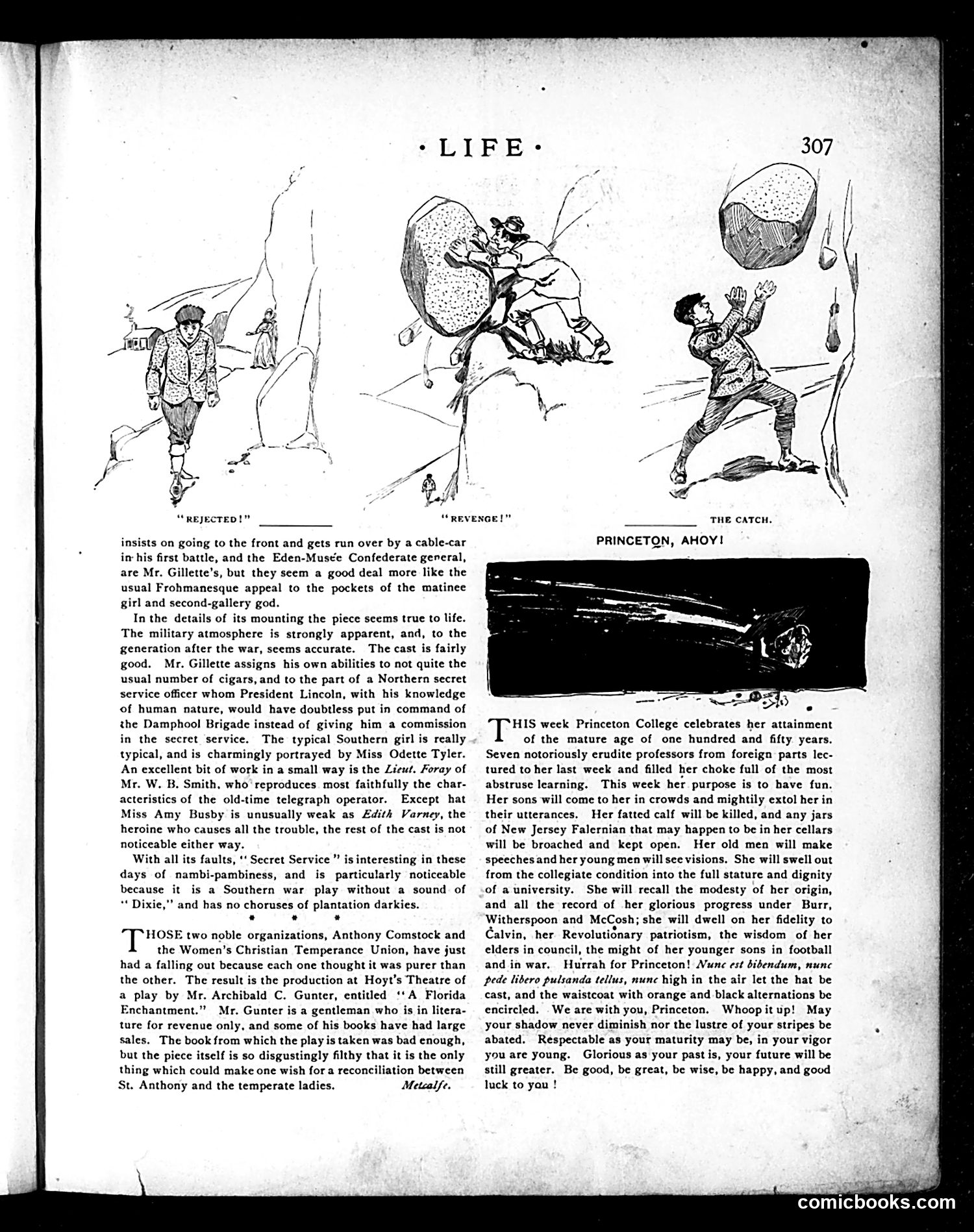
This page contains theatrical reviews and celebratory content rather than political cartoons. The three small sketches at top—"Rejected!," "Revenge!," and "The Catch"—illustrate scenes from a play called "Secret Service," likely depicting Civil War-era dramatic moments. The main review critiques a play about the Civil War, praising its military authenticity while mocking its melodramatic appeal to "matinee girls." The critic dismisses another play, "A Florida Enchantment," as "disgustingly filthy," sarcastically noting that even the notoriously strict Anthony Comstock (famous for obscenity censorship) and the Women's Christian Temperance Union—who were feuding—might unite against it. The lengthy final section celebrates Princeton College's 150th anniversary, offering tongue-in-cheek praise of the institution's history and achievements while encouraging festivities. The tone is affectionate satire rather than harsh critique.
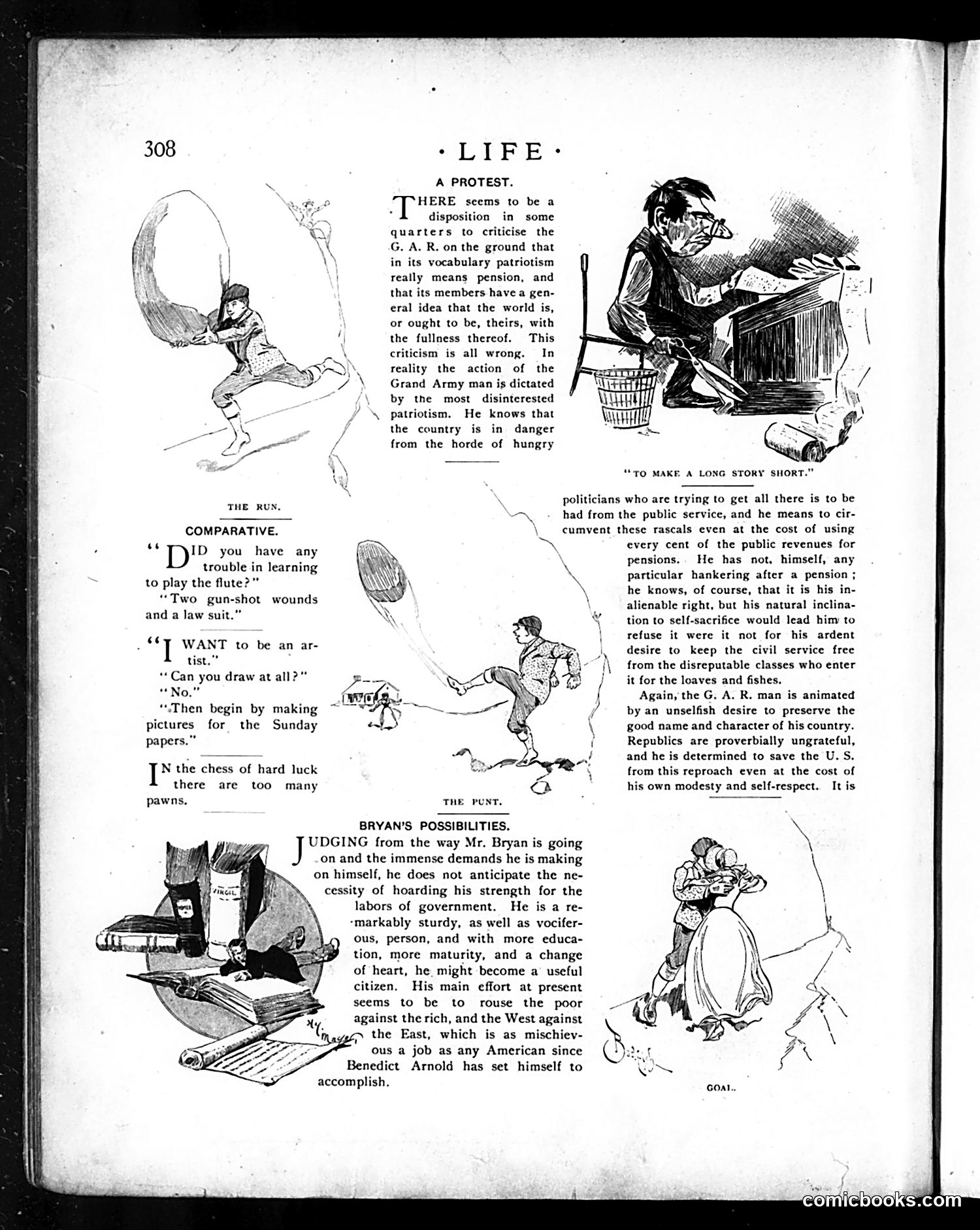
This page contains satirical commentary on American politics and social issues of the era: **"A Protest"** defends the Grand Army of the Republic (G.A.R.—Civil War veterans' organization) against criticism that members use "patriotism" as justification for collecting pensions. The piece sarcastically argues their pension-seeking actually protects the nation from corrupt politicians exploiting public service. **"Bryan's Possibilities"** mocks William Jennings Bryan (Democratic presidential candidate), portraying his efforts to incite class warfare ("rouse the poor against the rich, and the West against the East") as dangerously divisive—comparing him to Benedict Arnold, the Revolutionary War traitor. The piece suggests Bryan lacks the maturity for higher office. **Humor sections** include brief jokes about learning flute (mentioning "gun-shot wounds and a law suit") and aspiring artists whose poor drawing skills suit them for Sunday newspaper comics. The cartoons visually reinforce these satirical positions with exaggerated character sketches typical of the era's political humor.
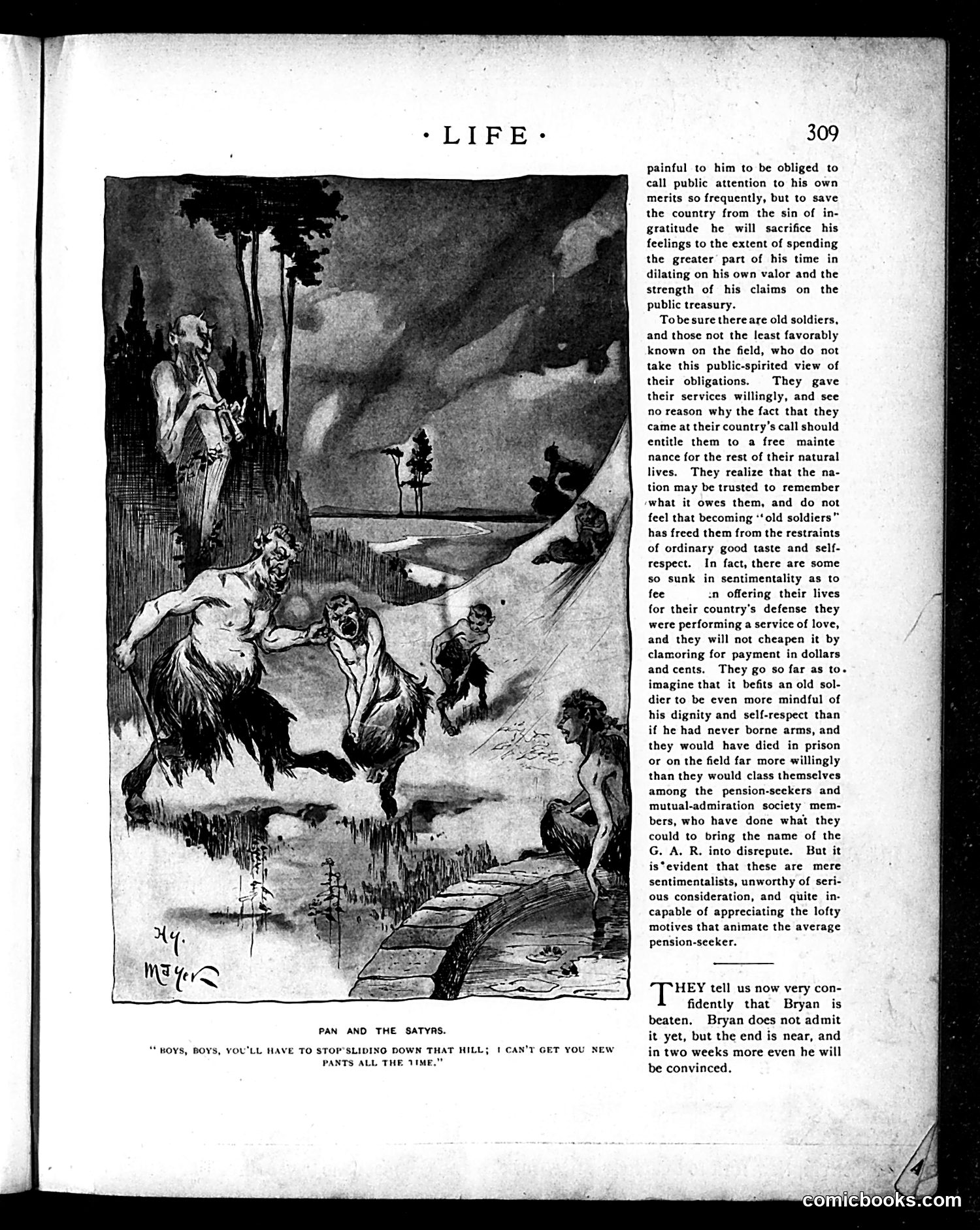
This cartoon satirizes **old soldiers seeking pensions**. Pan (the mythological goat-god, shown as an authority figure) scolds young satyrs (representing veterans) for wearing out their pants by sliding down a hill—a metaphor for their constant complaints and demands for financial support from the government. The accompanying text elaborates the satire's target: **Civil War veterans**, particularly those in the **G.A.R. (Grand Army of the Republic)**, who the author views as shamelessly leveraging their service to extract pension money rather than accepting it quietly with dignity. The piece contrasts these "pension-seekers" with idealized soldiers who served from patriotism alone and would never "cheapen" their sacrifice by demanding compensation. The final paragraph's mention of **Bryan** (likely William Jennings Bryan, the 1896 presidential candidate) appears unrelated to the pension debate and may indicate this is composite content from *Life* magazine.
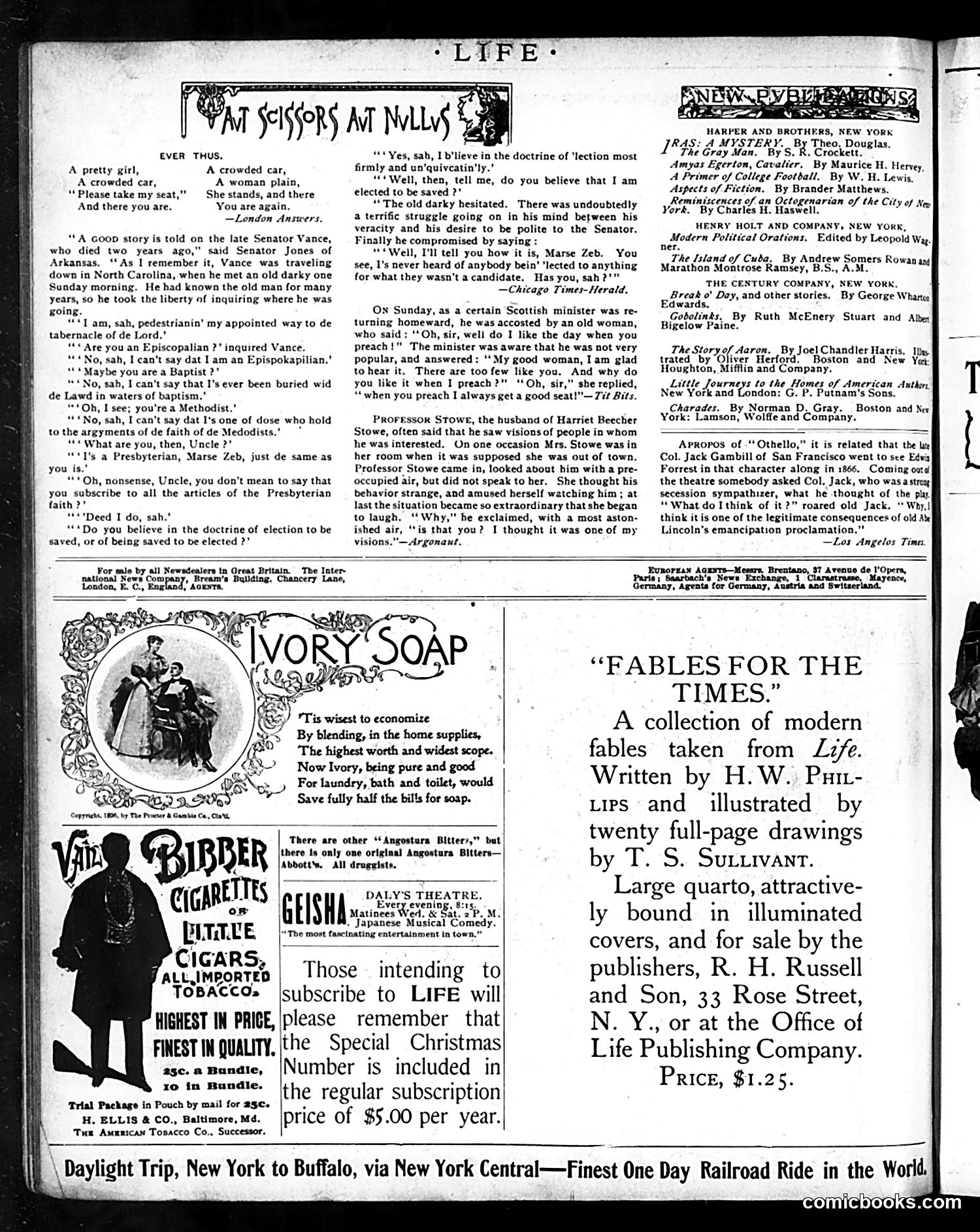
This page is primarily **advertising and book announcements**, not political satire. The main content consists of humorous anecdotes about social behavior and religious doctrine. The cartoon title "I'm Scissors at Nulls" (likely a corrupted OCR reading) introduces several jokes: one about crowded streetcars where a woman's presence changes men's courtesy (they offer seats to pretty women but not plain ones), and longer anecdotes mocking religious hypocrisy and pedantry. The most pointed piece ridicules Senator Vance through a story where an elderly Black man (written in dialect) politely exposes Vance's presumption about his own salvation—suggesting that being "elected" requires first being a "candidate" worthy of election. It's genteel mockery of political self-importance. The remaining content is book advertisements from major publishers (Harper, Century, Holt), promoting novels and collections typical of the era. This appears to be a back-of-magazine page mixing light humor with commercial listings.
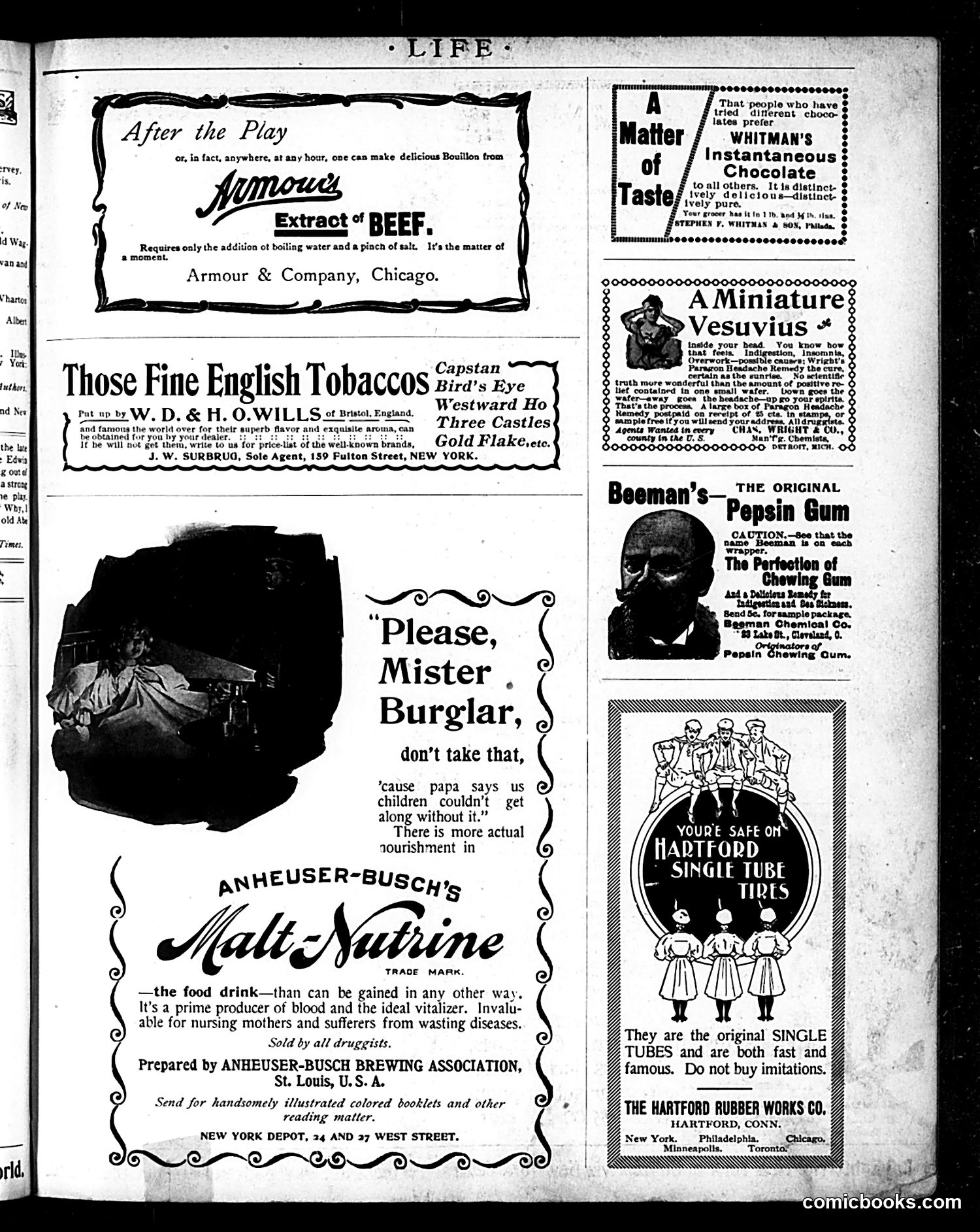
This page is primarily **advertising**, not satire or political commentary. It features various turn-of-the-century consumer products pitched to middle-class readers. The notable visual element is a domestic scene captioned "Please, Mister Burglar, don't take that"—showing a family protecting their bottle of **Anheuser-Busch's Malt-Nutrine**, a malt beverage marketed as nutritious medicine. The joke is that the product is so valued, even burglars shouldn't steal it. This reflects the era's patent-medicine culture, when malt tonics were genuinely believed to provide health benefits. Other ads promote **Armour beef extract** (convenient bouillon), **English tobacco brands**, **Whitman's chocolate**, **Beeman's Pepsin Gum** (for indigestion), and **Hartford Single Tube Tires**. The advertising reflects early 1900s consumer goods and marketing claims (nutrition from malt, digestive aids from gum) that would seem dubious today. There is **no political satire**—this is straightforward period advertising targeting affluent readers.
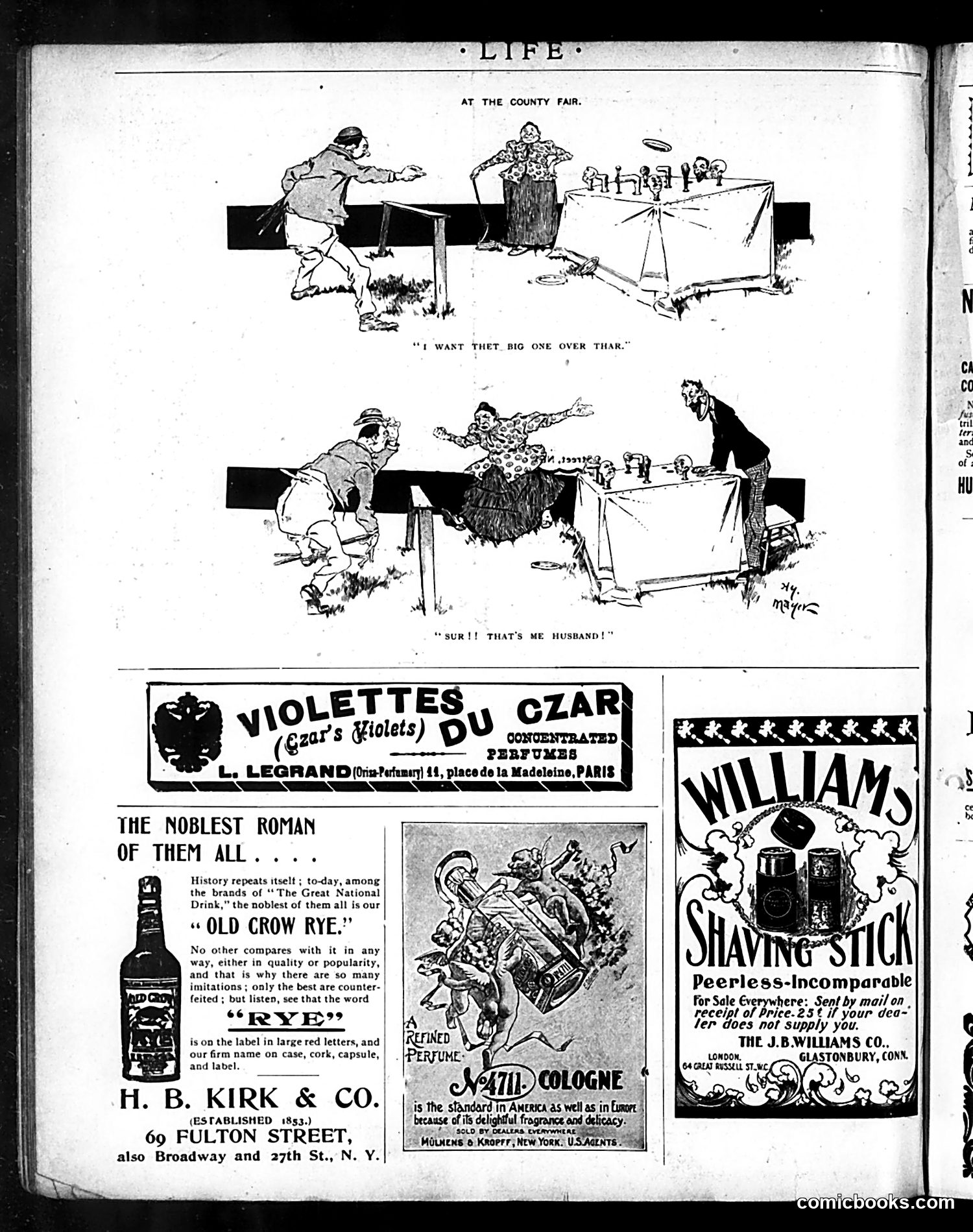
This page combines two humorous county fair cartoons with period advertisements. **The Cartoons:** The top two panels depict a couple at a county fair game. In the first, a man attempts to win a ring toss, saying "I want that big one over there." In the second, he's apparently failed, and his wife exclaims "Sure!! That's me husband!"—a joke about her embarrassment at his poor performance at the carnival game. The humor relies on gender dynamics and marital teasing common to early 20th-century comedy. **The Advertisements:** The page features three product ads: Old Crow Rye whiskey (comparing itself to historical "noble" things), Violettes du Czar perfume, and Williams Shaving Stick. These represent typical Life magazine revenue alongside editorial content. The cartoons reflect simple domestic humor typical of the era, while the ads showcase luxury consumer goods marketed to middle and upper-class readers.
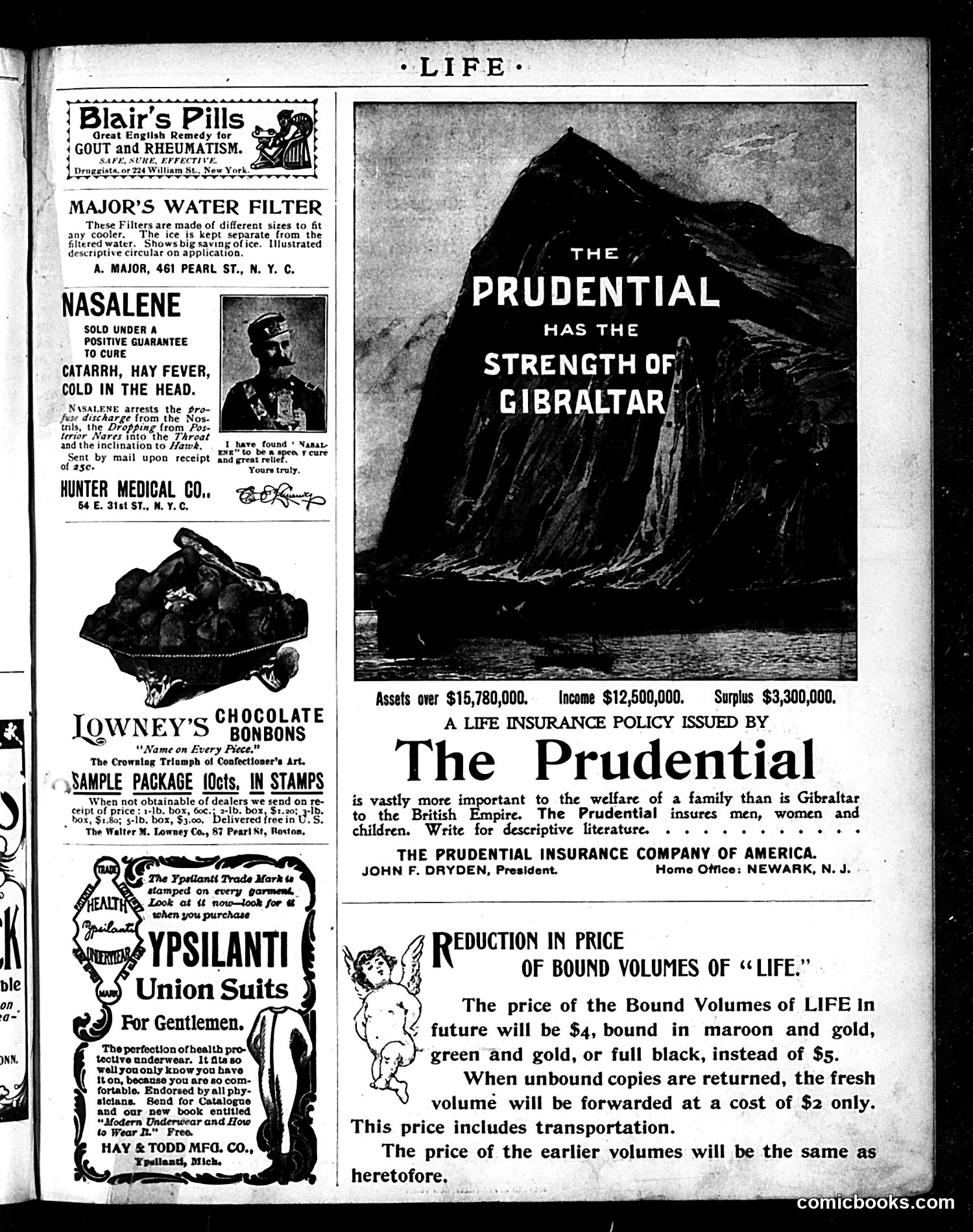
This is primarily an **advertising page** from an early 1900s issue of *Life* magazine, not a satirical cartoon page. The left side features patent medicine and consumer product ads typical of the era: Blair's Pills for gout, Nasalene for catarrh, Lowney's chocolates, and Ypsilanti Union Suits underwear—products making dubious health claims. The dominant right-side advertisement uses **Gibraltar as a metaphor for strength**. The Prudential Insurance Company compares its financial stability (Assets $15.78M, Surplus $3.3M) to the famous Rock of Gibraltar, implying the company is as solid and reliable as that natural fortress. The copy argues Prudential's insurance protection is "vastly more important to the welfare of a family than is Gibraltar to the British Empire"—a bold claim leveraging patriotic imperial sentiment to sell life insurance. The bottom announces a price reduction for bound volumes of *Life* magazine itself. No political satire is present; this is straightforward period advertising reflecting turn-of-century commercial messaging and medical skepticism.
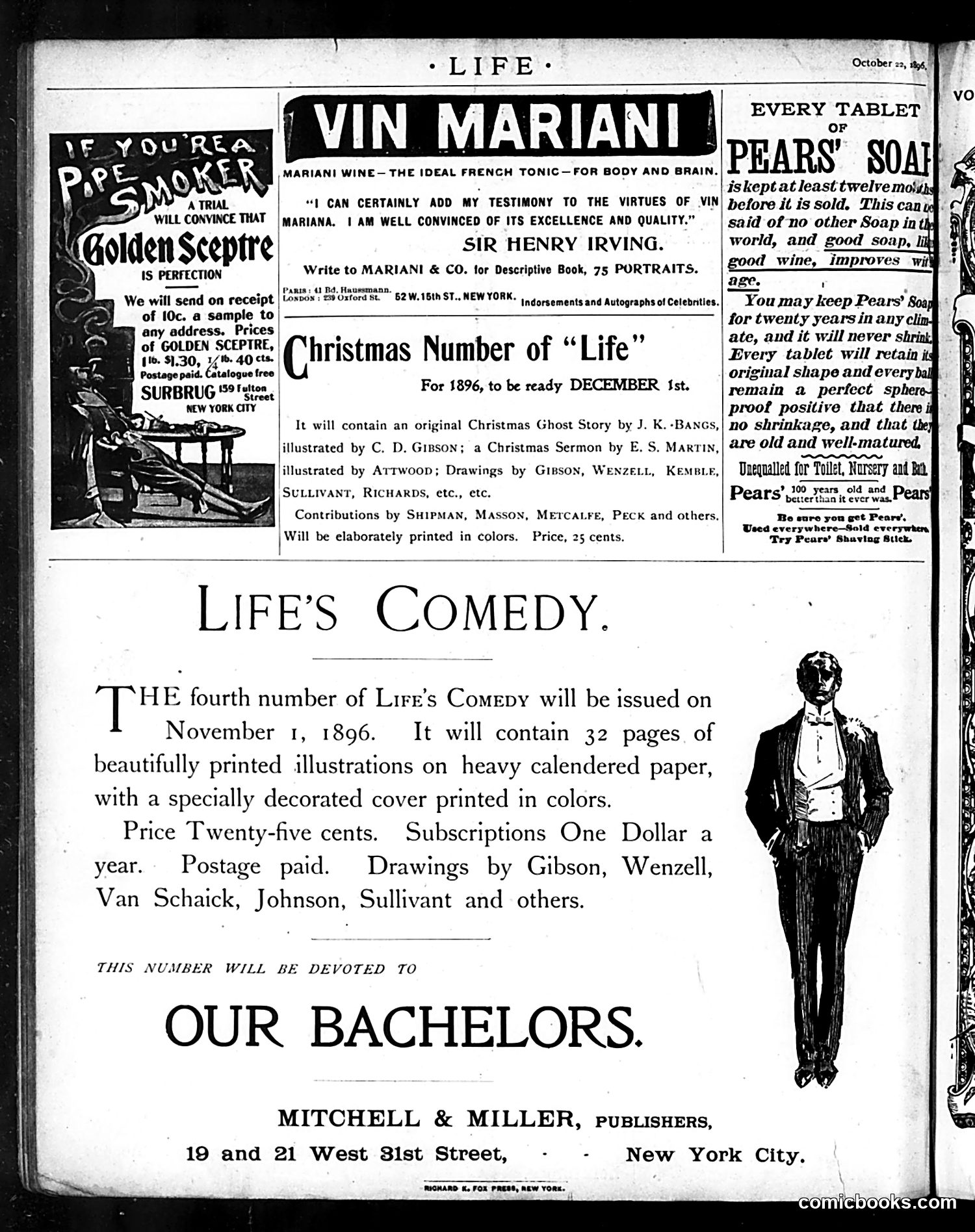
This is primarily a **advertising and announcements page** with no political cartoons. The content consists of period advertisements and editorial notices: **Advertisements:** - **Vin Mariani**: A French wine tonic marketed as beneficial for "body and brain," endorsed by Sir Henry Irving (a famous actor). This appears to be a genuine product claim of the era. - **Golden Sceptre Pipe Tobacco**: Offering sample distribution - **Pears' Soap**: Emphasizing durability and quality, claiming tablets retain shape for twenty years **Editorial Announcements:** - **Christmas 1896 Issue**: Life announces its December 1st Christmas special featuring a ghost story by J.K. Bangs and contributions from notable writers and illustrators - **Life's Comedy**: Promoting the fourth issue of a comedy section, to be published November 1, 1896, devoted to "Our Bachelors"—likely humorous content about unmarried men The page reflects late-Victorian consumer culture and Life's status as a prominent satirical weekly publication.